This is an open access journal, and articles are distributed under the terms of the Creative Commons Attribution-Non Commercial-ShareAlike 4.0 License, which allows others to remix, tweak, and build upon the work non-commercially, as long as appropriate credit is given and the new creations are licensed under the identical terms.
© 2019 Journal of Advanced Pharmacy Education & Research | Published by SPER Publication
82
Investigation of HPLC behaviour and system suitability
estimation for combination Galantamine Hydrobromide and
Pymadine
Dobrina Tsvetkova*, Stefka Ivanova
Medical University-Sofia, Faculty of Pharmacy, Department of Pharmaceutical Chemistry, 2 Dunav Str., Sofia 1000, Bulgaria.
Correspondence:
Dobrina Tsvetkova, Department of Pharmaceutical Chemistry, Faculty of Pharmacy, Medical University-Sofia, Dunav str. N: 2, 1000, Sofia, Bulgaria.
E mail: [email protected]ABSTRACT
The aim of the current study was the investigation of HPLC behaviour, separation and system suitability for the combination of Galantamine hydrobromide/Pymadine in model mixtures, in accordance with the new trend of multi-target therapy of Alzheimer’s disease by combining acetylcholinesterase inhibitor with its potential synergist. The system suitability test for the simultaneous determination of the components was carried out by the following criteria: 1) retention times in the analysis of 6 model mixtures; 2) the change of values for separation degrees in minor changes of the ratio of mobile phase components and mobile phase flow rates. The system suitability was confirmed by the lack of the statistically significant differences between the values of parameter retention time
tR [min.]: tR = 3.179 (Galantamine hydrobromide), tR = 5.272 (Pymadine). In changing the ratio of mobile phase components, the
data for separation degree were in the range of 1.76 ÷ 1.83, and the symmetry factor (T) was in the range of 0.94 ÷ 1 (Galantamine
hydrobromide), 0.96 ÷ 1.03 (Pymadine). Upon varying the mobile phase velocity, T values varied between 0.94 ÷ 1 (Galantamine
hydrobromide) and 0.95 ÷ 1.06 (Pymadine). The system suitability was confirmed by the fact that minor changes in the ratio of the
mobile phase components or in the mobile phase flow rate didn’t decrease the degree of separation.
Keywords:HPLC, Galantamine hydrobromide, Pymadine, system suitability
Introduction
Alzheimer is a chronic progressive neurodegenerative disease [1]
in which the amyloid plaques, neurofibrillary tangles and oxidative stress lead to cholinergic neurons loss in brain, and cause a disorder of higher cortical functions and cognitive
impairements [2]. Free-radical processes damage biomarker
molecules: proteins, lipids, nucleic acids (DNA, RNA) leading to nerve cell damage and apoptosis, and they are one of the causes of pathogenetic changes [3, 4].
The conventional treatment strategy for Alzheimer’s disease has been an application of acethylcholinesterase inhibitors, like
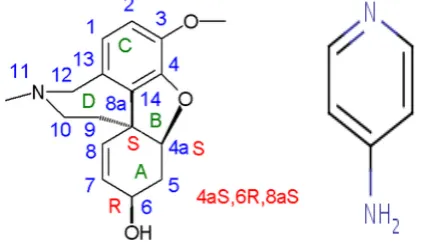
natural alkaloid Galantamine (Fig. 1.) [5]. A potent inhibitory
activity against acetylcholinesterase possess extracts of Ocimum
sanctum [6] and Cinnamon zeylanicum [7].
Galantamine leads to the enhancement of concentration in
Alzheimer [8] with cerebrovascular disease, vascular dementia
and ischemia [9] due to its antioxidant effects [10, 11], decreases
neurodegeneration, and protects against β-amyloid toxicity,
due to its action as a reversible acethylcholinesterase inhibitor, and an allosteric nicotinic receptors modulator [5], and improves
memory alone, and in combination with 4-aminopyridine (Pymadine)(Fig. 1.) [12]: Nivalin P [13]. 4-aminopyridine is a drug
for symptomatic multiple sclerosis treatment, and increases the acetylcholine release [14].
A new trend in Alzheimer's disease treatment has been the combination of Galantamine/Pymadine due to the potential synergy of their pharmacological effects [14].
Access this article online
Website: www.japer.in E-ISSN: 2249-3379
How to cite this article: Dobrina Tsvetkova, Stefka Ivanova.Investigation
of HPLC behaviour and system suitability estimation for combination Galantamine Hydrobromide and Pymadine. J Adv Pharm Edu Res 2019;9(2):82-88.
Figure 1. Chemical structures of Galantamine hydrobromide and 4-aminopyridine.
HPLC methods are often applied for analysis of different drugs:
Amlodipine besylate [15], Lansoprazole and Aspirin [16],
Pantoprazole and Mosapride [17], Olmesartan Medoxomil,
Atorvastatin calcium [18], and Cefadroxil Monohydrate [19].
For analysis of Galantamine hydrobromide substance, HPLC-methods with mass-detection [20] and UV-detection [20-23] at λ = 225 nm [21] and λ = 289 nm [23] have been developed.
4-aminopyridine in plasma has been analysed by HPLC [24], gas
chornatography [25], and capillary electrophoresis [26].
The aim of the current study was the investigation of HPLC behaviour, separation and system suitability in combination of Galantamine hydrobromide/Pymadine in model mixtures.
Materials
I. Pharmacopoeial purity compounds were investigated
including: Galantamine hydrobromide (Sopharma, N: 10796132); 4-aminopyridine.
II. Reagents with pharmacopoeal purity were studied
including: disodium hydrogen phosphate (99.5 %) (Merck, N: K28661174105).
III. Solvents with pharmacopoeial purity were investigated
including: acetonitrile (99.9 %) (Sigma Aldrich, N: SZBD 150 SV UN 1648), methanol (99.9 %) (Sigma Aldrich, N: SZBD 063AV UN 1230), distilled water.
Methods
HPLC-method was used for simultaneous determination of Galantamine hydrobromide and Pymadine in model mixtures.
I. Equippment
HPLC system Shimadzu LC-10 Advp Liquid Chromatograph, fixed-length wavelength SPD 10 AVP UV-VIS detector were used.
II. Chromatographic conditions.
The chromatographic conditions applied were: isocratic mode,
stationary phase: column RP C18 ODC Spherisorb (250 mm ×
4.6 mm × 5 мm), column temperature: 25 °C, mobile phase:
50 mM disodium hydrogen phosphate: acetonitrile = 80:20
v/v, flow rate: 1.5 ml/min., UV-detection at л = 280 nm,
injection volume: 20 μl. The column was equilibrated for 30
min with degased mobile phase.
III. Preparation of model mixtures of
reference substances: Galantamine
hydrobromide and 4-aminopyridine
6 model mixtures were prepared at the following manner: from reference substances an accurately messured quantities: 0.1 g Galantamine hydrobromide and 0.05 g 4-aminopyridine were dissolved in destilled water in 100.0 ml volumetric flasks.
Results and Discussion
I. Selectivity
In the same manner like model mixtures, a blank solution without Galantamine hydrobromide and Pymadine was prepared for the estimatiton of analytical parameter selectivity, which was proved by the fact that in chromatograms of blank solutions, there were not observed peaks with retention time, corresponded to retention times of Galantamine hydrobromide and Pymadine.
II. Investigation of chromatographic
behavior of Galantamine hydrobromide and Pymadine in different
chromatographic systems
For the selection of a chromatographic system for separation of mixture components, the chromatographic behavior of Galantamine hydrobromide and Pymadine was investigated with
isocratic HPLC-method, stationary phase: 250 mm× 4.6 mm ×
5 μm and other different chromatographic conditions.
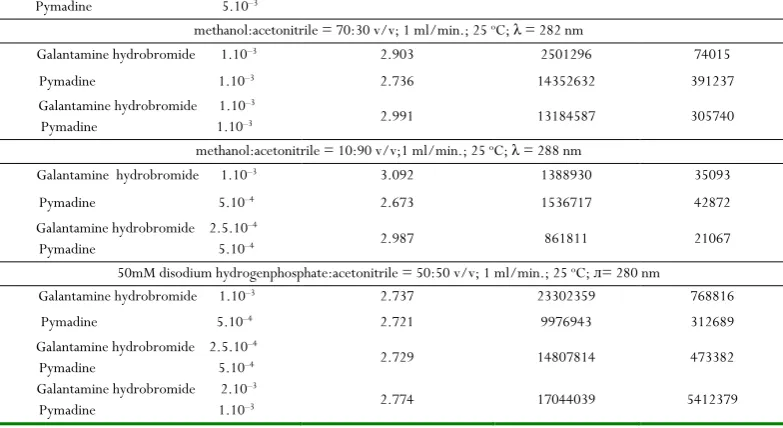
Results were summarized on Table 1. that inducates: C –
concentration, tR – retention time, A – peak area, H – peak
hight.
Table 1. Chromatographic behavior of Galantamine hydrobromide and Pymadine at different chromatographic systems.
C [g/ml] tR [min.] A H
methanol:acetonitrile:water = 70:20:10v/v; 1 ml/min.; 25 oC; λ = 288 nm
Galantamine hydrobromidе 1.10–4 3.374 325950 8847
Pymadine 1.10–3 3.085 5949137 127165
Pymadine 5.10–3
methanol:acetonitrile = 70:30 v/v; 1 ml/min.; 25 oC; λ = 282 nm
Galantamine hydrobromide 1.10–3 2.903 2501296 74015
Pymadine 1.10–3 2.736 14352632 391237
Galantamine hydrobromide 1.10–3
Pymadine 1.10–3 2.991 13184587 305740
methanol:acetonitrile = 10:90 v/v;1 ml/min.; 25 oC; λ = 288 nm
Galantamine hydrobromide 1.10–3 3.092 1388930 35093
Pymadine 5.10–4 2.673 1536717 42872
Galantamine hydrobromide 2.5.10–4
Pymadine 5.10–4 2.987 861811 21067
50mM disodium hydrogenphosphate:acetonitrile = 50:50 v/v; 1 ml/min.; 25 oC; л= 280 nm
Galantamine hydrobromide 1.10–3 2.737 23302359 768816
Pymadine 5.10–4 2.721 9976943 312689
Galantamine hydrobromide 2.5.10–4
Pymadine 5.10–4 2.729 14807814 473382
Galantamine hydrobromide 2.10–3
Pymadine 1.10–3 2.774 17044039 5412379
The results included in Table 1., showed that the retention times of Galantamine hydrobromide and Pymadine were close, and that only one peak was obtained in analyzing the model mixture, therefore these systems weren’t suitable for separation of the components.
Table 2. presents the data for: tR – retention time, A – peak
area, H – peak height, N – number of theoretical plates and Rs
– degree of separation for isocratic HPLC, and chromatographic systems, by which two peaks were obtained in the analysis ofthe model mixtiures with Galantamine hydrobromide and Pymadine.
Table 2. Chromatographic parameters of Galantamine hydrobromide and Pymadine at different chromatographic systems.
Parameters tR [min.] A H N Rs
methanol:acetonitrile:water = 70:20:10v/v;1 ml/min.;25 oC; λ = 220 nm
Pymadine 3.504 2010320 58877 215
0.92 Galantamine hydrobromide 4.697 6015356 141670 183
methanol:water = 50:50 v/v; 1 ml/min.; 25 oC;λ =288 nm
Pymadine 3.245 1029411 43111 889
0.44 Galantamine hydrobromide 3.461 2188596 113306 484
methanol:water = 95:5 v/v; 1 ml/min.; 25 oC;λ =288 nm
Pymadine 3.469 913993 36690 361
0.1 Galantamine hydrobromide 3.617 905668 37048 400
50mM disodium hydrogenphosphate: acetonitrile= 80:20 v/v; 1 ml/min.;25 oC;
л= 244 nm
Pymadine 3.071 8011684 235963 196
0.53 Galantamine hydrobromide 3.890 3578087 104476 165
50 mM disodium hydrogenphosphate:methanol = 80:20 v/v;1 ml/min.; 25 oC; л= 280 nm
Pymadine 3.307 483035 15498 369
0.89 Galantamine hydrobromide 3.917 252838 8177 256
50 mM disodium hydrogenphosphate:acetonitrile = 90:10 v/v; 1 ml/min.;25 oC;л= 280 nm
Pymadine 3.550 844190 22462 144
0.59 Galantamine hydrobromide 4.498 1176047 28695 104
The values for parameter (Rs) given in Table 2. were lower than 1, demonstrating that these systems didn’t achieve separation of Galantamine hydrobromide and Pymadine. For the separation and simultaneously identification and determination of the components of the model mixture of Galantamine hydrobromide and Pymadine, HPLC is suitable with isocratic mode of operation on the chromatographic
system: stationary phase; column RP of (250 mm× 4.6 mm ×
5 μm); column temperature of 25 oC; mobile phase of 50 mM
disodium hydrogenphosphate:acetonitrile = 80:20 v/v; flow
rate of 1 ml/min.; and UV-detection at λ = 280 nm.
III. System suitability test
the simultaneous determination of Galantamine hydrobromide and Pymadine was carried out by following criteria: 1) retention times in the analysis of 6 model mixtures; 2) change of degree of separation (Rs) in minor change of the ratio of mobile phase components, and of mobile phase flow rate.
The results for retention times tR [min.] for Galantamine
hydrobromide and Pymadine in model mixtures have been presented in Table 3.
Тable 3. Retention times tR [min] for Galantamine
hydrobromide and Pymadine in model mixtures.
N: Model mixture
Galantamine hydrobromide Pymadine tR [min.] tR [min.]
1. 3.188 5.223
2. 3.180 5.218
3. 3.175 5.231
4. 3.173 5.522
5. 3.181 5.238
6. 3.175 5.198
± SD 3.179 ÷ 0.006 5.272 ÷ 0.12
RSD [%] 0.19 2.28
The system suitability was confirmed by the lack of a statistically significant difference between the values of the chromatographic parameter retention time for the components
in the analysis of 6 samples: tR = 3.179 (Galantamine
hydrobromide), tR = 5.272 (Pymadine) (Table 3.).
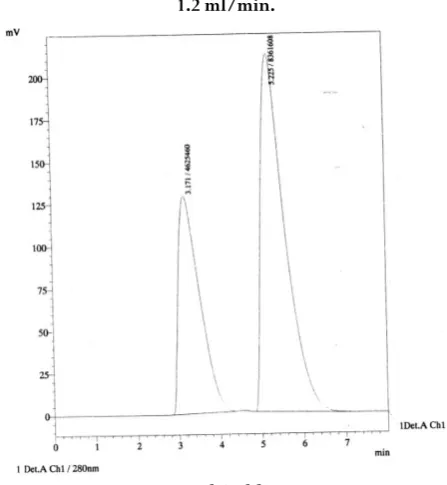
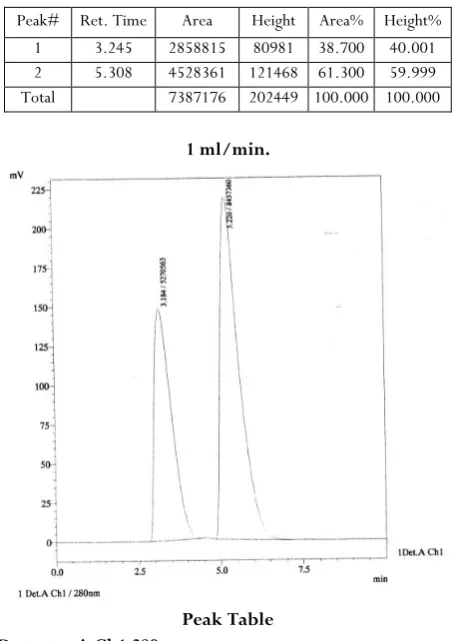
The chromatograms of model mixtures obtained with HPLC system for the minor change of the ratio of mobile phase components, and the minor change of mobile phaseflow rate are illustrated in Fig. 2. (80:20 v/v), Fig 3. (77:23 v/v), Fig.4. (83:17 v/v).
0.8 ml/min.
Detector A Ch1 280 nm
Peak# Ret. Time Area Height Area% Height% 1 4.007 7395992 198703 46.936 41.377 2 8.388 8361609 281525 53.064 58.623
Total 1557602 480228 100.000 100.000
1.2 ml/min.
Peak Table Detector A Ch1 280 nm
Peak# Ret. Time Area Height Area% Height% 1 3.171 4625460 129061 35.616 37.849 2 5.225 8361608 211925 64.384 62.151 Total 12987069 340986 100.000 100.000
Figure 2. Chromatograms of solutions containing Galantamine hydrobromide and Pymadine in system: 80:20 v/v = 50 mM
disodium hydrogenphosphate: acetonitrile; 25 oC; λ = 280 nm.
1 ml/min.
Peak Table Detector A Ch1 280 nm
1.2 ml/min.
Peak Table Detector A Ch1 280nm
Peak# Ret. Time Area Height Area% Height% 1 3.214 8779689 248809 47.427 44.789 2 4.605 9732316 306700 52.573 55.211 Total 18512005 555509 100.000 100.000
Figure 3. Chromatograms of solutions containing Galantamine hydrobromide and Pymadine insystem: 77:23 v/v = 50 mM
disodium hydrogenphosphate: acetonitrile; 25 oC; λ = 280 nm
0.8 ml/min.
Peak Table Detector A Ch1 280 nm
Peak# Ret. Time Area Height Area% Height% 1 3.245 2858815 80981 38.700 40.001 2 5.308 4528361 121468 61.300 59.999 Total 7387176 202449 100.000 100.000
1 ml/min.
Peak Table Detector A Ch1 280nm
Peak# Ret. Time Area Height Area% Height% 1 3.184 5270563 148308 38.393 40.465 2 5.220 8457360 218200 61.607 59.535 Total 13727923 366508 100.000 100.000
Figure 4. Chromatograms of solutions containing Galantamine hydrobromide andPymadine in system: 83:17 v/v = 50 mM
disodium hydrogenphosphate : acetonitrile; 25 oC; λ = 280 nm.
Results for system suitability test were shown in Table 4., where:
N/m –number of the theoretical plates at the peak width of baseline and column length 1 m
T – tailing factor
f – distance from the beginning of the peak to the intersection of peak height with
peak width at 5% of the peak height As – asymmetry factor
S – symmetry factor
Table 4. HPLC system suitability for Galantamine hydrobromide/Pymadine mixtures.
Parameter tR [min.]
A [AU]
H
[AU] N/m Rs 𝑇𝑇=
𝑊𝑊0.05 2. 𝑓𝑓 𝐴𝐴𝐴𝐴=
𝐴𝐴0.1 𝐵𝐵0.1 𝐴𝐴=
𝑁𝑁0.1 𝑁𝑁0.5
80:20 v/v = 50 mM disodium hydrogenphosphate:acetonitrile;1 ml/min.; 25 oС: л = 280 nm
Galantaminе hydrobromide 5.223 10078460 246787 1272 1.77 1 1 1.16 80:20 v/v = 50 mM disodium hydrogenphosphate:acetonitrile; 0.8 ml/min.; 25 oС; л = 280 nm
Pymadine 4.007 7395992 198703 696
2.8
0.95 1 1.05
Galantaminе hydrobromide 8.388 8361609 281525 3892 0.94 1 1.11 80:20 v/v = 50 mM disodium hydrogenphosphate:acetonitrile; 1.2 ml/min.;25 oС; л = 280 nm
Pymadine 3.171 4625460 129061 680
2.06
1 1 1.51
Galantaminе hydrobromide 5.225 8361608 211925 1516 1 0.93 1.35 77:23 v/v = 50 mM disodium hydrogenphosphate:acetonitrile; 1 ml/min.; 25 oС; л = 280 nm
Pymadine 3.186 4752161 132904 576
1.83
1.03 1 1.22
Galantaminе hydrobromide 5.251 8533279 218996 1360 0.94 1 1.08 77:23 v/v = 50 mM disodium hydrogenphosphate:acetonitrile; 1.2 ml/min.; 25 oС; л = 280 nm
Pymadine 3.214 8779689 248809 828
1.6
1.06 0.8 1.51 Galantaminе hydrobromide 4.605 9732316 306700 1376 1 1 1.05
83:17 v/v = 50 mM disodium hydrogenphosphate:acetonitrile; 0.8 ml/min.; 25 oС; л = 280 nm
Pymadine 3.245 2858815 80981 628
2.0
1 1 1.67
Galantaminе hydrobromide 5.308 4528361 121468 1684 1 0.91 1.31 83:17 v/v = 50 mM disodium hydrogenphosphate:acetonitrile; 1 ml/min.; 25 oС; л = 280 nm
Pymadine 3.184 5270563 148308 576
1.76
0.96 1 1.67
Galantaminе hydrobromide 5.220 8457360 218200 1272 0.96 1 1.16
In changing the ratio of mobile phase components, the separation degree data were in the range of 1.76 ÷ 1.83, and the symmetry factor (T) was in range of 0.94 ÷ 1 (Galantamine hydrobromide), 0.96 ÷ 1.03 (Pymadine). Upon varying the mobile phase velocity, T values varied between 0.94 ÷ 1 (Galantamine hydrobromide) and 0.95 ÷ 1.06 (Pymadine).
Conclusion
For the separation, simultaneous identification and determination of Galantamine hydrobromide and Pymadine in model mixture, isocratic HPLC was Suitable with RP (250 mm
× 4.6 mm ×5 μm); column temperature of 25 oC; mobile phase
of 50 mM disodium hydrogenphosphate:acetonitrile = 80:20
v/v; flow rate of 1 ml/min.; and UV-detection at λ = 280 nm.
The system stability was confirmed by the fact that the minor changes in the ratio of mobile phase components or in mobile phase flow rate did not decrease the degree of separation.
Conflicts of Interests
All authors had none to declare.
References
1. Nikolova I., Danchev N., Lamvob N., Grudeva V.
Neurodegenerative diseases in geriatry – opportunities dof currrent pharnacotherapy. Clin. Homeopathy 2010; 1(1): 3-6.
2. Danchev N., Nikolova I. Pharmacological treatment of
cognitive impairements in Alzheimer’s disease. Autonomic Autocoid Pharmacol. 2006; 26(1): 46-49.
3. Axelsen P.H., Komatsu H., Murray I.V.J. Oxidative
stress and cell membranes in the pathogenesis of Alzheimer's disease. Physiol. 2011; 26(1): 54-69.
4. Obreshkova D. Reactive oxygen species induced
neurodegeneration in Alzheimer's disease. Pharmacia 2013; 60(1): 71-82.
5. Maelicke A., Samochock M., Jostock R., Fehrenbacher
A., Ludwig J., Albuquerque E.X., Zerlin M. Allosteric sensitization of nicotinic receptors by Galantamine, a new treatment strategy for Alzheimer’s disease. Biol. Psychiatry 2001; 49(3): 279-288.
6. Kandhan T.S., Thangavelu L., Roy A.
Acetylcholinesterase activity of Ocimum sanctum leaf extract. J. Adv. Pharm. Edu. Res. 2018; 8(1): 41-44.
7. Jain P., Thangavelu L, Roy A. Acetylcholinesterase
activity of Cinnamon zeylanicum extract. J. Adv. Pharm. Edu. Res. 2017; 7(4): 482-448.
8. Dengiz A.N., Kershaw P. The clinical efficacy and
safety of Galantamine in the treatment of Alzheimer’s disease. CNS Spectr. 2004; 9(5): 377-392.
9. Erkinjuntti T., Kurz A., Gauthier S., Bullock R.,
Lilienfeld S., Damaraju C.V. Efficacy of Galantamine in probable vascular dementia and Alzheimer's disease combined with cerebrovascular disease: a randomised trial. Lancet 2002; 359(9314): 1283-1290.
10. Traykova M., Traykov T., Hadjimitova V., Krikorian
K., Bojadgieva N. Antioxidant properties of Galantamine hydrobromide. Z. Naturforsch. C. 2003; 58(5-6): 361-365.
11. Tsvetkova D., D. Obreshkova, D. Zheleva-Dimitrova,
of its derivatives. Curr. Med. Chem. 2013; 20(36): 4595-4608.
12. Markov M., Danchev N., Uzunov P., Higashino H.,
Suzuki A. Influence of Nivalin P on the training and memorizing processes in rats. Acta Med. Kinki. Univ. 1994; 19(2); 119-1126.
13. Radicheva N., Mileva K., Stoyanova N., Georgieva B.
Further studies on Nivalin P-induced changes in muscle fiber membrane processes. Methods Find. Exp. Clin. Pharmacol. 1999; 21(1): 5-10.
14. Espejo C., Montalban X. Dalfampridine in multiple
sclerosis: from symptomatic treatment to immunomodulation. Clin. Immunol. 2012; 142(1): 84-92.
15. Sah R., Arora S. Development and validation of a
HPLC analytical assay method for Amlodipine besylate tablets: a potent Ca+2 channel blocker. J. Adv. Pharm. Edu. Res. 2012; 2(3): 93-100.
16. Rajput S., Fanse S. RPHPLC method for simultaneous
estimation of Lansoprazole and Aspirin in bulk and laboratory mixture. J. Adv. Pharm. Edu. Res. 2015; 5(2): 87-93.
17. Siddartha B., Babu I.S., Gupta C.R., Panigrahy U.P.
Analytical method development and validation for simultaneous estimation of Mosapride and Pantoprazole in bulk and pharmaceutical dosage form by RP-HPLC method. J. Adv. Pharm. Edu. Res. 2014; 4(2): 186-192.
18. Yunoos M., Rayalla A., Raju B., Venkateswarlu G.
Stability indicating RP-HPLC method for the simultaneous estimation of Olmesartan Medoxomil and Atorvastatin calcium in bulk and tablet Dosage form. J. Adv. Pharm. Edu. Res. 2014; 4(3): 372-379.
19. Rao K.G., Shankar B.U., Phanindra B. Development
and validation of RP HPLC method for the estimation of Cefadroxil Monohydrate in bulk and its tablet dosage form. J. Adv. Pharm. Edu. Res.2014: 4(1): 71-74.
20. Ingkaninan K., De Best C.M., Van Der Heijden R.,
Hofte A.J., Karabatak B., Irth H., Thaden U.R., Van
Der Greef J., Verpoorte R. High performance liquid chromatography with on-line coupled UV, mass spectrometric and biochemical detection for identification of acetylcholinesterase inhibitors from natural products. J. Chromatogr. A 2000; 872(1-2): 61-73.
21. Deshpande G.R., Roy A.K., Rao N.S., Rao B.M.,
Reddy J.R. Rapid screening of volatile ion-pair reagents using UHPLC and robust analytical method development using DoE for an acetyl cholinesterase inhibitor: Galantamine hydrobromide. Chromatogr. 2011; 73(7-8): 639-648.
22. Obreshkova D.P., Pangarova T., Lazarova T. HPLC
determination of Galanthamine and related alkaloids in Nivalin. Compt. Rend. Acad. Bulg. Sci., 2000; 53(9): 51-53.
23. Zhi C.-M., Cang Y. Determination of Galantamine
hydrobromide by HPLC. J. Appl. Chem. Ind. 2007; 3(1): 927-930.
24. Hayes K.C., Katz M.A., Devane J.G., Hsieh J.T.C.,
Wolfe D.L, Potter P.J., Blight A.R. Pharmacokinetics of an immediate - release oral formulation of Fampridine (4-aminopyridine) in normal subjects and patients with spinal cord injury. J. Clin. Pharmacol. 2003; 43(4): 379-365.
25. Watson E. Determination of 4-aminopyridine in
plasma. Anal. Biochem. 1981; 113(1): 139-143.
26. Namura S., De la Parra M.G., Castañeda-Hernández
G. Quantification of 4-aminopyridine in plasma by capillary electrophoresis with electrokinetic injection. J. Chromatogr. B 2010; 878(3-4): 290-294.
27. International Conference on Harmonization of
Technical Requirement for Registration ofPharmaceuticals for Human use, ICH harmonized tripartite Guideline, Validation of Analytical procedures Text and methodology Q2 (R1), 2005.
28. Gamil A.M. Validation as applied for pharmaceutical