This is an open access journal, and articles are distributed under the terms of the Creative Commons Attribution-Non Commercial-ShareAlike 4.0 License, which allows others to remix, tweak, and build upon the work non-commercially, as long as appropriate credit is given and the new creations are licensed under the identical terms.
© 2019 Journal of Advanced Pharmacy Education & Research | Published by SPER Publication
123
Analysis of handling practice with unused medicines in home
first aid kits of the Ukrainian households
Iana
О
. Proskurova
1*, Inna V. Kubarieva
1, Larysa V. Yevsieieva
2, Galina E. Boldar
11 Department of Social Pharmacy, National University of Pharmacy, Kharkiv, Ukraine. 2NGO “Social and Environmental Safety”, Kharkiv, Ukraine.
Correspondence: Iana Proskurova, Department of Social Pharmacy, Valentynivska Street, 4, Kharkiv, 61168. Email: ya.proskurova @ gmail.com
ABSTRACT
Background: The irrational use of medicines and their improper disposal is a serious global problem. The presence of unused medicines in households poses a potential danger to both the individual and the environment. Aims: Determination of the presence of unused medicines in home first aid kits (HFAK) of the Ukrainian households, their therapeutic groups, the causes for their non-use and common practices of disposal. Materials and Methods: Materials of the study were the results of the survey by questionnaire. Analytical-comparative, system, logical, mathematical-statistical methods and the method of questioning were used. Research Results: According to the results of a pilot survey conducted among households in the Kharkiv region of Ukraine, it was found that 94% of households had unused medicines. It was determined that the number of unused units of drugs in HFAK was an average of 5 units per household; 25.4% of the total number of unused medicines in HFAK was expired. The main causes for non-use of medicines and their collection in HFAK improved health, which did not require further administration of drugs, large package, crossover to another drug, and side effects of the treatment. It was found that the most common therapeutic groups of the second level of the ATC classification among unused medicines in HFAK were: “Anti-inflammatory and antirheumatic products” (M01), namely group M01A “Anti-inflammatory and antirheumatic products, non-steroids” (29.7%); J01 “Antibacterials for systemic use”, including antibiotics (17.7%), group N02 “Analgesics” (14.3%). 100% of respondents disposed of unnecessary medications through the sewers or as part of household waste. Conclusions: According to the results of the pilot study, it has been found that in Ukraine there is a problem of the presence of unused medicines in HFAK and improper handling with them. There is an urgent need to address the problem of unused medicines and to conduct public information campaigns on the rational use and safe disposal of medicines in households.
Keywords:unused medicines, home first aid kit, pharmaceutical waste, Ukrainian households.
Introduction
The pharmaceutical market of Ukraine today remains one of the fastest growing by the volume of sales. In recent years, a 20% growth has been shown in monetary terms annually [1]. Sales of
pharmaceutical products in Ukraine reached $ 2.6 billion. Consumption of medicines per capita is on average $62 [2]. A
significant increase in drug consumption of the population leads
to the problem of their irrational use, collection of unnecessary medicines in households and improper handling with them. The amount of medicines unused by the population and discarded as part of household waste is up to 10% of the total number of drugs sold [3]. The problem of drug accumulation in households
is a global problem worldwide.
Analysis of recent research and publications.
The annual increase in drug consumption in the world is associated with both the population growth and the increased life expectancy, as well as with the irrational and uncontrolled use of medicines. The presence of drug residues in the environment, in particular in water sources, increases with the increase in drug consumption by the population. Issues of pharmaceutical pollution of the environment and related risks to human health are increasingly raised both in the scientific literature and at the level of industry guidelines and recommendations [4].Access this article online
Website: www.japer.in E-ISSN: 2249-3379
How to cite this article: Iana О. Proskurova, Inna V. Kubarieva, Larysa V. Yevsieieva, Galina E. Boldar. Analysis of handling practice with unused medicines in home first aid kits of the Ukrainian households. J Adv Pharm Edu Res 2019;9(3):123-127.
Iana . Proskurova et al.: Analysis of handling practice with unused medicines in home first aid kits of the Ukrainian households
124 Journal of Advanced Pharmacy Education & Research | Jul-Sep 2019 | Vol 9 | Issue 3
According to the results of a significant number of scientific studies, it has been proven that the problem of the presence of residues of medicines in water bodies around the world poses a risk to the environment and human health and requires an integrated approach to its understanding [5, 6]. The main sources
of pollution include improper disposal of unnecessary medicines by the population. At the same time, there is a problem of unused medicines in households and handling with them [7].
The presence of unused medicines in HFAK can also be regarded as an indicator of non-compliance with the drug regimen by patients. According to the World Health Organization (WHO) recommendations, increased attention to the algorithm “the right medicines in the right dosage in the right way at the right time” will contribute to the rational use of medicines by the population [8]. As patients (citizens) play an
increasingly active role in treatment decisions, the role of pharmacists as drug consumption consultants is increasing. The irrational use of drugs is an extremely serious global problem. Experts estimate that more than half of all medicines worldwide are prescribed, dispensed or marketed inappropriately. Non-compliance to recommendations of doctors concerning the specified course of treatment leads to administration of drugs in an insufficient dose or within a shorter period of time [9]. The irrational use and improper
self-treatment can lead, for example, to polypragmasy, an excessive use of drugs, refusal of prescription according to clinical recommendations [10]. This also leads to collection of unused
medicines in HFAK.
In 2015, FIP developed the document “Green pharmacy practice” where it was noted that pharmacists should take some responsibility for the entire process of drug consumption to minimize the environmental impact at all stages of the life cycle of medicines. Pharmacists have definite knowledge about the management and responsible use of medicines and can play an important role in raising awareness and engaging consumers in the proper, effective, safe and responsible use of medicines. All this, in the end, should lead to a reduction in the release of pharmaceutical waste into the environment [11].
Unused medicines left in HFAK are of a potential hazard to children (accidental use) and can be harmful to the environment. This is especially true of antimicrobials, which are used improperly and excessively in all regions [12]. Many patients
store antibiotics in HFAK in the case of incomplete courses of treatment and dispose them as part of household waste or through the sewers. There is new concern about the presence of antimicrobials in wastewater, which can modify bacteria and cause the growth of antibiotic-resistant bacteria [13].
A number of studies conducted in different countries are devoted to the study of the presence of unused medicines in households and their general therapeutic groups, determination of the causes of non-use and disposal practices of such drugs. Therefore, the first stage of our work was the analysis and generalization of the world experience in the research direction chosen.
For example, 72 pharmacies in the Belgian communities conducted a cross-sectional study concerning the presence of medicines in households. The study revealed a high prevalence of representatives of groups of analgesics and non-steroidal anti-inflammatory drugs that were available in HFAK [14].
Israel has no legislation on the collection and disposal of pharmaceutical waste from households. Most expired or unused medicines are stored in HFAK and disposed in litter or thrown into the sewers, potentially contaminating wastewater, water resources and even potable water [7].
A study conducted among University students in Vietnam found that more than half of those surveyed stopped taking medication on their own when their health improved. This was the main reason for collection of unused medicines, which continued to be stored in HFAK. The majority of respondents disposed of unnecessary medications through the sewers or as part of household waste. The most common therapeutic groups of drugs that remained unused were analgesics, antipyretics, antibiotics, vitamins [15].
The studies of conformity to norms of the legislation concerning disposal of pharmaceutical wastes received as a result of home treatment was also conducted among the population of the Western part of Romania. According to the results of the study, 19.0% of respondents used self-treatment. Most of them reported the use of drugs for acute or seasonal diseases, 95.3% of respondents threw unused medicines in litter, 4.0% gave to other people and only 0.7% returned them to the pharmacy [16].
A study conducted in southern California (USA) found that approximately two of the three prescription drugs were not fully used by respondents. The main causes for their non-use were improved health (42.4%), irregular drug intake (5.8%), and side effects (6.5%). It was found that throwing medicines in litter was a common method of disposal (63%). Painkillers (23.3%) and antibiotics (18%) were most often noted as unused, while drugs that were usually used in chronic conditions (hypertension, diabetes, atherosclerosis, heart disease) were only 17%, psychotropic medicines were 8.3% [17].
The aim of the study conducted in the Serbian households was to study collection of unused medicines in HFAK, as well as to identify the therapeutic groups generating most of the waste [18].
Of 383 families, who agreed to participate in the survey, almost half of the households (44.4%) kept unused medicines. The number of drugs, which shelf life expired, was 10 % of the total amount of drugs in HFAK. Most of the unused medicines belonged to 3 categories: antimicrobial agents for systemic use (16.7%), dermatological preparations (15.9%) and preparations for digestion and metabolism (14.2%).
In Ukraine, the problem of unused medicines was studied from the point of view of factors of non-compliance with the treatment regime by the urban and rural population of elderly and senile age [19]. It was determined that one of the factors of
Iana . Proskurova et al.: Analysis of handling practice with unused medicines in home first aid kits of the Ukrainian households s
Journal of Advanced Pharmacy Education & Research | Jul-Sep 2019 | Vol 9 | Issue3 125
studied appeared to be the following reasons: “forgot to take the medicine” and the lack of symptoms (improvement of health).
Materials and Methods
The aim of this pilot study was to determine the presence of unused medicines in HFAK, their therapeutic groups, the causes of non-use and the general practices of disposing unnecessary drugs. The study was conducted in October of 2018. The questionnaire method was chosen as a survey tool.
The study involved 205 households of Kharkiv (Ukraine); their average composition was 3.3 people. Households were selected by random sampling. Respondents were offered a questionnaire, which contained questions about the presence of unused medicines in HFAK, therapeutic groups of these medicines, the causes for non-use and the ways of their disposal. Unused medicines were considered as one separate package regardless of the number of tablets (capsules, ampoules) in the package.
Results
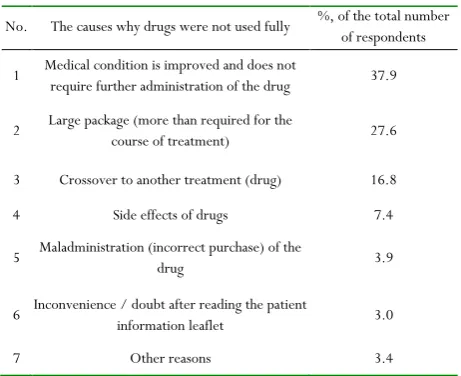
The results of the study showed that 94% of households had unused medicines. In households, 1026 units of unused medicines were identified; it was an average of 5 units per household; 25.4% of the total number of unused medicines in HFAK was expired. The main causes for non-use of medicines and their collection in HFAK were improved health, which did not require further administration of drugs, large package, crossover to another drug, and side effects of the treatment (Tab. 1).
Table 1. The causes why drugs were not used fully
No. The causes why drugs were not used fully %, of the total number of respondents
1 Medical condition is improved and does not
require further administration of the drug 37.9
2 Large package (more than required for the
course of treatment) 27.6
3 Crossover to another treatment (drug) 16.8
4 Side effects of drugs 7.4
5 Maladministration (incorrect purchase) of the
drug 3.9
6 Inconvenience / doubt after reading the patient
information leaflet 3.0
7 Other reasons 3.4
It was found that among the unused medicines in HFAK, there were drugs of the following therapeutic groups of the first level according to the international Anatomical Therapeutic Chemical (ATC) Classification recommended by the WHO [20]
(Fig. 1).
Figure 1.Unused medicines in HFAK by therapeutic groups of
the first level according to the ATC classification, in % of the total number of unused medicines.
The most common therapeutic groups among unused medicines (Tab. 2) were medicines from the following ATC groups: “Musculo-skeletal system”, namely group M01A “ Anti-inflammatory and antirheumatic products, non-steroids” (29.7%), “Anti-infectives for systemic use”, namely group J01 “Antibacterials for systemic use”, including antibiotics (17.7%), and “Nervous system” (17.3%).
Table 2. Unused medicines of the main therapeutic groups of levels 1 and 2 of the ATC classification
ATC group The name of the ATC group %, of the total number of unused medicines M Musculo-skeletal system, including 29.7
(М01) Anti-inflammatory and antirheumatic products, non-steroids 29.7
J Anti-infectives for systemic use, including 22.2 (J01) Antibacterials for systemic use 17.7
(J02) Antimycotics for systemic use 0.5
(J05) Antivirals for systemic use 4.0
N Nervous system, including 17.3
(N02) Analgesics 14.3
(N05) Psycholeptics 3.0
For Ukraine, non-steroidal anti-inflammatory drugs are the most popular medicines; they are in the TOP 10 of the pharmacy sales [21]. High level of self-medication tends to make
these drugs the most prevalent medicines used by the population in case of the disease at the first signs of pain and fever. Most people keep such drugs at home for reuse in case of disease.
The high amount of unused antibiotics in HFAK indicates their inappropriate use. Taking into account the general practice of disposing unnecessary medications through the sewers and household waste, it leads to environmental pollution with these drugs. In developed countries, pharmacists, as a rule, collect unused medicines, reducing the presence of antimicrobials in the environment [22]. Unfortunately, this practice does not exist
Iana . Proskurova et al.: Analysis of handling practice with unused medicines in home first aid kits of the Ukrainian households
126 Journal of Advanced Pharmacy Education & Research | Jul-Sep 2019 | Vol 9 | Issue 3
disposed of unnecessary medications through the sewers or as part of solid household waste.
Conclusions
The study conducted determined the characteristics of unused medicines and identified the causes for their storage in HFAK among the sample of households in the Kharkiv region of Ukraine. As a result of the study, it became known that the main causes for non-use of medicines and their collection in HFAK were improved health, which did not require further administration of drugs, large package, crossover to another drug, and side effects of the treatment. It was found that the most common therapeutic groups among unused medicines were medicines of “Musculo-skeletal system” group, namely group M01A “Anti-inflammatory and antirheumatic products, non-steroids” (29.7%), “Anti-infectives for systemic use”, namely group J01 “Antibacterials for systemic use”, including antibiotics (17.7%), and “Nervous system” (17.3%). It has been shown that in the Ukrainian households the storage of unused medicines in HFAK is a common practice, which is the result of the irrational use of drugs. Inappropriate disposal of drugs leads to the ingress of pharmaceutical compounds into the environment. Conducting information campaigns for the population on the rational use of drugs, waste reduction, safe storage, and disposal of drugs is relevant for Ukraine.
Prospects for further research.
Elimination or minimization of environmental pollution by waste of medicinal products requires actions both at the level of sectoral decisions and educational activities for the rational use of medicines by the population. At the same time, there is an urgent need for research in Ukraine to develop a program for the return of unnecessary drugs by the population in order to safely dispose them.
Conflict of Interests:
authors have no conflict of interests to declare.
The Limitations of the Study
The limitations of the study include small sample size from a specific region; therefore, we cannot make a common generalization.
References
1. Pharmaceutical market of Ukraine in the first half of 2018. [Electronic resource] Rating agency Credit-rating. - 2018 - Resource access mode: http://www.credit-rating.ua/ua/analytics/analytical-articles/14474/
2. The pharmaceutical market of Ukraine in 2017 increased by 20%, - research. [Electronic resource] LB.ua. – 2018. – Resource access mode: https://ukr.lb.ua/economics/2018/04/24/396071_f armatsevtichniy_rinok_ukraini_2017.html
3. Castensson S, Ekedahl A. In: Green and Sustainable pharmacy. Kümmerer K, Hempel M, editor.
BerlinHeidelberg: Springer; 2010.
PharmaceuticalWaste: ThePatientRole; pp. 170-200 4. Pharmaceuticals in the environment: Global
occurrence and potential cooperative action under the Strategic Approach to International Chemicals Management (SAICM)/ Dessau-Roßlau, September
2016 – 94 p. – Available at :
https://www.umweltbundesamt.de/sites/default/file s/medien/1968/publikationen/iww_abschlussbericht _saicm_arzneimittel_final.pdf
5. Study on the environmental risks of medicinal products/Final Report prepared for Executive Agency for Health and Consumers/ BIO Intelligence Service,
2013. – 310 p. – Available at :
https://ec.europa.eu/health//sites/health/files/files/ environment/study_environment.pdf Accessed 04.06.2018
6. FIP statement of policy: Environmentally sustainable pharmacy practice: Green pharmacy [Еlectronic resource]. – Buenos Aires, Argentina, 2016. –
Available at:
https://www.fip.org/www/uploads/database_file.ph p?id=376&table_id= Accessed 04.06.2018
7. Barnett-Itzhaki, Z. Household medical waste disposal policy in Israel / Barnett-Itzhaki Z, Berman T., Grotto I, Schwartzberg E. // Isr J Health Policy Res. 2016; 5:
48. Available at :
https://www.ncbi.nlm.nih.gov/pmc/articles/PMC50 57219/#CR3
8. FIP statement of policy: Patient safety is ensured by pharmacists [Еlectronic resource]. International Pharmaceutical Federation (FIP). 2017. – Available at : https://www.fip.org/patient_safety
9. World Health Organization maximizing positive synergies collaborative group. An assessment of interactions between global health initiatives and country health systems. Lancet, 2009, 373:2137–2169 10. World Health Organization. The world medicines
situation 2011 [site na Internet].
http://apps.who.int/medicinedocs/documents/s2005 4en/s20054en.pdf Acesso: 11/02/2019
11. FIP statement of policy: Green pharmacy practice. Taking responsibility for the environmental impact of medicines./ [Еlectronic resource]. International Pharmaceutical Federation (FIP), 2015. – Available at : https://fip.org/files/fip/publications/2015-12-Green-Pharmacy-Practice.pdf
12. Law A.V. et al. Taking stock of medication wastage: Unused medications in US households / Law et al. //Research in Social and Administrative Pharmacy 11 (2015) 571–578
Iana . Proskurova et al.: Analysis of handling practice with unused medicines in home first aid kits of the Ukrainian households s
Journal of Advanced Pharmacy Education & Research | Jul-Sep 2019 | Vol 9 | Issue3 127
International Pharmaceutical Federation (FIP). – 2015.
Available at:
https://www.fip.org/files/fip/publications/2015-11-Fighting-antimicrobial-resistance.pdf
14. De Bolle L Home medication cabinets and self-medication: a source of potential health threats? /De Bolle L, Mehuys E, Adriaens E, Remon JP, Van Bortel L, Christiaens T.// Ann Pharmacother. 2008 Apr;42(4):572.
15. Shivaraju Р. Knowledge and awareness of disposal of unused and expired medications among medical undergraduates of a tertiary care teaching hospital at B G Nagar: A cross-sectional observational study / P. Shivaraju, M. Gangadhar // National Journal of Physiology, Pharmacy and Pharmacology. 2017, Vol 7.
№ 11 р. 1268 – 1273.
https://www.ejmanager.com/mnstemps/28/28-1500559626.pdf?t=1549883953
16. Tit, Delia Mirela & Bungau, Simona & Nistor-Cseppento, Carmen & Copolovici, Dana & Buhas, Camelia. (2016). Disposal of unused medicines resulting from home treatment in Romania. Journal of environmental protection and ecology. 17. 1425-33. 17. Anandi V. Law. Taking stock of medication wastage:
Unused medications in US households/ //Research in Social and Administrative Pharmacy: – 2015, v.11, №
4, рр. 571-578. Available at :
https://www.sciencedirect.com/science/article/pii/S 1551741114003337
18. Kusturica M. Analysis of expired medications in Serbian households / M. Kusturica, A. Tomas, Z. Tomic// Slovenian Journal of Public Health: – 2016 v.55, № 3, рр.195-201. Available at : https://app.dimensions.ai/details/publication/pub.10 22305455
19. Kuprash L.P. Eligibility (compliance) of medical therapy in geriatric clinic / L.P. Kuprash, Yu.O.Grinenko, O.V.Kuprash, S.O. Gudarenko // Problems of aging and longevity ", 2015, 24, № 3-4. – P. 375—382.
20. Compendium OnLine
https://compendium.com.ua/atc/
21. Pharmaceutical market of Ukraine in the first half of 2018: https://www.apteka.ua/article/464478 22. FIP statement of policy: Pharmacists fight antimicrobial
resistance/ International Pharmaceutical Federation
(FIP). 2017. – Available at: