Volume -3, Issue-3, May - June 2017, Page No. 09 - 15
e9
An Improved TCP congestion Control Technique by Using QoS Policy in WIMAX Network
Chahat Gupta, Navdeep Kumar
M. Tech. Scholar, Haryana Engineering College, Jagadhri, Haryana India.
Associate Professor, Haryana,Engineering College,Jagadhri, Haryana India.
E-Mail: [email protected], E-Mail:[email protected]
Abstract
WiMAX technology is widely used for wireless communication systems in many countries because it has rich set of
features with promising broadband wireless access (BWA) networks. It provides fast access to the internet where TCP is
the core transport protocol. Congestion is the main problem for wimax which give rise to poor quality of service (QoS).
This paper focuses on the improvement of congestion control in wimax environment and thus will improve the Quality of
Service. We focus on performance variation of two main TCP’s congestion control algorithms viz. Sack and
TCP-Fack. The simulation study is done for higher traffic rates on these two protocols under random losses and retransmission
timeouts in high delay networks. We have enhanced the protocol with buffer management schemes namely Drop tail and
random early detection. NS-2 is used as a simulation tool that supports several networking protocols like TCP. The
simulation results enhance the performance of TCP-Fack and improved the Quality of Service in terms of high throughput
and low end-to-end delay.
Keywords: Wimax, BWA, congestion avoidance, TCP-Sack and TCP-Fack, QoS.
1. Introduction
In the mid-1990s, when the rapid growth of the internet clearly revealed that free and anonymous access to data, written
communications were extremely valued by most individuals. Digital voice transmission in telephone networks was one of
the first signs that came into use. For the time being, Wireless networking is by far the most popular way of
communication that is available. The development of new technological devices that are made for users, they demand
higher possible methods of speed, larger coverage and mobility. Thus came the existence of the technology; Worldwide
interoperability for Microwave access (WiMAX). It is defined as IEEE standard 802.16. The standard was approved in
April, 2002 [5]. WIMAX adopted some of its technology from WiBro, a service marketed in Korea. Mobile WIMAX
(originally based on 802.16e-2005) is the revision that was deployed in many countries, and basis of future revisions such
as 802.16m-2011. It is similar to Wi-Fi, but it can enable usage at much greater distances. Mobile WiMAX is considered a
promising next generation wireless technology because it has a long transmission range and supports high data rates and
handover [1]. The WiMAX NWG has developed a network reference model to serve as an architecture framework for
WiMAX deployments and to ensure interoperability among various WiMAX equipment and operators. So, far a number
of specifications for WiMAX were standardized by the IEEE 802.16 Working Group[6]. The overall network may be
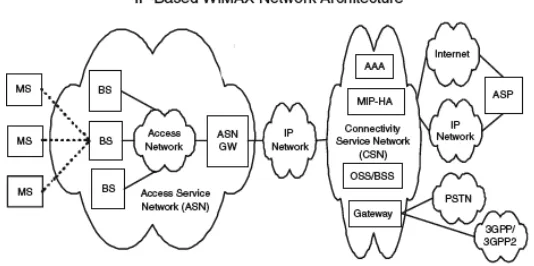
logically divided into three parts: Mobile Station (MS) , Access Service Network (ASN), Connectivity Service Network
(CSN) [10] (Fig. 1). WIMAX is called the next generation broadband wireless technology which offers high speed,
secure, sophisticate and last mile broadband services along with a cellular back haul and Wi-Fi hotspots. The broadband
e10 e10e10 e10e10 e10e10 e10e10
e10
e10
e10
e10e10 e10e10 e10e10 e10e10
e10
of terminals. IEEE 802.16e Mobile WiMAX is the given standard for broadband wireless access in a metropolitan area.
Many mobile carriers worldwide have been setting up Mobile WiMAX infrastructure. For interoperability testing, several
WiMAX profiles have been developed by WiMAX Forum. The WiMAX forum currently has more than 470 members
comprising the majority of operators, component, and equipment companies in the communications ecosystem [9].
Regardless of all these immense facilities QoS remains one major factor that most of the broadband wireless
technologies lookout as a challenge. Quality of Service (QoS) is the service that is used to deliver the different services to
the mobile user in appropriate time [8]. We surveyed various papers presented in this regard and come up with some
congestion control algorithms of upgrading the quality of service (QoS) in the WiMAX network. Section 2 gives the
introduction to various flavors of TCP congestion control variants. Section 3 covers the overview of literature survey that
serves as the foundation approaches to the algorithms we surveyed. Lastly, Conclusions and future scope comes up in
section 5.
Fig. 1: IEEE 802.16 / WiMAX network architecture
2. Related Analysis
TCP and its variants are designed for congestion avoidance and some of these principles are slow start, fast retransmit,
AIMD, fast recovery and congestion avoidance etc. TCP variants follow these principles along with active queue
management techniques to regulate the traffic sending rate.
1) Tahoe
TCP Tahoe utilizes the Slow Start, Congestion Avoidance and fast retransmit algorithms [7]. In the slow start algorithm, a
cwnd is added to the per-connection state. When starting or restarting after a packet loss, the cwnd is set to one packet.
Thereafter, on each ACK for new data, the cwnd is increased by one packet. Congestion avoidance in TCP Tahoe relies on
setting the cwnd to half the current window size on timeout. Thereafter, on each ACK for new data, the cwnd is increased
by 1/cwnd. In addition, information about the receiver's advertised window and cwnd is also sent. Finally, the fast
retransmit algorithm works by monitoring the reception of duplicate ACKs for the same TCP segment. From this, the TCP
sender infers that a packet loss has occurred and will retransmit lost packets without having to wait for the retransmission
timer to expire.
e11 e11e11 e11e11 e11e11 e11e11
e11
e11
e11
e11e11 e11e11 e11e11 e11e11
e11
The original retransmission mechanism of TCP is based on a timeout where round-trip time (RTT) and variance estimates
are computed by sampling the time between when a segment is sent and when an ACK arrives [3]. It uses the Slow Start
and Congestion Avoidance mechanisms. The sender window size is gradually increased until packet losses are
experienced. Thereafter, the window size is halved and a linear, less gradual increase of packet transmission occurs.
Consequently, this additive increase and multiplicative decrease lead to periodic oscillations in the cwnd, round-trip delay,
and queue length.
3) New Reno
TCP New Reno maintains two variables, the cwnd, which initially set to 1 segment, and SS Threshold (ssthresh). At the
beginning of the TCP connection, the sender enters the Slow Start (SS) phase, in which it increases the cwnd by 1 segment
for every ACK it receives. When cwnd reaches the ssthresh, the TCP sender enters the Congestion Avoidance (CA) phase,
in which it increases the cwnd by 1/cwnd for every ACK it receives, in order to slowly probe the available network
bandwidth. This linear growth ends when cwnd reaches the receiver‘s advertized window, or by the reception of 3
DUPACKs. In the latter case, TCP infers that packets were lost due to link congestion, and it reduces the cwnd by ½ of its
current value, in an attempt to prevent network collapse (Fast Recovery).
4) SACK
Sack is a short name for selective acknowledgement. It works best when various packets got dropped from one window of
data. The receiver use the ―option‖ fields of TCP header (SACK option) for notifying the sender of three blocks of non
-contiguous set of data received and enqueued by the receiver. The first starting block represent the most recent packet
received, and the next blocks represent the most recently reported SACK blocks. The sender keeps a scoreboard in order
to provide information about SACK blocks received so far.
5) FACK
Fack is short for Forward Acknowledgment and is based on TCP Reno with Sack. TCP FACK is using the information
provided by Sack to compute a better estimate of the amount of data currently in transit(outstanding data). This
information is essential for any congestion control algorithm. To estimate the amount of outstanding data, Fack introduces
a new variable, fack, denoting the highest sequence number known to have been received plus 1.
3. Simulation Environment
In this section we will present the simulation setup used for TCP variants and buffer management schemes. The traffic
scenarios were implemented in network simulator-2 (ns-2) for WiMAX networks. Table 1 depicts the most important
WiMAX and traffic parameters used in our simulations. The Simulation setup consists of an area of 1000x1000, where
randomly 30 mobile nodes are placed. Simulation parameters are as follows:
Table 1: Simulation Parameters
PARAMETERS VALUE
Simulator NS-2
Routing protocol OLSR
e12 e12e12 e12e12 e12e12 e12e12
e12
e12
e12
e12e12 e12e12 e12e12 e12e12
e12
Area 1000mX 1000m
Packet size 512bytes
Simulation time 200sec.
Mobility Model Random wavepoint model
Antenna Omni directional
Traffic FTP
Modulation
Technique
OFDM
TCP Variants TCP-Sack, TCP-Fack
Active Queue
Management
Techniques
Drop Tail & Random
Early Detection (RED)
MAC IEEE/802.16 e
4. Performance Metrics
Following are the performance metrics:
Throughput – Throughput is rate of number of packets received at the receiver with respect to the time taken. Units are
bytes/sec or bits/sec.
Packet Delivery Ratio - It is calculated by dividing the number of packet received by destination through the number
packet originated from source.
PDF = (Pr/Ps)
Where Pr is total Packet received and Ps is the total Packet sent.
Average end-to end delay - It is defined as the time taken for a data packet to be transmitted across an MANET from
source to destination.
D = (Tr –Ts)
where Tr is receive Time and Ts is sent Time.
Routing Overhead- It can also be defined as the ratio of routed packets to data transmissions in a single simulation. It is
the routing overload per unit data delivered successfully to the destination node.
SIMULATION RESULTS ANALYSIS:
In this section we present our simulation scenarios in WiMAX and discuss the results obtained. With the help of 2D
graphs, the simulation has been analyzed for TCP variants based on traffic generators like FTP under higher traffic load
network scenario based on cyclic prefixes using NS-2.
Throughput: The figure 1 shows the impact of average speed on the throughput. It is observed that the throughput of
TCP-FACK+DropTail+RED is improved as compared to TCP-Sack and TCP-Fack. Throughput is maximum for cyclic
e13 e13e13 e13e13 e13e13 e13e13
e13
e13
e13
e13e13 e13e13 e13e13 e13e13
e13
Fig. 2: Throughput
Delay: The figure 2 shows the average end-to-end delay. OLSR protocol uses the route cache which many a times
contains stale routes, as a result delay is comparatively higher. As the load on base satation increases the delay increases.
The end to end delay of TCP-FACK+DropTail+RED is lower as compared to TCP-Sack and TCP-Fack.
Fig. 3: Delay
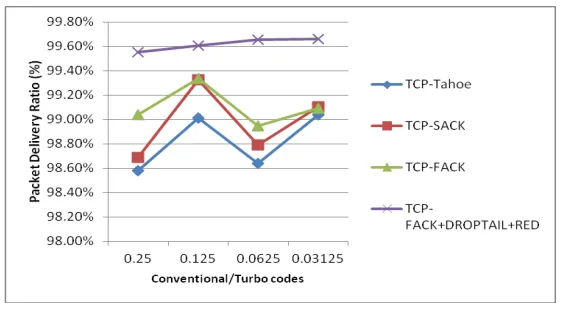
PDR: Figure 3 shows the packet delivery ratio for TCP-Sack, TCP-Fack and TCP-Fack+DropTail+RED when the cyclic
prefix is varied. Simulation result shows that TCP-Fack gives higher performace when the value of cyclic prefix
decreases. It is observed that the packet delivery ratio of TCP FACK with buffer management techniques over OLSR
under higher traffic load is better than TCP-Sack and TCP-Fack.
e14 e14e14 e14e14 e14e14 e14e14
e14
e14
e14
e14e14 e14e14 e14e14 e14e14
e14
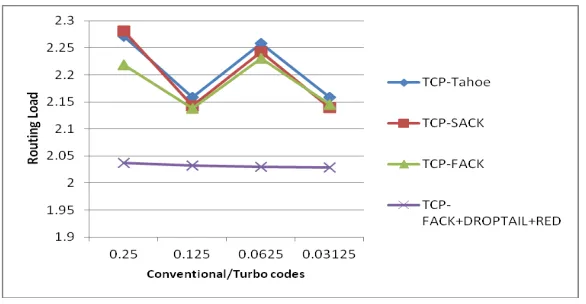
Routing load: The figure 4 shows the impact of cyclic prefix on the routing load. It is observed that the routing load of
TCP-FACK+DropTail+RED is better than both TCP-Sack and TCP-Fack variants. When cyclic prefix is lower the value
of routing load is lower as cyclic prefix increases routing load increases.
Fig. 5: Routing Overhead
5. Conclusion And Future Scope
This paper has provided the required details that the TCP-Fack protocol when enhanced with buffer management schemes
Drop Tail and RED can enhance the throughput and packet delivery ratio with considerable amount and reduce the
random packet loss and retransmission timeout drawbacks. Hence it improved the Quality of Service in Wimax
environment.
The behavior of TCP and its variants in a simple mobility scenario under higher traffic rates is observed. For subsequent
studies, we can develop a hybrid solution combining the principles of various TCP-variants in congestion avoidance and
fast recovery phase, could be an ideal candidate in WiMAX network to improve TCP-FACK performance over WiMAX
environment.
6. References
[1]. J. Cecilia Rana A., “Enhanced TCP Friendly Congestion Control Protocol”, International Journal of Computer Theory
and Engineering, Vol. 6, No. 1, pp.39-42, February 2014.
[2]. K. Kishor and A. Sharma,” TCP Based Performance Evaluation of WiMax Environment”,
ISSN No: 2309-4893 International Journal of Advanced Engineering and Global Technology, Vol-05, Issue-01, pp.
1445-1448, January 2017.
[3]. Monika and A. Kaur, “A Review on Qos Oriented Congestion Control and Load Balancing Algorithms over
WiMAX”, IJARIIE-ISSN(O)-2395-4396 Vol-2 Issue-3, pp. 4163-4168, 2016.
[4]. B. Subramani1 and T. Karthikeyan, “A Review on Congestion Control”, ISSN (Online) : 2278-1021, International
Journal of Advanced Research in Computer and Communication Engineering, Vol. 3, Issue 1, pp. 5213-5217, January
2014.
[5]. A. Rajpoot et al., “A Review Paper on WiMAX Technology”, ISSN: 2278 – 1323, International Journal of Advanced
e15 e15e15 e15e15 e15e15 e15e15
e15
e15
e15
e15e15 e15e15 e15e15 e15e15
e15
[6]. A. Chabra et al,, ”Performance evaluation of variants of TCP based on buffer management on wimax”,
ISSN:2249-5789, International Journal of Computer Science & Communication Networks,Vol 4(3),67-75, pp. 67-75.
[7]. B. Jaglan and N. Pawar, “A Review of congestion control variantsof TCP over IEEE 802.16 standard networks”,
SSRG International Journal of Computer Science and Engineering (SSRG-IJCSE) – EFES, ISSN: 2348 – 8387, pp. 12-17,
April 2015.
[8]. R. Gupta and C. Rawal, “A Novel Approach to Enhance QoS in Mobile WiMAX Networks”, International Journal of
Computer Applications (0975 – 8887) Volume 140 – No.2, pp, 23-26, April 2016.
[9]. G. Singh Dhaliwal et al., “A Survey on Versions of TCP over WiMAX”, International Journal of Emerging Research
in Management &Technology ISSN: 2278-9359 (Volume-4, Issue-2), pp. 83-90, February 2015.
[10]. K. Bhavsar et al., “Improving the Quality of Service in WiMax Using NS3”, ISSN 2350-1022 International Journal
of Recent Research in Mathematics Computer Science and Information Technology Vol. 3, Issue 1, pp: (1-5), Month: