http: // www.ijrtsm.com© International Journal of Recent Technology Science & Management 1
ISSN : 2455-9679
[Ramji et al. , 4(10), Oct 2019] Impact Factor : 3.340
IJRTSM
INTERNATIONAL JOURNAL OF RECENT TECHNOLOGY SCIENCE & MANAGEMENT
“An Investigation On Optimization Of Turning Parameters using Taguchi & ANOVA Techniques”
Ramji Dwivedi
1,
Dharmendra Tyagi
21
M.Tech. Scholar, Department of Mechanical Engineering, SIRTE, Bhopal 2 Associate Professor, Department of Mechanical Engineering, SIRTE, Bhopal
________________________________________________________________________________________________
ABSTRACT
The main purpose of today’s manufacturing industries is to produce low cost, high quality products in short time. They mainly focused on achieving high quality, in term of part accuracy, surface finish, high production rate etc. So, the selection of optimal cutting parameters is a very important issue for every machining process in order to reduce the machining costs and increase the quality of machining products. In this project the cutting of Ductile Iron under wet and dry condition is carried out using CNC lathe machine. Taguchi method is used to formulate the experimental layout. The effect of cutting condition (spindle speed, feed rate and depth of cut) on surface roughness were studied and analysed. The CNC turning machine is used to conduct experiments based on the Taguchi design of experiments (DOE) with orthogonal L9 array. Optimal cutting parameters for each performance measure were obtained employing Taguchi techniques. The orthogonal array, signal to noise ratio and analysis of variance were employed to find minimum surface roughness. Optimum results are finally verified with the help of confirmation experiments.
I. INTRODUCTION
Manufacturing means transformation of raw materials into finished goods for the satisfaction of human needs. To transform the raw material different manufacturing processes are applied because of which the shape, size and physical properties of given material are altered. Different types of manufacturing process for metals are: -
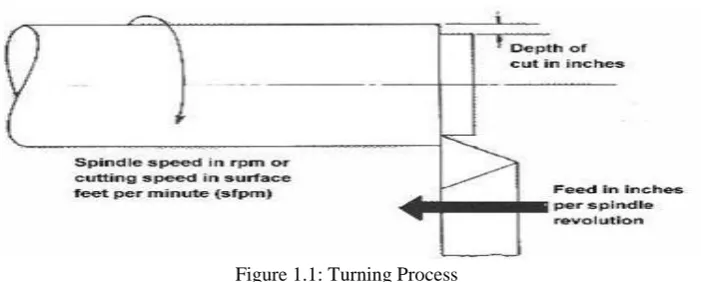
Turning Process
http: // www.ijrtsm.com© International Journal of Recent Technology Science & Management 2
ISSN : 2455-9679
[Ramji et al. , 4(10), Oct 2019] Impact Factor : 3.340
Figure 1.1: Turning Process
Turning is used to produce rotational, typically axi-symmetric, parts that have many features, such as holes, grooves, threads, tapers, various diameter steps, and even contoured surfaces. Parts that are fabricated completely through turning often include components that are used in limited quantities, perhaps for prototypes, such as custom designed shafts and fasteners. Turning is also commonly used as a secondary process to add or refine features on parts that were manufactured using a different process. Due to the high tolerances and surface finishes thatturning can offer, it is ideal for adding precision rotational features to a part whose basic shape has already been formed.
Speed
Speed always refers to the spindle and the work piece.
V = m min-1
Here, v is the cutting speed in turning,
D is the initial diameter of the work piece in mm and N is the spindle speed in RPM.
Feed
It is the rate at which the tool advances along its cutting path. The feed of the tool also affects to the processing speed and the roughness of surface.
Fm= f. N mm. min-1
Here, Fm is the feed in mm per minute, f is the feed in mm/rev and N is the spindle speed in RPM.
Depth of Cut
Depth of cut is practically self explanatory. It can be defined as the thickness of the layer being removed (in a single pass) from the work piece or the distance from the uncut surface of the work to the cut surface, expressed in mm.
dcut = mm
Here, D and d represent initial and final diameter (in mm) of the job respectively.
http: // www.ijrtsm.com© International Journal of Recent Technology Science & Management 3
ISSN : 2455-9679
[Ramji et al. , 4(10), Oct 2019] Impact Factor : 3.340
II. LITERATURE REVIEW
S. Khrais, A.M. Hassan, A. Gazawi(2016) develop a multiple regression model for surfaceroughness as a function of
cutting parameters during the turning of flame hardened medium carbon steel with TiN-Al2O3-TiCN coated inserts. An experimental plan of work and signal-to-noise ratio (S/N) were used to relate the influence of turning parameters to the workpiece surface finish utilizing Taguchi methodology. The effects of turning parameters were studied by using the analysis of variance (ANOVA) method. Evaluated parameters were feed, cutting speed, and depth of cut. It was found that the most significant interaction among the considered turning parameters was between depth of cutand feed. The average surface roughness (Ra) resulted by TiN-Al2O3-TiCN coated inserts was about 2.44 μm and minimum value was 0.74 μm. In addition, the regression model was able to predict values for surface roughness in comparison with experimental values withinreasonable limit.
U. K. Yadav, D. Narang, P.S. Attri(2016)analyzed the effect and optimization of machining parameters (cutting speed, feed rate and depth of cut) on surface roughness is investigated. An L’27 orthogonal array, analysis of variance (ANOVA) and the signal-to-noise (S/N) ratio are used in this study. Three levels of machining parameters are used and experiments are done on STALLION-100 HS CNC lathe. The optimum value of the surface roughness (Ra) comes out to be 0.89. It is also concluded that feed rate is the most significant factor affecting surface roughness followed by depth of cut. Cutting speed is the least significant factor affecting surface roughness. Optimum results are finally verified with the help of confirmation experiments.
M. V. Ramana, A. V. Vishnu, G. K.M. Rao, D.H. Rao (2017)analyzed experimentally and optimization of process
parameters for surface roughness in turning of Ti-6Al-4V alloy under dry, flooded and Minimum Quantity Lubrication (MQL) conditions using Taguchi’s robust design methodology and development of prediction models for surface roughness using multiple regression analysis. The results have been compared among dry, flooded and MQL conditions and it reveals that MQL shows better performance and improvement in reduction of surface roughness compared to dry and flooded lubricant conditions. From Analysis of Mean (ANOM), it is observed that MQL is suitable at higher depth of cut compared to dry and flooded lubricant conditions. It is observed from ANOM that, under MQL condition uncoated tool shows better performance compared to the CVD and PVD coated tools, whereas CVD coated tool shows better performance for dry and flooded lubricant conditions compared to uncoated and PVD coated tools. It is also observed from the ANOVA that, feed rate has major contribution in optimizing the surface roughness.
K. Hassan, A. Kumar, M.P. Garg (2018) investigates the effects of process parameters on material removal rate (mrr)
in turning of C34000. The single response optimization problems i.e. optimization of mrr is solved by using Taguchi method. The optimization of MRR is done using twenty seven experimental runs based on L’27 orthogonal array of the Taguchi method are performed to derive objective functions to be optimized within the experimental domain When the MRR is optimized alone the MRR comes out to be 8.91. The optimum levels of process parameters for simultaneous optimization of MRR have been identified. Optimal results were verified through confirmation experiments.
III. EXPERIMENTATION
Cutting Parameters and Levels for Dry and Wet Turning
Parameters/Factors level
1 2 3
A Spindle speed (rpm) 160 320 620
B Feed rate (mm/rev) 0.3 0.4 0.5
http: // www.ijrtsm.com© International Journal of Recent Technology Science & Management 4
ISSN : 2455-9679
[Ramji et al. , 4(10), Oct 2019] Impact Factor : 3.340
Design of ExperimentsExperiment no. Spindle speed
(rpm), N
Feed rate (mm/rev), f
Depth of cut (mm),
A
1 160 0.3 0.7
2 160 0.4 0.8
3 160 0.5 0.9
4 320 0.3 0.8
5 320 0.4 0.9
6 320 0.5 0.7
7 620 0.3 0.9
8 620 0.4 0.7
9 620 0.5 0.8
Chemical Composition of SG Iron steel in %
C Si Mn P S Cu Ni Cr
0.45 0.20 0.72 0.015 0.018 0.10 0.09 0.07
IV. RESULT & DISCUSSION
Analysis of Variance for Means of Surface Roughness (Ra) for Dry Turning
Source
DF
Adj SS
Adj MS
F
P
Spindle speed (rpm), N
2
3.4417
1.7208
2.11
0.322
Feed rate (mm/rev), f
2
7.2395
3.6197
4.43
0.184
Depth of cut (mm), d
2
2.6564
1.3282
1.63
0.381
Error
2
1.6347
0.8173
Total
8
14.972
Response table of Means for Surface roughness (Ra) for Dry Turning
Level
Spindle Speed
(rpm), N
Feed rate (mm/rev), f
Depth of Cut (mm), d
1
4.613
3.497
4.030
2
5.427
4.773
5.353
3
3.913
5.683
4.570
Delta
1.513
2.187
1.323
http: // www.ijrtsm.com© International Journal of Recent Technology Science & Management 5
ISSN : 2455-9679
[Ramji et al. , 4(10), Oct 2019] Impact Factor : 3.340
Analysis of Variance for Means of Surface Roughness (Ra) for Wet TurningSource
DF
Adj SS
Adj MS
F
P
Spindle speed (rpm), N
2
0.03442
0.01721
0.09
0.92
Feed rate (mm/rev), f
2
3.09109
1.54554
7.8
0.114
Depth of cut (mm), d
2
0.13976
0.06988
0.35
0.739
Error
2
0.39636
0.19818
Total
8
3.66162
Response table for Means for Surface roughness (Ra) for Wet Turning
Level
Spindle Speed (rpm), N
Feed rate
(mm/rev), f
Depth of Cut (mm), d
1
3.047
2.2
2.9
2
2.953
3.623
2.857
3
2.897
3.073
3.140
Delta
0.15
1.423
0.283
Rank
3
1
2
Main Effect Plots for Surface Roughness
Main effect plots for surface roughness for dry and wet turning are shown in the fig. 4.1 and fig. 4.2. Main effect plot
shows the variation of surface roughness with respect to Spindle speed, feed rate and depth of cut. X axis represents
http: // www.ijrtsm.com© International Journal of Recent Technology Science & Management 6
ISSN : 2455-9679
[Ramji et al. , 4(10), Oct 2019] Impact Factor : 3.340
Main effects plot for means for surface roughness for dry turning
Main effects plot for means for surface roughness for wet turning
http: // www.ijrtsm.com© International Journal of Recent Technology Science & Management 7
ISSN : 2455-9679
[Ramji et al. , 4(10), Oct 2019] Impact Factor : 3.340
Main effects plot for S/N ratios for surface roughness in Wet Turning
Percentage contribution of process parameters on surface roughness in dry turning
Percentage contribution of process parameters on surface roughness in wet turning
Determination of Optimum Solution
http: // www.ijrtsm.com© International Journal of Recent Technology Science & Management 8
ISSN : 2455-9679
[Ramji et al. , 4(10), Oct 2019] Impact Factor : 3.340
Parameters and their selected levels for optimal surface roughness in dry turning
Parameter designation Process parameters Optimal levels
A Spindle speed (rpm), N (620 rpm)
B Feed rate (mm/rev), f (0.3 mm/rev)
C Depth of cut (mm), d (0.7 mm)
Parameters and their selected levels for optimal surface roughness in wet turning
Parameter designation Process parameters Optimal levels
A Spindle speed (rpm), N (620 rpm)
B Feed rate (mm/rev), f (0.3 mm/rev)
C Depth of cut (mm), d (0.8 mm)
V. CONCLUSION
Dry Turning
It has been found that feed rate is found to be the most significant factor & its contribution to surface roughness is
48.44 %. The best results for surface roughness (lower is better) would be achieved when SG IRON workpiece is
machined at spindle speed of 620 rpm, feed rate of 0.3 mm/rev and depth of cut of 0.7 mm. With 95% confidence
interval, the feed rate effects the surface roughness most significantly
The Surface roughness is mainly affected by feed rate, depth of cut and spindle speed. With the increase in feed
rate the surface roughness also increases, as the depth of cutincreasesthe surface roughness first increase and
decrease and as the spindle speed increase surface roughness decreases.
1. Spindle speed = 620 rpm
2. Feed rate = 0.3 mm/ rev
http: // www.ijrtsm.com© International Journal of Recent Technology Science & Management 9
ISSN : 2455-9679
[Ramji et al. , 4(10), Oct 2019] Impact Factor : 3.340
Wet Turning
It has been found that depth of cut is found to be the most significant factor & its contribution to surface
roughness is 66.84 %. The best results for surface roughness (lower is better) would be achieved when SG
IRON work piece is machined at spindle speed of 620 rpm, feed rate of 0.3 mm/rev and depth of cut of 0.8 mm.
With 95% confidence interval, the depth of cut effects the surface roughness most significantly
The Surface roughness is mainly affected by depth of cut, feed rate and spindle speed. With the increase in depth
of cut the surface roughness also increases, as the feed ratedecreasesand as the spindle speed increase surface
roughness decreases.
1. Spindle speed = 620 rpm
2. Feed rate = 0.3 mm/ rev
3. Depth of cut = 0.8 mm
REFERENCES
[1] Pytlak,B.; (2010) ‟Multicriteria optimization of hard turning operation of the hardened18HGT steel‟,
International Journal Advance Manufacturing Technology, Volume 49: pp. 305-312.
[2] Sieben,B., Wagnerite. and Biermann,D.; (2010) „ “Empirical modeling of hard turning of AISI 6150 steel
using design and analysis of computer experiments”, Production Engineering Research Development, Volume
4: pp. 115 - 125.
[3] Cappellini,C., Attanasio,A., Rotella,G. and Umbrello,D.; (2010) ‟Formation of dark and white layers in hard
turning: influence of tool wear”, International Journal of Material Forming,Volume 3 No.1: pp. 455 - 458.
[4] D. Philip Selvaraj, P. Chandramohan; (2010)“Optimization of surface roughness of AISI 304 Austenitic
stainless steel in dry turning operation using Taguchi design method”, Journal of Engineering Science and
Technology, Volume 5, No. 3: pp 293-301.
[5] R. Ramanujam, R. Raju, N. Muthukrishnan; (2010) “Taguchi-multi machining characteristics optimization in
turning of Al-15% SiCp composites using desirability function analysis”, Journal of Studies on
Manufacturing, Volume 1 Issue2-3: pp 120-125.
[6] J.S.Senthilkumaar, P.Selvarani, RM.Arunachalam; (2010) “Selection of machining parameters based on the
analysis of surface roughness and flank wear in finish turning and facing of Inconel 718 using Taguchi
Technique”, Emirates Journal for Engineering Research, Volume 15, No.2: pp 7-14.
[7] H. Yanda, J.A. Ghani, M.N.A.M. Rodzi, K. Othman and C.H.C. Haron; (2010) “Optimization of material
removal rate, surface roughness and tool life on conventional dry turning of FCD 700”, International Journal
of Mechanical and Materials Engineering, Volume 5 No. 2: pp 182-190.
[8] D. Mittal, M.P. Garg, R. Khanna; (2011) “An investigation of the effect of the process parameters on MRR in
turning of pure Titanium (Grade -2)”, International journal of Engineering Science & Technology, Volume 3
No. 8: pp 6345-6349.
[9] S. Pahda, S. M Sharma, N. Malhotra; (2011) “Analysis of variance and Optimization of surface roughness in
CNC Turning of EN-8 steel by Taguchi method”, International Journal of Advanced Engineering Technology,
http: // www.ijrtsm.com© International Journal of Recent Technology Science & Management 10
ISSN : 2455-9679
[Ramji et al. , 4(10), Oct 2019] Impact Factor : 3.340
[10] M. Vellibor, M. milos; (2011) “Optimization of surface roughness in turning alloy steel by using Taguchimethod”, Scientific Research and Essays, Volume 6(16): pp 3474-3484.
[11] S.Khrais, A.M. Hassan, A. Gazawi; (2011) “Investigations into the turning parameters effect on the surface
roughness of flame hardened medium carbon steel with TiN-Al2O3-TiCN coated inserts based on Taguchi
techniques”, Word Academy of Science, Engineering and Technology, published online: pp 2137-2141.
[12] U. K. Yadav, D. Narang, P.S. Attri; (2012) “Experimental investigation and optimization of machining
parameters for surface roughness in CNC turning by Taguchi method”, International Journal of Engineering
Research and Applications, Volume 2 Issue 4: pp 2060-2065.
[13] M. V. Ramana, A. V. Vishnu, G. K.M. Rao, D.H. Rao; (2012) “Experimental investigations, optimization of
process parameters and mathematical modeling in turning of Titanium alloy under different lubricant
conditions”, Journal of Engineering, Volume 2 Issue 1: pp 86-101.
[14] K. Hassan, A. Kumar, M.P. Garg; (2012) “Experimental investigation of Material removal rate in CNC
turning using Taguchi method”, International Journal of Engineering Research and Applications, Volume 2
Issue 2: pp 1581-1590.
[15] R.K. Patel, H.R. Prajapati; (2012) “Parametric Analysis of Surface roughness and Material removal rate of
Harden steel on CNC Turning using ANOVA Analysis: A Review”, International journal of Engineering