Grażyna Gebuza
1, A–G, Marzena Kaźmierczak
1, B, C, E–G, Estera Mieczkowska
1, B, C, E–G,
Małgorzata Gierszewska
1, B, C, E, F, Roman Kotzbach
2, E, FLife Satisfaction and Social Support Received
by Women in the Perinatal Period
1 Department of Obstetric Care Basics, Nicolaus Copernicus University in Torun, Collegium Medicum in Bydgoszcz, Poland
2 NCU, Head of the Department of Nursing and Midwifery, Nicolaus Copernicus University in Torun, Collegium Medicum in Bydgoszcz, Poland
A – research concept and design; B – collection and/or assembly of data; C – data analysis and interpretation;
D – writing the article; E – critical revision of the article; F – final approval of article; G – other
Abstract
Background. Birth of a baby has a big impact on women’s lives. The presence and help of loved ones favours well-being, health, coping with difficult situations. The aim of this study was to determine whether women’s satisfaction with life changes during pregnancy and after delivery, and to identify correlates of life satisfaction.
Material and Methods. Life satisfaction was measured using The Satisfaction with Life Scale – SWLS and received social support was assessed using the Berlin Social Support Scales – BSSS. The study was conducted in the third trimester of pregnancy and during the postpartum period, before discharge from the hospital. The research sample included a total of 199 women in the third trimester of pregnancy and 188 of initially participating women, who had physiological births or caesarean sections.
Results. The results clearly show a significant increase in life satisfaction in the postpartum period (p < 0.0001). An important correlate of life satisfaction in the third trimester of pregnancy is social support received (p < 0.0001). During pregnancy such a correlate is emotional support received, and in the postnatal period- instrumental sup-port received. An increase in instrumental supsup-port received (p = 0.031) and informational (p = 0.013) has been observed in the postpartum period.
Conclusions. The assessment of life satisfaction and received social support seem to be needed to gain a full picture of women’s situation during birth, which will allow for planning and implementing maternity care appropriate to the needs of women (Adv Clin Exp Med 2014, 23, 4, 611–619).
Key words: life satisfaction, social support, pregnancy, postpartum period. Adv Clin Exp Med 2014, 23, 4, 611–619
ISSN 1899–5276
ORIGINAL PAPERS
© Copyright by Wroclaw Medical University
Childbirth is a joyful and unique period in the lives of women that will remain in their memory forever. It is a period of many changes that affect the body, emotions, and perceptions of others. For a long time, women have taken on the main re-sponsibility for childcare, not only because of their ability to breast-feed, but also because of the in-tuition and sensitivity which women are endowed with. These are the reasons why women are main-ly responsible for the quality of childcare; there-fore, a challenge of being a mother is not easy. In view of such circumstances, it becomes extremely important to receive support from loved ones. It is well known that the presence of other people, their
help and kindness promotes well-being, health and the ability to cope with difficult situations [1]. Research has shown that the birth of a baby and changes taking place in the perinatal period have a big impact on the lives of women.
The aim of this study was to determine wheth-er women’s satisfaction with life changes during pregnancy and after giving birth and to identify the correlates of life satisfaction.
assessed by the use of the Questionnaire of the Sat-isfaction with Life Scale – SWLS by E. Diener, RA Emmons, RJ Larson, S. Griffin and in Polish ad-aptation by Z. Juczyński [2]. The test results indi-cated the overall sense of life satisfaction. The re-sults ranged from 5 to 35 points. The higher the score, the greater the satisfaction with life. Results of 1–4 in scale of Sten were accepted as low and in the range of 7–10 in Scale of Sten as high, results between 5 and 6 in Scale of Sten were treated as average. Life satisfaction was tested twice, in the third trimester of pregnancy and in the postpar-tum period, before women were discharged from the hospital.
Life satisfaction was compared in the third tri-mester of pregnancy and in the postpartum period to evaluate the type of changes that occurred dur-ing pregnancy and in childbirth.
By the term social support this research re-lates to the type and amount of social support that women received from partners. In this context, at-tention is paid to social support given to women who are under the influence of the problematic sit-uation – awaiting the birth of a baby and who are worried about their own and the baby’s health. Ac-cording to a research tool used in the study, social support was divided into three types: emotional, instrumental and informational. The women’s so-cial support networks during pregnancy and post-partum period can include many supporting peo-ple: partners and immediate family, as well as medical personnel. In this research study, the sup-port received by women refers to the one coming from loved ones – partners/husbands. The vari-able indicator was assessed by the use of the Ber-lin Social Support Scale (BSSS) by A. Łuszczyń-ska, M. KowalŁuszczyń-ska, M. Mazurkiewicz, R. Schwarzer, U. Schulz [3]. The received support was examined using the scale of emotional, instrumental and in-formation support received, where the score of 0 meant the lack of support and a score of 1 meant maximum support.
The Berlin Social Support Scale (BSSS) is a set of tools to assess cognitive and behavioural dimen-sions of social support. The Polish version of BSSS is available on the website and can be download-ed free of charge for the research purposes on Ber-lin Social Support Scales (BSSS) – Polish Version http://userpage.fu-berlin.de/ ~ health/ soc_pol. htm.n. The scale of emotional support received contains statements relating to the subjective as-sessment of the person receiving the support, re-ferring to her feelings, acceptance, comforting, un-derstanding of the situation, complaints, evaluation and care of the emotional state and trust. The scale of instrumental support received refers to care and settling issues which could not be possible to deal
by the person receiving support. The scale of the informational support received relates to the per-ception of a situation as positive and manageable. The results of the support emotional received can be a maximum of 36 points, instrumental support – 12, information support – 8, satisfaction with the support received – 4 points. In view of the fact that items included in evaluation of the social sup-port provided by the BSSS scale have different lim-its “min-max”, the value of the individual i-items were normalized to the scale of 0–1.
Material and Methods
The study was conducted from July 2010 to April 2011. Ethical approval for the study was granted by the Bioethics Committee at the Nico-laus Copernicus University in Torun, Medical Col-lege in Bydgoszcz, No. 270/10.
The study was conducted in two parts, in the third trimester of pregnancy and in the postnatal period, at discharge from the hospital. The same participants took part at each stage of the study. The first stage of the research was carried out on the antenatal ward and in the Clinic “K” in the hos-pital of Dr Jan Biziela in Bydgoszcz, at the private gynaecological practice of M. Bułatowicz and at the birth school of Ms Anna Appelt; women were asked to complete the Fear of Childbirth Question-naire. The second stage of the research was con-ducted on the postnatal ward at the University Hospital of Dr Jan Biziela in Bydgoszcz.
199 (100%) women in the third trimester of pregnancy were included in the statistical analysis. In the second stage of the study – after giving birth, 182 (91.45%) of the initial participating women were included in the analysis. The respondents completed the questionnaires on a specially pre-pared table in the doctor’s office, patient’s room, at the birth school. Questionnaires were prepared in envelopes.
199 women participated in the study, 96 of which (48.24%) were primiparae, 72 (36.18%) gave birth for the second time, 26 (13.06%) for the third time, 3 (1.50%) for the fourth time, and 2 (1.00%) for the fifth time. 172 (91.00%) of newborns were born in good condition (8–10 Apgar score), 17 (8.99%) in the average state (4–7 Apgar score). Two babies in poor health were not taken into account. 164 (84.10%) newborns were born with normal weight (more than 2500 g) and 31 (15.89%) weighed 2500 g or less. On average, birth took place in the 38th week of pregnancy. The vast majority of women described their relationship with a partner as very good 153 (77.27%) and good 44 (22.22%), one per-son found their relationship with her partner as bad (0.51%). In the opinion of 29 (14.57%) wom-en their financial situation was very good, good – 165 (82.91%). However, 4 (2.01%) women de-scribed it as poor and 1 (0.50%) as very poor. Dur-ing the pervious year, social benefits were taken by 8 (4.04%) women. 12 (6.09%) women had re-cently used the help of a psychologist. Most of the women were employed 125 (63.78%), 71 (36.22%) unemployed. The pregnancy was planned for 156 (78.39%) women, unplanned for 43 (21.61%). 26 (13.07%) women attended antenatal classes during pregnancy, 3 (1.51%) participants attended class-es with their husband/partner, reprclass-esenting a total of 29 (14.58%). 58 (34.31%) women had problems with breastfeeding.
The obtained results were based on statistical methods using the software Microsoft Excel 2000 and a package of programs for statistical analysis – STATISTICA version 10. We used Student’s t-test for dependent variables (paired data) and Stu-dent’s t-test to verify the hypothesis about the sig-nificance of Pearson’s product- moment correlation coefficients. The level of significance of p = 0.05, for which the critical values were given, has been ac-cepted as reliable when verifying hypotheses.
Results
According to the aims of this research, the analysis of levels of life satisfaction in each period was undertaken. In the third trimester of pregnan-cy, the highest result belongs to high sten, which equals to over half of the observation (59.29%). Similarly, in the postpartum period, the results be-longing to the high sten was observed in (71.82%) women. The low level of life satisfaction was de-clared by 10% of women during pregnancy and about 5% in the postnatal period. The results of average life satisfaction were declared by about 30% of pregnant women and 23% in the postna-tal period.
The mean values of the variable ‘life satisfac-tion’ indicate that in the third trimester of preg-nancy women participating in the study had an average satisfaction with life (24.51) and in the postpartum period (25.71). The results are in the high range according to the scale of sten (7).
Based the analysis of life satisfaction, it can be inferred that in the perinatal period the partici-pant women felt a high level of satisfaction with life, with an upward trend after the baby has been born (Table 1, 2).
In order to determine whether women’s life satisfaction changes over the period of time (from the third trimester of pregnancy to the postnatal period), differences (changes) of evaluation of life satisfaction were calculated for each of the women by subtracting the postnatal period values from the values of the third trimester and followed by Stu-dent’s t-test used for dependent samples. The hy-pothesis ‘the mean of change in life satisfaction is positive and significant’ was verified. The analysis included 181 women (181 relevant pairs) who took part in each stage research (Table 3).
With the help of the Student’s t-test, it has been found that the average rate of change in life satis-faction ratings is significantly different from zero.
Table 1. The average and standard deviation of the vari-able life satisfaction in the sample of women
The life satisfac-tion (SWLS) according to points
Third trimester
of pregnancy Postpartum period
N 199 182
Min 10 9
Max 35 35
Median 25 26
Mean 24.43 25.76
SD 5.30 4.72
Table 2. Distribution of life satisfaction in the third tri-mester of pregnancy and the postpartum period in the sample of women
Parameters Life satisfaction (SWLS)
according to the scale of sten third trimester
of pregnancy postpartum period
Sten 199 (100%) 181 (100%)
This means that after childbirth the life satisfac-tion of women significantly increases (p < 0.0001) (Table 3).
According to the research aims, the analysis of the various types of support received by women was undertaken. The assessment of social support received is based on the evaluation of the amount of the support. The women declared how much and what type of support was received from part-ners. The final result concluded the support and it ranged from 0 to 1. It was divided into groups on the basis of the received results: low level of support range (0.00 ≤ x < 0.33), average level of
support (0.34 ≤ x < 0.66), and high level of support (0.67 ≤ x < 1.00).
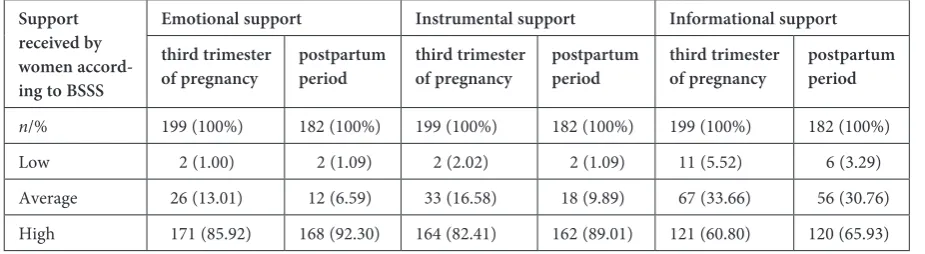
The lowest value of the variable ‘emotional sup-port received’ in the sample in the third trimester of pregnancy was 0.33, the highest-1.00, the mean was 0.88. In the postnatal period the lowest value was 0.19, and the highest 1.00, the mean of 0.91 (Table 4). Dur-ing pregnancy, the highest results ranged in the group of ‘high level of support’, which consisted of 85% of the observations and in the postpartum period 92% of the results. This means that women in our sample were surrounded by care, protection, empathy expe-rienced from their partners/husbands (Table 4, 5).
Table 3. Comparison of satisfaction with life during pregnancy and postpartum
The women’s life satisfaction in SWLS scale Third timester of pregnancy Postpartum period Difference
n 181 181 181
Min 10 9 –12.00
Max 35 35 15.00
Median 25.00 26.00 1.00
Mean 24.51 25.76 1.24
SD 5.11 4.72 3.66
Student‘s t-test (tkr = 1.97) t 4.55
p < 0.0001
Table 4. The average and standard deviation of the variable support received in sample women
Support received by women accord-ing to BSSS
Emotional Support Instrumental support Informational support
third trimester
of pregnancy postpartum period third trimester of pregnancy postpartum period third trimester of pregnancy postpartum period
n 199 182 199 182 199 182
min 0.33 0.19 0.22 0.11 0.00 0.00
max 1.00 1.00 1.00 1.00 1.00 1.00
median 0.96 0.96 1.00 1.00 0.83 0.83
mean 0.88 0.91 0.89 0.92 0.79 0.83
SD 0.15 0.14 0.16 0.14 0.21 0.21
Table 5. Distribution of the support received by women according to BSSS
Support received by women accord-ing to BSSS
Emotional support Instrumental support Informational support
third trimester
of pregnancy postpartum period third trimester of pregnancy postpartum period third trimester of pregnancy postpartum period
n/% 199 (100%) 182 (100%) 199 (100%) 182 (100%) 199 (100%) 182 (100%)
The lowest value of the variable ‘instrumen-tal support received’ in the sample in the third tri-mester of pregnancy was 0.22, the highest-1.00, the mean was 0.89. In the postnatal period the lowest value of instrumental support was 0.11, the high-est-1.00, while the average was 0.92 (Table 4). In pregnancy, the highest results ranged in the group of high level of support, which consisted of 82% of the observations and the postpartum period – 89% of the results. This means that the surveyed wom-en were provided with support from partners/hus-bands with daily tasks and responsibilities.
The lowest value of the variable information support received in the sample in the third trimes-ter of pregnancy was 0.00, the highest 1.00, the mean was 0.79. In the postnatal period, the low-est value of information support was 0.00, and the highest-1.00, the mean was 0.83 (Table 4). In preg-nancy, the highest results ranged in the group of high level of support, which consisted 60% of the observations and in the postpartum period – 65% of the observations. This means that in our sample partners provided women with information on the solution in a particular situation.
The mean of variable ‘the social support ceived’ indicate that the women in the study re-ceived high levels of social support in each study period. This means that women in the perinatal period were not left without help, but they could count on the support from close partner/husband.
When studying the support received during the perinatal period, it is important to determine the changes that occurred from the first assessment to another. In order to determine the changes which have occurred in different types of support, the Stu-dent’s t-test was used for dependent samples. The difference (change) between the values associated with the support of the studied parameters in the third trimester of pregnancy and the postpartum period was calculated for each woman. A positive
difference indicated an increase in that parameter in the postpartum period, while the negative testi-fied to its decline. Then, the mean of the differenc-es was calculated for the entire sample.
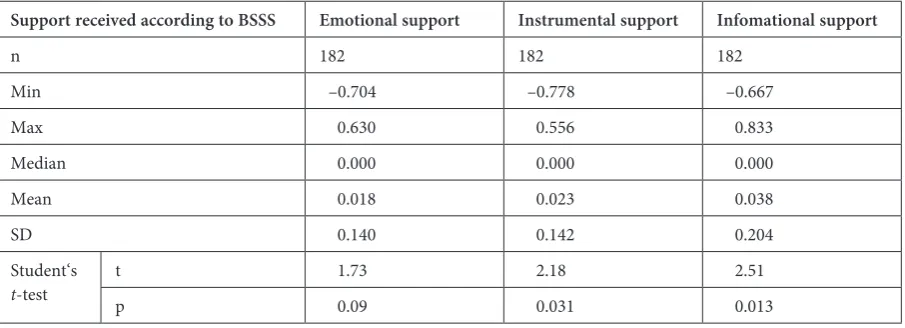
The following table lists the basic statistical pa-rameters referring to the change trends over time studied. As a result of statistical calculations, it has been found that the average variations in the pa-rameters were positive, while in the case of instru-mental and informational support (in bold), the mean changes (the rises) were found to be signif-icant, which was significantly different from zero (Student’s t-test for dependent samples, tkr = 1.97)
(Table 6).
In the postpartum, period the use of the Stu-dent’s t-test for related pairs (dependent samples) showed that the received emotional, instrumental and information support increased for women. Sig-nificant changes were observed in the instrumental (p = 0.031) and information support (p = 0.013).
In the postpartum period, the increase of the value in different types of social support was prob-ably related to the support, care and understanding experienced by women, and greater involvement of partners in the care of a woman and a child.
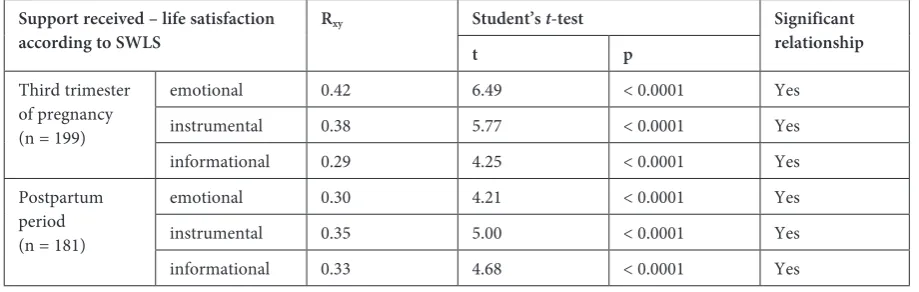
The presented study attempted to determine which of the three types of social support re-ceived is the most associated with life satisfaction of women during pregnancy and postpartum. For this purpose, the Pearson correlation coefficients were calculated and verified, which evaluates the strength of the relationship of individual types of social support with life satisfaction. Table 7 shows the calculated Pearson product – moment correla-tion coefficients assessing the relacorrela-tionship between life satisfaction and various types of social support received in each stage of the research. We also give the results of the verification of the hypothesis about the significance of the correlation obtained with the help of Student’s t-test (Table 7).
Table 6. Comparison of mean value changes in the social support received by women in the third trimester of pregnancy and the postpartum period
Support received according to BSSS Emotional support Instrumental support Infomational support
n 182 182 182
Min –0.704 –0.778 –0.667
Max 0.630 0.556 0.833
Median 0.000 0.000 0.000
Mean 0.018 0.023 0.038
SD 0.140 0.142 0.204
Student‘s
All the relationships in the third trimester of pregnancy and the postpartum period between the social support and the women’s life satisfaction by the SWLS are important. In the third trimester of pregnancy, the greatest strength of the relationship between support received and life satisfaction were found in emotional support, and postnatally – in-strumental support (Table 7).
Discussion
The study provided an opportunity to draw attention to the life satisfaction of women while awaiting the birth of a child and immediately after-wards, and the importance of social support dur-ing this period. It is a primary responsibility of the woman already in the prenatal period to ensure the best conditions for the fetal development and after giving birth to look after children. However, not all women are able to meet their assigned duties. In the postpartum period, wounds heal, there are compli-cations associated with complicated deliveries; there are often problems with breastfeeding, women are sleepy, tired, have significant deficits in self-care, feel pain and, therefore, it is difficult for them to care for their own children [4]. Due to these chang-es in the women’s livchang-es, significant deficits in self-care and initial difficulties with child self-care [5], the satisfaction with life may be reduced in the postpar-tum period. Therefore, in postnatal period, the so-cial support received seems to be necessary for the normal functioning of women after childbirth.
According to the researchers, the level of sat-isfaction with life can change, and the respondents assessing the life satisfaction often use informa-tion which is relevant at the time. [6] In this study, women could have based their assessment of life satisfaction during pregnancy and after delivery on the recent positive outcome (birth of a child), al-though this is not indicated in the study. The da-ta showed that the respondents have achieved im-pressive high level of satisfaction with life during
pregnancy – 24.51 (7 in scale of sten) and dur-ing postpartum period – 25.76 (7 in scale of sten), where the maximum achievable value was 35. Thus, the results for this group are impressive. Notewor-thy is the fact that in the postpartum period there was a significant increase in life satisfaction of the women (Table 1). 60% of the respondents achieved such a level in the first assessment and over 70% in the second. According to Czapiński, about 80% of the Polish population is evaluated as being high-ly satisfied with their lives [7]. Many factors un-doubtedly influenced such a high level of life satis-faction by the women. Having a baby born at term of normal weight and in good health are the most important for women. In this study, 91% of chil-dren were born in good condition and 84% with body weight above 2500 grams. On average, birth took place in the 38th week of pregnancy, and the vast majority of women reported feeling good after birth. The lower level of life satisfaction in the sam-ple was represented by pregnant women in high-risk pregnancy (mean 21.34 – 7 in scale of sten) [2] and by the nurses (20.08) [8], as well as by students of the University of the Third Age (20.86) [9].
According to the researchers, having children has a rather small effect on life satisfaction and marital happiness. According to many research-ers, generally the impact is negative [10], the best is to have two or three children, and the effect is as-sociated with the stages of the life cycle of the fam-ily. The honeymoon period and when the children are grown up are the best; the periods when chil-dren are under five years of age and teenagers are the worst in terms of the life satisfaction. However, children are the source of enjoyment, but also the source of stress for their own parents [6, 7, 11].
In studies of Angeles, the increase in life satis-faction occurs immediately after the birth and up to 6 months of age, following a steady decline until the third year of the child’s live. It should be noted that the decrease in life satisfaction was commonly associated with single motherhood. However, peo-ple in relationship showed a positive experience of
Table 7. Life satisfaction and social support correlation coefficients in the perinatal period
Support received – life satisfaction
according to SWLS Rxy Student’s t t-test p Significant relationship
Third trimester of pregnancy (n = 199)
emotional 0.42 6.49 < 0.0001 Yes
instrumental 0.38 5.77 < 0.0001 Yes
informational 0.29 4.25 < 0.0001 Yes
Postpartum period (n = 181)
emotional 0.30 4.21 < 0.0001 Yes
instrumental 0.35 5.00 < 0.0001 Yes
having children [12]. According to Preis (2010), having more children than desired may be asso-ciated with the decreased quality of the marriage. These results were obtained by studying the preg-nant women with single and multiple pregnancies. Lower satisfaction often was indicated by wom-en with multiple pregnancies [13]. Childbirth un-doubtedly changes the women’s lives, but not al-ways necessarily lowers life satisfaction. However, there are many studies which show that with the passage of time from the birth of the child, life sat-isfaction decreases [14–20].
In these studies, social support received by women was significantly related to their life satis-faction, both during pregnancy and in the postpar-tum period (Table 7). This data is consistent with the results of Dyrdal, Young and Xie [20–22]. Our results indicate that during pregnancy the most important factor for life satisfaction was emotion-al support, which undoubtedly has got great im-portance due to the well-being of women, con-cerns about childbirth and child. However, in the postnatal period, the most important type of sup-port for women’s satisfaction with life proved to be instrumental support, which probably was related to practical help and partner’s commitment to the care of the child and the mother. Our findings are consistent with results obtained by other research-ers [21–27]. However, it appears that women do not always receive social support, which is impor-tant due to fatigue after childbirth, postoperative wound pain after a caesarean section, and pain due to the injury to the perineum. Worrying and contradictory results to the analysed above were obtained by the other researchers [28, 29]. The American women particularly of Spanish origins pointed numerous problems in obtaining emo-tional and instrumental support during the post-partum period. The lack of instrumental support was the main cause of postpartum depression. Ac-cording to the researchers, the received instrumen-tal support influenced the women’s physical and emotional well-being [28].
According to Argyle, the main sources of well-being are social relationships and social support, which positively influence the mental and physi-cal health [19, 7]. In this study, women received a high level of social support during pregnancy and postpartum period. Noteworthy is the fact that the women’s assessment of instrumental and informa-tional support significantly increased in the post-partum period compared to the third trimester of pregnancy (Table 4). The high level of support received by women is related to the strong com-mitment of partners and current transformations of the role of the father in Poland. Until recent-ly, men rarely participated in childbirth because
there was no such possibility. Since the mid-90s of the last century, there has been a significant in-crease in the father’s participation during child-birth. Men are involved in caring activities during labour, participate in antenatal education and help with childcare after birth. Nowadays, many fathers are involved in the care of the child, which helps to establish bonds and good relations with a part-ner. However, it should be noted that these re-sults do not apply to the whole population of Pol-ish women, because most of the surveyed women had a university degree 50.75%, 82.91% of wom-en were in good financial situation, and these can-not be found in the whole of Polish society. The high economic status of the surveyed women al-so demonstrated the preparation and maturity to parenthood of the participants. Similar values of social support received have also been found in women studied by other researchers [26, 30–32]. After childbirth, from women’s point of view, the increase in the level of support received was impor-tant for them due to the exceptional circumstanc-es in which they have received the support. This is confirmed by the increase in the level of satis-faction with life in the postpartum period. During their stay in the postnatal ward, the partners’ help was needed because in this time women could re-lax, take a bath, sleep. Therefore, it can be conclud-ed that the support which the respondent receivconclud-ed from their partners, particularly the instrumental support, has a positive impact on women’s expe-rience of motherhood. Results of these studies on the men’s role are contrary to reports in the litera-ture, in which there is a tendency to diminish the man’s role and blame him for the main cause of depression in the postpartum period. These results are contrary to the results of study by Gjerdingen and Negron. Satisfaction with partner’s care and concern significantly decreased in the postpar-tum period [33, 28]. Inadequate support in early pregnancy was received by 5% of Swedish wom-en, most of them were multiparous [34] Similar re-sults were obtained by Waldenström’s study [35]. Interesting research results were presented by Riv-ieres-Pigeon. Women after the birth of their sec-ond child received little support from the partners. The author suggests that inadequate support may have been received by women after the third and subsequent birth. But despite of the lack of sup-port, we found that multiparous women had lower levels of depression than primiparae [36].
and the postpartum period. The received social support experienced by women helps to adapt and fulfill the social role and determines the wom-en’s life satisfaction in the perinatal period.
The knowledge of the type of social support re-ceived from partners, which determines the wom-en’s life satisfaction during pregnancy and in the postpartum period should be widespread.
Acknowledgements. Many thanks to all the women involved in each stage of the study. It is worth mentioning that despite their many duties, pain and tiredness, many respondents agreed to participate in the second stage of the study, so we could continue the research in the postnatal period.
References
Sęk H, Cieślak R:
[1] Wsparcie społeczne – sposoby definiowania, rodzaje i źródła wsparcia, wybrane koncepcje teo-retyczne, In: Wsparcie społeczne, stres i zdrowie. Eds.: Sęk H, Cieślak R. Wydawnictwo Naukowe PWN, Warszawa 2006, 11–28.
Juczyński Z:
[2] Narzędzia pomiaru w promocji i psychologii zdrowia, Pracownia Testów Psychologicznych Polskiego Towarzystwa Psychologicznego. Warszawa 2001, 134–139.
Łuszczyńska A, Kowalska M, Mazurkiewicz M, Schwarzer R:
[3] Berlińskie Skale Wsparcia Społecznego (BSSS): Wyniki wstępnych badań nad adaptacją skal i ich własnościami psychometrycznymi. Stud Psychol 2006, 44, 3, 17–27.
Gebuza G, Kaźmierczak M, Gierszewska M, Michalska E:
[4] Problemy kobiet w połogu i ich przyczyny. Perinatol Neonatol Ginekol 2010, 3, 290–295.
Bartosz B:
[5] Doświadczanie macierzyństwa. Analiza narracji autobiograficznych. Wydawnictwo Uniwersytetu Wrocławskiego, Wrocław 2002, 10–50.
Diener E, Lucas RE, Oshi S:
[6] Dobrostan psychiczny. Nauka o szczęściu i zadowoleniu z życia. In: Psychologia pozytywna. Ed.: Czapiński J., PWN, Warszawa 2004, 35–51.
Czapiński J, Panek T:
[7] Diagnoza społeczna 2011. Warunki i jakość życia Polaków. Rada Monitoringu Społecznego, Warszawa 2011, 160–264.
Wysokiński M, Fidecki W, Walas L, Ślusarz R:
[8] Satysfakcja z życia polskich pielęgniarek. Probl Pielęg 2009, 17, 167–172.
Piotrowski A:
[9] Radzenie sobie ze stresem a poczucie własnej skuteczności i satysfakcja z życia u słuchaczy Uniwersytetu Trzeciego Wieku. In: Ekofizjologiczne uwarunkowania zdrowia człowieka. Eds.: Kurhalyuk N, Kamiński P. Słupski Uniwersytet Trzeciego Wieku. Słupsk 2010, 77–83.
Argyle M:
[10] Przyczyny i korelaty szczęścia, In: Psychologia pozytywna. Ed.: Czapiński J., PWN, Warszawa 2004, 165– 204.
Kotowska IE, Matysiak A, Styrc M, Pailhé A, Solaz A, Vignoli D:
[11] Drugie europejskie badanie jakości życia: Życie rodzinne i praca. Eurofound. Luksemburg: Urząd Publikacji Unii Europejskiej 2010. Available from: http://www. eurofound.europa.eu/pubdocs/2010/02/pl/1/EF1002PL.
Angeles L:
[12] Children and life satisfaction. J Happiness Stud 2007, 11, 523–538.
Preis J, Bieleninik Ł, Bidzan M:
[13] Jakość związku małżeńskiego matek z ciążą wielopłodową i jednopłodową. Perinatol Neonatol Ginekol 2010, 3, 140–144.
Elek SM, Hudson DB, Buffard C:
[14] Marital and parenting satisfaction and infant care self-efficacy during the transi-tion to parenthood: the effect of infant sex. Issues Compr Pediatr Nurs 2003, 26, 45–57.
Twenge JM, Campbell WK, Foster CA:
[15] Parenthood and Marital Satisfaction: A Meta – Analytic Review. J Marriage Fam 2003, 65, 574–583.
Meijer AM, van den Wittenboer GL:
[16] Contribution of infants’ sleep and crying to marital relationship of first-time parent couples in the 1st year after childbirth. J Fam Psychol 2007, 21, 49–57.
Lawrence E, Nylen K, Cobb RJ:
[17] Prenatal expectations and marital satisfaction over the transition to parenthood. J Fam Psychol 2007, 21, 155–164.
Lawrence E, Cobb EJ, Rothman AD, Rothman MT, Bradbury T:
[18] Marital Satisfaction Across the Transition to Parenthood. J Fam Psychol 2008, 22, 41–50.
Doss BD, Roades GK, Stanley SM, Markman HJ:
[19] The effect of transition to parenthood on relationship quality: An 8-year prospective study. J Pers Soc Psychol 2009, 96, 601–619.
Dyrdal GM, Roysamb E, Bang Nes R, Vitterso J:
[20] Can a Happy Relationship Predict a Happy Life? A Population – Based study of Maternal Well-Being During the Life Transition of Pregnancy, Infancy, and Toddlerhood. J Happiness Stud 2010, 12, 947–962.
Young KW:
[21] Social Support and Life Satisfaction: Int J Psychosoc Rehabil 2006, 10, 155–164.
Xie R, On G, Koszycki D, Walker M, Wen S:
[22] Prenatal Social Support, Postnatal Social Support, and Postpartum Depression. Ann Epidemiol 2009, 19, 637–643.
Hung CH, Chung HH:
[23] The effects of postpartum stress and social support on postpartum women’s health status. J Adv Nurs 2001, 36, 676–684.
Hung CH:
[24] Women’s postpartum stress, social support, and health status. West J Nurs Res 2005, 27, 148–165.
Chen CM, Kuo SF, Chou YH, Chen HC:
[25] Postpartum Taiwanese women: their postpartum depression, social sup-port and health-promoting lifestyle profiles. J Clin Nurs 2007, 16, 1550–1560.
Leahy-Warren P, McCarthy G, Corcoran P:
Relationships Between Functional and Structural Social Support at 6 and 12 Weeks Postpartum. Arch Psychiatr Nurs 2011, 25, 174–184.
Tanner-Stapleton LR, Dunkel-Schetter Ch, Westling E, Rini Ch, Glynn LM, Hobel CJ, Sandman CA:
[27] Perceived
Partner Support in Pregnancy Predicts Lower Maternal and Infant Distress. J Fam Psychol 2012, 26, 453–463.
Negron R, Martin A, Almong M, Balbierz A, Hoell EA:
[28] Social Support During the Postpartum Period: Mothers’ Views on Needs, Expectations, and Mobilization of Support. Matern Child Health J 2012, Springer Science + Business Media, LLC.
Senturk V, Abas M, Berksum O, Stewart R:
[29] Social support and antenatal depression in extended and nucle-ar family environments in Turkey: a cross-sectional survey, BMC Psychiatry, 2011, http://www.biomedcentral. com/1471–244X/11/48.
Sygulla K, Smędowski A, Szatan A, Michalak A:
[30] Potrzeby i oczekiwania kobiet ciężarnych dotyczące opieki oko-łoporodowej – czy trudno je spełnić? Prob Med Rodz 2009, VOL. XI: 4.
Milgrom J, Gemmill AW, Bilszta JL, Hayes B, Barnett B, Books J, Ericksen J, Ellwood D, Buist A:
[31] Antenatal risk
factors for postnatal depression: a large prospective study. J Affect Disord 2008, 108, 147–157.
Sheng X, Le H, Perry D:
[32] Perceived satisfaction with social support and depressive symptoms in perinatal Latinas. J Transcul Nurs 2010, 21, 35–44.
Gjerdingen DK, Center BA:
[33] The relationship of postpartum partner satisfaction to parents’ work, health, and social characteristics. Women Health 2004, 40, 25–39.
Hildingsson I, Tinqvall M, Rubertsson C:
[34] Partner support in the childbearing period- a follow up study. Women Birth 2008, 21, 141–148.
Waldenström U, Hildingsson I, Robertsson C, Rådestad I:
[35] A negative birth experience: prevalence and risk fac-tors in a national sample. Birth 2004, 31, 17–27.
Rivieres – Pigeon C, Seguin L, Goilet L, Descarries F:
[36] Unravelling the complexities of the relationship between employment status and postpartum depressive symptomatology. Women Health 2001, 34, 61–79.
Address for correspondence:
Grażyna Gebuza Niesiołowskiego 2B/30 87-100 Toruń
Poland
Tel: +48 79 60 61 139
E-mail: [email protected]
Conflict of interest: None declared