• No results found

Download Download PDF

N/A
N/A
Protected

Academic year: 2020

Share "Download Download PDF"

Copied!
8
0
0

Loading.... (view fulltext now)

Full text

(1)

The Journal of Threatened Taxa is dedicated to building evidence for conservation globally by publishing peer-reviewed articles online every month at a reasonably rapid rate at www.threatenedtaxa.org. All articles published in JoTT are registered under Creative Commons Attribution 4.0 International License unless otherwise mentioned. JoTT allows unrestricted use of articles in any medium, reproduction, and distribution by providing adequate credit to the authors and the source of publication.

OPEN ACCESS

www.threatenedtaxa.org

ISSN 0974-7907 (Online) | ISSN 0974-7893 (Print) Building evidence for conservation globally

Journal of Threatened Taxa

For Focus, Scope, Aims, Policies and Guidelines visit http://threatenedtaxa.org/index.php/JoTT/about/editorialPolicies#custom-0 For Article Submission Guidelines visit http://threatenedtaxa.org/index.php/JoTT/about/submissions#onlineSubmissions For Policies against Scientific Misconduct visit http://threatenedtaxa.org/index.php/JoTT/about/editorialPolicies#custom-2

For reprints contact <[email protected]>

Short Communication

A winter roost count of the Short-eared Owl

Asio flammeus (Aves: Strigiformes: Strigidae)

at Porbandar, Gujarat, India

Dhavalkumar Varagiya & Anita Chakraborty

26 October 2018 | Vol. 10 | No. 11 | Pages: 12566-12570 10.11609/jott.3617.10.11.12566-12570

Threatened Taxa

Member

Partners

(2)

Shor

t C

ommunica

tion

DOI: https://doi.org/10.11609/jott.3617.10.11.12566-12570

Editor: Reuven Yosef, Ben Gurion University of the Negev, Eilat, Israel. Date of publication: 26 October 2018 (online & print)

Manuscript details: Ms # 3617 | Received 30 June 2017 | Final received 12 September 2018 | Finally accepted 02 October 2018

Citation: Varagiya, D. & A. Chakraborty (2018). A winter roost count of the Short-eared Owl Asio flammeus (Aves: Strigiformes: Strigidae) at Porbandar, Gujarat, India. Journal of Threatened Taxa 10(11): 12566–12570; https://doi.org/10.11609/jott.3617.10.11.12566-12570

Copyright: © Varagiya & Chakraborty 2018. Creative Commons Attribution 4.0 International License. JoTT allows unrestricted use of this article in any medium, reproduction and distribution by providing adequate credit to the authors and the source of publication.

Funding: Field work was self funded by Dhavalkumar Varagiya.

Competing interests:The authors declare no competing interests.

Acknowledgements: We are thankful to Kishore Joshi, Bhaskar Thankey, Vijay Jethva, Nayan Thanki, Vikrant Rana, Punit Karia, Zeel Badiyani, Konark Karia for joining us during surveys voluntarily.

A winter roost count of the Short-eared Owl Asio flammeus

(Aves: Strigiformes: Strigidae) at Porbandar, Gujarat, India

Dhavalkumar Varagiya 1 & Anita Chakraborty 2

1 School of Pharmacy, RK University, Rajkot-Bhavnagar Highway, Kasturbadham, Rajkot, Gujarat 360020, India 2 Department of Botany, SSLNT Mahila Mahavidlaya, Luby Circular Road, Dhanbad, Jharkhand 826001, India 1 [email protected] (corresponding author), 2 [email protected] ISSN 0974-7907 (Online)

ISSN 0974-7893 (Print)

OPEN ACCESS

The Short-eared Owl Asio flammeus is a widespread winter migrant to India (Blanford 1894). It prefers grassland and open country (Ali & Ripley 1987). In India, it is reported from Maharashtra (Jamdar & Shrivastava 1988; Chandrasekaran 1995), Madhya Pradesh (Pasha et al. 2004), Tamil Nadu (Thyagaraju 1933), Kerala (Jayson & Mathew 2002; Chandrasekhara & Nameer 2003), Gujarat (19 November 1993 specimen: The Field Abstract: The Short-eared Owl Asio flammeus is a common to uncommon winter visitor to Gujarat. The species roosted in bushes of Prosopis juliflora in the grassland of Shiroda area, Odadar Village of

Porbandar District. Communal roosts were identified by foot surveys between 9–17 November 2016. A total of 20 individuals co-existed with grazing cattle in the grassland of ca. 1km2. At present due to their restricted nesting habits and nomadic nature, the species is vulnerable to habitat loss at their feeding and roosting grounds. Conversion of open habitats to agriculture, grazing, recreation, housing and tourism development are the current threats to the species in the wetland complex. The IUCN conservation status further confirms that though they are assessed as Least Concern, in spite of the species population constantly declining with global population estimated at 3,000,000 individuals which equates to 2,000,000 mature individuals. The present study is the first systematic attempt to count a roost in Gujarat.

Keywords: Gujarat, IUCN, Porbandar, Short-eared Owl, wetland, wintering roost.

Museum), Rajasthan (5 January 1949 specimen: The Field Museum; Singh 1997), Karnataka (20 January 1941 specimen: The Field Museum), Uttar Pradesh (Grewal 2000), Andhra Pradesh (Kanniah & Ganesh 1993) and

other states.

The Short-eared Owl has an extremely large range, and therefore it does not approach the thresholds for Vulnerable under the range size criterion (extent of occurrence <20,000km2 combined with a declining or fluctuating range size, habitat extent/quality, or population size and a small number of locations or severe fragmentation) as well as under the population

trend criterion (>30% decline over 10 years or three

generations) and population size criterion (<10,000 mature individuals with a continuing decline estimated to be >10% in 10 years or three generations, or with a specified population structure) in IUCN conservation status evaluation. For these reasons the species is designated as Least Concern.

(3)

Journal of Threatened Taxa | www.threatenedtaxa.org | 26 October 2018 | 10(11): 12566–12570

Winter roost count of Short-eared Owl Varagiya & Chakraborty

12567 species in the wetland complex.

The Short-eared Owl is a common to uncommon winter visitor to Gujarat (Ganpule 2016). The species is usually present from September/October to March/ April in the Indian Subcontinent (Grimmett et al. 1998; Ali & Ripley 2001; Srinivasulu & Srinivasulu 2007).

The species usually nests and roosts on the ground and prefers grassland habitat. It is often seen flying low like harriers; its opportunistic diet consists mainly of small mammals and rarely small birds. It is an active hunter, flying low over the ground (less than 6 feet) in search of prey; usually hovers and drops vertically pouncing on prey. The species is considered to be a highly migratory in the northern limits of its global range. Banding data shows 1,000-mile movements in 50 days. These movements also vary and large movements are often related to juvenile dispersals. The longevity

record for a Short-eared Owl in the wild is 13 years (Rumet 2012).

Material and Methods

Observations and counts were recorded in November

2016 for nine days in the Shiroda region, located between

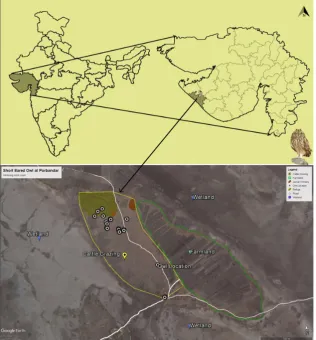
Odadar and Mokar villages of Porbandar District (Fig. 1). It is located about a distance of 5km from Porbandar Somnath National Highway and connected by a tar road with Odadar and Mokar villages. The study area is Gosabara Mokarsagar Wetland Complex (here after Mokarsagar) which was declared an Important Bird and Biodiversity Area by the Bombay Natural History Society and Birdlife International in March 2017 (Rahmani et al. 2016).

Mokarsagar (21.5650N & 69.7640E) is the largest wetland of Porbandar District and spread across 106km2. The wetland complex supports more than

20,000 waterbirds annually and thus is shortlisted as a

potential Ramsar site as well as Biodiversity Heritage Site. Recently, a public interest litigation has been also

filed in Gujarat High Court to declare it as a wildlife

sanctuary.

The wetland complex is drained by the Bhadar

River, the longest river of the Saurashtra region along

with River Billeshwari (Minsar). Before the 1970s, the region was an intertidal mudflat due to the ingress of sea water through the mouth close to Gosabara (21.5350N

& 69.7100E) which mixed with fresh water during the

(4)

monsoon season. The culvert was created near Gosa Village and resident fishermen used fixed oja nets for

catching Prawns Penaeus penicillatus (Mansuri 1986). Gradually the tidal influx started impacting the soil and fresh water biota of the region. In order to prevent and control the impacting phenomenon Salinity Ingress Prevention Cell (SIPC), Gujarat, built structures across the creek such as tidal regulators (masonry wall) and bunds at different locations (Singh et al. 2014). These structures prevented the free flow of tidal ingress. As a result prawn fishing was stopped but the quality of agricultural soil improved.

In Mokarsagar, there are four elevated inland islands

which usually do not get submerged during the peak monsoon (because the islands lie at about 4–6 m above sea level and the Mokarsagar is at sea level). Shiroda is one amongst these four islands mainly used by the

Odadar villagers for grazing livestock.

The wetland complex has been monitored since 2012 for water as well as terrestrial bird count, the frequency is once every month of the year. On 9 November 2016,

during the survey in Shiroda, one Short-eared Owl was

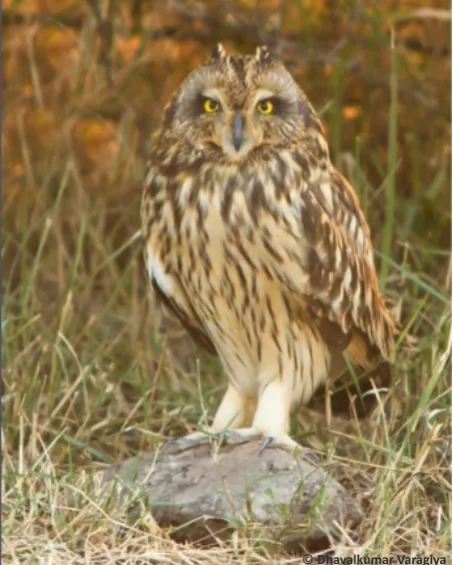
observed and photographed in the bushes close to the road (Image 1). The bird was not disturbed and count and observation plan was structured to survey the region for the total wintering population of the species.

It was assumed that the Short-eared Owl will be present on all of the four islands of Mokarsagar. Starting from Shiroda, all islands were surveyed for presence of Short-eared Owls. The region was diligently surveyed on foot (after Fuller & Mosher 1987). Randomly, 500m long transect lines (total nine) were conducted in the study area. Walking the transects and counting of roosting birds on both sides and locations were geo-tagged with Garmin eTrex® 30x Handheld GPS device. Apart from Shiroda, the Short-eared Owl was not found on

any of the other islands of Mokarsagar. Thus, the data presented is from Shiroda only.

Observation and Discussion

The species was found to roost in bushes of Prosopis juliflora on Shiroda island. Realizing the fact that the

species was spotted for the first time, an effort for identifying communal roosts was undertaken by going on foot surveys. A total 20 individuals (Table 1) were observed to co-exist with grazing cattle in the grasslands spread over an area of 1km2 between November 9–17, 2016 (Table 2; Fig. 2). The species prefers bushes to hide (Image 2) but, when unknowingly disturbed by cattle herders, it flies to refuge areas as shown in Fig. 1. The refuge area covers 0.14km2 with dense vegetation of

Proposis spp. along with grasses.

The species was observed to co-exist with mammals

like Golden Jackal Canis aureus, Bengal Fox Vulpes bengalensis, Jungle Cat Felis chaus, Nilgai Boselaphus tragocamelus, Wild Boar Sus scrofa, and domestic cattle Bos domesticus. The species was also observed to co-exist with 48 bird species (Table 2). No attempts were made to study its interactions with other species. Generally, it remains silent during wintering stage thus

no call was observed.

The current sighting of the Short-eared Owl in

Image 1. Short-eared Owl on Shiroda Island Table 1. Observationchart

Date Time (hrs) Comments

09.xi.2016 18:00

Area is mainly grassland with scattered

Prosopis juliflora; location was also very close to a ‘kacha’ road less frequently

used

10.x.2016 16:00–18:00 Bird was found at same place but remain stable and hidden.

11.xi.2016 18:15 Bird was spotted about 200m away from previous site from the road

13.xi.2016 16:00–18:00 Observed two pairs (4 individuals) from the road

14.xi.2016 16:00–18:00 Observed 12 individuals by foot survey

16.xi.2016 16:00–18:00 Observed 14 individuals by foot survey 17.xi.2016 16:00–19:00 Observed 20 individuals by foot survey

(5)

Journal of Threatened Taxa | www.threatenedtaxa.org | 26 October 2018 | 10(11): 12566–12570

Winter roost count of Short-eared Owl Varagiya & Chakraborty

12569 Table 2. Bird Species observed to coexist with Short-eared Owl

Bird Species Status in Gujarat (Ganpule 2016)

1 Common Quail coturnix Coturnix Common winter visitor

2 Grey Francolin pondicerianusFrancolinus Common resident

3 Cattle Egret Bubulcus ibis Common resident

4 Short-toed Snake-Eagle Circaetus gallicus Common to uncommon resident

5 Eurasian Marsh-Harrier aeruginosus Circus Common winter visitor 6 Pallid Harrier Circus macrourus Common to uncommon winter visitor 7 Montagu's Harrier pygargus Circus Common winter visitor

8 Shikra Accipiter badius Common resident

9 Indian Thick-knee indicus Burhinus Common resident 10 Yellow-wattled Lapwing Vanellus malabaricus Common resident 11 Red-wattled Lapwing indicus Vanellus Very Common resident 12 Kentish Plover alexandrinus Charadrius Common resident and local winter migrant 13 Barred Buttonquail suscitator Turnix Resident and fairly common resident

14 Chestnut-bellied Sandgrouse Pterocles exustus Common resident

15 Rock Pigeon Columba livia Very common resident

16 Eurasian Collared-Dove Streptopelia decaocto Common resident

17 Greater Coucal sinensis Centropus Common resident

18 Sykes's Nightjar mahrattensis Caprimulgus Uncommon winter visitor

19 Indian Nightjar asiaticus Caprimulgus Common resident

20 Green Bee-eater orientalis Merops Common resident

21 Eurasian Kestrel tinnunculus Falco Common winter visitor

22 Isabelline Shrike isabellinus Lanius Winter visitor

23 Bay-backed Shrike vittatus Lanius Common resident

Figure 2. Bird Species of different families observed to coexist with Short-eared Owl

Bird Species Status in Gujarat (Ganpule 2016)

24 Long-tailed Shrike schach Lanius Common resident

25 Southern Grey Shrike meridionalis Lanius Common resident

26 Black Drongo macrocercusDicrurus Very common resident

27 Rufous-tailed Lark Ammomanes phoenicura Very common resident 28 Ashy-crowned Sparrow-Lark Eremopterix griseus Very common resident

29 Indian Bushlark throptera Mirafraery Common resident

30 Greater Short-toed Lark Calandrella brachydactyla Common winter visitor 31 Sand Lark Alaudala raytal Common resident 32 Crested Lark Galerida cristata Common resident

33 Red-vented Bulbul cafer Pycnonotus Very common resident

34 Sykes's Warbler Iduna rama Common winter visitor

35 Common Tailorbird Orthotomus sutorius Common resident

36 Plain Prinia Prinia inornata Common resident

37 Lesser Whitethroat curruca Sylvia Common winter visitor 38 Common Babbler caudata Turdoides Very common resident 39 Large Grey Babbler malcolmi Turdoides Very common resident

40 Jungle Babbler striata Turdoides Common resident

41 Indian Robin fulicatus Copsychus Common resident

42 Oriental Magpie-Robin Copsychus saularis Common resident

43 Rosy Starling Pastor roseus Very common winter visitor

44 Purple Sunbird asiaticus Cinnyris Common resident

45 Paddyfield Pipit Anthus rufulus Common resident

46 Long-billed Pipit Anthus similis Common winter visitor

47 Tawny Pipit Anthus campestris Common winter visitor

(6)

Image 2. Short-eared Owl in the bushes of Prosopis

juliflora

Porbandar is the first published record for the district as it was not mentioned in previous checklists (Meena & Kumar 2014). Foot surveys were repeated for three days on the same transects and a maximum number of the owls were observed on the third day (i.e., 17 November 2016). Prey base and feeding ecology were not studied, however, we speculate that there is abundant prey at Shiroda Island & its adjacent farmlands, and the dense vegetation of Prosopis juliflora along with grass provide spaces roosting and sheltering. The present study is the first systematic attempt to count Short-eared Owls in Gujarat and reports the highest wintering roost congregation of the species.

Based on our limited study and data, we recommend that the management measures should maintain large contiguous tracts of wetland, and grassland habitat for the species and their prey. Controlled human disturbance and predation as well as possible, public education, and continued field research is required.

References

Ali, S. & S.D. Ripley (1987). Compact Handbook of the Birds of India and Pakistan together with those of Bangladesh, Nepal, Bhutan and Sri Lanka. IInd Edition. Oxford University Press, Delhi, 562pp.

Ali, S. & S.D. Ripley (2001). Handbook of Birds of India and Pakistan - Vol. 3 Stone Curlews to Owl. 2nd Edition. Bombay Natural History Society and Oxford University Press, Mumbai, 367pp.

Blanford, W.T. (1894). Notes on the Indian Owls. Ibis 6(24): 524–531.

Chandrasekaran, S. (1995). A survey of migratory birds at Dativara. Black-buck 11(2): 41–52.

Chandrasekhara, S. & P.O. Nameer (2003). Short-eared Owl (Asio

flammeus) in Kerala, India. Zoos’ Print Journal 18(10): 1235;https:// doi.org/10.11609/JoTT.ZPJ.18.10.1235

Fuller, M.R. & J.A. Mosher (1987). Raptor Survey Techniques. US Fish

and Wildlife Service, 37–65pp.

Ganpule, P. (2016). The birds of Gujarat: Status and distribution. Flamingo 8(3–12): 2–40.

Grewal, B. (2000). Birds of the Indian Subcontinent. IIIrd Edition. Local Colour Limited, Hong Kong.

Grimmett, R., C. Inskipp & T. Inskipp (1998). Birds of Indian Sub-continent. Oxford University Press, New Delhi, 888pp.

Jamdar, N. & K. Shrivastava (1988). A note on possible migration route of Short-eared Owl (Asio flammeus) over sea. Journal of the Bombay Natural History Society 85(2): 423–424.

Jayson, E.A. & D.N. Mathew (2002). Structure and composition of two

bird communities in the southern Western Ghats. Journal of the Bombay Natural History Society 99(1): 8–25.

Kanniah, P. & T. Ganesh (1993). Some interesting owl species around Alwal. Mayura 10: 1–4.

Mansuri, A.P. (1986). Assessment of Prawn Fishery Resources of River

Ojat, Bhadar, Mindsar and Their Estuaries-Their impact on socio-economic condition of the fisher fishermen villages (Saurashtra) - A case study. Final Report. Saurashtra University, Rajkot, 247pp.

Meena, R.L. & S. Kumar (2014). Management Plan for Porbandar Bird Sanctuary. Gujarat Forest Department, Gujarat, India, 252pp.

Pasha, M.K.S., R. Jaypal, G. Areendran, Q. Qureshi & K. Sankar (2004). Birds of Pench Tiger Reserve, Madhya Pradesh, central India. Newsletter for Ornithologists 1(1&2): 2–9.

Rahmani, A.R., M.Z. Islam & R.M. Kasambe (2016). Important Bird and Biodiversity Areas in India: Gujarat. Important Bird and Biodiversity Areas in India: Priority Sites for Conservation (Revised and updated),

Bombay Natural History Society, Indian Bird Conservation Network, Royal Society for the Protection of Birds and BirdLife International (U.K.), 1992pp.

Rumet, R.B. (2012). Asio flammeus Short-eared Owl. http://eol.org/

pages/915736/details Downloaded on 15 November 2017.

Singh, B. (1997). Houbara Bustard and Short-eared Owl in eastern Rajasthan. Newsletters for Birdwatchers 37: 17.

Singh, V.V., A. Sharma & P.C. Joshi (2014). Seasonal Wetlands of Porbandar District, Gujarat. Acta Biologica Indica 3(2):636–641.

Srinivasulu, B. & C. Srinivasulu (2007). Diet of short-eared owl Asio

flammeus (Pontopiddan, 1763) wintering in Rollapadu wildlife

Sanctuary and its vicinity in Andhra Pradesh India. Zoo’s Print Journal

22(9): 2829–2831; https://doi.org/10.11609/JoTT.ZPJ.1550.2829-31 Thyagaraju, A.S. (1933). On the occurrence of the Short-eared Owl

(Asio flammeus flammeus) in Madras City. Journal of the Bombay Natural History Society 36 (3): 752–753.

Threatened Taxa

(7)
(8)

ISSN 0974-7907 (Online); ISSN 0974-7893 (Print)

October 2018 | Vol. 10 | No. 11 | Pages: 12443–12618 Date of Publication: 26 October 2018 (Online & Print)

DOI: 10.11609/jott.2018.10.11.12443-12618

www.threatenedtaxa.org

peer-reviewed articles online every month at a reasonably rapid rate at www.threatenedtaxa.org. All articles published in JoTT are registered under Creative Commons Attribution 4.0 International License

unless otherwise mentioned. JoTT allows unrestricted use of articles in any medium, reproduction, and distribution by providing adequate credit to the authors and the source of publication.

Article

The terrestrial life of sea kraits: insights from a long-term study on two Laticauda species (Reptilia: Squamata: Elapidae) in the Andaman Islands, India

-- Zoya Tyabji, Nitya Prakash Mohanty, Erina Young & Tasneem Khan, Pp. 12443– 12450

Communications

Fishing Cat Prionailurus viverrinus Bennett, 1833 (Carnivora: Felidae) distribution and habitat characteristics in Chitwan National Park, Nepal

-- Rama Mishra, Khadga Basnet, Rajan Amin & Babu Ram Lamichhane, Pp. 12451– 12458

Status distribution and feeding habit of Wild Boar Sus scrofa (Mammalia: Artiodactyla: Suidae) in Pench Tiger Reserve, Madhya Pradesh, India

-- Shaheer Khan & Orus Ilyas, Pp. 12459–12463

The composition and status of waterbirds of Perur Lake in Tamil Nadu, India

-- G. Parameswaran & R. Sivashankar, Pp. 12464–12488

The herpetofauna of Jigme Singye Wangchuck National Park in central Bhutan: status, distribution and new records

-- Sangay Tshewang & Letro Letro, Pp. 12489–12498

The Odonata (Insecta) of Dhofar, southern Oman

-- Elaine M. Cowan & Peter J. Cowan, Pp. 12499–12514

New kissing bug (Hemiptera: Reduviidae: Triatominae) records from Napo and Morona-Santiago provinces with distribution updates in Ecuador

-- Ana Soto-Vivas, Sandra Enríquez, Ernesto Villacrés, Jazzmin Arrivillaga, Martín Hinojosa & Jonathan Liria, Pp. 12515–12522

Orchid diversity in two community forests of Makawanpur District, central Nepal

-- Bijaya Pant, Mukti Ram Paudel, Mukesh Babu Chand, Shreeti Pradhan, Bijaya Bahadur Malla & Bhakta Bahadur Raskoti, Pp. 12523–12530

Habitat distribution modeling for reintroduction and conservation of Aristolochia indica L. - a threatened medicinal plant in Assam, India

-- Bhaskar Sarma, Prantik Sharma Baruah & Bhaben Tanti, Pp. 12531–12537

Pollination ecology of Synedrella nodiflora (L.) Gaertn. (Asteraceae)

-- B. Usharani & A.J. Solomon Raju, Pp. 12538–12551

Review

Status of studies on zooplankton fauna of Arunachal Pradesh, India

-- Bikramjit Sinha, Pp. 12552–12560

Short Communications

First record of the endangered Arabian Tahr Arabitragus jayakari (Thomas, 1894) in the Hatta Mountain Conservation Area, Dubai, United Arab Emirates

-- Jeruel Cabadonga Aguhob, Junid N. Shah, Esmat Elfaki Mohammed Elhassan, Aisha Almurr Al Muhery, Mohamed Mustafa Eltayeb Mohamed, Juma Abdulla Saeed Mohammad Al Omairi, Hamad Hashim Mohammed Khalaf Albedwawi,

Obaid Mohammed Salem Mohammed Al Bedwawi, Hassan Zain Alsharif & Afra Mahmood Mohammad Ali Haji, Pp. 12561–12565

A winter roost count of the Short-eared Owl Asio flammeus (Aves: Strigiformes: Strigidae) at Porbandar, Gujarat, India

-- Dhavalkumar Varagiya & Anita Chakraborty, Pp. 12566–12570

Crocodiles of river Krishna: impact on agriculture, economy, and the sociology of human population in Sangli, Maharashtra, India

-- Rajaram Hindurao Atigre, Pp. 12571–12576

A new report on the clasper movements of a captive Sand Tiger Shark Carcharias taurus (Lamniformes: Odontaspididae) and a possible reason for the behaviour

-- Helen Colbachini, Rafael Caprioli Gutierrez, Cristiane Schilbach Pizzutto & Otto Bismarck Fazzano Gadig, Pp. 12577–12581

New species of termite Pericapritermes travancorensis sp. nov. (Isoptera: Termitidae: Termitinae) from India

-- Jobin Mathew & Chinnu Ipe, Pp. 12582–12588

A checklist of vascular epiphytes of El Cometa Lagoon, Pantanos de Centla Biosphere Reserve, Mexico

-- Derio Antonio Jiménez-López, Candelario Peralta-Carreta, Jonathan V. Solórzano, Gerardo Luis Cervantes-Jiménez & Marco Antonio Domínguez-Vázquez,

Pp. 12589–12597

Notes

Two moth species of Lasiocampidae (Lepidoptera: Lasiocampoidea) recorded for the first time in Bhutan

Jatishwor Singh Irungbam & Meenakshi Jatishwor Irungbam, Pp. 12598–12601

New nymphalid butterfly records from Jammu & Kashmir, India

-- Shakha Sharma & Neeraj Sharma, Pp. 12602–12606

Argostemma khasianum C.B. Clarke (Rubiaceae): a new record of a genus and species of flowering plant for the state of Arunachal Pradesh (India) and its lectotypification

-- Umeshkumar L. Tiwari & V.K. Rawat, Pp. 12607–12609

Amorphophallus longiconnectivus and A. margaritifer: additional aroids from Maharashtra with notes on the floral variations

-- Avinash R. Gholave, Ravikiran S. Govekar, Vasanta I. Kahalkar, Milind M. Sardesai & Shrirang R. Yadav, Pp. 12610–12613

Cultivation of the Himalayan seasoning Allium in a remote village of Uttarakhand, India

-- Chandra Prakash Kuniyal & Bir Singh Negi, Pp. 12614–12617

Miscellaneous

National Biodiversity Authority

Member

Partners

Figure

Figure 1. Study area (Shiroda island of Mokarsagar) of Short-eared Owl covering
Table 1. Observation chart
Figure 2. Bird Species of different families observed to coexist with

References

Related documents

Download The Bannonbridge Musicians Raymond Fraser PDF Free pdf download Download The Monkey Wrench Gang Edward Abbey PDF Free pdf download Download A Princess in Berlin Arthur

Synonyms PDF Download · Basic English Grammar Book PDF Download for ... pdf spoken english practice super fast english speaking book pdf free download.. Normally, books on

• View / Download The Complete Journal - Volume 20, 2001 (PDF Format - 37.1MB) View / Download Individual Articles (PDF Format).. • Editors' Introduction: Entering the

Ottoman Centuries Download PDF, Free Download Ottoman Centuries Ebooks Lord Kinross, PDF Ottoman Centuries Popular Download, Ottoman Centuries Full Collection, PDF

Download True History of the Kelly Gang Peter Carey PDF Free pdf download Download The Portable Dorothy Parker Dorothy Parker PDF Free pdf download Download History of the

1626031312-71512 ✔ Download The Taming - Jude Deveraux PDF ✔ Free pdf download 1626031312-71512. download The Taming Jude

1626031299-16447 ✔ Download The Endurance: Shackleton's Legendary Antarctic Expedition - Caroline Alexander PDF ✔ Free pdf download 1626031299-16447. download The

Download The Persian Boy Mary Renault PDF Free pdf download Download Forbidden Colors Yukio Mishima PDF Free pdf download. Download The Chaneysville Incident David Bradley PDF Free