every month at a reasonably rapid rate at
www.threatenedtaxa.org
. All articles published in JoTT are registered under
Creative Commons
Attribution 4.0 International License
unless otherwise mentioned. JoTT allows unrestricted use of articles in any medium, reproduction, and
distribution by providing adequate credit to the authors and the source of publication.
www.threatenedtaxa.org
ISSN 0974-7907 (Online) | ISSN 0974-7893 (Print)
Building evidence for conservation globally
Journal of Threatened Taxa
For Focus, Scope, Aims, Policies and Guidelines visit http://threatenedtaxa.org/index.php/JoTT/about/editorialPolicies#custom-0
For Article Submission Guidelines visit http://threatenedtaxa.org/index.php/JoTT/about/submissions#onlineSubmissions
For Policies against Scientific Misconduct visit http://threatenedtaxa.org/index.php/JoTT/about/editorialPolicies#custom-2
For reprints contact <[email protected]>
Communication
An annotated checklist of the birds of
upper Chenab catchment, Jammu & Kashmir, India
Neeraj Sharma, Suresh Kumar Rana, Pankaj Raina, Raja Amir &
Muzaffar Ahmed Kichloo
26 June 2018 | Vol. 10 | No. 7 | Pages: 11869–11894
10.11609/jott.3464.10.7.11869-11894
Member
Partners
Communica
tion
DOI:http://doi.org/10.11609/jott.3464.10.7.11869-11894 | ZooBank: urn:lsid:zoobank.org:pub:3776FD33-C423-488D-927C-F206534F6D4E
Editor: Tim Inskipp, Bishop Auckland Co., Durham, UK. Date of publication: 26 June 2018 (online & print)
Manuscript details: Ms # 3464 | Received 25 April 2017 | Final received 10 May 2018 | Finally accepted 23 May 2018
Citation: Sharma, N., S.K. Rana, P. Raina, R. Amir & M.A. Kichloo (2018). An annotated checklist of the birds of upper Chenab catchment, Jammu & Kashmir, India. Journal of Threatened Taxa 10(7): 11869–11894; http://doi.org/10.11609/jott.3464.10.7.11869-11894
Copyright: © Sharma et al. 2018. Creative Commons Attribution 4.0 International License. JoTT allows unrestricted use of this article in any medium, reproduction and distribution by providing adequate credit to the authors and the source of publication.
Funding: The surveys were funded by Institute of Mountain Environment (IME) internal grant for mountain biodiversity studies and Rufford Small Grant (18107-1) received for occupancy studies in Kishtwar National Park. The surveys conducted by Suresh K. Rana and Raja Amir were self financed.
Competing interests: The authors declare no competing interests.
Author Details: Neeraj Sharma, Assistant Professor in Faculty of Life Sciences, Institute of Mountain Environment, University of Jammu (Bhaderwah Campus) works on mountain biodiversity with interest in alpine plants, birds and butterflies. He supports conservation outreach programmes in the mountainous region of the state. Suresh K. Rana is researcher at Wildlife Institute of India with a keen interest in biogeography and evolutionary biology of birds and plants. He has worked on elevational gradients of birds and plants across Himalaya. Pankaj Raina, Wildlife Warden, Chenab circle (now WLW Leh) is working on Trans-Himalayan biodiversity with interest in Snow Leopard ecology and breeding birds of Ladakh. Raja Amir, post graduate in Fisheries Science is an avid birder and equally good photographer from Kishtwar. Muzaffar A. Kichloo, Assistant Professor in Department of Higher Education, Govt. of Jammu & Kashmir is a passionate researcher and academician currently working on large mammals.
Author Contribution: All authors carried joint / individual field surveys in the respective watersheds of their residence. NS collected and compiled the data and wrote
the manuscript in consultation with SKR. SKR and MAK helped in the identification of species and literature consultation. SKR and RA made significant contributions by providing the checklists and good quality photographs from Paddar and Kishtwar, respectively. PR besides his technical inputs on species distribution provided necessary field logistics.
Acknowledgements: The authors gratefully acknowledge the financial support received from IME, University of Jammu and Rufford Small Grant programme for Kishtwar National Park (KNP). Department of Wildlife Protection, Govt. of Jammu and Kashmir is duly acknowledged and accredited for granting the necessary permits to conduct the field investigations in and around KNP. Sh. Majid Bashir, Wildlife Warden (Chenab Circle) is thanked for providing the field logistic support during surveys in Marusudhar watershed. Sh. Anup Soni, DFO Doda is thanked for contributing images from Doda. The help rendered by the research scholars of IME, Anu Sharma, Dinesh Singh, Sudesh Kumar especially Asha Sohil in compiling and updating this manuscript is highly appreciated. Authors are grateful to numerous people who accompanied, served and helped us in many ways during the field surveys. Authors are thankful to the subject editors and reviewers for their valuable suggestions and comments in making this manuscript worth.
An annotated checklist of the birds of upper
Chenab catchment, Jammu & Kashmir, India
Neeraj Sharma
1, Suresh Kumar Rana
2, Pankaj Raina
3, Raja Amir
4&
Muzaffar Ahmed Kichloo
51
Institute of Mountain Environment, University of Jammu, Bhaderwah, Jammu & Kashmir 182222, India
2Wildlife Institute of India, Chandrabani, Dehradun, Uttarakhand 248001, India
3
Wildlife Warden, Leh (Ladakh), Department of Wildlife Protection (J & K), Jammu & Kashmir 194101, India
4House number 97/9, Near Dak Bunglow, Kishtwar, Jammu & Kashmir 182204, India
5
Department of Environmental Sciences, Govt. Degree College, Thathri, Doda, Jammu & Kashmir 182203, India
1[email protected] (corresponding author),
2[email protected],
3[email protected],
4[email protected],
5[email protected]
ISSN 0974-7907 (Online) ISSN 0974-7893 (Print)
OPEN ACCESS
Abstract: Watershed avifaunal inventories are useful in devising management strategies appropriate to the habitat, as well as species
conservation. The Chenab River basin forms one of the largest and most important river basins in Jammu & Kashmir. The upper Chenab
catchment offers a rich and diverse fauna, especially birds, owing to variety of habitats, different climatic regimes, and a wide range
of altitude,. We present an avifaunal list of four watersheds—Bhot, Marusudar, Kalnai and Neeru of the Chenab River basin including
Kishtwar Town and the surrounding area of the upper Chenab catchment over an elevation range of 820–4,500 m. The list includes 251
species belonging to 60 families and 150 genera of which six are globally threatened, 127 residents, 124 migrants and three new to the
state. The paper also describes species-wise habitat occupancy, feeding behaviour, migratory status and abundance of the avifauna. The
study reveals that mosaic habitats comprising forests, riverbeds, rangelands and rocky outcrops are crucial for the conservation of birds
in the region.
Keywords: Avifauna, Chenab River, climatic regimes, conservation and management, distribution pattern, Himalaya, important bird
INTRODUCTION
Owing to its distinct climate and physiography, the
Himalayan state of Jammu & Kashmir comprises an
impressive avifaunal diversity unique to higher altitudes
(Rahmani et al. 2013) with 21 important bird areas
(IBAs) (Islam & Rahmani 2004) and seven potential IBAs
(Rahmani 2012) home to 12 globally threatened bird
species and six near threatened species (Rahmani et
al. 2013) mostly restricted to Kashmir and Ladakh. The
Jammu plains constitute a part of the Indo-Gangetic
plains from where rises the mass of the Pir-Panjal that
passes through Kashmir into the Murree Hills and ‘Galis’
(mountain passes) with a strip of territory narrowing to
its ultimate end. Kishtwar and Bhaderwah comprising
most of the upper Chenab catchment are certainly
positioned in the Oriental region (Price et al. 2003). It is
noteworthy that these mountainous landscapes though
contiguous to Kashmir and Ladakh in the west and north
are the least known and least studied in terms of avian
ecology.
Montane areas represent rugged landscapes that
are uplifted to an extent that affects local climate.
Birds inhabiting mountains show a large variety of
distributional patterns with some restricted to narrow
elevation bands and others occurring over relatively
broader elevations (Price et al. 2011). The changes
in environmental conditions such as temperature,
moisture and oxygen from the low valleys to mountain
summits lead to higher turnover and species diversity
to specific elevations in the mountains than other
habitats of equivalent areas (Graham et al. 2014). This
characteristic elevation stratification in the mountain
ecosystem makes the avian communities dynamic (Dixit
et al. 2016). No accurate definition of these zones has
yet been attempted for the Himalaya as a whole, but the
divi sion of the zones as proposed by Whistler (1929) of
the outer Himalaya more or less fits in the context of
the present study area, i.e.,
Foothill zone (150–1,200
m), Ban-Oak zone (1,200–2,450 m), Kharsu-Oak zone
(2,450–3,350 m), and Alpine zone (3,350m and above).
Baseline information is pre-requisite for conservation
endeavors for any ecosystem and to understand the
consequences of habitat destruction and deterioration
as well as the effects of climate change (Llanos et al.
2011). Bird surveys provide useful information for
basic and applied ecology and are useful for identifying
priority areas for conservation (Daniels et al. 1991;
Peterson et al. 2000). Due to the remote location and
inaccessibility (of the study area), only a few efforts
have been made to inventorize the biodiversity that
too mostly restricted to Kishtwar National Park (Kichloo
1992; Parsa 1999; Baba 2002; Naqash 2006). Wani &
Sahi (2005) conducted avifaunal surveys in Doda District
with recent contributions by Kichloo (2014), Sharma &
Kichloo (2016), Sharma (2017), Sharma & Sohil (2017),
and Sharma & Rana (2018).
The region, owing to the variety of habitats, different
climatic regimes and a wide range of altitude offers
favourable habitats to avifauna. The aim of this study
is to present a list of bird species in different hitherto
little or unexplored landscapes of the upper Chenab
catchment within the geographical limits of Jammu &
Kashmir. Three teams conducted extensive avifaunal
surveys in four major watersheds and along river Chenab
(including Kishtwar, Thathri and Pul Doda townships)
in an elevation range of 820–4,500 m during the years
2012–2017. This paper provides an insight into the
species composition, sight records with information on
location, preferred habitats, feeding, migratory status
and abundance.
MATERIALS AND METHODS
Study area
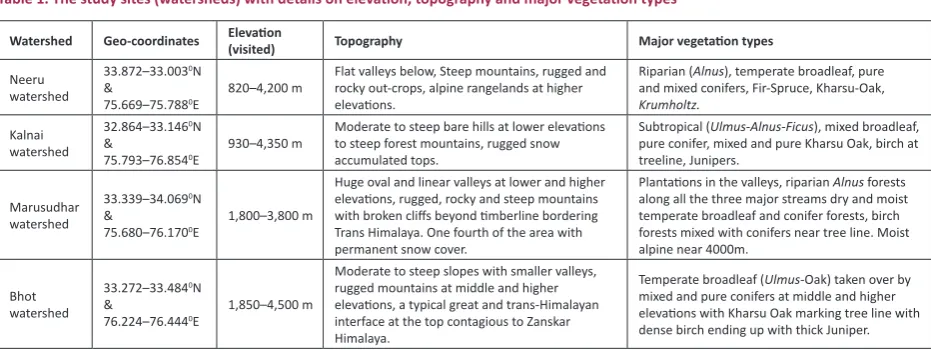
The complex physiography and topographic
complexity of the mountain ranges of the upper
Chenab catchment has resulted in extreme habitat and
microclimatic heterogeneity especially in the highlands.
Our study was focused on four topographically diverse
watersheds (Bhot, Marusudar, Kalnai and Neeru) of the
Chenab River system located in the far southeastern
fringe of the state contiguous with Himachal Pradesh
(Table 1, Fig. 1; see recent study on Chamba birds by
Shah et al. 2016). The study area is characterized by
variety of habitats and life zones, such as subtropical
dry scrub, temperate broadleaf and pure conifer forests,
tree line and alpine rangelands in an elevation range of
820–4,500 m. The mountains beyond 4,500m remain
inaccessible owing to rugged topography and extreme
environmental conditions. Major vegetation comprises
of subtropical dry scrub (850–1,100 m), temperate
broadleaf mixed forests including riparian habitats (1400
– 1950 m, Image 1), broadleaf-conifer mixed forests
(1,900–2,600 m), pure conifer forests (2300 – 3000 m,
Image 2), conifer-oak mixed forests (2,700–3,200 m,
Image 3), dense oak forests (2,900–3,400 m, Image 4),
moist alpine scrub and rangelands (3,200–4,300 m,
Image 5), and rocky outcrops with cushion and mat
formations (>4,300 m, Image 6).
short summers and long dry winters. The temperature
in the study area regularly drops as low as -25
0C in
winter and varies primarily by elevation with a lapse rate
of ~6
0C/km. Maximum humidity (80–85 %) is usually
recorded during August whereas minimum humidity
values are measured during November-December.
Precipitation ranges between 1,450mm at moderate
altitudes (<2,000m) and gradually declines to 800mm
above 2,500m. The whole study area is characterized
by four major seasons: short spring (February–March),
warm and dry summer (mid-April to mid-July), warm
and wet monsoon (mid-July to mid-September), and
relatively dry winter (mid-October to February).
Data collection
Organized field surveys were conducted along with
opportunistic bird sightings to obtain checklists of four
different watersheds during the years 2012 to 2017.
Belt transects and, in some cases, point counts and call
surveys (Gibbons & Gregory 2006) were used to record
the birds in different habitats and seasons. Transects of
variable lengths (100–1,000 m) and standard 50m width
were laid around the tracks mostly during the morning
and evenings covering all the seasons in the Neeru
watershed. The opportunistic observation method
was mostly used during the surveys and the birds
especially the riparian and aquatic were recorded based
on this. The birdcalls were confirmed using Grimmett
et al. (2013) e-book and Xeno-Canto bird call database
(Xeno-canto 2016). Field photographs were thoroughly
cross checked with the images available on the online
database; www.orientalbirdimages.org with subsequent
confirmation from Ali & Ripley (2001), Grimmett et al.
(2011), Rasmussen & Anderton (2012), and Grewal et al.
(2016).
The Birds of South Asia (Rasmussen & Anderton
2012) was referred for the binomial names. Based on
foraging observations six classes of feeding guilds, viz.,
insectivorous, granivorous, frugivorous, carnivorous,
omnivorous and nectarivorous were identified in the
study area while birds based on the frequency of sightings
were categorized as common, frequent, occasional
and rare following Khan (2002). We assigned habitat
types (aquatic, urban, open scrub, riparian, temperate
broadleaf & conifer forest, pure conifer forest, dense oak
forest, alpine scrub, alpine pasturelands, rocky outcrops,
cultivated lands, forest edges, garbage dumps, aerial,
open hill / cliff dwellers) to each species based on their
occurrence, sightings and behavioral activities observed
during the field surveys. The extent of distribution
including the nominations for range extensions and new
records for the state have been confirmed by consulting
the available literature (Grimmett et al. 2011; Rasmussen
& Anderton 2012), avian experts, birding groups / clubs
and authentic facebook groups.
RESULTS
The checklist of the upper Chenab catchment in
Jammu & Kashmir produced in this study includes a
total of 251 species contained in 60 families and 150
Image 1. Low lying temperate Riparian forest
Image 3. Conifer-Oak forest
Image 5. Moist sub-alpine scrub
Image 2. Pure conifer forest (Cedrus deodara)
Image 4. Dense (Kharsu) Oak forest
Image 6. Alpine rocky outcrops
© Neeraj Sharma © Neeraj Sharma
© Neeraj Sharma
© Neeraj Sharma © Neeraj Sharma
genera (Table 2). Most of the species are represented
in the families Muscicapidae (33 species in 19 genera),
Accipitridae (21/12), Fringlillidae (18/11), Corvidae
(12/7), Phylloscopidae (11/1), and Motacillidae (9/3)
(Fig. 2). Phylloscopidae is the only monotypic family
represented by 11 species under one genus. Raptors are
represented in good numbers with 30 species recorded
in three families, i.e., Accipitridae with 21 species
followed by Strigidae (5 species) and Falconidae (4
species). Out of 251 bird species, 189 (about 75%) were
recorded from Kishtwar followed by Neeru 170 (67%),
Bhot 133 (53%), Marusudar 117 (47%), and Kalnai 111
(44%) watersheds. Sixty-eight species (27%) were found
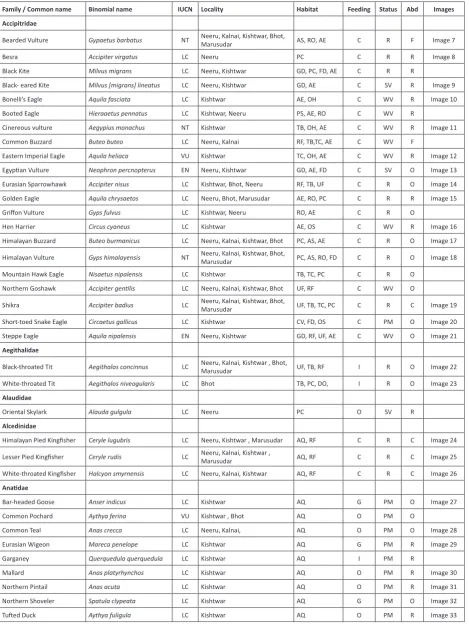
common in all the four watersheds (Table 2). Based
on our repeated surveys and opportunistic sightings,
83 species have been found rarely, 75 occasionally, 57
commonly, and 36 frequently (Table 2, Fig. 3).
We observed a great affinity of birds for specific
vegetation associations mostly for food and habitat
availability. Since most of the area under study is covered
by forests, the woodland habitats revealed the highest
species richness with 115 species found in temperate
broadleaf forest followed by 80 in urban forest, 67
(temperate broadleaf conifer forest), 65 (riparian forest),
59 (pure conifer forest) 58 (alpine scrub), 41 (forest edges
and ecotones), 22 (dense Oak forest), 14 (open scrub)
and 12 along the open hills. Forty-one birds were found
Figure 2. Dominant families of the study area
Figure 3. Visual abundance of birds
near the alpine rangelands and exposed rocky outcrops
above 3,500m, while 44 species were recorded from the
cultivable fields. Raptors were mostly observed in flight
all over and mostly near the garbage dumps.
Thirty-nine species were exclusively aquatic found around local
ponds, tributaries of river Chenab and high-altitude
lakes, mainly the Kailash Kund (Lake) at Bhaderwah.
In terms of distribution and migratory status, 127
species were found to be resident, 80 summer visitors,
21 winter visitors and 23 passage migrants (Table 2, Fig.
4). The number of species observed exclusively at a
single site varied from 3–42 (maximum from Kishtwar).
Sixty-eight species (27%) exhibited a wider range of
distribution in the catchment. Bird species richness
exhibited peaks at intermediate elevations mostly
between 1,400–1700m and 2,200–2,500 m with
two-thirds of the species recorded below 1,800m. Wagtails,
redstarts, doves, parakeets, cuckoos, flycatchers,
thrushes, woodpeckers, treepies and magpies, bulbuls,
robins, chats and tits mainly occupied the riparian
woodlands, temperate broadleaf and mixed conifer
forests at lower and middle elevations whereas most
of the finches, warblers, pipits, buntings, accentors and
pheasants were invariably sighted in the dense oak,
fir-spruce forests at middle and higher elevations. The
Figure 4. Migratory status of the birds
pheasants were restricted along open forests, forest
edges and timberline-rangeland interfaces.
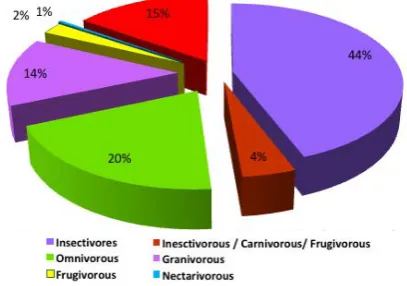
Different feeding guilds assigned to birds based
on foraging observations identified 111 species as
insectivorous, 49 insectivorous/carnivorous, 50
omnivorous, 34 granivorous, six frugivorous and one
nectarivorous respectively (Table 2, Fig. 5). Most of
the insectivorous species were restricted to lower and
middle elevations, whereas omnivores exhibited the
larger elevational distribution. The frugivores mainly
occupied human-dominated landscapes. Most of the
carnivores, especially the raptors and corvids, were
found feeding on carcasses and dead fowls in and
around garbage dumps near townships and along the
national highway.
Of the total bird species recorded so far, six are
considered globally threatened (Endangered and
Vulnerable) as per IUCN (2016). These include the
Endangered
Neophron percnopterus and
Aquila
nipalensis,
and Vulnerable
Aquila heliaca,
Catreus
wallichii,
Tragopan melanocephalus and
Aythya ferina.
The Near Threatened include
Gypaetus barbatus, Gyps
himalayensis and Aegypius monachus.
The present study reports three new species, Cyornis
tickelliae, Dicrurus aeneus
(Sharma & Sohil 2017), and
Yuhina flavicollis
(Sharma & Rana 2018) for the state
of Jammu & Kashmir. The study also added isolated
records for
Cephalopyrus flammiceps,
Dendronanthus
indicus
and Ficedula strophiata and range extensions
for Picus chlorolophus, Lonchura punctulata, Mycerobas
carnipes and Chrysominla strigula.
It was observed that the low-lying forests are highly
fragmented owing to typical lithology, aspect and
anthropogenic stresses, while those at higher elevations
are vulnerable to climatic vagaries and tremendous
biological pressures (grazing, extraction, tourism and
pilgrimage). The influence of these impacts on avian
diversity and ecology has not been accounted for in the
present surveys.
DISCUSSION
The distribution of birds in a particular area depends
on various factors, which include quantity and quality of
food available, perching, roosting and nesting sites. Our
observations during the current surveys clearly suggest
that factors such as elevation, topography, climate and
habitat heterogeneity have a marked influence on the
distribution pattern of avian fauna in the study area.
A large number of species have been recorded during
the summer and much less in winters. Those at higher
elevations move below the snow line during winters
while a few passage migrants stopover for few days en
route to their destinations. This has led to the dynamic
nature of the avian community in the region. Similar
observations were made by Acharya et al. (2011). In
the western Himalaya, mid and high elevation habitats
experience high species turnover between winter and
summer (Somvielle et al. 2013). A few species of long
distance latitudinal migrants take advantage of food rich
mild summers at high elevations for breeding and spend
winters at warmer latitudes (McCain 2009). Seasonal
fluctuations of birds occur due to changes in weather
conditions or fluctuations in food productivity and
habitat quality (Loiselle & Blake 1991; Norris & Marra
2007) as also observed during the current surveys.
The authors have observed that many birds usually
Table 1. The study sites (watersheds) with details on elevation, topography and major vegetation types
Watershed Geo-coordinates Elevation(visited) Topography Major vegetation types
Neeru watershed
33.872–33.0030N
&
75.669–75.7880E 820–4,200 m
Flat valleys below, Steep mountains, rugged and rocky out-crops, alpine rangelands at higher elevations.
Riparian (Alnus), temperate broadleaf, pure and mixed conifers, Fir-Spruce, Kharsu-Oak, Krumholtz.
Kalnai watershed
32.864–33.1460N
&
75.793–76.8540E 930–4,350 m
Moderate to steep bare hills at lower elevations to steep forest mountains, rugged snow accumulated tops.
Subtropical (Ulmus-Alnus-Ficus), mixed broadleaf, pure conifer, mixed and pure Kharsu Oak, birch at treeline, Junipers.
Marusudhar watershed
33.339–34.0690N
&
75.680–76.1700E 1,800–3,800 m
Huge oval and linear valleys at lower and higher elevations, rugged, rocky and steep mountains with broken cliffs beyond timberline bordering Trans Himalaya. One fourth of the area with permanent snow cover.
Plantations in the valleys, riparian Alnus forests along all the three major streams dry and moist temperate broadleaf and conifer forests, birch forests mixed with conifers near tree line. Moist alpine near 4000m.
Bhot watershed
33.272–33.4840N
&
76.224–76.4440E 1,850–4,500 m
Moderate to steep slopes with smaller valleys, rugged mountains at middle and higher elevations, a typical great and trans-Himalayan interface at the top contagious to Zanskar Himalaya.
seen during winter and early spring in the foothills of
Jammu, Kathua and Udhampur migrate towards the
middle and upper Chenab catchment during summer.
Summer migrants invade the mountains to breed
alongside residents (Dixit et al. 2016). About two-thirds
of the birds recorded are breeding residents in the upper
Chenab catchment. Twenty-nine percent of the species
exhibited a very narrow range of spatial distribution.
Most of them occurred exclusively at specific sites
suggesting that range sizes are extremely limited
probably by a combination of habitat associations,
competition or environmental tolerance (Gaston 1996;
Orme et al. 2006; Harris & Pimm 2008; Acharya et al.
2011). During the present survey, Kishtwar has emerged
as a favoured destination for birds especially raptors,
robins, flycatchers, warblers, etc. and most of the
passage migrants. This may be attributed to its affinity
to oriental regime owing to its central location, high
habitat heterogeneity and a conducive climate. Weather
conditions, vegetation structure and tree diversity are
responsible for the variation in avifauna from habitat
to habitat (Beehler et al. 1987; Daniels 1989; Joshua &
Johnsingh 1986).
Sadly, widespread ecological damage in the upper
Chenab catchment poses a deleterious effect on the bird
life of its mountains. The increase in human population
all along the range and the rising demands for electricity
(hydro-electric projects), roads, medicinal plants and
timber extraction, fuelwood, etc. pose a serious threat
to the fragile mountain ecosystems. The increased
tourism activity especially the pilgrimage practiced
at highlands during different times of the year puts
immense pressure on vegetation and birds in the region
as observed elsewhere in the Himalayan region (Chettri
et al. 2001, 2002; Laiolo 2003; Acharya et al. 2011). This
unprecedented human presence virtually coincides
with the breeding season of most of the migrants and
pheasants thus emerging as a great threat to their
survival.
This study reveals that mosaic habitats comprising
forests, riverbeds, rangelands and rocky outcrops
are crucial for the conservation of birds in the region.
This being a preliminary study calls for more intensive
surveys and investigations to establish the drivers of
avian distribution, richness and diversity in the region
in the near future. The current checklist of birds from
the upper Chenab catchment, together with information
on habitat use, feeding guilds and migratory status,
substantially improves the current knowledge base of
avifauna in the upper Chenab catchment. We expect
that our study will trigger more intense and detailed
ornithological research in the whole of the Chenab basin
in Indian Territory.
REFERENCES
Acharya, B.K., N.J. Sanders, L. Vijayan & B. Chettri (2011). Elevational
gradients in bird diversity in the eastern Himalayas: An evaluation of
distribution patterns and their underlying mechanisms. PLoS ONE
6(12): e29097;
http://doi.org/10.1371/journal.pone.0029097
Ali, S. & S.D. Ripley (2001).
Handbook of the Birds of India and Pakistan
- I. Oxford University Press, New Delhi.
Baba, M.M. (2002). Management Plan of Kishtwar High Altitude
National Park, Department of Wildlife Protection, Kishtwar,
Government of J&K.
Beehler, B.C., K. Raju & A Shahid (1987). Avian use of man disturbed
forest habitats in the Eastern Ghats, India.
Ibis
129: 197–211.
Chettri, N., E. Sharma & D.C. Deb (2001). Bird community structure
along a trekking corridor of Sikkim Himalaya: a conservation
perspective.
Biological Conservation
102: 1–16.
Chettri, N., E. Sharma, D.C. Deb & R.C. Sundryal (2002). Impact of
firewood extraction on tree structure, regeneration and woody
biomass productivity in a trekking corridor of the Sikkim Himalaya.
Mountain Research and Development
22: 150–158.
Daniels, R.J.R. (1989). A conservation strategy for the birds of Uttara
Kanada District. Ph.D Thesis. Indian Institute of Science, Bangalore.
Daniels, R.J.R., M. Hegde, N.V. Joshi & M. Gadgil (1991). Assigning
conservation value; a case study from India.
Conservation Biology
5(4): 464–475.
Dixit, S., V. Joshi & S. Barve (2016). Bird diversity of the Amrutganga
Valley, Kedarnath, Uttarakhand, India with special emphasis on the
elevational distribution of species.
Checklist
12(2): 1–11.
Gaston, K.J. (1996). Species-range-size distribution patterns,
mechanisms and implications.
Trends Ecol Evol
11; 197-201.
Gibbons, D.W. & R.D. Gregory (2006). Birds, pp. 319–328. In:
Sutherland, W.J. (ed.).
Ecological Census Techniques - A Handbook.
Cambridge University Press, Cambridge.
Graham, C.H., A.C Carnaval, C.D. Cadena, K.R. Zamudio, T.E.
Roberts, J.L. Parra, C.M. McCain, R.C.K. Bowie, C. Mortiz, S.B.
Baines, C.J. Schnider, J. VanDerWal, C. Rahbak, C.H. Kozak & N.J.
Sanders (2014). The origin and maintenance of montane diversity:
integrating evolutionary and ecological processes. Ecography 37(8):
711–719;
http://doi.org/10.1111/ecog.00578
Grewal, B., S. Sen, S. Singh, N. Devasar & G. Bhatia (2016).
A Pictorial
Field Guide to Birds of India, Pakistan, Nepal, Bhutan, Sri Lanka and
Bangladesh
. Om Books International, 791pp.
Grimmett, R., C. Inskipp & T. Inskipp (2011).
Birds of the Indian
Subcontinent.
2
ndEdition. Oxford University Press & Christopher
Helm, London, 528pp.
Grimmett, R., C. Inskipp & T. Inskipp (2013).
Birds of the Indian
Subcontinent: India, Pakistan, Sri Lanka, Nepal, Bhutan, Bangladesh
and the Maldives
. e-book downloaded http://play.google.com/
store/books/details/Richard_Grimmett_Birds_of_the_Indian_
Subcontinent
Harris, G. & S.L. Pimm (2008). Range size and extinction risk in forest
birds.
Conservation Biology
22: 163–172.
IUCN (2016). International Union for Conservation of Nature,
downloaded from https://www.iucn.org/ on 28-09-2016.
Islam, M.Z. & A.R. Rahmani (2004).
Important Bird Areas in India:
Priority Sites for Conservation
. Indian Bird Conservation Network,
Bombay Natural History Society, and Birdlife International, UK,
xvii+1133pp.
Joshua, J. & A.J.T. Johnsingh (1986). Observation on birds on
Mandathurai Plateau Tamil Nadu.
Journal of the
Bombay Natural
History Society 75: 1028–1035.
Khan, M.A. (2002). Avifauna of Kaghan Valley Northwest Frontier
Province, Pakistan, Tigerpaper 29(3): 16–19.
Table 2. Birds species distribution in the upper Chenab catchment, Jammu & Kashmir, India
Family / Common name Binomial name IUCN Locality Habitat Feeding Status Abd Images
Accipitridae
Bearded Vulture Gypaetus barbatus NT Neeru, Kalnai, Kishtwar, Bhot, Marusudar AS, RO, AE C R F Image 7
Besra Accipiter virgatus LC Neeru PC C R R Image 8
Black Kite Milvus migrans LC Neeru, Kishtwar GD, PC, FD, AE C R R
Black- eared Kite Milvus [migrans] lineatus LC Neeru, Kishtwar GD, AE C SV R Image 9
Bonelli’s Eagle Aquila fasciata LC Kishtwar AE, OH C WV R Image 10
Booted Eagle Hieraaetus pennatus LC Kishtwar, Neeru PS, AE, RO C WV R
Cinereous vulture Aegypius monachus NT Kishtwar TB, OH, AE C WV R Image 11
Common Buzzard Buteo buteo LC Neeru, Kalnai RF, TB,TC, AE C WV F
Eastern Imperial Eagle Aquila heliaca VU Kishtwar TC, OH, AE C WV R Image 12
Egyptian Vulture Neophron percnopterus EN Neeru, Kishtwar GD, AE, FD C SV O Image 13
Eurasian Sparrowhawk Accipiter nisus LC Kishtwar, Bhot, Neeru RF, TB, UF C R O Image 14
Golden Eagle Aquila chrysaetos LC Neeru, Bhot, Marusudar AE, RO, PC C R R Image 15
Griffon Vulture Gyps fulvus LC Kishtwar, Neeru RO, AE C R O
Hen Harrier Circus cyaneus LC Kishtwar AE, OS C WV R Image 16
Himalayan Buzzard Buteo burmanicus LC Neeru, Kalnai, Kishtwar, Bhot PC, AS, AE C R O Image 17
Himalayan Vulture Gyps himalayensis NT Neeru, Kalnai, Kishtwar, Bhot, Marusudar PC, AS, RO, FD C R O Image 18
Mountain Hawk Eagle Nisaetus nipalensis LC Kishtwar TB, TC, PC C R O
Northern Goshawk Accipiter gentilis LC Neeru, Kalnai, Kishtwar, Bhot UF, RF C WV O
Shikra Accipiter badius LC Neeru, Kalnai, Kishtwar, Bhot, Marusudar UF, TB, TC, PC C R C Image 19
Short-toed Snake Eagle Circaetus gallicus LC Kishtwar CV, FD, OS C PM O Image 20
Steppe Eagle Aquila nipalensis EN Neeru, Kishtwar GD, RF, UF, AE C WV O Image 21
Aegithalidae
Black-throated Tit Aegithalos concinnus LC Neeru, Kalnai, Kishtwar , Bhot, Marusudar UF, TB, RF I R O Image 22
White-throated Tit Aegithalos niveogularis LC Bhot TB, PC, DO, I R O Image 23
Alaudidae
Oriental Skylark Alauda gulgula LC Neeru PC O SV R
Alcedinidae
Himalayan Pied Kingfisher Ceryle lugubris LC Neeru, Kishtwar , Marusudar AQ, RF C R C Image 24
Lesser Pied Kingfisher Ceryle rudis LC Neeru, Kalnai, Kishtwar , Marusudar AQ, RF C R C Image 25
White-throated Kingfisher Halcyon smyrnensis LC Neeru, Kalnai, Kishtwar AQ, RF C R C Image 26
Anatidae
Bar-headed Goose Anser indicus LC Kishtwar AQ G PM O Image 27
Common Pochard Aythya ferina VU Kishtwar , Bhot AQ O PM O
Common Teal Anas crecca LC Neeru, Kalnai, AQ O PM O Image 28
Eurasian Wigeon Mareca penelope LC Kishtwar AQ G PM R Image 29
Garganey Querquedula querquedula LC Kishtwar AQ I PM R
Mallard Anas platyrhynchos LC Kishtwar AQ O PM R Image 30
Northern Pintail Anas acuta LC Kishtwar AQ O PM R Image 31
Northern Shoveler Spatula clypeata LC Kishtwar AQ G PM O Image 32
Family / Common name Binomial name IUCN Locality Habitat Feeding Status Abd Images Apodidae
Alpine Swift Tachymarptis melba LC Neeru, Kalnai, Kishtwar, Bhot, Marusudar AS, RO, AE I SV F Image 34
Common Swift Apus apus LC Neeru, Kalnai, Kishtwar UF, RF, TB, AE I SV F
White-throated Needletail Hirundapus caudacutus LC Kishtwar TB, TC, PC, FD I SV R
Ardeidae
Eastern Cattle Egret Bubulcus coromandus LC Kishtwar CV, AQ I WV C Image 35
Campephagidae
Long-tailed Minivet Pericrocotus ethologus LC Neeru, Kalnai, Kishtwar, Bhot UF, TC, PC I SV F Image 36
Megalaimidae
Great Barbet Megalaima virens LC Neeru, Kalnai, Kishtwar, Bhot UF, TB O R O Image 37
Certhiidae
Bar-tailed Treecreeper Certhia himalayana LC Neeru, Kalnai, Kishtwar, Bhot, Marusudar UF, TB, TC, PC I R C Image 38
Hodgson’s Treecreeper Certhia hodgsoni LC Neeru, Kalnai, Kishtwar, Bhot TB, TC, PC I R F
Cettiidae
Strong-footed Bush Warbler Horornis fortipes LC Neeru, Kalnai, Kishtwar, Marusudar, Bhot FD, TB, RF I SV O
Charadriidae
Red-wattled Lapwing Vanellus indicus LC Kishtwar CV, AQ I SV O Image 39
Cinclidae
Brown Dipper Cinclus pallasii LC Neeru, Kalnai, Kishtwar, Bhot, Marusudar AQ I R C Image 40
White-throated Dipper Cinclus cinclus LC Bhot, Marusudar AQ I R F Image 41
Cisticolidae
Grey-breasted Prinia Prinia hodgsonii LC Neeru, Kalnai, Kishtwar UF, TB I R C Image 42
Striated Prinia Prinia criniger LC Neeru UF, TB, OS I R F Image 43
Common Tailorbird Orthotomus sutorius LC Neeru UF, OS I R O Image 44
Columbidae
Eurasian Collared Dove Streptopelia decaocto LC Neeru, Kalnai, Kishtwar, Bhot UF, TB, CV G SV O Image 45
Hill Pigeon Columba rupestris LC Bhot, Marusudar TB, AS, PC G R O
Oriental Turtle Dove Streptopelia orientalis LC Neeru, Kalnai, Kishtwar, Bhot, Marusudar TB, PC, FD, UF G SV F Image 46
Rock Pigeon Columba livia LC Neeru, Kalnai, Bhot, Kishtwar, Marusudar UF, TB, CV G R C Image 47
Snow Pigeon Columba leuconota LC Kishtwar, Bhot, Marusudar AS, RO G R R
Speckled Wood Pigeon Columba hodgsonii LC Bhot AS G R R Image 48
Spotted Dove Spilopelia chinensis LC Neeru, Kalnai, Kishtwar UF, TB, CV G SV O Image 49
Wedge Tailed Green Pigeon Treron sphenurus LC Neeru TB G SV R Image 50
Coraciidae
European Roller Coracias garrulus LC Neeru TB, CV G PM O Image 51
Corvidae
Alpine Chough Pyrrhocorax graculus LC Neeru, Kalnai, Kishtwar, Bhot, Marusudar AS, RO, PS I R F Image 52
Black-headed Jay Garrulus lanceolatus LC Neeru, Kishtwar, Bhot, Marusudar UF, TC O R O Image 53
Common Raven Corvus corax LC Kishtwar, Bhot, Marusudar AS, RO O R R
Eurasian Jackdaw Coloeus monedula LC Kishtwar UF, TB, TC O R F Image 54
Eurasian Jay Garrulus glandarius LC Neeru, Kishtwar TB, TC O R F Image 55
Family / Common name Binomial name IUCN Locality Habitat Feeding Status Abd Images
House Crow Corvus splendens LC Neeru, Kalnai, Kishtwar UF, RF, TB, CV O R C Image 57
Kashmir Nutcracker Nucifraga multipunctata LC Neeru, Kalnai, Kishtwar, Bhot, Marusudar TB, TC O R F Image 58
Rufous Treepie Dendrocitta vagabunda LC Neeru RF O SV R Image 59
Large-billed Crow Corvus [macrorhynchos] japonensis LC Neeru, Kalnai, Kishtwar, Bhot, Marusudar UF, TC, AS, CV, OS, PC, DO, GD O R C Image 60
Red-billed Chough Pyrrhocorax pyrrhocorax LC Neeru, Kishtwar, Bhot, Marusudar AS, RO I R R Image 61
Yellow-billed Blue Magpie Urocissa flavirostris LC Neeru, Kalnai, Kishtwar, Bhot, Marusudar UF, TB, TC, RF O R C Image 62
Cuculidae
Asian Koel Eudynamys scolopaceus LC Kishtwar UF, TB, OS F SV F Image 63
Common Cuckoo Cuculus canorus LC Kishtwar, Bhot, Marusudar, Kalnai, Neeru UF, TB, TC I SV O Image 64
Jacobin Cuckoo Clamator jacobinus LC Bhot UF, TB, TC I SV R Image 65
Lesser Cuckoo Cuculus poliocephalus LC Kishtwar, Bhot, Marusudar, Neeru, Kalnai TB, TC I SV O
Dicruridae
Ashy Drongo Edolius leucophaeus LC Neeru, Kalnai, Kishtwar, Bhot, Marusudar UF, RF, TB I SV C Image 66
Black Drongo Edolius macrocercus LC Neeru, Kalnai, Kishtwar UF, RF, TB, FD I SV C Image 67
Bronzed Drongo Dicrurus aeneus LC Neeru TB I SV R Image 68
Emberizidae
Crested Bunting Emberiza lathami LC Kishtwar, Neeru CV, RF, OH O SV R Image 69
Pine Bunting Emberiza leucocephalos LC Kishtwar OH, TC, PC, CV O WV R Image 70
Rock Bunting Emberiza cia LC Neeru, Kalnai, Kishtwar, Bhot, Marusudar UF, TB, TC, PC O R C Image 71
White-capped Bunting Emberiza stewarti LC Neeru, Kishtwar, Bhot, Marusudar UF, TB, CV O SV C Image 72
Yellowhammer Emberiza citrinella LC Neeru OS O WV R
Estrildidae
Scaly-breasted Munia Lonchura punctulata LC Neeru CV, TB G SV R Image 73
Falconidae
Common Kestrel Falco tinnunculus LC Neeru, Kalnai, Kishtwar, Bhot, Marusudar UF, TB, TC, PC C R C Image 74
Eurasian Hobby Falco subbuteo LC Kishtwar, Bhot, Marusudar TB, OH, TC, OS, RF C SV O Image 75
Peregerine Falcon Falco peregrinus calidus LC Kishtwar, Bhot, Marusudar, Neeru RF, TB, OHRF, TB, OH C WV R
Shaheen Falcon Falco peregrinus peregrinator LC Neeru GD, OH C R O Image 76
Fringillidae
Black-and-Yellow Grosbeak Mycerobas icterioides LC Neeru, Kalnai, Kishtwar, Bhot, Marusudar TB, TC, PC G R C Image 77
Brambling Fringilla montifringilla LC Kishtwar OS, TB, UF G WV R Image 78
Brandt’s Mountain Finch Leucosticte brandti LC Bhot AS, RO G R R
Collared Grosbeak Mycerobas affinis LC Neeru, Kalnai, Kishtwar, Bhot TC, PC, FD G R O
Common Rosefinch Erythrina erythrina LC Neeru, Kalnai, Kishtwar, Bhot, Marusudar RF, UF, AS, CV G SV C Image 79
Dark-breasted Rosefinch Procarduelis nipalensis LC Marusudar, Neeru DO, AS, RO G SV R Image 80 Eurasian Goldfinch Carduelis carduelis LC Kishtwar, Bhot, Marusudar TC, PC, DO, FD G R F Image 81 Fire-fronted Serin Serinus pusillus LC Neeru, Kishtwar, Bhot RF, UF, TB G R R Image 82
Himalayan Greenfinch Chloris spinoides LC Neeru, Kalnai, Kishtwar, Bhot, Marusudar TB, TC, AS, CV G SV C Image 83
Himalayan White-browed
Family / Common name Binomial name IUCN Locality Habitat Feeding Status Abd Images
Orange Bullfinch Pyrrhula aurantiaca LC Bhot, Marusudar TC, PC G R R Image 84
Pink-browed Rosefinch Carpodacus rodochroa LC Neeru, Kalnai, Kishtwar, Bhot, Marusudar DO, AS, PS G R F Image 85
Plain Mountain Finch Leucosticte nemoricola LC Neeru, Kalnai, Kishtwar, Bhot, Marusudar AS, PS, FD, RO G R C
Red-browed Finch Callacanthis burtoni LC Neeru, Kalnai, Kishtwar, Bhot, Marusudar TC, PC G R F
Red-fronted Rosefinch Carpodacus puniceus LC Bhot, Marusudar AS, RO G R O Image 86
Red-headed Bullfinch Pyrrhula erythrocephala LC Bhot, Marusudar DO, AS G R R
Red-mantled Rosefinch Carpodacus rhodochlamys LC Bhot, Marusudar DO, AS G R R
White-winged Grosbeak Mycerobas carnipes LC Neeru, Kalnai, Kishtwar, Bhot, Marusudar TC, PC, AS, FD G R R
Hirundinidae
Asian House Martin Delichon dasypus LC Neeru, Kalnai, Kishtwar, Bhot, Marusudar UF, RF, CV I SV O
Barn Swallow Hirundo rustica LC Neeru, Kalnai, Kishtwar, Bhot AQ, RF, UF I SV C Image 87
Red-rumped Swallow Cecropis daurica LC Kishtwar AQ, RF, UF I SV O Image 88
Ibidorhynchidae
Ibisbill Ibidorhyncha struthersii LC Marusudar AQ I R R Image 89
Laniidae
Bay-backed Shrike Lanius vittatus LC Neeru, Kalnai, Kishtwar, TB, RF, UF, CV C SV O
Grey-backed Shrike Lanius tephronotus LC Kishtwar, Bhot, Marusudar,Bhot TB, RF, UF, CV C SV O
Long Tailed Shrike Lanius schach LC Neeru. Kalnai, Kishtwar,Bhot, Marusudar TB, RF, UF, CV C SV C Image 90
Laridae
Brown-headed gull Chroicocephalus brunnicephalus LC Kishtwar AQ, CV C PM R Image 91
Leiothrichidae
Bar-throated Minla Chrysominla strigula LC Neeru. Kishtwar UF, AS, FD F R O Image 92
Rufous Sibia Malacias capistratus LC Neeru TB, TC, DO I/F R F
Streaked Laughingthrush Trochalopteron lineatum LC Neeru, Kalnai, Kishtwar, Bhot, Marusudar UF, RF, TB I R C Image 93
Variegated Laughingthrush Trochalopteron variegatum LC Neeru, Kalnai, Kishtwar, Bhot, Marusudar UF, RF, TB, AS I R F Image 94
White-throated
Laughingthrush Garrulax albogularis LC Kishtwar UF, RF, TB, AS I R O
Meropidae
European Bee-eater Merops apiaster LC Kishtwar OS, CV, OH I SV O Image 95
Monarchidae
Asian Paradise Flycatcher Terpsiphone paradisi LC Neeru, Kalnai, Kishtwar UF, RF, TB I SV C Image 96 Motacillidae
Citrine Wagtail Motacilla citreola LC Neeru. Kalnai, Kishtwar, Bhot AQ, UF, RF, CV I SV C Image 97
Forest Wagtail Dendronanthus indicus LC Kishtwar TB, TC, OS I PM R Image 98
Grey Wagtail Motacilla cinerea LC Neeru, Kalnai, Kishtwar, Bhot, Marusudar UF, RF, CV,AQ I SV C Image 99
Paddyfield Pipit Anthus rufulus LC Neeru, Kishtwar CV, OS I R O Image 100
Rosy Pipit Anthus roseatus LC Neeru, Kalnai, Kishtwar, Bhot, Marusudar AS, RO, FD I SV C Image 101
Tree Pipit Anthus trivialis LC Neeru, Kalnai, Kishtwar TB, TC, PC, CV I SV O
Upland Pipit Anthus sylvanus LC Kishtwar OH, RO, PC I R R Image 102
Western Yellow Wagtail Motacilla flava LC Marusudar, Kishtwar CV, AQ, UF I PM R Image 103
Family / Common name Binomial name IUCN Locality Habitat Feeding Status Abd Images Muscicapidae
Black Redstart Phoenicurus ochruros LC Neeru, Kishtwar, Bhot,Marusudar RF, TB I PM O Image 105
Blue Whistling Thrush Myophonus caeruleus LC Neeru, Kalnai, Kishtwar, Bhot, Marusudar AQ, RF, UF, TB I R C Image 106
Blue-capped Redstart Phoenicurus coeruleocephala LC Neeru, Kalnai, Kishtwar, Bhot, Marusudar RF, UF, TB. AS I R C Image 107
Blue-fronted Redstart Phoenicurus frontalis LC Neeru, Kishtwar, Bhot, Marusudar TB, DO, AS O R O Image 108
Blue-headed Rock-thrush Monticola cinclorhynchus LC Neeru, Kalnai, Kishtwar, Bhot,
Marusudar RF, UF, TB, PC O SV C Image 109
Blue Rock- thrush Monticola solitaries LC Marusudar, Neeru AS O SV O Image 110
Bluethroat Luscinia svecica LC Neeru RF, FD, CV O PM R Image 111
Chestnut-bellied
Rock-thrush Monticola rufiventris LC Kishtwar, Neeru TC, PC O R O Image 112
Siberian Stonechat Saxicola torquatus LC Neeru, Kalnai, Kishtwar, Bhot, Marusudar RF, TB,TC O SV C Image 113
Dark-sided Flycatcher Muscicapa sibirica LC Kishtwar, Bhot, Marusudar TB,TC I SV O Image 114
Desert Wheatear Oenanthe deserti LC Kishtwar CV, OH G SV R Image 115
Eversmann’s Redstart Phoenicurus erythronotus LC Neeru OS O WV R Image 116
Golden Bush Robin Tarsiger chrysaeus LC Kishtwar TB I R R Image 117
Grey Bushchat Rhodophila ferrea LC Neeru, Kalnai, Kishtwar, Bhot, Marusudar RF, UF, TB I R C Image 118
Himalayan Red-flanked
Bush-robin Tarsiger rufilatus LC Neeru, Kalnai, Kishtwar, Bhot, Marusudar TB, TC, DO I R C Image 119 Himalayan Rubythroat Calliope pectoralis LC Neeru, Bhot, Marusudar AS, RO I SV O Image 120 Hodgson’s Blue Robin Hodgsonius phaenicuroides LC Bhot, Marusudar TC, AS, FD I SV O
Indian Blue Robin Larvivora brunnea LC Neeru, Kishtwar, Marusudar RF, UF I SV O Image 121
Little Forktail Enicurus scouleri LC Neeru, Kalnai, Kishtwar, Bhot, Marusudar AQ, RF I R F Image 122
Oriental Magpie-robin Copsychus saularis LC Neeru, Kishtwar RF, UF, TB I R F Image 123
Pied Bushchat Saxicola caprata LC Neeru, Kishtwar TB, CV, OS I R C Image 124
Plumbeous Water-redstart Phoenicurus fuliginosus LC Neeru, Kalnai, Kishtwar, Bhot, Marusudar AQ, RF I R C Image 125
Rufous-bellied Niltava Niltava sundara LC Bhot, Neeru TB, DO I R O Image 126
Rufous-gorgeted Flycatcher Ficedula strophiata LC Neeru PC I R R Image 127
Rufous-tailed Scrub Robin Cercotrichas galactotes LC Neeru CV I PM R Image 128
Rusty-tailed Flycatcher Muscicapa ruficauda LC Neeru, Kalnai, Bhot TB, TC I SV F Image 129 Slaty-blue Flycatcher Ficedula tricolor LC Bhot, Marusudar,Neeru, Kalnai FD, AS, PS I SV F Image 130
Spotted Forktail Enicurus maculates LC Neeru,Kalnai, Kishtwar, Bhot, Marusudar AQ, RF I R C Image 131
Tickell’s Blue Flycatcher Cyornis tickelliae LC Neeru OS I SV R Image 132
Ultramarine Flycatcher Ficedula superciliaris LC Neeru,Kalnai, Kishtwar, Bhot, Marusudar UF, TB, TC, PC I SV F Image 133
Verditer Flycatcher Eumyias thalassinus LC Neeru,Kalnai, Kishtwar, Bhot, Marusudar UF, TB, TC, CV I SV C Image 134
White-capped River-chat Phoenicurus leucocephalus LC Neeru, Kalnai, Kishtwar, Bhot, Marusudar AQ, RF I R C Image 135
White-winged Redstart Phoenicurus erythrogastrus LC Kishtwar, Neeru RF, AS, RO I SV R Image 136 Nectariniidae
Purple Sunbird Cinnyris asiaticus LC Kalnai RF, UF N SV O
Oriolidae
Family / Common name Binomial name IUCN Locality Habitat Feeding Status Abd Images
Paridae
Cinereous Tit Parus cinereus LC Neeru, Kalnai, Kishtwar, Bhot, Marusudar RF, UF, TB, TC, PC, FD, CV I R C Image 138
Coal Tit Periparus ater melanolophus LC Neeru, Kalnai, Kishtwar, Bhot, Marusudar TB, TC, PC, FD I SV C Image 139
Fire-capped Tit Cephalopyrus flammiceps LC Neeru TB O SV R Image 140
Green-backed Tit Parus monticolus LC Neeru, Kalnai, Kishtwar, Bhot, Marusudar RF, UF, TB, TC, PC I R C Image 141
Rufous-napped Tit Periparus rufonuchalis LC Neeru, Kalnai, Kishtwar, Bhot, Marusudar RF, UF, TB, TC, PC, FD I R F Image 142
Rufous-vented Tit Periparus rubidiventris LC Marusudar PC I R R
Passeridae
House Sparrow Passer domesticus LC Neeru, Kalnai, Kishtwar, Bhot, Marusudar RF, UF, TB,CV G R C Image 143
Cinnamon Sparrow Passer rutilans LC Neeru, Kalnai, Kishtwar, Bhot, Marusudar RF, UF, TB,CV G R C Image 144
Pelecaniformes
Indian Pond-heron Ardeola grayii LC Kishtwar AQ I/C R C Image 145
Little Egret Egretta garzetta LC Kishtwar AQ I/C R C Image 146
Phalacrocoracidae
Great Cormorant Phalacrocorax carbo LC Kishtwar AQ I/C WV F
Little Cormorant Phalacrocorax niger LC Neeru AQ I/C WV R
Phasianidae
Cheer Pheasant Catreus wallichii VU Neeru, Kalnai TC, PC, FD O R R Image 147
Chukar Partridge Alectoris chukar LC Neeru, Kalnai, Kishtwar, Bhot, Marusudar TB, TC, OS, CV O R F Image 148
Hill Patridge Arborophila torqueola LC Neeru RF O R R
Himalayan Monal Lophophorus impejanus LC Neeru, Kalnai, Kishtwar, Bhot, Marusudar PC, DO, AS, FD, PS O R O Image 149
Himalayan Snowcock Tetraogallus himalayensis LC Bhot, Marusudar AS, RO O R R
Kaleej Pheasant Lophura leucomelanos LC Neeru, Kalnai, Kishtwar, Bhot RF, TB, CV O R F Image 150
Koklass Pheasant Pucrasia macrolopha LC Neeru, Kalnai, Kishtwar, Bhot, Marusudar TB, TC, PC, FD O R O Image 151
Snow Partridge Lerwa lerwa LC Bhot, Marusudar AS, RO O R R
Western Tragopan Tragopan melanocephalus VU Neeru, Kalnai, Kishtwar, Bhot, Marusudar DO, AS, RO O R R
Phylloscopidae
Common Chiffchaff Phylloscopus collybita LC Neeru, Kalnai, Kishtwar, Bhot, Marusudar RF, TB, DO, AS I WV C Image 152
Greenish Warbler Phylloscopus trochiloides LC Neeru, Kalnai, Kishtwar, Bhot TB, PC, AS, FD I SV C Image 153
Grey-hooded Warbler Phylloscopus xanthoschistos LC Neeru, Kalnai, Kishtwar, Bhot, Marusudar TB, TC, DO, FD I R F Image 154
Hume’s Leaf-warbler Phylloscopus humei LC Kishtwar, Bhot, Marusudar TB, DO, AS I SV O Image 155
Mountain Chiffchaff Phylloscopus sindianus LC Neeru, Kalnai, Kishtwar, Bhot AS, RO, FD I SV O Image 156 Pale-rumped warbler Phylloscopus chloronotus LC Kishtwar, Bhot, Marusudar TB, DO, PC, AS I SV F Image 157 Orange-barred Leaf-warbler Phylloscopus pulcher LC Kishtwar, Bhot, Marusudar TB, PC, AS, CV I R O
Smoky Leaf-warbler Phylloscopus fuligiventer LC Kishtwar AS, RO, FD I PM R
Sulphur-bellied warbler Phylloscopus griseolus LC Kishtwar, Marusudar TC, PC, AS I SV R
Tickell’s Leaf-warbler Phylloscopus affinis LC Neeru, Kalnai, Kishtwar, Bhot UF, TB, FD, CV I SV O Image 158
Western Crowned Warbler Phylloscopus occipitalis LC Bhot, Marusudar, Neeru, Kalnai, Kishtwar PC, AS I SV R Image 159
Picidae
Family / Common name Binomial name IUCN Locality Habitat Feeding Status Abd Images
Grey faced Woodpecker Picus canus LC Neeru, Kalnai, Kishtwar TB, FD I R O Image 161
Himalayan Pied
Woodpecker Dendrocopos himalayensis LC Neeru, Kalnai, Kishtwar, Bhot, Marusudar TB, TC, PC, DO, FD I R C Image 162
Lesser Yellownape Picus chlorolophus LC Neeru UF I R R Image 163
Scaly-bellied Woodpecker Picus squamatus LC Neeru, Kalnai, Bhot TC, PC, FD I R O Image 164
Speckled Piculet Vivia innominata LC Kishtwar TB, TC I R R Image 165
Podicipedidae
Little Grebe Tachybaptus ruficollis LC Kishtwar AQ C R O Image 166
Prunellidae
Alpine Accentor Prunella collaris LC Neeru, Kalnai, Kishtwar, Bhot, Marusudar AS, RO, PS I R O Image 167
Altai Accentor Prunella himalayana LC Bhot, Marusudar AS, RO, PS I WV R
Black-throated Accentor Prunella atrogularis LC Kishtwar, Neeru, Bhot UF, TC, FD I WV R Image 168
Brown Accentor Prunella fulvescens LC Neeru,Bhot AS, RO I R R
Rufous-breasted Accentor Prunella strophiata LC Neeru, Bhot, Marusudar,Kishtwar, Kalnai TC, PC, DO, FD, PS I R O Image 169
Psittacidae
Himalayan Parakeet Psittacula himalayana LC Neeru, Kalnai, Kishtwar, Bhot, Marusudar UF, TB F SV O Image 170
Plum-headed Parakeet Psittacula cyanocephala LC Neeru, Kalnai, Kishtwar, UF, RF, TB F SV O Image 171
Rose-ringed Parakeet Psittacula krameri LC Kishtwar UF F SV O Image 172
Pycnonotidae
Himalayan Black Bulbul Hypsipetes leucocephalus LC Neeru, Kalnai, Kishtwar, Bhot, Marusudar RF, UF, TB O R C Image 173
Himalayan Bulbul Pycnonotus leucogenys LC Neeru, Kalnai, Kishtwar, Bhot, Marusudar RF, UF, TB, TC, PC O R C Image 174
Red-vented Bulbul Pycnonotus cafer LC Neeru UF O R O
Rallidae
Common Moorhen Gallinula chloropus LC Kishtwar AQ I/C R O
Eurasian Coot Fulica atra LC Kishtwar AQ I/C R C
Recurvirostridae
Black-winged Stilt Himantopus himantopus LC Neeru AQ, CV I PM O Image 175
Regulidae
Goldcrest Regulus regulus LC Neeru, Kalnai, Bhot, Marusudar TC, PC, FD I R O Image 176 Scolopacidae
Common Sandpiper Actitis hypoleucos LC Bhot AQ I/C SV R
Eurasian Curlew Numenius arquata LC Kishtwar AQ, CV I/C PM R Image 177
Wood Sandpiper Tringa glareola LC Marusudar AQ I/C PM R Image 178
Sylviidae
Hume’s Whitethroat Sylvia althaea LC Kishtwar AS, AQ I SV R
Sittidae
Kashmir Nuthatch Sitta cashmirensis LC Kalnai, Kishtwar, Bhot, Marusudar TC, PC, FD O R R
White-cheeked Nuthatch Sitta leucopsis LC Kalnai, Kishtwar, Bhot TC, PC O R O
Stenostiridae
Grey-headed
Canary-flycatcher Culicicapa ceylonensis LC Neeru, Kalnai, Kishtwar, RF, TB, TC I SV C Image 179
Family / Common name Binomial name IUCN Locality Habitat Feeding Status Abd Images Strigidae
Asian Barred Owlet Glaucidium cuculoides LC Neeru, Kalnai, Kishtwar UF, TB, TC, PC C R O Image 181
Collared Owlet Glaucidium brodiei LC Kishtwar DO, PC C R O Image 182
Collard Scops-owl Otus bakkamoena lettia LC Neeru TC, PC C PM R Image 183
Jungle Owlet Glaucidium radiatum LC Marusudar TB, TC C R R
Tawny Owl Strix aluco LC Kishtwar PC, DO, TB C R R Image 184
Sturnidae
Brahminy Starling Sturnia pagodarum LC Kishtwar, Neeru UF, TB O SV F Image 185
Common Myna Acridotheres tristis LC Neeru, Kalnai, Kishtwar, RF, UF, CV O R C Image 186
Common Starling Sturnus vulgaris LC Neeru UF, CV O PM R
Tichodromadinae
Wallcreeper Tichodroma muraria LC Neeru, Kalnai, Kishtwar, Bhot,
Marusudar OH, RO (River side) I WV F Image 187
Timaliidae
Black-chinned babbler Cyanoderma pyrrhops LC Neeru, Kishtwar TB, OS O R O Image 188
Rusty-cheeked
Scimitar-babbler Megapomatorhinus erythrogenys LC Kishtwar Tb, TC, CV O R R Image 189
Troglodytidae
Eurasian Wren Troglodytes troglodytes LC Neeru, Kalnai, Kishtwar, Bhot, Marusudar RF, TB, DO, AS, RO I R C Image 190
Turdidae
Black-throated Thrush Turdus atrogularis LC Kishtwar, Neeru, Bhot PC, AS, PS, FD I WV R Image 191
Chestnut Thrush Turdus rubrocanus LC Neeru, Bhot, Kishtwar, Marusudar, RF, UF, TB, TC I SV O Image 192
Grey-winged Blackbird Turdus boulboul LC Neeru, Kalnai, , Kishtwar UF, TB, TC I R F Image 193
Mistle Thrush Turdus viscivorus LC Neeru, Kalnai, Bhot, Kishtwar, Marusudar PC, TC, AS, FD I R O Image 194
Plain-backed Thrush Zoothera mollissima LC Bhot, Kishtwar, Marusudar PC, AS, RO I R O
Small-billed Scaly Thrush Zoothera dauma LC Bhot, Marusudar PC, FD I SV R
Tibetan Blackbird Turdus maximus LC Bhot, Marusudar AS, RO, FD I R R
Tickell’s Thrush Turdus unicolor LC Kishtwar, Bhot, Marusudar TB,UF I SV F Image 195
Upupidae
Common Hoopoe Upupa epops LC Neeru, Kalnai, Bhot, Kishtwar CV, UF I SV F Image 196
Zosteropidae
Oriental White-eye Zosterops palpebrosus LC Neeru, Kalnai, Kishtwar RF, UF, TB I SV C Image 197
Whiskered Yuhina Yuhina flavicollis LC Neeru RF, TB O R R Image 198
Locality: Neeru - Bhaderwah; Kalnai - Bhalessa; Bhot - Paddar; Marusudar - Dachhan, Marwah and Kishtwar high altitude National Park; Kishtwar-Low lying areas
including Kishtwar town and surroundings.
IUCN: LC - Least Concern; EN - Endangered; NT - Near Threatened; VU - Vulnerable
Habitat where the species was detected: AQ - Aquatic; UF - Urban Forest; OS - Open Scrub; RF - Riparian Forest; TB - Temperate Broadleaf Forest, TC - Temperate
Broadleaf Conifer Forest; PC-Pure Conifer Forest; DO - Dense Oak Forest; AS - Alpine Scrub; PS - Alpine Pasturelands; RO - Rocky Outcrops; CV - Cultivated lands; FD - Forest Edges; GD - Garbage Dumps, AE - Aerial, OH-Open Hill / Cliffs.
Status in terms of migration: R - Resident; SV - Summer visitor; WV - Winter visitor; PM - Passage migrant.
Feeding guild: I - Insectivorous; C - Carnivorous; G - Granivorous; F - Frugivorous; O - Omnivorous.
the established forest stands in different elevational zones of
Bhaderwah, J &K. M. Phil Thesis. University of Jammu, Jammu.
Kichloo, N.A. (1992). Census report of Kishtwar High Altitude National
Park, Department of Wildlife Protection, Kishtwar, Government of
J&K.
Laiolo, P. (2003). Diversity and structure of the bird community
overwintering in the Himalayan subalpine zone: is conservation
compatible with tourism?
Biological Conservation
115: 251--262.
Llanos, F.A., M. Failla, G.J. García, P.M. Giovine, M.Carbajal, P.M.
González, D.P. Barreto, P. Quillfeldt & J.F. Masello (2011). Birds
from the endangered Monte, the Steppes and Coastal biomes of
the province of Río Negro, northern Patagonia, Argentina.
Checklist
7(6): 782–797.
Loiselle, B.A. & J.G. Blake (1991). Temporal variation in birds and fruits
along an elevational gradient in Costa Rica. Ecology 72: 180–193.
McCain, C.M. (2009). Global analysis of bird elevational diversity.
Global Ecology and Biogeography
18(3): 346–360;
http://doi.
org/10.1111/j.1466-8238.00443x
Naqash, R.A. (2006). Census report in survey of mammals in Kishtwar
High Altitude National Park, Department of Wildlife Protection,
Kishtwar, Government of J&K.
Norris, D.R. & P.P. Marra (2007). Seasonal interactions, habitat quality
and population dynamics in migratory birds. Condor 109: 535–547.
Orme, C.D.I., R.G. Davies, V.A. Olson, G.H. Thomas & T.S. Ding (2006).
Global patterns of geographic size in birds.
PLoS Biology
4: 1276–
1283.
Parsa, M.A. (1999). Survey of animals in Kishtwar High Altitude
National Park, Department of Wildlife Protection, Kishtwar,
Government of J&K.
Peterson, A.T., L.G. Ball & K.W. Brady (2000). Distribution of the birds
of the Philippines: biogeography and conservation priorities.
Bird
Conservation International
10 (2): 149–167.
Price, T.D., D. Mohan, D.T. Tietze, D.M. Hooper, C.D.L. Orme & P.C.
Rasmussen (2011). Determinants of northerly range limits along
the Himalayan bird diversity gradient.
American Naturalist 178(4):
97–108;
http://doi.org/10.1086/661926
Price, T.D., J. Zee, K. Jamdar & N. Jamdar (2003). Bird species diversity
along the Himalayas; a comparison of Himachal Pradesh with
Kashmir.
Journal of the Bombay Natural History Society
100(2&3):
394–409.
Rahmani, A.R. (2012).
Threatened Birds of India-their Conservation
Requirements. Indian Bird Conservation Network : Bombay Natural
History Society, Royal Society for the Protection of Birds and Birdlife
International. Oxford University Press, xvi +864pp.
Rahmani, A.R., I. Suhail, P. Chandan, K. Ahmad & A.A. Zarri (2013).
Threatened birds of Jammu & Kashmir. Indian Bird Conservation
Network, Bombay Natural History Society, Royal Society for the
Protection of Birds, and Birdlife International. Oxford University
Press, xiv+150pp.
Rasmussen, P.C. & J.C. Anderton (2012).
Birds of South Asia: the Ripley
Guide. 2nd Edition.
Washington, D.C. and Barcelona: Smithsonian
Institution and Lynx Edicions. 2 vols. Pp. 1–378; 1–683.
Shah, T.A., V. Ahuja, M. Anandam & C. Srinivasulu (2016). Avifauna
of Chamba District, Himachal Pradesh, India with emphasis on
Kalatop-Khajjiar Wildlife Sanctuary and its surroundings.
Journal
of Threatened Taxa 8(1): 8333–8357;
http://dx.doi.org/10.11609/
jott.1774.8.1.8333-8357
Sharma, N. (2017). First record of Rufous-tailed Scrub Robin
Cercotrichas galactotes (Aves: Passeriformes: Muscicapidae) from
Jammu & Kashmir, India. Journal of Threatened Taxa 9(9): 10726–
10728;
http://doi.org/10.11609/jott.2979.9.9.10726-10728
Sharma, N. & A. Sohil (2017). Bronzed Drongo
Dicrurus aenea
and
Hair-crested Drongo
Dicrurus hottentottus
from Jammu & Kashmir,
India.
Indian BIRDS
13(6): 168.
Sharma, N. & M.A. Kichloo (2016). Chestnut-tailed Minla
Chrysominla
strigula, an addition to the avifauna of Jammu &Kashmir, India.
Indian BIRDS
11(2): 51
Sharma, N. & S.K. Rana (2018). Whiskered Yuhina
Yuhina flavicollis
from Jammu & Kashmir, India.
Indian BIRDS
14(2): 55.
Somveille, M., A. Manica, S.H.M. Butchart & A.S.L. Rodrigues (2013).
Mapping global diversity patterns for migratory birds. PLoS ONE 8
(8): e70907;
http://doi.org/10.1371/journal.phone.0070907
Wani, A.A. & D.N. Sahi (2005). Diversity and Status of birds of Tehsil
Doda, Jammu.
Journal of Nature and Conservation
173(1): 135–143.
Whistler, H. (1929). Some aspects of birdlife in Kashmir.
The Himalayan
Journal 1: 29–50.
Xeno-canto (2016). Sharing birds sounds from around the world.
Image 7. Bearded Vulture
Gypaetus barbatus
Image 11. Cinereous Vulture Aegypius monachus
Image 14. Eurasian
Sparrowhawk Accipiter nisus
Image 18. Himalayan Vulture
Gyps himalayensis
Image 9. Black-eared Kite
Milvus [migrans] lineatus
Image 12. Eastern Imperial
Eagle Aquila heliaca
Image 16. Hen Harrier
Circus cyaneus
Image 20. Short-toed Snake
Eagle Circaetus gallicus
Image 8. Besra Accipiter
virgatus
Image 15. Golden Eagle
Aquila chrysaetos
Image 19. Shikra
Accipiter badius
Image 10. Bonelli’s Eagle
Aquila fasciata
Image 13. Egyptian Vulture
Neophron percnopterus
Image 17. Himalayan Buzzard
Buteo burmanicus
Image 21. Steppe Eagle
Aquila nipalensis
© Neeraj Sharma
© Neeraj Sharma
© Raja Amir
© Neeraj Sharma
© Neeraj Sharma
© Neeraj Sharma © Raja Amir
© Dinesh Singh
© Raja Amir © Neeraj Sharma
© Raja Amir
© Neeraj Sharma
© Neeraj Sharma © Neeraj Sharma