NUMERICAL SIMULATION IN BIOMECHANICS – A FORENSIC EXAMPLE
Jiří Adamec, Matthias Graw, Norbert Praxl
Institute for Legal Medicine, Ludwig-Maximilian University, Munich, Germany
Submitted in April, 2006
The paper presents an example of a forensic application of biomechanical methods including numerical simula-tion with human body models. By means of a case study of an unwitnessed lethal fall the course of the biomechanical forensic reconstruction is demonstrated. The traces available at the place of finding and the injuries of the victim are the facts that the analysis is based on. The ultimate expected result of the biomechanical analysis is the assignment of all available traces and the explanation of the event.
The injuries observed in the described case were partly typical fall injuries, but there were also some injuries that could not be prima vista assigned. The police investigation at the place of finding also brought to light some facts that could not be satisfactorily explained at first. By using numerical simulation, additional information was obtained that enabled us to explain many aspects of the case that could not have been analysed otherwise. Numerical simulation offers objective and quantitative data enabling a far more exact analysis of the studied event – the kinematical as well as dynamical parameters of the human body and its interaction with the surroundings structures can be studied and even the human body’s internal forces can be analysed enabling thus an accurate injury prediction. All the important unknown parameters (initial conditions of the simulated event, i. e. body position, body orientation, initial velocity etc.) can be easily varied so that all the possibilities can be taken into account. Another very important asset of this method is its powerful visualisation capability that enhances the understanding of the studied events even for persons without extensive biomechanical knowledge. The major limitation of numerical simulation at the moment is the lack of muscle activity; the models represent only a totally passive human body so far.
Keywords: Forensic biomechanics, numerical simulation, human body model, fall.
INTRODUCTION
Forensic biomechanics is a discipline undergoing rapid development in recent years thanks to its increas-ing knowledge and technology level. Many forensic biomechanical problems were for long assessed only qualitatively, based on the experience of the expert. This paper presents the advantages of a new tool employed in forensic biomechanics that enables an objective and quantitative analysis of human kinematics and human body loading – numerical simulation.
Falls are a frequent cause of serious or even lethal injuries. Questions are sometimes raised regarding third party fault especially in unwitnessed cases with fatal out-comes. To distinguish between a suicide, an accident, and third party fault is a very challenging task that com-prises various aspects. Considerable attention has been paid to this problem in the literature (Püschel & Wisch-husen, 2005; Shaw & Hsu, 1998; and others). A neces-sary condition for the clarification of unwitnessed falls is their reconstruction based on a thorough biomechanical analysis involving the assessment of suffered injuries, the kinematical analysis of the fall and the assignment of
the available traces. Based on a real case, the aim of this paper is to present the methods of biomechanics in this specific type of forensic application. In addition to the traditional approach of using numerical simulation with human models, this method has also been employed and has proven to be a very promising tool in forensic biome-chanics (Adamec et al., 2003; Muggenthaler et al., 2003; Adamec et al., 2005). The benefits as well as potential drawbacks of numerical simulation are discussed.
METHODS
Relevant autopsy results
The victim was a 57 year old man, stature 176 cm, body mass 68.9 kg. There was a skin laceration in the occiput region; there was a skull fracture hereunder with a 6 cm × 10 cm fragment. At the border between the lumbar and buttocks region on the left hand side a superficial injury was found apparently caused by ex-tensive strain of the skin. Teeth 11 and 22 were knocked out (and found near the corpse), teeth 21 and 23 were broken. The aorta was partially torn at the typical loca-tion. There was a haematoma in the right m. sternoclei-domastoideus and a comminuted fracture of the upper part of the sternum. All ribs were fractured and left with soft tissue perforations. Compression fractures of the VI.–VIII. thoracic vertebral bodies were observed. The pelvic injuries comprised both SI joint destruction and a comminuted fracture of the left ilium. The right liver lobe was lacerated. There were no injuries whatsoever on both upper extremities, no marks of suffocation.
Relevant parameters of the place of the finding
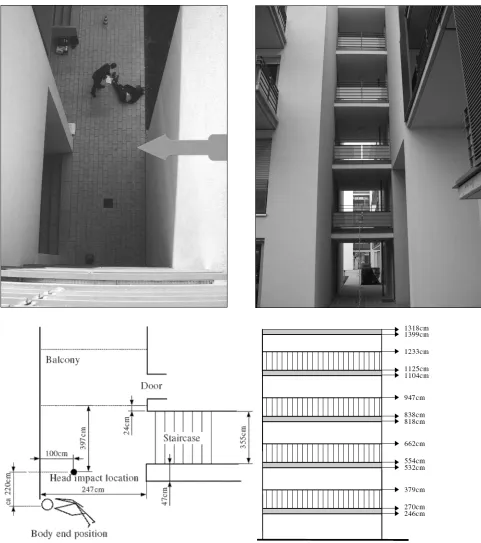
The basic parameters documented for the biomechan-ical analysis were the end position of the body and the overall geometry of the place. A picture of the place of the finding with the end position of the body and a drawing with the most relevant parameters is presented in Fig. 1. A balcony – like passages were identified as the only pos-sible platform for a fall (heights of 270–1125 cm, 1st–4th
floor), because all other building parts were inaccessible. A definite head impact location could be identified on the pavement (skin and hair traces) at a horizontal distance of 397 cm from the balconies. The corpse lay another 2 m farther. The height of the guard rail at each balcony was 118 cm; there were no traces on the balconies.
Biomechanical analysis
The victim evidently suffered a very severe blunt trau-ma; the injury severity allows for the assumption that the highest balcony was the fall platform. Also, the guard rail of the balcony was considered (height 1233 cm above the ground). The relatively high horizontal distance sup-ported further this assumption. An accidental fall as the result of a balance loss (slipping, tripping etc.) was excluded because the centre of body gravity of the victim is located lower then the guard rail height.
Most of the injuries can be attributed (based on their location and characteristics) to a fall on the back side of the body with a slight left hand side accentuation. This does not necessarily hold for the teeth and sternum in-juries, neither for the skin defect in the lumbar/buttocks region. In order to clarify the course of the fall includ-ing the location of the head impact and the end
posi-tion of the body, a series of numerical simulaposi-tions were performed with the MADYMO human model. A 50% Human Male Pedestrian model version 6.2 was used because its body parameters correspond very well to those of the victim (174 cm vs. 176 cm, 75 kg vs. 69 kg). The model has been extensively validated for impact situations and represents human kinematics very well (MADYMO, 2004).
As the starting point of the simulation, two alterna-tive initial positions of the human model were chosen: a stance at the verge of the highest balcony (would cor-respond to a person who had climbed over the balcony guard rail) and a stance on the balcony guard rail. From a standing position the model tilts away from the bal-cony. As no hints were at hand regarding the direction of the movement, the forward (i. e. the model stands initially with the balcony behind his back) as well as the backward (i. e. the model stands initially facing the balcony) fall directions were considered and simulated. The used model is passive, i. e. no muscle actions were taken into account. However, a person falling like this would not be completely passive (as if unconscious); it can be assumed that the legs would be kept stretched. For this reason, all the degrees of freedom of the lower extremities were locked into the simulation until the models reached a tilting angle of 40 degrees. Then they were released and along with the rest of the degrees of freedom they were constrained only to the extent that corresponds to a passive human body.
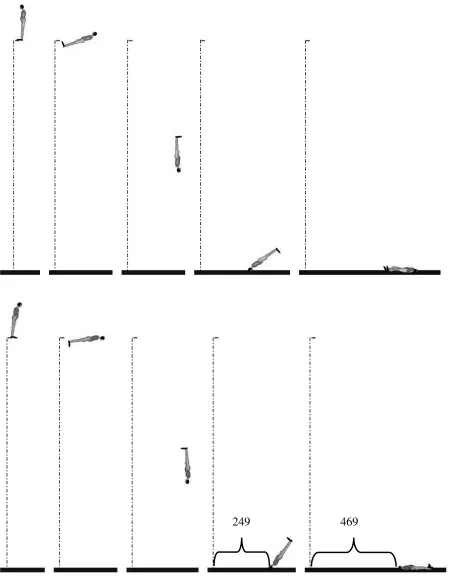
The human model kinematics during the forward fall from a height of 1125 cm (the balcony floor) is shown in Fig. 2. The kinematics of the model from the guard rail height of the same balcony (1233 cm) differs only very slightly from this case, all the predicted injury locations are the same and are in agreement with the observed injuries and also the end position of the body is well predicted.
On the contrary, the backward fall kinematics pre-dicts a completely different injury pattern and the end position of the body is significantly different (Fig. 2).
With the help of numerical simulation, the injury mechanism of some of the injuries that could not be assigned at first glance was clarified. Shortly after the head’s impact with the ground a contact could be ob-served between the jaw and the upper part of the chest (Fig. 3). This can easily explain the observed teeth in-juries as well as the fracture of the sternum. The trunk impacts the ground after the head and then a rebound can be observed. During this rebound, an extensive flex-ion of the trunk and the strain injury of the skin in the lumbar region can be explained (Fig. 4).
guard rail height, respectively. The real distance was 220 cm and it corresponds thus with the simulation.
The horizontal distance of the head impact loca-tion from the balcony is, in the simulaloca-tion, 249 cm, i. e. 148 cm less than the observed real measure. It means that there was an active force involved; the real falling was not completely passive. The numerical simulation
does not allow for resolving whether it was an active movement of the falling/jumping person or whether the horizontal force was caused by third party involvement. The necessary additional horizontal velocity during the flying phase of 1.2 m/s² could be explained both by a “step forward” as well as by third party intervention in terms of pushing/throwing the person out of the bal-cony.
Fig. 1
Fig. 2
Human body model kinematics during the fall backwards (top) and forwards (bottom)
249
469
Fig. 3
Chest/jaw contact shortly after the head impact
Fig. 4
Trunk flexion during the rebound phase after the first trunk impact to the ground
Summary of the analysis
With the help of numerical simulation, all observed injuries could be assigned to a single event. There were no traces of a fight on the whole site and none of the injuries suggested an act of violence (above all, there were no injuries whatsoever on the upper extremities). There were no hints suggesting an impaired state of con-sciousness (negative toxicological findings). The expert opinion suggested suicidal behaviour of the victim. The police investigation provided later hints suggesting that the awkward personal situation of the victim might have been the motive. A former suicide attempt was also as-certained.
DISCUSSION
Reconstructions of falls are a relatively frequent fo-rensic application of biomechanics. A fall is, from the mechanical point of view, a relatively simple event (es-pecially in the flight phase). The trajectory of the body centre of gravity can be computed by using simple meth-ods and the results are, of course, in agreement with the simulation.
The advantages of numerical simulation are twofold. Firstly, numerical simulation offers a lot more
informa-tion than the mere centre of gravity trajectory. After the first attempts to reconstruct a fall numerically (Sloan & Talbott, 1996) with 2D models with a few degrees of freedom that did not enable any quantitative assess-ment of body loading nor numerical simulation and the human body models were developed into a technology offering a detailed and quantitative (i. e. objective) information, not only about the kinematics, but also about the dynamics of the studied events. In the pre-sented case, all the impacts with the ground as well as the body kinematics after the rebound to the end posi-tion of the body could be analysed and thus the injury mechanisms clarified. Secondly, the huge advantage of numerical simulation is the possibility to visualise the results in an understandable and effective way. A video or a sequence of pictures enhances the understanding of the studied event even to persons without extensive biomechanical knowledge.
The numerical human models have been validated extensively for impact situations and they offer informa-tion about external forces as well as about forces occur-ring inside the human body. This way the probability of injury occurrence can be assessed.
REFERENCES
Adamec, J., Muggenthaler, M., Praxl, N., Schönpflug, M., & Graw, M. (2005). The usage of numerical simu-lation in the analysis of hazardous movements. In F. Vaverka (Ed.), 4thInternational conference Move-ment & Health (pp. 27). Olomouc: Palacký Univer-sity.
Adamec, J., Schuller, E., Praxl, N., & Schönpflug, M. (2003). Possible driver injury causation/aggrava-tion by the unbelted back seat passenger in a frontal crash: A simulation study. Forensic Science Interna-tional, 1, 194–195.
MADYMO® 6.2 manual (2004). TNO automotive BV.
Muggenthaler, H., Schuller, E., Schönpflug, M., Praxl, N., & Graw, M. (2003). Computer aided biomechanical analysis of lumbar spine loading. Forensic Science International, 1, 189.
Püschel, K., & Wischhusen, F. (2005). Rekonstruktive Aspekte bezüglich der Differenzierung Sturz/Sprung aus der Höhe: Speziell zur Fallweite. In B. Bockholdt & E. Ehrlich (Eds.), Der Sturz-Festschrift für Volkmar Schneider. Berliner Wissenschafts-Verlag.
Shaw, K. P., & Hsu, S. Y. (1998). Horizontal distance and height determining falling pattern. Journal of Forensic Sciences, 43(4), 765–771.
NUMERICKÁ SIMULACE V BIOMECHANICE – FORENZNÍ PŘÍKLAD
(Souhrn anglického textu)
Příspěvek prezentuje vybraný příklad forenzní apli-kace biomechanických metod zahrnujících numeric-kou simulaci s použitím modelů lidského těla. Postup biomechanické rekonstrukce je demonstrován na kon-krétním případu smrtelného pádu z výšky. Základem biomechanické rekonstrukce jsou stopy na místě nálezu těla spolu se zraněními zjištěnými při provedné soudní pitvě. Konečným cílem biomechanické analýzy je jedno-značné a bezesporné přiřazení veškerých zjištěných stop a objasnění celé události z mechanického hlediska.
Některá zranění zjištěná v tomto konkrétním přípa-dě byla pro pád z výšky typická, část nálezu ale neby-lo možno prima vista zařadit. Policejní vyšetřování na místě nálezu také přineslo některá fakta, která nebylo možno uspokojivě vysvětlit. Numerická simulace s po-užitím modelů lidského těla přinesla údaje umožňující vysvětlení mnoha do té doby nejasných aspektů případu. Tato metoda poskytuje objektivní a kvantitativní infor-mace umožnující daleko přesnější analýzu studovaného jevu nebo události – kinematické i dynamické parametry lidského těla a jeho interakce s okolními strukturami. Dokonce je možné zjišťovat i síly působící uvnitř orga-nismu a díky tomu přesněji predikovat trauma. Všechny důležité neznámé parametry (počáteční podmínky nu-merické simulace, jako pozice těla a jeho jednotlivých segmentů, jeho orientace v prostoru, počáteční rychlost atp.) lze parametrizovat a obsáhnout tak všechny možné konstelace. Další velmi důležitou předností této metody je propracovaná a efektivní vizualizace výsledků výpo-čtů, která usnadňujě pochopení studovaných událostí a jevů i bez důkladných biomechanických znalostí. Nej-větší omezení použití modelů lidského těla představuje v současné době nemožnost simulovat aktivní pohyby; modely svých chováním odpovídají zcela pasivnímu lidskému tělu.
Klíčová slova: forenzní biomechanika, numerická simula-ce, model lidského těla, pád.
Jiří Adamec, Ph.D.
Education and previous work experience
1993–1998 Faculty of Physical Culture, Palacký Univer-sity in Olomouc – Mathematics and PE,
1998–2002 Faculty of Physical Culture, Palacký Uni-versity in Olomouc – doctoral study of kinanthropolo-gy – focus on biomechanics,
since 2002 – scientific worker at the Institute for Legal Medicine,
since 2005 – deputy head of the biomechanics group.
First-line publication
Adamec, J., Schuller, E., Praxl, N., & Schönpflug, M. (2003). Possible driver injury causation/aggravati-on by the unbelted back seat passenge in a frcausation/aggravati-onta cash – simulation study. Forensic Science Internatio-nal (194–195).
Schönpflug, M., Muggenthaler, H., Adamec, J., & Praxl, N. (2003). Numerical simulation in forensic sci-ence: Behavior of a numerical human body model in a vehicle side impact scenario. Forensic Science International, 196.
Praxl, N., Schönpflug, M., Adamec, J., & Muggentha-ler, H. (2003). Occupant morión in vehicle rollover: Simulation with human dummy model. Forensic Sci-ence International, 189.
Halley, S., Adamec, J., Praxl, N., Schönpflug, M., & Graw, M. (2005). Das numerische Hatze modell? Auch für Berechnungen an Kindern geeignet? Archiv für kriminologie, 215, 164–172.
Muggenthaler, H., Praxl, N., Schönpflug, M., Adamec, J., von Merten, K., Peldschus, S., Schneider, K., & Graw, M. (2005). Oberflächenmyographie: Grund-lagen und Anwendungen in der forensischen Biome-chanik am Beispiel der passiven Fahrzeugsicherheit.
Rechtsmedizin, 15, 161–166.
Muggenthaler, H., von Merten, K., Adamec, J., Praxl, N., Schneider, K., Graw, M., & Schönpflug, M. (2005). Muscle measurements furing volunteer impact tests for improvement of numerical human models. Bio-medizinische Technik, 50(1), 1513–1514.
Adamec, J., Praxl, T., Miehling, T., Muggenthaler, H., & Schönpflug, M. (2005). The occupant kinematics in the first phase of a rollover accident: Experiment and simulation. In Proceedings of the 2005 IRCOBI conference in Prague, 145–156. Lyon: INRETS.
Institute for Legal Medicine Frauenlobst. 7a