V
OLUMEN
O.
9
(2019),
I
SSUEN
O.
06
(J
UNE)
ISSN 2231-5756
A Monthly Double-Blind Peer Reviewed (Refereed/Juried) Open Access International e-Journal - Included in the International Serial Directories
Indexed & Listed at:
Ulrich's Periodicals Directory ©, ProQuest, U.S.A., Cabell’s Directories of Publishing Opportunities, U.S.A., Google Scholar, Indian Citation Index (ICI), J-Gage, India [link of the same is duly available at Inflibnet of University Grants Commission (U.G.C.)],
Index Copernicus Publishers Panel, Poland with IC Value of 5.09 (2012) & number of libraries all around the world.
V
OLUMEN
O.
9
(2019),
I
SSUEN
O.
06
(J
UNE)
ISSN 2231-5756
CONTENTS
Sr.
No.
TITLE & NAME OF THE AUTHOR (S)
Page
No.
1
.
TRANSITION TO INDIAN ACCOUNTING STANDARDS (Ind AS) FROM
INDIAN GENERALLY ACCEPTED ACCOUNTING PRINCIPLES (IGAAP):
A CRITICAL ANALYSIS
AMRITA DUTTA & Dr. RATAN BORMAN
1
2
.
A STUDY ON THE PROPOSED MERGER OF VIJAYA BANK AND DENA
BANK WITH BANK OF BARODA
Dr. A. C. PRAMILA
5
3
.
AFFECTS OF PLASTIC MONEY ON DAY TO DAY LIFE OF A COMMON
MAN
VANDANA SHARMA
8
4
.
A STUDY ON PREVALENCE OF ANXIETY DISORDERS AMONG FIRST
YEAR B.Com. DEGREE STUDENTS
MAHENDRA KUMAR B R & CHENNAMMA K
18
5
.
A STUDY ON ANALYSIS OF SHARE PRICES OF NATIONAL STOCK
EXCHANGE COMPANIES
EMILDA KANNANTHANAM
20
V
OLUMEN
O.
9
(2019),
I
SSUEN
O.
06
(J
UNE)
ISSN 2231-5756
FOUNDER PATRON
Late Sh. RAM BHAJAN AGGARWAL
Former State Minister for Home & Tourism, Government of Haryana
Former Vice-President, Dadri Education Society, Charkhi Dadri
Former President, Chinar Syntex Ltd. (Textile Mills), Bhiwani
CO-ORDINATOR
Dr. BHAVET
Former Faculty, Shree Ram Institute of Engineering & Technology, Urjani
ADVISOR
Prof. S. L. MAHANDRU
Principal (Retd.), Maharaja Agrasen College, Jagadhri
EDITOR
Dr. PARVEEN KUMAR
Professor, Department of Computer Science, NIMS University, Jaipur
CO-EDITOR
Dr. A. SASI KUMAR
Professor, Vels Institute of Science, Technology & Advanced Studies (Deemed to be University), Pallavaram
EDITORIAL ADVISORY BOARD
Dr. S. P. TIWARI
Head, Department of Economics & Rural Development, Dr. Ram Manohar Lohia Avadh University, Faizabad
Dr. CHRISTIAN EHIOBUCHE
Professor of Global Business/Management, Larry L Luing School of Business, Berkeley College, USA
Dr. SIKANDER KUMAR
Vice Chancellor, Himachal Pradesh University, Shimla, Himachal Pradesh
Dr. JOSÉ G. VARGAS-HERNÁNDEZ
Research Professor, University Center for Economic & Managerial Sciences, University of Guadalajara,
Guadala-jara, Mexico
Dr. TEGUH WIDODO
Dean, Faculty of Applied Science, Telkom University, Bandung Technoplex, Jl. Telekomunikasi, Indonesia
Dr. M. S. SENAM RAJU
Professor, School of Management Studies, I.G.N.O.U., New Delhi
Dr. A SAJEEVAN RAO
Professor & Director, Accurate Institute of Advanced Management, Greater Noida
Dr. D. S. CHAUBEY
Professor & Dean (Research & Studies), Uttaranchal University, Dehradun
Dr. CLIFFORD OBIYO OFURUM
Professor of Accounting & Finance, Faculty of Management Sciences, University of Port Harcourt, Nigeria
Dr. KAUP MOHAMED
Dean & Managing Director, London American City College/ICBEST, United Arab Emirates
Dr. VIRENDRA KUMAR SHRIVASTAVA
Director, Asia Pacific Institute of Information Technology, Panipat
Dr. MIKE AMUHAYA IRAVO
Principal, Jomo Kenyatta University of Agriculture & Tech., Westlands Campus, Nairobi-Kenya
Dr. SYED TABASSUM SULTANA
Principal, Matrusri Institute of Post Graduate Studies, Hyderabad
Dr. BOYINA RUPINI
Director, School of ITS, Indira Gandhi National Open University, New Delhi
Dr. NEPOMUCENO TIU
V
OLUMEN
O.
9
(2019),
I
SSUEN
O.
06
(J
UNE)
ISSN 2231-5756
Dr. SANJIV MITTAL
Professor & Dean, University School of Management Studies, GGS Indraprastha University, Delhi
Dr. RAJENDER GUPTA
Convener, Board of Studies in Economics, University of Jammu, Jammu
Dr. SHIB SHANKAR ROY
Professor, Department of Marketing, University of Rajshahi, Rajshahi, Bangladesh
Dr. SRINIVAS MADISHETTI
Professor, School of Business, Mzumbe University, Tanzania
Dr. NAWAB ALI KHAN
Professor & Dean, Faculty of Commerce, Aligarh Muslim University, Aligarh, U.P.
MUDENDA COLLINS
Head, Operations & Supply Chain, School of Business, The Copperbelt University, Zambia
Dr. EGWAKHE A. JOHNSON
Professor & Director, Babcock Centre for Executive Development, Babcock University, Nigeria
Dr. A. SURYANARAYANA
Professor, Department of Business Management, Osmania University, Hyderabad
P. SARVAHARANA
Asst. Registrar, Indian Institute of Technology (IIT), Madras
Dr. MURAT DARÇIN
Associate Dean, Gendarmerie and Coast Guard Academy, Ankara, Turkey
Dr. ABHAY BANSAL
Head, Department of Information Technology, Amity School of Engg. & Tech., Amity University, Noida
Dr. YOUNOS VAKIL ALROAIA
Head of International Center, DOS in Management, Semnan Branch, Islamic Azad University, Semnan, Iran
WILLIAM NKOMO
Asst. Head of the Department, Faculty of Computing, Botho University, Francistown, Botswana
Dr. JAYASHREE SHANTARAM PATIL (DAKE)
Faculty in Economics, KPB Hinduja College of Commerce, Mumbai
SHASHI KHURANA
Associate Professor, S. M. S. Khalsa Lubana Girls College, Barara, Ambala
Dr. SEOW TA WEEA
Associate Professor, Universiti Tun Hussein Onn Malaysia, Parit Raja, Malaysia
Dr. OKAN VELI ŞAFAKLI
Professor & Dean, European University of Lefke, Lefke, Cyprus
Dr. MOHENDER KUMAR GUPTA
Associate Professor, Government College, Hodal
Dr. BORIS MILOVIC
Associate Professor, Faculty of Sport, Union Nikola Tesla University, Belgrade, Serbia
Dr. LALIT KUMAR
Course Director, Faculty of Financial Management, Haryana Institute of Public Administration, Gurugram
Dr. MOHAMMAD TALHA
Associate Professor, Department of Accounting & MIS, College of Industrial Management, King Fahd University
of Petroleum & Minerals, Dhahran, Saudi Arabia
Dr. V. SELVAM
Associate Professor, SSL, VIT University, Vellore
Dr. IQBAL THONSE HAWALDAR
Associate Professor, College of Business Administration, Kingdom University, Bahrain
Dr. PARDEEP AHLAWAT
Associate Professor, Institute of Management Studies & Research, Maharshi Dayanand University, Rohtak
Dr. ALEXANDER MOSESOV
V
OLUMEN
O.
9
(2019),
I
SSUEN
O.
06
(J
UNE)
ISSN 2231-5756
Dr. ASHOK KUMAR CHAUHAN
Reader, Department of Economics, Kurukshetra University, Kurukshetra
Dr. BHAVET
Former Faculty, Shree Ram Institute of Engineering & Technology, Urjani
YU-BING WANG
Faculty, department of Marketing, Feng Chia University, Taichung, Taiwan
SURJEET SINGH
Faculty, Department of Computer Science, G. M. N. (P.G.) College, Ambala Cantt.
Dr. TITUS AMODU UMORU
Professor, Kwara State University, Kwara State, Nigeria
Dr. RAJESH MODI
Faculty, Yanbu Industrial College, Kingdom of Saudi Arabia
Dr. SAMBHAVNA
Faculty, I.I.T.M., Delhi
Dr. THAMPOE MANAGALESWARAN
Faculty, Vavuniya Campus, University of Jaffna, Sri Lanka
Dr. SHIVAKUMAR DEENE
Faculty, Dept. of Commerce, School of Business Studies, Central University of Karnataka, Gulbarga
SURAJ GAUDEL
BBA Program Coordinator, LA GRANDEE International College, Simalchaur - 8, Pokhara, Nepal
FORMER TECHNICAL ADVISOR
AMITA
FINANCIAL ADVISORS
DICKEN GOYAL
Advocate & Tax Adviser, Panchkula
NEENA
Investment Consultant, Chambaghat, Solan, Himachal Pradesh
LEGAL ADVISORS
JITENDER S. CHAHAL
Advocate, Punjab & Haryana High Court, Chandigarh U.T.
CHANDER BHUSHAN SHARMA
Advocate & Consultant, District Courts, Yamunanagar at Jagadhri
SUPERINTENDENT
V
OLUMEN
O.
9
(2019),
I
SSUEN
O.
06
(J
UNE)
ISSN 2231-5756
CALL FOR MANUSCRIPTS
We invite unpublished novel, original, empirical and high quality research work pertaining to the recent developments & practices in the areas of Com-puter Science & Applications; Commerce; Business; Finance; Marketing; Human Resource Management; General Management; Banking; Economics; Tourism Administration & Management; Education; Law; Library & Information Science; Defence & Strategic Studies; Electronic Science; Corporate Gov-ernance; Industrial Relations; and emerging paradigms in allied subjects like Accounting; Accounting Information Systems; Accounting Theory & Practice; Auditing; Behavioral Accounting; Behavioral Economics; Corporate Finance; Cost Accounting; Econometrics; Economic Development; Economic History; Financial Institutions & Markets; Financial Services; Fiscal Policy; Government & Non Profit Accounting; Industrial Organization; International Economics & Trade; International Finance; Macro Economics; Micro Economics; Rural Economics; Co-operation; Demography: Development Planning; Development Studies; Applied Economics; Development Economics; Business Economics; Monetary Policy; Public Policy Economics; Real Estate; Regional Economics; Political Science; Continuing Education; Labour Welfare; Philosophy; Psychology; Sociology; Tax Accounting; Advertising & Promotion Management; Management Information Systems (MIS); Business Law; Public Responsibility & Ethics; Communication; Direct Marketing; E-Commerce; Global Business; Health Care Administration; Labour Relations & Human Resource Management; Marketing Research; Marketing Theory & Applications; Non-Profit Or-ganizations; Office Administration/Management; Operations Research/Statistics; Organizational Behavior & Theory; Organizational Development; Pro-duction/Operations; International Relations; Human Rights & Duties; Public Administration; Population Studies; Purchasing/Materials Management; Re-tailing; Sales/Selling; Services; Small Business Entrepreneurship; Strategic Management Policy; Technology/Innovation; Tourism & Hospitality; Transpor-tation Distribution; Algorithms; Artificial Intelligence; Compilers & Translation; Computer Aided Design (CAD); Computer Aided Manufacturing; Computer Graphics; Computer Organization & Architecture; Database Structures & Systems; Discrete Structures; Internet; Management Information Systems; Mod-eling & Simulation; Neural Systems/Neural Networks; Numerical Analysis/Scientific Computing; Object Oriented Programming; Operating Systems; Pro-gramming Languages; Robotics; Symbolic & Formal Logic; Web Design and emerging paradigms in allied subjects.
Anybody can submit the soft copy of unpublished novel; original; empirical and high quality research work/manuscriptanytime in M.S. Word format
after preparing the same as per our GUIDELINES FOR SUBMISSION; at our email address i.e. [email protected] or online by clicking the link online
submission as given on our website (FOR ONLINE SUBMISSION, CLICK HERE).
GUIDELINES FOR SUBMISSION OF MANUSCRIPT
1. COVERING LETTER FOR SUBMISSION:
DATED: _____________
THE EDITOR
IJRCM
Subject: SUBMISSION OF MANUSCRIPT IN THE AREA OF______________________________________________________________.
(e.g. Finance/Mkt./HRM/General Mgt./Engineering/Economics/Computer/IT/ Education/Psychology/Law/Math/other, please specify)
DEAR SIR/MADAM
Please find my submission of manuscript titled ‘___________________________________________’ for likely publication in one of your journals.
I hereby affirm that the contents of this manuscript are original. Furthermore, it has neither been published anywhere in any language fully or partly, nor it is under review for publication elsewhere.
I affirm that all the co-authors of this manuscript have seen the submitted version of the manuscript and have agreed to inclusion of their names as co-authors.
Also, if my/our manuscript is accepted, I agree to comply with the formalities as given on the website of the journal. The Journal has discretion to publish our contribution in any of its journals.
NAME OF CORRESPONDING AUTHOR : Designation/Post* : Institution/College/University with full address & Pin Code : Residential address with Pin Code : Mobile Number (s) with country ISD code : Is WhatsApp or Viber active on your above noted Mobile Number (Yes/No) : Landline Number (s) with country ISD code :
E-mail Address :
Alternate E-mail Address :
Nationality :
* i.e. Alumnus (Male Alumni), Alumna (Female Alumni), Student, Research Scholar (M. Phil), Research Scholar (Ph. D.), JRF, Research Assistant, Assistant
Lecturer, Lecturer, Senior Lecturer, Junior Assistant Professor, Assistant Professor, Senior Assistant Professor, Co-ordinator, Reader, Associate
V
OLUMEN
O.
9
(2019),
I
SSUEN
O.
06
(J
UNE)
ISSN 2231-5756
NOTES:
a) The whole manuscript has to be in ONE MS WORD FILE only, which will start from the covering letter, inside the manuscript. pdf.
version is liable to be rejected without any consideration.
b) The sender is required to mention the following in the SUBJECT COLUMNof the mail:
New Manuscript for Review in the area of (e.g. Finance/Marketing/HRM/General Mgt./Engineering/Economics/Computer/IT/ Education/Psychology/Law/Math/other, please specify)
c) There is no need to give any text in the body of the mail, except the cases where the author wishes to give any specific message
w.r.t. to the manuscript.
d) The total size of the file containing the manuscript is expected to be below 1000 KB.
e) Only the Abstract will not be considered for review and the author is required to submit the complete manuscript in the first instance.
f) The journal gives acknowledgement w.r.t. the receipt of every email within twenty-four hours and in case of non-receipt of
acknowledgment from the journal, w.r.t. the submission of the manuscript, within two days of its submission, the corresponding author is required to demand for the same by sending a separate mail to the journal.
g) The author (s) name or details should not appear anywhere on the body of the manuscript, except on the covering letter and the cover page of the manuscript, in the manner as mentioned in the guidelines.
2. MANUSCRIPT TITLE: The title of the paper should be typed in bold letters, centeredand fully capitalised.
3. AUTHOR NAME (S) & AFFILIATIONS: Author (s) name, designation, affiliation (s), address, mobile/landline number (s), and email/al-ternate email address should be given underneath the title.
4. ACKNOWLEDGMENTS: Acknowledgements can be given to reviewers, guides, funding institutions, etc., if any.
5. ABSTRACT: Abstract should be in fully Italic printing, ranging between 150 to 300 words. The abstract must be informative and eluci-dating the background, aims, methods, results & conclusion in a SINGLE PARA. Abbreviations must be mentioned in full.
6. KEYWORDS: Abstract must be followed by a list of keywords, subject to the maximum of five. These should be arranged in alphabetic order separated by commas and full stop at the end. All words of the keywords, including the first one should be in small letters, except special words e.g. name of the Countries, abbreviations etc.
7. JEL CODE: Provide the appropriate Journal of Economic Literature Classification System code (s). JEL codes are available at www.aea-web.org/econlit/jelCodes.php. However, mentioning of JEL Code is not mandatory.
8. MANUSCRIPT: Manuscript must be in BRITISH ENGLISH prepared on a standard A4 size PORTRAIT SETTING PAPER. It should be free
from any errors i.e. grammatical, spelling or punctuation. It must be thoroughly edited at your end.
9. HEADINGS: All the headings must be bold-faced, aligned left and fully capitalised. Leave a blank line before each heading. 10. SUB-HEADINGS: All the sub-headings must be bold-faced, aligned left and fully capitalised.
11. MAIN TEXT:
THE MAIN TEXT SHOULD FOLLOW THE FOLLOWING SEQUENCE:
INTRODUCTION REVIEW OF LITERATURE
NEED/IMPORTANCE OF THE STUDY STATEMENT OF THE PROBLEM OBJECTIVES
HYPOTHESIS (ES)
RESEARCH METHODOLOGY RESULTS & DISCUSSION FINDINGS
RECOMMENDATIONS/SUGGESTIONS CONCLUSIONS
LIMITATIONS
SCOPE FOR FURTHER RESEARCH REFERENCES
APPENDIX/ANNEXURE
V
OLUMEN
O.
9
(2019),
I
SSUEN
O.
06
(J
UNE)
ISSN 2231-5756
12. FIGURES & TABLES: These should be simple, crystal CLEAR, centered, separately numbered & self-explained, and the titles must be above the table/figure. Sources of data should be mentioned below the table/figure. It should be ensured that the tables/figures are
referred to from the main text.
13. EQUATIONS/FORMULAE: These should be consecutively numbered in parenthesis, left aligned with equation/formulae number placed at the right. The equation editor provided with standard versions of Microsoft Word may be utilised. If any other equation editor is utilised, author must confirm that these equations may be viewed and edited in versions of Microsoft Office that does not have the editor.
14. ACRONYMS: These should not be used in the abstract. The use of acronyms is elsewhere is acceptable. Acronyms should be defined on its first use in each section e.g. Reserve Bank of India (RBI). Acronyms should be redefined on first use in subsequent sections. 15. REFERENCES: The list of all references should be alphabetically arranged. The author (s) should mention only the actually utilised
references in the preparation of manuscript and they may follow Harvard Style of Referencing. Also check to ensure that everything
that you are including in the reference section is duly cited in the paper. The author (s) are supposed to follow the references as per the following:
All works cited in the text (including sources for tables and figures) should be listed alphabetically. Use (ed.) for one editor, and (ed.s) for multiple editors.
When listing two or more works by one author, use --- (20xx), such as after Kohl (1997), use --- (2001), etc., in chronologically ascending order.
Indicate (opening and closing) page numbers for articles in journals and for chapters in books.
The title of books and journals should be in italic printing. Double quotation marks are used for titles of journal articles, book chapters, dissertations, reports, working papers, unpublished material, etc.
For titles in a language other than English, provide an English translation in parenthesis.
Headers, footers, endnotes and footnotes should not be used in the document. However, you can mention short notes to elucidate
some specific point, which may be placed in number orders before the references.
PLEASE USE THE FOLLOWING FOR STYLE AND PUNCTUATION IN REFERENCES: BOOKS
Bowersox, Donald J., Closs, David J., (1996), "Logistical Management." Tata McGraw, Hill, New Delhi. Hunker, H.L. and A.J. Wright (1963), "Factors of Industrial Location in Ohio" Ohio State University, Nigeria.
CONTRIBUTIONS TO BOOKS
Sharma T., Kwatra, G. (2008) Effectiveness of Social Advertising: A Study of Selected Campaigns, Corporate Social Responsibility, Edited by David Crowther & Nicholas Capaldi, Ashgate Research Companion to Corporate Social Responsibility, Chapter 15, pp 287-303.
JOURNAL AND OTHER ARTICLES
Schemenner, R.W., Huber, J.C. and Cook, R.L. (1987), "Geographic Differences and the Location of New Manufacturing Facilities," Jour-nal of Urban Economics, Vol. 21, No. 1, pp. 83-104.
CONFERENCE PAPERS
Garg, Sambhav (2011): "Business Ethics" Paper presented at the Annual International Conference for the All India Management Asso-ciation, New Delhi, India, 19–23
UNPUBLISHED DISSERTATIONS
Kumar S. (2011): "Customer Value: A Comparative Study of Rural and Urban Customers," Thesis, Kurukshetra University, Kurukshetra.
ONLINE RESOURCES
Always indicate the date that the source was accessed, as online resources are frequently updated or removed.
WEBSITES
V
OLUMEN
O.
9
(2019),
I
SSUEN
O.
06
(J
UNE)
ISSN 2231-5756
TRANSITION TO INDIAN ACCOUNTING STANDARDS (Ind AS) FROM INDIAN GENERALLY ACCEPTED
ACCOUNTING PRINCIPLES (IGAAP): A CRITICAL ANALYSIS
AMRITA DUTTA
RESEARCH SCHOLAR
DEPARTMENT OF COMMERCE
ASSAM UNIVERSITY
DIPHU CAMPUS
DIPHU
Dr. RATAN BORMAN
PROFESSOR
DEPARTMENT OF COMMERCE
ASSAM UNIVERSITY
DIPHU CAMPUS
DIPHU
ABSTRACT
In this present liberalizing and globalizing era, the earth has become a monetary village and this requires the harmonization and uniformity of procedures and practices. One such attempt is the introduction of International Financial Reporting Standards (IFRS) which aims at bringing uniformity in the reporting practices of corporate sector across the globe. India in its attempt to make its reporting practices competent with IFRS has made it mandatory for the listed companies to adopt converged form of IFRS (i.e. Ind AS) from 1st April, 2016 onwards. The adoption of Ind AS would bring about a change in the reported values of income, assets and liabilities which would further affect the financial performance and financial position of the companies. This paper makes an attempt to provide an overview of Ind AS and critically analyse the main differences between Ind AS and IGAAP.
KEYWORDS
Indian Generally Accepted Accounting Principles (IGAAP), Indian Accounting Standards, International Financial Reporting Standards, convergence.
JEL CODES
M40, M41, M42, M48, M49.
INTRODUCTION
rthashasthra clearly describes India’s tradition on accounts and the role of traditional accountants. Although India is one among the last countries for convergence of IFRS with local GAAP, it was one among the major countries which has realized the need for a global accounting standard much earlier. India stuck to its local accounting standard until it has entered the globalized economy in 1990’s. When it started accessing global capital and products markets, the increased FDI in India has also made it an urgent need to adapt IFRS as early as possible.
OBJECTIVES OF THE STUDY
The present study has been undertaken with the following objectives.
1. To provide a detailed overview of Ind AS along with principles and rationale behind adopting Ind AS.
2. To identify the major differences between IGAAP and Ind AS.
METHODOLOGY
The present study is analytical in nature. For the study, secondary sources are used to collect the facts or information regarding IFRS, Ind AS and IGAAP. Official websites of ICAI, MCA, IASB have been visited to collect data and information for the study.
THE IGAAP
Generally Accepted Accounting Principles (GAAP) are a common set of accounting principles, standards and procedures that companies must follow when they compile their financial statements (https://www.investopedia.com/terms/i/ifrs.asp). GAAP is a combination of authoritative standards (set by policy boards) and the commonly accepted ways of recording and reporting accounting information. Indian Generally Accepted Accounting Principles (IGAAP) are a set of accounting standards that are specifically designed for the Indian context. “Indian GAAP” is a combination of standards notified by the Central Government under the Com-panies (Accounting Standards) Rules, 2006 (applicable to all comCom-panies), as amended and the relevant requirements of the ComCom-panies Act, 2013 (Deloitte 2015).
THE IFRS
The standards and interpretations adopted by the International Accounting Standards Board is known as IFRS. IFRS is a particular set of best quality, clear and enforceable universal accounting standards. It is a "principles based" set of standards which are drafted logically and are easily understandable and applicable. They comprise of International Financial Reporting Standard, International Accounting Standards, and Interpretations issued by the IFRS Interpretations Committee or the former Standing Interpretations Committee (Deloitte 2015).
THE IND AS
IND-AS is one of the great revolutions in the field of accounting. Earlier India was following IGAAP, but due to globalization more and more foreign companies are expanding their branches in India and Indian companies are going abroad. It raises the need for globally acceptable accounting standards to prepare financial statements which can be compared with their global peers. For the very reason India opted for Ind AS, which is simply termed as “Indian Version of IFRS” or “Indian IFRS accounting standards”. Ind AS is the convergence of IFRS with IGAAP after taking into consideration the peculiarities of Indian business environment and the requirements of Indian entities. Ind AS refers to those accounting standards which are specifically mentioned in the Annexure of the Companies (Indian Accounting Standards) Rules 2015 (Deloitte 2015).
V
OLUMEN
O.
9
(2019),
I
SSUEN
O.
06
(J
UNE)
ISSN 2231-5756
RATIONALE BEHIND ADOPTING IFRS
Countries like The European Union, Australia, Malaysia, India, Pakistan, Russia, Turkey, South Africa, Hong Kong, Singapore etc. are focusing their attention towards the adoption of IFRS and in many countries, IFRS have already been adopted. From the review of the existing literature it is seen that more than 160 countries and over 12,000 companies have implemented IFRS either on the basis of adoption or convergence for preparation and presentation of financial statements. Compa-nies that are involved in foreign activities are benefited from a switch to IFRS. The following reasons, try to put emphasis on the use of IFRS worldwide.
Global comparability: Adopting IFRS enables the companies to compare their performance with other organization in the same field of the business in the
foreign markets. Use of different reporting standards will discourage cross border merger and acquisition.
Benefits for concerned parties: Concerned parties will highly be benefitted by IFRS while understanding various reporting regime and will better assure on
the quality of their work on a global scale.
Free flow of international capital: It would also permit for free flow of international capital, enabling the companies to develop consistent global practices
on accounting problems.
Common accounting language: IFRS can be regarded as the common language in the field of accounting/reporting practices which is accepted all over the
world. Implementation of IFRS helps international organization or multinational companies with their respective branches to communicate over the globe in a common language of accounting/reporting.
Improved transparency of financial statements: Transparency regarding preparation and presentation of financial statements would be possible due to the
fact that IFRS has allowed firms with subsidiaries in the regional market to harmonize their training, auditing, operation and reporting standards. Thus, IFRS helps standardized presentation of financial statement whether the subsidiary is located within the country or abroad.
OVERVIEW OF IND AS
(https://www.pwc.in/assets/pdfs/publications/2015/ind-as-pocket-guide-2015.pdf)Generally, the entities ‘general purpose financial statements’ provide information about performance and position of the business along with cash flow which are useful to a range of users such as shareholders, creditors, employees and the general public in making financial decisions.
Ind AS includes the following complete set of financial statements:
• Statement of Profit and Loss for the period
• Balance sheet at the end of the period
• Balance sheet as at the beginning of the preceding period.
• Statement of changes in equity for the period.
• Statement of cash flows for the period.
• Comparative financial information in respect of the preceding period as specified.
India has not directly adopted the IFRS but it has chosen a path of IFRS convergence. Thus, though Ind AS is mainly based on the IFRS issued by the International Accounting Standards Boards (IASB) but there are definite carve-outs from the IFRS.
CHALLENGES FOR ADOPTION OF IND AS
India has to face several challenges regarding adoption and compliance with Ind AS. Adoption of Ind AS implies that the complete set of financial statements required to go through a harsh transformation. So it was needed to change some laws and regulations that are governed in financial reporting practices in India. The main problem in adoption of Ind AS is that the companies in India have to rely upon outsider advisors and auditors which are very costly as there is lack of adequate professionals with the experience of IFRS and Ind AS conversion. Following are some of the challenges faced while adopting Ind AS:
Lack of training and education facilities: The concerned parties like the auditor’s, tax authorities etc. to whom the financial statements are of concern should
be well versed with the provision of Ind AS which requires training and it is time consuming. Training facilities and related programs are lacking in India. So it leads to delaying in adopting Ind AS in India and hence there is a necessity to provide instruction and training on Ind AS and its application.
Requires huge cost: Ind AS requires huge cost to maintain books of accounts through dual reporting of financial statement. So, the corporates are not ready
to execute it as they cannot afford that cost.
Fair value method: Ind AS uses fair value to measure majority of transactions in financial statements. By using fair value accounting can lead lot of flexibility
and subjectivity to the financial statements. The professionals have to work hard to arrive at the fair value and valuation experts have to be used.
Unwillingness: Indian companies follow historical cost based accounting; so it is not so easy to shift from historical cost based accounting. It also requires
huge cost. As a result Indian companies are not willing to implement Ind AS, which led to delay in adoption of Ind AS in India.
ADVANTAGES OF IND AS
(https://abcaus.in/companiesact2013/download-indian-accounting-standards-indas-201...)It reduces diversity in accounting practices.
It improves the quality and transparency of the financial reporting process.
It increases the trust and reliance placed by investors, analysts and stakeholders in a company’s financial statements.
It reduces the cost of conversion of financial statements for local companies which makes investments, raising capital, listing abroad etc.
It provides a drive to cross-border acquisitions, partnerships and alliances with foreign entities thereby business as well as economic growth expands globally.
IND AS IMPLEMENTATION IN INDIA
The Ministry of Corporate Affairs (MCA) issued a note (on 2 January 2015) outlining the various phases in which Ind AS is proposed to be implemented in India. Ind AS is applicable only on the basis of the listing status and net worth of a company (https://mca.gov.in/Ministry/pdf/Press_Release_18012016.pdf).
IND AS ROADMAP
Salient features of Ind AS Adoption Roadmap (https://puneicai.org/.../Introduction-and-roadmap-of-Ind-AS-for-1st-2nd-August-Pune-Bran.)
• Early adoption permitted from 1 April 2015, with one year comparatives. (https://www.ey.com/Publication/vwLUAssets/EY-step-up-to-ind-as/$FILE/EY-step-up...)
• Once adopted, cannot be revoked.
• Companies which are not covered by the roadmap are to continue with the existing standards. • Phase I is applicable from 1st April 2016 onward to:
• Listed or unlisted companies whose net worth is more than INR 500 crores.
• Holding companies, subsidiaries companies, joint ventures or associates of these companies.
• Phase 2 is applicable from 1st April 2017 onward to:
• Listed companies whose net worth is less than INR 500 crores.
• Unlisted companies whose net worth is more than INR 250 crores but less than INR 500 crores. • Holding companies, subsidiaries companies, joint ventures or associates of these companies.
V
OLUMEN
O.
9
(2019),
I
SSUEN
O.
06
(J
UNE)
ISSN 2231-5756
• Subsidiary, associate, joint venture and other similar entity or entities of an Indian company in a foreign country may prepare its stand-alone financial statements based on the requirements of the specific jurisdiction. However, for the group reporting purpose, it will have to report to its Indian parent companies under Ind AS to enable its parent to present Cash Flow Statements in accordance with Ind AS (http://www.sjaykishan.com/wp-content/uploads/2016/06/Ind_AS_ Conver-gence_with_IFRS. pdf).• As per exemption under Rule 5, companies like banking companies, Insurance companies, and NBFCs need not apply Ind AS for preparing their financial state-ments voluntarily or mandatorily, as specifically mentioned in the roadmap (sub-rule (1) of rule 4).
KEY DIFFERENCES BETWEEN Ind AS AND INDIAN GAAP
The differences between Ind AS and Indian GAAP are discussed below on some particular standards and some particular items of financial statements.
PRESENTING FINANCIAL STATEMENTS
Under IGAAP, presentation of financial statements is administered by Disclosure of Accounting Policies/Schedule III to the Companies Act, 2013 (AS 1) and Net Profit or Net Loss for the period, items relating to prior period and Changes in Accounting Policies (AS 5). Under Ind AS primary literature for presentation of financial statements is Presentation of Financial Statements (Ind AS 1). (https://www.iasplus.com/en/binary/asia/1103intrackingifrs9.pdf)
DISCLOSURE OF MATERIAL INFORMATION
Under IGAAP, financial statements should disclose all “material” items, i.e., items, knowledge of which might influence the decisions of the users of the financial statements. Under Ind AS 1, a specific disclosure required by an Ind AS is not provided if the information is not material apart from it is required by law.
REVENUE RECOGNITION
As per Indian GAAP, revenue recognition is dealt under Revenue Recognition (AS 9) and Construction Contracts (AS 7). Revenue from Contracts with Customers (Ind AS 115) is a single standard where revenue recognition is dealt in a comprehensive manner under the Ind AS regime.
FINANCIAL INSTRUMENTS
Indian GAAP generally deals with the financial instruments like Effects of Changes in Foreign Exchange Rates (AS 11), Accounting for Investments and the ICAI Announcement on Accounting for Derivatives (AS 13). Financial Instruments (Ind AS 109), Financial Instruments: Presentation (Ind AS 32), Financial Instruments: Disclosures (Ind AS 107) and Fair Value Measurement deal with presentation, recognition, measurement and disclosure aspects of financial and equity instruments (Ind AS 113) in a comprehensive manner.
INCOME TAXES
Under IGAAP Deferred taxes reflect the impact of current year timing differences between taxable income and the accounting income for the year and reversal of timing differences of earlier years i.e., Income Statement Approach. Under Ind AS Deferred taxes are recognised for future tax consequences of temporary differ-ences between the forwarding value of assets and liabilities in the books with the respective tax base which is also called balance sheet approach.
PROPERTY, PLANT & EQUIPMENT (PPE)
As per Ind AS, the preliminary estimate of the value of dismantling and removing the item and restoring the site where it is located is required to be included in the “cost of the respective item of PPE” (known as Asset Retirement Obligation). Asset is to be depreciated throughout the span of life of that asset or lease period whichever is earlier and Interest is to be accrued for the amount payable. Under IGAAP, there is no concept of Decommissioning Liability.
EMPLOYEE BENEFITS
Under IGAAP, the interest cost on defined benefit liability and expected return on plan assets and Actuarial Gains/Losses is recognized as employee benefit ex-penses. Under Ind AS, Re-measurement of the net defined benefit liability/(asset) will be recognized in ‘Other Comprehensive Income’.
STATEMENT OF COMPREHENSIVE INCOME
Some items such as revaluation surplus which are treated as ‘other comprehensive income’ under Ind AS are recognised directly in equity under IGAAP.
DISCLOSURES OF CRITICAL JUDGEMENTS
Under IGAAP, AS 1 does not specifically require disclosure of judgements that management has made in the summary of significant accounting policies or other notes. Ind AS requires disclosure of critical managerial judgements in applying accounting policies.
DISCLOSURE OF INFORMATION REGARDING CAPITAL
As per IGAAP, AS 1 does not require an entity to disclose information that facilitates users of the financial statements to evaluate the objectives, policies and practices of managing capital of the entities. Ind AS requires disclosure of information about management of capital and compliance with externally imposed capital requirements, if any.
CONCLUSION
IFRS is considered as the need of the hour in this current era of glocal business environment. India has also adapted IFRS through convergence with Indian GAAP. And that Indian version of IFRS is termed as Indian Accounting Standards i.e. Ind AS. India did not go for adoption of IFRS, because there are some peculiarities in Indian business environment and requirements of Indian entities which could not be entertained by the global standards. The Ministry of Corporate Affairs, through its notification, has provided the roadmap for execution of Ind AS which stipulates the execution of Ind AS in a phased manner starting from the accounting period 2016-17. Though there are number of challenges regarding adoption and compliance of Ind AS, these are of one time effect. It is believed that adoption of Ind AS will provide better insights on companies and will facilitate the benchmarking of the financials of Indian companies with global companies and by this means Indian companies would be able to access into foreign funding.
REFERENCES
1. CRISIL (2016) “Ind AS Impact” available at https://www.crisil.com/content /dam/crisi l / our - analysis/.../CRISIL-Ind-AS-Impact.pdf accessed on 16-07-2018
at 15:36.
2. Deloitte (2015) “The path to Ind AS conversion” available at www.deloitte.com/about.
3. Deloitte (2015), “Indian GAAP, IFRS and Ind AS – A Comparison” available at https://www2.deloitte.com/.../Deloitte
/.../in-audit-indian-gaap-ifrs-and-indas-a-compar... accessed on 12-12-2018 at 05:35.
4. Grant Thornton in India (2015) “Comparing Indian GAAP and Ind AS - Valuation perspective” available at www.grantthornton.in.
V
OLUMEN
O.
9
(2019),
I
SSUEN
O.
06
(J
UNE)
ISSN 2231-5756
6. https://abcaus.in/companiesact2013/download-indian-accounting-standards-indas-201... accessed on 16-02-2019 at 22:33.
7. https://mca.gov.in/Ministry/pdf/Press_Release_18012016.pdf accessed on 15.06.2018 at 6.05 p.m.
8. https://puneicai.org/.../Introduction-and-roadmap-of-Ind-AS-for-1st-2nd-August-Pune-Bran.
9. https://www.ey.com/Publication/vwLUAssets/EY-step-up-to-ind-as/$FILE/EY-step-up...
10. https://www.iasplus.com/en/binary/asia/1103intrackingifrs9.pdf
11. https://www.investopedia.com/terms/i/ifrs.asp accessed on 16-02-2019 at 21:29.
12. https://www.pwc.in/assets/pdfs/publications/2015/ind-as-pocket-guide-2015.pdf accessed on 16-02-2019 at 21:29.
13. Muniraju, Dr. M. and Ganesh. S. R (2016) “A study on the impact of International Financial Reporting Standards Convergence on Indian Corporate Sector”
IOSR Journal of Business and Management (IOSR-JBM Volume 18, Issue 4.Ver. V (Apr. 2016), PP 34-41 www.iosrjournals.org.
14. Shukla, Suchita (2016) “An Empirical Study of the Impact of Adoption of IFRS on the Financial Activities of Companies in India” IIJRSI, Volume III Issue ISSN
V
OLUMEN
O.
9
(2019),
I
SSUEN
O.
06
(J
UNE)
ISSN 2231-5756
A STUDY ON THE PROPOSED MERGER OF VIJAYA BANK AND DENA BANK WITH BANK OF BARODA
Dr. A. C. PRAMILA
ASST. PROFESSOR OF COMMERCE
MAHARAJA’S COLLEGE
UNIVERSITY OF MYSORE
MYSURU
ABSTRACT
The economic reforms in 1991 turned the Indian banking industry into an efficient tool to facilitate the development of the Indian economy. It has been more than 27 years since a committee headed by RBI governor M.Narasimham first made out a case for pruning the number of government or state owned banks. This committee which was appointed in 1991 by Manmohan Singh, who was then Finance Minister, had recommended a restructuring of Indian banks, with three or four banks including State Bank of India (SBI) that could be positioned as global banks, besides eight to ten banks with a national footprint or presence, rather than having over two dozen state owned banks. In 2018 the government has proposed the merger of Vijaya Bank and Dena Bank with Bank of Baroda. The merger of these banks will be the first ever three-way consolidation of banks in India. This merger will make Bank of Baroda the second largest public sector bank and the third largest lender. The scheme of merger is expected to come into force April 1st, 2019. This paper highlights the rationale behind the merger of these banks, scheme of merger and challenges before Bank of Baroda for the merger.
KEYWORDS
Bank of Baroda, Dena Bank, mergers and Vijaya Bank.
JEL CODE
G34.
INTRODUCTION
he economic reforms in 1991 turned the Indian banking industry into an efficient tool to facilitate the development of the Indian economy. In 1991, Dr. Manmohan Singh, who was then Finance Minister constituted a committee for bringing reforms in the banking sector. The committee was headed by the RBI governor M. Narasimham. The committee recommended for pruning of state owned banks and called for the restructuring of Indian banks, with three or four large banks including SBI that could be positioned as global banks, besides eight to ten banks with a national footprint or presence, rather than having over two dozen state owned banks.
Accordingly, in 2017, the 5 state owned banks namely State Bank of Travanacore, State Bank of Bikaner and Jaipur, State Bank of Hyderabad, State Bank of Mysore and State Bank of Patiala and Bharatiya Mahila Bank merged with SBI making it the largest public sector bank in the country. In 2018 the government has proposed the merger of Vijaya Bank and Dena Bank with Bank of Baroda. The merger of these banks will be the first ever three-way consolidation of banks in India. This merger will make Bank of Baroda the second largest public sector bank and the third largest lender. The scheme of merger is expected to come into force April 1st, 2019.
LITERATURE REVIEW
There have been a number of studies on mergers and acquisitions of banks in India and abroad. The studies are conducted to validate the mergers and acquisitions. Some of the reviews of literature on mergers and acquisitions of banks are put forth as under:
Pilloff1 (1996) has stated that the primary reason for mergers and acquisitions is synergy, i.e., performance improvement following merger and acquisitions.
According to him performance can be improved by mergers and acquisitions which range from transfer of management skills, elimination of redundant facilities and personnel, to consolidation of technologies and combination of fragmented market shares separately held by each firm before the merger. Awdeh and E. Moussawi2 (2011) are of the opinion that mergers and acquisitions enable a bank to achieve its growth in both size and value, revenues and profits through
reduction of costs, enhanced market power, reduction of earnings volatility and economies of scale and scope. Anand Manoj and Singh Jagandeep3 (2008) studied
the impact of merger on the shareholders of five banks and revealed that the announcement of merger of banks had positive and significant impact on shareholders
wealth. Azeem Ahmed Khan4 (2011) explored various motivations of mergers and acquisitions in the Indian banking sector. The result of the study indicated that
the merged banks could obtain efficiency and gains through mergers and acquisitions and could pass the benefits to the equity shareholders in the form of dividend.
OBJECTIVES
The objectives of the study are:
1. To understand the rationale behind the merger of banks.
2. To highlight the scheme of merger.
3. To examine the challenges before Bank of Baroda for the merger.
RESEARCH METHODOLOGY
The research design used to carry out this study is descriptive research. The data required for the study has been collected from secondary sources. The data collection includes:
a. Various web sites connected with the topics of merger and acquisition of banks.
b. News paper, Journals and magazines and
c. Other relevant sources.
RATIONALE BEHIND MERGER
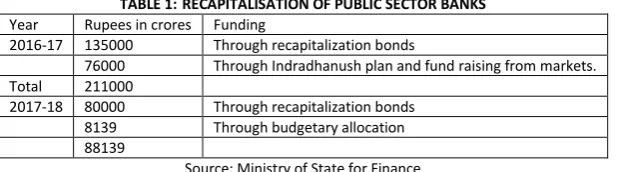
In India a vast majority of public sector banks are virtually doing the same business and competing for the same pie of customers since a long time. But this strategy could lower the return on the capital employed by the government. The government and RBI have also emphasized the changing face of banking marked by technological changes and are infusing capital periodically. The following table shows the recapitalization of public sector banks and Dena Bank, Vijaya Bank and Bank of Baroda in particular by the government:
V
OLUMEN
O.
9
(2019),
I
SSUEN
O.
06
(J
UNE)
ISSN 2231-5756
TABLE 1:RECAPITALISATION OF PUBLIC SECTOR BANKS
Year Rupees in crores Funding
2016-17 135000 Through recapitalization bonds
76000 Through Indradhanush plan and fund raising from markets.
Total 211000
2017-18 80000 Through recapitalization bonds
8139 Through budgetary allocation
88139
Source: Ministry of State for Finance
TABLE 2: RECAPITALISATION OF DENA BANK, VIJAYA BANK AND BANK OF BARODA (CAPITAL INFUSION FOR FINANCIAL YEAR 2018-19)
Bank Rupees in crore
Dena bank 5375
Vijaya Bank 3045
Bank of Baroda 1277
Source: Ministry of State for Finance
The Finance Minister giving the context of the merger of Dena Bank and Vijaya Bank with the Bank of Baroda has stated that bank lending was becoming weak, hurting corporate sector investments and these banks are in fragile condition due to excessive lending and increasing NPAs. The following table shows the bank financials of these three banks:
TABLE 3: BANK FINANCIALS AS ON 30-06-2018 (Rs. Crore)
Particulars Bank of Baroda Dena Bank Vijaya Bank Total
Deposits 581484 103020 157326 841830
Advances 414517 69917 119666 604101
Total Assets 714402 116925 177646 1008974
Total Income 50306 10096 14190 74592
Net Profit -2432 -1923 727 -3628
Gross NPAs 55875 15866 7579 79320
Net NPAs 22384 6704 4904 33992
Market capital 35741 3603 7799 47143
No. of employees 56361 13613 15874 85848
No. of branches 5573 1858 2129 9560
No. of ATMs 9615 1646 2171 13432
Gross NPAs in % 12.46 22.69 6.19 _
Capital Adequacr ratio (%) Basel III 12.13 10.60 13.91 _
Source: Ministry of State for Finance
All the above mentioned reasons have necessitated the merger of these banks putting an end to fragmentation. This merger will lead to economies of scale, huge customer base, 9489 branches, 87675 staff and to make Bank of Baroda a strong globally competitive bank.
SCHEME OF MERGER
In the process of merger, Dena Bank and Vijaya Bank will be the transferor banks and Bank of Baroda is the transferee bank. According to the scheme of merger, the fair equity share exchange ratio for the amalgamation is:
1. For every 1000 equity shares of Rs. 10 each of Vijaya Bank, 402 equity shares of Rs.2 each of Bank of Baroda will be issued.
2. For every 1000 equity shares of Rs. 10 each of Dena Bank, 110 equity shares of Rs.2 each of Bank of Baroda will be issued.
CHALLENGES BEFORE BANK OF BARODA
The merger of Dena Bank and Vijaya Bank will pose certain challenges to the Bank of Baroda. Some of the challenges the Bank of Baroda has to face are:
1. IT INTEGRATION
The financial implications of the merger would amount to several crores of rupees in terms of software upgradation as Vijaya Bank uses Finacle 10, while Bank of Baroda uses Finacle 7.
2. BUSINESS INTEGRATION
The Bank of Baroda has to undertake printing new stationery like cheque books, pass books, pay in slips, business cards and other establishment costs like new bill boards and advertisements and remodeling the branch interiors that match the Bank of Baroda schemes.
3. INCREASED COST OF BUSINESS OPERATIONS
The cost of business operations would increase as the bank has to switch over from the old IFSC to new IFSC codes. This requires additional man hours of work.
4. PROBLEM OF LAY OFF
The new Bank of Baroda entity cannot lay off the employees of Dena Bank and Vijaya Bank. This may result in the excess work force for similar jobs which would increase the operating costs.
5. CLOSURE OF BRANCHES
The merger may result in the closure of some branches. For instance, if the branches of Dena Bank and Vijaya Bank are located in the same territorial proximity, there would be overlap and therefore they may resort to closure of banks.
6. WORK CULTURE
The merger of Dena Bank and Vijaya Bank may cause difficulty for the employees of these banks to adjust to the work culture of Bank of Baroda.
CONCLUSION
V
OLUMEN
O.
9
(2019),
I
SSUEN
O.
06
(J
UNE)
ISSN 2231-5756
REFERENCES
1. Anand Manoj and Singh Jagandeep, Impact of merger announcements on shareholders wealth: Evidence from Indian Private sector banks. Vikalpa Journal
for Decision makers, Jan-March Vol-33, No.1, pp 35-54.
2. Article in Deccan Herald – Banking reform to perform by Girish Shivanna and Raghunandan Gopal.
3. Article in Deccan Herald dated January 7th, 2019 – Big bank merger: Remedy worse than the malady by S. Narendra
4. Awdeh. A. and E. Moussawi, Analyzing the motives and the outcomes of bank mergers. Middle eastern Finance and Economics. 15, 6-20.
5. Azeem Ahmed Khan, Mergers and Acquisitions in Indian Banking sector in post Liberalization Regime. International Journal of Contemporary Business Studies.
Vol-2, No.11, Nov 2011.
6. Pilloff, Performance changes and shareholder wealth creation associated with mergers of publicly traded banking institutions, journal of Money, Credit and
V
OLUMEN
O.
9
(2019),
I
SSUEN
O.
06
(J
UNE)
ISSN 2231-5756
AFFECTS OF PLASTIC MONEY ON DAY TO DAY LIFE OF A COMMON MAN
VANDANA SHARMA
ASST. PROFESSOR
SACHEDVA GIRLS COLLEGE
KHARAR
ABSTRACT
In this study we shall critically evaluate that how plastic money affects the day to day life of a common man. The development of plastic money is one of the recent phenomenons in the banking sector. Plastic money is changing the life style of common man and also makes them easy to use various banking products and services. The objective of providing this facility is to increase of convenience and security. The current study presents an overview of the development of banking in India from time to time specifically focused on the plastic cards usage trends since these have been introduced in Indian banking sector. Various types of plastic cards provided by banks in India like ATM cards, Debit Cards, Credit Cards and Smart cards have been discussed. The study also highlights the role of these cards as electronic payment tool to be used by customers and discusses clearing and settlement process of these cards. Some future plans made by various banks and institutions are also summarized in a way that it depicts the picture of its future growth and prospects in India.
KEYWORDS
plastic money, electronic banking, information technology.
JEL CODE
G21
INTRODUCTION
echnology has changed the way we deal with money giving us more convenience and easy access to funds from anywhere. It all started with a simple credit card that allowed you to make purchases today and pay later. Further, technological advancements lead to a new trend where most banks gave you one ATM card or debit card which can be used for withdrawing money as well as for making purchases or payments – offline as well as online. The development of plastic money is one of the recent phenomenon’s in the banking sector. It is a debt instrument issued by some specialised companies. It is one step forward towards cashless and cheque less society and economy. The operation of plastic money is through electronic funds transfer (EFT) installation and inter-bank network. Credit cards are key to opening of bank accounts for daily payments by the card holders. Credit card has been rightly called “PLASTIC MONEY”. The objective is to provide convenience, spread of banking facilities, and security to the common man. It eliminates negative consequences of cash transactions, eliminates black money, protect from the danger of pick pocketing a lot of cash. There is usually interest free credit for 30 to 45 days.
PLASTIC MONEY: SIGN OF MODERNISING ECONOMY
Money is always regarded as a medium of exchange and payment tool. Initially barter system was used as the significant mode of payment. Over the years, money has changed its form from coins to paper cash and today it is available in the form as electronic money and/or plastic card (Ramasamy et.al.2006). Hence, the major change in the banks which has been brought in by technology is through introduction of products which are alternative to cash or paper money. Plastic cards are one of those types of innovations through which the customer can make use of banking services just by owning the card issued by bank and that too without restricting himself in the official banking hours. Plastic cards were the component of e-banking has been in use in the country for many years now. However, the card -based usage has picked up only during the last five years. Payments by cards is now becoming a much preferred mode for making retail payments in the country (report on trend and progress of banking in India 2006-07, RBI). Thus plastic cards are such payments tool which gives a customer an opportunity of non cash payment of goods and services and are designed to facilitate small value retail payments by offering a substitute for bank notes and coins and thus to complement traditional payment instruments.
THE ROLE OF VARIOUS PARTIES INVOLVED IN PLASTIC CARDS PAYMENT
1. Customers or cardholder: the authorised person holding the card and use it for purchase of goods and services also. 2. Card issuing bank: the bank or institution which issues the card to its eligible customers.
3. Merchants: entities which sell the goods and services to the cardholder and duly agree to accept the card for payment.
4. Bank card association: the association (visa, master card, American express) These plastic cards have the photo identity and holders signature embossed on the card. It also has the issuing banks name and validity period card. The bank issuing the plastic money knows well the customer and his credit worthiness. Basically, the use of plastic money helps the holder to take advantage of two essential aspects of the financial services functions, first one is Transmission of payments and other is granting of credit.
TYPES OF CARDS
CREDIT CARDS
A credit card is a card or mechanism which enables a bank customer to purchase goods, travel and dine in a hotel without making immediate payments. Unlike debit cards, credit cards also provide overdraft facility and common man can purchase over and above the amount available in his account and thus regarded as authentic payment tool(mishra,2007). The holder a can use the cards to credit from banks upto 45 days. The credit card relives the common man from the
both-eration of keeping cash and thus ensures safety. It also provides convenience of an extended credit without formality. Thus, credit card is a passport to SAFETY,
CONVENIENCE, PRESTIGE & CREDIT. Interest charges are levied on the unpaid balance after the payment is due. Cardholders may pay the entire amount due and
save on the interest that would otherwise be charged. Equated monthly on instalments (EMI) scheme is also offered by some banks to the customers who make huge purchases so that they can feel convenient while paying back the outstanding amount (Vardhaman, 2008). Clearing and settlement through credit card is simple and reliable process in which bank plays a crucial role.
SMART CARD
A Plastic card containing a computer chip and enabling the holder to purchase goods and services enter restricted areas, access medical financial or other records or Performa other operations requiring data stored on the chip. Smart cards currently introduced by BRTS which stands for bus rapid transit services in Gujarat in India.
CHARGE CARD
A Charge card carries all the features of credit cards. However, after using a charge card you will have to pay off the entire amount billed, by the due date. If you fail to do so, you are likely to be considered defaulters and will usually have to pay up a steep late payment charge.
V
OLUMEN
O.
9
(2019),
I
SSUEN
O.
06
(J
UNE)
ISSN 2231-5756
AMEX CARDAMEX Stands for American express and is one of the well-known charge cards. This card has its own merchant establishment tie-ups and does not depend on the network of master card or visa.
MASTER CARD AND VISA
Master card and visa are global non-profit organisations dedicated to promote the growth of card business across the world.they have built a vast network of merchant establishments so that customer’s world –wide may use their respective credit cards to make various purchases.
DEBIT CARDS
Debit card is a magnetically encoded plastic card issued by banks, which replaced cash and cheques. It allows the customers to pay for goods and services without carrying cash with them. In some cases, debit card is multipurpose which can also be used as ATM for withdrawing cash and to check account balances. It is issued free of cost with saving or current account. Debit cards is one of the best online e-payment tool through which amount of purchase is immediately deducted from customer account and credited to merchant account provided if that much amount is available in customer account. It has overcome the delayed payment process of cheques, due to which sometimes merchant have to suffer. There are currently two ways that debit cards transactions are processed, first one is Online debit (also known as PIN) and other is offline debit (also known as signature debit).
ATM CARDS
These cards are typically used at automatic teller machines (ATMs)to withdraw cash, make deposits or transfer funds between the accounts. ATM card is used by inserting the card into automatic teller machine and enter a personal identification number or PIN, for security. The systems check the account for adequate funds before permitting any transaction.
PARTICULARS DISPLAYED ON THE PLASTIC CARD MONEY
Every credit card bears the following particulars:
1. NAME OF THE CUSTOMER: Every card displays the name of customer. It should be spelled correctly. In case, it does not, the customer can contact the customer
service cell/helpline and get the necessary correction done. This facility is provided free of cost by the bank.
2. 16 DIGIT CARD NUMBER: a unique 16 digit number is allotted to every customer /cardholder.
3. VALIDITY DATE: The card mentions the period through which it is valid. The card is usually valid from the date it is received by the customer upto and including
the last day of the month indicated on the card. After the card has to be renewed.
4. THE VISA HOLOGRAM AND THE VISA LOGO: the hologram and the logo ensure that all the establishments throughout the world displaying the visa logo will
accept the card.
5. NAME OF THE ISSUING BANK: The card indicates on the top the name of issuing bank.
6. SIGNATURE PANEL: The back of the card contains the signature panel. The customer must put his signature on signature panel to prevent misuse by any other
person. This identifies the card holder. Signature on the panel would imply that card holder has given his consent to abide by the terms and conditions governing the use of the credit card. The card is valid is only if signed.
7. MAGNETIC STRIP: the black magnetic strip contains important information in encoded from and needs special handily. The card should not be kept in an area
where there is a continuous magnetic field. It should be kept away from heat and direct sunlight.
8. PIN (PERSONAL IDENTIFICATION NUMBER): Each card holder is issued a password or pin to enable use of the card for accessing his/her card account on the
ATM and internet and also any privilege, benefit or service that may be offered by bank on the card. The pin is communicated to the card holder entirely at his/her risk who shall not disclose the pin to any person and shall take all possible care to avoid its discovery by any person. The card holder shall be liable for all transactions made with the use of the pin whether with or without the knowledge of the cardholder.
BENEFITS OF PLASTIC MONEY
Eliminates the need for carrying huge cash: This eliminates the need for carrying huge load of cash which is risky and inconvenient too.
Risk of Loss or Theft minimized: In case of cash there is a high risk of losing cash and a chance of cash getting stolen. However, in case of debit/credit card you can report the matter to the bank and block the card to avoid misuse.
Anytime/Anywhere Access Using cards you have the unique advantage and convenience of using it anywhere in the country or even abroad.
Credit Facility: In case of credit card you have the option of buying on credit or paying later. Although the charges are high, it helps you in case of emergencies and contingencies.
Online Payments: You can use cards for online payments, fund transfers and various other transactions.
DISADVANTAGES OF PLASTIC MONEY
Shops not accepting multiple Cards: There are numerous shops which accept credit cards of a specific company only. In this situation the cash is the only
way of payment for those who use a credit card of another company.
Non-Acceptance at Small Retail Outlets: Unless you are a person who shops only in supermarkets and hypermarkets you will be forced to use cash
Cannot be used for all daily needs: You cannot pay your milkman, servant, paper wala (newspaper guy), etc by card.
Loss & Misuse: Once a card is lost you have to immediately report it and get the card blocked to avoid misuse. Sometimes when you are not aware that you
lost the card….the chances of misuse is higher. However, today lot of checks and balances have been put in place. For instance, for debit card the customer has to key in the PIN for offline purchases, and additional passwords/authentication for online transactions. Even then taking precautions is absolutely necessary.
Low Value Transactions: As discussed above already there are cases where small and medium sized retailers don’t accept cards for low value transactions
(say less than Rs.200 or other criteria). You may have noticed this even in case of outlets like petrol pumps or restaurants.
Service Charges: In some cases, the outlets charge additional service charges for cards. So this can be another burden on your pocket.
Damage to Card: Sometimes the card’s magnetic strip gets damaged or scratches or cuts can render the card unusable. So keeping it safe and secure is very
important.
Carrying or Keeping the Card: Keeping the card and cash in the wallet together is like “inviting trouble”. This is the way everyone (including me) used to carry
cash and cards. But this means once you lose your wallet you lose everything. So here the card doesn’t come to your rescue after losing cash. The best practice is to keep cash and cards separately so that if you lose one you have the other to bank upon. By the way, nowadays I don’t carry cards in my wallet. It’s mostly in the bag or sometimes in a different pocket. You can try this or other methods but ensure that you don’t keep everything in one place and lose it all.
Overuse of Cards: I find that people who are finding cards as a convenient medium try to use it everywhere – left, right and centre. Further, they have 3-4
cards which are used one after the other at different places. I would advise them to have fewer transactions so that it is easier to keep a check on the transactions every month and easier to pay the bill as well.
Special Offers, Discounts: Some people have this fancy and think that they are smart when they get special discounts on cards at retail outlets. Ha ha ha