A Modified LEACH Routing Protocol in Terms of Lifetime Enhancement Schema
Comparative to PEGASIS Protocol in Wireless Sensor Networks (WSNs)
Author’s Details: Nusrat Jahan1, Md. Imran Hossain2
1
Student, Department of Information & Communication Technology, Comilla University Cumilla, Bangladesh – Email: [email protected]
2
Assistant Professor, Department of Information & Communication Technology, Comilla University Cumilla, Bangladesh Email: [email protected]
__________________________________________________________________________________________ Abstract
Wireless sensor network (WSN) is a dominant technology among different wireless communication technologies. It’s very important to maximize the lifetime of networks for better and long-term performance. However, the lifetime of a network depends greatly on the lifetime of the battery of related nodes. Generally, Sensor networks are limited in energy and, thus, require the use of routing protocols to minimize energy consumption. After a comparative study of the performance of two hierarchical routing protocols namely LEACH and PEGASIS, which indicates that PEGASIS has a longer lifetime than LEACH because of its low energy consumption techniques but has more delay, this paper presents a lifetime enhancement schema and a modified version of LEACH protocol to overcome the short lifetime problem of LEACH protocol comparative to PEGASIS protocol. The modified LEACH protocol increases the lifetime of the network by 300% more than that of the traditional LEACH protocol.
Keywords: WSNs, Routing Protocols, LEACH, PEGASIS, Modified LEACH.
__________________________________________________________________________________________
1. Introduction
lifetime and delay. There are various routing protocols and selecting an energy-efficient routing protocol is very important for WSNS to overcome energy consumption and lifetime problem [4].
The major contribution of this paper is the proposal of a new modified LEACH protocol that will increase the lifetime of a network system by 300% more than traditional LEACH protocol focusing on residual energy of the node.
The rest of the paper is organized as follows: Section 2 gives the basic knowledge of LEACH and PEGASIS routing protocol. Performance evaluation of LEACH and PEGASIS is explained in Section 3 and lifetime enhancement schema is explained in Section 4. Section 5 proposes and discusses a modified LEACH protocol and Section 6 concludes this paper.
2. Overview of LEACH and PEGASIS Routing Protocol
In WSN, routing protocols determine how different nodes communicate with each other to distribute the information through the network. The main reason behind the use of routing protocol is to ensure the successful transition of the packets from the source node to the sink or base station (BS). LEACH and PEGASIS are examples of hierarchical routing protocols.
A secure routing protocol should guarantee the Confidentiality, Integrity, Authenticity, and Availability. In this section hierarchical routing protocols namely LEACH and PEGASIS are described in detail.
2.1 LEACH (Low Energy Low Energy Adaptive Clustering Hierarchy) Protocol
LEACH is a hierarchical and cluster-based routing protocol in which a cluster head is selected to maintain the routing procedure. A network is divided into some clusters and each cluster has one cluster head. Cluster head performs the following task:
Collects data from the sensor nodes.
Sends the collected data to the sink node after the data aggregation process.
Creates a TDMA-based schedule where each node is assigned a time-slot used for data transmission [5].
Each cluster chooses a number between 0 and 1 and this number is compared with a threshold value, T(n), of a node. The cluster head is selected using this threshold value [6]. If the selected value is less than the threshold value, then the node becomes the cluster head, else it behaves as an ordinary node [7] [8]. Each node becomes a cluster head for a single round. The threshold value is given by the Eq. (1).
(1)
Here, p is the desired percentage of cluster heads (e.g. 0.05), r is the current round and G is the set of nodes that have not been cluster heads in the last 1/p rounds [8]. LEACH is completely a distributed network that requires no control information from the base station and no node requires the knowledge of the global network. The LEACH protocol is consists of two phases: Set-up phase and Steady phase.
Set-up phase has three fundamental steps:
Cluster head advertisement.
Creation of transmission schedule.
Steady-state phase focuses on:
Data collection.
Data Aggregation and
Delivery of the collected data to the base station.
There are three types of communications in the clustering mechanism: inter-cluster communication (cluster to clusters communication), intra-cluster communication (communication within a cluster), cluster-based communication (communication between CH and BS). Inter and intra-cluster communication require less amplification energy compared to cluster-based communication. Therefore, by keeping different amplification energy levels for inter and intra-cluster communication with respect to cluster-based communication type, the lifetime of sensor nodes can be improved [9].
2.2 PEGASIS (Power-Efficient Gathering in Sensor Information System) Protocol
PEGASIS protocol is also a hierarchical protocol that follows the chain-based approach and the greedy algorithm. The sensor nodes either organize themselves to form the chain or they use a greedy approach. If any of the nodes dies in between, then the chain is reconstructed to bypass the dead node. One chain-leader is selected for the chain. The chain-leader node will transmit the data to the base station (BS) [10]. The main goal of PEGASIS is to receive and transmit data to and from the nearest neighbor and take turns being the leader for transmission to the BS. Gathered data moves from node to node, get fused and eventually, a designated node transmits to the base station. Chain-leader is selected randomly. All the data is collected to the leader node, get fused and send it to the base station. PEGASIS performs data fusion at every node except the end nodes in the chain. Each node will fuse it's neighbor’s data with its own to generate a single packet of the same length and then transmit that to another neighbor [11].
3. Comparative Analysis of LEACH and PEGASIS Routing Protocol 3.1 Simulation Environment
MATLAB is used to simulate and analyze the performance of both LEACH and PEGASIS protocols. MATLAB is an interactive system whose basic data element is an array and it does not require dimensioning. It allows users to solve various technical and computing problems with matrix and vector formulations.
3.2 Simulation Parameters
In the simulation process, the following network parameters have been used:
Table 1 Simulation Parameters
Parameters Value
Simulation area (m) 100 x 100 Initial energy 0.25 j Number of nodes 50/100/150/200 Energy transmission (j) 50*10^(-9)
Energy reception (j) 50*10^(-9)
Simulator MATLAB
3.3 Simulation Result and Performance Analysis
Lifetime Analysis: The network lifetime is the number of rounds that can be determined as the start of the operation to the round that the last node dies. Network lifetime is divided into stability and instability period. The stability period is the number of the rounds started from the beginning of the operation until the first node of the network is dead. Where the instability period is the number of rounds when the first node dies in the network to the death of the last node in the network.
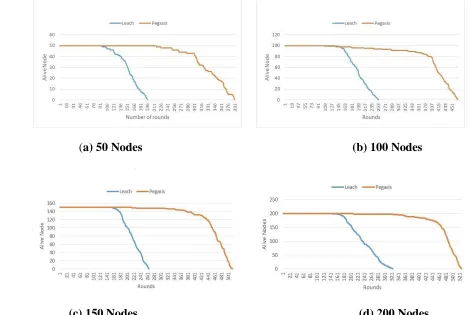
(a) 50 Nodes (b) 100 Nodes
(c) 150 Nodes (d) 200 Nodes Fig. 1 The lifetime of LEACH and PEGASIS protocols
The lifetime of both LEACH and PEGASIS protocols is given by Fig. 1. Where Fig.1 (a) shows the lifetime of both LEACH and PEGASIS using 50 nodes. The first node in the LEACH protocol dies at round 95, whereas the first node dies at round 226 in PEGASIS. This study shows that the PEGASIS protocol has a long stable period than the LEACH protocol and both LEACH and PEGASIS protocols have a network lifetime of 196 and 391 rounds respectively. This indicates that the lifetime of PEGASIS protocol is better than that of LEACH protocol. Fig.1 (b) shows the simulation result of the lifetime of LEACH and PEGASIS protocols for 100 nodes. Similarly Fig.1 (c) and Fig.1 (d) show the lifetime of LEACH and PEGASIS protocol for 150 and 200 nodes. The simulation result of the lifetime of both protocols using different numbers of nodes is shown in Table 2.
Table 2 Lifetime of LEACH and PEGASIS Protocols
Protocol 50 Nodes 100 Nodes 150 Nodes 200 Nodes
LEACH 196 rounds 253 rounds 261 rounds 321 rounds
Energy Consumption: In WSNs, if a node dies, the network loses control over the space, which was being sensed by that dead node. The death of that node creates a hole in the sensing field and the network will be incomplete. To avoid such situations, a network should monitor the energy consumption of each node. Energy consumption is an important issue for the longevity of the network and a node should not be consumed energy at such a rate that may harm the network. Fig. 2 shows the energy consumption of LEACH and PEGASIS protocols for 50, 100, 150 and 200 nodes. These indicate that the energy consumption of the LEACH protocol is much more than the PEGASIS protocol.
(a) 50 Nodes (b) 100 Nodes
(c) 150 Nodes (d) 200 Nodes Fig. 2 Energy consumption of LEACH and PEGASIS protocols
Delay: PEGASIS forms a single chain among the nodes. So it introduces excessive delay. But LEACH introduces less delay than PEGASIS. LEACH performs better than PEGASIS in terms of delay.
4. Proposed Lifetime Enhancement Schema of LEACH Protocol
In WSN data should reach the destination through the intermediate nodes. If the distance between intermediate sensor nodes and the sink is long, more energy is consumed. LEACH protocol has less network lifetime than PEGASIS. In this section, an enhancement schema is proposed to improve the lifetime of LEACH. Therefore, by reducing the distance between sensor nodes and sink, it is possible to increase the network lifetime of LEACH. The distance between sensor nodes and BS can be reduced by increasing the number of nodes in a particular area. When the number of nodes is increased, the distance will be reduced and will consume less energy for intra and inter-communication routing protocol.
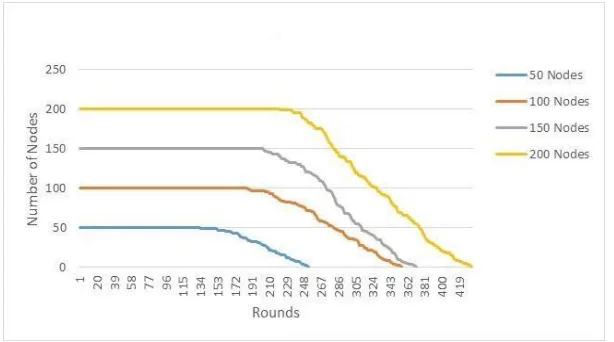
The simulation of the LEACH protocol at 0.05 probability is shown in Fig. 3 and Fig. 4. In LEACH, all nodes have the same energy (0.25 j). The network lifetime and energy consumption of LEACH protocol are simulated for 50, 100, 150 and 200 nodes. Fig. 3 shows the graphical representation of the result of the network lifetime of LEACH protocol that indicates that the lifetime increases if the number of nodes increases and Fig. 4 shows the energy consumption of LEACH protocol at 0.05 probability.
Fig. 3 Lifetime of LEACH protocol at 0.05 probability
Though this enhancement schema increases the lifetime of the network, it increases energy consumption as well. This requires to overcome the energy consumption problem for a better network lifetime. Considering the energy consumption problem, a modified LEACH protocol is proposed.
5. Proposed Modified LEACH Protocol
A new modified LEACH protocol is proposed to increase the lifetime of the LEACH protocol by considering the residual energy means the current energy of the node that reduces the energy consumption of the network. Residual energy affects the lifetime of wireless sensor networks. This energy considered during clustering and routing approached to maximize the network lifetime. To prolong the network lifetime, an efficient power control mechanism is used to reduce the power consumption in sensor nodes. In traditional LEACH protocol, the cluster head selection process depends on random probability, residual energy or current energy of node is not considered. A node will be cluster head if a random number generated by a node satisfies the following condition given by Eq. (2), discussed in LEACH protocol in section 2:
If (rand<= (p/ (1-p*mod(r, round (1/p))))) (2)
In our modified LEACH, the current node energy is considered and multiplied with the previous value used for cluster head selection in traditional LEACH protocol. Cluster head needs more energy than non-cluster head nodes. In the modified LEACH protocol, a node will be cluster head, which satisfies the condition given by Eq. (3).
If (rand<= (p/ (1-p*mod(r, round (1/p))))*current energy of the node / total energy of the network) (3)
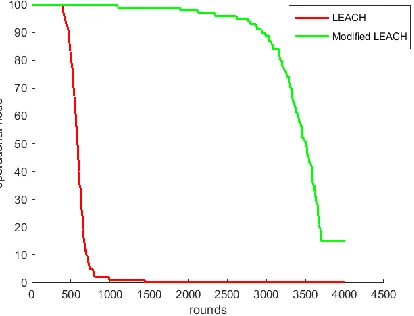
Fig. 5 Lifetime of LEACH protocol and modified LEACH protocol
Fig. 5 shows the comparison of the lifetime of modified LEACH and traditional LEACH protocol. The figure shows that the modified LEACH has a higher lifetime than the traditional LEACH protocol. The stable period of LEACH is at 365 round, whereas the stable period of modified LEACH is at 1131 round. The longer the stable period is, the better the performance of the network. Therefore, with a longer stable period, the Modified LEACH protocol gives a 300% increased lifetime than the traditional LEACH protocol.
5.1 Comparative Analysis of LEACH and Modified LEACH Protocol
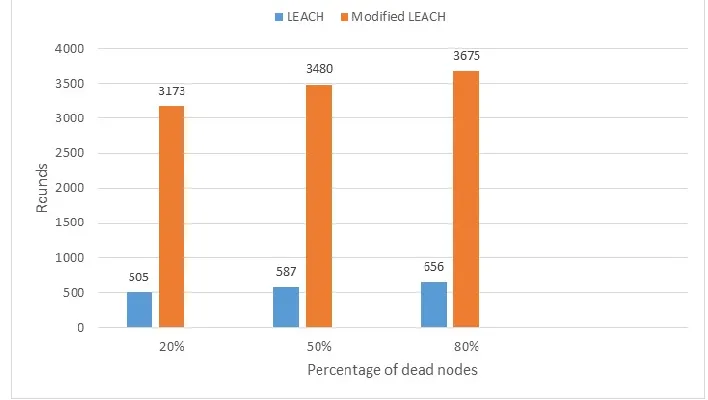
than a normal node to collect data from cluster members and then aggregate and transmit the collected data to the base station. Network lifetime is defined as the time from the beginning of the simulation to the time when the last node died. Fig. 6 shows a comparative analysis of LEACH and modified LEACH protocol according to the lifetime of the network. It gives the percentage of the dead nodes in different rounds. In LEACH, 80% nodes die at 656 round, but in modified LEACH, 80% nodes die at 3675 round, which indicates a 300% improvement in the lifetime of the network. In modified LEACH, residual energy is considered to increase the lifetime of the network with reduced energy consumption.
Fig. 6 Comparative analysis of LEACH and modified LEACH protocols
4. Conclusions
Wireless sensor network operates with the limited capacity of batteries and this energy limitation affects the overall performance of the network. The main challenges in designing a protocol for wireless sensor network is the consideration of the lifetime and energy efficiency due to the limited energy of the sensor nodes. The main purpose of using any routing protocol is to make the network as energy-efficient as possible to keep it running for a longer period. This paper presented the comparative study of LEACH and PEGASIS routing protocols describing the working process of these two routing protocols. The working process of these two protocols is simulated using MATLAB and the comparative study of the performance of these protocols is done based on the outcome of lifetime, energy consumption of the network and delays in transmission related to each protocol. The simulation shows that the PEGASIS protocol has a higher lifetime than LEACH protocol and even consumes less energy than LEACH protocol. However, in the LEACH protocol, the transmission delay is much lesser than the PEGASIS protocol which is a great characteristic of any network.
reducing the energy consumption and gives 300% better performance than the traditional LEACH protocol in terms of lifetime.
References
i. Shamsad Parvin and Muhammad Sajjadur Rahim, “Performance Evaluation of LEACH and PEGASIS: Two Prominent Routing Protocols for Wireless Sensor Networks”, National Conference on Electronics, Information and Telecommunication, 2007, University of Rajshahi, Bangladesh.
ii. Waltenegus Dargie and Christian Poellabauer, Fundamentals of Wireless Sensor Networks: Theory and Practice, John Wiley & Sons, 2011.
iii. S. R. Jino Ramson and D. Jackuline Moni, “Applications of Wireless Sensor Networks – A Survey”, in International Conference on Innovations in Electrical, Electronics, Instrumentation and Media Technology (ICEEIMT), 2017, pp. 325-329.
iv. Shijin Dai, Xiaorong Jing and Lemin Li, “Research and Analysis on Routing Protocols for Wireless Sensor Networks”, in International Conference on Communications, Circuits and Systems, 2005, vol. 1, pp. 407-411.
v. Meena Malik and Dr. Yudhvir Singh, “Energy Efficient Routing Protocols for wireless sensor network: A Survey”, NCACCNES, 2012.
vi. Chunyao FU, Zhifang JIANG, Wei WEI and Ang WEI, “An Energy Balanced Algorithm of LEACH Protocol in WSN”, IJCSI International Journal of Computer Science Issues, Vol. 10, Issue 1, No 1, 2013, pp. 354-359.
vii.Dipti Balkrushna Ram and Grishma Shailesh Kumar Shah, “Analysis of Different Hierarchical Protocol of Wireless Sensor Networks”, International Journal of Engineering Science Invention (ISNN), Volume 3, Issue 11, 2014.
viii. M. Younis, M. Youssef and K. Arisha, “Energy-Aware Routing in Cluster-Based Sensor Networks”, in IEEE International Symposium on Modeling, Analysis and Simulation of Computer and Telecommunications Systems (MASCOTSí02), 2002, Vol. 10.
ix. Muhammad Nasir Khan and Mohsin Jamil, “Performance Improvement in Lifetime and Throughput of LEACH Protocol”, Indian Journal of Science and Technology, Vol. 9, No. 21, 2016, pp. 1-6.
x. Di Tang, Tongtong Li, Jian Ren and Jie Wu, “Cost-Aware SEcure Routing (CASER) Protocol Design for Wireless Sensor Networks”, IEEE Transactions on Parallel and Distributed Systems, Vol. 26, Issue. 4, 2015, pp. 1-13.