______________
BENJAMIN G. BISHIN is an assistant professor of political science at the University of Miami in Coral Gables, Florida.
The American Review of Politics, Vol. 25, Fall, 2004: 201-220 ©2004 The American Review of Politics
The Validity and Accuracy of Commonly Used Ideology Measures:
A Consumer’s Guide
Benjamin G. Bishin
Are measures of legislator ideology derived from behavior accurate and valid? Past research says yes. However, the benchmarks used to reach these conclusions are often also based on legis-lators’ public actions. Non-ideological factors that cause legislators to take specific issue positions may be highly related across measures and mistakenly lead scholars to believe that action-based estimates are valid. This question is important because scholars frequently wish to use action-based ideology estimates as explanatory variables. Without independent validation, it is unclear whether the results of these studies are valid or the product of measurement error. Applying an ideological benchmark that is not based on legislators’ actions, I evaluate the validity of several commonly used ideology measures. The results show that action-based ideology measures produce valid estimates of legislator ideology.
Political ideology is central to the study of democratic representation and institutions. Measures of ideology are used to evaluate phenomena such as the degree to which congressional committees are representative of the chamber (e.g., Krehbiel 1990), whether judges vote their preferences or the facts (e.g., Brace and Gann Hall 1995), whether legislators in authoritarian regimes are career seeking (Desposato 2001), and to evaluate whether vari-ous institutions are becoming more or less conservative (e.g., Poole and Rosenthal 1997). Scholars continually develop new measures of ideology to examine a wide range of political phenomena (see for example, Brimhall and Otis 1948; Gage and Shimberg 1949; MacRae 1958; Carson and Oppen-heimer 1984; Poole and Rosenthal 1985; Krehbiel 1986; Levitt 1996; Hill, Hannah, and Shafquat 1997; Groseclose, Levitt, and Snyder 1999; Burden 2004).
This paper applies a sociological measure of ideology developed by Bishin (2003) to examine the characteristics of six commonly used legisla-tive ideology measures. The measure is based on the idea that an individ-ual’s attitudes and beliefs are shaped by their experience and group associations. A vast literature in sociology and social psychology is applied using a two-stage instrumental variable type procedure to develop action free ideology estimates that are comparable across politicians.
unobserv-able (e.g., Jackson and Kingdon 1992; Hall and Grofman 1990; Bianco 1994; Hill, Hannah, and Shafquat 1997; Londregan 2000). Consumers of these measures are left to wonder whether ideology measures are accurate. Most importantly, because many consumers wish to use ideology variables to explain legislator behavior it is important to determine whether commonly used measures are valid.
The distinction between public and private ideology is important for several reasons. First, a central theme in representation scholarship examines the degree to which legislators’ personal preferences drive their behavior. However, to use public ideology measures is to assume they do. Second, in some cases, public officials are not free to behave in a manner consistent with their personal preferences. This may occur, for instance, when legisla-tors accede to the pressure of party leaders or when cabinet officials toe the president’s agenda. Without measures distinguishing between public and private ideology there is no way to differentiate personal from private prefer-ences in these cases.
Measures of ideology are used almost interchangeably in studies of legislator behavior. Distinguishing between public and private ideology is a step toward gaining better understanding of commonly used tools. Despite the development of numerous measures of legislator preferences, scholars pay little attention to their measurement characteristics. Moreover, choices of which measure to use appear driven by convenience rather than by theo-retical or measurement considerations. These issues are particularly impor-tant given the problems identified with specific applications of particular measures (e.g., Hall and Grofman 1986; Jackson and Kingdon 1992; Bianco 1994; Londregan 2000). However, the distinction between public and private ideology can also be important for methodological reasons as well.
Action-based ideology measures are commonly used as explanatory variables in studies of legislator behavior. In virtually every study, action-based ideology measures are a significant influence on legislator behavior (e.g., Bernstein and Anthony 1974; Kau and Rubin 1979, 1993; Dennis 1988; Bernstein 1989; Cohen and Noll 1991; Kalt and Zupan 1984; Peltz-man 1984; Bailey and Brady 1998; Ansolabehere, Snyder, and Stewart 2001). However, the use of action-based measures in studies of legislator behavior is problematic since the unobserved influences on the ideology measure also influence the behavior being studied (Jackson and Kingdon 1992). Consequently, it is unclear whether the findings of these studies result solely from measurement error or whether such measures are even valid.
than the ‘structure’ that underlies it (Campbell et al. 1960). The disjuncture between the formal and operational definitions of ideology interferes with political analysis (Jackson and Kingdon 1992).
Scholars’ ability to evaluate ideology measures is hampered because virtually all existing measures are ‘action-based’; measures are constructed by relying on legislators’ public actions or behavior.2 Since politicians may behave strategically to gain political support, their public behavior need not reflect their private beliefs. Indeed, there is reason to believe that some poli-ticians may behave in a manner inconsistent with their beliefs in order to appeal to voters. Examples might be seen when a Catholic Democrat such as John Kerry votes the pro-choice position despite his personal belief that abortion is wrong (Seelye 2004) or when a conservative Republican supports farm subsidies.
This underlying commonality introduces two problems for scholars attempting to evaluate the efficacy of these measures. First, all measures based on visible, purposive behavior likely share the same biases. Evaluating one action-based measure with another overlooks problems that affect action-based measures as a group. Indeed, if action based measures are in-valid because of some lurking variable, then as the influence of that variable increases, our tests will show these measures to be increasingly related. This could lead to a paradox—the most highly related ideology measures may be least valid.3 Second, since most measures are action-based, there is no way to independently assess the validity of these commonly used ideology measures.4
To overcome these problems, I evaluate several commonly used ideol-ogy measures using a new measure that is not action-based. This paper eval-uates the validity of ideology measures independent of legislators’ public behavior (e.g., Fowler 1982; Smith, Herrera, and Herrera 1991; Burden, Cal-deria, and Groseclose 2000; Hill 2001). The results show that action-based ideology measures produce valid estimates of legislator behavior. Conse-quently, this research promises to aid scholars in the selection of ideology measures in their research.
This paper proceeds by describing a new ideological benchmark that is not based on legislators’ purposive behavior. Then, I evaluate the validity of the several commonly used ideology measures by comparing them to this benchmark. I conclude with a discussion of the conditions under which vari-ous action-based measures should be used.
FILTER: A Benchmark
ideology measures might appear valid simply because they share the same underlying influence—even if that influence leads to the invalidity. Conse-quently, to provide external validation, we need a new method of measuring ideology that is not action-based.
I overcome this problem, by applying a measure called FILTER (Bishin 2003). Instead of relying on legislators’ observed behavior to estimate ideol-ogy, FILTER exploits the socializing events that occur before legislators enter politics. FILTER is an acronym for Forecasting Ideology of Leaders’
Through Elite Response. Since attitudes and beliefs are largely a function of an individual’s background and experience, they can be used to forecast ideology. The primary assumption is that the process through which political elites are socialized is the same as legislators.6
Candidates for office are predominantly recruited from among the active political elite in the community. The similarity of the manner in which candidates for office and political elites develop is central to the FILTER methodology. An extensive literature on candidate recruitment supports this assumption, as scholars find that the vast majority of candidates for office are political elites who have previous involvement or contact with the party (e.g., Kazee and Thornberry 1990). Moreover, studies of political recruiters find that candidates that are recruited look much like the recruiters them-selves “. . . group affiliated recruiters overlook . . . community leaders in favor of those who have accumulated direct political experience through service on local governmental boards and commissions” (Hunt and Pendley 1972, 437). These findings provide the basis for using surveys of political elites to generate forecasts that can be applied to legislators.7
Scholars have long used instrumental variables type techniques to esti-mate phenomena that are otherwise unobservable (e.g., Berelson, Lazarsfeld, and McPhee 1954; Petrocik 1991). Similar methods have also been used to simulate public opinion (Seidman 1975).8
I use a three-step process to estimate FILTER scores. First, variables that influence attitudes and behavior are used to estimate a regression model (run on non-elected elites) with ideological self-placement as the dependent variable.9 Elite data is obtained from Party Elites in the U.S., 1984: Repub-lican and Democratic Party Leaders.10 Second, data on the background characteristics used to estimate the first model is collected for legislators. In step three, the coefficients obtained from the elite regression model is applied to legislators’ background data to generate an ideological forecast for legislators.
systems are shaped largely in response to their environment. Consequently, by identifying commonalities in their background we can draw inferences about their beliefs. Unfortunately, while a vast literature identifies numerous variables that influence belief systems, only a handful are available in stud-ies of political elites. The variables included in this model emanate from three sources of influence.
Family values and economic conditions are a major influence on attitudes (Sherif and Cantril 1947; Lazarsfeld, Berelson, and Gaudet 1947; Campbell et al. 1960; Key 1963; Hyman 1969; Franklin 1984; Reeher 1996; Jennings and Stoker 1999). The model includes whether the respondent is a farmer or rancher, and whether the respondent is single or divorced.11 Farm-ers and ranchFarm-ers have long been associated with property rights and been shown to be more conservative (e.g., Rice 1924; Merelman 1969; Herzon 1980).
Political events and group membership as well as physical character-istics, influence beliefs (e.g., Berelson, Lazarsfeld, and McPhee 1954, 54). Specifically, the experiences individuals with the same physical character-istics share lead to common attitudes. Measures of education, whether the individual grew up during the Great Depression, or lives in the south or northeast, and their party affect account for these influences.12 Research shows that liberalism increases with education (e.g., Centers 1961). While conservatism increases slightly with age, those socialized during the great depression tend to be more liberal as do those who grow up in the northeast (e.g., Rosenstone and Hansen 1993; Jennings and Stoker 1999). Southerners tend to be more conservative (e.g., Nie, Verba, and Petrocik 1979). Gender and race reflect important differences that influence attitudes (Centers 1961; Page and Shapiro 1992). More specifically, women and African-Americans tend to be more liberal (Campbell et al. 1960).
The precise statistical specification of the model applied herein is taken directly from past research on ideology formation and is depicted in Table 1. The coefficients are all significant and signed in the expected direction. Not surprisingly, increased age, being a Republican, a farmer, or from the south are all associated with increased conservatism. This model is then used to forecast ideology for the 101st Senate, which is the comparison group for all of the measures evaluated herein.13
Table 1. Elite Model Used to Generate FILTER Scores and Standard Errors for the 101st Senate
Variable Estimate
Intercept 2.652***
.0985
Education –.0586***
.0115
Gender –.175***
.0328
South .2671***
.0339
North –.1933***
.0444
Divorced –.1414*
.0628
Single –.3127***
.0602
Farmer .1482*
.065
Black –.2036***
.0783
Party 1.131***
.0315
Age .0036*
.0017
Depression –.1288*
.0629
N 1972
Adjusted R2 .48
*p < .05; **p < .01; ***p < .001
of member’s ideological self-placement on a seven point ideological scale. While the power of these tests are limited by the small samples, the strong positive relationship between the two measures across both chambers and time is especially impressive given that both measures are based on opinion data, a source often thought to be noisy.
Action-Based Ideology Measures
In this section I describe six ideology measures classified into three general categories: spatial models, interest group ratings, and news con-tent ratings. While dozens of ideology measures exist, these measures are selected because they are most commonly used. The criteria used to assess each measure are based on the concept of convergent validity, one implica-tion of which is that two valid measures of the same concept should be highly related (Campbell and Fiske 1959; Adcock and Collier 2001). The accuracy is defined as the degree to which ideology measures conform to a model or true value (Websters 2004). I assess accuracy by evaluating the degree to which the predictions made by each of the measures is close to the FILTER benchmark.
Spatial Models: NOMINATE
NOMINATE scores estimate legislators’ ideological location by iden-tifying their distance from a cut point using an multidimensional spatial model (Poole and Rosenthal 1985, 1997). Since the NOMINATE procedure uses virtually all non-unanimous votes to estimate legislators spatial loca-tions, it results in a virtually continuous ideology spectrum. The use of such a large number of votes also allows it to overcome selection bias that may afflict other ideology measures (Fowler 1982).14 Overall, research suggests NOMINATE has excellent relative measurement characteristics (Burden, Calderia and Groseclose 2000).
Interest Group Ratings: ADA, ACU, and Residualized Scores
to publicize the groups’ friends and enemies. Indeed, Brunell, Koetzle, Dinardo, Grofman, and Feld (1999) find that interest groups discriminate well only among their friends, while lumping their enemies together at the bottom of their scales.16 Thus, the votes selected for inclusion are not repre-sentative of legislators’ overall behavior.
Roll call vote based measures are frequently inapplicable to some of the most important questions scholars wish to study. Vote-based measures are biased when applied to studies of legislator roll call voting (Jackson and Kingdon 1992). This occurs because the votes used to estimate ideology produce an independent variable with non-random measurement error. This error is correlated with the behavior being studied—usually a roll call vote.
In an attempt to overcome these problems, scholars refine interest group ratings by estimating the residuals from a regression with an interest group rating as the dependent variable (e.g., Carson and Oppenheimer 1984; Kau and Rubin 1979; Kalt and Zupan 1984; Uslaner 1999). This procedure reduces measurement error in the ideology variable.17 However, the validity of these measures are seldom examined. In order to generate residualized ADA and ACU scores used in this paper, I estimate the models shown below:
ADA = α + β1*Party + β2*Ideology + β3*Exports + β4*Education + β5*Union + ε ACU = α + β1*Party + β2*Ideology + β3*Exports + β4*Education + β5*Union + ε
The independent variables used are typical of those seen in the congressional representation literature. The results are in shown in Appendix B. Residuals from the results of these models are used a measure of legislator ideology.
News Content Ratings
Evaluating Ideology Measures
To examine their validity, I obtained scores for the six measures and FILTER for the 101st Senate (1989). This Senate is chosen because it is the only year and chamber for which all of the measures are available. I examine the general validity of the measures using scatterplots and correlations. Then, I examine the relative accuracy of the measures by comparing their mean squared error and the degree to which they produce large outliers. Using the FILTER benchmark, the results show that action-based measures produce valid estimates of legislator ideology.
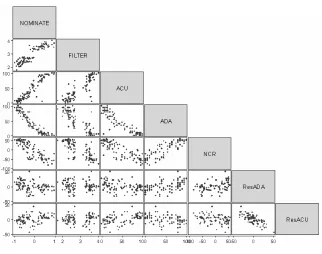
The relationship between FILTER and various ideology measures is depicted in the scatterplot matrix seen in Figure 1. This figure shows that the quality of the predictions varies substantially. The most clearly linear pattern is between FILTER and NOMINATE. This plot has both the tightest fit around the line, and exhibits the fewest outliers. However, we also see a clear distinction between the ideology of members of the two parties. The strength of the relationship is further illustrated by the fact that the most liberal senator according to FILTER, Barbara Mikulski (D–MD), is the third most liberal according to NOMINATE. Similarly, Jesse Helms (R–NC), the most conservative senator according to FILTER is the third most conservative according to NOMINATE.
ADA and ACU also appear linearly related to FILTER. Interestingly, ACU scores depict several extreme outliers that are not present in the plot for ADA. Clearly, the worst plots are FILTER with residualized ADA and ACU and the NCR scores. These plots show large numbers of points with a wide, almost random, spread. Of particular interest is the gap between the parties in all of the plots. While the continuity of the measures vary, taken in combination, these gaps appear to reflect the substantial partisan polarization (Poole and Rosenthal 1997; Jacobson 2003). However, even in these plots there is a clear relationship between the measures.20
Due to their differing scales these plots tell us little about how well each measure predicts personal ideology. Table 2 shows a matrix of correla-tion coefficients that confirms the scatterplots.
Three of the five measures are strongly and significantly associated with FILTER. Generally these results meet our expectations raised from the plots. NOMINATE correlates most highly (.91) while the residual interest group ratings exhibit little relationship. Not surprisingly, ACU and ADA scores correlate similarly with FILTER. Also, the NCR measure does reasonably well.
Figure 1. Scatterplot Matrix of Ideology Measures
Table 2. Correlation Matrix of Ideology Measures
–Residualized–
ACU ADA NOMINATE NCR ACU ADA FILTER
ACU 1.00
ADA –.95 1.00
NOMINATE .96 –.94 1.00
NCR –.85 .86 –.84 1.00
Residualized ACU .40 –.36 .30 –.41 1.00 Residualized ADA –.28 .43 –.26 .42 –.73 1.00
measures may produce artificially high correlations is unfounded. While the vote based measures correlate more highly with each other than they do with NCR or FILTER, these differences are small. The standard vote based mea-sures correlate more highly with FILTER than they do with NCR. However, the residualized interest group ratings fare especially poorly. Not only is the correlation with FILTER close to zero, but each of these measures correlates only modestly with the original rating, suggesting that the quality of these measures are substantially denuded through the residualization process. In-deed, these results further augment Uslaner’s (1999) conclusion that ideol-ogy has little impact on legislator behavior once the constituency influences are removed by suggesting that this occurs because there is little ideology left once these influences are removed. While the scatterplots and correla-tions provide insight into the general validity of the measures, they only hint at their relative validity.
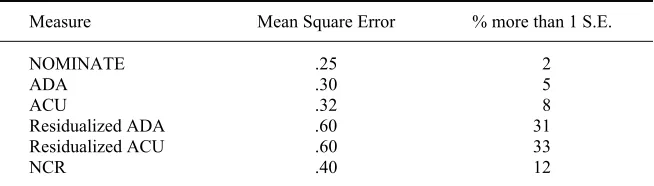
Two additional tests illustrate the accuracy of the measures. First, I calculate the mean squared error statistic for each association. The mean squared error gives us a good idea of the overall accuracy of the measures, by telling us how far off the measure is on average. However, any given mean squared error could result from either many estimates that are far off the mark, or a relatively small number of extremely large errors. Conse-quently, I perform a second test, by examining the degree to which the vari-ous measures produce extreme predictions of individual senators’ ideology.
The nature of the errors is examined by constructing confidence inter-vals around the FILTER estimates using the standard error of each FILTER prediction. Specifically, by regressing FILTER on each of the measures, we are able to calculate predicted values for each legislator on each measure. The degree to which the various measures suffer from prediction extremism can be evaluated by examining the proportion of cases in which the pre-dicted value for each observation falls within one standard error on either side of the FILTER score.21 The mean squared error and prediction extrem-ism results are seen in Table 3.
Table 3. Mean Squared Error and Percent of Cases Falling Out of Confidence Interval
Measure Mean Square Error % more than 1 S.E.
NOMINATE .25 2
ADA .30 5
ACU .32 8
Residualized ADA .60 31
Residualized ACU .60 33
NCR .40 12
interest group ratings. Overall, the residualized interest group ratings fare the worst. They have both the largest MSE and the largest number of extreme outliers.23
Discussion and Conclusion
This paper evaluates the validity of commonly used ideology measures by comparing them to FILTER scores, an exogenous benchmark that is not based on legislators’ public behavior. FILTER uses legislators’ background characteristics to predict their ideology. The results show that action-based measures of legislator ideology are accurate and valid. While the relative accuracy varies, the differences are relatively small. Excepting the NCR, because, This research suggests that excepting the residualized interest group ratings, measure selection should be based primarily on theoretical considerations because the measurement characteristics are so similar.
These results suggest that the findings for legislator ideology in studies of legislator behavior are unlikely to result solely from measurement error. Indeed, this is not surprising given citizens’ low levels of knowledge and lack of meaningful preferences on a wide variety of issues. The lack of citi-zen knowledge means that on many issues legislators have to rely on other decisional cues. Personal ideology seems as reasonable as any. To the extent that a legislator’s ideology is similar to that of their constituents, acting on the basis of ideology may provide accurate estimates of what constituents are likely to prefer. Indeed, these results also suggest that legislator ideology is quite similar to constituent ideology.
described using NOMINATE scores. However, in studies of an individual legislator’s behavior, action-based measures ought to be avoided all together. In such cases, FILTER scores might be used. Moreover, the results of this study suggest that FILTER type scores might also be constructed for estimating the ideology of members of other institutions such as judges and administrators, groups individuals for whom roll call vote positions do not exist and media coverage tends to be limited.
Once a particular class of measures is identified, scholars should con-sider their relative accuracy. Overall, this paper shows that NOMINATE scores are more accurate than other measures of public ideology. NOMI-NATE scores have the smallest MSE and generate the fewest large errors. Importantly, scholars who choose to use interest group ratings should recog-nize that a substantial loss in accuracy from the residualization process may attend. Residualized ADA and ACU scores both bear little resemblance to their base measures and should be avoided. News content ratings are less accurate than vote based measures.
Importantly, the results here show that the measures examined here are reasonable proxies for unobservable ideology. However, because they are proxies, measurement error still exists and it most certainly affects the results of studies of legislator behavior (Londregan 2000; Jackson and King-don 1992). Future research should investigate the degree to which action based measures overstate the influence of legislator ideology in such studies.
This study should not be overly generalized, however. The results pre-sented herein are based on examination of only the 101st Senate. Future work should evaluate the degree to which the relative measurement charac-teristics vary across chambers and years. While the results confirm past findings concerning NOMINATE, this caveat applies primarily to the evalu-ation of the relative measurement characteristics of interest group rating based measures.
In summary, this research shows that excepting the residualized interest group ratings, the validity of the measures is similar. Measure selection should be guided by the intended application. In cases where all other factors are equal, measures should be selected on the basis of their accuracy. In these cases it appears that NOMINATE scores provide the most accurate estimates of legislator ideology.
Appendix A. Coding and Explanation of Variables in the Forecast Model
Appendix A (continued)
Dependent Variable: Ideological Self Placement 1 Very Liberal
2 Liberal 3 Moderate 4 Conservative 5 Very Conservative
Independent Variables
Education: 1 H.S. or less, 2 Some college, 3 B.A. or B.S., 4 MA, 5 Professional Degree (JD, MBA), 6 PhD, MD
Gender: 0 Male, 1 Female
Southern State: 0 Non-south, 1 South Northern State: 0 Non-Northern State, 1 North Divorced: 0 Not Divorced, 1 Divorced Single: 0 Not Single, 1 Single
Farmer or Rancher: 0 Other, 1 Farmer or Rancher Black: 0 Not black, 1 Black
Party: 0 Democrat or Independent, 1 Republican Age: Coded in years.
Depression (grew up during): 1 if born between 1905 and 1920, else 0.
Appendix B. Regression of ADA and ACU Scores on Constituency Characteristics
ADA ACU
Intercept 27.04 73.52***
(14.83) (13.16)
Party 49.83*** –55.56***
(3.62) (3.21)
Ideology –1.14*** .865**
(.341) (.303)
Economy –20.18 –24.17
(Exports/GSP) (50.91) (45.20)
Union 49.18 –62.07*
(29.06) (25.80)
Education .19 10.38
(32.30) (28.68)
N 96 96
Adjusted R2 .75 .81
higher scores reflect increased conservatism. Economy is measured by dividing each state’s exports in a year by the size of its economy to obtain a per capita measure of the impact of exports to the economy. Union and Education variables reflect the percentage of the state that belongs to a labor union and who holds a Bachelors degree, respectively.
NOTES
1The distinction between ‘public’ and ‘private’ ideology is important and often overlooked. The term ‘public ideology’ refers to a politician's ‘operative preferences’ (e.g., Farris 1958; Burden, Calderia, and Groseclose 2000). Public ideology reflects the choice an individual makes given a particular set of conditions. In contrast, the term ‘personal' or 'private ideology’ reflects an individual’s private beliefs or personal values. These values need not be reflected by behavior (Hall 1996).
2There are three exceptions. First, Burden, Caldaria, and Groseclose (2000) and Hill (2001) both use the results of a 1982 CBS / New York Times senate poll. Second, Smith, Herrera, and Herrera (1991) administered their own poll of about 120 House members. Finally, Jackson and King (1989) apply a measure based on race and age.
3For instance, if ideology measures based on speeches or roll call votes are influ-enced by some non-ideological factor like interest groups, political parties or even current events, then high correlations across measures may simply reflect commonality among these other influences.
4Measures that are not action-based are available for only individual years (e.g., Smith, Herrera, and Herrera 1991; Burden, Calderia, and Groseclose 2000; Hill 2001). This precludes their wide application and often, their use in studies designed to validate more widely used measures.
5NOMINATE scores, perhaps the most widely used ideology proxy estimate ideol-ogy using a spatial model based on legislators’ roll call votes. In contrast, the ideolideol-ogy scores developed by Hill, Hannah, and Shafquat (1997) rely exclusively on legislators’ public statements prior to their first Senate campaign. Interest groups usually rate legislators based on how frequently they agree on the 20 or so votes they deem important.
6Consequently, the underlying logic of the model applied herein is similar (though theoretically and methodologically distinct) to one of the measures applied by Hill (2001). The primary difference is that one measure applied by Hill estimates state elite ideology by party, while FILTER generates individual estimates of ideology using a sample of elites.
7Even were candidates not recruited from among the politically active, this analysis assumes only that (elite) candidates ideologies are formed in the same manner as are the ideologies of other (elite) non-candidates.
8However, this measure avoids the criticisms that limit opinion simulation by applying the multiple regression framework as Seidman suggests (see Seidman 1975, 339).
9The results are robust to the choice of estimator. OLS is used rather than ordered probit or logit because the data generating process—the manner in which ideology is formed—is thought to be continuous. The ordinality observed in the data is an artifact of the instruments used to collect the data.
had no reason to lie about their ideology since they were not themselves candidates for office.
11Other appropriate variables falling into this category, such as income and religion, are unavailable in the elite sample. Consequently, coefficients for these variables cannot be obtained from this data set.
12The inclusion of party is controversial. Research shows that the development of party identification precedes that of political ideology (Jennings and Neimi 1968; Merel-man 1969). Moreover, the model predicts well within parties suggesting that party alone does not determine the forecast (Bishin 2003).
13Research on the FILTER methodology shows that estimates based on the elite background data are valid over time. Specifically, the FILTER estimates based on 1984 elite data are valid and reliable predictors of legislator ideology in 1980 and 1987, the two years on which the elite data has been validated (Bishin 2003).
14NOMINATE is still subject to other biases, which decrease inversely with the number of other legislators (Poole and Rosenthal 1997; Londregan 2000).
15The mechanics vary slightly across groups. For instance, the ACU does not count absences against a legislator while the ADA does.
16Occasionally votes are selected to get members to change their votes (Fowler 1982).
17While this process may reduce the error in variables problem, it does not com-pletely overcome it. See the Appendix in Jackson and Kingdon 1992.
18Similar measures have been developed to estimate the ideology of members of the judiciary (e.g., Segal and Cover 1989).
19Of course, NCR scores are likely the subject of different types of bias. In particu-lar, they are likely to be biased by issue saliency. Newspapers are more interested in covering the extreme event rather than the mundane every day issue position reported by the candidate. Additionally, the candidate also can decide what they talk about publicly, which is another source of bias.
20The gap observed in many of the plots results from the bimodal distribution of the variables. This gap is the product of party differences in the measures and likely polariza-tion of senators. While all of the measures examined here are bimodal to varying degrees, the effect is especially pronounced in FILTER as it exploits party affiliation to help esti-mate ideology. See footnote 7 infra.
21The one standard error criteria is applied because we are attempting to find cases where the action-based measures poorly predict individual legislator’s scores. The stan-dard errors used are for the individual FILTER point forecast and are thus fairly large.
22ADA scores appear to be slightly more accurate than ACU since they have both a slightly smaller mean squared error, and about 15% fewer extreme outliers.
REFERENCES
Adams, Greg D., and Chris Fastnow. 1998. On the Difference Between Legislative Ideol-ogy Measures. Presented at the annual meeting of the Midwest Political Science Association. Chicago.
Adcock, Robert, and David Collier. 2001. Measurement validity: A Shared Standard for Qualitative and Quantitative Research. American Political Science Review 95:529-546.
Ansolabehere, Stephen, James M. Snyder Jr., and Charles Stewart. 2001. The Effects of Party and Preferences on Congressional Roll Call Voting. Legislative Studies
Quarterly 26:533-572.
Bailey Michael, and David Brady. 1998. Heterogeneity and Representation: The Senate and Free Trade. American Journal of Political Science 42:524-544.
Berelson, Bernard R., Paul F. Lazarsfeld, and William N. McPhee. 1956. Voting. Chicago: University of Chicago Press.
Bernstein, R.A. 1989. Elections, Representation and Congressional Voting Behavior: The
Myth of Constituency Control. New Jersey: Prentice Hall.
Bernstein, Robert, and William Anthony. 1974. The ABM Issue in the Senate, 1968-1970: The Importance of Ideology. American Political Science Review 68:1198-1206. Bianco, William T. 1994. Trust: Representatives and Constituents. Ann Arbor:
Univer-sity of Michigan Press.
Bishin, Benjamin G. 2003. Independently Validating Ideology Measures: a look at NOMINATE and Adjusted ADA Scores. American Politics Research 31:404-425. Brace, Paul, and Melinda Gann Hall. 1995. Studying the Courts Comparatively: The
View from the American States. Political Research Quarterly 48:31-42.
Brimhall, Dean R., and Arthur S. Otis. 1948. Consistency of Voting by Our Congress-men. Journal of Applied Psychology 32:1-14.
Brunell, Thomas L., William Koetzel, John Dinardo, Bernard Grofman, and Scott L. Feld. 1999. The R2=.93: Where Then Do They Differ? Comparing Liberal and Conservative Interest Group Ratings. Legislative Studies Quarterly 24:87-101. Burden, Barry C. 2004. Candidate Positioning in U.S. Congressional Elections. British
Journal of Political Science 34:211-227.
Burden, Barry C., Gregory A. Caldeira, and Tim Groseclose. 2000. Measuring the Ideol-ogies of U.S. Senators: The Song Remains the Same. Legislative Studies Quarterly
25:237-258.
Campbell, Angus, Philip E. Converse, Warren E. Miller, and Donald E. Stokes. 1960.
The American Voter. Chicago: University of Chicago Press.
Campbell, Donald T., and Donald W. Fiske. 1958. Convergent and Discriminant Valida-tion by the Multitrait-Multimethod Matrix. Psychological Bulletin 56:81-105. Carson, Richard T., Joe A. Oppenheimer. 1984. A Method for Estimating the Personal
Ideology of Political Representatives. American Political Science Review 78:163-178.
Centers, Richard. 1961. The Psychology of Social Classes. New York: Russell and Russell.
Cohen, Linda R., and Roger G. Noll. 1991. How to Vote, Whether to Vote: Strategies for Voting and Abstaining on Congressional Roll Calls. Political Behavior 13:97-127. Dennis, Christopher D. 1988. The Revenue Side of Budgetary Politics: The Impact of
Desposato, Scott. 2001. Legislative Politics in Authoritarian Brazil. Legislative Studies
Quarterly 26:287-320.
Erikson, Robert S., Gerald C. Wright, and John P. McIver. 1993. Statehouse Democracy:
Public Opinion and Policy in the American States. Cambridge: Cambridge
Univer-sity Press.
Farris, Charles D. 1958. A Method for Determining Ideological Groupings in Congress.
Journal of Politics 20:308-338.
Fowler, Linda L. 1982. How Interest Groups Select Issues for Rating Voting Records of Members of the U.S. Congress. Legislative Studies Quarterly 7:401-414.
Franklin, Charles H. 1984. Issue Preferences, Socialization, and the Evolution of Party Identification. American Journal of Political Science 28:459-478.
Franklin, Charles H. 1989. Estimation Across Data Sets: Two Stage Auxiliary Instru-mental Variables Estimation (2SAIV). Political Analysis 1:23-40.
Gage, N.L., and Ben Shimberg. 1949. Measuring Senatorial ‘Progressivism’. Journal of
Abnormal and Social Psychology 44:112-117.
Groseclose, Tim, Steven D. Levitt, and James M. Snyder Jr. 1999. Comparing Interest Group Scores across Time and Chambers: Adjusted ADA Scores for the U.S. Congress. American Political Science Review 93:33-50.
Hall, Richard, and Bernard Grofman. 1990. The Committee Assignment Process and the Conditional Nature of Committee Bias. American Political Science Review 84: 1149-1166.
Herron, Michael C. 1999. Artificial Extremism in Interest Group Ratings and the Prefer-ences versus Party Debate. Legislative Studies Quarterly 24:525-542.
Herzon, F. 1980. Ideology, Constraint, and Public Opinion: The Case of Lawyers.
Ameri-can Journal of Political Science 24:233-258.
Hill, Kim Quaile. 2001. Multiple-Method Measurement of Legislators’ Ideologies.
Legis-lative Studies Quarterly 26:263-274.
Hill, Kim Quaile, Stephen Hannah, and Sahar Shafquat. 1997. The Liberal-Conservative Ideology of U.S. Senators: A New Measure. American Journal of Political Science
41:1395-1413.
Hunt, A. Lee Jr., and Robert E. Pendley. 1972. Community Gatekeepers: An Examina-tion of Political Recruiters. Midwest Journal of Political Science 16:411-438. Hutchings, Vincent L. 1998. Issue Salience and Support for Civil Rights Legislation
Among Southern Democrats. Legislative Studies Quarterly 23:521-544.
Hyman, Herbert H. 1969. Political Socialization: A Study in the Psychology of Political
Behavior, 2d ed. New York: The Free Press.
Jacobson, Gary C. 2003. Terror, Terrain and Turnout: Explaining the 2002 Midterm Elections. Political Science Quarterly 118:1-22.
Jackson, John E., and David C. King. 1989. Public Goods, Private Interests and Repre-sentation. American Political Science Review 83:1143-1164.
Jackson, John E., and John W. Kingdon. 1992. Ideology, Interest Group Scores and Legislative Votes. American Journal of Political Science 36:805-823.
Jennings, M.K., and R.G. Niemi. 1968. The Transmission of Political Values form Parent to Child. American Political Science Review 62:169-184.
Jennings, M. Kent, and Laura Stoker. 1999. The Persistence of the Past: The Class of 1965 Turns Fifty. Presented at the annual meeting of the American Political Sci-ence Association, Atlanta, GA.
Kau, James B., and Paul H. Rubin. 1979. Self Interest, Ideology, and Logrolling in Con-gressional Voting. Journal of Law and Economics 22:365-384.
Kau, James B., and Paul H. Rubin. 1993. Ideology, Voting and Shirking. Public Choice
76:151-172.
Kazee, Thomas A., and Mary C. Thornberry. 1990. Where’s the Party? Congressional Candidate Recruitment and American Party Organizations. Western Political
Quarterly 43:61-80.
Key, V.O. 1963. Public Opinion and American Democracy. New York: Knopf.
Krehbiel, Keith. 1986. A Technique for Estimating Congressmen's Ideal Points. Journal
of Politics 48:97-115.
Krehbiel, Keith. 1990. Are Congressional Committees Composed of Preference Outliers?
American Political Science Review 84:149-163.
Lazaerfeld, Paul F., Bernard Berelson, and Hazel Gaudet. 1948. The Peoples Choice, 2d ed. New York: Columbia University Press.
Lebo, Matthew, and Adam McGlynn. 2004. The Dynamic of Party Unity: Party Compe-tition Models of Congressional Voting. Presented at the annual meeting of the Mid-western Political Science Association.
Levitt, Steven D. 1996. How Do Senators Vote? Disentangling the Role of Voter Prefer-ences, Party Affiliation and Senator Ideology. American Economic Review 86:425-441.
Londregan, John. 2000. Estimating Legislators’ Preferred Points. Political Analysis 8:35-56.
MacRae, Duncan. 1958. Dimensions of Congressional Voting: A Statistical study of the House of Representatives in the 81st Congress. Berkeley: University of California Press.
Merelman, R. 1969. The Development of Political Ideology: A Framework for the Analy-sis of Political Socialization. American Political Science Review 63:750-767. Miller, Warren E., Donald R. Kinder, Steven J. Rosenstone, and the National Election
Studies. 1988, 1990, 1992. American National Election Study: Pooled Senate
Elec-tion Study [Computer File]. 2nd release. Ann Arbor, MI: University of Michigan,
Center for Political Studies [producer], 1993. Ann Arbor, MI: Inter-University Consortium for Political and Social Research [distributor], 1993.
Miller, Warren, and Donald E. Stokes. 1963. Constituency Influence in Congress.
Ameri-can Political Science Review 57:45-56.
Nie, Norman N., Sidney Verba, and John R. Petrocik. 1979. The Changing American
Voter. Chicago: University of Chicago Press.
Page, Benjamin I. and Robert Y. Shapiro. 1992. The Rational Public: Fifty Years of
Trends on Americans’ Policy Preferences. Chicago: University of Chicago Press.
Peltzman, Sam. 1984. Constituent Interest and Congressional Voting. Journal of Law and
Economics 27:181-210.
Petrocik, John R. 1991. An Algorithm for Estimating Turnout as a Guide to Predicting Elections. Public Opinion Quarterly 55:643-647.
Poole, Keith T., and Howard Rosenthal. 1985. A Spatial Model for Legislative Roll Call Analysis. American Journal of Political Science 29:357-385.
Poole, Keith T., and Howard Rosenthal. 1997. Congress: A Political History of Roll Call
Voting. New York: Oxford University Press.
Reeher, Grant. 1996. Narratives of Justice: Legislator’s Beliefs about Distributional
Rice, Stewart. 1924. Farmers and Workers in American Politics. In Studies in History,
Economics and Public Law, eds. Faculty of Political Science Department of
Columbia University. New York: Columbia University.
Rosenstone, Steven J., and John. M. Hansen. 1993. Mobilization, Participation and
Democracy in America. New York: Macmillian.
Seelye, Cathrine Q. 2004. http://www.nytimes.com/2004/04/12/politics/campaign/ 12KERR.html.
Segal, Jeffery A., and Albert D. Cover. 1989. Ideological Values and the Votes of U.S. Supreme Court Justices. American Political Science Review 83:557-585.
Seidman, David. 1975. Simulation of Public Opinion: A Caveat. Public Opinion
Quar-terly 39: 331-342.
Shaffer, William R. 1989. Rating the Performance of the ADA in Congress. Western
Political Quarterly 42:33-51.
Sherif, Muzafer. 1935. A Study of Some Social Factors in Perception. Archives of
Psy-chology 27.
Sherif, Muzafer, and Hadley Cantril. 1947. The Psychology of Ego-Involvements: Social
Attitudes and Identifications. New York: Wiley and Sons.
Smith, Eric R.A.N., Richard Herrera, and Cheryl Herrera. 1991. The Measurement Char-acteristics of Congressional Roll Call Indexes. Legislative Studies Quarterly 25: 283-295.
Snyder, James. 1992. Artificial Extremism in Interest Group Ratings. Legislative Studies
Quarterly 25:319-345.