ISSN 0975-928X
Research Article
Per se
performance of genotypes and correlation analysis in Pumpkin
(
Cucurbita moschata
Duch.ex Poir)
N.A.Tamil selvi, 1* P.Jansirani1, L.Pugalendhi1, A.Nirmalakumari2
1Department of Vegetable Crops, Tamil Nadu Agricultural University, Coimbatore-641 003 2
Department of Millets, CPBG,Tamil Nadu Agricultural University, Coimbatore-641 003 *E mail:[email protected].
(Received: 22 Dec 2012; Accepted: 24 Dec 2012)
Abstract
Evaluation of 15 pumpkin genotypes collected from various sources was carried out. Observations were recorded on the following traits viz. vine length, days to first female flower appearance, node number for first female flower appearance, sex ratio, days to first harvest, fruit number per vine, fruit weight,fruit equatorial diameter, fruit polar diameter, flesh thickness, seed number per fruit, seed weight per fruit and fruit yield per vine along with quality traits such as total carbohydrates content, total carotenoids content and crude fibre content of the fruit and analysed statistically. Among the genotypes, CM6 followed by CM10 and CM9 recorded the highest mean value of fruit yield. Correlation analysis revealed that fruit yield per vine was significantly and positively correlated with fruit number per vine, flesh thickness and total carotenoids content. However negative association was observed with days to first female flower appearance, node number for first female flower appearance, sex ratio, days to first harvest, fruit weight, fruit equatorial diameter, fruit polar diameter and crude fibre content. Hence selecting pumpkin genotypes with narrow sex ratio, more number of fruits per vine, fruits with high flesh thickness and total carotenoids content will help to improve yield per vine and quality of pumpkin fruits.
Key words
Pumpkin, correlation analysis, evaluation
Introduction
Pumpkin (Cucurbita moschata Duch.ex Poir) is one of the most important cucurbitaceous vegetable crop grown throughout India under wide range of agro climatic conditions and is known for its high carotene content in the fruit. In our country, a wide range of variability in vegetative and fruit characters is available in pumpkin. But very little attention has been paid for its genetic improvement. Selection of high yielding types with desired quality attributes is very essential to meet the growing need of yield and quality enhancement. This could be achieved through several improvement programmes. Evaluation or screening of germplasm is the first step in any improvement programme to select high yielding types with all desirable attributes. The genetic correlation of yield components is an ideal tool for selecting suitable genotypes and such information is inadequate in this crop. This is very helpful for a plant breeder in developing a commercial variety with market preference by determining the component characters on which selection can be exercised based on the improvement in yield and quality .Hence, the present study was undertaken with an objective of selecting high yielding types of pumpkin to determine the interrelationship of quantitative and qualitative characters contributing to yield and quality characters of pumpkin.
Material and Methods
The investigation was carried out at the Department of Vegetable Crops, Horticulture College and Research Institute, Tamil Nadu
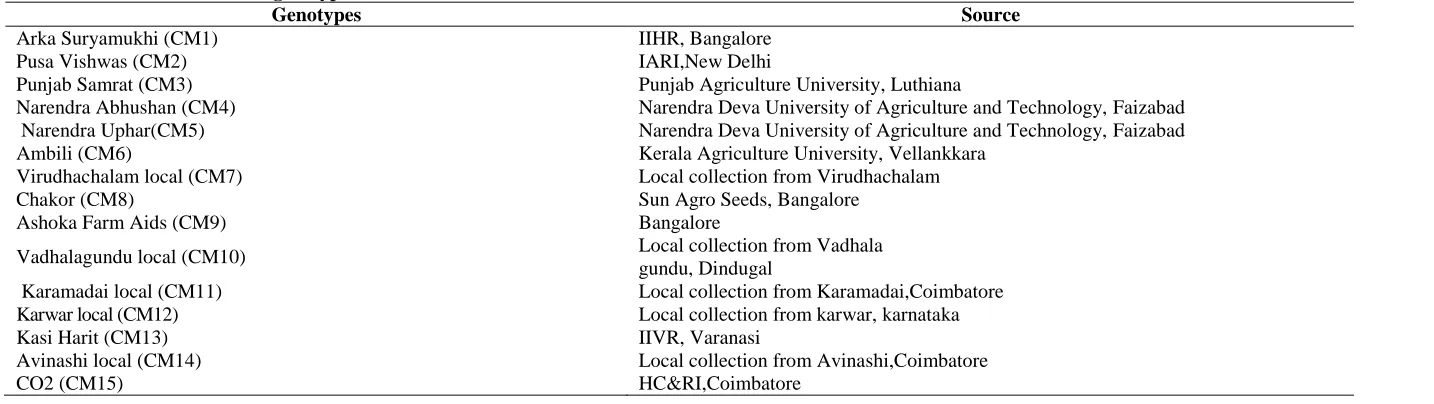
Agricultural University, Coimbatore during 2009-10 with 15 genotypes from diverse sources. The details and source of genotypes has been given in the table 1. These plants are raised in randomized block design (RBD) replicated thrice with seven plants in each replication following a spacing of 2.5 x2.5 m2. Recommended package of practices of TNAU was followed to grow a successful crop of pumpkin (Anon, 1985).Observations were recorded on vine length, days to first female flower appearance, node number for first female flower appearance, sex ratio, days to first harvest, fruit number per vine, fruit equatorial diameter, fruit polar diameter, fruit weight, flesh thickness, seed number per fruit, seed weight per fruit and fruit yield per vine along with quality traits such as total carbohydrates content, total carotenoids content and crude fibre content of the fruit. The data were subjected to statistical analysis to obtain information on the mean performance and to assess the association between yield and its components. Correlation analysis was done using GENRES package and genotypic correlation was worked out as per the methods suggested by Grafius (1956).
Results and Discussion
ISSN 0975-928X
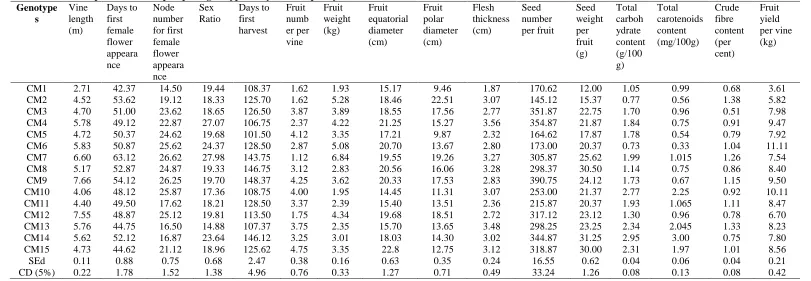
accessions, the highest mean value of fruit weight was recorded by the accession CM10 (6.84 kg) followed by CM2 (5.28 kg). Though the fruit number per vine is an important trait, in recent days, preference is more for small to medium sized fruits. In the present study, the accessions, CM10 (2.39 kg) and CM13 (2.35 kg) registered comparatively lesser fruit weight in favorable direction. Earlier results recorded by Shivanand Hegde (2009) in ridge gourd also confirmed the relationship with less fruit weight and high yield favourably. The data on vine length indicated that among the 15 genotypes, the accession CM 9 (7.66 m) recorded the longest vine length followed by the accession CM6 which recorded 5.83 m. Similar to these results, Uma Maheshwari and Hari Babu (2005) also identified the highest mean performance for vine length in the line CM-12 of pumpkin genotype.
In general, earliness in cucurbits is measured as the days taken for first female flower appearance and node number for first female flower appearance and are considered as desirable traits in any hybrid development programme. In the present study, minimum number of days taken for first female flower appearance and node number for first female flower appearance was observed in the genotype CM13 (44.75 days) followed by CM1 (42.37 days) (for less days taken for first female flower appearance) and CM11 (for less node number for first female flower appearance) which could be adjudged as the best parents for development of pumpkin hybrids with earliness. Similar results were also obtained by Suganthi (2008) in bottle gourd for earliness.
Estimation of sex ratio is highly essential for cucurbits which indicates the ability of the crop to set fruits. Evaluation of genotypes with mean performance revealed that the accession CM13 (14.82) followed by CM10 (17.36) and CM15 (18.96) recorded desirable sex ratio (low values).
Dey et al. (2007) reported similar results of lowest sex ratio in bitter gourd. The days to first harvest is yet another indicator of the earliness especially in hybrid vegetables which could fetch premium price and catch the early market. The accession CM5 (101.50 days) followed by CM13 (107.37 days) and CM1 (108.37 days) recorded the lowest favorable per se values among the pumpkin genotypes of study. Number of fruits produced by any kind of vegetable is a direct indicator of high yield. Higher the fruit number more will be the yield. In this study, the accession CM15 (4.75) followed by CM9 (4.25) and CM10 (4.00) recorded the highest per se value for this trait. Similar findings were reported by Shivanand Hegde (2009) in ridge gourd for higher fruit number per vine.
The measure of fruit equatorial diameter decides the shape of the fruit. Lesser its value, more is the
fruit shape towards the cylindrical shape. Cylindrical shape pumpkin is novel type and preferable for easy packing, transport and display in the market. Among the fifteen genotypes of pumpkin, the accessions CM10 (14.45cm) and CM14 (18.03cm) recorded favorable per se values of minimum fruit equatorial diameter. These results were supported by the findings of Srinivasan (2003) in pumpkin lines CM16 and CM81. Higher the fruit polar diameter more will be the cylindrical shape of the pumpkin fruits which is a preferable shape of pumpkin in recent days. Among the genotypes, the accessions CM 2 (22.51 cm) and CM14 (14.30) showed favorable higher fruit polar diameter. This was also supported by the findings of Srinivasan (2003) in pumpkin. He observed that the pumpkin genotype CM16 followed by CM32 recorded the highest fruit polar diameter.
Pumpkin fruit flesh as powder is now valued as industrial product for nutrient supplement. Fruit flesh thickness is a desirable quality trait in pumpkin. Among the 15 lines of pumpkin, the accessions CM13 (3.48 cm) and CM15 (3.12) recorded the highest per se value for fruit flesh thickness. Similar findings were made by Devi et al. (1989) and Srinivasan (2003) in pumpkin genotypes CM23 and CM67 respectively.
Fruits with more number of seeds are a preferable trait in hybrid vegetables which could increase revenue during hybrid seed production. Seed number per fruit was the highest in the accessions CM9 (390.75) and CM14 (344.87) among the genotypes. Similar findings were made by Sirohi and Chaudhary (1977) in bitter gourd variety Pusa Do Mousami. Pumpkin seeds are good source of protein. Tribal people consume pumpkin seeds as roasted one. In pumpkin fruits with more seed weight is preferred. Observation on seed weight per fruit of fifteen genotypes of present study revealed that the accession CM8 (30.50 g per fruit) and followed by the accession CM14 (31.25 g per fruit) recorded the highest per se value for this trait. Similar findings were made by Nisha (1999) in pumpkin genotype CM31
ISSN 0975-928X
Estimation of total carotenoids content in pumpkin is nutritionally important parameter to be considered. Next to carrot, pumpkin is the cheapest source of carotene. Extraction of pumpkin flesh powder as source of carotene can be exploited very well on industrial level as nutraceuticals. Among the fifteen pumpkin genotypes, the accession CM14 (3.00 mg per 100 g) followed by the accession CM10 (2.25 mg per 100 g) recorded the highest per se value for carotene content. These parents could be involved further to develop hybrids with high carotene content. Similar findings were made by Nisha (1999) in pumpkin parental lines P3 (CM31) and P5 (CO2).
Analysis of crude fibre content in fruit would be useful in the selection of vegetable as a source of dietary fibre. Among the fifteen genotypes of pumpkin the accessions CM2 (1.38 per cent) followed by CM15 (1.01 per cent) recorded favorable high per se values of crude fibre content. Shivanand Heghde (2009) who recorded the highest crude fibre content in the line IC363016 (0.49 per cent) and the tester IC 362481(0.45 per cent) of ridge gourd.
Correlation analysis: Yield being a complex character, is influenced by many yield components. Knowledge on the impact of various components on yield is essential before selection of desirable genotypes. In this context, correlation analysis will indicate possible association between
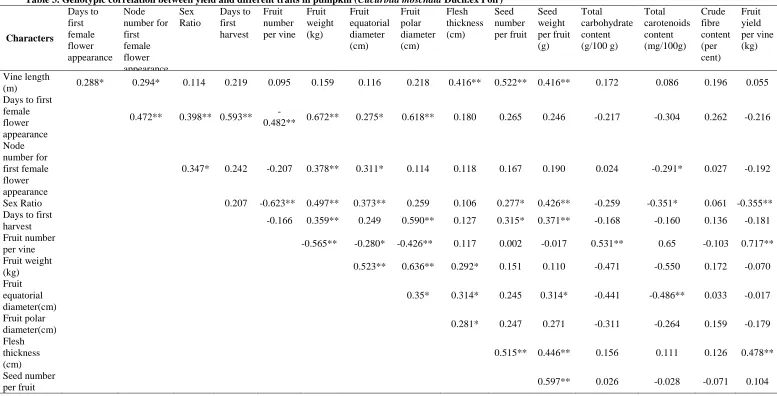
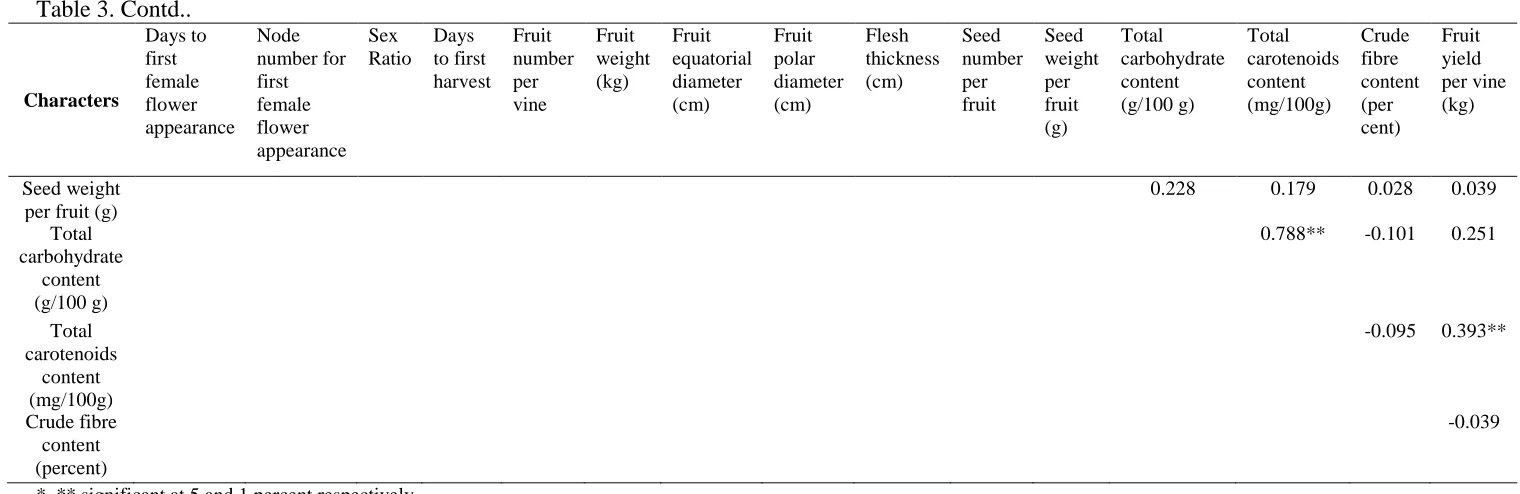
the yield and yield attributes of pumpkin genotypes. Estimation of correlation is a simple tool to select pumpkin genotypes suitable for further crop improvement programme. The genotypic correlation coefficients among the yield and yield attributes in pumpkin are presented in Table 2.Doku (1970) suggested that inter correlation among the yield components need to be estimated because one component influences the other related components.The correlation analysis revealed that among the traits studied, fruit number per vine, flesh thickness, and the quality traits namely total carotenoids had positive and significant correlation with fruit yield per vine (Hazara et al., 2007). Sex ratio had negative and significant correlation with fruit yield per vine. Hence it is suggested that the selection of genotypes based on the performance of these characters will be of immense use by the breeder.
Followed by direct correlation, inter correlations among the characters are also discussed. The inter correlation analysis among the yield components revealed that the vine length exhibited significant and positive correlation with days to first female flower appearance (Uma Maheswari and Hari Babu, 2006) node number for first female flower appearance (Raghvendra Singh et al., 2006), flesh thickness, seed number per fruit (Kumar et al., 2007) and seed weight (Suganthi, 2008). Days to
first female flower appearance had significant and positive correlation with node number for first female flower appearance, sex ratio (Kadam et al., 1992) and days to first harvest and fruit weight
(Raghavendra Singh et al., 2006).
It was also observed that days to first female flower appearance exhibited significant negative correlation with fruit number per vine (Srinivasan, 2003). Node number for first female flower appearance had positive significant association with sex ratio and fruit weight (Shivanand Hegde, 2009).Sex ratio had positive and significant association with fruit weight, seed number per fruit (Shivanand Hegde, 2009) and seed weight per fruit. It was also observed that sex ratio had negative and significant association with fruit number per vine (Josephin, 2008) and total carotenoids content. Days to first harvest exhibited positive and significant correlation with fruit weight, seed number and seed weight (Raghvendra Singh et al., 2006).
Fruit number per vine had negative association with fruit weight (Saikia et al,, 1995), and positive association with total carbohydrates content and yield per vine which was in accordance with the results obtained by Suganthi (2008) in bottle gourd. Fruit weight showed positive correlation with fruit equatorial diameter and fruit polar diameter and flesh thickness (Srinivasan, 2003). It was also observed that flesh thickness (Srinivasan, 2003) and total carotenoids content (Hazara et al., 2007) were significantly and positively correlated with yield which are much preferred traits in pumpkin. Seed numbers per fruit were also positively and significantly correlated with seed weight per fruit. The quality traits viz., total carotenoids and total carbohydrates content were also positively and significantly inter correlated.
Conclusion
ISSN 0975-928X
References
Anonymous, 1985. Crop production manual of Horticultural Crops.Tamil Nadu Agric. Univ., Coimbatore.
Devi, S. D., Balakrishnan, R., Paulas, D., Subbiah, R. and Natarajan, S.1989.Evaluation studies in pumpkin. South Indian Hort., 37(5):274-276. Dey, S. S,, Behra, T. K., Munshi, A. D. and Sirohi, P.S.,
2007. Studies on genetic divergence in bitter gourd (Momordica charantia L.). Indian J. Hort., 64 (1): 53-57
Doku, R. V. 1970. Variability in local and exotic varieties of cowpea (Vigna unguiculata L.).
Ghana J. Agric. Sci.,3:145-149.
Grafius, J E. 1956. Components of yield in oats: A geometrical interpretation. Agron J, 48, 419– 423..
Hazara, P., Mandal, A. K., Dutta, A. K., Sikadar, D. and Pandit, M. K. 2007. Breeding Pumpkin (Cucurbita moschata Duch. ex Poir.) for High Yield and Carotene Content. Acta Hort.,
752:432-434.
Josephin, P. 2008. Studies on development of F1 hybrids in ash gourd [Benincasa hispida
(Thunb.) Cogn.] for yield and quality. M.Sc. Thesis. Tamil Nadu Agriculture University, Coimbatore.
Kadam, P.Y., Desai, U.T. and Kale, P. N. 1992. Correlation studies in ridge gourd.
Maharashtra J. Hort.,6(1): 45-47
Kumar, S., Singh, R. and Pal, A. K. 2007. Genetic variability, heritability, genetic advance, correlation coefficient and path analysis in bottle gourd. Indian J. Hort.,64(2): 163-168 Nisha, S. K. 1999. Genetic studies in pumpkin
(Cucurbita moschata Duch. ex. Poir.) through diallel analysis. M.Sc. (Hort.) Thesis, Tamil Nadu Agric. Univ., Coimbatore.
Raghavendra Singh, Sanjay Kumar and Dixit, S K. 2006. Correlation coefficient and path analysis in bottle gourd (Lagenaria siceraria
(Molina)Standl.). Progressive Hort.,
38(2):256-261
Saikia, J., Shadeque, A. and Bora, G. C. 1995. Genetic studies in cucumber-correlation and path coefficient analysis. Haryana J. Hort. Sci.,
24(2): 126-130.
Shivanand Hegde, 2009. Studies on heterosis in ridge gourd. M.Sc. Thesis. Tamil Nadu Agric. Univ., Coimbatore.
Sirohi, P. S. and Choudhary, B.1977. Combining ability in Bitter gourd. Veg. Sci., 4:107-115
Srinivasan, M. 2003. Studies on genetic parameters and characterization in pumpkin (Cucurbita moschata Duch ex. Poir). M.Sc. Thesis. Tamil Nadu Agric.Univ., Coimbatore.
Suganthi, M. 2008. Line x tester analysis in bottle gourd (Lagenaria siceraria M.) M.Sc. Thesis. Tamil Nadu Agric.Univ., Coimbatore. Uma Maheshwari, K. and Hari Babu, K. 2005.
Combining ability for yield and its components in F3 generation of pumpkin (Cucurbita moschata Duch. ex Poir.). Madras Agric. J., 92 (4-6): 288-292.
ISSN 0975-928X
Table 1. Details and source of genotypes
Genotypes Source
Arka Suryamukhi (CM1) IIHR, Bangalore
Pusa Vishwas (CM2) IARI,New Delhi
Punjab Samrat (CM3) Punjab Agriculture University, Luthiana
Narendra Abhushan (CM4) Narendra Deva University of Agriculture and Technology, Faizabad
Narendra Uphar(CM5) Narendra Deva University of Agriculture and Technology,Faizabad
Ambili (CM6) Kerala Agriculture University, Vellankkara
Virudhachalam local (CM7) Local collection from Virudhachalam
Chakor (CM8) Sun Agro Seeds, Bangalore
Ashoka Farm Aids (CM9) Bangalore
Vadhalagundu local (CM10) Local collection from Vadhala
gundu, Dindugal
Karamadai local (CM11) Local collection from Karamadai,Coimbatore
Karwar local (CM12) Local collection from karwar, karnataka
Kasi Harit (CM13) IIVR, Varanasi
Avinashi local (CM14) Local collection from Avinashi,Coimbatore
ISSN 0975-928X
Table 2 Mean performance of pumpkin genotypes for yield and quality traits Genotype
s
Vine length (m)
Days to first female flower appeara nce
Node number for first female flower appeara nce
Sex Ratio
Days to first harvest
Fruit numb er per vine
Fruit weight (kg)
Fruit equatorial diameter (cm)
Fruit polar diameter (cm)
Flesh thickness (cm)
Seed number per fruit
Seed weight per fruit (g)
Total carboh ydrate content (g/100 g)
Total carotenoids content (mg/100g)
Crude fibre content (per cent)
Fruit yield per vine (kg)
CM1 2.71 42.37 14.50 19.44 108.37 1.62 1.93 15.17 9.46 1.87 170.62 12.00 1.05 0.99 0.68 3.61
CM2 4.52 53.62 19.12 18.33 125.70 1.62 5.28 18.46 22.51 3.07 145.12 15.37 0.77 0.56 1.38 5.82
CM3 4.70 51.00 23.62 18.65 126.50 3.87 3.89 18.55 17.56 2.77 351.87 22.75 1.70 0.96 0.51 7.98
CM4 5.78 49.12 22.87 27.07 106.75 2.37 4.22 21.25 15.27 3.56 354.87 21.87 1.84 0.75 0.91 9.47
CM5 4.72 50.37 24.62 19.68 101.50 4.12 3.35 17.21 9.87 2.32 164.62 17.87 1.78 0.54 0.79 7.92
CM6 5.83 50.87 25.62 24.37 128.50 2.87 5.08 20.70 13.67 2.80 173.00 20.37 0.73 0.33 1.04 11.11
CM7 6.60 63.12 26.62 27.98 143.75 1.12 6.84 19.55 19.26 3.27 305.87 25.62 1.99 1.015 1.26 7.54
CM8 5.17 52.87 24.87 19.33 146.75 3.12 2.83 20.56 16.06 3.28 298.37 30.50 1.14 0.75 0.86 8.40
CM9 7.66 54.12 26.25 19.70 148.37 4.25 3.62 20.33 17.53 2.83 390.75 24.12 1.73 0.67 1.15 9.50
CM10 4.06 48.12 25.87 17.36 108.75 4.00 1.95 14.45 11.31 3.07 253.00 21.37 2.77 2.25 0.92 10.11
CM11 4.40 49.50 17.62 18.21 128.50 3.37 2.39 15.40 13.51 2.36 215.87 20.37 1.93 1.065 1.11 8.47
CM12 7.55 48.87 25.12 19.81 113.50 1.75 4.34 19.68 18.51 2.72 317.12 23.12 1.30 0.96 0.78 6.70
CM13 5.76 44.75 16.50 14.88 107.37 3.75 2.35 15.70 13.65 3.48 298.25 23.25 2.34 2.045 1.33 8.23
CM14 5.62 52.12 16.87 23.64 146.12 3.25 3.01 18.03 14.30 3.02 344.87 31.25 2.95 3.00 0.75 7.80
CM15 4.73 44.62 21.12 18.96 125.62 4.75 3.35 22.8 12.75 3.12 318.87 30.00 2.31 1.97 1.01 8.56
SEd 0.11 0.88 0.75 0.68 2.47 0.38 0.16 0.63 0.35 0.24 16.55 0.62 0.04 0.06 0.04 0.21
ISSN 0975-928X
Table 3. Genotypic correlation between yield and different traits in pumpkin (Cucurbita moschata Duch.ex Poir)
Characters
Days to first female flower appearance
Node number for first female flower appearance
Sex Ratio
Days to first harvest
Fruit number per vine
Fruit weight (kg)
Fruit equatorial diameter (cm)
Fruit polar diameter (cm)
Flesh thickness (cm)
Seed number per fruit
Seed weight per fruit (g)
Total carbohydrate content (g/100 g)
Total carotenoids content (mg/100g)
Crude fibre content (per cent)
Fruit yield per vine (kg)
Vine length
(m) 0.288* 0.294* 0.114 0.219 0.095 0.159 0.116 0.218 0.416** 0.522** 0.416** 0.172 0.086 0.196 0.055
Days to first female flower appearance
0.472** 0.398** 0.593**
-0.482** 0.672** 0.275* 0.618** 0.180 0.265 0.246 -0.217 -0.304 0.262 -0.216
Node number for first female flower appearance
0.347* 0.242 -0.207 0.378** 0.311* 0.114 0.118 0.167 0.190 0.024 -0.291* 0.027 -0.192
Sex Ratio 0.207 -0.623** 0.497** 0.373** 0.259 0.106 0.277* 0.426** -0.259 -0.351* 0.061 -0.355**
Days to first
harvest -0.166 0.359** 0.249 0.590** 0.127 0.315* 0.371** -0.168 -0.160 0.136 -0.181
Fruit number
per vine -0.565** -0.280* -0.426** 0.117 0.002 -0.017 0.531** 0.65 -0.103 0.717**
Fruit weight
(kg) 0.523** 0.636** 0.292* 0.151 0.110 -0.471 -0.550 0.172 -0.070
Fruit equatorial diameter(cm)
0.35* 0.314* 0.245 0.314* -0.441 -0.486** 0.033 -0.017
Fruit polar
diameter(cm) 0.281* 0.247 0.271 -0.311 -0.264 0.159 -0.179
Flesh thickness (cm)
0.515** 0.446** 0.156 0.111 0.126 0.478**
Seed number
ISSN 0975-928X
Table 3. Contd..
Characters
Days to first female flower appearance
Node number for first female flower appearance
Sex Ratio
Days to first harvest
Fruit number per vine
Fruit weight (kg)
Fruit equatorial diameter (cm)
Fruit polar diameter (cm)
Flesh thickness (cm)
Seed number per fruit
Seed weight per fruit (g)
Total carbohydrate content (g/100 g)
Total carotenoids content (mg/100g)
Crude fibre content (per cent)
Fruit yield per vine (kg)
Seed weight per fruit (g)
0.228 0.179 0.028 0.039
Total carbohydrate
content (g/100 g)
0.788** -0.101 0.251
Total carotenoids
content (mg/100g)
-0.095 0.393**
Crude fibre content (percent)
-0.039