Zebari, H.M., Rutter, S.M. and Bleach, E.C.L. 2018. Characterizing changes in activity and feeding behaviour of housed, lactating dairy cows during behavioural and silent oestrus. Applied Animal Behaviour Science.
20 June 2018
Characterizing changes in activity
and feeding behaviour of housed,
lactating dairy cows during
behavioural and silent oestrus
by Zebari, H.M., Rutter, S.M. and Bleach, E.C.L.
Copyright, Publisher and Additional Information: This is the author accepted manuscript. The final published version (version of record) is available online via Elsevier.
This version is made available under the CC-BY-ND-NC licence:
https://creativecommons.org/licenses/by-nc-nd/4.0/legalcode
Please refer to any applicable terms of use of the publisher
DOI: https://doi.org/10.1016/j.applanim.2018.06.002
1 Characterizing changes in activity and feeding behaviour of housed, lactating 1
dairy cows during behavioural and silent oestrus 2
Hawar M. Zebari 1,2*, S. Mark Rutter 1, Emma C.L. Bleach 1 3
1Department of Animal Production, Welfare and Veterinary Sciences, Harper Adams 4
University, Newport, Shropshire, TF10 8NB, UK
5
2Department of Animal Production, College of Agriculture, University of Duhok, Duhok, 6
Kurdistan region, Iraq.
7
*Corresponding author: Hawar M. Zebari
8
Present address: Department of Animal Production, Welfare and Veterinary Science, Harper
9
Adams University, TF10 8NB, UK
10
Mobile number: +447741327862
11
Email address: [email protected] 12
13
14
15
16
Highlights 17
Activity was increased on the day of behavioural oestrus
18
Resting time, lying bouts and feeding behaviours were reduced on the day of behavioural
19
oestrus
20
Only feeding duration was reduced on the day of silent oestrus
21
22
23
24
2 Abstract
26
The normal time budgets of dairy cows are influenced by oestrus, with cows spending less
27
time resting and eating but more time walking. Previous studies have shown that cows spend
28
approximately 21% less time feeding where the day of oestrus is assumed to be the day of
29
successful artificial insemination. The objective of the present study was to determine whether
30
the number of steps, lying time, lying bouts, dry matter intake (DMI), feeding duration and the
31
number of visits to feed were affected by behavioural and silent oestrus in lactating dairy cows.
32
Thirty Holstein Friesian cows were housed in a free-stall barn with 34 cubicles and were
33
continuously monitored by four video cameras. Milk samples were collected on Monday,
34
Wednesday and Friday afternoon and analysed for progesterone concentration by enzyme
35
immunoassay. Steps, lying time and lying bouts were measured using IceQubes (IceRobotics
36
Ltd., Edinburgh, UK) from three days before (3DB) to three days after (3DA) oestrus. Daily
37
feed intakes and feeding duration were recorded by a Roughage Intake Control (RIC) system
38
(Insentec B. V., Marknesse, Netherlands) over the same period.
39
Of the 40 behavioural oestrus events, standing behaviour was observed in 50% of events. 40
On the day of behavioural oestrus the number of steps were increased significantly (P < 0.001) 41
compared to 3DB and 3DA oestrus, whilst the percentage of lying time, lying bouts, DMI,
42
feeding duration and the number of visits to feed were reduced (P < 0.001) compared to 3DB 43
and 3DA oestrus. On the predicted day of silent oestrus, the duration of feeding was reduced 44
(P < 0.03) only when compared to one day before and one day after oestrus. 45
In conclusion, although the number of steps were increased, lying time, lying bouts, DM
46
intake and feeding duration were reduced by behavioural oestrus, and only feeding duration
47
was significantly lowered during silent oestrus. Technologies that facilitate the on-farm
48
measurement of feeding duration could potentially be used to help farmers detect silent
49
oestrus in their cattle.
50
51
Keywords: Dairy cows; Time budgets; Behavioural oestrus; Silent oestrus; Activity
52
3 1. Introduction
54
The normal time budget of a Holstein dairy cow fed a total mixed ration (TMR) and in
free-55
stall housing is 3 to 5 h/d eating, with an average 14 feeding bouts per day, 12 to 14 h/d lying
56
time, 2 to 3 h/d social interaction, 7 to 10 h/d rumination during both standing and lying time,
57
0.5 h/d drinking and 2.3 to 3.5 h/d spent outside of the yard for milking and other management
58
practices (Grant and Albright, 2000).
59
In mammals, oestrus is a behavioural sign that ensures that the female is ready to be mated
60
close to the time of ovulation. Mounting behaviour with standing to be mounted is the definitive
61
sign of oestrus (Roelofs et al., 2010). However, over the past 30 to 50 years, the incidence of 62
mounting behaviour has decreased from 80% to 50% in dairy cows (Dobson et al., 2008) and 63
over the last 50 years the duration of oestrus in dairy cattle has also declined from 18 to 8 h
64
(Dolecheck et al., 2015). Oestrus is the period of maximum sexual activity, it has been shown 65
to range from 2-30 h (Hanzen, 2000). Standing oestrus is often defined as true oestrus, when
66
the cow makes no effort to escape when mounted by other cows and is defined as “the interval
67
between the first and last standing events” (Hurnik et al., 1975). Other signs of oestrus include 68
mounting of other cows, increased activity and mucus discharge from the vulva (Sveberg et 69
al., 2011). While standing to be mounted is considered as the primary behavioural sign of 70
oestrus, other behaviours such as ano-genital sniffing, restlessness, bellowing, chin resting,
71
head mounting, and an attempt to mount are considered secondary signs (Gordon, 2011).
72
The cows’ normal time budget can be influenced by oestrus (Yaniz et al., 2006). During 73
oestrus, the activity of dairy cows increases about 2 to 4 times compared to non-oestrus cows
74
(Kiddy, 1977). In addition, during the period from 72 to 16 h before standing oestrus, dairy cow
75
activity increases linearly with further increases during the 16 h before standing oestrus (Arney
76
et al., 1994). In dairy cows ovulation occurs from 8 to 30 h after the onset of increased activity
77
(Hocky et al., 2010). With the availability of activity monitoring on commercial dairy farms, 78
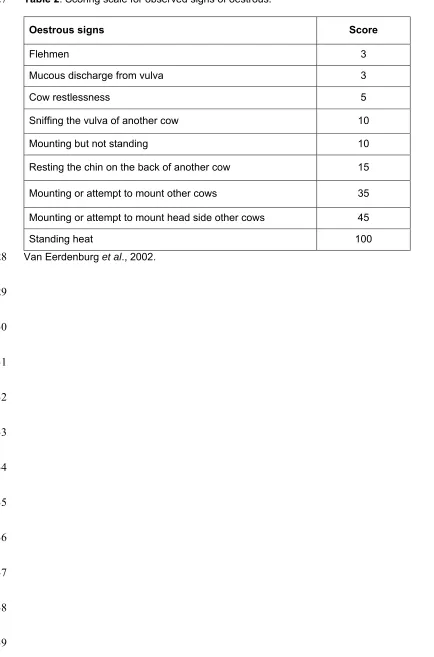
restlessness has become an important indicator of oestrus (Diskin and Sreenan, 2000).
79
During oestrus, the time spent lying by dairy cows decreased as a result of increased
80
4
(Sumiyoshi et al., 2014) from the developing ovulatory follicle (Allrich, 1994). According to 82
Dolecheck et al. (2015) oestrus-synchronised cows spent less time lying than non-oestrus 83
cows (10.19 vs 24.82 min/h, respectively) when IceQubes were used to monitor activity and
84
Reith et al. (2014) found that dairy cows drank 15.3% less water during oestrus. In a study
85
where the day of AI was assumed to be the day of oestrus (rather than observing for oestrus
86
behaviour), Halli et al. (2015) found that cows spent approximately 21% less time feeding on 87
the day of oestrus in comparison to other days of the oestrous cycle (2.82 vs. 3.54 h/d,
88
respectively), but it was unclear whether the cows were synchronised or naturally cycling. In
89
addition, Reith and Hoy (2012) showed that rumination was reduced on the day of oestrus
90
from 7.2 to 5.9 h/d.
91
However, 35 % of cows show no obvious behavioural signs of oestrus and are defined as
92
showing silent oestrus (Palmer et al., 2010). This means that despite the use of oestrus 93
detection aids such as activity monitors, judging the correct time for AI in naturally cycling
94
cows is difficult. The present study was designed to investigate whether the activity and
95
feeding behaviour of lactating Holstein Friesian cows undergoing spontaneous oestrus cycle
96
is affected by behavioural and silent oestrus.
97
2. Materials and methods 98
The experiment was undertaken between June and August 2016 at the dairy unit of Harper
99
Adams University, Newport, Shropshire, TF10 8NB, UK. The Harper Adams University
100
Research Ethics Committee approved the research protocol.
101
2.1. Experimental animal, housing and management 102
Thirty Holstein-Friesian cows (parity 2.5 ± 1.1) with initial body weight of 637.0 ± 60.0 kg
103
and daily milk yield of 35.8 ± 1.8 kg/d, were used at Harper Adams University dairy unit. At the
104
start of the study the cows were 29 ± 6.3 days in milk and 2.9 ± 0.28 body condition score
105
(Scale 1-5; AHDB Dairy, 2014). The average locomotion score (Scale 1-5; as described by
106
Chapinal et al., 2009) of the selected cows was 2.0 ± 0.58. Cows were housed in a covered
5
yard with 34 cubicles (2.7 x 1.2 m, with 3 cm thick rubber mattresses) and two grooved
108
concrete passageways (6 x 50 m) giving approximately 10.8 m2 area per cow. The cubicles 109
were bedded with sawdust three times per week. The passageways were scrapped by an
110
automatic scraper 4-5 times per day. Study cows were milked twice a day from approximately
111
05:00 and 16:30 through a 40-point internal rotary milking parlour (Wesfalia, GEA Milking
112
System, Germany). Milking took approximately 30-40 minutes for the group.
113
Cows were fed from 30 Roughage Intake Control (RIC) system bins and intake recorded
114
using an automated feed recording system (1.0 x 0.9 x 0.8 m; RIC, Insentec B. V. Marknesse,
115
the Netherlands). They were moved into the study area on 6th June 2016 and data were 116
collected until 19th August 2016. All the cows used in the study were trained to feed through 117
RIC bins over a one week period in order to ensure that each cow could access feed without
118
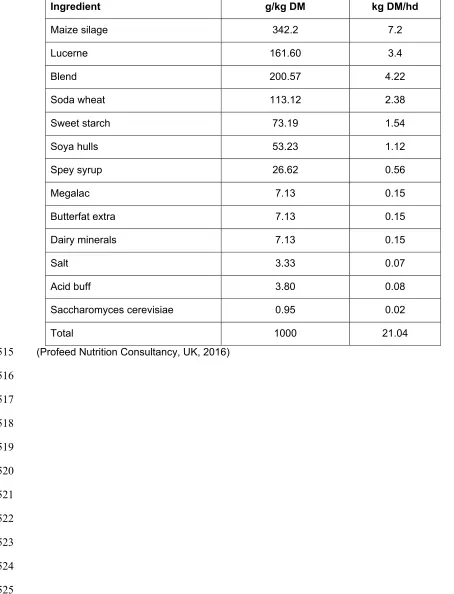
assistance. Approximately 65 kg (fresh weight) of a total mixed ration (TMR) (see Table 1)
119
was provided daily at approximately 08:30, sufficient for ad libitum availability. Refused feed
120
was removed three times per week on Monday, Wednesday and Friday morning at 08:00 and
121
the RIC bins were cleaned before fresh feed was allocated. Water was provided ad libitum 122
from three water troughs. Feed samples were collected directly from the RIC bins daily at
123
feeding time and immediately oven dried overnight at 105°C to constant weight (AOAC, 2012;
124
934.01) for determination of dry matter (DM). The nutrient content of the ration composed of
125
DM (39.5%), ME (11.8 MJ/kgDM), CP (17.6% DM) and NDF (36.4% DM).
126
2.2. Data collection 127
2.2.1. Video recording of oestrus behaviours 128
The cows were monitored to detect spontaneous behavioural oestrus using four video
129
cameras (Voltek, KT&C Co Ltd, Seoul, South Korea) for approximately 19.46 ± 1.7 h/d. The
130
four cameras were placed at about 5.25 m above the trial cubicles and passageways to give
131
a clear view of the area in which cows were housed. The cameras were connected to an
132
external hard drive video recorder (Sentient 960H, England, UK). Cows were clearly identified
133
by numbers from 1 to 30 on both sides of the cow and an individual combination of coloured
6
tape on each cow (Kerbrat and Disenhaus, 2004). Video recordings were retrospectively
135
reviewed to determine the time and intensity of oestrus. The scores of Van Eerdenburg et al. 136
(2002) (Table 2) were allocated and recorded each time a sign of oestrus was observed on
137
the video recording. The total number of points scored in a day indicated oestrus intensity.
138
2.2.2. Cow’s activity and feed intake 139
To monitor cow activity, IceQubes (IceRobotics Ltd., Edinburgh, UK) were attached to the
140
back left leg of each cow using a Velcro hook and loop strap (Dolecheck et al., 2015). The 141
IceQube is a 3-axis accelerometer which reports cow activity summarised in 15 minute blocks
142
(Dolecheck et al., 2015). These generate data to show the number of steps taken, lying time 143
and lying bouts for each cow, every day. Daily TMR intake was recorded by the RIC system.
144
Dry matter intake was calculated as TMR intake (fresh weight; kg/d) x dry matter of TMR. Total
145
daily feeding duration and the number of feeding bouts were also recorded by the RIC system.
146
2.3. Milk progesterone assay 147
Oestrus periods were identified by measuring the concentration of progesterone in whole
148
milk. Milk samples (40 ml) were collected from each cow 3 times per week on Monday,
149
Wednesday and Friday afternoon. Immediately after sampling one preservative tablet (Broad
150
Spectrum Microtabs II, Advanced Instrument, INC. USA; containing 8 mg Bronopol and 0.30
151
mg Natamycin) was added to each milk sample. Sample pots were inverted to mix until the
152
tablet was dissolved. The samples were stored in a refrigerator at 4ºC until the progesterone
153
assay which was completed within one week of collection. Milk samples were brought to room
154
temperature and mixed well before analysis using an enzyme immunoassay (Ridgeway
155
Science Ltd., Rodmore Mill Farm, Alvington, Gloucestershire, UK). A cow was considered in
156
oestrus when milk progesterone concentrations were <3 ng/ml for two to three days before a
157
period when progesterone rose to >5 ng/ml for at least 5 days (Isobe et al., 2004). 158
159
7 2.4. Definition of behavioural and silent oestrus
161
Each oestrus identified by the progesterone profile was classified as a behavioural or silent
162
oestrus. A cow was defined to be in behavioural oestrus when the sum of the points scored
163
for oestrus behaviour observed by the video recording exceeded 100 (Van Eerdenburg et al., 164
2002). A cow was considered to be in silent oestrus when the cow did not display any 165
behavioural signs of oestrus or the oestrus score was < 100 points at or around the day of
166
oestrus as defined by her milk progesterone profile (Van Eerdenburg et al., 2002).
167
2.5. Duration of oestrus 168
The duration of oestrus recorded by the camera was defined as the interval between the
169
time that cows showed the first signs of oestrus and the time that the last signs of oestrus
170
were observed. Oestrus duration based on accelerometer data was defined as an increase in
171
walking activity and the number of steps taken increased to > 80% above the mean number
172
for the preceding three days followed by a decrease to < 80% in the following two days. The
173
periods between the two thresholds was considered as the duration of oestrus (Lopez-Gatius,
174
et al., 2008).
175
2.6. Data-set construction 176
Data from 61 oestrus events were collected during the study period. The six parameters
177
analysed were the number of steps taken by cows each day, time spent lying (h/d), number of 178
lying bouts per day, DM intake (kg/d), feeding duration (h/d) and number of visits to feed per
179
day. Prior to statistical analysis, the data for all parameters were summarized to one value per 180
day using Microsoft Excel. A day was defined as the period from midnight to midnight. The
181
day of oestrus was defined as day (0) and compared with three days before (-3, -2 and -1;
182
3DB) and three days after (+1, +2 and +3; 3DA). Fresh TMR intakes (kg/d) intakes were
183
converted into DM intake (kg DM/d) based on the DM content of the TMR (39.5%).
184
185
8 2.7. Statistical analyses
187
Statistical analyses were performed using the Genstat statistical software package
188
(Genstat V 17th edition, VSN international Ltd, UK). The datasets were analysed by repeated 189
measures ANOVA to compare between groups (behavioural and silent oestrus) days before 190
and after oestrus and the group x day interaction. Factorial one way ANOVA was used to
191
compare behavioural and silent oestrus. Differences were reported as significant at P < 0.05 192
and trends were reported when P was between < 0.1 and > 0.05. Linear regression analysis 193
was used to determine the relationship between the number of steps taken per day and dry
194
matter intake (kg DM/d) on the day of behavioural oestrus.
195
3. Results 196
3.1. The duration of oestrus and scores of behavioural activity 197
Using the milk progesterone profiles, 61 spontaneous oestrus events were detected for all
198
cows during the study period. Of the 61 oestrus events detected, 40 were defined as
199
behavioural (65.5%) and 21 defined as silent (34.5%) oestrus. The percentage of silent
200
oestrus at the first, second and third oestrus post-partum were 44.8%, 27.3% and 20.0%
201
respectively in the present study. The percentage of cows standing to be mounted during
202
behavioural oestrus was 50%.
203
The average duration of behavioural oestrus (determined from video recordings) was 9.1 ± 204
3.1 h and the duration of oestrus based on the number of steps recorded by IceQubes was
205
12.9 ± 2.5 h. The number of points scored during behavioural oestrus determined from the 206
camera recordings were between 225 and 2921 points. However, during silent oestrus the 207
number of points scored were between 0 and 32 points.
208
3.2. Oestrus activity 209
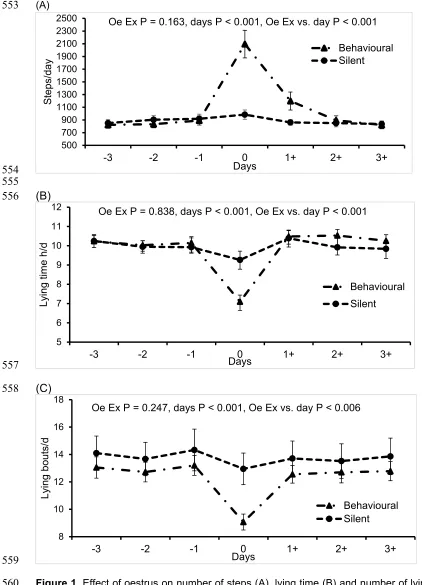
On the day of behavioural oestrus the number of the steps (2095 ± 217 steps; mean ± 210
SEM) were higher (F6,354 = 32.2, P < 0.001) compared to 3DB (849 ± 60 steps) and 3DA (971 211
± 61 steps) while on the day of silent oestrus the number of steps (984 ± 73.5 steps) were not 212
significantly different in comparison to 3DB (891 ± 63 steps) and 3DA (849 ± 50 steps). From
9
factorial one way ANOVA, cows took significantly more steps during behavioural oestrus (F1,39 214
= 13.2, P < 0.001) compared to silent oestrus. There was a significant interaction (F6,354 = 5.6, 215
P < 0.001) between oestrus expression and day of oestrus on the number of steps taken
216
(Figure1, A). In addition, there was a significant (F1,39 = 31.9, P < 0.001) positive correlation 217
between the number of points scored and the number of steps taken (y= 0.348x + 486; P < 218
0.001; r2 = 0.32) during behavioural oestrus. 219
Lying time and the number of lying bouts (7.1 ± 0.3 h/d and 9.1 ± 0.5 bouts, respectively)
220
were reduced (F6,354 = 17.2, P < 0.001) on the day of behavioural oestrus in comparison to 221
3DB (10.0 ± 0.3 h/d and 13.0 ± 0.7 bouts, respectively) and 3DA (10.1 ± 0.3 h/d and 12.7± 0.8
222
bouts, respectively). However, lying times (9.3 ± 0.5 h/d) and the number of lying bouts (13.0
223
± 1.1) bouts were not significantly affected by the day of silent oestrus compared to 3DB (10.0 224
± 0.4 h/d and 14.0 ± 1.2 bouts, respectively) and 3DA (10.4 ± 0.4 h/d and 13.7 ± 1.3 bouts,
225
respectively). Furthermore, from a factorial one way (ANOVA), lying times were lower (F1,39 = 226
17.2, P < 0.001) on the day of behavioural oestrus compared to silent oestrus and the number 227
of lying bouts were also lower (F1,39 = 17.2, P < 0.001) on the day of behavioural oestrus 228
compared to silent oestrus. With regard to lying time, there was a significant oestrus x day 229
interaction (F6,354 = 5.6, P < 0.001) with lying time significantly reduced during behavioural 230
oestrus but not silent oestrus (Figure 1, B). Similarly, the number of lying bouts was reduced 231
during behavioural oestrus but not during silent oestrus as well as there being an interaction 232
between oestrus expression and day (F6,354 = 3.3, P < 0.006) (Figure 1, C). 233
3.3. Feeding behaviour 234
Dry matter intakes were significantly (F6,354 = 12.0, P < 0.001) lower on the day of 235
behavioural oestrus (19.8 ± 0.41 kg/d) in comparison to 3DB (22.4 ± 0.5 kg/d) and 3DA (22.6
236
± 0.5 kg/d). There was a significant (F1,39 = 31.9, P < 0.001) negative correlation between the 237
number of steps taken and DMI (y= -0.0014 + 22.46; P < 0.001; r2 = 0.46) during behavioural 238
oestrus. However, DMI was not significantly lower on the day of silent oestrus compared to 239
other days. There was also no interaction between oestrous expression and day (Table 3).
10
The occurrence of behavioural oestrus significantly (F6,354 = 9.2, P < 0.001) reduced the 241
mean duration of feeding (2.4 ± 0.09 h/d) in comparison to 3DB (3.4 ± 0.17 h/d) and 3DA (3.2
242
± 0.12 h/d). Duration of feeding (2.9 ± 0.15 h/d) was also significantly (P < 0.03) reduced
243
during silent oestrus when compared to one day before (3.4 ± 0.2 h/d) and one day after (3.6 244
± 0.2 h/d) the predicted day of oestrus. There was a tendency for an interaction between
245
oestrous expression and day (F6,354 = 2.1, P = 0.06) effect on feeding duration (Table 3). 246
The mean number of visits to the RIC feed bin during behavioural oestrus was less (25.3 247
± 1.26 visits/d; F6,354 = 9.5, P < 0.01) compared with 3DB and 3DA oestrus. However, there 248
were no significant differences between the day of silent oestrus (29.0 ± 1.71 visits/d) in 249
comparison to other days. There was also no significant interaction between oestrus
250
expression and day with regard to the number of visits to feed. Analysing the number of visits
251
to feed with regard to oestrous expression, there was also no significant difference (F1,59 = 252
1.0, P = 0.318) between behavioural and silent oestrus (Table 3).
253
4. Discussion 254
4.1. Oestrus duration and observed oestrus activity 255
Previously, the duration of standing oestrus in dairy cows has been considered to be 18 h
256
(Valenza et al., 2012). The average duration of oestrus measured using the video camera in 257
the present study was 9.1 ± 3.1 h. However this was 2 hours longer than the duration reported
258
by Sveberg et al. (2011) of (7.1 ± 1.4 h) in oestrus detected by video recording of 22 Holstein-259
Friesian cows housed on an outdoor wood chip-pad. Based on the number of steps recorded
260
by the IceQubes, the duration of oestrus in the present study was (12.9 ± 2.5 h) very similar
261
to that seen in the study of Roelofs et al. (2005) which found that the duration of oestrus 262
detected by pedometer lasted for 12.3 h, while a study by Silper et al. (2015), reported longer
263
oestrus in 12 month old Holstein heifers (14.3 ± 4.1 h) using neck mounted accelerometers.
264
However, the duration of oestrous activity in the present study was 3.2 h shorter than that
265
reported by Valenza et al. (2012) of 16.1 (± 4.7 h) also using an activity monitoring system. 266
The present study found that the duration of oestrus determined by activity monitor was 3 h
11
longer than that detected by observation. The difference between the duration of oestrus
268
activity in high yielding dairy cows may be due to the disconnection of secondary signs of
269
oestrus behaviour detected by activity monitors (restlessness) and standing oestrus (Valenza
270
et al. (2012). Our finding is supported by a reported increase in activity, detected by
271
pedometers in dairy cows, 1 to 3 h before the onset starting of standing oestrus (Sveberg et 272
al., 2011). 273
In the present study, standing behaviour was observed in 50% of those cows expressing
274
behavioural oestrus. Similarly, Van Eerdenburg et al. (2002) detected 50% of standing 275
oestrus events in Holstein Frisian cows. However, Kerbrat and Disenhaus (2004) observed
276
standing events by video camera in 32% of Holstein cows housed in a loose housing system
277
with a concrete floor. The results of the present study indicate that there is great variability
278
between cows in the total points scored with between 225 and 2921 points during behavioural 279
oestrus and the number of steps taken during oestrus (754 to 6008 steps). The results of the
280
current study agree with those reported by Van Eerdenburg et al. (1996) who continuously 281
monitored cows and another study conducted on Holstein cows by Kerbrat and Disenhaus
282
(2004) who reported the total number of behavioural signs (rather than points score) which
283
ranged from 27 to 239 signs. As expected, the oestrus scores of the present study were
284
higher than the scores (approximately 50 -1000 points) reported by Van Eerdenburg et al. 285
(2000) who observed cows during two time periods of about 30 min in the morning at 5:00
286
before milking and 30 min in the afternoon at 17:00.
287
In dairy cows, oestrus often takes place without clear changes in behaviour (Kyle et al., 288
1992). Indeed this was the case in 44.8% of first post-partum oestruses observed in the
289
present study. Low expression of oestrus behaviour at the first oestrus post-partum in
290
lactating dairy cows is thought to be an effect of high concentrations of oestradiol from foetal
291
origin during late gestation, which induces refractoriness of the hypothalamus to oestradiol
292
(Kyle et al., 1992). Other studies suggested this may also be caused by lower frequency of 293
LH pulses as a result of negative energy balance in early lactation (Lucy, 2001) which results
12
in lower oestradiol synthesis (Butler, 2000; Isobe et al., 2004) by the pre-ovulatory follicle and 295
decreased the sensitivity of the hypothalamus to oestradiol which leads to a high incidence
296
of silent oestrus.
297
4.2. Oestrus activity detected by activity monitor 298
Overall, 65.5% of the spontaneous oestruses identified in the present study were
299
associated with behavioural signs detected by video recording and the percentage of oestrus
300
detected by accelerometer was 52.5%. This was within the range 51 to 87% found by Roelofs
301
et al. (2005) using pedometers for oestrus detection. The results of the present study also
302
agree with the previously reported 52% detection rate in cubicle housed Holstein-Friesian
303
cows studied by Palmer et al. (2010). At-Taras and Spahr (2001) detected approximately 304
54% of oestrus by visual observation. Conversely, this finding was lower than the 70% of
305
oestrus events detected recorded by Fricke et al. (2014) in oestrus-synchronized Holstein 306
cows using an activity monitor attached to the neck (Heatime, SCR Engineer Ltd, Netanya,
307
Israel). This high detection rate may be related to the high number of cows in oestrus at the
308
same time (Gilmore et al., 2011). 309
Restlessness is one of the most important secondary indicators of oestrus in cattle (Firk
310
et al., 2002). In the current study, on the day of behavioural oestrus, the number of steps was
311
increased by 146.8%, while during silent oestrus, step count was only 10% higher. Similarly,
312
Sakaguchi et al. (2007) recorded a 100% increase in the number of steps on the day of 313
behavioural oestrus using radiotelemetric pedometers on grazing dairy Holstein heifers in
314
Japan. Using pedometers, ultrasound and visual observation, Roelofs et al. (2005) recorded 315
a 5.5 fold increase in the number of steps taken on the day of visually observed oestrus.
316
Environmental conditions, the type of housing and management conditions may affect the
317
extent of walking activity (Lopez-Gatius et al., 2005; Yaniz et al., 2006). 318
Alongside the increase in activity, on the day of behavioural oestrus in the present study, 319
cows spent significantly less time lying down (32.2%) and had 28.3% fewer lying bouts during
320
spontaneous oestrous events. On the day of behavioural oestrus, continuously observed
13
Friesian cows housed in cubicles were also found to spend less time lying down
322
(approximately 5 h/d) and more time standing than non-oestrus cows (Esslemont and Bryant,
323
1976).
324
A recent study at the University of Kentucky conducted by Dolecheck et al. (2015) using 325
oestrus-synchronised Holstein cows, found a 50% decrease in lying time and also a reduction
326
in lying bouts (56.0%) during oestrus. The greater reduction in lying behaviour may be
327
because oestrus synchronization meant there are more cows in oestrus at the same time
328
(Hurnik et al., 1975) resulting in greater restlessness and activity on the day of behavioural 329
oestrus (Roelofs et al., 2005; Jónsson et al., 2011). 330
4.3. Feeding behaviour 331
In the present study, cows consumed approximately 22 kg DMI/d during a normal days,
332
similar to other published studies of early lactation cows: e.g. Dado and Allen (1994) reported
333
average DMI/d of 22.8 kg during a normal day. However, on the day of behavioural oestrus,
334
the increase in activity observed was associated with a 12% reduction in DMI. Furthermore,
335
both feeding duration and the number of visits to feed per day were lower on the day of
336
behavioural oestrus compare to 3DB and 3DA. These data suggest that increased activity at
337
oestrus diverts cows from their normal time budget with more steps replacing both feeding
338
and resting time (Walker et al., 2008). This is exacerbated in more active cows which had a 339
greater reduction in DMI demonstrated by the negative correlation between the number of
340
steps taken and DMI during the day of behavioural oestrus. Other studies of Holstein-Friesian
341
cows have shown reduced DMI on the day of AI (14.6%; Reith et al., 2014, 10.3%; Halli et 342
al., 2015). Cows spent a similar amount of time feeding (2.8 h/d) but had many more visits to 343
the feed troughs (46.2 visits/d) than in the present study (Halli et al., 2015). This may be
344
because Halli et al. (2015) only determined feeding behaviours in relation to AI rather than 345
behavioural oestrus.
346
As far as we are aware, the present study is the first to report feeding behaviour during
347
silent oestrus in dairy cows. Interestingly, while behavioural measures were not changed
14
during the predicted time of silent oestrus in the current study, DMI and number of visits to 349
the RIC bins were numerically lower in comparison to 3DB and 3DA oestrus. In addition
350
feeding duration was significantly reduced compared to one day before and one day after
351
oestrus. This finding indicates that cows deemed in silent oestrus may show subtle changes 352
to their behavioural repertoire that are not apparent using commercial oestrus detection
353
regimes. Alternatively, oestradiol has been shown to suppress feed intake (Ingvartsen and
354
Andersen, 2000) and an increase in oestradiol concentration at silent oestrus may be
355
sufficient to reduce feed intake but not sufficiently adequate to increase oestrus activity. On
356
the day of oestrus, the higher physical activity and restlessness in dairy cows may replace
357
feeding behaviour (DMI, feeding duration and number of visits to feed) (Hurnik et al., 1975; 358
Kiddy, 1977). In the present study there was a negative relationship between the number of
359
steps and DMI. In comparison to non-oestrus cows, during oestrus, cows spent more time
360
walking and consequently less time resting and eating (Hurnik et al., 1975). Conversely,
361
Lukas et al. (2008) found that cows consumed more feed on the day of oestrus, while De 362
Silva et al. (1981) reported no change in feed intake on the day oestrus. 363
5. Conclusion 364
During the day of behavioural oestrus, high yielding dairy cows in cubicle housing spend
365
more time walking, less time lying down and a reduced number of lying bouts, but none of
366
these parameters were affected during silent oestrus. In addition, on the day of behavioural
367
oestrus, DM intake, feeding duration and number of visits to feed were reduced. On the day
368
of silent oestrus, only feeding duration was reduced. Technologies that facilitate the on-farm
369
measurement of feeding duration could potentially be used to help farmers detect silent
370
oestrus in their cattle. Where behavioural oestrus is expressed there is considerable variation
371
in the extent of activity, but the reasons for this remain to be elucidated. It remains to be
372
determined why these differences are seen but one factor worthy of investigation maybe
373
circulating oestradiol concentrations.
374
15 Acknowledgements
376
The study was financially supported by HCED-Iraq. Special thanks are due to the HAU
377
farm staff and technicians (Carrie Gauld and Sarah Williams) for their assistance.
378
6. Referenes 379
AHDB 2014. Body condition scoring. [Online] Accessed online at 07-03-2014.
380
( https://dairy.ahdb.org.uk/resources-library/technical-information/health-welfare/body-condition-381
scoring/#.Wqach-jFKUk). 382
Allrich, R.D., 1994. Endocrine and neural control of estrus in dairy cows. J Dairy Sci 77, 2738-383
2744.
384
Arney, D.R., Kitwood, S.E. and Phillips, C.J.C., 1994. The increase in activity during oestrus
385
in dairy cows. Appl Anim Behav Sci 40, 211-218.
386
At-Taras, E.E. and Spahr, S.L., 2001. Detection and characterization of estrus in dairy cattle
387
with an electronic heat mount detector and an electronic activity tag. J Dairy Sci 84, 792-798.
388
Butler, W.R., 2000. Nutritional interactions with reproductive performance in dairy cattle. Anim
389
Reprod Sci 60, 449-457.
390
Chapinal, N., De Passille, A.M., Weary, D., Von Keyserlingk, M., and Rushen, J. 2009. Using
391
gait score, walking speed, and lying behaviour to detect hoof lesions in dairy cows. J Dary Sci
392
92, 4365-4374.
393
Dado, R.G. and Allen, M.S., 1994. Variation in and relationships among feeding, chewing, and
394
drinking variables for lactating dairy cows. J Dairy Sci 77, 132-144.
395
De Silva, A.W., Anderson, G.W., Gwazdauskas, F.C., McGilliard, M.L., Lineweaver J.A., 1981.
396
Interrelationships with estrous behavior and conception in dairy cattle. J Dairy Sci 64,
2409-397
2418.
398
Diskin, M.G. and Sreenan, J.M., 2000. Expression and detection of oestrus in cattle. Reprod
399
Nut Devel 40, 481-491.
400
Dobson, H., Walker, S.L., Morris, M.J., Routly, J.E. and Smith, R.F., 2008. Why is it getting
401
more difficult to successfully artificially inseminate dairy cows?. Animal 8, 1104-1111.
16
Dolecheck, K.A., Silvia, W.J., Heersche, G., Chang, Y.M., Ray, D.L., Stone, A.E., and Bewley,
403
J.M., 2015. Behavioural and physiological changes around estrus events identified using
404
multiple automated monitoring technologies. J Dairy Sci 98, 8723-8731.
405
Esslemont, R.J. and Bryant, M.J., 1976. Oestrous behaviour in a herd of dairy cows.Vet Repo
406
99, 472-475.
407
Firk, R., Stamer, E., Junge, W. and Krieter, J., 2002. Automation of oestrus detection in dairy
408
cows: a review Livest Prod Sci 75, 219-232.
409
Fricke, P.M., Carvalho, P.D., Giordano, J.O., Valenza, A., Lopes, G., and Amundson, M.C.
410
2014. Expression and detection of estrus in dairy cows: the role of new technologies. Animal 8,
411
134-143.
412
Gilmore, H.S., Young, F.J., Patterson, D.C., Wylie, A.R.G., Law, R.A., Kilpatrick, D.J., Elliott,
413
C.T. and Mayne, C.S., 2011. An evaluation of the effect of altering nutrition and nutritional
414
strategies in early lactation on reproductive performance and estrous behavior of high-yielding
415
Holstein-Friesian dairy cows. J Dairy Sci 94, 3510-3526.
416
Gordon, P. 2011. Oestrus detection in dairy cattle. In Practice 33, 542-546.
417
Grant, R.J., and Albright, J.L., 2000. Feeding behaviour. In Farm Animal Metabolism and
418
Nutrition. J.P.F. D'Mello, ed. CABI Publishing. New York, NY.
419
Halli, K., Koch, C., Romberg, F.J. and Hoy, S., 2015. Investigations on automatically measured
420
feed intake amount in dairy cows during the oestrus period. Archiv Tierz, 58, 93. 421
Hanzen, C.H., Pieterse, M., Scenczi, O. and Drost, M., 2000. Relative accuracy of the
422
identification of ovarian structures in the cow by ultrasonography and palpation per
423
rectum. The Veterinary J 159, 161-170.
424
Hockey, C.D., Morton, J.M., Norman, S.T. and McGowan, M.R., 2010. Evaluation of a neck
425
mounted 2‐hourly activity meter system for detecting cows about to ovulate in two paddock‐ 426
based Australian dairy herds. Repro in Domestic Anim 45, 107-117.
427
Hurnik, J.F., King, G.J. and Robertson, H.A., 1975. Estrous and related behaviour in
428
17
Ingvartsen, K.L. and Andersen, J.B., 2000. Symposium: Dry matter intake of lactating dairy
430
cattle. J Dairy Sci 83, 1573-1597.
431
Isobe, N., Yoshimura, T., Yoshida, C. and Nakao, T., 2004. Incidence of silent ovulation in
432
dairy cows during post-partum period. DTW De Tie 111, 35-38.
433
Jónsson, R., Blanke, M., Poulsen, N.K., Caponetti, F. and Højsgaard, S., 2011. Oestrus
434
detection in dairy cows from activity and lying data using on-line individual models. Comp Elect
435
Agri 76, 6-15.
436
Kerbrat, S. and Disenhaus, C., 2004. A proposition for an updated behavioural
437
characterisation of the oestrus period in dairy cows. Appl. Anim Behav Sci 87, 223-238.
438
Kiddy, C.A., 1977. Variation in physical activity as an indication of estrus in dairy cows. J Dairy
439
Sci 60, 235-243.
440
Kyle, S.D., Callahan, C.J. and Allrich, R.D., 1992. Effect of progesterone on the expression of
441
estrus at the first postpartum ovulation in dairy cattle1. J Dairy Sci 75, 1456-1460.
442
López-Gatius, F., Santolaria, P., Mundet, I. and Yániz, J.L., 2005. Walking activity at estrus
443
and subsequent fertility in dairy cows. Theriogenol 63, 1419-1429.
444
Lucy, M.C., 2001. Reproductive loss in high-producing dairy cattle: where will it end?. J Dairy
445
Sci 84, 1277-1293.
446
Lukas, J.M., Reneau J.K., Linn J.G., 2008. Water intake and dry matter intake changes as a
447
feeding management tool and indicator of health and estrus status in dairy cows. J Dairy Sci
448
91, 3385-94.
449
Palmer, M.A., Olmos, G., Boyle, L.A. and Mee, J.F., 2010. Estrus detection and estrus
450
characteristics in housed and pastured Holstein–Friesian cows. Theriogenol 74, 255-264.
451
Reith, S. and Hoy, S., 2012. Relationship between daily rumination time and estrus of dairy
452
cows. J Dairy Sci 95, 6416-6420.
453
Reith, S., Pries, M., Verhülsdonk, C., Brandt, H. and Hoy, S., 2014. Influence of estrus on dry
454
matter intake, water intake and BW of dairy cows. Animal 8, 748.
455
Roelofs, J., Lopez-Gatius, F., Hunter, R.H.F., Van Eerdenburg, F.J.C.M. and Hanzen, C.,
456
2010. When is a cow in estrus? Clinical and practical aspects. Theriogenol 74, 327-344.
18
Roelofs, J.B., van Eerdenburg, F.J., Soede, N.M. and Kemp, B., 2005. Pedometer readings
458
for estrous detection and as predictor for time of ovulation in dairy cattle. Theriogenol 64,
459
1690-1703.
460
Sakaguchi, M., Fujiki, R., Yabuuchi, K., Takahashi, Y. and Aoki, M., 2007. Reliability of estrous
461
detection in Holstein heifers using a radiotelemetric pedometer located on the neck or legs
462
under different rearing conditions. J Reprod Devel 53, 819-828.
463
Schwarz, F. J., 2008. Concentration and intake amount of nutrients in lactating dairy cows/feed
464
intake. Guide to the study, advice and practice, 12th ed., Frankfurt am Main, Germany,
366-465
372.
466
Silper, B.F., Madureira, A.M.L., Kaur, M., Burnett, T.A. and Cerri, R.L.A., 2015. Short
467
communication: Comparison of estrus characteristics in Holstein heifers by 2 activity
468
monitoring systems. J Dairy Sci 98, 3158-3165.
469
Sumiyoshi, T., Tanaka, T. and Kamomae, H., 2014. Relationships between the appearances
470
and changes of estrous signs and the sstradiol-17β peak, luteinizing hormone surge and
471
ovulation during the periovulatory period in lactating dairy cows kept in tie-stalls. J Reprod
472
Devel 60, 106-114.
473
Sveberg, G., Refsdal, A., Erhard, H., Kommisrud, Aldrin, M., Tvete, I. and Ropstad, E.2011.
474
Behaviour of lactating Holstein-Friesian cows during spontaneous cycles of estrus. J Dairy
475
Sci 94, 1289-1301.
476
Valenza, A., Giordano, J.O., Lopes, G., Vincenti, L., Amundson, M.C. and Fricke, P.M., 2012.
477
Assessment of an accelerometer system for detection of estrus and treatment with
478
gonadotropin-releasing hormone at the time of insemination in lactating dairy cows. J Dairy
479
Sci 95, 7115-7127.
480
Van Eerdenburg, F.J.C.M., Karthaus, D., Taverne, M.A.M., Mercis, I. and Szenci, O., 2002.
481
The relationship between estrous behavioural score and time of ovulation in dairy cattle. J
482
Dairy Sci 85, 1150-1156.
483
Van Eerdenburg, F.J.C.M., Loeffler, H.S.H. and Van Vliet, J.H., 1996. Detection of oestrus in
484
dairy cows: a new approach to an old problem. Veterinary Quarterly 18, 52-54.
19
Yániz, J.L., Santolaria, P., Giribet, A. and López-Gatius, F., 2006. Factors affecting walking
486
activity at estrus during postpartum period and subsequent fertility in dairy
487
cows. Theriogenol66, 1943-1950.
488
489
490
491
492
493
494
495
496
497
498
499
500
501
502
503
504
505
506
507
508
509
510
511
512
20 Table 1. Dietarycomposition of the trial ration.
514
(Profeed Nutrition Consultancy, UK, 2016)
515
516
517
518
519
520
521
522
523
524
525
526
Ingredient g/kg DM kg DM/hd
Maize silage 342.2 7.2
Lucerne 161.60 3.4
Blend 200.57 4.22
Soda wheat 113.12 2.38
Sweet starch 73.19 1.54
Soya hulls 53.23 1.12
Spey syrup 26.62 0.56
Megalac 7.13 0.15
Butterfat extra 7.13 0.15
Dairy minerals 7.13 0.15
Salt 3.33 0.07
Acid buff 3.80 0.08
Saccharomyces cerevisiae 0.95 0.02
21 Table 2. Scoring scale for observed signs of oestrous.
527
Oestrous signs Score
Flehmen 3
Mucous discharge from vulva 3
Cow restlessness 5
Sniffing the vulva of another cow 10
Mounting but not standing 10
Resting the chin on the back of another cow 15
Mounting or attempt to mount other cows 35
Mounting or attempt to mount head side other cows 45
Standing heat 100
Van Eerdenburg et al., 2002. 528
529
530
531
532
533
534
535
536
537
538
22 Table 3. Means of dry matter intake (gkDM/d), feeding duration (h/d) and the number of
540
visiting to feed/d, 3 days before, on the day of oestrus (0) and 3 days after oestrus, during
541
behavioural (n = 40) and silent (n = 21) oestrus.
542
Oe Ex = Oestrus Expression, B = Behavioural oestrous and S = Silent oestrus, 0 = day of
543
oestrus, SED = standard errors of differences
544
545
546
547
548
549
550
551
552
Feeding behaviour
Oe EX
Time/Day
SED
P-value
-3 -2 -1 0 1+ 2+ 3+ Oe Ex Days
Oe Ex vs. days Dry
matter intake kg/d
B 22.5 22.1 22.5 19.8 22.5 22.5 22.7
0.906 0.314 <0.001 0.371 S 21.9 21.8 21.6 20.5 21.8 21.8 22.0
Feeding duration
h/d
B 3. 5 3.4 3.3 2.4 3.2 3.2 3.3
0.180 0.306 <0.001 0.06 S 3.1 3.4 3.4 2.9 3.6 3.4 3.4
Number of visits to feed/d
B 29.2 28.8 27.2 25.3 27.8 28.3 28.3
23
(A)
553
554 555
(B) 556
557
(C) 558
559
Figure 1. Effect of oestrus on number of steps (A), lying time (B) and number of lying bouts
560
(C), 3 days before, on day of oestrus (0) and 3 days after and during silent (n=21) and
561
behavioural (n=40) oestrus. Oe Ex = Oestrus Expression, 0=day of oestrus.
562
500 700 900 1100 1300 1500 1700 1900 2100 2300 2500
-3 -2 -1 0 1+ 2+ 3+
Steps/day
Days
Oe Ex P = 0.163, days P < 0.001, Oe Ex vs. day P < 0.001
Behavioural Silent
5 6 7 8 9 10 11 12
-3 -2 -1 0 1+ 2+ 3+
Ly
ing time
h/d
Days
Oe Ex P = 0.838, days P < 0.001, Oe Ex vs. day P < 0.001
Behavioural Silent
8 10 12 14 16 18
-3 -2 -1 0 1+ 2+ 3+
Lying bouts/d
Days
Oe Ex P = 0.247, days P < 0.001, Oe Ex vs. day P < 0.006