Increasing nitrogen use efficiency with lower nitrogen application frequencies using
zeolite in rice paddy fields**
Qi Wu1, Taotao Chen1, Daocai Chi1*, Guimin Xia1*, Yidi Sun1, and Yonghua Song2 1College of Water Resource, Shenyang Agricultural University, Shenyang, Liaoning 110866, P.R. China
2Water Conservancy Bureau of Donggang, Dandong, Liaoning 118000, P.R. China
Received July 21, 2018; accepted December 22, 2018
*Corresponding author e-mail: [email protected] [email protected]
**This work was supported by the National Key R&D Program of China under Grant 2018YFD0300300 (2018-2020); the National Science Foundation of China under Grant 51679142 & 51709173
(2016-2019, 2017-2019). © 2019 Institute of Agrophysics, Polish Academy of Sciences
A b s t r a c t.Zeolite can effectively regulate the nutrient status in the root zone of crops, thereby increasing nitrogen utiliza-tion. However, there has been relatively little research conducted concerning a possible reduction in the frequency of nitrogen appli-cation due to the sustained-release properties of zeolite. In this study, 157.5 kg ha-1 nitrogen in the form of urea fertilizer was applied at the same rate, either as a one-time application or as a 3-way split application with and without 10 t ha-1 zeolite. The effects on rice yield, nitrogen uptake, root morphology and soil properties were evaluated in 2014 and 2015. Results showed that zeolite could enhance the biomass, leaf area index and nitrogen uptake. A higher rice grain yield and nitrogen uptake following soil treatment with zeolite could be attributed to a higher soil cation exchange capacity as well as nitrogen and potassium avail-ability in the soil especially during the vegetative period of the rice plant. The addition of nitrogen to the soil as a one-time appli-cation or 3-way split appliappli-cation with 10 t ha-1 zeolite significantly increased rice grain yield by 8.5 or 10.7% compared with nitrogen as a one-time application without zeolite. Zeolite addition great-ly improved the development of root morphology and activity compared with treatments without zeolite, which contributed to additional plant growth. The addition of nitrogen to the soil with 10 t ha-1 zeolite as a one-time application that can significantly increase nutrient retention is recommended to improve rice grain yield and decrease nitrogen application frequencies in order to lower both labour forces and energy requirements.
K e y w o r d s : available nitrogen, nitrogen uptake, root sys-tem, labour force
INTRODUCTION
Rice has become the most important food crop in Asia because it constitutes approximately 32% of food calorie intake (Belder et al., 2004). Rice is also a daily source of
nutrition for 60% of the population of China, the people of that country will require 0.64-0.72 billion t of rice when the population reaches 1.6 billion, and this is expected to occur in 2030 (Liu and Zhang, 2005; Bi et al., 2009). Reductions in fertilizer use may threaten the production of rice. Therefore, novel or at the very least, reasonable nitro-gen (N) management strategies must be explored in order
to enhance N use efficiency (NUE) and rice productivity.
In paddy soil, N is the most important and widely used fertilizer nutrient, it plays an essential part in developing yield capacity and maintaining photosynthetic activity
dur-ing the grain filldur-ing stage (Wienhold et al., 1995). Hence, management strategies for N are critical for enhancing
NUE and rice grain yield (Sandhu et al., 2012). Ideally, N management strategies should apply optimum rates and frequencies, which match crop demand (Belder et al., 2004). Appropriate nitrogen management, where the right amounts of nitrogen are applied and best practices are
implemented to ensure higher efficiency use, may enhance
the availability of soil N and maintain strong root activity in order to allow the rice plants to increase nitrogen accu-mulation. However, the improper use of N has resulted in environmental concerns, especially in developing countries (Barea, 2015). NO3-N present in the soil may be
suscep-tible to leaching and hence contaminate the surface soil and groundwater (Ippolito et al., 2011). At a range of 0.2 to 0.5 mg L-1 NH
4-N concentrations could be fatal to fish
and aquatic animals (Weatherley and Miladinovic, 2004). Therefore, a reasonable fertilization regime would not only
benefit rice growth, but also greatly reduce the ecological
Zeolites (Z) are crystalline, hydrated aluminosilicates that have three-dimensional crystal structures (Rehakova et al., 2004; Gholamhoseini et al., 2013). As a non-metallic mineral resource, Z has been investigated for the purpose of decreasing N leaching and enhancing soil fertility due to
its considerable cation exchange capacity (CEC) and ion
adsorbing capacity (Sepaskhah and Yousefi, 2007). NH4-N
in the pores of Z crystals could be released slowly for
con-tinuous uptake by plants and also decrease nitrification
(Sepaskhah and Barzegar, 2010). Researchers have deter-mined the effects of combining chemical fertilizers with Z
and found that Z addition to soil could significantly decrease
phosphorus (P) and nitrate leaching (Gholamhoseini et al.,
2012). Mixing N with Z significantly increased the rice
grain yield due to enhanced N retention in surface soil (Sepaskhah and Barzegar, 2010; Kavoosi, 2007). However, there was a lack of information available concerning re- search into decreasing N application frequencies using the Z amendment while maintaining higher rice grain yield and
N use efficiency.
Therefore, the objectives of the experiment were to investigate the effects of different N application
frequen-cies with Z on rice grain yield, root morphology, CEC, N
uptake, available N and K during two growth seasons of 2014 and 2015 in the northeast coastal region of China. Z was only applied in 2014 and no additional Z was applied in 2015.
MATERIALS AND METHODS
The experiment was conducted from May 2014 to October 2015 at Donggang experimental irrigation station
(39°52′48″ N latitude, 123°34′48″ E longitude and altitudes
of 8.1 m above mean sea level). The area belongs to the continental moist monsoon climatic region of the temperate zone. It is affected by the Yellow Sea and is characterized by a maritime climate. Its average annual air temperature is 8.4oC. The yearly average precipitation which is mainly
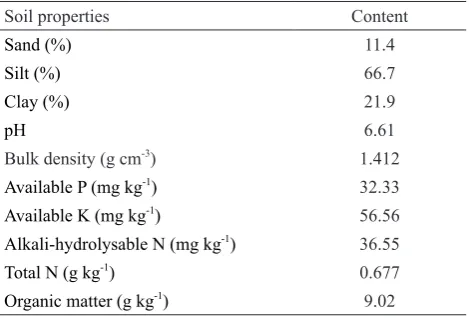
concentrated in the summer months is 967 mm. The physi-cal and chemiphysi-cal properties of the soil used in the two-year experiment are shown in Table 1 with reference to our previous research (Chen et al., 2014; Wu et al., 2016a). According to Table 1, the soil texture was a silty clay loam.
The field experiment had a completely random design
with 3 replications. There were 4 treatments in this experi-ment: urea was used as basal fertilization once (N1Z0); urea
was used as basal fertilization once with Z (N1Z10); urea
was used as third-split fertilization according to the tradi-tional fertilization method below (N3Z0); urea was used as
third-split fertilization with Z (N3Z10). Z application rates of
10 tha-1 could significantly increase rice grain yield in this
region under traditional N regimes (Chen et al., 2014; Wu
et al., 2016a). Therefore, Z was applied at an application rate of 10 t ha-1 (Z
10) for all 4 treatments.
The natural Z used in this study originated from Liaoning province, China. Z had the following chemical compo-sition (in %): SiO2 = 65.56, Al2O3 = 10.62, Na2O = 0.39,
K2O = 2.87, CaO = 2.59, Fe2O3 = 0.63, MgO = 0.82, FeO
= 0.09, TiO2 = 0.069, P2O5 = 0.001, MnO = 0.01, H2O =
8.16, and loss of ignition (LOI) = 16.59. Z was applied to the near-surface soil as basal fertilizer with N. Based on the traditional fertilization method in the experimental station, N (157.5 kg ha-1) as urea was applied to the near-surface
soil layer in three parts: 60% – basal, 30% – 10 days after transplanting and 10% – 15 days after the jointing-boot-ing stage, respectively. K (K2O, 72 kg ha-1) was applied
in the form of potassium sulfate in two fractions: 50% basal and 50% 15 days after the jointing-booting stage, respectively for all 4 treatments. P (P2O5, 172 kg ha-1) was
applied as the basal fertilizer. The traditional variety used in the experimental station was Gangyu6 (Japonica rice) for both experiments over two years. Sowing begins on the 22nd of April, with transplanting being conducted on the 28th of May. The seeding recovery stage (R) begins on the 29th of May, the tillering stage (T) on the 5th of June, the jointing-booting stage (J) occurs on 4-6th of July,
the heading-flowering stage (H) on 3rd-7th of August, the
milky ripening stage (M) on 23rd-28th of August, the yel-low ripening stage (Y) on 5-10th of September and rice
harvest on 16-20th of September, respectively. Each hill
had 3 rice seedlings (7×17-hills per plot). Plot sizes were 2.5×2 m2 and rice was transplanted at 14×30 cm spacing.
The plots were regularly hand-weeded and pesticides were used to prevent insect and pest damage. No noticeable crop damage was observed during the experiment. The water layer in these plots was maintained at 1-7 cm in rice whole growth stages. Water was distributed by pipe to each plot for irrigation. Water depth was measured at a permanently
fixed depth gauge. The irrigation water flow was stopped
15 days before harvest.
Crop samples for biomass, N accumulation and leaf area index (LAI) were taken 4-5 times from transplanting onward. The sampling days were on June the 6th and 22nd
Table 1. Physical and chemical properties of experimental soil
Soil properties Content
Sand (%) 11.4
Silt (%) 66.7
Clay (%) 21.9
pH 6.61
Bulk density (g cm-3) 1.412
Available P (mg kg-1) 32.33
Available K (mg kg-1) 56.56
Alkali-hydrolysable N (mg kg-1) 36.55
Total N (g kg-1) 0.677
at the tilling stage, July the 5th and 12th at the
jointing-boot-ing stage, August the 6th and 8th at the headjointing-boot-ing-flowerjointing-boot-ing
stage, August the 26th and September the 2nd at the milky ripening stage and September the 15th and 18th at the yel-low ripening stage, respectively. At each sampling, 2 hills per plot with 3 replications were removed, separated and rinsed. The dry weight of the plant was determined after drying at 75oC until a constant weight was reached. LAI
was determined using a Plant Canopy Analyser LICOR, model-2000. The root cap ratio refers to the ratio of the dry weight of the underground part of the plant to the above-ground part. For each plot, a 0.14 (width)×0.3 (length)×0.3 (active rooting depth) metre clod sample transferred into a mesh bag made from 100 mesh nylon mesh. After water panning, the roots were separated and the root morpho- logy was determined. The roots were randomly selected at the milky-ripening stage to calculate the average main root length and root diameter using Vernier Calipers. The dis-placement method was used to accurately obtain the volume
of the roots. The bleeding rate defined as the root activity
was measured using cotton traps (Zhang et al., 2013). After the removal of the rice stem at around 10cm above ground level, pre-weighted absorbent cotton was placed on the cut
surface of the stump and wrapped in plastic film secured by
a rubber band. Pre-weighed cotton was weighed again after 14 h from 6:00 p.m. till the next day 8:00 a.m. to calculate the bleeding rate.
At the end of the growth stage, the rice grain yield was calculated based on a 12-14% moisture content. The num-ber of panicles was counted from three randomly selected plants and the weight of the grains per panicle was obtained
using electronic scales. The unfilled grain percentage and
1000-grain weight were determined after the process of drying and enzyme deactivation.
Soil samples from depths of 0-30 cm (15 cm) were taken both in the vegetative period (15 days after transplanting) and reproductive period (5 days after the milky ripening stage). The soil samples remaining in the centrifuge tubes were extracted using 60 ml of 1M NH4OAc solution (pH
7.0) followed by steam distillation to determine the soil
CEC (Rabai et al., 2013). The total N concentration in the plant and soil were determined by the semi-micro Kjeldahl
method and available K was tested using a flame photome
-ter for K available on the exchange sites of Z (Shi and Bao, 1996). Soil samples were passed through a 2 mm sieve after being blended, and air-dried in a laboratory and 5 g of each soil sample was extracted using 50 ml of 2M KCl solution. Concentrations of NH4-N and NO3-N were determined
using the AA3 Continuous Flow Analytical System (Shi and Bao, 1996; Malekian et al., 2011).
All data (two-year mean) were subjected to analysis of variance (ANOVA) using SAS9.3 software. The separation
of the means was performed using least significant
diffe-rence (LSD).
RESULTS
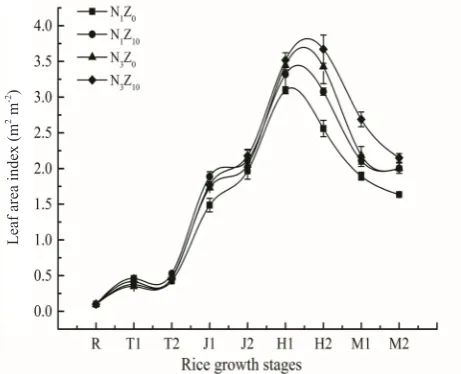
Figures 1 and 2 show the different growth and develop-ment of rice within 4 treatdevelop-ments. Rice plots treated with N1Z10, N3Z0 and N3Z10 produced higher LAI and biomass
compared with N1Z0. The LAI and biomass of N1Z10 does
not seem to differ significantly from those of N3Z0. In the
rice reproductive period, N3Z0 and N3Z10 treatments
pro-duced better performances with regard to LAI and biomass whereas N1Z0 and N1Z10 exerted a more obvious influence
at the initiation of the rice growth stage. Maximum LAI (3.67) and biomass (13893.74 kg ha-1) were observed for
N3Z10. N3Z10 and N1Z10 treatments resulted in a 37.3 and
18.8% heavier biomass compared with N1Z0. Compared
with N3Z0, N3Z10 and N1Z10 increased the biomass by 18.7
and 2.8%, respectively.
Fig. 1. Leaf area index changes at different rice growth stages. R, T, J, H and M were the stages of recovery stage, tillering stage, jointing-booting stage, heading-flowering stage and milky ripen-ing stage, respectively.
Fig. 2. Biomass changes at different rice growth stages. R, T, J, H, M and Y were the stages of recovery stage, tillering stage, joint-ing-booting stage, heading-flowering stage, milky ripening stage and yellow ripening stage, respectively.
Aboveground biomass (kg ha
-1)
Leaf area index
(m
The effects of different combinations of N application frequencies with Z on rice grain yield and yield compo-nents are shown in Table 2. Rice grain yield with N3Z10 and
N1Z10 treatments were significantly enhanced by 8.5 and
10.7% compared with N1Z0. What’s more, N3Z10 and N1Z10
treatments can also lead to higher 1000-grain weight and
the lower unfilled grain percentage compared with N1Z0.
It is suggested that the Z amendment could enhance rice grain yield mainly due to the higher 1000-grain weight
and lower unfilled grain percentage. However, there is no
clear difference between N1Z10 and N3Z0 on the 1000-grain
weight of rice.
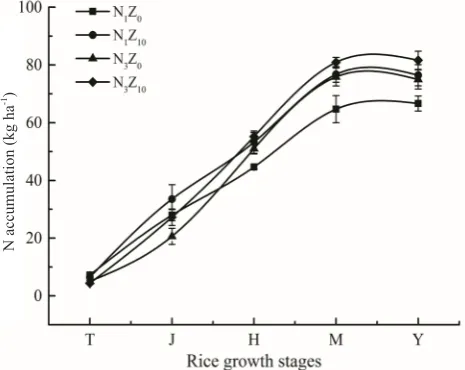
N accumulation at various growth stages of rice in both of the two growing seasons are shown in Fig. 3. Rice with N3Z0 and N3Z10 treatments achieved a higher N uptake
compared with N1Z0 at harvest time, which is in complete
contrast to the result from the tilling stage to the jointing-booting stage. This was due to the fact that the applied N was lower than that of N1Z0 and N1Z10 treatments at the
initial growth stage. The maximum value of N uptake at harvest time (81.61 g kg-1) was observed in N
3Z10. This
result suggests that the Z amendment regulated the soil available N from the tillering stage to the jointing-booting stage. The dynamic changes in N matched the N
require-ment of the rice plant and finally N3Z10 produced a higher
grain yield.
The impacts of different N management regimes on soil
residual N (SRN) and CEC are shown in Table 2. Soil water
and nutrition supply capacity has been shown to depend
on CEC. There were no significant effects on soil CEC
between different N application frequencies. Higher soil
CEC was achieved at many N application frequencies with
Z amendments. However, both N application frequencies and Z had little effect on SRN. The average content of SRN was lower than its original content. This may be due to N
losses in the saturated conditions of rice fields. Adequate Z application rates greatly contributed to the CEC and Z
amendment that increased soil-available N retention might also exhibit the continuing effect of boosting soil fertility over the next year.
The reasons for the enhancement of dry weight bio-mass and N accumulation are explored in Table 3. During the vegetative period of rice, N1Z0, N1Z10 and N3Z10
treat-ments achieved higher NH4-N content in soil compared
with N3Z0. NO3-N content of N1Z0 treatment resulted in the
lowest content of NH4-N due to long-term N consumption
through leaching or uptake by plants under the one-time N application method. It demonstrates that Z addition to soil increased the N availability due to its longer con-trolled-release time of NH4-N. However, during the rice
reproductive period, there were no clear differences in available N between different treatments, which indicated that the controlled-release function of Z mainly happened at the initial growth stages of rice rather than in the repro-ductive period.
Regarding the chemical composition, K2O constitutes
a significant portion of Z. In the vegetative period of rice,
N1Z10 and N3Z10 treatments considerably increased the
available K content of soil compared with N1Z0. The K
con-tent of N3Z0 was higher than that of N1Z0 mainly due to the
fact that considerable amounts of K were utilized by rice plants under the one-time N application method. During the reproductive period, Z10 treatment still significantly
Table 2. Rice grain yield, yield components, soil residual nitrogen and soil cation exchange capacity as affected by zeolite and nitro-gen application at rice harvest time: urea used as basal fertilization one time (N1Z0), N1Z0 with zeolite (N1Z10), urea used as third-split fertilization (N3Z0), N3Z0 with zeolite (N3Z10)
Treatments Grain yield(t ha-1) 1000-grain weight (g) percentage (%)Unfilled grain (cmol kgCEC -1) (g kgSRN-1)
N1Z0 7.28c 26.270c 4.43a 11.99b 0.46a
N1Z10 7.90ab 26.648b 2.60c 15.01a 0.51a
N3Z0 7.74b 26.542b 4.34ab 12.05b 0.47a
N3Z10 8.06a 26.848a 3.01bc 13.69a 0.49a
Mean values followed by different indices are significant at 0.05 probability level. CEC – soil exchange capacity, SRN – soil residual nitrogen content.
Fig. 3. N accumulation at different rice growth stages. R, T, J, H, M and Y were the stages of recovery stage, tillering stage, joint-ing-booting stage, heading-flowering stage, milky ripening stage and yellow ripening stage, respectively.
N accumulation (kg ha
increased soil K content compared with Z0. It appears that
the Z amendment increased soil K content throughout the growth period of rice.
Table 4 shows the effects of various N management regimes on rice root morphology and activity. According to
Table 4, the Z amendment significantly increased the root
dry weight, main root length, diameter, root volume and root activity compared with N1Z0. Developed root traits
may enhance the nutrient transport from the root to the aboveground parts and result in higher biomass and grain
yield. However, Z input did not statistically significantly
improve the root cap ratio.
DISCUSSION
N nutrition is one of the most pivotal factors of crop production. The mixture between Z and N, which is comparable to slow-release fertilizers, played an impor-tant role in the rice grain yield increasing (Sepaskhah and Barzegar, 2010). Compared with N1Z0, the rice grain yield
resulting from the N3Z10 and N1Z10 treatments were signifi
-cantly enhanced by 8.5 and 10.7% mainly due to a higher
1000-grain weight and lower unfilled grain percentage.
Similar results were found by Sepaskhah (Sepaskhah and
Yousefi, 2007; Sepaskhah and Barzegar, 2010), but they
found that the Z amendment could only slightly enhance the 1000-grain weight. However, there were no clear differ-ences between N1Z10 and N3Z0 on 1000-grain weight of rice.
Some researchers have suggested that the higher 1000-grain weight was obtained mainly due to an enhancement in sink and source parameters (Wu et al., 2016a). In the present
study, when compared with N3Z0, the sink parameter of the
N1Z10 treatment was significantly enhanced by the one-time
N application.
In our research, N3Z10 and N1Z10 treatments resulted in
a 22.4 and 14.7% higher N uptake than N1Z0. The
differ-ence between N1Z10 and N3Z0 was small at harvest time.
The dominant reasons for the trend that Z clearly increased N uptake may be (1) NH4+ absorption by Z to decrease N
losses when N is available at the initial growth stage of rice, and (2) slow release of N in contrast to N management without Z (Gholamhoseini et al., 2012; Malekian et al., 2011). A larger average content of available N released by Z that corresponded to the N requirement of the rice plant from the jointing-booting stage in surface soil resulted in a higher N uptake. In fact, when N was applied at early days of the plant life cycle, the Z amendment could decrease N
availability to the plant due to its high CEC. Ippolito et al.
(2011) showed that N with a Z amendment contained more NH4-N at day 7 and less NH4-N at day 35. It is
demon-strated that at the first 7 days, Z decreased N availability to
the plant and lead to slow growth. In this experiment, Fig. 3 showed an observable shrinkage in N uptake and biomass at the initial tillering stage with Z addition. However, it is apparent that Z clearly alleviated N stress from the tiller-ing stage to jointtiller-ing-boottiller-ing stage. At the jointtiller-ing-boottiller-ing stage, N uptake of the N1Z10 and N3Z10 treatments were
inclined to be higher than that of N1Z0 and N3Z0.
N1Z10 and N3Z10 treatments resulted in a higher NH4-N
content in soil compared with N3Z0 at the rice tillering
stage. However, there were no clear differences in the N
Table 3. NH4-N, NO3-N and potassium content in soil as affected by zeolite and nitrogen management in different rice growth
peri-ods: urea used as basal fertilization one time (N1Z0), N1Z0 with zeolite (N1Z10), urea used as third-split fertilization (N3Z0), N3Z0 with zeolite (N3Z10)
Treatments In vegetative period (mg kg
-1) In reproductive period (mg kg-1)
NH4-N NO3-N K NH4-N NO3-N K
N1Z0 16.33a 8.49b 274.54c 0.948a 0.841a 25.50c
N1Z10 17.44a 10.59ab 302.72b 0.952a 0.842a 28.50b
N3Z0 11.29b 10.71ab 311.14b 0.986a 0.873a 24.00c
N3Z10 15.70a 12.81a 353.68a 1.012a 0.863a 30.99a
Mean values followed by different indices are significant at 0.05 probability level.
Table 4. Root system as affected by zeolite and nitrogen managements at the milky-ripening stage: urea used as basal fertilization once (N1Z0), N1Z0 with zeolite (N1Z10), urea used as third-split fertilization (N3Z0), N3Z0 with zeolite (N3Z10), the root cap ratio refers to the ratio of the dry weight of the underground part to the aboveground part
Treatments Dry weight(g plant-1) Root cap ratio(%) Main root length(cm) Root diameter(mm) Root volume(cm3) Root activity(g h-1)
N1Z0 6.38c 7.61a 30.81b 0.79b 33.45b 0.11c
N1Z10 7.56a 9.11a 35.60a 0.98a 38.48a 0.13b
N3Z0 6.58bc 8.53a 34.35a 0.91ab 36.15ab 0.13b
N3Z10 7.16ab 9.59a 37.75a 0.97ab 38.12a 0.15a
available at harvest time, which indicated that the con-trolled-release function of Z mainly occurred at the initial growth stages of the rice plant rather than in the reproduc-tive period of rice. The slow-release fertilizer allowed for the successive release rate of N to correspond well with the N requirements of crops (Wu et al., 2016b; Geng et al.,
2015). Furthermore, the Z amendment could also signifi
-cantly increase the N availability for crops similarly to the effects of the slow-release fertilizer (Rehakova et al., 2004; Gholamhoseini et al., 2012).
Either in the vegetative period or reproductive period
of rice, Z10 resulted in a greater average K concentration
compared with Z0. Z improved the N use efficiency through
increased N availability and reduced N losses through the leaching of exchange cations, especially Na+ and K+
(Leggo, 2000; Harland et al., 1997; Mohammad et al., 2004). Ferguson et al. (1986) found that the establishment of creeping bentgrass decreased as the Z application rate increased by 5 to 10% (by volume), this phenomenon was associated with a decrease in Z sodium content. These results suggest that there could be abundant K and slight Na exchanged by NH4+ from Z in the surface soil, which might
greatly enhance rice growth. Moreover, there may be inter-action effects between K and slow-release N to stimulate rice biomass and LAI. Furthermore, a higher total P and available P in the soil with Z treatment may also contribute to higher biomass and LAI to achieve a higher rate of rice production (Gholamhoseini et al., 2012). Natural Z incor-porated into soil could improve the long-term soil quality
by enhancing soil CEC. This affected the retention of the
most essential nutrients for crops such as N, P and K in soil (Li et al., 2013). However, Z also provided some ions such as Ca2+ and Mg2+ (Doula et al., 2012). The increased
con-tent of Ca2+ and Mg2+ present in the soil with increasing Z
application rates may affect soil structure and result in soil hardening. Therefore, appropriate rates of Z are critical for rice farmers to increase rice grain yield.
The NUE is very low with an average of 27.5% in
China, which has led to some concerns that excessive N in
field negatively may influence the quality of the environ -ment through leaching and volatilization (Malekian et al., 2011; Wu et al., 2016b). Rice roots, as important organs for absorbing water, nutrients, and growth regulation, have
a direct influence on aboveground biomass and nutrient
use. Root growth can be used to determine the uptake
abil-ity of nutrition and water, it also reflects crop growth and
development. In our research, it was found that Z input
could statistically significantly enhance the root system.
There was little information available on the effects of Z on root morphology. However, the effects of slow-release fertilizer on root morphology were known while the effects of N application plus Z are comparable to the slow-release fertilizer of N. Slow-release fertilizer based on biochar can delay root senescence and greatly increase the main root length, volume, active absorption area and root activity, which results in a higher rice grain yield (Zhang et al.,
2013). Rice grain yield has a significantly positive cor -relation with root dry weight, total root length, total root surface area, root bleeding intensity and the root cap ratio. All of these traits could be enhanced by slow-release fer-tilizer application (Peng et al., 2013). In conclusion, the enhanced N uptake and rice grain yield by Z were not only attributed to higher available N and K content in the soil but they were also attributed to a developed root system.
CONCLUSIONS
The results herein indicated that:
1. Zeolite application could greatly enhance rice growth and development.
2. At the vegetative stage of the life cycle, a higher content of available nitrogen and potassium in soil could contribute to a higher rice grain yield.
3. Using urea as a basal fertilizer in conjunction with
zeolite could significantly increase nutrient retention,
whilst conserving the biodiversity of the environment of
paddy fields, and this approach is recommended in order to
improve rice grain yield and decrease fertilizer application frequencies.
Conflict of interest: No conflict of interest exists in the
submission of this manuscript.
REFERENCES
Barea J.M., 2015. Future challenges and perspectives for
apply-ing microbial biotechnology in sustainable agriculture based on a better understanding of plant-microbiome inter-actions. J. Soil Sci. Plant Nut., 15(2), 261-282.
https://doi.org/10.4067/s0718-95162015005000021
Belder P., Bouman B.A.M., Cabangon R., Lu G., Quilang E.J.P., Li Y., and Tuong T.P., 2004. Effect of water-saving irrigation on rice yield and water use in typical lowland conditions in Asia. Agric. Water Manage., 65(3), 193-210. https://doi.org/10.1016/j.agwat.2003.09.002
Bi L., Zhang B., Liu G., Li Z., Liu Y., Ye C., and Linag Y., 2009.
Long-term effects of organic amendments on the rice yields for double rice cropping systems in subtropical China. Agric Ecosyst Environ, 129(4), 534-541.
https://doi.org/10.1016/j.agee.2008.11.007
Chen T., Wu Q., Zheng J., Xu X., Chi D., and Sun D., 2014.
Effect of water and nitrogen coupling on rice yield based on clinoptilolite (in Chinese). J. Irri. and Drain, 4/5(33), 71-76.
Doula M.K., Elaiopoulos K., Kavvadias V.A., and Mavraganis V., 2012. Use of clinoptilolite to improve and protect soil qual-ity from the disposal of olive oil mills wastes. J. Hazard. Mater, 207, 103-110.
https://doi.org/10.1016/j.jhazmat.2011.04.014
Ferguson G.A., Peppe I.L., and Kneebone W.R., 1986. Growth
of creeping bentgrass on a new medium for turfgrass growth: Clinoptilolite zeolite-amended sand. Agron. J., 78(6), 1095-1098.
https://doi.org/10.2134/agronj1986.00021962007800060031x
Geng J., Sun Y., Zhang M., Li C., Yang Y., Liu Z., and Li L., 2015. Long-term effects of controlled release urea applica-tion on crop yields and soil fertility under rice-oilseed rape rotation system. Field Crop Res., 184, 65-73.
Gholamhoseini M., AghaAlikhani M., Dolatabadian A.,
Khodaei-Joghan A., and Zakikhani H., 2012. Decreasing
nitrogen leaching and increasing canola forage yield in a sandy soil by application of natural zeolite. Agron J, 104(5), 1467. https://doi.org/10.2134/agronj2012.0145
Gholamhoseini M., Ghalavand A., Khodaei-Joghan A., Dolatabadian A., Zakikhani H., and Farmanbar E., 2013.
Zeolite-amended cattle manure effects on sunflower yield, seed quality, water use efficiency and nutrient leaching. Soil Till. Res., 126, 193-202.
https://doi.org/10.1016/j.still.2012.08.002
Harland J., Lane S., and Price D., 1997. Further experiences
with recycled zeolite as a substrate for the sweet pepper crop. Int. Symp. Grow Med. Soilless Culture, 481, 187-196. https://doi.org/10.17660/actahortic.1999.481.19
Ippolito J.A., Tarkalson D.D., and Lehrsch G.A., 2011. Zeolite
soil application method affects inorganic nitrogen, mois-ture, and corn growth. Soil Sci., 176(3), 136-142.
https://doi.org/10.1097/ss.0b013e31820e4063
Kavoosi M., 2007. Effects of zeolite application on rice yield, nitrogen recovery, and nitrogen use efficiency. Commun. Soil Sci. Plant Anal., 38(1-2), 69-76.
https://doi.org/10.1080/00103620601093652
Leggo P.J., 2000. An investigation of plant growth in an organo-zeolitic substrate and its ecological significance. Plant Soil, 219, 135-146.
Li J., Wee C., and Sohn B., 2013. Effect of Ammonium- and
Potassium-Loaded Zeolite on Kale, Growth and Soil Property. Amer. J. Plant Sci., 4(10), 1976-1982.
https://doi.org/10.4236/ajps.2013.410245
Liu X., and Zhang C., 2005. Food security situation thinking and related measures in current China (in Chinese). Economy in Shandong, 20(6), 25-27.
Malekian R., Abedi-Koupai J., and Eslamian S.S., 2011.
Influences of clinoptilolite and surfactant-modified clinop-tilolite zeolite on nitrate leaching and plant growth. J. Hazard. Mater, 185(2-3), 970-976.
https://doi.org/10.1016/j.jhazmat.2010.09.114
Mohammad M.J., Karam N.S., and Al-lataifeh N.K., 2004.
Response of croton grown in zeolite-containing substrate to different concentrations of fertilizer solution. Commun. Soil Sci. Plant Anal., 35(15-16), 2283-2297.
https://doi.org/10.1081/css-200030637
Peng Y., Ma J., Jiang M., Yan F., Sun Y., and Yang Z., 2013.
Effects of slow/controlled release fertilizers on root mor-phological and physiological characteristics of rice (in Chinese). J. Plant Nut. Fert., 19(5), 1048-1057.
Rabai K.A., Ahmed O.H., and Kasim S., 2013. Use of
formu-lated nitrogen, phosphorus, and potassium compound fertilizer using clinoptilolite zeolite in maize (Zea mays L.) cultivation. Emir. J. Food Agric., 25(9), 713-722.
https://doi.org/10.9755/ejfa.v25i9.16248
Rehakova M., Čuvanová S., Dzivak M., Rimár J., and
Gaval’Ova Z., 2004. Agricultural and agrochemical uses
of natural zeolite of the clinoptilolite type. Curr. Opin. Solid State Mater Sci., 8(6), 397-404.
https://doi.org/10.1016/j.cossms.2005.04.004
Sandhu S.S., Mahal S.S, Vashist K.K., Buttar G.S., Brar A.S.,
and Singh M., 2012. Crop and water productivity of bed
transplanted rice as influenced by various levels of nitrogen and irrigation in northwest India. Agric. Water Manag., 104, 32-39. https://doi.org/10.1016/j.agwat.2011.11.012
Sepaskhah A.R., and Barzegar M., 2010. Yield, water and
nitro-gen-use response of rice to zeolite and nitrogen fertilization in a semi-arid environment. Agric. Water Manag., 98(1), 38-44. https://doi.org/10.1016/j.agwat.2010.07.013
Sepaskhah A.R., and Yousefi F., 2007. Effects of zeolite applica-tion on nitrate and ammonium retenapplica-tion of a loamy soil under saturated conditions. Soil Res, 45(5), 368-373. https://doi.org/10.1071/sr06069
Shi R., and Bao S., 1996. Soil Agro-chemistrical Analysis.
Beijing Agricultural Press, Beijing, P.R. China.
Weatherley L.R. and Miladinovic N.D., 2004. Comparison of
the ion exchange uptake of ammonium ion onto New Zealand clinoptilolite and mordenite. Water Res., 38(20), 4305-4312. https://doi.org/10.1016/j.watres.2004.08.026
Wienhold B.J., Trooien T.P., and Reichman G.A., 1995. Yield
and nitrogen use efficiency of irrigated corn in the northern great plains. Agron. J., 87, 842-846.
https://doi.org/10.2134/agronj1995.00021962008700050010x
Wu Q., Xia G., Chen T., Chi D., Jin Y., and Sun D., 2016a.
Impacts of nitrogen and zeolite managements on yield and physicochemical properties of rice grain. Int. J. Agric. Biol. Eng., 9(5): 93-100.
Wu Q., Xia G., Chen T., Wang X., Chi D., and Sun D., 2016b.
Nitrogen use and rice yield formation response to zeolite and nitrogen coupling effects: Enhancement in nitrogen use efficiency. J. Soil Sci. Plant Nut., 16(4), 999-1009. https://doi.org/10.4067/s0718-95162016005000073
Zhang W., Meng J., Wang J., Fan S., and Chen W., 2013. Effect
of biochar on root morphological and physiological charac-teristics and yield in rice (in Chinese). Acta Agron. Sin., 39(8), 1445-1451.