A HYBRID MODEL PROPOSAL FOR PERSONNEL PERFORMANCE
EVALUATION PROCESS UNDER FUZZY ENVIRONMENT
Burak Fahir Memik
,
(MSSc) Istanbul Commerce University, TurkeyBerk Ayvaz
,
(PhD)Istanbul Commerce University, Turkey
Received: Apr. 12, 2017 Accepted: May 11, 2017 Published: June 1, 2017
Abstract
Performance evaluation process is becoming more and more important for today's organizations because of directly influencing the organizations performance. The performance evaluation process is a multi-criteria decision-making problem due to involving the qualitative and quantitative criteria. In this study, TOPSIS (Technique for Order Preference by Similarity to Ideal Solution) and Analytical Hierarchy Process (AHP) in fuzzy environment are suggested as an integrated model for the personnel performance evaluation problem. The proposed model provides convenience for the executives in the personnel performance evaluation stage.
Keywords:
Performance Evaluation, Multi Criteria Decision Making, Fuzzy Logic1. Introduction
In recent years, the competition among the organizations has increased due to the globalization effect, technological advances, economic and social reasons. Under these conditions, it is now deemed as a need by the organizations to establish more efficient and effective systems, meaning more successful systems compared to their competitors. There are many factors having an impact on the success of an organization, yet one of the most important factors is the employed human source. The organizations, being aware of this matter, must focus particularly on the personnel performance issue while measuring the performance of critical points in their systems.
The term "Performance Evaluation" has been discussed for the first time during early 1900s in USA, and started to be used scientifically with the studies of Frederick Taylor. The term "Performance Evaluation" has started to draw the attention of both organizations and also the academic researchers in the recent years. The personnel performance evaluation is a multi-criteria decision-making problem, which involves both numerical and non-numerical criteria within. Since the non-numerical criteria is not based on the subjective evaluation of the decision maker, the evaluation based on such criteria may variate depending on the decision makers. This matter prevents the performance evaluation phase to be objective. Fuzzy decision multi-criteria decision-making methods have been used because of the fact that certain criteria as designated within the performance evaluation phase involves uncertainty, and that they are based on the subjective opinions of the decision makers.
2. Literature Review
On this part of the study, the literature review conducts related to the performance evaluation are analyzed.
Eraslan and Algun (2004) formed four main criteria for white-collar workers in a company, which are personal criteria (work experience, following the orders, respecting to the superiors, taking initiatives, leadership, marital status, saving behaviour, bringing the family problems in work environment), behavioral criteria (working in cooperation and in harmony, dependability, taking responsibility, improving the subordinates, communication with thecustomers, creativity, protection of the office supplies, social relations, disciplinary punishment), technical criteria (knowledge & skill levels, protecting the machinery, tools and equipment, supervision requirement, having the ability to work in different lines of business) and general criteria (work attendance and resistance to stress).On the other hand, the Personal Criteria, Behavioral Criteria, Technical Criteria and Productivity & efficiency criteria have been used for blue-collar workers. The AHP method was used for performance evaluation in the study. Camgoz and Alperten (2006) applied the 360 degree performance evaluation method, as one of the human resources practices. The following criteria have been analyzed as evaluation criteria in the study: Personal integrity, Technical skill, Analysis, Leadership, Motivation, Implementation, Contribution to Personal Development. Kadak (2006) used the AHP method for the performance evaluation problem of the sales department employees in a company in pharmaceutical industry. Sixteen sub-criteria were used under the following main criteria: sales based targets, member based targets, skill based targets. These sub-criteria are as follows: sales target realization, revenue alteration, active member, campaign-target realization, number of mistakes, revenue alteration of the members with lower revenue, online ordering member, informed member, communication, adaptation to teamwork, job-tracking and finalization, personal development. Dagdeviren (2007) divided the factors to be used in personnel evaluation with fuzzy AHP method, as occupational and personal factors in his study, discussing the exchange knowledge, foreign trade knowledge and legislation knowledge as occupational factors, while discussing the matters of taking initiative, perception, analytical thinking, physical appearance as personal factors.
Demirtas (2009) offered a new model for the performance evaluation system of engineer officers in Turkish Armed Forces. Three main evaluation criteria are discussed in this study, as personal, martial and inner criteria, while the subcriteria are as follows: creativity, communication, experience, leadership, researching, sense of responsibility, initiative, sticking by the disciplinary rules, decision-making skills on politeness and kindness, physical and mental endurance, success in the auditing process, task knowledge and dominance, planning skills, organizing skills, tracking and control skills. Akcakanat (2009) focused on the performance evaluation problem in a police department in his study. In this study, twenty one evaluation criteria in total are determined by discussing the basic and administrative skills. Kayhan (2010) analyzed the employee performance by using the Fuzzy AJP and Fuzzy TOPSIS methods with two separate normalization techniques in his study. The performance evaluation criteria are discussed in four groups in the study as follows: Basic Competence Criteria, First-Stage Administrative Competence Criteria, Mid-Level Administrative Competence Criteria and Top-Level Competence criteria. "Teamwork, Communication, Innovation, Problem solving and Decision making, Customer centricity, Loyalty to his/her job" criteria are used as basic competence criteria, while "Performance Management, Work Development, Decision Making and Crisis Management, Representation and Effectiveness, Planning and Organization, Corporate Culture and Awareness" sub-criteria are applied as Administrative Competence Criteria. Moon et al. (2009) developed an evaluation system with fuzzy logic method for performance evaluation problem in military in the study. The main criteria of service evaluation, sophisticated skills, growth potential and innovation are used in the performance evaluation process. Balli et al. (2009) developed a fuzzy extern system in order to evaluate the annual performance of employees in an organization in his study. The following criteria are discussed during practical process: self-confidence, adaptation, resolution, skills, responsibility criteria. Ozdaban (2010) created a fuzzy decision model on work evaluation and personnel evaluation in his study. Twelve subcriteria are designated under four main criteria, while fifty other criteria are determined under these subcriterias. The main criteria comprise of skills, responsibility, effort and work conditions.
collaboration. In this study, the fuzzy multi-criteria decision-making technique was used. Gungor and Biberci (2011) used the 360 degree performances evaluation and AHP method. The criteria used in this study are as follows: leadership, occupational & technical skills, adaptation to changes, communication skills, human relations, result accomplishment, personnel training. Kara (2011) used 360 degree performance evaluation method in his study and put it into practice for mid-level managers. The criteria of leadership, task management, adaptation to changes, communication, human relations, result oriented, personnel training and developing were used. Gorener and Tepe (2014) used the AHP and Moora methods for personnel selection problem. Graduation, computer skills, competence level, foreign language level, projected generated concerning the job definition, experience, references, face-to-face meeting, interview, social activities are discussed as evaluation test criteria. Espinilla et al. (2013) designated eleven criteria for personnel performance evaluation. These criteria comprise of productivity, sales amount, average off-time, company introduction, interest in training, work management, customer services, responsibility, initiative, exemplifying, personal appearance. Tore (2014) designated fourteen performance criteria concerning the performance of employees in banking sector. These criteria are as follows: completing the work on time, good-humoredly communication with the customers, having a good knowledge store on its profession, vocational-trainings received, type of graduation, graduation grade, working hours, assigned department, personnel number in the department, number of customers coming to the branch, type of transactions carried out in the branch, specifications of the site - where the branch is located, working hours in the branch. Samuel et al. (2014) focused on the performance evaluation of academic personnel. The main criteria of academic competence, publications, educational & research studies, contributions, corporate belonging, specialties are discussed in his study. The fuzzy decision system is used for the evaluation process. Kang and Shen (2015) discussed the work performance, occupational behaviors, competence and corporate belonging criteria in the study carried out on personnel performance evaluation. Karadag Albayrak and Senger (2015) carried out a study on personnel evaluation with gray relation analysis method. The personnel performance criteria, which were used in the study, are as follows: professional knowledge store level, professional quality level, professional quantity level, tendency to collaboration, level of entrepreneurism, level of work responsibility, level of work commitment, as well as the decision-making skills.
3. Problem Definition and the Methodology
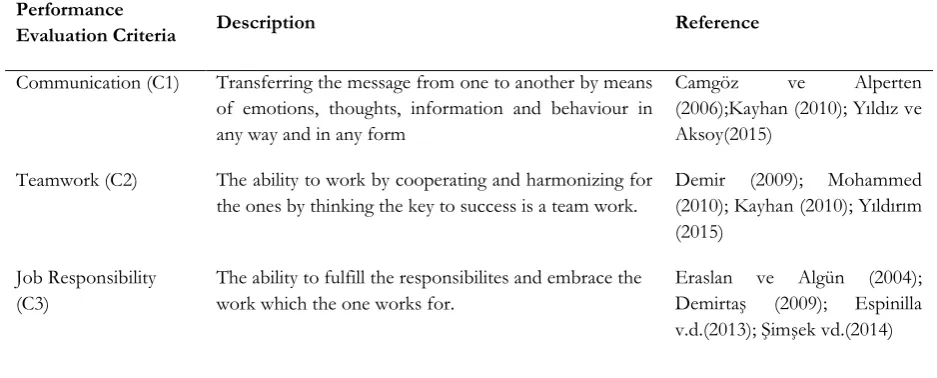
The following criteria are decided to be used for personnel evaluation problem based on the literature review and the discussions with experts: communication, teamwork, job responsibility, business development, problem solving and decision making, technical knowledge and skills, honesty (see Table 1).
Table 1 - Performance Evaluation Criteria Performance
Evaluation Criteria Description Reference
Communication (C1) Transferring the message from one to another by means of emotions, thoughts, information and behaviour in any way and in any form
Camgöz ve Alperten
(2006);Kayhan (2010); Yıldız ve Aksoy(2015)
Teamwork (C2) The ability to work by cooperating and harmonizing for the ones by thinking the key to success is a team work.
Demir (2009); Mohammed (2010); Kayhan (2010); Yıldırım (2015)
Job Responsibility (C3)
The ability to fulfill the responsibilites and embrace the work which the one works for.
Business Development (C4)
The ability of firm providing all possibilities that accommodates for the worker to present proposals and create new ideas
Mohammed (2010); Kayhan (2010); Yıldırım (2015)
Problem Solving and Decision Making (C5)
The ability to think all the alternatives in case of any crisis in the frame of rationality, sound judgements and problem solving.
Demir (2009); Demirtaş (2009); Kayhan (2010); Karadağ ve Senger. (2016)
Technical knowledge and skills (C6)
The ability to have technical data and information for the relevant position in the firm.
Eraslan ve Algün (2004); Camgöz ve Alperten (2006); Güngör ve Biberci (2011); Yıldırım (2015)
Honesty(C7) With the aim of sustainability of the work and healty information that spreads to managers, co-workers and employees , it is the ability to be honest and clear when it comes to transferring the message within the frame of the work.
Küçü (2007); Ekin (2014)
On this chapter of the study can be found the methods suggested for personnel performance evaluation problem. 3.1.Fuzzy AHP
AHP is one of the multi-criteria decision-making methods used in modelling the unstructured problems in many fields like social, economic, political and management sciences (Saaty, 1980). The AHP method has been criticized many times since it is argued that it remains incapable of handling the uncertainties encountered during the parried comparison process, although the calculations are made based on the knowledge of decision maker (Deng, 1999; Kahraman, 2003). For this reason, the theories of AHP and fuzzy logic are combined, and certain studies have been carried out for determining the criteria degree of the decision maker based on his/her personal judgement, thus naming these studies as Fuzzy AHP (Yang and Chen, 2004). In Fuzzy AHP method, the value ranges are utilized for determining the paired comparison rates instead of definite numbers, differently from the traditional AHP method (Bender and Simonovic, 2000). The experts are stating their opinions with non-graphic analyses, which - in fact- is a more realistic alternative, instead of a definite numerical statement on a certain subject. These non-graphic analyses comprise of triangular fuzzy numbers, indicating the judgement range (Gu and Zhu, 2004).
When the literature in considered from this point of view, the first study on AHP was carried out by Van Laarhoven and Pedrytez (1993) with triangular fuzzy numbers. Then, Buckley developed a model in AHP with trapezoidal fuzzy numbers (1985). The steps to be taken in Fuzzy AHP Method are as follows (Kahraman, 2004):
Range of Objects =
The object represents the main criteria when considered from the point of main objective, while representing the sub criteria when viewed from the point of main criteria. In accordance with the grade analysis by Chang, each and every object is analyzed one by one, the grade analysis is performed for each objective and respectively . The grade analysis values for each object are expressed with the following serial (Kahraman, 2004).
These values are triangular fuzzy numbers.
(1)
For getting this result, the following additional fuzzy process is performed.
(2) for getting this amount, the fuzzy addition is performed for these values:
(3) Taking the reciprocal of the above stated vector is stated as follows:
; (4)
i, m, u values indicate the triangular fuzzy numbers.(i=lowest value, m=most probable value, u=highest value) 2nd step: probability is indicated as follows:
And it is also stated as follows:
(5)
In order to compare the ve values, ve values are required.
3rd step:
The possibility of the convex fuzzy number to be higher than the
k convex fuzzy number is stated as follows:(6) ; i=1,2,3,…,k
In case for each k=1,2,3,…,n; k≠i;
, the weight vector will be as follows:
( 7) 4th step: The weight vector is normalized through normalization process. The W value received here is not the fuzzy number, but it is the number indicating certainty.
(8) 3.2.1. Liou and Wang Method
Calculation algorithm of total integral values for triangular fuzzy numbers is as follows:
] ( 9) The value is taken in the range [0,1] for "a", which is defined as the optimism index of the decision maker. The higher "a" index is used for an optimistic decision maker, while this value is used for pessimistic decision maker, when it gets lower.
3.2 Fuzzy TOPSIS
TOPSIS is a multi-criteria decision making method, developed by C. L. Hwang and K. Yoon (1981). While it is the closeness to be found for ideal solution in TOPSIS method, which is based on finding and selecting the alternative that is the most probable ideal solution, the distance is analyzed in terms of positive and negative ideal solution (Hwang and Yoon, 1981). In this method, it is argued that the fuzzy logic can be utilized to become free of subjective judgments of decision makers, and the first study on this matter was carried out by Negi in 1989 through the usage of triangular fuzzy numbers with TOPSIS method in his Ph.D. dissertation. After then, this method has been used in many decision making problems. The triangular fuzzy numbers can be utilized in TOPSIS method, and the trapezoidal fuzzy numbers are frequently utilized, as well. The Fuzzy TOPSIS method can be defined as a method for evaluating and ranking of alternatives based on many decision criteria under certainty by more than one decision maker, thus making the right decision for the selection. The grades of the criteria used for evaluating the importance of criteria are stated with non-graphic variables. The used non-graphic variables and used variables, as triangular fuzzy numbers, can be found on Table 2 and Table 3 (Ying Ming Wang, 2006).
Table 2 - Non-graphic variables for importance level of criteria, and the relevant triangular fuzzy numbers (Chen et al., 2006)
Linguistic variable Triangular fuzzy numbers Trapezoidal fuzzy numbers
Absolutely Low (0, 0, 0.1) (0, 0, 0.1, 0.2)
Low (0, 0.1, 0.3) (0, 0.2, 0.2, 0.3)
Medium Low (0.1, 0.3, 0.5) (0.2, 0.3, 0.4, 0.5)
Fair (0.3, 0.5, 0.7) (0.4, 0.5, 0.5, 0.6)
Medium High (0.5, 0.7,0.9) (0.5, 0.6, 0.7, 0.8)
High (0.7, 0.9,1) (0.7, 0.8, 0.8,0.9)
Very High (0.9, 1, 1) (0.8, 0.9, 1.0, 1.0)
Table 3 - Non-graphic variables for importance level of criteria, and the relevant triangular fuzzy numbers (Chen et al., 2006)
Linguistic variable Triangular fuzzy numbers Trapezoidal fuzzy numbers
Very bad (0, 0, 1) (0, 0, 1, 2)
Bad (0, 1, 3) (0, 2, 2, 3)
Fair (3, 5, 7) (4, 5, 5, 6)
Medium Good (5, 7, 9) (5, 6, 7, 8)
Good (7, 9, 10) (7, 8, 8, 9)
Very Good (9, 10, 10) (8, 9, 10, 10)
In here, k x decision maker is equal to Dr (r=1,..,k). is for the importance level on Kj (j=1,.., m) through j. criteria by r. decision maker. indicates the level of i. alternative Ai (i=1,…,n), based on the value given by r. decision maker concerning j. criteria. The Fuzzy TOPSUS method comprises of the following steps (Chen et al., 2006): 1) For personnel performance evaluation process, k x decision maker is to be designated. The designated k x decision maker designate(s) the personnel performance evaluation criteria based on the literature review.
2) The importance of selection criteria and evaluation of the alternatives for each criteria by the k x decision maker is to be calculated using the equation (10) and (11):
(10)
(11)
3) A fuzzy decision matrix is formed for criteria and alternatives. (12)
(13)
4) The fuzzy decision matrix is normalized for the personnel with linear scale conversion. (14)
As the set of B benefit criteria and C cost criteria: , (15)
, (16)
eğer (17)
eğer (18)
5) The weighted-normalized fuzzy decision matrix is calculated by multiplying the criteria weight with normalized fuzzy decision matrix elements i=1, 2,…., m and j=1,2,….,n (19)
(21) (22) and j=1,2,….,n (23) 7) The distance of each alternative from and is calculated.
, i=1,2,….,m (24)
,i=1,2,….,m (25)
d(.,.)The difference between two fuzzy numbers
8) Closeness coefficient is calculated for each alternative.
, i=1, 2,…., m (26) 9) A ranking is applied between the alternatives based on the closeness coefficient
3. The Proposed Model
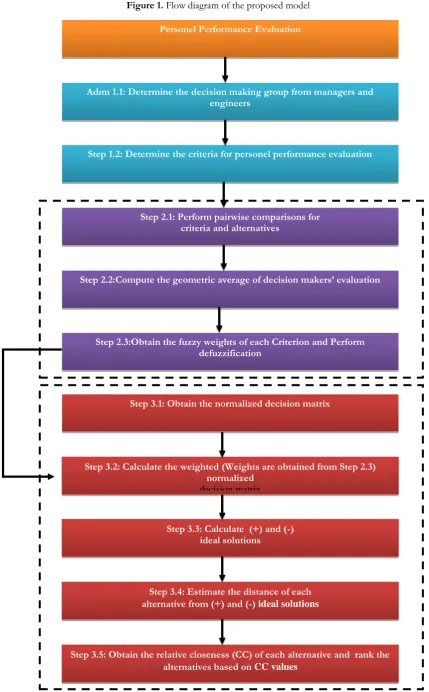
Figure 1. Flow diagram of the proposed model
Step 3.3: Calculate (+) and (-) ideal solutions
Step 3.4: Estimate the distance of each alternative from (+) and (-) ideal solutions
Step 3.5: Obtain the relative closeness (CC) of each alternative and rank the alternatives based on CC values
Personel Performance Evaluation
Adım 1.1: Determine the decision making group from managers and engineers
Step 1.2: Determine the criteria for personel performance evaluation
Step 2.1: Perform pairwise comparisons for criteria and alternatives
Step 2.2:Compute the geometric average of decision makers’ evaluation
Step 2.3:Obtain the fuzzy weights of each Criterion and Perform defuzzification
Step 3.1: Obtain the normalized decision matrix
Step 3.2: Calculate the weighted (Weights are obtained from Step 2.3) normalized
4. Application
The presented method in this study was applied on the personnel performance evaluation process of a company, which is a leading organization in its field in Turkey. The fuzzy AHP is used during the weighting phase of personnel performance evaluation criteria, seven criteria (C=1,..,7) were determined by three decision maker for the performance evaluation of seven employees (P=1,..,7) working in the technical marketing department of the company with Fuzzy TOPSIS method on the second phase.
PERFORMANS DEĞERLENDİRME
C1
C2
C3
C4
C5
C6
C7
P1
P2
P3
P4
P5
P6
P7
Figure 2: Hierarchical Structure of Performance Evaluation
4.1. Calculating the Criteria Weights using the Fuzzy AHP
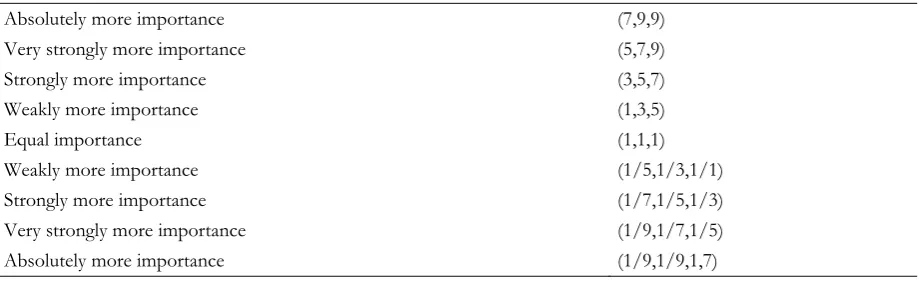
Step 1: On this phase - the phase of criteria weighting - the Fuzzy AHP method is utilized, the decision makers were asked to compare each criteria with each other and to state these comparisons based on the scale on Table 4. The data obtained based on the comparisons made by three decision makers can be found on Table 5.
Table 4 - The Importance Level of Triangular Fuzzy Numbers
Absolutely more importance (7,9,9)
Very strongly more importance (5,7,9)
Strongly more importance (3,5,7)
Weakly more importance (1,3,5)
Equal importance (1,1,1)
Weakly more importance (1/5,1/3,1/1)
Strongly more importance (1/7,1/5,1/3)
Very strongly more importance (1/9,1/7,1/5)
Table 5 - Integrated Evaluation Matrix in which the criteria are compared via paired comparison method.
Criteria C1 C2 C3 C4
C1 (1,00; 1,00; 1,00) (3,98; 6,08; 7,61) (0,57; 0,79; 1,22) (0,48; 0,75; 1,00) C2 (0,13; 0,16; 0,25) (1,00; 1,00; 1,00) (1,71; 2,60; 3,98) (1,44; 2,32; 3,66) C3 (0,82; 1,26; 1,75) (0,25; 0,39; 0,58) (1,00; 1,00; 1,00) (1,00; 1,91; 3,56) C4 (1,00; 1,33; 2,08) (0,27; 0,43; 0,69) (0,28; 0,52; 1,00) (1,00; 1,00; 1,00) C5 (1,61; 2,29; 3,56) (1,00; 1,44; 1,71) (1,00; 1,33; 2,08) (1,44; 1,71; 1,91) C6 (0,49; 0,82; 1,91) (0,52; 0,70; 1,00) (0,52; 0,78; 1,44) (0,52; 0,78; 1,44) C7 (7,00; 9,00; 9,00) (7,00; 9,00; 9,00) (7,00; 9,00; 9,00) (7,00; 9,00; 9,00)
Criteria C5 C6 C7
C1 (0,28; 0,44; 0,62) (0,52; 1,22; 2,03) (0,11; 0,11; 0,14) C2 (0,58; 0,69; 1,00) (1,00; 1,42; 1,91) (0,11; 0,11; 0,14) C3 (0,48; 0,75; 1,00) (0,69; 1,29; 1,91) (0,11; 0,11; 0,14) C4 (0,52; 0,58; 0,69) (0,69; 1,29; 1,91) (0,11; 0,11; 0,14) C5 (1,00; 1,00; 1,00) (0,84; 1,10; 1,71) (0,11; 0,11; 0,14) C6 (0,58; 0,91; 1,19) (1,00; 1,00; 1,00) (0,11; 0,11; 0,14) C7 (7,00; 9,00; 9,00) (7,00; 9,00; 9,00) (1,00; 1,00; 1,00)
Step 2: The data on Table 5 are calculated with the equations stated on the 1st step of Fuzzy AHP method, and stated as in Table 6.
Table 6 - The fuzzy numbers obtained on the 1st stage of Fuzzy AHP
C1 C2 C3 C4
l 0,05871663 0,050555307 0,036850934 0,032818372
m 0,104198136 0,083253832 0,067288601 0,052781226
u 0,181739643 0,159416918 0,132811932 0,100391961
C5 C6 C7
l 0,059269652 0,031768127 0,363554115
m 0,090018952 0,051103493 0,55135576
u 0,161648938 0,108443553 0,733996455
Step 3:
For finding the probability
The equation no.: 5 is utilized. The probabilities as found are indicated with the following equations.V(C1) ≥ V(C2)=1 V(C1) ≥ V(C3) =1 V(C1) ≥ V(C4) =1 V(C1) ≥ V(C5) =1 V(C1) ≥ V(C6)= 1 V(C1) ≥ V(C7)= 0 V(C2) ≥ V(C1) =1,276 V(C2)≥ V(C3) =1 V(C2)≥ V(C4) =1 V(C2)≥ V(C5) =1,284 V(C2)) ≥ V(C6) =1
V(C3) ≥ V(C4) =1 V(C3) ≥ V(C5) =1,09 V(C3) ≥ V(C6) =1 V(C3) ≥ V(C7) =0 V(C4) ≥ V(C1) 0,82 V(C4) ≥ V(C2)=1,01 V(C4) ≥ V(C3) =1,30 V(C4) ≥V(C5) =0,83 V(C4) ≥V(C6) =1 V(C4) ≥V(C7) =0 V(C5) ≥ V(C1) =1,39
V(C2)≥ V(C7) =0 V(C3) ≥ V(C1) =1,085 V(C3) ≥ V(C2)=1,22
V(C5) ≥V(C2)=1 V(C5) ≥V(C3) =1 V(C5) ≥ V(C4) =1
V(C7) ≥V(C4) =1 V(C7) ≥V(C5) =1 V(C7) ≥V(C6) =1
Step 4: The weight vector is obtained as stated in Equation 6. Then this weight vector is normalized, thus being stated as following. However, since each and every criteria - except for one - receives the value of "0", the ranking is not performed as per Cheng, but the rankingmethod by Liou and Wang, mentioned in the literature, is used, which we think is more suitable. The weight vector with Cheng Ranking Method: and the raking method, as per Liou and Wang, can be found as follows:
, defined as the optimism index of the decision maker, is taken as 0,5 in the range of [0,1]. This is calculated with the formula in Figure 9, thus having the following results.
The weight vector as per these values:
When this vector is normalized:
4.2. Analysis of Performance Evaluation with Fuzzy TOPSIS Method
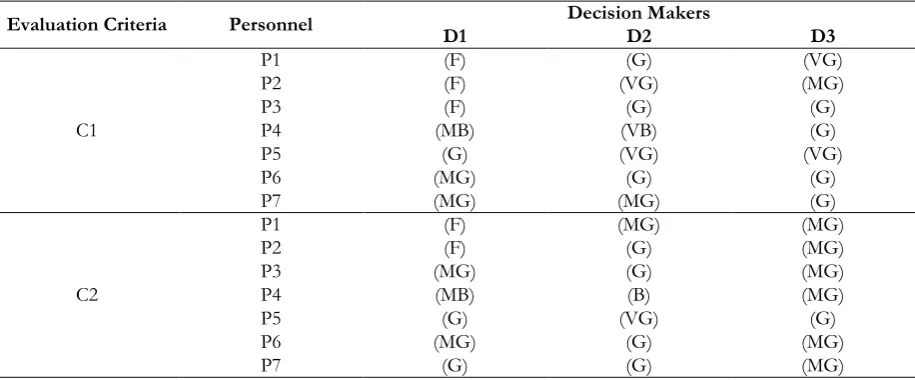
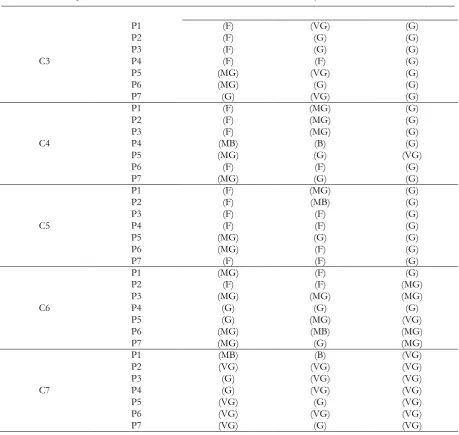
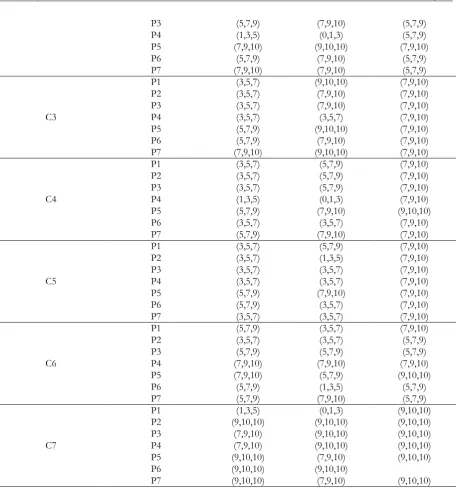
Three decision makers designated each personnel for designated criteria with the non-graphic variables as in Table 7. And in Table 8 can be found the non-graphic variables in terms of triangular fuzzy numbers.
Table 7 - Evaluation of personnel by the Executives with verbal expressions
Evaluation Criteria Personnel D1 Decision Makers D2 D3
C1
P1 (F) (G) (VG)
P2 (F) (VG) (MG)
P3 (F) (G) (G)
P4 (MB) (VB) (G)
P5 (G) (VG) (VG)
P6 (MG) (G) (G)
P7 (MG) (MG) (G)
C2
P1 (F) (MG) (MG)
P2 (F) (G) (MG)
P3 (MG) (G) (MG)
P4 (MB) (B) (MG)
P5 (G) (VG) (G)
P6 (MG) (G) (MG)
C3
P1 (F) (VG) (G)
P2 (F) (G) (G)
P3 (F) (G) (G)
P4 (F) (F) (G)
P5 (MG) (VG) (G)
P6 (MG) (G) (G)
P7 (G) (VG) (G)
C4
P1 (F) (MG) (G)
P2 (F) (MG) (G)
P3 (F) (MG) (G)
P4 (MB) (B) (G)
P5 (MG) (G) (VG)
P6 (F) (F) (G)
P7 (MG) (G) (G)
C5
P1 (F) (MG) (G)
P2 (F) (MB) (G)
P3 (F) (F) (G)
P4 (F) (F) (G)
P5 (MG) (G) (G)
P6 (MG) (F) (G)
P7 (F) (F) (G)
C6
P1 (MG) (F) (G)
P2 (F) (F) (MG)
P3 (MG) (MG) (MG)
P4 (G) (G) (G)
P5 (G) (MG) (VG)
P6 (MG) (MB) (MG)
P7 (MG) (G) (MG)
C7
P1 (MB) (B) (VG)
P2 (VG) (VG) (VG)
P3 (G) (VG) (VG)
P4 (G) (VG) (VG)
P5 (VG) (G) (VG)
P6 (VG) (VG) (VG)
P7 (VG) (G) (VG)
Table 8 - The fuzzy numbers obtained after the personnel evaluation
Evaluation Criteria Personnel D1 Decision Makers D2 D3
C1
P1 (3,5,7) (7,9,10) (9,10,10)
P2 (3,5,7) (9,10,10) (5,7,9)
P3 (3,5,7) (7,9,10) (7,9,10)
P4 (1,3,5) (0,0,1) (7,9,10)
P5 (7,9,10) (9,10,10) (9,10,10)
P6 (5,7,9) (7,9,10) (7,9,10)
P7 (5,7,9) (5,7,9) (7,9,10)
P3 (5,7,9) (7,9,10) (5,7,9)
P4 (1,3,5) (0,1,3) (5,7,9)
P5 (7,9,10) (9,10,10) (7,9,10)
P6 (5,7,9) (7,9,10) (5,7,9)
P7 (7,9,10) (7,9,10) (5,7,9)
C3
P1 (3,5,7) (9,10,10) (7,9,10)
P2 (3,5,7) (7,9,10) (7,9,10)
P3 (3,5,7) (7,9,10) (7,9,10)
P4 (3,5,7) (3,5,7) (7,9,10)
P5 (5,7,9) (9,10,10) (7,9,10)
P6 (5,7,9) (7,9,10) (7,9,10)
P7 (7,9,10) (9,10,10) (7,9,10)
C4
P1 (3,5,7) (5,7,9) (7,9,10)
P2 (3,5,7) (5,7,9) (7,9,10)
P3 (3,5,7) (5,7,9) (7,9,10)
P4 (1,3,5) (0,1,3) (7,9,10)
P5 (5,7,9) (7,9,10) (9,10,10)
P6 (3,5,7) (3,5,7) (7,9,10)
P7 (5,7,9) (7,9,10) (7,9,10)
C5
P1 (3,5,7) (5,7,9) (7,9,10)
P2 (3,5,7) (1,3,5) (7,9,10)
P3 (3,5,7) (3,5,7) (7,9,10)
P4 (3,5,7) (3,5,7) (7,9,10)
P5 (5,7,9) (7,9,10) (7,9,10)
P6 (5,7,9) (3,5,7) (7,9,10)
P7 (3,5,7) (3,5,7) (7,9,10)
C6
P1 (5,7,9) (3,5,7) (7,9,10)
P2 (3,5,7) (3,5,7) (5,7,9)
P3 (5,7,9) (5,7,9) (5,7,9)
P4 (7,9,10) (7,9,10) (7,9,10)
P5 (7,9,10) (5,7,9) (9,10,10)
P6 (5,7,9) (1,3,5) (5,7,9)
P7 (5,7,9) (7,9,10) (5,7,9)
C7
P1 (1,3,5) (0,1,3) (9,10,10)
P2 (9,10,10) (9,10,10) (9,10,10)
P3 (7,9,10) (9,10,10) (9,10,10)
P4 (7,9,10) (9,10,10) (9,10,10)
P5 (9,10,10) (7,9,10) (9,10,10)
P6 (9,10,10) (9,10,10)
P7 (9,10,10) (7,9,10) (9,10,10)
Step 5:
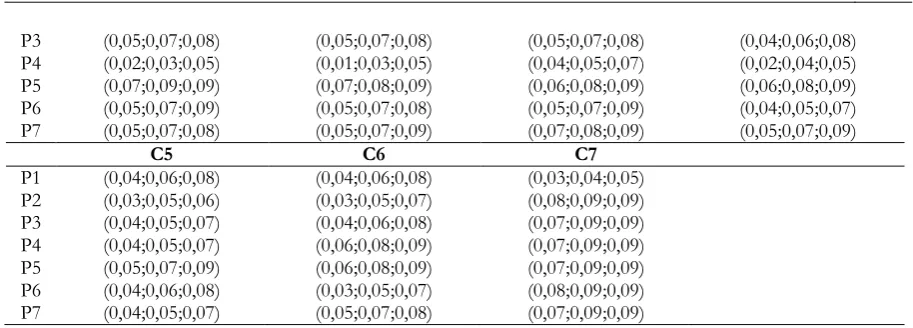
Averaging the fuzzy numbers obtained after the personnel evaluation by the executives as in Table 8, the
weight for each criteria is multiplied, thus being designated as in Table 9.Table 9 - Average normalized fuzzy decision matrix
C1 C2 C3 C4
P3 (0,05;0,07;0,08) (0,05;0,07;0,08) (0,05;0,07;0,08) (0,04;0,06;0,08) P4 (0,02;0,03;0,05) (0,01;0,03;0,05) (0,04;0,05;0,07) (0,02;0,04;0,05) P5 (0,07;0,09;0,09) (0,07;0,08;0,09) (0,06;0,08;0,09) (0,06;0,08;0,09) P6 (0,05;0,07;0,09) (0,05;0,07;0,08) (0,05;0,07;0,09) (0,04;0,05;0,07) P7 (0,05;0,07;0,08) (0,05;0,07;0,09) (0,07;0,08;0,09) (0,05;0,07;0,09)
C5 C6 C7
P1 (0,04;0,06;0,08) (0,04;0,06;0,08) (0,03;0,04;0,05) P2 (0,03;0,05;0,06) (0,03;0,05;0,07) (0,08;0,09;0,09) P3 (0,04;0,05;0,07) (0,04;0,06;0,08) (0,07;0,09;0,09) P4 (0,04;0,05;0,07) (0,06;0,08;0,09) (0,07;0,09;0,09) P5 (0,05;0,07;0,09) (0,06;0,08;0,09) (0,07;0,09;0,09) P6 (0,04;0,06;0,08) (0,03;0,05;0,07) (0,08;0,09;0,09) P7 (0,04;0,05;0,07) (0,05;0,07;0,08) (0,07;0,09;0,09)
Step 6: The distance of each alternative to fuzzy positive and negative ideal solution is calculated with Equation 23 and 24.
Table 10 - Distances to fuzzy positive and negative ideal solution
d*( Distances to fuzzy positive ideal solution) d- (Distances to fuzzy negativeideal solution)
0,229062923 0,260942134
0,209623049 0,241272657
0,189221675 0,236180538
0,271193026 0,191138313
0,103162733 0,211066264
0,186178887 0,244599881
0,154206618 0,212702723
Step 7: The closeness coefficient for each alternative is calculated with the formula in Equation 25, and the following results are obtained for each personnel via these calculations.
Table 11: Closeness Coefficients
Personnel CC (Closeness Coefficients)
P1 0,532529472
P2 0,535096373
P3 0,555193487
P4 0,413422792
P5 0,671695694
P6 0,567808581
P7 0,579714659
The personnel is ranked as P5>P7>P6>P3>P2>P1>P4 as per their closeness coefficients. According to this ranking, the personnel with the highest performance value is "P5", and the rest of which can be found on the above stated ranking.
5. Conclusion
more important with the rapidly changing and developing technologies & innovations. One of the most importance practices in the management of Human Resources is the performance evaluation. Including many qualitative and quantitative evaluation criteria, the performance evaluation process is the multi-criteria decision making problem. In this study, a model, in which the Fuzzy AHP and Fuzzy TOPSIS methods are utilized, is suggested for the personnel performance evaluation problem. For putting this study into practice, seven performance evaluation criteria were designated for seven personnel in a company, and these seven employees were subjected to an evaluation within the framework of designated criteria by three executives. The suggested model is two-phased; the Fuzzy AHP method is utilized for designating the importance of performance evaluation criteria on the first stage, while on the second phase, the Fuzzy TOPSIS method is used for evaluating the candidates. With these calculations, the personnel, with the code "P5", received the highest closeness coefficient value of 0.5325.
In the studies to be carried out in the future, such multi-criteria decision making methods as VIKOR, ELECTRE, DEMATEL in fuzzy environment can be developed for human resources performance evaluations.
5. References
Camgöz ve Alperten, 2006, 360 Derece Performans Değerlendirme ve Geri Bildirim: Bir Üniversite Mediko-Sosyal Merkezi Birim Amirlerinin Yönetsel Yetkinliklerinin Değerlendirilmesi Üzerine Pilot Uygulama Örneği, Cilt:13, Sayı:2, Celal Bayar Üniversitesi İİBF, Manisa
Demir, 2009, Hemşirelik Hizmetlerinde Performans Değerlendirme Sisteminin Oluşturulması ve bir Model Önerisi (Yüksek lisans Tezi), İstanbul Üniversitesi, Sağlık Bilimleri Enstitüsü, İstanbul
Demirtaş, 2009, Askeri Fabrikalarda Çalışan Mühendis Subaylara Yönelik Yeni Bir Performans Değerlendirme Model Önerisi, Erciyes Üniversitesi İktisadi ve İdari Bilimler Fakültesi Dergisi, Sayı: 34, Temmuz-Aralık 2009, ss.381-396
Ekin, 2014, Promethee Yöntemi İle Personel Seçimi ve Bir Uygulama (Yüksek lisans Tezi), Marmara Üniversitesi, Sosyal Bilimler Enstitüsü, İstanbul
Eraslan ve Aygün, 2005, İdeal Performans Değerlendirme Form Tasarımında Analitik Hiyerarşi Yönetimi Yaklaşımı, Journal of The Faculty of Engineering and Architecture of Gazi Üniversitesi , Cilt:20, Sayı:1, Ankara
Espinilla, 2013, A 360-degree performance appraisal model dealing with heterogeneous information and dependent criteria, Information Sciences, Volume 222, 10 February 2013, Pages 459–471
Ekin, 2014, Promethee Yöntemi İle Personel Seçimi ve Bir Uygulama (Yüksek lisans Tezi), Marmara Üniversitesi, Sosyal Bilimler Enstitüsü, İstanbul