How fund managers in Malaysia make decisions:
Samsukri Glanville bin Mohamad Glanville bin Mohamad Chad Perry
Article information:
To cite this document:
Samsukri Glanville bin Mohamad Glanville bin Mohamad Chad Perry , (2015),"How fund managers in Malaysia make decisions", Qualitative Research in Financial Markets, Vol. 7 Iss 1 pp.
-Permanent link to this document:
http://dx.doi.org/10.1108/QRFM-09-2013-0028 Downloaded on: 02 January 2015, At: 15:18 (PT)
References: this document contains references to 0 other documents. To copy this document: [email protected]
The fulltext of this document has been downloaded 8 times since 2015*
Access to this document was granted through an Emerald subscription provided by 161307 []
For Authors
If you would like to write for this, or any other Emerald publication, then please use our Emerald for Authors service information about how to choose which publication to write for and submission guidelines are available for all. Please visit www.emeraldinsight.com/authors for more information.
About Emerald www.emeraldinsight.com
Emerald is a global publisher linking research and practice to the benefit of society. The company manages a portfolio of more than 290 journals and over 2,350 books and book series volumes, as well as providing an extensive range of online products and additional customer resources and services.
Emerald is both COUNTER 4 and TRANSFER compliant. The organization is a partner of the Committee on Publication Ethics (COPE) and also works with Portico and the LOCKSS initiative for digital archive preservation.
*Related content and download information correct at time of download.
Introduction
The core of successful asset management firms is a competent fund manager who
makes investment decisions. Neoclassical economics and behavioural finance are two
academic approaches to this decision making (for example, Markowitz, 1952; Sharpe,
1964; Shiller, 2006). However, does investor practice go beyond what is taught in the
finance departments of universities in countries where cultures and economies are
different from those in Western countries where these approaches were developed?
The question is important for investment managers and their training and education, and
evidence about the question is mixed, as shown in the next section.
Thus this research aims to investigate how established investment managers in a
non-Western country like Malaysia actually make their decisions. Its methodology of
convergent interviews with investment managers has not been done in a rigorous way
before in any country, and so this research’s findings and its description of that
methodology contribute to the finance literature.
The article has six sections. The first provides some background from the Western
investment literature. The second briefly describes the research setting of Malaysia.
Next, a conceptual framework and related research issues are developed. Then the
methodology is justified and described in some detail. Findings and implications are
provided before limitations and further research are outlined.
Background about equity investment
There are two foundation methods to estimate or predict equity prices: valuation based
on neoclassical principles, and behavioural finance. Essentially, in neoclassical
principles, a present value estimate can be compared with the market price of a
company and conclusions about its value can be made. In turn, behavioural finance
focusses on how investment decisions can be based on emotion and not on rational,
logical methods.
Neoclassical principles were developed in the West and dominate the teaching of
finance around the world. For example, valuation models like beta are taught as core
valuation techniques in the Chartered Financial Analyst programme and university-level
finance courses. In turn, behavioural finance has explained anomalies not explained by
neoclassical finance by incorporating theories from psychologists and social scientists
(Shiller, 2006). It focuses on decision making processes, including their
inconsistencies and the effect of those inconsistencies on market decisions and on
public choice ( DeBondt et al. 2010; Kahnemen and Tversky, 2000).
But there are differences in the finance environments of Western and non-Western
countries, for example: openness of the capital market, investor protection, transparency
of the legal system, proportion of financial asset compared to GDP or real estate, and
development of financial markets. So does (Western) behavioural finance provide
practitioners with a better understanding of how they can value equities in a
non-Western country like Malaysia than neoclassical economics does? The evidence about
that question is mixed. Institutional investors at the Nairobi Stock Exchange appear to
exhibit behavioural finance practices (Waweru et al., 2008), and so do investors in
Saudi Arabia (Masood et al., 2009). In contrast, investors in Nigeria and Kuwait are
more rational or neoclassical (Almujamed et al., 2013; Tijjani et al., 2009). And
investors in Malaysia appeared to be rational before the 2008 downturn (Lai et al.,
2001); are they like that now? Perhaps the new in-depth, qualitative methodology of
convergent interviewing can uncover what investors in a non-Western country like
Malaysia are really doing.
Research setting
Consider the research setting of the Malaysian capital market. Investing in equities in
Malaysia has characteristics that make it worthy of study as one example of several
non-Western countries. The economy has its own culture, language, currency, and
fiscal and monetary management. In addition, one of the main tools for price
discovery for securities is the Bursa Malaysia Stock Exchange. After the financial
crises of the late 1990s the regulatory infrastructure shifted towards a disclosure based
system (SecuritiesCommision, 2009) That is, regulators no longer focused on the
investment merits of companies seeking to list their shares; instead, regulators focused
on the quality and completeness of disclosure given by those companies. This
regulation of the capital markets in Malaysia is conducted by the Securities
Commission of Malaysia and five frontline regulators: Bursa Malaysia Snd Bhd (The
Stock Exchange Limited), The Malaysian Clearing House, Malaysian Central
Depository Bhd, Malaysian Derivatives Exchange Bhd and the Malaysian Derivatives
Clearing House Bhd. There are approximately 1000 companies listed in Malaysia and
81 licensed asset management companies with total assets under management of
RM555.32 billion, which include equities, fixed income securities and money market
placements. Sources of assets under management include unit trust funds, corporate
bodies, Employee Provident Fund (EPF), private pension funds and charitable bodies
(SecuritiesCommission 2013). The interviewees in this research were taken from
companies who manage assets from these sources. Almost two-thirds of the capital
market in Malaysia is owned by institutional investors instead of by individual/retail
investors (unlike in Thailand, for instance). This predominance of institutional
investors in Malaysia guided the researchers towards them; moreover, institutional
investors have more time to search for stocks and so are more likely to use their
financial literacy (Barber and Odeon 2004). How do these asset managers decide
which of the 1000 companies to invest in? In brief, Malaysia appeared to be a
suitable step in this line of research.
Conceptual framework: what investment processes are used in Malaysia?
A conceptual framework to guide data collection and analysis can now be developed.
This framework is based on an investment decision process that was developed by an
investment manager using the inductive method of reflective practice (Glanville and
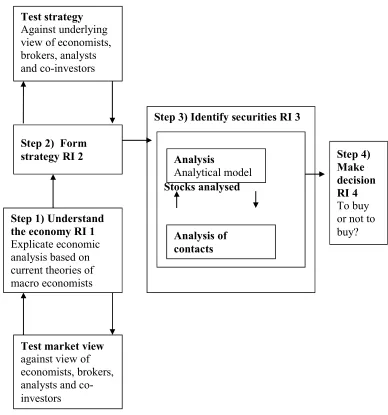
Perry, 2010) and is illustrated in Figure 1. The framework has four steps: understanding
the economy, investment strategy, fundamental analysis, and decision.
INSERT FIGURE 1 ABOUT HERE
The first step is to understand the economy, that is, sense making about the current state
of the economy in order to predict future security prices. Some practitioners do not
regard an accurate forecast of this macroeconomic environment to be important in
making investment decisions (Hagstrom, 2005). However, other practitioners do base
their investment decisions on forecasting macroeconomic events (Soros, 1995;Rogers,
2004). Research about investors in a Malaysian context has not concluded a position on
whether or not a view of the economy is necessary. Given these concerns about whether
and how to understand the economy, the first research issue is: How do investment
decision makers in Malaysia understand the economy?
The second step in the decision making process is constructing a strategy consistent
with the economic view built in step 1. Are the strategies top down or bottom up, in
Malaysia? Top down investment strategies are examined and defined in the investment
literature (Matlin, 2002; Zvi Bodie and Marcus, 1995). Alternatively, bottom up
processing could be used. Bottom up processes focus on the importance of stimuli in
object recognition (Matlin 2002). Thus research issue 2 is: How are investment
strategies formed by investors in Malaysia?
The strategy of step 2 leads into step 3, which is the analytical process of identifying
target investment securities. This research centres on ascertaining the value of an
investment security in order to estimate the future price of that security. Neoclassical
theoreticians did not provide methods to estimate future income or the risk of whether
or not that income will materialize (Markowitz, 1952). Thus the question arises: how
do investors in Malaysia deal with risk? Is risk quantified and what meaning would
investors give to that quantification? Moreover, it is not known if their investment
decisions are based merely on valuations or if other more complex factors are involved.
In addition, it is not known whether they employ stochastic models in order to invest.
And is behavioural finance helpful? All the uncertainty above leads to research issue 3:
How is the future price of securities estimated for investment decision making in
Malaysia?
The final step 4 in the investment decision making process is making the actual
decision. Neoclassical finance sees this decision as rational and the product of steps 1,
2 and 3. However, decision theorists from other fields describe decisions as including
complex factors that lie outside of this rational processing model like emotion, intuition
and gut feel (Klein, 1998: Simon, 1957; Kahneman 2002). These complex factors have
not been studied in a Malaysian investment context. In brief, the fourth research issue
is: How are investment decisions made in Malaysia?
There are three more, later steps of the investment process made after the investment
decision: execution, monitoring and exiting. Because this research seeks to investigate
the core investment decision making processes, these final three steps that flow from
the four core steps above will not be research issues. However, the final three steps will
be discussed in the section on future research.
The methodology of convergent interviewing
Convergent interviewing was used to triangulate findings from an initial research stage
that used the reflective practice method, as noted. This methodology section is about
the second stage that followed that initial one (Rao and Perry, 2003, 2007; Williams and
Lewis, 2005). This section adds to the finance literature because the methodology has
not been used in finance.
Definition and justification of convergent interviews
First, consider a definition and justification for using the relatively unusual
methodology of convergent interviewing. All interviews aid an investigator in
understanding ‘realities’ or perceptions that are formed by individuals (Bauer and
Gaskell, 2000, p. 45; Qu and Dumay, 2011; Warren, 2001), and so assist theory
development and testing (Vaivio, 2008). However, convergent interviewing
investigates one’s perceptions and beliefs about a topic in a different way than other
types of interviews. While the convergent interviewing process is structured, each
interview is somewhat unstructured for the interview questions can change from one
interview to the next (Rao and Perry, 2003, 2007). Final convergence occurs when
agreements are uncovered and/or disagreements are understood and when the last
interviewee does not add an issue to those uncovered previously.
The convergent interviewing method is justified for this research for four reasons (Rao
and Perry, 2003). Firstly, it burrows deeper and deeper into a phenomenon as each
interview uncovers more insights about it (and here that deepening was based on the
earlier, in-depth, exploratory research project cited above). Secondly, it converges
quickly on important issues. This point is important in research where interviewees
may be time–limited, like the busy expert fund managers in this research. The method
also provides an efficient and systematic way of analysing the data after each interview
that reduces bias. Next, it has a mechanism for knowing when to stop collecting data –
when convergence has occurred. Finally, it complements other exploratory methods
(like the reflective practice method on which this research was based) because the
convergent interviews help to reduce personal interpretation biases that may have been
included in the conclusions derived from other methods.
Steps in convergent interviewing
The framework for convergent interviewing used in this research had four steps:
planning, framing and closing the interviews, and analysing the data.
Step 1: planning the convergent interview. There were six phases involved in the first,
planning step. In the first phase, the four research issues were formulated from the
literature and the previous research project. Next, the interviewer’s guide provided a
design for the interviewer to follow (Carson et al., 2001; Kvale, 1996). A copy of the
first and final interviewer’s guides are available on request. The first interviewer’s
guide contained questions on the broad topic of how the interviewees make investment
decisions. Later interview guides had more detailed elements as the interviewees
brought up further issues related to investment decision making.
The third phase of planning the interviews was selecting and recruiting interviewees.
For a start, purposive sampling, rather than random sampling, was used to select
interviewees in this study because it is especially suited for in-depth analysis of issues
(Patton 1990). This purposive sampling included the two techniques of opportunistic
and typical sampling. Firstly, opportunistic sampling involved following leads that
arose in the course of the researcher’s day-to-day work as a fund manager. For
example, the lead researcher had contact with other fund managers at regulatory and
fund management briefings. In addition, this personal relationship gave the researcher
access to an open and honest dialogue in the interviews because the interviewees saw
the researcher as sympathetic to their livelihood. As well as preventing other potential
interview failings, this rapport prevented the fund managers from presenting a sales
pitch instead of an account of an idealised investment decision making process -
salesmanship was avoided (Bogle 2009).
Secondly, these interviewees were typical – they had practical knowledge of the
research problem about investment decision making. The interviewees were mostly
equity, long-term value fund managers. The researcher accessed a broad range of
established and experienced managers from institutional funds - all interviewees were
professional money managers and so were typical of the kinds of investors this research
is about. That is, they were financially literate; indeed respondent 2 had conducted
similar research when she wrote a book on investing; respondent 4 had two master’s
level qualifications in finance and engineering; and another won an Asia-wide award
after this research. In brief, the interviewees made up a relevant selection of investors.
The next planning phase was considering how many interviews might be needed.
Convergence (described above) occurs when the interviewees’ perceptions of the
underlying issues are consistent. Convergence has been achieved in previous research
with between 6 and 10 convergent interviews (Rao and Perry, 2003, 2007). In this
investigation, stability emerged after the fifth interview; this stability was confirmed in
three more interviews to make a total of eight.
Now, site selection and duration of the interview was considered. This research’s
interviews were conducted face-to-face so that more subtle modes of communication
such as body language could be read (Gordon and Langmaid, 1988). Although neutral
territory is recommended for conducting convergent interviewing (Dick, 1990),
familiarity to the respondent and the sereneness of the site facilitate the discussion
(Carson et al., 2001). For this reason, each interviewee was asked to choose the time
and location of the interview. For example, respondent 2 was interviewed at a
Vietnamese restaurant at lunch time, and respondent 5 was interviewed in the evening at
the Royal Selangor Golf Clubhouse. In general, the duration of most interviews was
between 1 and 1.5 hours (Gaskell, 2000), but some went on longer when fund
managers were especially financially literate.
The final planning phase was choosing a suitable interviewer. A suitable interviewer
must be knowledgeable about the topic of research (Kvale, 1996). The first author was
the interviewer, for three reasons. First, his experience as a fund manager in Malaysia
helped to build rapport with the interviewees. Moreover, he had developed the emergent
theory in the previous stage of this research. Finally, he was familiar with the purpose
and direction of the research. (In this section, ‘the interviewer’ refers to the first author.)
Step 2: framing the interview. There are three aspects involved in framing convergent
interviews: creating a comfortable atmosphere, obtaining informed consent and the
interview proper (Carson et al., 2001). The first aspect is creating a comfortable
atmosphere. Setting is important here and was covered above. In addition, the
interviewer greeted the interviewees warmly and then engaged in a rapport building,
ice-breaker discussion which lasted about five minutes.
Interviewing requires researchers to abide by ethical codes of conduct that enforce
informed consent (Carson et al., 2001; Warren, 2001). The interviewer used an ethics
consent form approved by his research institution that detailed the outline of the
research topic and the rights of the interviewees, to confidentiality for instance. The
interviewees were first given the consent form and then the interviewer covered its
features. The interviewees were then asked to read the form and sign it if they agreed
with it.
If the interviewee agreed, the interview was taped (Carson et al., 2001). However, the
interviewer also made interview notes of the concepts that derived from visual elements
- those elements that the audio recording may have missed like body language - but did
this in an unobtrusive manner so as not to interrupt the flow of the interview. In
addition, this written record was kept in case of an audio recording malfunction (Carson
et al., 2001). After each interview, the recording was transcribed.
After the ice breaker questions, broad questions about the interviewees’ experience in
investing were asked. For example, ‘Could you tell me the story about your investment
experience?’ This type of question did not make the respondent anxious about whether
they were giving the right answer or not. Following these topic-entering questions, the
interview started to cover more specific decision making questions. At this point in the
interview, the interviewer reminded himself to not interrupt the respondent, ask leading
questions, present his own ideas or be concerned with pauses in the interview (Carson et
al., 2001; Dick, 1990). Interviewees were encouraged to continue talking by showing
understanding by my active listening (Gordon 1977). This process kept the interview
focused on the respondent’s ideas rather than the interviewer’s (Hollway and Jefferson,
2000). Probing was used to explore the interviewees’ ideas that provided new
understanding to the research question of how investment decision making occurs. So a
question often used during the interviews to induce probing was, ‘Why … ?’
Step 3: closing the convergent interview. When the interviews were coming to a close,
the interviewer invited a summary of the most important points from the interviewee
(Dick, 1990). Then, at the end of the interview, he used several non-verbal cues to
indicate the interview was about to end. For example, he turned the recording device
off and sat back. He asked the interviewees if they had any final questions or issues
they wanted to bring up. Finally, he thanked the interviewees for their contribution and
their time, and left the interview site.
Step 4: analysing and interpreting data of the convergent interviews. A summary note
of the issues raised was drawn up immediately after each interview. These notes
contained two parts: the issues and an interpretation of those issues. The interpretation
of the issues was revised until ambiguities were resolved and key points were identified
(Dick, 1990). The final analysis of this data of the convergent interviews is below.
Limitations of convergent interviews
Convergent interviewing involves the following four limitations addressed in this
research (Rao and Perry, 2003). Firstly, convergent interviewing should be used in
conjunction with other research methods (Carson et al., 2001; Dick 1990). To
neutralise this limitation, convergent interviewing was used in conjunction with the
earlier reflective practice research project. The second limitation of convergent
interviewing is biases of the interviewer. These biases were mitigated by not asking
leading questions and thus not introducing the interviewer’s own ideas.
The third limitation of convergent interviewing is the limitation of the skill set of the
interviewer (Dick, 1990). The interviewer is a fund manager which ensured working
knowledge of the subject matter. In addition, the questions were meticulously prepared
before the interviews. The fourth limitation of convergent interviewing is the cost of
hosting interviews (Carson et al., 2001). This limitation was mitigated by holding
interviews in the interviewees’ offices or at restaurants. In addition, the interviewer
lived in the financial capital of Malaysia, Kuala Lumpur, where all interviewees lived.
In brief, the limitations of convergent interviewing were identified and mitigated in this
research.
Findings from the convergent interviews
The sections above outlined the convergent interviewing method in order to collect data.
Now consider what analyses of that data revealed. The analysis is based on the four
research issues developed above that are based on gaps in the literature and on the
previous reflective practice research project. The findings and illustrative quotations
below are from a long report that is kept by the researchers. That report has details of
themes and responses for each research issue, and Table 1 is a summary table of the
findings about the four research issues; more details are available from the authors.
INSERT TABLE 1 ABOUT HERE
Research issue 1: How do investment decision makers in Malaysia understand the
economy?
Overall, all participants expressed the use of some form of economic understanding and
thus the experience of trying to understand the economy as a part of their investment
decision making process. According to interviewees, the role of understanding the
economy in an investment process had two elements. The first element was experience.
All interviewees thought experience was an important element in building
understanding, for two reasons. Firstly, experience was important because it helped the
interviewees deal with complexity. In particular, interviewees believed that experience
induced the recognition of a knowledge limit. Respondent 2 expressed this realisation
of the unknown, of uncertainty: “Well I think there are a lot of people who think they are
sure but there are a lot of uncertainties to be taken into account.”
A related issue about understanding the economy was that the process was mostly
implicit. That is, how interviewees derived an understanding of the economy was
unknown to them. Indeed, only interviewees 2 and 4 could discuss economic issues in
depth and away from the context of a company.
The experience of the interviewees was built in three ways. Firstly, all interviewees had
reported that an initial experience of investment had come from working as an analyst
or broker before becoming an investment professional. The second way that
interviewees enhanced experience was by specialising in a field. For example,
respondent 2 said:
Better to study the first 10 companies in the same sector to get an in-depth
understanding of the market / industry. Suppliers, customers, competitors so that future
company analysis can be measured against that level and depth of understanding
The third way that experience was enhanced was by furthering education while
working. Six of the eight interviewees had researched and written an investment book
or had a master’s level qualification. In brief, understanding the economy was
important but was an ongoing learning process for the interviewees.
Research issue 2: How are investment strategies formed by investors in Malaysia?
For research issue 2, investment strategy was not an important investment decision
making issue for interviewees. No interviewees brought up strategy as part of how they
make investment decisions. It seems that their equity type of investing had dictated
investment strategy.
Research issue 3: How is the future price of securities estimated for investment
decision making in Malaysia?
All interviewees described some kind of fundamental analysis when describing how
they carried out the investment decision making process. That is, the centrepiece of the
investment decision process was ascertaining value or finding ‘cheap’ assets to
purchase. For example, when asked the broad question of how investment decisions are
made, respondent 1 spoke about her bottom up approach that began with firm-level
considerations:
Respondent 1 Value stocks based on valuation methods such as PE [price/ earnings
ratio] and discounted cash flow models.
Interviewer How do you interpret the raw data such as company accounts into the
valuation models?
Respondent 1 I look at the bigger picture and how the relevant elements fit in…
.
This bottom up approach to analysis ended with a discussion of
understanding the economy that is described in research issue 1.
Alternatively, some interviewees such as respondent 4 described a top
down approach based on some high level considerations such as the
macro economy’s interest rates and inflation.
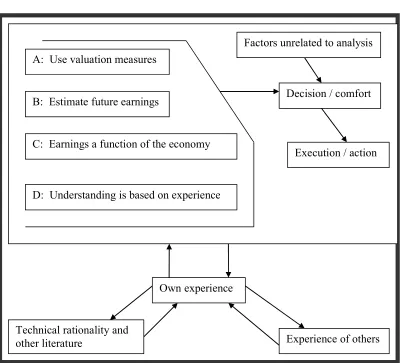
In more detail, descriptions of the interviewees’ fundamental analysis activities can be
categorized into four layers that cover both bottom up and top down considerations.
Firstly, all interviewees used valuation measures such as PE (price/earnings ratio) or
discounted cash flow. The next layer of analysis was that these valuation models were
based on future earnings and the current price of those earnings. All interviewees used
valuation models based on future earnings. The third layer of analysis was that these
future earnings derived from the future profitability of the company in the context of the
economy. That is, the place of the company in the context of the economic environment
had to be understood before future earnings could be estimated. The final layer was
covered in detail in research issue 1 and concerned how the interviewees understood the
economy. Research issue 4: How are investment decisions made in Malaysia?
After completing this four layer analytical process, all interviewees described the actual
investment decision as being based on a feeling of comfort, conviction or gut feel
(based, of course, on their long practical experience and some analysis). For example,
respondent 2 said:
Interviewer: How do you know when you are sure enough to commit money to an
investment idea?
Respondent 2: I don’t know…..
Interviewer: Does knowing when to commit to your investment have anything to do
with experience?
Respondent 2: [Yes] After the analysis…. a level of comfort. Building a level of
comfort that seems adequate.
Some interviewees displayed discomfort in divulging this seemingly arbitrary
description of how decisions are made, perhaps because these fund managers were
custodians of millions of dollars if not hundreds of millions. For example, respondent 8
said:
Respondent 8: I don’t want to say gut feeling but after analyzing all those things (and
we feel) there is no way this stock can go down…If all things are equal this
stock is strong. The income will grow… I don’t want to use gut feel but being
human we are the ones making the decision.
Note that all interviewees had at least a decade of experience working in the finance
industry, and most had at least a master’s degree qualification (for example, from
Imperial College London). All used robust analytical methods (described in research
issues 1, 2 and 3). Nevertheless, no interviewee used computer programs, quantitative
methods or any other rule-based systems to make investment decisions. Some
interviewees had tried quantitative models personally or worked in departments that had
tried quantitative models, but unsuccessfully. For example, respondent 4 had used
modelling and found it useless:
Respondent 4: We have done modelling before but it breaks down every so often,
there is always subjectivity behind the modelling
Interviewer: Do you mean a quantitative model?
Respondent 4: Yes, not really a success [wry smile]
So why can the investment process not be quantified? The first reason is because an
unknown cannot be measured and thus cannot be quantified. For example, respondent
4:
Interviewer: Do you think the decision making process can be quantified?
Respondent 4: No, because of the evolving set of data in the market the ability to
quantify what is happening is limited ... Getting all information relevant for an
investment is a challenge.
The end of this thought flow connects to how professional fund managers deal with the
unknown that was discussed in the first research issue. One of the elements in the
investment process that interviewees felt could not be quantified was uncertainty. All
interviewees thought uncertainty could not be entirely quantified, it could not be
transformed into risk. To explore this question of risk quantification, from the third
interview onwards the interviewer asked interviewees if security risk was a relative or
an absolute measure. All six interviewees asked saw security risk as a relative measure.
For example, a security of an internet business may sometimes be relatively less risky
than a government bond. So a numerical measurement of security risk is only useful
when comparing securities at the same time and not over time
A second reason that not all elements in an investment process could be
quantified was because of the vast amount of information that is
associated with an investment decision. Respondent 4 describes it like
this: “Like a cup that you keep pouring water into you need a bigger and
bigger cup to capture all these assumptions. “
In brief, interviewees did not believe the investment process could be quantified.
6. A concluding framework about investing
In conclusion, this research found that investment decisions were finally based on a
feeling of comfort or conviction and not on quantitative analyses. Because many
factors affect mood and mood has an effect on decision making (de Vries et al., 2008),
it is difficult to tell if that mood and its decision derives from a preceding analytical
process or is anchored by other personal issues. This finding is consistent with theorists
who postulate that emotion and feeling are linked with rational decision making (Garro,
1998; Pfister, 2008). Since the decision mechanism inludes a feeling and is thus opaque,
and because of the amount of implicit processes that go on in the four layers of analysis,
conclusions based on rationality are difficult to make. This conclusion that a decision is
finally a gut feeling of comfort confirms findings of decision theorists in other fields
using different methodologies in different locations (Simon, 1959; Klein, 1998;
Kahneman, 2002).
Figure 2 shows a final framework derived from all the findings above.
INSERT FIGURE 2 ABOUT HERE
Implications for policy and practice, and for methodology
Now consider implications for policy and practice in Malaysia and possibly in other
countries. This research found that experience is an important part of building an
investment decision making process. This importance of experience provides three
implications for potential and current investment practitioners. Firstly, those wishing to
become investment practitioners should accumulate their own experience of making
investment decisions with real money in real markets in real time, or possibly with
realistic simulations. The second aspect of experience that should interest practitioners
is leveraging the experience of other practitioners by triangulating one’s own experience
and knowledge, perhaps with research like this. A third implication for investment
practitioners is the creation of knowledge through personal experience that could be
done by reflective practice and other action reflection methodologies like action
research or grounded theory (Sankaran, 2001; Dick, 1999; Sankaran et al., 2007). Note
that the interpretation of data in this research is different from the standard reflection or
evaluation that occurs in funds management firms. This qualitative method contained
more details than their usual quantitative evaluation criteria such as percentage return
divided by volatility. In this study, the richer details were important for understanding
and modelling the investment decision making process. This research does not
recommend that practitioners ignore that existing investment literature. Instead, this
research suggests ways that practitioners may complement that book knowledge by
extracting understanding from practical experience. In brief, practitioners should
include more types of knowledge when investing (and this is consistent with the
assumptions of behavioural economists (Shiller, 2006)).
These implications for practice based on the importance of experience and the
expansion of knowledge have two implications for teaching. Firstly, since learning and
the development of an investment decision making process cannot occur in artificial
environments, investment courses should include opportunities for learners to make real
investment decisions with real money. This could be done by allocating a small amount
of funds for each student to invest. Moreover, experiential learning methods should be
used more in tertiary education of finance managers, for example, simulations,
competitions and internships could teach students real world practices and processes.
Finally, business school researchers could more often use non-quantitative methods
such as convergent interviewing and so capture the complexity of real investment
decision making, especially when investors’ practices break down as they did in the
global financial crisis just before this research.
The overall conclusion derived from this study and implied in the literature but not
specifically tested before in this research setting, is that solely quantitative methods and
models of understanding are a small part of finance practice. This conclusion confirms
behavioural finance theorists (Shiller, 1998). That is, behavioural finance should occupy
a stronger place in the syllabi of business schools and their MBA programmes.
Limitations of this research and implications for further research
One limitation of this research is that it occurred in Malaysia in 2009 and so its
conclusions are relevant only to that time period and location. In particular, the global
financial crisis of 2007 and 2008 may limit the findings to the aftermath of that stock
market upheaval and/or to stock markets like Malaysia’s. Moreover, the model of
investment decision making processes built in this research was based on investment
professionals, and so generalizations to other types of investment decision makers are
not intended.
Future researchers may consider extending the research to different periods, different
research settings in other emerging economies like India or Indonesia, and different
types of investors such as individual/retail investors (Bialkowski and Otten, 2011).
Future research may include more detailed methods of investigating emotion and feel
such as the appraisal pattern (Scherer et al., 2001). Finally, the three steps of execute
entry, monitoring and exit that exist beyond the four core ones investigated here, could
be investigated in future research.
Conclusion
The domination of quantitative reduction and scientific positivism paradigms in
modelling both the underlying economy and methods of decision making in finance
literature was questioned in this research. It used an unusual methodology to develop a
new framework of investor decision making that incorporates experience and qualitative
processes. Some steps forward have been made for real world investors like the
researchers and for theoreticians.
References
Almujamed, H. I., Fifield, S. and Power, D. (2013) "An investigation of the role of technical analysis in Kuwait", Qualitative Research in Financial Markets, Vol. 5, Iss, 1, pp.43 – 64
Barber, B. M. and Odean, T. (2008). “All that glitters: The effect of attention and news on the buying behavior of individual and institutional investors”, Review of Financial Studies, Vol. 2, Iss. 2, pp. 785-818.
Bauer, M. W. and Gaskell, G. (2000), Qualitative Researching With Text, Image And Sound: A Practical Handbook, Sage, London.
Bialkowski, J. and Otten, R. (2011), "Emerging market mutual fund performance: Evidence for Poland", North-American Journal of Economics and Finance, Vol. 22, No. 2, pp. 118-130.
Bogle, J.C. (2009), Enough: True Measures Of Money, Business And Life, Wiley, Hoboken, NJ.
Carson, D., Gilmore, A., Perry, C. and Gronhaug, K. (2001), Qualitative Marketing Research, Sage, London.
de Vries, M., Holland, R. W. and Witteman, C. L. M. (2008), "In the winning mood; affect in the Iowa gambling task", Judgement and Decision Making, Vol. 3, pp. 42-50.
DeBondt, W., Forbes, W, Hamalainen, P. and Muradoglu, Y.G. (2010), "What can behavioural finance teach us about finance?", Qualitative Research in Financial Markets, Vol. 2 , Iss. 1, pp. 29 - 36
Dick, R. (1990), Convergent Interviewing, Interchange, Brisbane.
Garro, I. C. (1998), "On the rationality of decision-making studies: part 1: decision models of treatment choice", Medical Anthropology Quarterly, Vol. 12, pp. 319 - 340.
Gaskell, G., (2000), "Individual and group interviewing", in Bauer, M. and Gaskell, G. (Eds), Qualitative Researching With Text, Image and Sound, Sage, London. Gladwell, M. (2006), Blink, Gardners Books, New York.
Glanville, S. and Perry C. (2010), "Learning how to invest: using reflective practice to understand how a Malaysian fund manager makes decisions", Gibaran Journal of Applied Management, Vol. 4, pp. 22-57.
Gordon, T. (1977), Leader Effectiveness Training, Bantam, New York. Gordon, W. and Langmaid, R. (1988), Qualitative Marketing Research, Gower,
Aldershot.
Graham, B. (1949), The Intelligent Investor: A Book Of Practical Counsel, Harper and Rowe, New York.
Hagstrom, R. G. (2005), The Warren Buffett Way, Wiley, Hoboken, NJ.
Hollway, W. and Jefferson, T. (2000), Doing Qualitative Research Differently, Free Association, Narrative And The Interview Method, Sage, London.
Kahneman, D. (2002), "Maps of bounded rationality: a perspective on intuitive judgment and choice", Nobel Prize Lecture, pp. 449–489.
Kahneman, D. and Tversky, A. (2000), Choices, Values, and Frames, Cambridge University Press, London.
Klein, G. (1998), Sources Of Power: How People Make Decisions, MIT Press, Cambridge.
Kvale, S. (1996). Interviews: An Introduction To Qualitative Research Interviewing, Sage, Thousand Oaks.
Lai, M. M., Low, K. L. T. and Lai, M. L. (2001), "Are Malaysian investors rational?", The Journal of Psychology and Financial Markets, Vol. 2, No. 4, pp. 210-215. Markowitz, H. (1952), "Portfolio selection", The Journal of Finance, Vol. 7, Iss. 1, pp.
77-91.
Masood, O., Aktan, B. and Chaudhary, S. (2009), "The investment decision-making process from a risk manager's perspective: a survey", Qualitative Research in Financial Markets, Vol. 1 Iss: 2, pp.106 - 120
Matlin, M. W. (2002), Cognition, Holt, Rinehardt and Winston, New York.
Patton, M. Q. (1990), Qualitative Evaluation and Research Methods, Sage, Newbury Park.
Pfister, G. B. (2008), "The multiplicity of emotions: a framework of emotional functions in decision making", Judgment and Decision Making, Vol. 3, pp. 5– 17.
Qu, S. Q. and Dumay, J. (2011) "The qualitative research interview", Qualitative Research in Accounting & Management, Vol. 8. Iss, 3, pp.238 – 264. Rao, S. and Perry, C. (2003), "Convergent interviewing to build a theory in
under-researched areas: principles and an example investigation of internet usage in inter-firm relationships, Qualitative Market Research: An International Journal, Vol. 6, Iss. 4, pp. 236-247.
Rao, S. and Perry, C. (2007), "Convergent interviewing: a starting methodology for an enterprise research program" , in Hine, D and Carson, D. (Eds), Innovative Methodologies In Enterprise Research, Edward Elgar, Northampton, MA. Rogers, J. (2004), Hot Commodities: How Anyone Can Invest Profitably In The
World's Best Market, Random House, New York.
Scherer, K.R., Schorr, A. and Johnstone, T. (2001), Appraisal Processes In Emotion: Theory, Methods, Research, Oxford University Press, London.
SecuritiesComision (2013), 'Data & statistics: statistics for the funds management industry', viewed 22 October 2013,
<http://www.sc.com.my/data-statistics/statistics-for-fund-management-industry/>.
Sharpe, W. F. (1964), "Capital asset prices: a theory of market equilibrium under conditions of risk", Journal of Finance, Vol. 19, pp. 425-442.
Shiller, R. J. (1998), Human Behaviour And The Efficiency Of The Financial System, The Foundation, New Haven.
Shiller, R. (2006), "Tools for financial innovation: neoclassical versus behavioral finance", The Financial Review, Vol. 41, pp. 1-8.
Simon, H. A. (1957), Models Of Man: Social And Rational; Mathematical Essays On Rational Human Behaviour In Society Setting, New York, Wiley.
Simon, H. A. (1959), "Theories of decision making in economics and behavioural science", The American Economic Review, Vol. 49, pp. 253-283.
Simon, H. A. (1959), "Theories of decision-making in economics and behavioural science", The American Economic Review, Vol. 49, pp. 253-283.
Soros, G. (1995), Soros on Soros, Wiley, New York.
Tijjani, B., Fifield, S.G.M. and Power, D. M., (2009), "The appraisal of equity
investments by Nigerian investors", Qualitative Research in Financial Markets, Vol. 1 Iss. 1, pp.6 - 26.
Vaivia, J. (2008), "Academics as professionals or managers: a textual analysis of interview data", Qualitative Research in Accounting & Management, Vol. 5, Iss 1, pp. 64-86.
Warren, C. (2001), "Qualitative interviewing", in Gubrium, G. and Holstein, J. (Eds), Handbook Of Interview Research: Context And Methods, Sage, Thousand Oaks. Waweru, N. M., Munyoki, E., & Uliana, E. (2008), "The effects of behavioural factors
in investment decision-making: a survey of institutional investors operating at the Nairobi Stock Exchange", International Journal of Business and Emerging Markets, Vol. 1, No. 1, pp. 24-41.
Williams, W. and Lewis, D. (2005), "Convergent interviewing: a tool for strategic investigation", Strategic Change, Vol. 14, Iss. 4, pp. 219-228.
Zvi Bodie, A. K. and Marcus A. J. (1995), Essentials of Investment, Irwin, New York.
Biographies
Dr Sam Glanville has been a professional investment manager in Malaysia over several
years
Chad Perry is Emeritus Professor of the Australian Institute of Business, Adelaide,
Australia
1 Understanding of the economy was part of the fundamental analysis stage and not its own explicit activity 2 The role of understanding the economy in an investment process had two elements. The first element was experience and the second was that it was implicit.
3 The experience of the interviewees was built in three ways. Firstly, all interviewees had reported that an initial experience of investment had come from working as an analyst or broker before becoming an investment professional. The second way that interviewees enhanced experience was by specialising in a field. The third way that experience was enhanced was by furthering education while working.
Research issue 2: How are investment strategies formed by investors in Malaysia?
1 No interviewees brought up strategy as a part of how they make investment decisions.
Research issue 3: How is the future price of securities estimated for investment decision making in
Malaysia?
1 The centrepiece of the investment decision process was ascertaining value or finding ‘cheap’ assets to purchase.
2 The bottom up approach began with firm-specific data and analysis ended with a discussion of understanding the economy that is described in research issue 1. Alternatively, some interviewees described a top down approach based on some high level considerations such as the macro economy. 3 In more detail, descriptions of the interviewees’ fundamental analysis activities can be categorized into four layers that cover both bottom up and top down considerations. Firstly, all interviewees used valuation measures such as PE (price/earnings ratio) or discounted cash flow. The next layer of analysis was that these valuation models were based on future earnings and the current price of those earnings. The third layer of analysis was that these future earnings derived from the future profitability of the company in the context of the economy. The final layer was covered in detail in research issue 1 and concerned how the interviewees understood the economy - all interviewees linked understanding the economy with experience.
Research issue 4: How are investment decisions made in Malaysia?
1 After completing this four layer analytical process uncovered in research issue 3, all interviewees described the actual investment decision as being based on a feeling of comfort, conviction or gut feel (based, of course, on their long practical experience and some analysis).
2 Why can the investment process not be quantified? The first reason is that an unknown cannot be measured and thus cannot be quantified. The second reason is the vast amount of information that is associated with an investment decision.
Source: Reflective practitioner research described in Glanville and Perry (2010).
Step 4) Make decision RI 4 To buy or not to buy?
Test market view against view of economists, brokers, analysts and co-investors Test strategy Against underlying view of economists, brokers, analysts and co-investors
Step 3) Identify securities RI 3
Step 2) Form strategy RI 2
Step 1) Understand the economy RI 1 Explicate economic analysis based on current theories of macro economists
Stocks analysed
Analysis of contacts Analysis
Analytical model
A: Use valuation measures
D: Understanding is based on experience B: Estimate future earnings
C: Earnings a function of the economy
Decision / comfort Factors unrelated to analysis
Execution / action
Technical rationality and
other literature Experience of others
Own experience