The Thirty-Third AAAI Conference on Artificial Intelligence (AAAI-19)
Low-Rank Semidefinite Programming for the MAX2SAT Problem
Po-Wei Wang
Machine Learning DepartmentCarnegie Mellon University Pittsburgh, PA 15213 [email protected]
J. Zico Kolter
School of Computer ScienceCarnegie Mellon University Pittsburgh, PA 15213, and Bosch Center for Artificial Intelligence
Pittsburgh, PA 15222 [email protected]
Abstract
This paper proposes a new algorithm for solving MAX2SAT problems based on combining search methods with semidef-inite programming approaches. Semidefsemidef-inite programming techniques are well-known as a theoretical tool for approx-imating maximum satisfiability problems, but their applica-tion has tradiapplica-tionally been very limited by their speed and randomized nature. Our approach overcomes this difficult by using a recent approach to low-rank semidefinite program-ming, specialized to work in an incremental fashion suitable for use in an exact search algorithm. The method can be used both within complete or incomplete solver, and we demon-strate on a variety of problems from recent competitions. Our experiments show that the approach is faster (sometimes by orders of magnitude) than existing state-of-the-art complete and incomplete solvers, representing a substantial advance in search methods specialized for MAX2SAT problems.
1
Introduction
The maximum satisfiability (MAXSAT) task — the optimization-based version of satisfiability, where the goal is to find a maximal set of clauses to be satisfied — is a foundational problem in combinatorial optimization. These problems can be written as the optimization task
maximize v1,...,vn∈{0,1}
m
∑
j=1
⋁
i∈Sj+
vi
⋁
i∈Sj−
¬vi, (1)
wherev1, . . . , vn denote the binary optimization variables,
andSj+/Sj− denotes the set of variables and negated vari-ables respectively in the jth clause. MAXSAT problems have been used to solve probabilistic inference (Park, 2002), planning (Zhang and Bacchus, 2012), and clustering (Berg and J¨arvisalo, 2017). And the recent MAXSAT contests (Argelich et al., 2016) have aimed at evaluating a wide num-ber of different solution methods on a wide variety of both real and synthetic problems.
In this paper, we present an approach based upon low-rank semidefinite programming (SDP) and a simple branch-and-bound strategy for solving the simplest case of the MAXSAT problem: the MAX2SAT problem, where each clause contains only two variables. While this is naturally
Copyright c⃝2019, Association for the Advancement of Artificial Intelligence (www.aaai.org). All rights reserved.
a very limited special case of the MAXSAT problem, un-like the SAT setting (where 2-SAT can be solved in polyno-mial time), the MAX2SAT problem is NP-COMPLETE and forms a non-trivial starting point for more general MAXSAT problems. Although SDP relaxations of the MAX2SAT problem have been known for some time (Goemans and Williamson, 1994, 1995; Gomes, van Hoeve, and Leahu, 2006), they have not generally been viewed as practical strategies for solving MAXSAT problems (of any type), owing to the high computational cost of solving SDPs via standard methods (e.g., interior point methods, whose run-time grows cubically in the number of variables). Indeed, to the best of our knowledge, no entry in the history of the MAXSAT competition (Argelich et al., 2016) has ever used an approach based upon semidefinite programming. Further-more, our approach also applies to more general MAXSAT problems, though the practical efficiency is much less for settings with a large number of variables per clause; but later in the paper, we will also highlight MAX3SAT results, for example, where the method is also still competitive.
In this work, we show that a recent method for low-rank semidefinite programming (the Mixing method (Wang, Chang, and Kolter, 2017)) combined with branch-and-bound strategy, warm-starts, and simple pruning based upon a dual bound, can achieve state-of-the-art performance for MAX2SAT problems. Specifically, for the MAXSAT 2016 competition problems1, our single proposed approach
dom-inates the best solvers (selecting the best solver for each individual problem instance for all the 2016 problems) in boththe incomplete and complete tracks of the competition. While naturally these results need to be taken with a grain of salt, as the MAXSAT competition solvers of course didnot specialize for the MAX2SAT case, it is notable our single solver, using ultimately a very simple search procedure, can outperform highly specialized and tuned solvers so heavily in this domain across both competition tracks. Thus, while a great deal of work remains to turn the approach into a gen-eral MAXSAT solver, the work here strongly suggests that semidefinite programming techniques can play a sizable role in the solution to MAXSAT problems going forward.
1
2
Preliminaries and related work
In this section we highlight a number of current approaches for solving MAXSAT problems, and review relevant recent work on semidefinite approximations and fast semidefinite programming methods. We will specifically highlight the recent Mixing method (Wang, Chang, and Kolter, 2017), which forms the basis of our inner solution method.2.1
Discrete MAXSAT solvers
The vast majority of modern methods for the MAXSAT problem are based upon discrete search method. As our pro-posed approach in this work (which based upon continu-ous optimization) differs quite substantially from these ap-proaches, we refer the reader to a recent survey (Morgado et al., 2013) for much more detailed descriptions about the current state of the art. However, broadly speaking, there have been two main classes for these discrete solvers: 1) those based upon bounding the solution via SAT method (Marques-Sila and Planes, 2011; Koshimura et al., 2012; Ans´otegui, Bonet, and Levy, 2013; Fu and Malik, 2006; Le Berre and Parrain, 2010; E´en and Sorensson, 2006) which in turn exploit the heuristic developed by the SAT community such as those in the MiniSAT solver; these solvers typically arecompletein that they will both produce a satisfying assignment with some number of clauses sat-isfiedand a verification that this is the optimal solution to the problem. And 2) those based upon local search (Luo et al., 2015, 2017), which maintain and locally adjust a solu-tion to satisfy an increasing number of clauses; these solvers typically areincompletein that they may quickly find an as-signment, but often cannot prove whether or not it is opti-mal. There are also aggregation-based solvers such as Open-WBO (Martins, Manquinho, and Lynce, 2014), which inte-grate several solvers for different instances.
2.2
Approximation algorithms for MAXSAT
In addition to exact solvers based upon combinatorial search, several approaches have also considered approxima-tionalgorithms for the MAXSAT problem, both from theo-retical and practical standpoints. Generally speaking, these focus on obtaining a high approximation ratioα, such that
Approximated objective≥α·Optimal objective. (2)
Specifically, Goemans and Williamson (1994) proposed an LP approximation algorithm for MAXSAT withα= 0.75. They latter proposed also an SDP approximation (Goemans and Williamson, 1995) for MAX2SAT with α = 0.878, which will form the basis for the SDP problem we solve here, and which we describe in more detail below. Feige and Goemans (1995) used a different and more refined SDP to raise the approximation ratio toα= 0.931, and Karloff and Zwick (1997) extend the result to deal with MAX3SAT with
α= 0.875. Interested readers can refer to Biere, Heule, and van Maaren (2009) for a comprehensive introduction.
Although several authors have noted the effectiveness of the SDP relaxation for the MAX2SAT problem (Lotgering, 2012; Gomes, van Hoeve, and Leahu, 2006) in terms of the approximation quality, no previous works we are aware of
have succeeded at turning this into a practical algorithm. Several efforts were made: Anjos (2004) investigated the ef-fectiveness of different SDPs for the MAXSAT problems, but didn’t consider their integration into an exact solver. van Maaren, van Norden, and Heule (2008) investigated the ef-fectiveness of sum-of-squares based SDP solvers and found them not practical. And Rendl, Rinaldi, and Wiegele (2010); Krislock, Malick, and Roupin (2017) demonstrated an SDP-based branch-and-bound framework for the related MAX-CUT and binary quadratic problem (using interior point and bundle solvers) and created the Biq Church tool; however, this method was only feasible for small dense instances.
2.3
Low-rank semidefinite programming
As mentioned, the approach we ultimately use is one based upon semidefinite programming. A general SDP can be writ-ten as the optimization problem
minimize X∈Rn×n
⟨C, X⟩
subject to ⟨Ai, X⟩=bi, i= 1, . . . m,
X ≽0
(3)
whereAi ∈ Rn×n, bi ∈ R, i = 1, . . . , n andC ∈ Rn×n
are problem data, andX is the optimization variable. Most general purpose semidefinite programs typically use interior point methods (Nocedal and Wright, 2006) to solve prob-lems to very high precision, but the methods scale very poorly: interior point solvers operate in the space ofX ∈
Rn×n, and the solution time is cubic in the number of
vari-ables, i.e.,O(n6).
Owing to this fact, a number of approaches based upon low-rank factorization have become popular for solving large-scale semi-definite programs. Specifically, a now-classic result (Pataki, 1998) guarantees that for a problem withmconstraints, there exists a rank-√2moptimal solu-tion. Motivated by this fact, in a seminal work, Burer and Monteiro (2003) proposed to solve the semidefinite program directly in terms of the low-rank factorizationX = VTV
for V ∈ Rk×n, where one can omit the semidefinite
con-straint (because it is implied by the factorization), and where
k could be chosen for instance to satisfy k ≥ √2m; this leads to many fewer variables in the problem of interest. They specifically used an augmented Lagrangian method to solve the constrained optimization problem, and noticed that despite the fact that the resulting problem is of course non-convex, in practice this would virtually always find the op-timalsolution to the original SDP. Although this remained an empirical rather than theoretical property for many years, very recently Boumal, Voroninski, and Bandeira (2016) has shown that there are no spurious local optima in the aug-mented Lagrangian form for these problems, and thus such methods are guaranteed to find the optimal solution.
2.4
The Mixing method
Lagrangian and adjust the Lagrangian penalty parameter. For a specific class of semidefinite program, however, Wang, Chang, and Kolter (2017) developed a specific form of block coordinate descent, called the Mixing method, which substantially improves upon the generic low-rank approach both practically and theoretically. Specifically, the Mixing method aims to solve the diagonally-constrained SDP
minimize X≽0∈Rn×n
⟨C, X⟩, s.t. Xii= 1, i= 1, . . . , n (4)
i.e., an SDP where there are onlynequality constraints, con-straining each diagonal entry ofX to be 1. This is referred to as the MAXCUT SDP, since it corresponds to the SDP relaxation of the maximum cut problem, whereCis the ad-jacency matrix of a graph. In factorized formX = VTV, this corresponds to the non-convex problem
minimize V∈Rk×n
⟨C, VTV⟩, s.t. ∥vi∥2= 1, i= 1, . . . , n, (5)
wherevi ∈Rk denotes theith column ofV. The approach
is then quite simple: if we hold all but onevifixed, there is
a simple closed-form solution for the remainingvigiven by
vi := normalize
⎛
⎝− ∑
j̸=i
cijvj
⎞
⎠. (6)
The Mixing method simply repeats this iteration until con-vergence; unlike the augmented Lagrangian approach, the method does not require any step size or tuned penalty pa-rameter. In practice, it is also an order of magnitude or more faster than any other state-of-the-art solver for such prob-lems. And as shown by Wang, Chang, and Kolter (2017), as long askis chosen such thatk >√2n, the method will still converge to the globaloptimum of the original SDP. This fast method for low-rank semidefinite programming will be the basis for our fast SDP-based MAX2SAT solver.
3
MAXSAT and the semidefinite relaxation
In this section we first derive a general SDP relaxation for the MAXSAT problem (although in the subsequent section we will focus on the MAX2SAT problem, we note that the formulation here is general and applies to anyMAXSAT problem, though it is substantially looser for settings with more than two variables per clause). We then derive a ver-sion of the Mixing method specifically for this SDP; because the SDP is virtually identical to that for the MAXCUT prob-lem, the algorithm is mathematically the same as the original Mixing method, with just a few additional elements intro-duced to make it computationally efficient for the specific problem structure of the MAXSAT.3.1
The MAXSAT SDP
For the purposes of this section, we will define the general MAXSAT problem slightly different than in the introduc-tion, as the optimization problem
maximize v∈{−1,1}n
m
∑
j=1
n
⋁
i=1
1{sjivi>0}, (7)
wherevi ∈ {−1,1}are the binary optimization variables
(i.e., making these+1/−1instead of 0/1 as we did in the introduction); and wheresji=±1for variable in the clause
(and taking each value depending on whether the variable is negated or not in that clause), and sji = 0 otherwise.
For conversion to SDP form it is slightly more convenient to formulate this in minimization, orunsatisfiability, form
minimize V∈{−1,1}n
m
∑
j=1
n
⋀
i=1
1{sjivi<0}, (8)
where⋀
is the logical and symbol. At this point, we now seek a continuouslower-boundon this objective, which we refer to simply as theloss, and which takes the value+1if an only if all variables within the clause are false (-1) and is zero or less otherwise, i.e.,
loss(v;sj)≤unsat(v, sj), ∀vi∈ {−1,1}n. (9)
In order to translate the problem specifically to an SDP, we specifically search for aquadraticloss; taking thegreatest such lower bound that satisfies the conditions above, we ar-rive at the loss function
loss(v;sj) = (∑n
i=0visji) 2
−(nj−1)2 4nj
, (10)
wherenj is the number of variables in clause j (i.e, 2 in
all cases for MAX2SAT), and where we definev0 = 1and
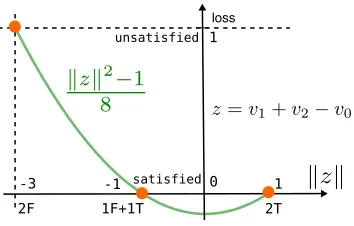
sj0 =−1(we introduce these variables to make the subse-quent SDP relaxation easier to write, with purely quadratic terms in the objective). This loss is best illustrated graphi-cally, as shown in Figure 1 for the case ofnj = 2. For the
case of anynj, it’s easy to verify that this quantity is equal
to+1if no clauses are satisfied,0if exactly one or exactly
njclauses are satisfied, and is strictly less than 0 otherwise;
these are exactly the conditions that the loss was required to meet.
We can now relax this binary problem into its vector form by relaxing the variable vi ∈ {−1,+1} tovi ∈ Rk with
∥vi∥2= 1. In this vector form, the loss above becomes sim-ply
loss(v;sj) =
∥V sj∥2−(nj−1)2 4nj
(11)
which is equivalent to the SDP
minimize V∈Rk×n
⟨STD−1S, VTV⟩, s.t. ∥vi∥2= 1, i= 1, . . . , n, (12)
where the matrices are all as defined above and withDjj = 4nj. This is precisely the form of the SDP solved by the
loss
2F 1F+1T 2T
1
-1 0
-3 1
unsatisfied
satisfied
Figure 1: Convex lower bound of the unsatisfiability loss.
1 Initialize allvirandomly on a unit sphere;
2 Letzj=∑ni=0sjiviforj= 1, . . . , m;
3 whilenot yet convergeddo 4 fori= 1, . . . , ndo
5 foreachsji̸= 0dozj :=zj−sjivi;
6 vi:=normalize
(
−∑m
j=1
sji
4njzj
)
;
7 foreachsji̸= 0dozj :=zj+sjivi;
8 end
9 end
Algorithm 1:The Mixing method for MAXSAT relaxation
3.2
The Mixing method for the MAXSAT SDP
Recall from the previous section that the Mixing method for solving the SDP above reduces to the iterations
vi := normalize
⎛
⎝− ∑
k̸=i
(STD−1S)ikvk
⎞
⎠. (13)
To compute this term efficiently without requiring precom-putation of the entireSTD−1Smatrix ahead of time (which is actually adensematrix owing to the fact that the “0th” variable v0 participates in ever clause), note that we can cache the vectorszj ∈Rk,j= 1, . . . , m, with
zj = n
∑
i=0
sjivi. (14)
Then the update equation can be written as
vi:= normalize
⎛
⎝−
m
∑
j=1
sji 4nj
zj
⎞
⎠. (15)
if we first remove all the terms in eachzj that depends on
vi. The final form of the Mixing method for this MAXSAT
SDP is given in Algorithm 1. Notice that updating the vari-ablevionly requires timeO(k·nnz)times, wherennzis
the number of clauses that contain theith variable. Further-more, although this would be a large number for thev0term, we can avoid updatingv0entirely, as it plays the role of an arbitrary “truth direction” that need not be updated from its original setting.
1 Initialize a priority queueQ={initial problem}; 2 whileQ is not emptydo
3 New SDP rootP =Q.pop();
4 Solvef∗:=SDP(P)with the Mixing method;
5 if⌈f∗−ϵ⌉ ≥bestthencontinue;
6 Updatebestand resolution orders by randomized rounding onV := argSDP(P);
7 foreachsubproblems ofPdo
8 Initializeprimalanddualobjective values;
9 ifprimal≤bestthenExpand;
10 else if⌈dual⌉ ≥bestthenPrune;
11 elsePush the subproblem into theQ;
12 end
13 end
Algorithm 2:The MIXSAT algorithm
4
The MIXSAT algorithm
In this section, we combine the previous SDP approach within a simple branch and bound framework to derive a exact and complete solver for MAX2SAT instances.2 Al-though the SDP relaxation and fast solution method plays the largest role in our solver, a number of other elements are crucial as well, such as warm starting based upon previous solutions in the tree, rounding to find feasible solutions at intermediate stages, and bounding the SDP optimal value by a particular set of primal and dual feasible points. We also introduce data structures such as a watched stack (similar to those used by SAT solvers) to efficiently make inferences about those clauses that have been fulfilled or falsified. De-spite some additional complexity, we highlight that the ul-timate algorithm here is still relatively simple compared to many state-of-the-art MAXSAT sovlers: just a branch and bound strategy with well-established optimizations adapted to this particular SDP-based heuristic. The fact that the ap-proach can nonetheless outperform existing solversbothfor complete and incomplete versions highlights the potential power of this SDP relaxation, not just from the theoretical side (which has been well-studied by past work), but from the practical side as well.
The basic method, which we refer to as MIXSAT (for Mixing applied to MAXSAT), is shown in Algorithm 2. The basic approach proceeds like a generic branch and bound search, with a priority queue storing problem instances (by using a priority queue ordered by heuristic values versus a stack, we can recover either a best first or depth first search, which we use in the incomplete and complete versions of the solver respectively). We pop these problems off the queue, solve the SDP via the Mixing method, and then round the re-sult to potentially obtain a new candidate solution (the SDP solution also leads to a subsequent ordering of variables to split on). For each split, we set the relevant set of variables be either true or false, and we initialize the primal and dual
ob-2
primal init: expand
dual init: prune
uncertain: new root SDP root
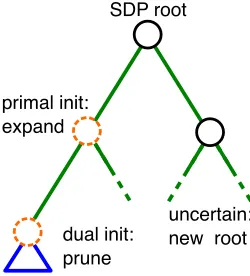
Figure 2: Illustration of primal and dual initialization.
jectives of each new subproblem, as described below, then push these on to the queue and continue until the queue is empty (for the complete solver). There are indeed several details of the process, which we describe next throughout this section.
4.1
Pruning and rounding via SDP
Pruning. Because our SDP approximation is a lower bound of the exact minimum unsatisfiability problem, it can serve as a lower-bound in the branch-and-bound framework. Specifically, as is standard in branch and bound, if the objec-tive value of a solved SDP value is higher than the current best known candidate solution, we can prune the entire sub-tree below that problem. Otherwise, we expand the subsub-tree and push the subproblems on to the queue.
Rounding. The SDP solutions also serve as a good method for obtaining candidate solutions via rounding, which can usually very quickly provide a good best known value, even in early stages of the algorithm. The random-ized rounding method works by repetitively drawing random vectorsruniformly from the sphere, and assigning binary
vi = sign(vT0r·viTr)as a candidate binary solution. That
is, if a variableviis at the same side with the truth direction
v0, we assign it to be true (+1) and otherwise false (−1). Fi-nally, if the rounded solution ever obtains the same integer objective value as the best lower bound, we know we have found an optimal solution.
4.2
Bounding SDP values by initializations
Even with the pruning and rounding strategies above, it typ-ically requires a large number of node expansions to solve even most MAX2SAT problem. As one data point, for in-stance for the MAX2SAT problems with120 variables, it typically requires searching through about 10k nodes in or-der to provide a verified solution to the problem. However, we reduce the number of expanded nodes (and hence the number of SDP solves) by reusing the solution of an SDP to quickly find both primal and dual feasible initialization to its subproblems. Indeed, sometimes we don’t even need to solve the SDP in order to expand or prune a subproblem.
Recall the vector program equivalent to our diagonal con-strained SDP relaxation
minimize V∈Rk×n
f(V) :=⟨C, VTV⟩, s.t. ∥vi∥2= 1. (16)
By the SDP duality, we have the following dual problem maximize
λ∈Rn
D(λ) :=−1Tλ, s.t. C+Dλ≽0. (17)
Anyfeasibleprimal and dual solution will provide an upper and lower bound respectively of the optimal SDP objective valuef∗. Furthermore, we know that the best known discrete solution, BEST, is always larger than the optimal discrete solutionUNSAT. That is,
f(V)≥f∗≥D(λ) and BEST≥UNSAT≥ ⌈f∗⌉.
Thus, for any feasible primal solution V and any feasible dual solution λ, we can prune or expand the subproblem when the following condition happens, as illustrated by Fig-ure 2.
• f(V)≤BEST⇒Expand (not prunable by SDP) • ⌈D(λ)⌉ ≥BEST⇒Prune (not contain optimal solution)
Upper bound by primal initialization. The primal ini-tialization is very simple: we simply copy all unassigned variables from the root solution into its subproblems, which will still provide a feasible solution. The effective length of the remaining clauses do change when this occurs, which can be updated efficiently by maintaining eachzj properly
after such updates.
Lower bound by dual initialization. The dual initializa-tion is more complex than the primal initializainitializa-tion because it involves the semidefiniteC+Dλ≽0constraint. The key
here is that variable assignment can be viewed equivalently as moving the necessary coefficients fromsjitosj0. For ex-ample, assigningv1as false can be written as
zj = 1·v1+1·v2−1·v0
v1:=F
====⇒ zj= 0·v1+1·v2−2·v0. Thus, if we look at the loss function, the coefficientscij for
unassignediandjactually remains the same in the new cost matrixCˆ. Thus, the difference in cost matricesCandCˆafter variable assignment will only reflects in the first column and row
C−Cˆ =
(
0 δT
δ 0
)
(18)
If we add a proper vectorξ=
(
∥δ∥1 |δ|
)
, we can see that
C+Dλ∗+ξ = (C+Dλ∗) +
(
∥δ∥1 δT
δ D|δ|
)
≽0, (19)
whereλ∗is the optimal solution from the root. That is,λ∗+ξ
is a feasible solution for the new dual problem, which pro-vides our lower bound as desired.
We also note that given anoptimalsolution of the SDP (as computed by Mixing), the optimal dual variable is simply given by
λi =∥V ci∥2. (20)
watched[lit]:=
lit next ... ptr stack
clause
Figure 3: Illustration the watched stack.
4.3
Data structures and implementation details
Finally, there are a number of data structures and/or mentation details that are important for an efficient imple-mentation of the branch and bound. For the full implemen-tation and more technical details, please see the source code in https://github.com/locuslab/mixsat .
Variable ordering. We have found that the dual variable
λin (20) is also very useful in determining the resolution order (the order for splitting on variables to create the new subproblems). Thus, every time we solve an SDP, we will reorder the remaining variables according to the descending order ofλ(that is, variable with larger λi will be resolved
first).
Inference via watched stack. In order to efficiently find the set of all clauses that contain a certain variable (includ-ing after variable reorder(includ-ing) and efficiently inferr(includ-ing which clauses have been fulfilled/falsified, we use a data struc-ture similar to the watched literal technique in SAT solvers (Moskewicz et al., 2001). Specifically, to accomplish this we used a watched stack data structure. For each literal, we maintain a stack of pointers, pointing to the next lit-eral (in pivot order) in a clause. The pointer is only pushed to the stack if it’s the last pointer being able to falsify the clause. This way, assigning/freeing variables only touches those clauses that haven’t been satisfied, and evaluating a set of variable assignment takes exactlyO(nnz)time. The watched stack is illustrated in Figure 3.
Estimating SDP objective and balancing prun-ing/rounding. Because the Mixing method is iterative, it is usually desirable to only solve to some given precision, and not solve the SDPs exactly. Since the Mixing method attains linear convergence (Wang, Chang, and Kolter, 2017), we estimate the converging constant by function decrease and estimate the distance to the optimal objective values. Furthermore, we need to balance between the time spent in solving SDPs and the randomized roundings (because we rounds multiple times). We have empirically found that taking rounding time proportion to the square root of the remaining variables works best.
DFS vs BFS. We have described our branch-and-bound solver in an abstract manner in Algorithm 2, where the prior-ity queue could prioritize by any ordering. When implement-ing the complete solver, where the full search tree needs to be searched anyway, we let the queueQbe an stack; that is, we evaluate the nodes in the deep-first search (DFS) order.
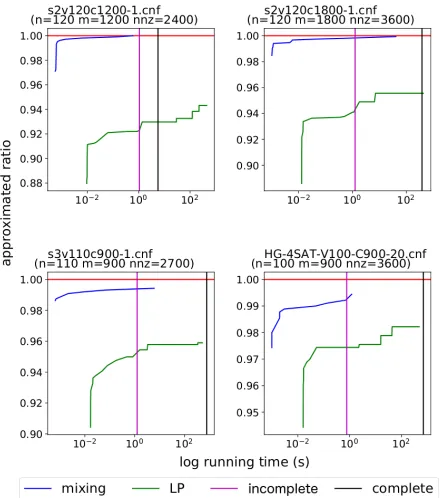
Figure 4: The approximation ratio versus running time. We demonstrated that the Mixing method not only outputs solu-tions faster than LPs, but also admits higher approximation ratio.
For the incomplete version, we letQbe the priority queue ordered by the clipped loss (∑
jmax(0, loss(V, sj))); that
is, we explore the nodes in a best-first search (BFS) order. However, the primal and dual initialization requires the DFS order to be efficiently implemented. Thus, we run one depth-limited DFS for each of the BFS node evaluated even in the incomplete version. Specifically, we limit the depth to be less than 8to limit the number of nodes (subproblems) pushed to the heap at each root.
5
Experimental results
0 20 40 60 80 100 120 140 160 180 instances
100
101
102
103
104
seconds
MAX2SAT in the complete track
MIXSAT
Best complete 2016
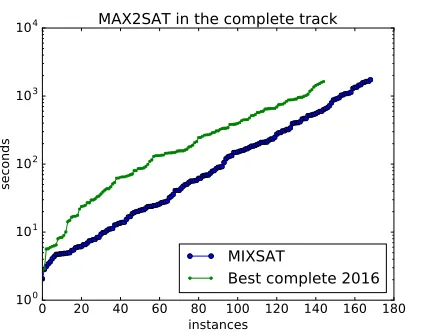
Figure 5: Experimental result of MAX2SAT in the com-plete track. We demonstrate that the MIXSAT algorithm consistently outperforms the best complete solvers in the MAXSAT 2016 competition in every MAX2SAT instances. Specifically, we solved 169/228 instances in 30 mins in avg 273 secs, while the best solvers solved only 145/228 in-stances in avg 341 secs.
to test the performance on harder problems, we evaluated our solver on the 107 crafted MAXCUT instances in the 2016/2018 competitions, comparing it to the best solvers in 2016/2018. We also tested our solver on all the random MAX3SAT instances in 2016 to see how it generalized to different clause length. For fair comparison, we replicate the experimental setup of the 2016 environment, with exactly the same CPU (Intel Xeon E5-2620) in single core mode and a 3.5 GB memory limit.
The approximation ratio of MAXSAT SDPs. As a start-ing point, we first highlight the power of the MAXSAT Mix-ing solver combined just with randomized roundMix-ing (i.e., just looking at a single relaxation, without any branch and bound). These results are shown in Figure 4. The starting points of the blue and green curves indicate the time that the Mixing / LP solver (by Gurobi) output the solution, and the following curves indicate the highest approximation ra-tio generated by the LP/SDP randomized rounding proce-dures. We can see that the Mixing method actually output solution faster than the LP solver, and has much higher ap-proximation ratio than LPs. Indeed, sometimes the simple randomized rounding procedure can output the optimal so-lution faster than the best complete and incomplete solvers (vertical black and purple lines).
Complete solvers. Next, we evaluate our solver on the above mentioned 228 MAX2SAT instances using the com-plete track rules, which only allows to output verified op-timal solution and has a 30 minutes time limit. The result is presented in Figure 5, showing the number of solved problems versus time for MIXSAT shown against the best MAXSAT 2016 solver results. We solved169out of the 228
0 50 100 150 200 250
instances 10-3
10-2
10-1
100
101
seconds
MAX2SAT in the incomplete track
MIXSAT
Best incomplete 2016
Figure 6: Experimental result of MAX2SAT in the incom-plete track. We demonstrate that the MIXSAT algorithm out-perform the best incomplete solvers in the MAXSAT 2016 competition in every MAX2SAT instances. The MIXSAT algorithm used 0.22 sec in average to obtain the optimal so-lution, while the best solvers use 1.92 sec in average. That is, we are approximately 8.72 times faster than the best solvers.
MAX2SAT instances in the random categories for the com-plete solvers in an average of 273 sec, while the best solvers solved only145instances in an average of 341 seconds (note however that the average times are not truly comparable here as we solve substantially more problems).
Incomplete solvers. We test our solvers on the 228 MAX2SAT instances using the incomplete track rules, which allows the solver to output solutions before verifi-cation and has a 5 minutes time limit. The result is pre-sented in Figure 6. We recovered the optimal solution of all the 228 MAX2SAT instances in the random categories for the incomplete solvers in an average of 0.22 sec, while the best solvers solved in averagely 1.92 sec. That is, we are8.72x fasterthan the best solvers in average. To be spe-cific, we found that the 2016 best solvers we compared with are usually one of CCLS (Luo et al., 2015), CnC-LS Luo et al. (2017), SC2016 (Wagner), and Swcca-ms (Cai and Su, 2013).
0 20 40 60 80 100 120 instances
10-4
10-3
10-2
10-1
100
101
seconds
Crafted MAXCUT in 2016/2018 incomplete track
MIXSAT
Best incomplete 2016 / 2018
Figure 7: Experimental result of the crafted MAXCUT in-stances in the 2016/2018 incomplete track. The MIXSAT algorithm used 0.62 sec in average to obtain the optimal so-lution, while the best solvers in 2016/2018 took 1.84 sec in average. That is, we are still 3x faster in the crafted tracks.
6
Conclusion
This paper has highlighted that an approach, based upon low-rank semidefinite programming and a simple branch-and-bound strategy, is extremely competitive for solving the MAX2SAT problem, compared with some state-of-the-art solvers in previous contest on MAXSAT solving. Fur-ther, preliminary experiments demonstrate the performance also generalizes to the MAX3SAT problem. Although the MAX2SAT/MAX3SAT domain is obviously a limited set-ting, the fact that an approach based upon SDP relaxations can perform well here offers substantial evidence that with modern methods for SDP solving, such relaxations can fi-nally go beyond merely theoretically interesting, but become practical tools in the toolset of combinatorial optimization. These results suggest that they could be a powerful tool (one of many) to integrate into current solvers. More fun-damentally, we hope that the work serves as a starting point for more continuous approaches integrated into combinato-rial search, ultimately providing a powerful new avenue for some fundamental problems in AI.
References
Anjos, M. F. 2004. On semidefinite programming relax-ations for the satisfiability problem.Mathematical Methods of Operations Research60(3):349–367.
Ans´otegui, C.; Bonet, M. L.; and Levy, J. 2013. Sat-based maxsat algorithms.Artificial Intelligence196:77–105. Argelich, J.; Li, C. M.; Manya, F.; and Planes, J. 2016. Max-sat-2016 eleventh max-sat evaluation. http://maxsat.ia.udl. cat/.
Berg, J., and J¨arvisalo, M. 2017. Cost-optimal constrained correlation clustering via weighted partial maximum satisfi-ability.Artificial Intelligence244:110–142.
0 20 40 60 80 100 120 140 160
instances 10-3
10-2
10-1
100
101
102
seconds
MAX3SAT in the incomplete track
MIXSAT
Best incomplete 2016
Figure 8: Experimental result of MAX3SAT in the incom-plete random track. Even though our solver is not designed for MAX3SAT, it still outperformed the 2016 best solvers in 114/144 instances and recover all the optimal solutions except for 2 instances.
Biere, A.; Heule, M.; and van Maaren, H. 2009. Handbook of satisfiability, volume 185. IOS press.
Boumal, N.; Voroninski, V.; and Bandeira, A. 2016. The non-convex burer-monteiro approach works on smooth semidefinite programs. InAdvances in Neural Information Processing Systems, 2757–2765.
Burer, S., and Monteiro, R. D. 2003. A nonlinear program-ming algorithm for solving semidefinite programs via low-rank factorization. Mathematical Programming95(2):329– 357.
Cai, S., and Su, K. 2013. Local search for boolean satisfi-ability with configuration checking and subscore. Artificial Intelligence204:75–98.
E´en, N., and Sorensson, N. 2006. Translating pseudo-boolean constraints into sat. Journal on Satisfiability, Boolean Modeling and Computation2:1–26.
Feige, U., and Goemans, M. 1995. Approximating the value of two power proof systems, with applications to max 2sat and max dicut. InTheory of Computing and Systems, 1995. Proceedings., Third Israel Symposium on the, 182– 189. IEEE.
Fu, Z., and Malik, S. 2006. On solving the partial max-sat problem. In International Conference on Theory and Applications of Satisfiability Testing, 252–265. Springer. Goemans, M. X., and Williamson, D. P. 1994. New 34-approximation algorithms for the maximum satisfiability problem.SIAM Journal on Discrete Mathematics7(4):656– 666.
Gomes, C. P.; van Hoeve, W.-J.; and Leahu, L. 2006. The power of semidefinite programming relaxations for max-sat. InInternational Conference on Integration of Artificial In-telligence (AI) and Operations Research (OR) Techniques in Constraint Programming, 104–118. Springer.
Karloff, H., and Zwick, U. 1997. A 7/8-approximation al-gorithm for max 3sat? InFoundations of Computer Science, 1997. Proceedings., 38th Annual Symposium on, 406–415. IEEE.
Koshimura, M.; Zhang, T.; Fujita, H.; and Hasegawa, R. 2012. Qmaxsat: A partial max-sat solver. Journal on Satis-fiability, Boolean Modeling and Computation8:95–100. Krislock, N.; Malick, J.; and Roupin, F. 2017. Biqcrunch: a semidefinite branch-and-bound method for solving binary quadratic problems. ACM Transactions on Mathematical Software (TOMS)43(4):32.
Le Berre, D., and Parrain, A. 2010. The sat4j library, release 2.2, system description. Journal on Satisfiability, Boolean Modeling and Computation7:59–64.
Lotgering, T. 2012. Sdp-based max-2-sat decomposition.
Luo, C.; Cai, S.; Wu, W.; Jie, Z.; and Su, K. 2015. Ccls: an efficient local search algorithm for weighted maximum satisfiability.IEEE Transactions on Computers64(7):1830– 1843.
Luo, C.; Cai, S.; Su, K.; and Huang, W. 2017. Ccehc: An ef-ficient local search algorithm for weighted partial maximum satisfiability.Artificial Intelligence243:26–44.
Marques-Sila, J., and Planes, J. 2011. Algorithms for max-imum satisfiability using unsatisfiable cores. InAdvanced Techniques in Logic Synthesis, Optimizations and Applica-tions. Springer. 171–182.
Martins, R.; Manquinho, V.; and Lynce, I. 2014. Open-wbo: A modular maxsat solver. InInternational Conference on Theory and Applications of Satisfiability Testing, 438–445. Springer.
Morgado, A.; Heras, F.; Liffiton, M.; Planes, J.; and Marques-Silva, J. 2013. Iterative and core-guided maxsat solving: A survey and assessment. Constraints18(4):478– 534.
Moskewicz, M. W.; Madigan, C. F.; Zhao, Y.; Zhang, L.; and Malik, S. 2001. Chaff: Engineering an efficient sat solver. InProceedings of the 38th annual Design Automation Con-ference, 530–535. ACM.
Nocedal, J., and Wright, S. 2006. Numerical optimization. Springer, second edition.
Park, J. D. 2002. Using weighted max-sat engines to solve mpe. InEighteenth national conference on Artificial intelli-gence, 682–687. American Association for Artificial Intel-ligence.
Pataki, G. 1998. On the rank of extreme matrices in semidef-inite programs and the multiplicity of optimal eigenvalues. Mathematics of operations research23(2):339–358.
Rendl, F.; Rinaldi, G.; and Wiegele, A. 2010. Solving max-cut to optimality by intersecting semidefinite and polyhedral relaxations. Mathematical Programming121(2):307. van Maaren, H.; van Norden, L.; and Heule, M. J. 2008. Sums of squares based approximation algorithms for max-sat. Discrete Applied Mathematics156(10):1754–1779. Wagner, M. Maxsat solver sc2016 (internal technical re-port).
Wang, P.-W.; Chang, W.-C.; and Kolter, J. Z. 2017. The mixing method: low-rank coordinate descent for semidefi-nite programming with diagonal constraints. arXiv preprint arXiv:1706.00476.