T E C H N I C A L N O T E
Open Access
U
–
Th isotopic microanalysis of zircon
reference materials and KBSI working
standards
Youn-Joong Jeong, Shinae Lee, Sook Ju Kim, Hui Je Jo, Keewook Yi and Albert Chang-sik Cheong
*Abstract
Background:The238U–230Th disequilibrium dating of the mineral zircon (ZrSiO4) provides an efficient tool for investigating the time scales of Quaternary magmatic processes. In situ mass spectrometric U–Th microanalysis of zircon requires careful calibration and correction of the measured isotope data, particularly for the instrumental fractionation of U and Th isotopes.
Findings:For the selection of suitable calibration materials for U–Th isotopic analysis using a laser ablation multiple collector inductively coupled plasma mass spectrometer (LA-MCICPMS), we estimated the homogeneity of four reference zircons (91500, TEMORA 2, FC1, and Plešovice) and two zircon working standards (LKZ-1 and BRZ-1) in terms of their232Th/238U ratios, based on the Pb isotopic compositions measured by a sensitive high-resolution ion microprobe (SHRIMP). The measured LA-MCICPMS232Th/238U ratios of the zircons were calibrated externally using the SHRIMP208Pb/206Pb-based average value of the 91500 zircon,232Th/238U = 0.351 ± 0.035 (error corresponds to 1 standard deviation). The molecular interference-corrected230Th/232Th ratios of the zircons were calibrated based on the assumption that the Plešovice zircon is in238U–230Th secular equilibrium. After the calibration and correction, the activity ratios of230Th/232Th and238U/232Th for all reference zircons and working standards were plotted on the equiline. Conclusions:This study confirms that the 91500 zircon is relatively homogeneous in terms of U/Th ratios (relative standard deviation = ~ 10%) and does not support a recent claim that the Plešovice zircon is not in238U–230Th radioactive equilibrium. The working standards LKZ-1 and BRZ-1 can be used to check the reliability of U–Th isotopic analyses for Quaternary zircons.
Keywords:Zircon standard, U–Th isotopes, Uranium-series disequilibrium dating, Laser ablation-ICPMS
Introduction
Geochronological methods using parent–daughter iso-tope pairs with long half-lives, such as 87Rb–87Sr
(half-life = 48.8 Gy), 147Sm–143Nd (106 Gy),
238
U–206Pb (4.47 Gy), and 40K–39Ar (1.25 Gy) sys-tems, pose many challenges for the dating of Quater-nary rocks and minerals, mainly because the amounts of daughter isotopes accumulated are extremely small. Also, in the case of 40K (or 40Ar)–39Ar dating, prob-lems associated with excess argon cannot always be avoided (e.g., Esser et al. 1997). On the other hand, the widely used radiocarbon dating method is only
applicable to the last ca. 50,000 years because of the short half-life of 14C (= 5730 years). The geochrono-logical gaps between the ranges of these dating methods are filled by uranium-series geochronometers using short-lived radionuclides in the decay chains, such as 230Th (half-life = 75,600 years) and 231Pa (32,500 years).
The mineral zircon (ZrSiO4) presents many
advan-tages as a 238U–230Th geochronometer. It has a rela-tively high uranium content (ca. 100–1000 ppm) and is strongly resistant to physicochemical breakdown.
Furthermore, the intracrystalline diffusion of its
constituent cations is relatively slow (Cherniak and
Watson 2003). Therefore, Quaternary zircons have
been a prime target for 238U–230Th disequilibrium dating since the advent of in situ microanalytical
* Correspondence:[email protected]
Division of Earth and Environmental Sciences, Korea Basic Science Institute, 162 Yeongudanji-ro, Cheongwon-gu, Cheongju 28119, Chungcheongbukdo, Republic of Korea
techniques that employ secondary ion mass spectrom-etry or laser ablation-assisted inductively coupled plasma mass spectrometry (LA-ICPMS) (Reid et al. 1997; Zou et al. 2010; Ito et al. 2013). These tech-niques have made it possible to investigate the sub-grain time records in single crystals but require careful calibration and correction of the measured isotope data. The zircon reference material plays a critical role in the calibration of LA-ICPMS data (Guillong et al. 2016).
For the selection of suitable reference materials for calibration of laser ablation data, we estimated the
homogeneity of four reference zircons (91500,
TEMORA 2, FC1, and Plešovice) and two zircon
working standards (LKZ-1 and BRZ-1) in terms of their 232Th/238U ratios, based on Pb isotopic composi-tions measured with a sensitive high-resolution ion microprobe (SHRIMP). Then, we assessed the reliabil-ity of the calibration for LA-multiple collector (MC)
ICPMS zircon U–Th isotope data using the
208
Pb/206Pb-based average 232Th/238U ratio in the most homogeneous zircon reference material (the 91500 zir-con), in addition to the 238U–230Th radioactive equilib-rium assumed for the Plešovice zircon.
Materials
According to Wiedenbeck et al. (1995), the 91500 zircon specimen stored at the Harvard Mineralogical Museum originally consisted of a single crystal presumably col-lected from a porphyroblastic syenite gneiss in Ontario, Canada. The authors reported its chemical composition and isotope dilution-thermal ionization mass spectro-metric (ID-TIMS)207Pb/206Pb age of 1065.4 ± 0.3 Ma. Its average U concentration and Th/U ratio were estimated to be 81.2 ppm and 0.3444 ± 0.0009, respectively. The sub-grain distributions of trace elements in this refer-ence zircon were investigated by Wiedenbeck et al. (2004). The 91500 zircon is a widely used reference material for O (δ18OV-SMOW= 10.07 ± 0.03‰; Valley
2003) and Hf isotopes (176Hf/177Hf = 0.282308 ± 0.000006; Blichert-Toft2008).
The TEMORA 2 zircon, introduced by Black et al. (2004), was collected from a gabbroic diorite stock in the Lachlan Orogen of Eastern Australia. The ID-TIMS analyses for this zircon yielded a206Pb/238U age of 416.78 ± 0.33 Ma, moderate U concentrations of 320–82 ppm, and Th/U ratios of 0.51–0.33 (Black et al.2004).
The FC1 zircon was collected from an olivine gabbroic anorthosite in northeastern Minnesota. Paces
a)
b)
3mm
3mm
0.5mm
0.2mm
and Miller Jr (1993) reported its ID-TIMS 207Pb/206Pb age as 1099.0 ± 0.6 Ma, with U concentrations ran-ging from 1510 to 218 ppm and Th/U ratios of 0.604–0.519.
The Plešovice zircon came from a potassic granulite in the southern Bohemian Massif, Czech Republic. The ID-TIMS analyses of this zircon by Sláma et al. (2008) yielded a weighted mean206Pb/238U age of 337.13 ± 0.37 Ma and relatively low Th/U ratios of 0.16–0.04. The U concen-trations of the pristine domains in the Plešovice zircon, determined by LA-ICPMS, range from 1106 to 465 ppm (Sláma et al.2008).
The Korea Basic Science Institute (KBSI) is devel-oping zircon working standards, namely LKZ-1 and BRZ-1. The former, from Sri Lanka, is a single trans-parent pale yellow crystal (length to width = ~ 1.7:1) with dark cathodoluminescence (CL) emissions, and the latter, from Brazil, consists of translucent dark brown crystals and exhibits a symmetric CL
band-ing (Fig. 1). The SHRIMP analyses by Kim et al.
(2015) yielded a weighted mean 206Pb/238U age of 591.1 ± 2.7 Ma (n= 29, mean square of weighted de-viates [MSWD] = 2.1) for LKZ-1 and 572.2 ± 4.9 Ma
(n= 30, MSWD = 4.1) for BRZ-1. The LKZ-1 is
fairly high in U content, at 646 ± 45 ppm (herein-after, errors correspond to 1 standard deviation (SD) unless otherwise stated), whereas the BRZ-1 has a significantly lower U content (90 ± 32 ppm) (Kim et al. 2015).
Methods
For Pb isotopic measurements using the KBSI SHRIMP, the primary O2− beam was focused into a ~ 25-μ
m-dia-meter spot at an accelerating voltage of 10 kV. The col-lector slit width was fixed at 100 μm, achieving a mass resolution of ~ 5000 at 1% peak height. The common Pb
was removed by 204Pb correction method (Williams
1998) using the model of Stacey and Kramers (1975). Data processing was conducted using the SQUID 2.50 program (Ludwig2009).
Zircon U–Th isotopic analyses were carried out at the KBSI using a Plasma II MCICPMS (Nu Instru-ments) equipped with an NWR193-nm ArF excimer laser ablation system (ESI). Typical laser ablation and
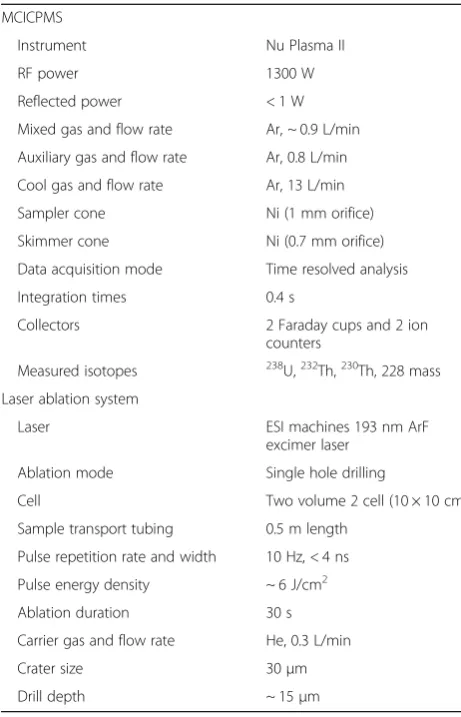
ICPMS parameters are summarized in Table 1. Signal
intensities were measured with Faraday collectors (for 238U and 232Th) and ion counters (for 230Th and 228 mass) simultaneously. The raw data were proc-essed using Iolite 2.5 running within Igor Pro 6.3.5.5 software (Paton et al. 2011). The activity ratios were calculated using the decay constants proposed by Steiger and Jäger (1977) (for 238U and 232Th) and Cheng et al. (2013) (for 230Th).
Results and discussion
SHRIMP analysis
Generally, the mass fractionation of Pb in the SHRIMP analysis occurs within the limits of analytical precision (Williams 1998 and references therein), and thus, no correction was applied to the measured 208Pb/206Pb ratios. The common Pb-corrected 208Pb/206Pb ratios of the zircon reference materials and KBSI working standards are listed in Additional file 1: Table S1. The
232
Th/238U ratios were calculated by assuming that the U–Pb and Th–Pb isotopic systems in the zircons were concordant (Eq. 1):
208Pb=206
PbSHRIMP¼ 232Th=238
UCONCORDANCE eλ232t−1=eλ238t−1
ð1Þ
where λ232, λ238, and t are the 232Th decay constant
(4.9475 × 10⁻¹¹ y−1), the238U decay constant (1.55125 × 10⁻¹⁰ y−1) (Steiger and Jäger 1977), and zircon
Table 1LA-MCICPMS instrument and operational parameters
MCICPMS
Instrument Nu Plasma II
RF power 1300 W
Reflected power < 1 W
Mixed gas and flow rate Ar, ~ 0.9 L/min
Auxiliary gas and flow rate Ar, 0.8 L/min
Cool gas and flow rate Ar, 13 L/min
Sampler cone Ni (1 mm orifice)
Skimmer cone Ni (0.7 mm orifice)
Data acquisition mode Time resolved analysis
Integration times 0.4 s
Collectors 2 Faraday cups and 2 ion counters
Measured isotopes 238U,232Th,230Th, 228 mass
Laser ablation system
Laser ESI machines 193 nm ArF excimer laser
Ablation mode Single hole drilling
Cell Two volume 2 cell (10 × 10 cm)
Sample transport tubing 0.5 m length
Pulse repetition rate and width 10 Hz, < 4 ns
Pulse energy density ~ 6 J/cm2
Ablation duration 30 s
Carrier gas and flow rate He, 0.3 L/min
Crater size 30μm
crystallization age, respectively. The 232Th/238U ratios were also calculated by the SQUID program, using the experimental relationship proposed by Williams et al. (1996) (Eq.2):
232Th=238
USQUID¼
0:03446238UOþ=238
Uþþ0:868
232
ThOþ=238UOþ
ð2Þ
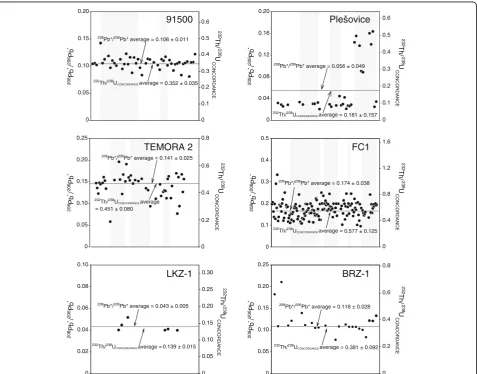
The average 232Th/238UCONCORDANCE of the 91500
zircon (0.352 ± 0.035, relative standard deviation [RSD]
= 10%, n= 48) is in agreement with the previous
ID-TIMS (0.356 ± 0.001; Wiedenbeck et al. 1995) and LA-ICPMS ([Th] = 29.9 ppm (RSD = 7%), [U] = 80.0 ppm (RSD = 10%), 232Th/238U = 0.386 ± 0.047; Wiedenbeck et al. 2004) values within the measurement uncertainties. The other reference zircon materials and working
standards were less homogeneous in terms of Th/U ra-tios (Fig. 2). However, the average 232Th/238U
CONCOR-DANCE ratios of TEMORA 2 (0.451 ± 0.080, RSD = 18%,
n= 47), FC1 (0.577 ± 0.125, RSD = 22%, n= 149), and Plešovice zircons (0.181 ± 0.157, RSD = 87%, n= 31)
are consistent with the previous ID-TIMS and
LA-ICPMS results (Paces and Miller Jr 1993; Black et al. 2004; Sláma et al. 2008). The Plešovice zircon showed the widest variation in 232Th/238U (0.52–0.07). The LKZ-1 and BRZ-1zircons yielded an average
232
Th/238UCONCORDANCE of 0.139 ± 0.015 (RSD = 11%,
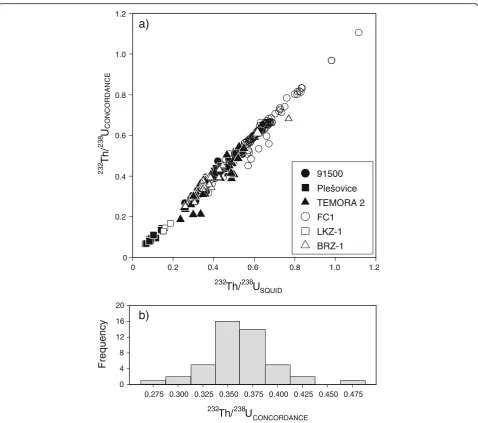
n= 6) and 0.381 ± 0.092 (RSD = 24%,n= 23), respectively. As shown in Fig. 3a, the 232Th/238U ratios calculated by the two equations (i.e., 232Th/238UCONCORDANCE and 232
Th/238USQUID) agree well with each other. The 232
Th/238USQUID ratios with > 1% standard error (SE)
are not displayed in this figure. It should also be noted that the 208Pb/206Pb ratios with poor internal
208 Pb */ 206 Pb * 0 0.05 0.10 0.15 0.20 208 Pb */ 206 Pb * 0 0.04 0.08 0.12 0.16 0.20 232 Th/ 238 U CONCORDANCE 0 0.1 0.2 0.3 0.4 0.5 0.6 208 Pb */ 206 Pb * 0 0.05 0.10 0.15 0.20 0.25 232 Th/ 238 U CONCORDANCE 232 Th/ 238 U CONCORDANCE 208 Pb */ 206 Pb * 232 Th/ 238 U CONCORDANCE 0 0.4 0.8 1.2 1.6 208 Pb */ 206 Pb * 0 0.02 0.04 0.06 0.08 0.10 232 Th/ 238 U CONCORDANCE 0 0.05 0.10 0.15 0.20 0.25 0.30 208 Pb */ 206 Pb * 0 0.05 0.10 0.15 0.20 0.25 232 Th/ 238 U CONCORDANCE 0 0.2 0.4 0.6 0.8 BRZ-1 LKZ-1 1 C F 2 A R O M E T Plešovice 91500 0 0.1 0.2 0.3 0.4 0.5 0 0.2 0.4 0.6 0.8 0 0.1 0.2 0.4 0.5 0.3 0.6
208Pb*/206Pb* average = 0.106 ± 0.011
208Pb*/206Pb* average = 0.056 ± 0.049
208Pb*/206Pb* average = 0.141 ± 0.025
208Pb*/206Pb* average = 0.174 ± 0.038
208Pb*/206Pb* average = 0.043 ± 0.005 208Pb*/206Pb* average = 0.118 ± 0.028
232Th/238U
CONCORDANCE average = 0.139 ± 0.015 232Th/238U
CONCORDANCE average = 0.451 ± 0.080 232Th/238U
CONCORDANCE average = 0.352 ± 0.035
232Th/238U
CONCORDANCE average = 0.181 ± 0.157
232Th/238U
CONCORDANCE average = 0.577 ± 0.125
232Th/238U
CONCORDANCE average = 0.381 ± 0.092
Fig. 2The SHRIMP208Pb/206Pb and calculated232Th/238U
precision (defined here as SE > 5%) were not consid-ered in the calculation of 232Th/238UCONCORDANCE.
The 232Th/238UCONCORDANCE ratios calculated for the
91500 zircon follow a normal distribution (Fig. 3b).
LA-MCICPMS analysis
Essentially, correction of inter-elemental isotope ra-tios measured by the LA-ICPMS is unavoidable be-cause the sensitivity varies between elements due to mass bias and differences in the vaporization and ionization efficiency of the aerosol introduced into
the plasma. Matrix-matched and homogeneous
standard materials are required for the external cali-bration of inter-elemental LA-ICPMS data. Our SHRIMP analyses confirm that the 91500 zircon is the most homogeneous in terms of the Th/U ratio
among the analyzed reference materials. We
employed its 238U/232ThCONCORDANCE (= 2.85 ± 0.29)
for the calibration of LA-MCICPMS 238U/232Th data.
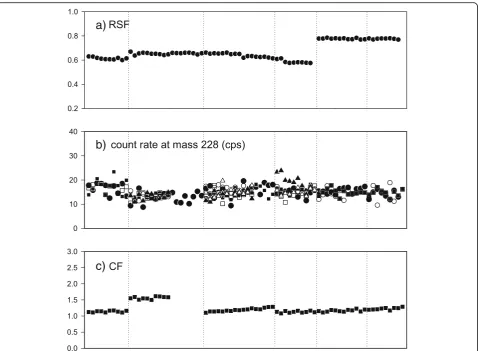
The relative sensitivity factor (RSF = 2.85 over
238
U/232Thmeasured) was fairly constant during single
analytical tests (RSD < 3%) but varied significantly
from run to run (Fig. 4a); this means that the RSF
SQUID
CONCORDANCE
91500
Plešovice TEMORA 2
FC1
LKZ-1 BRZ-1
0 0.2 0.4 0.6 0.8 1.0 1.2 0
0.2 0.4 0.6 0.8 1.0 1.2
232 Th/238U
a)
232
Th/238UCONCORDANCE
0.275 0.300 0.325 0.350 0.375 0.400 0.425 0.450 0.475
Frequency
0 4 8 12 16 20
232
Th/
238
U
b)
Fig. 3aComparison between232Th/238U ratios calculated using SHRIMP208Pb/206Pb data and the assumption that the U–Pb and Th–Pb isotopic
systems in the zircons are concordant (232Th/238UCONCORDANCE) and those calculated by the SQUID program (232Th/238USQUID).bThe frequency
value needs to be checked before and after the sam-ple analysis.
Of all the reference zircons analyzed in this study, the Plešovice zircon showed the widest variation in
232
Th/238U. Ito (2014) argued that the Plešovice zir-con is not in secular equilibrium, but this hypoth-esis may have been skewed by biased corrections for abundance sensitivity and molecular interferences
(Guillong et al. 2015). During our LA-MC-ICP-MS
analyses, the count rate at mass 228 was relatively constant (Fig. 4b), supporting the interpretation of Guillong et al. (2015) that mass 230 contains contri-butions from molecular zirconium sesquioxide ions. We removed these contributions using the isotopic abundance ratio proposed for 90Zr2 and (90Zr92Zr
+91Zr2) (= 0.7142; Guillong et al. 2015). Following
this, the 238U–230Th radioactive equilibrium
as-sumed for the Plešovice zircon was used for the
correction and calibration of the peak tail of 232Th and the Faraday–ion counter efficiency. The
correc-tion factor measured for the Plešovice zircon
[= (238U/232Th)corrected/(230Th/232Th)measured] also
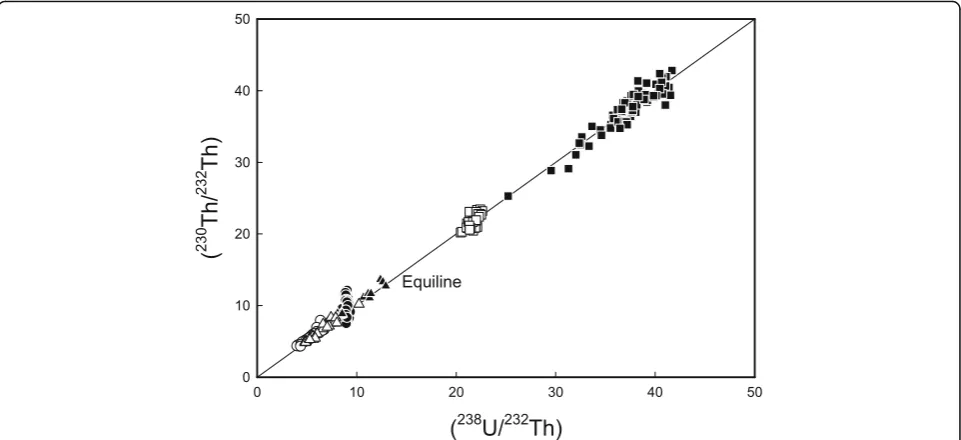
varied significantly from run to run (Fig. 4c). After calibration and correction, we confirmed that the activity ratios of 230Th/232Th and 238U/232Th for all zircons were plotted on the equiline as displayed in Fig. 5 and listed in Additional file 2: Table S2.
Conclusions
This study confirms that the 91500 zircon is relatively homogeneous in terms of U/Th ratios (RSD = ~ 10%). After calibration and correction using the SHRIMP
208
Pb/206Pb-based average 232Th/238U ratio for the 91500 zircon (= 0.351 ± 0.035), and the 238U–230Th
radioactive equilibrium assumed for the Plešovice
a)
b)
c)
Fig. 4Variation ofathe relative sensitivity factor (RSF) measured for the 91500 zircon (= 2.85 over238U/232Thmeasured),bthe count rate at mass
228, andcthe correction factor (CF) measured for the Plešovice zircon [= (238U/232Th)corrected/( 230
Th/232Th)measured] in the LA-MCICPMS analysis.
zircon, the activity ratios of 230Th/232Th and
238
U/232Th were plotted on the equiline for all zircon reference materials and KBSI working standards. The LKZ-1 and BRZ-1 employed by the KBSI can be used to check the reliability of U–Th isotopic analyses for Quaternary zircons.
Additional files
Additional file 1:Table S1.SHRIMP Pb isotope data with calculated
232Th/238U ratios. (XLSX 50 kb)
Additional file 2:Table S2.U–Th isotopic composition of the zircons. (XLSX 87 kb)
Acknowledgements
This study was supported by a KBSI grant (C38709) awarded to Albert Chang-sik Cheong.
Authors’contributions
ACSC designed the research and wrote the manuscript. YJJ, SL, SJK, HJJ, and KY analyzed the data. All authors read and approved the final manuscript.
Competing interests
The authors declare that they have no competing interests.
Publisher’s Note
Springer Nature remains neutral with regard to jurisdictional claims in published maps and institutional affiliations.
Received: 19 July 2018 Accepted: 26 July 2018
References
Black LP, Kamo SL, Allen CM, Davis DW, Aleinikoff JN, Valley JW, Mundil R, Campbell IH, Korsch RJ, Williams IS, Foudoulis C. Improved206Pb/238U
microprobe geochronology by the monitoring of a trace-element-related
matrix effect: SHRIMP, ID-TIMS, ELA-ICP-MS and oxygen isotope documentation for a series of zircon standards. Chem Geol. 2004;205:115–40.https://doi.org/10. 1016/j.chemgeo.2004.01.003.
Blichert-Toft J. The Hf isotopic composition of zircon reference material 91500. Chem Geol. 2008;253:252–7.https://doi.org/10.1016/j.chemgeo.2008.05.014.
Cheng H, Edwards RL, Shen CC, Polyak VJ, Asmerom Y, Woodhead J, Hellstrom J, Wang Y, Kong X, Spötl C, Wang X, Alexander EC Jr. Improvements in230Th
dating,230Th and234U half-life values, and U–Th isotopic measurements by multi-collector inductively coupled plasma mass spectrometry. Earth Planet Sci Lett. 2013;371–372:82–91.https://doi.org/10.1016/j.epsl.2013.04.006. Cherniak DJ, Watson EB. Diffusion in zircon. Rev Mineral Geochem. 2003;53:113–
43.https://doi.org/10.2113/0530113.
Esser RP, McIntosh WC, Heizler MT, Kyle PR. Excess argon in melt inclusions in zero-age anorthoclase feldspar from Mt. Erebus, Antarctica, as revealed by the40Ar/39Ar method. Geochim Cosmochim Acta. 1997;61:3789–801.https://
doi.org/10.1016/S0016-7037(97)00287-1.
Guillong M, Schmitt AK, Bachmann O. Comment on“zircon U-Th-Pb dating using LA-ICP-MS: simultaneous U-Pb and U-Th dating on 0.1 Ma Toya Tephra, Japan”by Hisatoshi Ito. J Volcanol Geotherm Res. 2015;296:101–3.https://doi. org/10.1016/j.jvolgeores.2015.03.003.
Guillong M, Sliwinski JT, Schmitt A, Forni F, Bachmann O. U-Th zircon dating by laser ablation single collector inductively coupled plasma-mass spectrometry (LA-ICP-MS). Geostand Geoanal Res. 2016;40:377–87.https://doi.org/10.1111/j. 1751-908X.2016.00396.x.
Ito H. Zircon U–Th–Pb dating using LA-ICP-MS: simultaneous U-Pb and U-Th dating on the 0.1 Ma Toya Tephra, Japan. J Volcanol Geotherm Res. 2014;289: 210–23.https://doi.org/10.1016/j.jvolgeores.2014.11.002.
Ito H, Tamura A, Morishita T, Arai S, Arai F, Kato O. Quaternary plutonic magma activities in the southern Hachimantai geothermal area (Japan) inferred from zircon LA-ICP-MS U-Th-Pb dating method. J Volcanol Geotherm Res. 2013; 265:1–8.https://doi.org/10.1016/j.jvolgeores.2013.08.014.
Kim SJ, Lee TH, Yi K, Jeong YJ, Cheong CS. Characterization of new zircon and monazite working standards LKZ-1, BRZ-1, COM-1 and BRM-1. Paper presented at the 1st Japan-Korea SHRIMP meeting, Hiroshima University, Higashi-Hiroshima, 14–16 September 2015; 2015.
Ludwig KR. User’s manual for Squid 2.50. Berkeley Geochronology Center Special Publication 5; 2009. p. 110.
Paces JB, Miller JD Jr. Precise U–Pb ages of Duluth complex and related mafic intrusions, northeastern Minnesota: geochronological insights to physical, petrogenic, paleomagnetic, and tectonomagmatic processes associated with
Fig. 5230Th/232Th vs.238U/232Th activity ratios for the reference zircon materials and KBSI working standards. Note that all zircons demonstrate
the 1.1 Ga midcontinent rift system. J Geophys Res. 1993;98:13997–4013. https://doi.org/10.1029/93JB01159.
Paton C, Hellstrom J, Paul B, Woodhead J, Hergt J. Iolite: freeware for the visualisation and processing of mass spectrometric data. J Anal At Spectrom. 2011;26:2508–18.https://doi.org/10.1039/C1JA10172B.
Reid MR, Coath CD, Harrison M, McKeegan KD. Prolonged residence times for the youngest rhyolites associated with Long Valley Caldera:230Th-238U ion
microprobe dating of young zircons. Earth Planet Sci Lett. 1997;150:27–39. https://doi.org/10.1016/S0012-821X(97)00077-0.
Sláma J, Košler J, Condon DJ, Crowley JL, Gerdes A, Hanchar JM, Horstwood MSA, Morris GA, Nasdala L, Norberg N, Schaltegger U, Schoene B, Tubrett MN, Whitehouse MJ. Plešovice zircon-a new natural reference material for U-Pb and Hf isotopic microanalysis. Chem Geol. 2008;249:1–35.https://doi.org/10. 1016/j.chemgeo.2007.11.005.
Stacey JS, Kramers JD. Approximation of terrestrial lead isotope evolution by a two-stage model. Earth Planet Sci Lett. 1975;26:207–21.https://doi.org/10. 1016/0012-821X(75)90088-6.
Steiger RH, Jäger E. Subcommission on geochronology: convention on the use of decay constants in geo- and cosmochronology. Earth Planet Sci Lett. 1977; 36:359–62.https://doi.org/10.1016/0012-821X(77)90060-7.
Valley JW. Oxygen isotopes in zircon. Rev Mineral Geochem. 2003;53:343–85. https://doi.org/10.2113/0530343.
Wiedenbeck M, Allé P, Corfu F, Griffin WL, Meier M, Oberli F, von Quadt A, Roddick JC, Speigel W. Three natural zircon standards for U-Th-Pb, Lu-Hf, trace element and REE analyses. Geostand Newslett. 1995;19:1–23.https:// doi.org/10.1111/j.1751-908X.1995.tb00147.x.
Wiedenbeck M, Hanchar JM, Peck WH, Sylvester P, Valley J, Whitehouse M, Kronz A, Morishita Y, Nasdala L, Fiebig J, Franchi I, Girard JP, Greenwood RC, Hinton R, Kita N, Mason PRD, Norman M, Ogasawara M, Piccoli PM, Rhede D, Satoh H, Schulz-Dobrick B, Skår Ø, Spicuzza MJ, Terada K, Tindle A, Togashi S, Vennemann T, Xie Q, Zheng YF. Further characterisation of the 91500 zircon crystal. Geostand Geoanal Res. 2004;28:9–39. https://doi.org/10.1111/j.1751-908X.2004.tb01041.x.
Williams IS. U-Th-Pb geochronology by ion microprobe. In: McKibben MA, Shanks III WC, Rindley WI, editors. Applications of microanalytical techniques to understanding mineralizing processes, Reviews in economic geology, vol. 7; 1998. p. 1–35.
Williams IS, Buick IS, Cartwright I. An extended episode of early mesoproterozoic metamorphic fluid flow in the Reynolds range, Central Australia. J Metamorph Geol. 1996;14:29–47.https://doi.org/10.1111/j.1525-1314.1996.00029.x. Zou H, Fan Q, Zhang H. Rapid development of the great millennium eruption of