Learning Gains and Response to Digital Lessons on Soil Genesis
and Development
Martha Mamo
1, James A. Ippolito
2, Timothy A. Kettler
3, Ronald Reuter
4, Dennis McCallister
5,
Patricia Morner
6, Dann Husmann
7, and Erin Blankenship
8ABSTRACT
Evolving computer technology is offering opportunities for new online approaches in teaching methods and delivery. Well-designed web-based (online) lessons should reinforce the critical need of the soil science discipline in today’s food, energy, and environmental issues, as well as meet the needs of the diverse clientele with interest in agricultural and/or environmental disciplines. The objectives of the project were to: (1) develop web-based lessons in soil genesis and develop-ment and (2) evaluate context-based case studies or application lessons (agronomic, environdevelop-mental, and ecological situa-tions) to teach soil genesis and development. Six principles lessons, along with three applications lessons, were developed for use by undergraduate soil science courses. Pre- and post-tests were used to assess learning gains. A postactivity survey was also used to assess perceptions of the web-based lessons by student users. Students’ test performance from pre- to post-test improved by 69%. Although there were no differences in post-test gains among learning styles, or between gen-ders, the students majoring in professional golf management had higher post-test gains than other majors. Since their inception in 2006, lessons have continued to be both primary and supplemental resources for multiple courses serving over 140 students each year at the University of Nebraska-Lincoln and Oregon State University-Cascades. The lessons will be especially useful for teachers who do not have extensive training in soil science yet cover the subject as part of a basic earth science course.VC 2011 National Association of Geoscience Teachers. [DOI: 10.5408/1.3651402]
INTRODUCTION
The Soil Science Society of America recently empha-sized the potential of soil science to help solve the critical global needs in food security, the environment, and alter-native energy (Lal, 2007). Soil science has the potential to produce quality graduates to help solve these major global-scale problems. However, soil science education has traditionally focused on the agricultural audience, thus in the past has fallen short of demonstrating the relevance of soil to students from nonagricultural disciplines, thus the need to broaden the application of soil science and dissemi-nate materials via web-lessons.
A survey of web-based resources suggests that existing educational materials are not meeting the needs described above. Materials that are available seem to occupy two poles in the educational spectrum. On one extreme, there is an extensive array of learning resources aimed mainly at pri-mary and middle school. These resources are illustrated by
the web site maintained by the Natural Resource Conserva-tion Service (NRCS) NaConserva-tional Soil Survey Center (http:// www.statlab.iastate.edu/soils/nssc/educ/edu_k-12.htm) by NASA (http://soil.gsfc.nasa.gov/) and by the Dig It exhibit of the Smithsonian’s National Museum of Natural History (http://forces.si.edu/soils/index.html). These sites contain resources on different aspects of soil focusing on primary and secondary school audiences. The other educational extreme found in current web-based resources consists of postsecondary level courses in soil science. These offerings are considerably less common than the resources available for primary and middle school. One illustration of such a course can be found at Oregon State University & (http:// ecampus.oregonstate.edu). The description of the course, however, suggests that its content and methodology are typ-ical of classroom courses in soil science, only offered at a dis-tance primarily using video. Other learning resources include one at Idaho State University on soil orders (http:// soils.cals.uidaho.edu/soilORDERS/). This site uses images, pictures, and maps to describe the 12 USDA soil orders. While the resources mentioned above are important and very useful in meeting some needs in the area of soil science, there is still a large gap that needs to be filled to increase the digital database of well designed soil science resources for undergraduate education. This is especially critical as many nonagricultural institutions are offering courses in soil sci-ence as part of their curriculum (Landa, 2004).
A computer-driven dual approach that links the gen-eral “principles” of soil science to various “application stories,” or problem-based learning, can broaden the stu-dent audience and application disciplines for what might otherwise be a traditional course. Compelling stories that link soil science principles will broaden the student audi-ence, increase self-efficacy (Ketelhut, 2007), increase stu-dent time-on-task, and extend the relevance of soil science (Keppell et al., 1998; McAlpine and Clements, 2001). The
Received 11 June 2009; revised 6 October 2010; accepted 30 October 2010; pub-lished online 14 November 2011.
1279 Plant Science, Department of Agronomy and Horticulture, University of Nebraska, Lincoln, NE 68583; [email protected]
23793 N 3600 E, USDA-ARS-Northwest Irrigation and Soils Research Lab-oratory, Kimberly, ID 83341; [email protected]
3279 Plant Science, Department of Agronomy and Horticulture, University of Nebraska, Lincoln, NE 68583; [email protected]
42600 NW College Way, Department of Forest Resources, Oregon State University, Bend, OR 97701; [email protected]
5279 Plant Science, Department of Agronomy and Horticulture, University of Nebraska, Lincoln, NE 68583; [email protected]
6279 Plant Science, Department of Agronomy and Horticulture, University of Nebraska, Lincoln, NE 68583; [email protected]
7300 Agricultural Hall, Department of Agricultural Leadership, Education and Communication, University of Nebraska, Lincoln, NE 68583; [email protected]
8
340 Hardin Hall North, Department of Statistics, University of Nebraska, Lincoln, NE 68583; [email protected]
objectives of the project were to: (1) develop web-based les-sons in soil genesis and development and (2) evaluate context-based case studies or application lessons (agro-nomic, environmental, and ecological situations) to teach soil genesis and development.
CONTEXT
At the University of Nebraska-Lincoln (UNL), Soil Resources (AGRO/HORT/SOIL 153) annually serves up to 280 students (>100 students/semester). It is a fundamental course for many students majoring in the College of Agricul-tural Sciences and NaAgricul-tural Resources (CASNR) and is benefi-cial for other students of diverse majors in the sobenefi-cial, biological, and physical sciences as well as future educators on the primary and secondary school level. Since 1988, the course has been taught using an active small-group learning style covering 25 soil science topics. The majority of these topics are student centered activities completed in small group.
In this study, 34% of the participants were in traditional agriculture-related majors while the remainder consisted of environmental sciences majors, horticulture, professional golf management, or other. The class-standing was 27% each freshmen and junior, 24% sophomore, 20% senior, and 3% postgraduate. The University of Nebraska undergradu-ate population is 85% non-Hispanic white with Hispanic and African-American at less than 3% each. Although, race and socioeconomic information were not obtained formally, participants in the study were all white except for 1 to 2 stu-dents who appeared to be of Hispanic background.
LESSON OBJECTS
To support the activities just described, two types of educational objects, principles and applications (i.e., situ-ated case study) lessons, were developed between 2005 and 2006. Principles and context specific case study lessons were developed modeling “backward design” (McTighe and Wiggins, 2001), where learning outcomes and assess-ment were first defined before lesson topics developassess-ment.
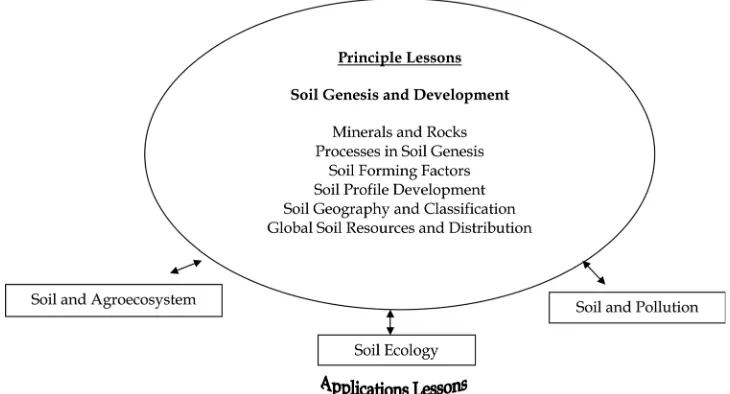
The conceptual framework for these lessons was that situated case study or application lessons can provide the
spark for student learning and that these application les-sons can be backstopped with the principles lesles-sons to impart fundamental knowledge (Fig.1). The model frame-work was that principles and application lessons give learners the opportunity to apply the same concepts to new and different situations. In this case, the application lessons were context-specific for the user to broaden the relevance of soil science principles. The advantage of developing separate principle and application lessons is to provide the opportunity for students to learn how to apply the same principle to new situations. This restructuring (Keppellet al., 1998) approach reinforces the principles les-son and strengthens the abilities of the learners to think creatively and critically.
The theoretical framework underlying the “backward design,” or application lessons approach, emphasizes the importance of helping students become independent thinkers and learners rather than simply being able to retrieve knowledge facts (Cognition and Technology Group at Vanderbilt, 1992).Barrows (1986)stated that the possible objectives of this learning style include structuring knowl-edge for future work learning, developing effective reason-ing processes and self-directed learnreason-ing skills, and increasing motivation for learning. Thus, by following “backward design,” student understanding should increase and concomitantly test scores should improve.Penuelet al. (2008) examined an application lessons approach with stu-dents studying Earth systems science. The authors found these students scored higher than control group students on a standards-based test of Earth science knowledge. Sriniva-san et al.(2007) used a similar approach with medical stu-dents, noting that a “backward design” model was preferred by 89% over the traditional learning method because of fewer unfocused tangents, less busy-work, and more opportunities for clinical skills application.
Project team members who included course instruc-tors, instructional design, and evaluator first met for a two day retreat at UNL to define learning outcomes and then define topics of principles lessons and case study scenarios, and lesson assets (questions, animations, etc.). The seven instructors from the UNL, Colorado State University
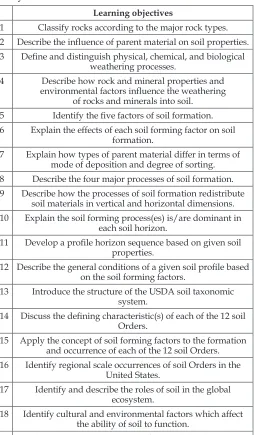
(CSU), Oregon State University (OSU), and Trinity College (Connecticut) developed the principles lessons based upon their topic knowledge and teaching experience to address 19 learning objectives (Table 1). The content of these les-sons assumed no previous soil science studies and was directed to an introductory postsecondary level audience.
Structure of Principles Lessons
The principles lessons were intended to teach funda-mental concepts that are critical for students to understand in an introductory college-level earth science and/or soil science course. The principles lessons were as follows:
Lesson 1: Rocks and Minerals
Lesson 2: Processes of Weathering
Lesson 3: Soil Forming Factors
Lesson 4: Soil Profile Development
Lesson 5: Soil Classification and Geography
Lesson 6: Global Soil Resources and Distribution
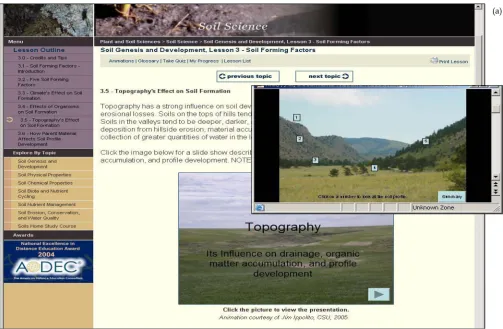
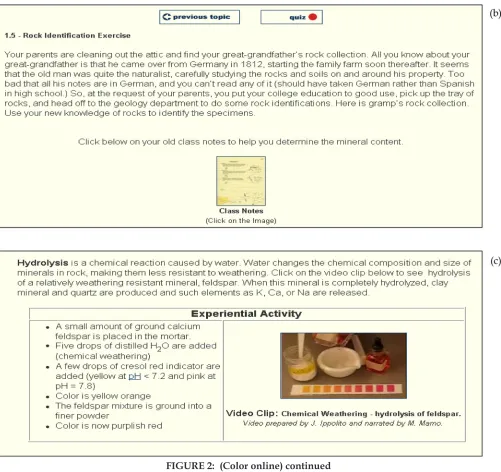
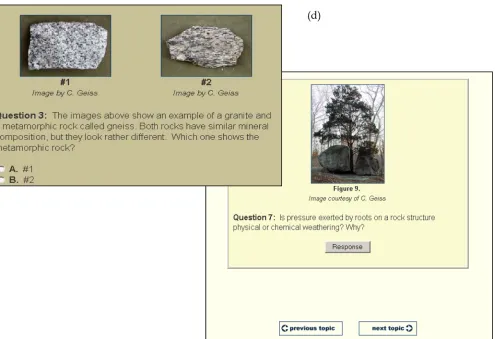
Interactive flash animations, experiential learning activities, transfer problems, embedded questions, images, and text are primary instructional elements in these lessons (Fig. 2). The lessons were designed as portable instruc-tional objects to provide future instructors with information-rich resources to present problems and the option of using the lessons’ content in a variety of learning situations.
Structure of Application Lessons
The key instructional design feature to the application lessons was the creation of an interactive dynamic between the discipline and the learner (Fig. 1). The application les-sons were as follows:
Food Production: Agroecosystem Soil, Food, and Fiber
Environmental Management: Biosolids Additions and Soil Formation
Ecology: Soils and Salts, the Case of the Salt Creek Tiger Beetle
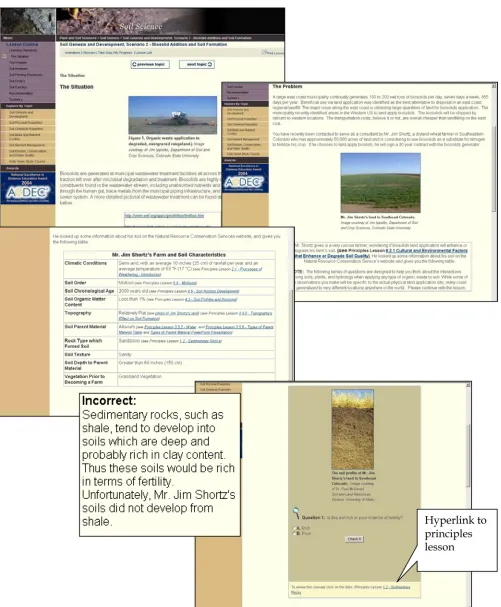
Each application lesson introduces the situation or case with some background information and states the problem (Fig. 3). Within each application lesson, a series of ques-tions are asked with hyperlinks below each question to refer students to one or more of the appropriate principles lessons sections (Fig.3). Each student then identifies major concepts and principles and writes a response to the ques-tion on a worksheet. The quesques-tions in each case study are objective; thus, once a student chooses an answer, he/she can check if the answer is right. The check feedback pro-vided by lesson developers for incorrect or correct answers were added based on surveys and round table discussion made with students during the informal evaluation of les-sons in 2005. The check feedback also allows the student to rethink the concepts being addressed. At the end of the case, the student restates the problem and makes the recommendations.
DEVELOPMENT PROCESS
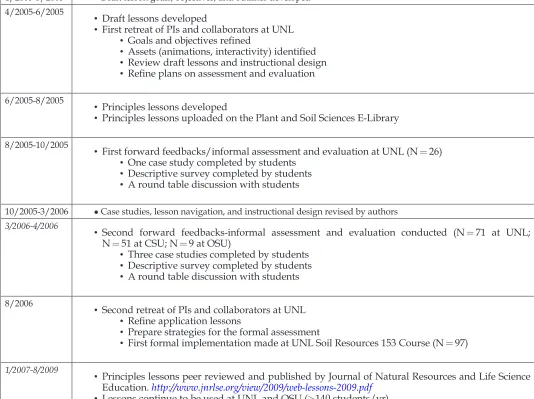
Lesson development and evaluation included internal peer review of lessons and two forward feedbacks or infor-mal implementation. The forward feedbacks in fall 2005 and spring 2006 allowed the team to refine lesson content, navigation, and overall instructional design. Formal imple-mentation was completed in fall 2006 after revisions were made based on internal peer lesson reviews, student TABLE I: Learning objectives developed for the soil genesis
and development lessons at the plant and soil sciences E-library.
Learning objectives
1 Classify rocks according to the major rock types.
2 Describe the influence of parent material on soil properties.
3 Define and distinguish physical, chemical, and biological
weathering processes.
4 Describe how rock and mineral properties and
environmental factors influence the weathering of rocks and minerals into soil.
5 Identify the five factors of soil formation.
6 Explain the effects of each soil forming factor on soil
formation.
7 Explain how types of parent material differ in terms of
mode of deposition and degree of sorting.
8 Describe the four major processes of soil formation.
9 Describe how the processes of soil formation redistribute
soil materials in vertical and horizontal dimensions.
10 Explain the soil forming process(es) is/are dominant in
each soil horizon.
11 Develop a profile horizon sequence based on given soil
properties.
12 Describe the general conditions of a given soil profile based on the soil forming factors.
13 Introduce the structure of the USDA soil taxonomic
system.
14 Discuss the defining characteristic(s) of each of the 12 soil Orders.
15 Apply the concept of soil forming factors to the formation and occurrence of each of the 12 soil Orders. 16 Identify regional scale occurrences of soil Orders in the
United States.
17 Identify and describe the roles of soil in the global ecosystem.
18 Identify cultural and environmental factors which affect
the ability of soil to function.
forward feedbacks, and students’ roundtable discussion. Development timeline and processes are detailed in Table 2. The process of lesson development and evaluation required coordination, extensive faculty time commitment. It was necessary to defer development of some planned video, simulations, animations, and other useful visualiza-tions due to lack of funds.
FORMAL IMPLEMENTATION
The goal of the project was to create resources with a strategy focused on applying soil science concepts in differ-ent context and to also diversify the teaching tools avail-able for our classroom and the geoscience teaching community. Because the study and lesson development was not designed to validate this approach against other approach(es), the team did not deem it necessary to have a control group.
During implementation at UNL, each student inde-pendently completed the three application lessons during two 2-h periods using notebook computers in the class-room. The instructor was available while each student worked to answer content questions and deal with techni-cal computer issues. Each student completed a written worksheet associated with each case study and turned in the worksheet at the end of the session (Table3).
ASSESSMENT TOOLS
Pre- and Post-TestFifty objective questions were developed collabora-tively by instructors at UNL, CSU, and OSU. These questions were designed to be used in an online testing system to allow both traditional multiple choice ques-tions but also embed images, some interactive, such as maps and soil profiles in the question. Based on instruc-tors’ experience, 75% of the test items were lower level on Bloom’s Taxonomy (Knowledge and Comprehension) and 25% of the test items were higher level on the Bloom Taxonomy (Bloom, 1956). The same test items were used for both the pretest and post-test as described below.
Pretest: A pretest was administered to students the day of the activity. Each student was given 60 min to complete the pretest before the activity began.
Post-test: A post-test was administered to students within the same week after completing the three appli-cations lessons. Each student was given 60 min to com-plete the post-test.
Learning Styles Inventory
TheKolb’s (1984)Learning Styles Inventory (LSI) is an instrument that categorizes student learning style. Each student was presented with 12 phrases, each with responses designed to identify how the student learns and deals with ideas and situations in their everyday lives (Mamoet al., 2005). The student ranks the responses from 1 to 4 (4¼most like the student, 1¼least like the student) based upon how they see themselves as learners. The rank-ings for each response category are totaled and used to cre-ate a score to place the student in 1 of 4 learning style categories (Mamoet al., 2005):
Divergers, learners who combine concrete experience with reflective observation;
Accommodators, learners who combine concrete experience and active experimentation;
Convergers, learners who combine abstract conceptualization and active experimentation;
Assimilators, learners who combine abstract conceptualization and reflective observation.
Kolb (1984, p. 77-78) characterizes both convergers and assimilators as being less involved with social or interpersonal issues and more attuned to ideas and con-cepts. In contrast, divergers and accommodators tend to rely on others in their problem-solving efforts. This would suggest that convergers and assimilators would function better in distance educational formats in which they interact primarily with an impersonal program. In contrast, divergers and accommodators would function better in a more social learning environment, even if that were online.
Post-Lesson User Survey
Students completed a 22-question survey covering lesson-users’ experience for each application lesson (Quia, 1998). The questions included aspects of lesson navigation, principle lessons layout and quality, quality of embedded questions, and usefulness of images and animations. A Lik-ert scale of 1 to 5 was used in the survey, where 1 was strongly agree or excellent and 5 was strongly disagree or poor.
Item Analysis
An item analysis is one that examines the response of the student to individual test items (correlation, difficulty level, etc.) and also evaluates the reliability or internal con-sistency of the test (UCLA Academic Technology Services, 2009). Item analysis was performed for both the pre- and post-test.
STATISTICAL ANALYSES
Differences between pre- and post-test scores among the learning styles were compared using analysis of var-iance (ANOVA), implemented inSASversion 9.2 (Statistical
Analysis System, 2008). An analysis of covariance (ANCOVA) using pretest as the covariate was done to test differences in post-test gains among students of different learning styles, majors, and class-standing. Because of the number of unique majors in the course, majors were
pooled into five categories: agriculture, environmental sci-ence/natural resources, horticulture, professional golf management, and other. Least significant differences (LSD) were declared significant at the 0.10 probability level.
RESULTS
Informal Evaluation Feedbacks and Revisions
The informal evaluation process in the fall 2005 and spring 2006 resulted in several revisions of lessons. Stu-dents thought that the lessons were about the right length and valued the charts, graphs, and pictures as the best resources in helping them learn the concepts and answer questions. Students also used the objective type questions embedded in each lesson as a learning tool and to prepare for the post-test. The bolded words with a link were also helpful. However, students thought that the case study sce-narios were too simple.
Some technical difficulty with the links discouraged students from using them for fear of being closed out of the lesson prematurely. The navigation from lesson to les-son was confusing to some students and the thinking ques-tions in the principles were too “time-consuming.” From students’ suggestions, feedbacks were provided to lesson authors for all questions posed within the application les-sons. A video feature explaining lesson feature and naviga-tion was also added as a link opening in a new window. In addition, links to animations and video clips within lesson were made more obvious.
Test Analysis
Both the pre- and post-test had good internal consis-tency with reliability of 0.92 for the pretest and 0.79 for the post-test. On average, 49% of students answered Bloom’s lower level (knowledge, comprehension) pretest questions correctly. This increased to 74% answering correctly for the post-test. On average, 40% of students answered Bloom’s higher level pretest questions correctly. This increased to 58% answering correctly for the post-test. The test reliabil-ity, item analysis, and Bloom categorized items indicated large knowledge gains made after students completed the lessons.
Test Comparison
Average pretest score out of 50 points was 20.9. Stu-dent pretest to post-test performance improved by 69% (Table4). Postbaccalaureate students (N¼5) outperformed
undergraduate students on the pretest (P¼0.0330); how-ever, performance was similar among all undergraduate class-standing with the most gain made by sophomores (ANOVA P¼0.9790; ANCOVA P¼0.7495). Pretest per-formance was similar among majors (P¼0.5972). The pro-fessional golf management (PGM) majors at UNL (N¼12) made the highest average score and most gain (17 points) from pre- to post-test. Using pretest as a covariate, the post-test score of students majoring in PGM was higher than that of other majors (P¼0.0171). The least average gain (9 pts) was made by Horticulture majors (N¼18). There were no differences in either pre- or post-test between gender (20% female, 80% male) and no correlation between post-test score and student survey responses, class-standing, learning style, or gender (data not presented).
The normalized gain f[(post-test score pretest score)/(50 pretest score)] * 100gin test score indicated TABLE II: Timeline and steps in the development of the soil genesis and development E-lessons at the University of Nebraska-Lincoln.
Period Activities
1/2005-3/2005 Draft lesson goals, objectives, and outlines developed
4/2005-6/2005
• Draft lessons developed
• First retreat of PIs and collaborators at UNL • Goals and objectives refined
• Assets (animations, interactivity) identified • Review draft lessons and instructional design • Refine plans on assessment and evaluation
6/2005-8/2005
• Principles lessons developed
• Principles lessons uploaded on the Plant and Soil Sciences E-Library
8/2005-10/2005
• First forward feedbacks/informal assessment and evaluation at UNL (N¼26) • One case study completed by students
• Descriptive survey completed by students • A round table discussion with students
10/2005-3/2006 Case studies, lesson navigation, and instructional design revised by authors
3/2006-4/2006
• Second forward feedbacks-informal assessment and evaluation conducted (N¼71 at UNL; N¼51 at CSU; N¼9 at OSU)
• Three case studies completed by students • Descriptive survey completed by students • A round table discussion with students
8/2006
• Second retreat of PIs and collaborators at UNL • Refine application lessons
• Prepare strategies for the formal assessment
• First formal implementation made at UNL Soil Resources 153 Course (N¼97)
1/2007-8/2009
• Principles lessons peer reviewed and published by Journal of Natural Resources and Life Science Education.http://www.jnrlse.org/view/2009/web-lessons-2009.pdf
that the least gain was made by LSI diverger group, although the increase from pre- to post-test was still signifi-cant for this LSI group (Table 5). This is consistent with Cox (2008), in his study to assess learning styles and stu-dent attitudes toward the use of the computer, who also found that the “Diverging” learning style had the least pos-itive attitude toward the use of technology, although the difference from other learning style groups was not signifi-cant.Huet al.(2007)found that English language learners who were abstract thinkers (associated with Kolb’s con-vergers and assimilators) benefited more from instructional technology than did concrete thinkers (associated with Kolb’s divergers and accommodators), although the differ-ences were not statistically significant. In this study, there were significant differences in post-test among learning styles at low pretest scores (pretest¼15) with the largest difference of 10.76 between accommodator and diverger (ANCOVA P¼0.0018). However, the differences in post-test among learning styles were not significant at middle (pretest¼20) and high (pretest¼25) scores.Huet al.(2007) note that learning style interacts with delivery medium to produce different student outcomes.
Survey Responses
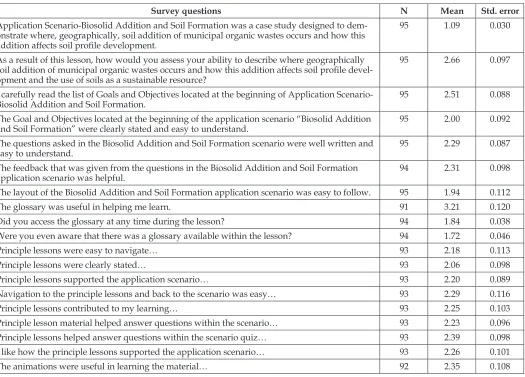
Students evaluated the effectiveness of the lessons on their ability to evaluate the effects of biosolids additions on soil profile, horizons, etc. at an average of 2.20 for applica-tion lesson dealing with Biosolids Applicaapplica-tion and Soil For-mation (Table6) and an average of 2.71 for the other two application lessons (data not presented). Participants also indicated that the layout and navigation to principles les-sons and ability to return to applications lesles-sons were
good (2.06-2.39). Students were aware of the availability of hyperlinked glossary terms and indicated accessing the glossary; however, they did not rate its utility highly (3.21).
CONCLUSIONS AND IMPLICATIONS
Gains in post-test scores of students who completed the soil genesis and development online lessons were 69%. The large range in post-test score gains points to the critical need for faculty to devise appropriate strategies to effec-tively use these online lessons. The results overall did not indicate a differences in cognitive gains among learning style. Although the design of the curriculum did not include simulation, the team of instructors designed the lessons and conducted several forward feedbacks (infor-mal implementation) to facilitate lessons aspects and design for diverse learning style. Instructors at OSU and CSU have used these lessons during the study period as supplemental resources and as homework assignment with some degree of success. This, however, demonstrates that while the technology allows creation of digital lessons TABLE III: Strategies, sample size, assessment tools used for
implementation of the soil genesis and development E-lessons at the University of Nebraska-Lincoln.
Activities Description
Semester Fall 2006
Course name Soil resources 153
N 97
50 Question online pretest In-class; 1 h
Three E-application lessons In-class; 2 h
50 Question online post-test In-class; 1 h
Descriptive survey In-class; 1 h
Learning style inventory In-class; 1 h
TABLE IV: Pretest and post-test scores by major and class-standing as assessment for the soil genesis and development E-lessons at the University of Nebraska-Lincoln
N Pretest Post-test
All 93 20.9 35.3
Agriculture 36 23.8 36.7
Environmental sciences/ natural resources
17 21.8 34.7
Horticulture 18 23.8 32.8
PGM 12 21.5 38.7
Other1 13 22.5 35.1
P-value 0.5972 0.0522
Freshman 26 21.6 34.8
Sophomore 23 19.2 35.7
Junior 26 20.7 35.3
Senior 19 21.7 35.7
Postgraduate 3 27.7 34.3
P-value 0.0330 0.9790
1Several other majors and postgraduates having N<3.
TABLE V: Pretest and post-test scores and gains among learning styles obtained from assessment of the soil genesis and develop-ment E-lessons at the University of Nebraska-Lincoln.
Test groups N Pretest score Post-test score Gain1 P-value
Diverger 11 21.4 32.4 38% 0.0004
Accommodator 21 21.0 36.9 55% 0.0001
Converger 36 20.7 35.2 48% 0.0001
Assimilator 22 20.9 36.1 53% 0.0001
Unknown 3 22.3 31.0 31%
-P-value 0.99 0.07 0.22
with graphics, animations, simulations, video, pedagogical sound use or strategies for classroom remains to be critical. Flexible use of the lessons is one of their strongest attributes. The lessons can be used by both teachers and students in various ways: nonguided learning, or as pri-mary or supplementary references in soil science and other earth science courses. The lessons may be especially useful for teachers who do not have extensive training in the area of soil science yet cover the subject as part of a basic earth science course. For field based courses, for example, all of the principles lessons or portions of the principles lessons can be used as preactivity reading resources or supporting resources. Teachers can also modify the case study or cre-ate new case studies and use the principles lessons to sup-port problem solving. Animations can be used as part of the lesson or alone to demonstrate specific concepts teach-ers may want to emphasize. Questions embedded within the principles lessons can be used as discussion thread for in-class activity and/or as homework assignment to rein-force reading.
Five principles lessons have been peer reviewed and published by an educational journal for use by the public and/or academic institutions. Lessons have continued to
be primary and/or supplemental resources for multiple courses serving greater than 140 students each year at both UNL and OSU. The lessons are hosted at the Plant and Soil Sciences E-Library (http://passel.unl.edu/pages), a digital library of 120 lessons and 116 animations that on the aver-age receives 400,000 unique visits annually. As part of the long-term goal to strengthen STEM education and through funds provided by the National Science Foundation, the digital Plant and Soil Sciences library is being redesigned to create an online learning community environment, where users including soil science lessons authors will team up to repackage the learning objects to more effi-ciently meet their specific academic learning needs and/or outcomes.
Acknowledgments
The authors wish to thank Christoph Geiss, Diane Nolan, Jody Soester, and William Zanner (deceased) for contributions in planning and development of this project. This work was supported by the National Science Founda-tion Division of Undergraduate EducaFounda-tion Course Curricu-lum Laboratory Improvement Program under Award No. 0042603.
TABLE VI: Survey responses of students at the University of Nebraska-Lincoln, completed after the soil genesis and development E-lesson activities. Scale: 1¼strongly agree or excellent; 5¼strongly disagree or poor.
Survey questions N Mean Std. error
Application Scenario-Biosolid Addition and Soil Formation was a case study designed to dem-onstrate where, geographically, soil addition of municipal organic wastes occurs and how this addition affects soil profile development.
95 1.09 0.030
As a result of this lesson, how would you assess your ability to describe where geographically soil addition of municipal organic wastes occurs and how this addition affects soil profile devel-opment and the use of soils as a sustainable resource?
95 2.66 0.097
I carefully read the list of Goals and Objectives located at the beginning of Application Scenario-Biosolid Addition and Soil Formation.
95 2.51 0.088
The Goal and Objectives located at the beginning of the application scenario “Biosolid Addition and Soil Formation” were clearly stated and easy to understand.
95 2.00 0.092
The questions asked in the Biosolid Addition and Soil Formation scenario were well written and easy to understand.
95 2.29 0.087
The feedback that was given from the questions in the Biosolid Addition and Soil Formation application scenario was helpful.
94 2.31 0.098
The layout of the Biosolid Addition and Soil Formation application scenario was easy to follow. 95 1.94 0.112
The glossary was useful in helping me learn. 91 3.21 0.120
Did you access the glossary at any time during the lesson? 94 1.84 0.038
Were you even aware that there was a glossary available within the lesson? 94 1.72 0.046
Principle lessons were easy to navigate… 93 2.18 0.113
Principle lessons were clearly stated… 93 2.06 0.098
Principle lessons supported the application scenario… 93 2.20 0.089
Navigation to the principle lessons and back to the scenario was easy… 93 2.29 0.116
Principle lessons contributed to my learning… 93 2.25 0.103
Principle lesson material helped answer questions within the scenario… 93 2.23 0.096
Principle lessons helped answer questions within the scenario quiz… 93 2.39 0.098
I like how the principle lessons supported the application scenario… 93 2.26 0.101
REFERENCES
Barrows, H.S., 1986, A taxonomy of problem-based learning methods: Medical Education, v. 20, p. 481–486.
Bloom, B.S., 1956, Taxonomy of educational objectives, Handbook I: The cognitive domain: New York, David McKay Co Inc. Cognition and Technology Grout at Vanderbilt, 1992, The Jasper
experiment: An exploration of issues in learning and instruc-tional design: Educainstruc-tional Technology and Research Devel-opment, v. 40, p. 65–80.
Cox, T.D., 2008, Learning styles and students’ attitudes toward the use of technology in higher and adult education classes: Institute for Learning Styles Research Journal, v. 1, p. 1–13. Hu, P. J.-H., Hui, W., Clark, T.H.K., and Tam, K.Y., 2007,
Technol-ogy-assisted learning and learning style: A longitudinal field experiment: IEEE Transactions on Systems, Man, and Cyber-netics - Part A: Systems and Humans, v. 37, p. 1099–1112. Ketelhut, D.J., 2007, The impact of student self-efficacy on
scien-tific inquiry skills: An exploratory investigation in River City, a multi-user virtual environment: Journal of Science Educa-tion and Technology, v. 16, p. 99–111.
Keppell, M., Elliott, K., and Harris, P., 1998, Problem based learn-ing and multimedia: Innovation for improved learnlearn-ing of medical concepts,inCorderoy, R.M., editor, Australian Soci-ety for Computers in Learning and Tertiary Education, Asci-lite Conference Proceedings: New South Wales, University of Wollongong, p. 417–424.
Kolb, D.A., 1984, Experiential learning: Experience as the source of learning and development: Englewood Cliffs, NJ, Prentice-Hall, p. 67–78.
Lal, R., 2007, Back to the future: Crops, Soils, Agronomy News, v. 52, p. 14–15.
Landa, E.R., 2004, Soil science and geology: Connects, disconnects and new opportunities in geoscience education: Journal of Geoscience Education, v. 52, p. 191–196.
Mamo, M., Kettler, T., and Husmann, D., 2005, Learning style responses to an online soil erosion lesson: Journal of Life Sciences and Natural Resources Education, v. 34, p. 44–48.
McAlpine, I., and Clements, R., 2001, Problem based learning in the design mulitimedia project: Australian Journal of Educa-tional Technology, v. 17, p. 115–130.
McTighe, J., and Wiggins, G., 2001, Understanding by design: Alexandria, VA, Merrill/Prentice Hall & ASCD.
Penuel, W.R., McWilliams, H., McAuliffe, C., Benbow, A., Mably, C., and Hayden, M.M., 2008, Preparing teachers to teach for deep understanding: A curriculum-based approach: The Earth Scientist, v. 27, p. 21–24.
Quia, 1998, Quia: Where learning takes you,http://www.quia.
com/ (12 April 2010).
Srinivasan, M., Wilkes, M., Stevenson, F., Nguyen, T., and Slavin, S., 2007, Comparing problems-based learning with case-based learning: Effects of a major curricular shift at two insti-tutions: Academic Medicine, v. 82, p. 74–82.
Statistical Analysis System, 2008, SAS/STATuser’s guide: Version Windows 9.2, Cary, NC, SAS Institute Inc.
UCLA Academic Technology Services, Statistical Consulting
Group, 2009, http://www.ats.ucla.edu/stat/Spss/faq/