REVIEW
Towards efficient terpenoid biosynthesis:
manipulating IPP and DMAPP supply
Qin Wang
1, Shu Quan
2and Han Xiao
1*Abstract
Terpenoids are a group of largest natural products with important biological functions, and their efficient biosynthesis
is of particular importance to both academia and industry. As the building blocks for terpenoid biosynthesis, a
suit-able supply of isopentenyl diphosphate (IPP) and dimethylallyl diphosphate (DMAPP) is extremely crucial for efficient
terpenoid biosynthesis. With this focus, we first introduce biosynthetic pathways of IPP and DMAPP, and then
sum-marize the current strategies adopted for manipulating IPP and DMAPP supply. At last, how to further manage IPP and
DMAPP supply to improve terpenoid biosynthesis is also proposed.
Keywords:
Terpenoid, Mevalonate pathway, 2-
C
-Methyl-
d-erythritol 4-phosphate (MEP), Isopentenyl diphosphate
(IPP), Dimethylallyl diphosphate (DMAPP), Biosynthesis
© The Author(s) 2019. This article is distributed under the terms of the Creative Commons Attribution 4.0 International License (http://creat iveco mmons .org/licen ses/by/4.0/), which permits unrestricted use, distribution, and reproduction in any medium, provided you give appropriate credit to the original author(s) and the source, provide a link to the Creative Commons license, and indicate if changes were made.
Introduction
Terpenoids are a class of natural products with diverse
structures and essential biological functions (Schrader
and Bohlmann
2015
; Tarkowska and Strnad
2018
). For
example, animal-derived terpenoids (e.g., cholesterol,
dolichol, ubiquinone) are involved in cell membranes
formation, glycoproteins biosynthesis and intracellular
electron transport (Goldstein and Brown
1990
).
Plant-derived terpenoids (e.g., tocopherol, brassinolide, and
gibberellin) are responsible for the regulation of cell
growth and defense (Piironen et al.
2000
; Tholl
2015
).
In addition, many commercially useful compounds (e.g.,
pharmaceuticals, flavorings, biofuel) belong to terpenoid
(Ajikumar et al.
2008
; Immethun et al.
2013
; Tippmann
et al.
2013
). Therefore, efficient biosynthesis of terpenoid
is receiving great interests from researchers (Bian et al.
2017
).
According to the number of C5 units involved
dur-ing their synthesis, terpenoids are classified as
hemit-erpenoid (C5), monothemit-erpenoid (C10), dithemit-erpenoid
(C20), triterpenoid (C30), tetraterpenoid (C40), and
polyterpenoid (> C40) (Connolly and Hill
1991
).
For-mation of terpenoid usually undergoes a continuous
head-to-tail addition of its building blocks, which are
isoprene diphosphate (IPP) and its isomer
dimethylal-lyl diphosphate (DMAPP) (Karine et al.
2012
; Laskovics
and Poulter
1981
). First, a head-to-tail condensation of
IPP and DMAPP produces geranyl diphosphate (GPP),
the precursor of monoterpenoid. Then, the successive
addition of IPP results in the formation of precursors
of sesquiterpenoid and diterpenoid, which are farnesyl
diphosphate (FPP) and geranylgeranyl diphosphate
(GGPP), respectively. On this basis, two molecules of FPP
and GGPP are, respectively, head-to-head condensed to
form squalene and phytoene, the precursors of
triterpe-noid and tetraterpetriterpe-noid. These linearized precursors are
further subjected to cyclization and post modifications
(e.g., oxidation, acetylation) to form various terpenoids
(Luthra et al.
1999
; Mcgarvey and Croteau
1995
).
Although IPP and DMAPP are the crucial requisite
to efficient terpenoid biosynthesis, their accumulation
is harmful to cell growth and can affect terpenoid
pro-duction in turn (George et al.
2018
; Martin et al.
2003
;
Sivy et al.
2011
). As a result, a suitable supply of IPP and
DMAPP is of great importance to efficient terpenoid
bio-synthesis. Other than providing a comprehensive view
of achieving efficient terpenoid biosynthesis based on
Open Access
*Correspondence: [email protected]
1 State Key Laboratory of Microbial Metabolism, Joint International Research Laboratory of Metabolic & Developmental Sciences, and Laboratory of Molecular Biochemical Engineering, School of Life Sciences and Biotechnology, Shanghai Jiao Tong University, 800 Dong-chuan Road, Shanghai 200240, China
one individual enzyme (Liao et al.
2014
) or a particular
biosynthetic pathway (Liao et al.
2016
), we focus on
sum-marizing the strategies of manipulating IPP and DMAPP
supply in this review, including important and recent
works which can reflect the latest progress. We also
propose several strategies for further improving
terpe-noid biosynthesis regarding managing IPP and DMAPP
supply.
Biosynthesis of IPP and DMAPP
IPP and DMAPP are mainly synthesized via two
path-ways: the mevalonate (MVA) pathway (Liao et al.
2016
)
and the non-mevalonate pathway, which is also known as
the 2-
C
-methyl-d-erythritol 4-phosphate (MEP) pathway
(Rohmer
1999
). The MVA pathway mainly exists in the
cytoplasm and peroxisome of eukaryotes, while the MEP
pathway exists in most bacteria (Boucher and Doolittle
2000
; Lange et al.
2000
). In addition, plants harbor the
MVA pathway in the cytoplasm to form
sesquiterpe-noid and triterpesesquiterpe-noid, and the MEP pathway in plastid
to form monoterpenoid, diterpenoid and tetraterpenoid,
respectively (Henry et al.
2015
; Lichtenthaler
1999
;
Lichtenthaler et al.
1997
).
In the 1950s, the MVA pathway was recognized as
the dominant pathway for terpenoid biosynthesis
(Lit-tle and Bloch
1950
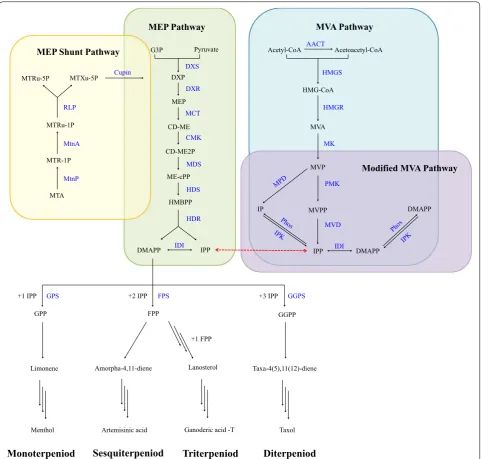
). In this pathway, two molecules of
CoA are condensed to acetoacetyl CoA by
acetyl-CoA acetyltransferase (AACT). Acetoacetyl acetyl-CoA and
another molecule of acetyl-CoA are then condensed by
hydroxymethylglutaryl-CoA synthase (HMGS) to form
3-hydroxy-3-methylglutaryl-CoA (HMG-CoA), which
is further reduced by 3-hydroxy-3-methylglutaryl-CoA
reductase (HMGR) to produce mevalonate. After a
two-step phosphorylation and decarboxylation catalyzed by
mevalonate kinase (MK), phosphomevalonate kinase
(PMK), and diphosphomevalonate decarboxylase (MVD),
mevalonate is converted into IPP (Bochar et al.
1999
),
and then, IPP is isomerized to DMAPP by isopentenyl
diphosphate isomerase (IDI) (Fig.
1
) (Kaneda et al.
2001
).
Most archaea were characterized to harbor enzymes of
the MVA pathway (Nishimura et al.
2013
), and a
modi-fied MVA pathway may exist in some archaea lacking
PMK and MVD (Vinokur et al.
2014
). Initially,
Gro-chowski et al. identified an isopentenyl phosphate kinase
(IPK) from
Methanocaldococcus jannaschii
capable of
phosphorylating isopentenyl phosphate (IP) to
gener-ate IPP (Grochowski et al.
2006
). Later, the
phospho-mevalonate decarboxylase (MPD) activity has been
identified in Chloroflexi bacterium
Roseiflexus
casten-holzii
(Dellas et al.
2013
) and archaeal extremophile
Haloferax volcanii
(Vannice et al.
2014
). Based on these
discoveries, researchers proposed an alternative route
to produce IPP (Henry et al.
2015
): after formation of
5-phosphomevalonate (MVP), the MPD catalyzes the
decarboxylation of MVP to IP, and IPK catalyze the
phos-phorylation of IP to IPP (Fig.
1
).
After the 1950s, a growing number of investigations
indicated that IPP might not be synthesized merely from
the MVA pathway. In one study, the
14C-labeled
meva-lonate was rarely incorporated into the isoprenoids (e.g.,
carotene) produced in the plastid of maize seedlings,
while the cytoplasmic sterols were quickly incorporated
(Goodwin
1958
). Similar phenomena were also reported
in carrot, tomato and oat (Braithwaite and
Good-win
1960a
,
b
; Lichtenthaler et al.
1982
). Moreover, the
14
C-labeled pyruvate and CO
2
were rapidly incorporated
into plastid-produced isoprenoid in
Sinapis alba
(Lutke-Brinkhaus and Kleinig
1987
). Using gas
chromatogra-phy–mass spectrometry, a series of follow-up studies
revealed a mevalonate-independent pathway, the MEP
pathway, for IPP biosynthesis (Rodriguez-Concepcion
and Boronat
2002
; Rohmer
1999
; Rohmer et al.
1993
;
Schwender et al.
1996
).
In MEP pathway, pyruvate and glyceraldehyde
3-phos-phate (G3P) are condensed by thiamin diphos3-phos-phate-
diphosphate-dependent enzyme 1-deoxy-d-xylulose-5-phosphate
synthase (DXS) to form 1-deoxy-d-xylulose 5-phosphate
(DXP). DXP was reduced by
1-deoxy-d-xylulose-5-phos-phate reductoisomerase (DXR) to form MEP (Kuzuyama
et al.
1998
), which is catalyzed by 2-
C
-methyl-d-eryth-ritol 4-phosphate cytidylyltransferase (MCT) to
gener-ate 4-(cytidine 5
′
-diphospho)-2-
C
-methyl-d-erythritol
(CD-ME). After phosphorylation, cyclization and ring
opening, CD-ME is converted into
1-hydroxy-2-methyl-2-butenyl 4-diphosphate (HMBPP) under the catalysis
of 4-diphosphocytidyl-2-
C
-methyl-d-erythritol kinase
(CMK), 2-
C
-methyl-d-erythritol 2,4-cyclodiphosphate
synthase (MDS) and
4-hydroxy-3-methylbut-2-enyl-diphosphate synthase (HDS), respectively (Herz et al.
2000
) (Fig.
1
). Different from the MVA pathway, in which
the DMAPP is synthesized via IPP isomerization, the IPP
and DMAPP derived from the MEP pathway are directly
generated from HMBPP by
4-hydroxy-3-methylbut-2-enyl diphosphate reductase (HDR) (Felix et al.
2002
).
oxygenase (RubisCO)-like protein (RLP) (Imker et al.
2008
). After that, MTXu-5P is converted into DXP
by cupin-type MTXu-5P sulfating enzyme-mediated
catalysis, which simultaneously produces mercaptan as
a sulfur source for cell growth. The
rlp
and
cupin
gene
are usually physically close in a cluster. The MEP shunt
pathway has been demonstrated to play an important
role in generating DXP in
R. rubrum
. In addition to
R. rubrum
, organisms carrying the
rlp
–
cupin
cluster
were predicted to have the MEP shunt pathway, such as
Rhodopseudomonas, Rhodomicrobium
, and
Nitrosococ-cus
. As confirmed in a recent study, the MEP shunt
path-way has been detected in
Rhodopseudomonas palustris
under aerobic cultivation (Miller et al.
2018
).
Manipulating the supply of IPP and DMAPP
to enhance terpenoid biosynthesis
A sufficient supply of IPP and DMAPP is the basic
prem-ise for terpenoids biosynthesis (Formighieri and Melis
2014
). However, an excessive level of IPP and DMAPP
G3P Pyruvate
DXP
MEP
CD-ME
CD-ME2P
ME-cPP
HMBPP
DXS
DXR
MCT
CMK
MDS
HDS
HDR
Acetyl-CoA Acetoacetyl-CoA
HMG-CoA
MVA
MVP
MVPP
HMGS
HMGR
MK
PMK
MVD
MEP Pathway
MVA Pathway
DMAPP IDI IPP IPP IDI DMAPP
IP DMAPP
MTA MTR-1P MTRu-1P
MTXu-5P MTRu-5P
MtnP MtnA RLP
Cupin
MEP Shunt Pathway
Modified MVA Pathway
GPP FPP GGPP
GPS FPS GGPS
Monoterpeniod
Sesquiterpeniod
Triterpeniod
Diterpeniod
+1 IPP +2 IPP +3 IPP
+1 FPP
Limonene Amorpha-4,11-diene Lanosterol Taxa-4(5),11(12)-diene
Menthol Artemisinic acid Ganoderic acid -T Taxol
AACT
may cause impaired cell growth and accordingly limit
ter-penoid production (George et al.
2018
; Sivy et al.
2011
).
Thus, manipulating the supply of IPP and DMAPP is of
particular importance for terpenoid biosynthesis. To
achieve it, strategies including rewiring the central
meta-bolic pathway, overcoming the rate-limiting step,
intro-ducing heterologous pathway, enhancing interaction
between different biosynthetic pathways, alleviation of
the toxicity of IPP and DMAPP, as well as discovering or
engineering downstream enzymes by exploration of the
toxicity of IPP and DMAPP will be thoroughly discussed
in this part.
Rewiring the central metabolic pathway
The initial substrates for IPP and DMAPP biosynthesis,
including acetyl-CoA, G3P and pyruvate, are generated
via the central metabolic pathway. Rewiring central
car-bon flux towards these substrates allows increased
pro-duction of IPP, DMAPP and downstream terpenoids.
To block the formation of acetic acid from acetyl-CoA
and direct more carbon flux into IPP synthesis, the gene
cluster
ackA
-
pta
was disrupted in
Escherichia coli
. As
expected, the acetate production was greatly reduced in
the resultant mutant and the lycopene production was
45% higher than the original strain (Vadali et al.
2005
).
As compared to the glycolytic pathway, the generation
of acetyl-CoA from the pyruvate dehydrogenase bypass
pathway is more efficient (Pronk et al.
1996
).
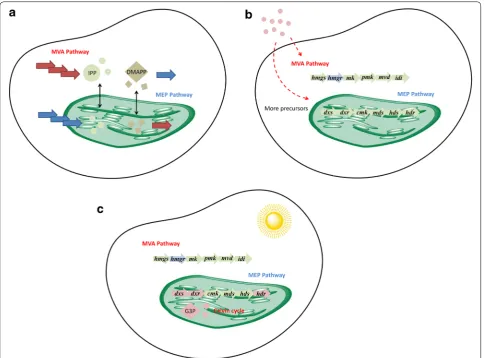
Overexpres-sion of pyruvate dehydrogenase, acetaldehyde
dehydro-genase, and acetyl-CoA synthetase encoding genes led to
increased production of mevalonate, IPP, and
amorpha-diene (Shiba et al.
2007
) (Fig.
2
a).
Supplying equal molar of G3P and pyruvate is
required for DMAPP and IPP generation via the MEP
pathway. At the end of glycolysis, conversion of G3P
into phosphoenolpyruvate (PEP) is achieved by
phos-phoglycerate mutase (PGM) and enolase (ENO),
fol-lowed by formation of pyruvate by pyruvate kinase
(PK) (Romano and Conway
1996
). Moreover,
produc-tion of PEP can also be achieved by conversion of either
oxaloacetate, an intermediate of TCA cycle, by PEP
car-boxykinase (PCK) (Clark
1989
) or pyruvate by PEP
syn-thase (PPS) (Geerse et al.
1989
; Ramseier et al.
1993
).
On the other hand, the opposite reaction from PEP to
pyruvate is catalyzed by the enzymes PykF and PykA
(Boiteux et al.
1983
; Waygood et al.
1976
). As a result,
overexpression of PCK and PPS led to the accumulation
of PEP, while deletion of PykF and PykA further
pre-vented the conversion of PEP into pyruvate. These
met-abolic engineering efforts maintained an equal balance
between pyruvate and G3P, and successfully improved
production of IPP and its downstream product
lyco-pene in
E. coli
(Farmer and Liao
2001
) (Fig.
2
b). In a
more recent work, five MEP feeding modules derived
from four glycolytic pathways in
E. coli
, which are
Emb-den–Meyerhof pathway (EMP), Entner–Doudoroff
pathway (EDP), pentose phosphate pathway (PPP) and
Dahms pathway, respectively, were tested for terpenoid
production. With simultaneous generation of G3P and
pyruvate, the EDP-containing module exhibited
signifi-cantly higher isoprene titer and yield than that of the
EMP-containing module, which provides a new
direc-tion to rewire the central metabolism for
MEP-depend-ent terpenoid biosynthesis (Liu et al.
2013
).
Fig. 2 Rewiring the central metabolic pathway by a increasing the supply of acetyl-CoA and b balancing the supply of glyceraldehyde
Overcoming the rate‑limiting step
Except for providing sufficient initial substrates,
over-coming the rate-limiting steps of IPP and DMAPP
biosynthesis is not new but an effective approach for
increasing their production. In the late 1980s, HMGR
was first identified as a rate-limiting enzyme in the MVA
pathway (Bach
1986
). In that study, the phytosterol
con-tents decreased significantly when their producing hosts
were treated with specific competitive inhibitors of
HMGR (Bach
1986
; Stermer and Bostock
1987
),
indicat-ing that HMGR activity greatly affected terpenoid
bio-synthesis. After that, there is increasing evidence to show
that HMGR plays a key role in increasing terpenoid yield
in plants, yeast and bacteria (Bach
1986
; Chappell et al.
1995
; Enfissi et al.
2005
; Kim et al.
2013
; Ma et al.
2011
;
Stermer et al.
1994
; Tsuruta et al.
2009
). Overexpression
of hamster HMGR in tobacco driven by the cauliflower
mosaic virus
35S
promoter resulted in an over 100-fold
increase in cycloartenol (a sterol biosynthetic
intermedi-ate) and a 2-fold increase in total sterols (Chappell et al.
1995
). Two isoenzymes of HMGR, Hmg1p and Hmg2p,
were identified in yeast. Although degradation of these
Hmg proteins was observed with increased level of
inter-mediates in MVA pathway, Hmg1p was more stable than
Hmg2p (Chun et al.
1990
; Hampton and Rine
1994
).
Since numerous studies indicated that overexpression of
Hmg1p enhanced the MVA pathway, it is still subjected
to feedback inhibition under high level of sterol
(Hamp-ton and Rine
1994
). To overcome this limitation, the
N-terminal domain-truncated Hmg1p (t-HMGR) was
constructed. As a result, overexpression of t-HMGR led
to nearly five times higher production of amorphadiene
in
Saccharomyces cerevisiae
(Ro et al.
2006
). This
strat-egy also increased sterol, sitosterol, stigmasterol and
artemisinic acid-12-β-diglucoside production in tobacco,
Lavandula latifolia
, and
Nicotiana benthamiana
,
respectively (Holmberg et al.
2003
; Munoz-Bertomeu
et al.
2007
; van Herpen et al.
2010
). On the other hand,
increasing the terpenoid production was also achieved
by protein engineering of Hmg2p. For example, a
sta-ble variant Hmg2p (K6R) was constructed to counteract
cellular ubiquitination, and improved the production of
monoterpenoid and sesquiterpenoid (Ignea et al.
2011
).
Besides, HMGS manipulation is also considered as
an effective engineering strategy for MVA-derived
ter-penoid production (Liao et al.
2014
). A HMGS mutant
from
Brassica juncea
BjHMGS1 (S359A), with tenfold
increased specific activity (Nagegowda et al.
2004
), was
overexpressed in
Solanum lycopersium
, which improved
the production of MVA-derived squalene and
phytoster-ols (Liao et al.
2018
). In addition, IPK plays a significant
role in the alternative MVA pathway, because it
regu-lates the ratios of IP–IPP and 4-dimethylaminopyridine
(DMAP)–DMAPP (Henry et al.
2015
). The IPK homologs
have been found in plant genomes (Dellas et al.
2013
).
Henry et al. confirmed that
Arabidopsis thaliana
IPK,
phosphorylates IP and DMAP (Henry et al.
2015
). The
contents of campesterol, sitosterol and β-caryophyllene
were reduced in
ipk
knockdown or knockout
A.
thali-ana
(Henry et al.
2015
). This may be due to a decrease
in the content of important precursors, IPP and DMAPP.
Later, overexpression of
Arabidopsis
-derived IPK in
tobacco led to increased production of cholesterol,
stig-masterol, sitosterol and campesterol (Henry et al.
2015
).
In a more recent study, overexpression of MPD from
Roseiflexus castenholzii
in tobacco enabled producing IP
from scratch, which introduced another branch of the
MVA pathway to increase the metabolic flux towards
downstream terpenoids. As a result, a 3.1- and a 6.4-fold
increase of monoterpene and sesquiterpene was achieved
in this plant, respectively (Henry et al.
2018
).
DXS is proved as the first rate-limiting step in MEP
pathway (Estevez et al.
2001
; Kim et al.
2006
; Zhao et al.
2011
), whose
k
cat/
K
Mvalue is substantially lower than
other enzymes in this pathway (Kuzuyama et al.
2000
).
Increasing DXS activity is recognized as the most
effec-tive strategy for terpenoid biosynthesis in many
spe-cies, such as
Synechococcus leopoliensis
(Bach and
Lichtenthaler
2010
; Schwender et al.
1996
),
Lycopersicon
esculentum
(Rohmer
1999
) and
Streptomyces
(Kuzuy-ama et al.
1998
). For example, heterologous expression
of DXS from
Bacillus subtilis
improved IPP, DMAPP and
β-carotene production in
E. coli
(Leonard et al.
2010
).
To improve enzymatic activity of DXS, site-directed
mutagenesis of the recombinant poplar DXS was
con-ducted by alleviating the feedback inhibition from IPP
and DMAPP (Banerjee et al.
2016
). In addition to DXS,
the IDI catalyzes a critical step by converting IPP into
its isomer DMAPP, which is important for balancing
the available precursors IPP and DMAPP to produce
desired terpenoids (Hahn et al.
1999
; Yoon et al.
2007
).
Heterologous overexpression of IDI from
Haematococ-cus pluvialis
enabled carotenoid accumulation in
E. coli
(Sun et al.
1998
). Later, the
idi
gene isolated from
Lycium
chinense
was characterized and overexpressed in
E. coli
.
The β-carotene of the IDI-overexpressed strain was about
twofold higher than of the control strain (Li et al.
2016
).
Introducing heterologous pathway
To overcome the limitation and circumvent the natural
cryptic regulation of the MEP pathway, introducing the
heterologous MVA pathway is a commonly adopted
alter-native to increase IPP and DMAPP in
E. coli
(Alonso-Gutierrez et al.
2013
; Carter et al.
2003
; Martin et al.
2003
; Vadali et al.
2005
; Yoon et al.
2009
; Zurbriggen et al.
2012
). For example, expression of MVA pathway from
Saccharomyces cerevisiae
in
E. coli
increased the
produc-tion of IPP, DMAPP and the sesquiterpenoid
amorpha-diene (Martin et al.
2003
). On this basis, replacing the
HMGR from
S. cerevisiae
with a more soluble homolog
from
Staphylococcus aureus
(Hedl et al.
2004
) resulted
in further increase of amorphadiene in
E. coli
(Newman
et al.
2006
). Similarly, the MVA pathway from
Strepto-myces sp
was reconstituted in
E. coli
to produce
11.8-fold higher lycopene than that of original
E. coli
strain
(Harada and Misawa
2012
). In addition, MVA pathway
genes from
Streptococcus pneumoniae
,
Streptococcus
pyogenes
,
S. aureu
s,
Enterococcus faecali
s and
S.
cerevi-siae
were co-expressed in
E. coli
to achieve a high yield
of β-carotene (Yoon et al.
2009
). Introduction of
heter-ologous MVA pathway and optimization of the
endoge-nous MEP pathway resulted in production of 122.4 mg/L
β-carotene in the engineered
E. coli
strain, which was
113- and 1.7-fold higher than that of strain harboring the
native MEP pathway alone and strain harboring the MVA
pathway and native MEP pathway, respectively (Yang and
Guo
2014
). Further, simultaneous or independent
over-expression of MEP and MVA pathway was performed
in
E. coli
to investigate whether there exists a synergy
between the two pathways. According to the
13C labeling
result, the MEP pathway flux in strain with
overexpres-sion of the dual pathways was 4.8-fold higher than that
of the strain with overexpression of MEP pathway alone,
and the MVA pathway flux in the dual pathway
overex-pressing strain was 1.5-fold greater than that of the strain
with overexpression of MVA pathway alone. Finally, the
resultant strain harboring dual pathways produced 24 g/L
isoprene in fed-batch fermentation (Yang et al.
2016
).
Compared to the MVA pathway, the MEP pathway is
superior in stoichiometry and accumulates less
byprod-uct (Dugar and Stephanopoulos
2011
). Researchers tried
to reconstitute MEP pathway of
E. coli
in
S. cerevisiae
,
which only harbors the MVA pathway to produce
terpe-noid, but failed to get functional expression of
4-hydroxy-3-methylbut-2-enyl-diphosphate synthase (IspG) and
4-hydroxy-3-methylbut-2-enyl diphosphate reductase
(IspH) (Carlsen et al.
2013
; Partow et al.
2012
). In the
MEP pathway, IspG and IspH are iron–sulfur cluster
pro-teins, which require functional assembly of the [4Fe–4S]
iron–sulfur cluster (ISC) (Seemann and Rohmer
2007
)
and electron transfer by flavodoxin (Fld) and ferredoxin
(flavodoxin) NADP
+reductase (FNR) (Grawert et al.
2004
; Xiao et al.
2009
; Zepeck et al.
2005
). Co-expression
of IspG from
Bacillus thuringiensis
, IspH from
E. coli
, Fld
from
Bacillus subtilis
, FNR from
Arabidopsis
and ISC
from
E. coli
successfully reconstituted MEP pathway in
S.
cerevisia
e (Kirby et al.
2016
).
Enhancing the interaction between the MVA
and MEP pathway
As mentioned above, plants naturally harbor the MVA
and MEP pathway in cytoplasm and plastid,
respec-tively. Single blocking the MVA or MEP pathway cannot
completely block terpenoid biosynthesis in cytoplasm
or plastid, indicating that the common precursor of
these two pathways (e.g., IPP, GPP, FPP, and GGPP) can
be freely transported into different subcellular regions
(Aharoni et al.
2004
; Asaph et al.
2003
; Bick and Lange
2003
; Bouvier et al.
2000
; Hemmerlin et al.
2003
;
Kasa-hara et al.
2002
; Laule et al.
2003
; Gutensohn et al.
2013
).
Therefore, enhancing such interaction helps to promote
terpenoid biosynthesis (Fig.
3
a). In spiked lavender, IPP
and DMAPP are mainly produced from the MEP
path-way. However, terpenoids 1,8-eucalyptol and camphor
increased in the HMGR overexpressed plants
(Men-doza-Poudereux et al.
2015
). Similarly, overexpression of
HMGR in
S. miltiorrhiza
hairy roots can also enhance the
production of diterpenoid tanshinones, which is believed
to be produced from the MEP pathway (Kai et al.
2011
;
Shi et al.
2014
). A possible explanation is that more IPP
synthesized in the cell cytoplasm is transported into the
plastid to serve as the precursor of the MEP pathway.
In another study, overexpression of HDR in
Artemisia
annua
L. increased the production of artemisinin and
other sesquiterpenes. Green florescence protein fusion
and confocal microscopy analysis indicated that HDR
was localized in the chloroplast, and transport of IPP
from chloroplast to cell cytoplasm was observed in the
13
C labeling experiment, suggesting that more IPP was
available for terpenoid production from the MVA
path-way (Ma et al.
2017
). In one specific exception, the
plas-tid-localized MEP pathway was the only active pathway
for supporting the biosynthesis of plastidial
monoterpe-noid and cytosolic sesquiterpemonoterpe-noid in snapdragon
flow-ers (Dudareva et al.
2005
).
intact
Arabidopsis
seedlings grown in medium
sup-plemented with sucrose (Laby et al.
2000
). Another is
light (Fig.
3
c). Light down-regulates the expression of
MVA pathway genes (Enjuto et al.
1994
; Learned
1996
;
Rodríguez-Concepción
2006
; Stermer et al.
1994
), but
up-regulates the expression of MEP pathway genes,
including DXS, DXR and HDR (Botella-Pavia et al.
2004
; Carretero-Paulet et al.
2002
; Cordoba et al.
2009
;
Hans et al.
2004
; Hsieh and Goodman
2005
;
Rod-ríguez-Concepción
2006
). In addition, photo-triggered
metabolism results in the increased production of
sub-strates (e.g., G3P from the Calvin cycle) for the MEP
pathway, which helps to increase IPP and DMAPP
production in chloroplasts and leads to an increase in
MEP-derived terpenoids.
Attenuation of the toxicity of IPP and DMAPP
As indicated in many investigations, accumulation of IPP,
DMAPP, and other intermediates may affect cell growth
and terpenoid biosynthesis in various species (Anthony
et al.
2009
; Martin et al.
2003
; Pitera et al.
2007
; Sivy
et al.
2011
). On one hand, overexpression of the
down-stream enzyme could effectively attenuate their
toxic-ity. To improve sesquiterpene β-farnesene production,
genes encoding farnesyl diphosphate synthase (
ispA
) and
β-farnesene synthase (
fg
) were expressed in
E. coli
, but
the yield of β-farnesene was very low due to the
inhib-ited cell growth caused by IPP accumulation. To solve
this problem, overexpression of IDI and IspA
success-fully reduced the IPP content. The engineered strain
produced 800-times higher β-farnesene than that of the
control strain (You et al.
2017
). Except for direct
overex-pression of enzymes, modification of key elements [e.g.,
promoter, ribosome binding site (RBS), etc.] is also
cru-cial for regulating the enzyme activity. In one study, a
series of FPP-responsive promoters were constructed to
dynamically regulate ADS expression to maintain FPP at
a non-toxic level. The terpenoid production of the
engi-neered strain was doubled as compared to the control
strain using a traditional inducible promoter to drive the
expression of ADS (Dahl et al.
2013
). In another study,
different strengths of RBS were selected for improving
the translation efficiency of MVA pathway enzymes. As
a result, using the medium-strength RBS for translation
of MK, PMK, MVD, and ADS reduced the accumulation
and excessive consumption of FPP in
E. coli
, and
improv-ing the production of amorphadiene by about fivefold
(Nowroozi et al.
2014
).
On the other hand, construction of a shunt pathway
is also adopted as an alternative to alleviate the toxicity
of IPP and DMAPP. To rescue the impaired cell growth
caused by the accumulated IPP in
E. coli
, overexpression
of MPD from
S. cerevisiae
was accordingly performed
to dephosphorylate IPP to IP (Kang et al.
2016
). Except
for MPD, enzymes belong to the nudix hydrolase
super-family can also dephosphorylate IPP and DMAPP (Dunn
et al.
1999
; Mildvan et al.
2005
). The IPP content was
sig-nificantly reduced after overexpression of
nudB
in
E. coli
(George et al.
2014
), and growth inhibition was relieved.
Further, George et al. optimized the Shine-Dalgarno
sequence of
nudB
to construct a more efficient NUDB
to reduce IPP (George et al.
2015
). In a recent study, the
effects of IPP accumulation in
E. coli
were
comprehen-sively assessed, which provided more novel targets for
alleviating IPP toxicity (George et al.
2018
).
Utilization of the toxicity of IPP and DMAPP
to discover or engineer downstream enzymes
Relying on the reduced cell growth caused by IPP toxicity,
attractive methods were developed to discover or
engi-neer downstream enzymes for terpenoid biosynthesis.
These toxicity-based screening methods are wide
appli-cable regardless of host cells. In one example, the
Bacillus
genomic DNA library was introduced into an engineered
E. coli
strain capable of producing excessive levels of IPP
and DMAPP, to screen mutants with restored cell growth
and discover potential downstream enzymes for
hemit-erpenoid production. As a result, two genes (
yhfR
and
nudF
) were discovered as prenyl phosphatases, which
could catalyze IPP and DMAPP to form isopentenol
(Withers et al.
2007
). In another example, similar method
was adopted for directed evolution of isoprene synthase
(ISPS) with enhanced catalytic activity on DMAPP.
Com-bined with protein engineering and metabolic
engineer-ing strategies, the engineered
S. cerevisiae
strain was able
to produce 3.7 g/L isoprene (Wang et al.
2017
).
Conclusions
Providing a suitable supply of IPP and DMAPP is
cru-cial for efficient terpenoid biosynthesis. Most efforts
in manipulating IPP and DMAPP supply focused on
rewiring the central metabolic pathway, overcoming the
rate-limiting step, introducing heterologous pathway,
enhancing the interaction between different pathways,
toxicity attenuation and utilization of the toxicity to
dis-cover or engineer downstream enzymes, which greatly
improved bioproduction of corresponding terpenoids.
For all organisms that contain a native pathway to
pro-duce terpenoid, strategies including rewiring central
metabolic pathway, overcoming the rate-limiting step
and toxicity attenuation have excellent potential to
gen-eralize. To overcome the natural regulation from the
host, introducing heterologous pathway is the method
of choice, while enhancing the interaction may harness
the advantages of different pathways to support
terpe-noid biosynthesis. The impaired cell growth caused by
the toxicity of IPP and DMAPP allows establishment of
a cell growth-based high-throughput screening method
to optimize the downstream pathway for higher
terpe-noid bioproduction. Since addition of exogenous
stim-uli could regulate the biosynthetic pathways of IPP and
DMAPP, and significantly change the terpenoids
produc-tion profile, it could be more meaningful to construct a
combination pathway to produce different terpenoids by
exploration of the exogenous stimuli for industrial
pro-duction. In the future, with the aid of multi-level omics
studies (Alcalde and Fraser
2018
; Martinez-Esteso et al.
2015
; Vickery et al.
2016
) and various genome editing
tools (e.g., CRISPR-Cas9), multiple metabolic
engineer-ing endeavors can be performed in parallel to test
poten-tial combinatorial effects of above-mentioned strategies
in a highly efficient manner. In addition to targeting
path-way genes, fine-tuning host regulation also plays vital
role for supplying IPP and DMAPP (Fitzpatrick et al.
2011
; Hemmerlin et al.
2004
,
2012
; Leivar et al.
2011
),
which could be considered as a promising alternative for
further improving terpenoid biosynthesis.
Abbreviations
IPP: isopentenyl diphosphate; DMAPP: dimethylallyl diphosphate; GPP: geranyl diphosphate; FPP: farnesyl diphosphate; GGPP: geranylgeranyl diphosphate; MVA: mevalonate; MEP: 2-C-methyl-d-erythritol 4-phosphate; AACT :
diphosphomevalonate decarboxylase; IDI: isopentenyl diphosphate isomer-ase; IPK: isopentenyl phosphate kinisomer-ase; IP: isopentenyl phosphate; MPD: phosphomevalonate decarboxylase; MVP: 5-phosphomevalonate; G3P: glycer-aldehyde 3-phosphate; DXS: 1-deoxy-d-xylulose-5-phosphate synthase; DXP:
1-deoxy-d-xylulose 5-phosphate; MCT: 2-C-methyl-d-erythritol 4-phosphate
cytidylyltransferase; CD-ME: 4-(cytidine 5′-diphospho)-2-C-methyl-d-erythritol;
HMBPP: 1-hydroxy-2-methyl-2-butenyl-4-diphosphate; CMK: 4-diphosphocyt-idyl-2-C-methyl-d-erythritol kinase; MDS: 2-C-methyl-d-erythritol
2,4-cyclodi-phosphate synthase; HDS: 4-hydroxy-3-methylbut-2-enyl-di2,4-cyclodi-phosphate synthase; HDR: 4-hydroxy-3-methylbut-2-enyl diphosphate reductase; MTA: 5-methylthioadenosine; MtnP: MTA phosphorylase; MTR-1P:
5-methylthio-d-ribose-1-phosphate; MTRu-1P: 5-methylthio-d-ribulose-1-phosphate; MtnA:
MTR-1P isomerase; MTRu-5P: 1-methylthio-ribulose-5-phosphate; MTXu-5P: 1-methylthio-xylulose-5-phosphate; RLP: ribulose-1,5-bisphosphate car-boxylase/oxygenase (RubisCO)-like protein; MVPP: 5-diphosphomevalonate; CD-ME2P: 2-phospho-4-(cytidine 5′-diphospho)-2-C-methyl-d-erythritol;
ME-cPP: 2-C-methyl-d-erythritol 2,4-cyclodiphosphate; Phos: phosphatase(s);
DXR: 1-deoxy-d-xylulose-5-phosphate reductoisomerase; Cupin:
1-methylthio-xylulose-5-phosphate methylsufurylase; GPS: GPP synthase; FPS: FPP synthase; GGPS: GGPP synthase; PEP: phosphoenolpyruvate; PGM: phosphoglycerate mutase; ENO: enolase; PK: pyruvate kinase; PCK: PEP carboxykinase; PPS: PEP synthase; EMP: Embden–Meyerhof pathway; EDP: Entner–Doudoroff pathway; PPP: pentose phosphate pathway; Glu: glucose; Pyr: pyruvate; A: acetyl-CoA; OAA: oxaloacetate; t-HMGR: truncated HMGR; DMAP: 4-dimethylamino-pyridine; IspG: 4-hydroxy-3-methylbut-2-enyl-diphosphate synthase; IspH: 4-hydroxy-3-methylbut-2-enyl diphosphate reductase; ISC: [4Fe–4S] iron–sul-fur cluster; FNR: ferredoxin (flavodoxin) NADP+ reductase; SnRK1: sucrose non-fermenting 1-related protein kinase 1; IspA: farnesyl diphosphate synthase; Fg: β-farnesene synthase; RBS: ribosome binding site; ISPS: isoprene synthase.
Authors’ contributions
HX conceived the study. QW collected references and prepared the draft with assistance from SQ. HX finalized the manuscript. All authors read and approved the final manuscript.
Author details
1 State Key Laboratory of Microbial Metabolism, Joint International Research Laboratory of Metabolic & Developmental Sciences, and Laboratory of Molecular Biochemical Engineering, School of Life Sciences and Biotechnol-ogy, Shanghai Jiao Tong University, 800 Dong-chuan Road, Shanghai 200240, China. 2 State Key Laboratory of Bioreactor Engineering, East China University of Science and Technology, Shanghai Collaborative Innovation Center for Bio-manufacturing (SCICB), Shanghai 200237, China.
Acknowledgements
H.X. gratefully acknowledges all the financial support.
Competing interests
The authors declare that they have no competing interests.
Availability of data and materials
Not applicable.
Consent for publication
Not applicable.
Ethics approval and consent to participate
Not applicable.
Funding
This work was supported by the National Natural Science Foundation of China (No. 31600071), Municipal Natural Science Foundation of Shanghai (Nos. 17ZR1448900, 18ZR1420300), and Open Funding Project of the State Key Laboratory of Bioreactor Engineering.
Publisher’s Note
Springer Nature remains neutral with regard to jurisdictional claims in pub-lished maps and institutional affiliations.
Received: 27 November 2018 Accepted: 31 January 2019
References
Aharoni A, Giri AP, Verstappen FW, Bertea CM, Sevenier R, Sun Z, Jongsma MA, Schwab W, Bouwmeester HJ (2004) Gain and loss of fruit flavor compounds produced by wild and cultivated strawberry species. Plant Cell 16(11):3110–3131
Ajikumar PK, Tyo K, Carlsen S, Mucha O, Phon TH, Stephanopoulos G (2008) Terpenoids: opportunities for biosynthesis of natural product drugs using engineered microorganisms. Mol Pharm 5(2):167–190 Alcalde E, Fraser PD (2018) Extending our tools and resources in the
non-conventional industrial yeast Xanthophyllomyces dendrorhous through the application of metabolite profiling methodologies. Metabolomics 14(3):30
Alonso-Gutierrez J, Chan R, Batth TS, Adams PD, Keasling JD, Petzold CJ, Lee TS (2013) Metabolic engineering of Escherichia coli for limonene and perillyl alcohol production. Metab Eng 19:33–41
Anthony JR, Anthony LC, Nowroozi F, Kwon G, Newman JD, Keasling JD (2009) Optimization of the mevalonate-based isoprenoid biosynthetic path-way in Escherichia coli for production of the anti-malarial drug precursor amorpha-4,11-diene. Metab Eng 11(1):13–19
Asaph A, Giri AP, Stephan D, Frans G, Willem-Jan DK, Verstappen FWA, Verho-even HA, Jongsma MA, Wilfried S, Bouwmeester HJ (2003) Terpenoid metabolism in wild-type and transgenic Arabidopsis plants. Plant Cell 15(12):2866
Bach TJ (1986) Hydroxymethylglutaryl-CoA reductase, a key enzyme in phytos-terol synthesis? Lipids 21(1):82–88
Bach TJ, Lichtenthaler HK (2010) Inhibition by mevinolin of plant growth, sterol formation and pigment accumulation. Physiol Plant 59(1):50–60 Banerjee A, Preiser AL, Sharkey TD (2016) Engineering of recombinant poplar
deoxy-d-xylulose-5-phosphate synthase (PtDXS) by site-directed
mutagenesis improves its activity. PLoS ONE 11(8):e0161534 Bian G, Deng Z, Liu T (2017) Strategies for terpenoid overproduction and new
terpenoid discovery. Curr Opin Biotechnol 48:234–241
Bick JA, Lange BM (2003) Metabolic cross talk between cytosolic and plastidial pathways of isoprenoid biosynthesis: unidirectional transport of inter-mediates across the chloroplast envelope membrane. Arch Biochem Biophys 415(2):146–154
Bochar DA, Friesen JA, Stauffacher CV, Rodwell VW (1999) Biosynthesis of mevalonic acid from acetyl-CoA. In: Barton SD, Nakanishi K, Meth-Cohn O (eds) Comprehensive natural products chemistry. Elsevier, London Boiteux A, Markus M, Plesser T, Hess B, Malcovati M (1983) Analysis of progress
curves. Interaction of pyruvate kinase from Escherichia coli with fructose 1,6-bisphosphate and calcium ions. Biochem J 211(3):631–640 Botella-Pavia P, Besumbes O, Phillips MA, Carretero-Paulet L, Boronat A,
Rodriguez-Concepcion M (2004) Regulation of carotenoid biosynthesis in plants: evidence for a key role of hydroxymethylbutenyl diphosphate reductase in controlling the supply of plastidial isoprenoid precursors. Plant J 40(2):188–199
Boucher Y, Doolittle WF (2000) The role of lateral gene transfer in the evolution of isoprenoid biosynthesis pathways. Mol Microbiol 37(4):703–716 Bouvier F, Suire C, d’Harlingue A, Backhaus RA, Camara B (2000) Molecular
cloning of geranyl diphosphate synthase and compartmentation of monoterpene synthesis in plant cells. Plant J 24(2):241–252 Braithwaite GD, Goodwin TW (1960a) Studies in carotenogenesis. 25. The
incorporation of [1-14C] acetate, [2-14C] acetate and 14CO
2 into lycopene by tomato slices. Biochem J 76:1–5
Braithwaite GD, Goodwin TW (1960b) Studies in carotenogenesis. 27. Incorporation of [2-14C] acetate, dl-[2-14C] mevalonate and 14CO
2 into carrotroot preparations. Biochem J 76:194–197
Carlsen S, Ajikumar PK, Formenti LR, Zhou K, Phon TH, Nielsen ML, Lantz AE, Kielland-Brandt MC, Stephanopoulos G (2013) Heterologous expression and characterization of bacterial 2-C-methyl-d-erythritol 4-phosphate
pathway in Saccharomyces cerevisiae. Appl Microbiol Biotechnol 97(13):5753–5769
reductoisomerase, the first committed enzyme of the 2-C
-methyl-d-erythritol 4-phosphate pathway. Plant Physiol 129(4):1581–1591
Carter OA, Peters RJ, Croteau R (2003) Monoterpene biosynthesis pathway construction in Escherichia coli. Phytochemistry 64(2):425–433 Chappell J, Wolf F, Proulx J, Cuellar R, Saunders C (1995) Is the reaction
catalyzed by 3-hydroxy-3-methylglutaryl coenzyme A reductase a rate-limiting step for isoprenoid biosynthesis in plants? Plant Physiol 109(4):1337–1343
Chun KT, Bar-Nun S, Simoni RD (1990) The regulated degradation of 3-hydroxy-3-methylglutaryl-CoA reductase requires a short-lived protein and occurs in the endoplasmic reticulum. J Biol Chem 265(35):22004–22010
Clark DP (1989) The fermentation pathways of Escherichia coli. FEMS Microbiol Rev 5(3):223–234
Connolly JD, Hill RA (1991) Dictionary of terpenoids. Chapman and Hall, London
Cordoba E, Salmi M, Leon P (2009) Unravelling the regulatory mecha-nisms that modulate the MEP pathway in higher plants. J Exp Bot 60(10):2933–2943
Dahl RH, Zhang F, Alonso-Gutierrez J, Baidoo E, Batth TS, Redding-Johanson AM, Petzold CJ, Mukhopadhyay A, Lee TS, Adams PD, Keasling JD (2013) Engineering dynamic pathway regulation using stress-response promoters. Nat Biotechnol 31(11):1039–1046
Dellas N, Thomas ST, Manning G, Noel JP (2013) Discovery of a metabolic alternative to the classical mevalonate pathway. Elife 2:e00672 Dudareva N, Andersson S, Orlova I, Gatto N, Reichelt M, Rhodes D, Boland
W, Gershenzon J (2005) The nonmevalonate pathway supports both monoterpene and sesquiterpene formation in snapdragon flowers. Proc Natl Acad Sci USA 102(3):933–938
Dugar D, Stephanopoulos G (2011) Relative potential of biosynthetic pathways for biofuels and bio-based products. Nat Biotechnol 29(12):1074–1078 Dunn CA, O’Handley SF, Frick DN, Bessman MJ (1999) Studies on the
ADP-ribose pyrophosphatase subfamily of the nudix hydrolases and tenta-tive identification of trgB, a gene associated with tellurite resistance. J Biol Chem 274(45):32318–32324
Enfissi EM, Fraser PD, Lois LM, Boronat A, Schuch W, Bramley PM (2005) Meta-bolic engineering of the mevalonate and non-mevalonate isopentenyl diphosphate-forming pathways for the production of health-promot-ing isoprenoids in tomato. Plant Biotechnol J 3(1):17–27
Enjuto M, Balcells L, Campos N, Caelles C, Arro M, Boronat A (1994) Arabidopsis thaliana contains two differentially expressed 3-hydroxy-3-methylglu-taryl-CoA reductase genes, which encode microsomal forms of the enzyme. Proc Natl Acad Sci USA 91(3):927–931
Erb TJ, Evans BS, Cho K, Warlick BP, Sriram J, Wood MK, Imker HJ, Sweedler JV, Tabita FR, Gerlt JA, Erb T et al (2012) A RubisCO-like protein links SAM metabolism with isoprenoid biosynthesis. Nat Chem Biol 8(11):926–932 Estevez JM, Cantero A, Reindl A, Reichler S, Leon P (2001) 1-Deoxy-d
-xylulose-5-phosphate synthase, a limiting enzyme for plastidic isoprenoid biosynthesis in plants. J Biol Chem 276(25):22901–22909
Farmer WR, Liao JC (2001) Precursor balancing for metabolic engineering of lycopene production in Escherichia coli. Biotechnol Prog 17(1):57–61 Felix R, Stefan H, Katrin GR, Petra A, Cornelia K, Sabine A, Duilio A, Adelbert B,
Wolfgang E (2002) Studies on the nonmevalonate terpene biosynthetic pathway: metabolic role of IspH (LytB) protein. Proc Natl Acad Sci USA 99(3):1158–1163
Fitzpatrick AH, Bhandari J, Crowell DN (2011) Farnesol kinase is involved in farnesol metabolism, ABA signaling and flower development in Arabi-dopsis. Plant J 66(6):1078–1088
Formighieri C, Melis A (2014) Carbon partitioning to the terpenoid biosyn-thetic pathway enables heterologous β-phellandrene production in Escherichia coli cultures. Arch Microbiol 196(12):853–861
Geerse RH, van der Pluijm J, Postma PW (1989) The repressor of the PEP: fruc-tose phosphotransferase system is required for the transcription of the pps gene of Escherichia coli. Mol Gen Genet 218(2):348–352
George KW, Chen A, Jain A, Batth TS, Baidoo EE, Wang G, Adams PD, Petzold CJ, Keasling JD, Lee TS (2014) Correlation analysis of targeted proteins and metabolites to assess and engineer microbial isopentenol production. Biotechnol Bioeng 111(8):1648–1658
George KW, Thompson MG, Kang A, Baidoo E, Wang G, Chan LJ, Adams PD, Petzold CJ, Keasling JD, Lee TS (2015) Metabolic engineering for the
high-yield production of isoprenoid-based C(5) alcohols in E. coli. Sci Rep 5:11128
George KW, Thompson MG, Kim J, Baidoo EEK, Wang G, Benites VT, Petzold CJ, Chan LJG, Yilmaz S, Turhanen P, Adams PD, Keasling JD, Lee TS (2018) Integrated analysis of isopentenyl pyrophosphate (IPP) toxicity in isoprenoid-producing Escherichia coli. Metab Eng 47:60–72
Goldstein JL, Brown MS (1990) Regulation of the mevalonate pathway. Nature 343(6257):425–430
Goodwin TW (1958) Studies in carotenogenesis. 25. The incorporation of 14CO
2, [2-14C] acetate and [2-14C]mevalonate into β-carotene by illumi-nated etiolated maize seedings. Biochem J 70(4):612–617
Grawert T, Kaiser J, Zepeck F, Laupitz R, Hecht S, Amslinger S, Schramek N, Schleicher E, Weber S, Haslbeck M, Buchner J, Rieder C, Arigoni D, Bacher A, Eisenreich W, Rohdich F (2004) IspH protein of Escherichia coli: studies on iron-sulfur cluster implementation and catalysis. J Am Chem Soc 126(40):12847–12855
Grochowski LL, Xu H, White RH (2006) Methanocaldococcus jannaschii uses a modified mevalonate pathway for biosynthesis of isopentenyl diphos-phate. J Bacteriol 188(9):3192–3198
Gutensohn M, Orlova I, Nguyen TT, Davidovich-Rikanati R, Ferruzzi MG, Sitrit Y, Lewinsohn E, Pichersky E, Dudareva N (2013) Cytosolic monoterpene biosynthesis is supported by plastid-generated geranyl diphosphate substrate in transgenic tomato fruits. Plant J 75(3):351–363 Hahn FM, Hurlburt AP, Poulter CD (1999) Escherichia coli open reading frame
696 is idi, a nonessential gene encoding isopentenyl diphosphate isomerase. J Bacteriol 181(15):4499–4504
Hampton RY, Rine J (1994) Regulated degradation of HMG-CoA reductase, an integral membrane protein of the endoplasmic reticulum, in yeast. J Cell Biol 125(2):299–312
Hans J, Hause B, Strack D, Walter MH (2004) Cloning, characterization, and immunolocalization of a mycorrhiza-inducible 1-deoxy-d-xylulose
5-phosphate reductoisomerase in arbuscule-containing cells of maize. Plant Physiol 134(2):614–624
Harada H, Misawa N (2012) Novel approach in the biosynthesis of functional carotenoids in Escherichia coli. Methods Mol Biol 892(1):33–141 Hedl M, Tabernero L, Stauffacher CV, Rodwell VW (2004) Class II
3-hydroxy-3-methylglutaryl coenzyme A reductases. J Bacteriol 186(7):1927–1932 Hemmerlin A, Hoeffler JF, Meyer O, Tritsch D, Kagan IA,
Grosdemange-Billiard C, Rohmer M, Bach TJ (2003) Cross-talk between the cytosolic mevalonate and the plastidial methylerythritol phosphate pathways in tobacco bright yellow-2 cells. J Biol Chem 278(29):26666–26676 Hemmerlin A, Gerber E, Feldtrauer JF, Wentzinger L, Hartmann MA, Tritsch D,
Hoeffler JF, Rohmer M, Bach TJ (2004) A review of tobacco BY-2 cells as an excellent system to study the synthesis and function of sterols and other isoprenoids. Lipids 39(8):723–735
Hemmerlin A, Harwood JL, Bach TJ (2012) A raison d’etre for two distinct pathways in the early steps of plant isoprenoid biosynthesis? Prog Lipid Res 51(2):95–148
Henry LK, Gutensohn M, Thomas ST, Noel JP, Dudareva N (2015) Orthologs of the archaeal isopentenyl phosphate kinase regulate terpenoid produc-tion in plants. Proc Natl Acad Sci USA 112(32):10050–10055
Henry LK, Thomas ST, Widhalm JR, Lynch JH, Davis TC, Kessler SA, Bohlmann J, Noel JP, Dudareva N (2018) Contribution of isopentenyl phosphate to plant terpenoid metabolism. Nat Plants 4(9):721–729
Herz S, Wungsintaweekul J, Schuhr CA, Hecht S, Luttgen H, Sagner S, Fellermeier M, Eisenreich W, Zenk MH, Bacher A, Rohdich F (2000) Biosynthesis of terpenoids: YgbB protein converts 4-diphosphocyt-idyl-2C-methyl-d-erythritol 2-phosphate to 2C-methyl-d-erythritol
2,4-cyclodiphosphate. Proc Natl Acad Sci USA 97(6):2486–2490 Holmberg N, Harker M, Wallace AD, Clayton JC, Gibbard CL, Safford R (2003)
Co-expression of N-terminal truncated 3-hydroxy-3-methylglutaryl CoA reductase and C24-sterol methyltransferase type 1 in transgenic tobacco enhances carbon flux towards end-product sterols. Plant J 36(1):12–20
Hsieh MH, Goodman HM (2005) The Arabidopsis IspH homolog is involved in the plastid nonmevalonate pathway of isoprenoid biosynthesis. Plant Physiol 138(2):641–653
Imker HJ, Singh J, Warlick BP, Tabita FR, Gerlt JA (2008) Mechanistic diversity in the RubisCO superfamily: a novel isomerization reaction catalyzed by the RuBisCO-Like protein from Rhodospirillum rubrum. Biochemistry 47(43):11171
Immethun CM, Hoynes-O’Connor AG, Balassy A, Moon TS (2013) Microbial production of isoprenoids enabled by synthetic biology. Front Micro-biol 4:75
Kai G, Xu H, Zhou C, Liao P, Xiao J, Luo X, You L, Zhang L (2011) Metabolic engi-neering tanshinone biosynthetic pathway in Salvia miltiorrhiza hairy root cultures. Metab Eng 13(3):319–327
Kaneda K, Kuzuyama T, Takagi M, Hayakawa Y, Seto H (2001) An unusual isopentenyl diphosphate isomerase found in the mevalonate pathway gene cluster from Streptomyces sp. strain CL190. Proc Natl Acad Sci USA 98(3):932–937
Kang A, George KW, Wang G, Baidoo E, Keasling JD, Lee TS (2016) Isopente-nyl diphosphate (IPP)-bypass mevalonate pathways for isopentenol production. Metab Eng 34:25–35
Karine B, Yannick E, Alain D, Frédéric P (2012) Isopentenyl diphosphate isomerase: a checkpoint to isoprenoid biosynthesis. Biochimie 94(8):1621–1634
Kasahara H, Hanada A, Kuzuyama T, Takagi M, Kamiya Y, Yamaguchi S (2002) Contribution of the mevalonate and methylerythritol phosphate pathways to the biosynthesis of gibberellins in Arabidopsis. J Biol Chem 277(47):45188–45194
Kim SJ, Kim MD, Choi JH, Kim SY, Ryu YW, Seo JH (2006) Amplification of 1-deoxy-d-xyluose 5-phosphate (DXP) synthase level increases
coen-zyme Q10 production in recombinant Escherichia coli. Appl Microbiol Biotechnol 72(5):982–985
Kim YK, Kim JK, Kim YB, Lee S, Kim SU, Park SU (2013) Enhanced accumulation of phytosterol and triterpene in hairy root cultures of Platycodon grandi-florum by overexpression of Panax ginseng 3-hydroxy-3-methylglutaryl-coenzyme A reductase. J Agric Food Chem 61(8):1928–1934 Kirby J, Dietzel KL, Wichmann G, Chan R, Antipov E, Moss N, Baidoo EEK,
Jackson P, Gaucher SP, Gottlieb S, LaBarge J, Mahatdejkul T, Hawkins KM, Muley S, Newman JD, Liu P, Keasling JD, Zhao L (2016) Engineering a functional 1-deoxy-d-xylulose 5-phosphate (DXP) pathway in
Saccharo-myces cerevisiae. Metab Eng 38:494–503
Kuzuyama TTS, Watanabe H, Seto H (1998) Direct formation of 2-C
-methyl-d-erythritol 4-phosphate from 1-deoxy-d-xylulose 5-phosphate by
1-deoxy-d-xylulose 5-phosphate reductisomerase, a new enzyme in
the non-mevalonate pathway to isopentenyl diphosphate. Tetrahedron Lett 39(25):4509–4512
Kuzuyama T, Takagi M, Takahashi S, Seto H (2000) Cloning and characteriza-tion of 1-deoxy-d-xylulose 5-phosphate synthase from Streptomyces
sp. strain CL190, which uses both the mevalonate and nonmeva-lonate pathways for isopentenyl diphosphate biosynthesis. J Bacteriol 182(4):891–897
Laby RJ, Kincaid MS, Kim D, Gibson SI (2000) The Arabidopsis sugar-insensitive mutants sis4 and sis5 are defective in abscisic acid synthesis and response. Plant J 23(5):587–596
Lange BM, Rujan T, Martin W, Croteau R (2000) Isoprenoid biosynthesis: the evolution of two ancient and distinct pathways across genomes. Proc Natl Acad Sci USA 97(24):13172–13177
Laskovics FM, Poulter CD (1981) Prenyltransferase; determination of the bind-ing mechanism and individual kinetic constants for farnesylpyrophos-phate synthetase by rapid quench and isotope partitioning experi-ments. Biochemistry 20(7):1893–1901
Laule O, Furholz A, Chang HS, Zhu T, Wang X, Heifetz PB, Gruissem W, Lange M (2003) Crosstalk between cytosolic and plastidial pathways of isoprenoid biosynthesis in Arabidopsis thaliana. Proc Natl Acad Sci USA 100(11):6866–6871
Learned RM (1996) Light suppresses 3-Hydroxy-3-methylglutaryl coenzyme A reductase gene expression in Arabidopsis thaliana. Plant Physiol 110(2):645–655
Leivar P, Antolin-Llovera M, Ferrero S, Closa M, Arro M, Ferrer A, Boronat A, Campos N (2011) Multilevel control of Arabidopsis 3-hydroxy-3-methyl-glutaryl coenzyme A reductase by protein phosphatase 2A. Plant Cell 23(4):1494–1511
Leonard E, Ajikumar PK, Thayer K, Xiao WH, Mo JD, Tidor B, Stephanopoulos G, Prather KL (2010) Combining metabolic and protein engineering of
a terpenoid biosynthetic pathway for overproduction and selectivity control. Proc Natl Acad Sci USA 107(31):13654–13659
Li Z, Ji J, Wang G, Josine TL, Wu J, Diao J, Wu W, Guan C (2016) Cloning and heterologous expression of isopentenyl diphosphate isomerase gene from Lycium chinense. J Plant Biochem Biotechnol 25(1):40–48 Liao P, Wang H, Hemmerlin A, Nagegowda DA, Bach TJ, Wang M, Chye ML
(2014) Past achievements, current status and future perspectives of studies on 3-hydroxy-3-methylglutaryl-CoA synthase (HMGS) in the mevalonate (MVA) pathway. Plant Cell Rep 33(7):1005–1022 Liao P, Hemmerlin A, Bach TJ, Chye ML (2016) The potential of the
meva-lonate pathway for enhanced isoprenoid production. Biotechnol Adv 34(5):697–713
Liao P, Chen X, Wang M, Bach TJ, Chye ML (2018) Improved fruit alpha-tocoph-erol, carotenoid, squalene and phytosterol contents through manipula-tion of Brassica juncea 3-hydroxy-3-methylglutaryl-CoA synthase 1 in transgenic tomato. Plant Biotechnol J 16(3):784–796
Lichtenthaler HK (1999) The 1-deoxy-d-xylulose-5-phosphate pathway of
isoprenoid biosynthesis in plants. Annu Rev Plant Physiol Plant Mol Biol 50(50):47–65
Lichtenthaler HK, Bach TJ, Wellburn AR (1982) Cytoplasmic and plastidic isoprenoid compounds of oat seedlings and their distinct labeling from 14C-mevalonate. In: Wintermans JFGM, Kuiper P (eds) Biochemistry and metabolism of plant lipids. Elsevier, Amsterdam
Lichtenthaler HK, Rohmer M, Schwender J (1997) Two independent biochemi-cal pathways for isopentenyl diphosphate and isoprenoid biosynthesis in higher plants. Physiol Plant 101(3):643–652
Little HN, Bloch K (1950) Studies on the utilization of acetic acid for the biologi-cal synthesis of cholesterol. J Biol Chem 183(1):33–46
Liu H, Sun Y, Ramos KRM, Nisola GM, Valdehuesa KNG, Lee WK, Park SJ, Chung WJ (2013) Combination of Entner–Doudoroff pathway with MEP increases isoprene production in engineered Escherichia coli. PLoS ONE 8(12):e83290
Luthra R, Luthra PM, Kumar S (1999) Redefined role of mevalonate-isopre-noid pathway in terpemevalonate-isopre-noid biosynthesis in higher plants. Curr Sci 76(2):133–135
Lutke-Brinkhaus F, Kleinig H (1987) Formation of isopentenyl diphosphate via mevalonate does not occur within etioplasts and etiochloroplasts of mustard (Sinapis alba L.) seedlings. Planta 171(3):406–411
Lv X, Gu J, Wang F, Xie W, Liu M, Ye L, Yu H (2016) Combinatorial pathway optimization in Escherichia coli by directed co-evolution of rate-limiting enzymes and modular pathway engineering. Biotechnol Bioeng 113(12):2661–2669
Ma SM, Garcia DE, Redding-Johanson AM, Friedland GD, Chan R, Batth TS, Hali-burton JR, Chivian D, Keasling JD, Petzold CJ, Lee TS, Chhabra SR (2011) Optimization of a heterologous mevalonate pathway through the use of variant HMG-CoA reductases. Metab Eng 13(5):588–597
Ma D, Li G, Zhu Y, Xie DY (2017) Overexpression and suppression of Artemisia annua 4-hydroxy-3-methylbut-2-enyl diphosphate reductase 1 gene (AaHDR1) differentially regulate artemisinin and terpenoid biosynthesis. Front Plant Sci 8:77
Martin VJ, Pitera DJ, Withers ST, Newman JD, Keasling JD (2003) Engineering a mevalonate pathway in Escherichia coli for production of terpenoids. Nat Biotechnol 21(7):796–802
Martinez-Esteso MJ, Martinez-Marquez A, Selles-Marchart S, Morante-Carriel JA, Bru-Martinez R (2015) The role of proteomics in progressing insights into plant secondary metabolism. Front Plant Sci 6:504
Mcgarvey DJ, Croteau R (1995) Terpenoid metabolism. Plant Cell 7(7):1015–1026
Mendoza-Poudereux I, Kutzner E, Huber C, Segura J, Eisenreich W, Arrillaga I (2015) Metabolic cross-talk between pathways of terpenoid backbone biosynthesis in spike lavender. Plant Physiol Biochem 95:113–120 Mildvan AS, Xia Z, Azurmendi HF, Saraswat V, Legler PM, Massiah MA, Gabelli
SB, Bianchet MA, Kang LW, Amzel LM (2005) Structures and mecha-nisms of Nudix hydrolases. Arch Biochem Biophys 433(1):129–143 Miller AR, North JA, Wildenthal JA, Tabita FR (2018) Two distinct aerobic
methionine salvage pathways generate volatile methanethiol in Rho-dopseudomonas palustris. Mbio 9(2):e00407–00418