Adv. Radio Sci., 9, 323–328, 2011 www.adv-radio-sci.net/9/323/2011/ doi:10.5194/ars-9-323-2011
© Author(s) 2011. CC Attribution 3.0 License.
Advances in
Radio Science
Accelerating the numerical computation of indirect lightning effects
by means of vector fitting
J. Anatzki and F. Gronwald
Institute of Electromagnetic Theory, Hamburg University of Technology, Harburger Schloss Str. 20, 21079 Hamburg, Germany
Abstract. In the context of numerical computation of indirect lightning effects it is customary to use volume-discretizing methods in time domain, such as the Finite Difference Time Domain (FDTD) method, the Finite Inte-gration Technique (FIT), or the Transmission Line Matrix (TLM) method. If standard lightning electromagnetic pulses (LEMPs) of tenths of microseconds duration are used as ex-citations, these methods require long computation times, as implied by the Courant criterion. It is proposed to use shorter pulse forms and to compare the transfer functions obtained by different pulse durations by means of macromodels that are obtained from the vector fitting method. Numerical com-putation of lightning related transfer functions of a canonical structure indicate that the duration of the exciting pulse can typically be shortened by at least one order of magnitude if compared to a standard pulse.
1 Introduction
Modern computer-based computation techniques make it possible to simulate lightning related effects on aircraft struc-tures (Apra et al., 2008). These techniques are defined either in time or frequency domain. In case of time domain com-putations long computation times usually are required. This is a consequence of the Courant criterion which relates the minimum discretisation length of the geometric model to the maximum allowed time step (Hoffman, 2001). Typically, if geometric details in the range of millimeters need to be re-solved, the maximum allowed time step will be of the order of picoseconds. Then the simulation of the lightning strike over its whole duration of several tenths of microseconds usually is a time consuming task.
Correspondence to: F. Gronwald
In this contribution an adaptive macromodelling technique is introduced which is based on the idea to determine the LEMP transfer function of a system by the use of excita-tion pulses that are shorter than standard lightning pulses. This method is based on an adaptive stopping criterion which has been used in the context of time domain characteriza-tion of microwave components (Deschrijver et al., 2009). In the present case of lightning analysis, several simulations with comparatively short excitation pulses have to be per-formed. The resulting transfer functions are characterized by a small number of parameters which are obtained from the vector fitting procedure and represent macromodels of the system (Gustavsen and Semlyen, 1999; Gustavsen, 2006). These macromodels can be used to quantitatively compare the transfer functions that are obtained by means of the dif-ferent excitation pulses.
In principle, transfer functions calculated from different excitations should be the same if they relate to the same sys-tem. However, due to numerical inaccuracies of the time domain data and rounding errors the use of short pulses is limited. On the other hand, the use of comparable long ex-citation pulses will result in long computation times. There-fore a compromise between these two constraints needs to be found. To this end, comparatively short pulses are used at the beginning of an adaptive procedure. The duration of the first pulse can be chosen to be about a hundredth of the duration of a regular LEMP pulse, yielding a first transfer function with an associated macromodel. Then the duration of the excitation pulses is successively increased, yielding further transfer functions with associated macromodels. The differences between the parameters of different macromod-els are observed until they fall below a predefined limit and an approximate convergence has been achieved, thus finally yielding an acceptable transfer function.
In the following Sect. 2, the methodology of the proposed method is described in more detail. In Sect. 3, a numerical example illustrates the method by means of a canonical tank model and Sect. 4 provides the conclusion.
324 J. Anatzki and F. Gronwald: Accelerating the numerical computation of indirect lightning effects 2 Methodology
In lightning analysis, LEMP transfer functions are the main quantities of interest. They relate a lightning currentiin(t )as
relevant input variable to an observable which often is given by an induced voltagevout(t ). In case of numerical
light-ning analyis in time domain an observable, such asvout(t ), is
calculated from the excitationiin(t )for a number of discrete
points in time. Then a discrete transfer functionHD(k)is obtained by Fourier or Laplace transformation according to
HD(k)=
Vout(k)
Iin(k)
=F{vout(m)}
F{iin(m)}
, (1)
wherekandmdenote discrete indices in frequency and time domain, respectively. The vector fitting method allows to approximately fit a rational function to the discrete transfer function (Gustavsen and Semlyen, 1999; Gustavsen, 2006). This rational function can be written as a residue-pole expan-sion of the form
HR(s)= N X
j=1
rj
s−pj
+d+s·e. (2)
The advantage ofHR(s)is that, as a result, in the context of lightning analysis LEMP transfer functions usually are char-acterized by only a small number of parametersrj,pj, d, ande. As will be seen below, realistic LEMP transfer func-tions can already be represented by a first order approxima-tion withN=1.
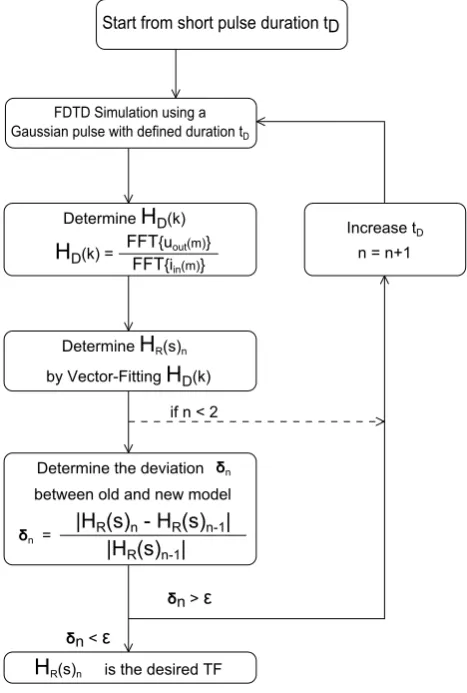
The proposed method can now be illustrated by the block diagram which is shown in Fig. 1. Starting from a compar-atively short excitation pulse, the desired observable is ob-tained from a numerical time-domain calculation. This al-lows to calculate the desired transfer functionHD(k)and a corresponding macromodel which is expressed byHR(s). A problem that is associated to the use of short pulses is that the discrete Fourier transform of such a signal will tend to have a sparse set of samples in the low frequency range. Due to dominant quasistationary contributions of typical light-ning currents, the main frequency range of interest is actu-ally located within this sparsely populated range of low fre-quencies. However, the sparsity makes the determination of a related transfer function susceptible to numerical errors. Therefore it is necessary to check the stability of results by using longer excitation pulses. It is then possible to compare the transfer functionsHR(s)that are obtained by excitation pulses of different lengths. If an increase of pulse duration does not lead to a significant change ofHR(s)it is assumed that the desired transfer function is obtained with sufficient accuracy.
To make the notion of a short excitation pulse more pre-cise, in Fig. 2 a standard double exponential lightning pulse of the form
2
J. Anatzki and F. Gronwald: Accelerating the Numerical Computation of Indirect Lightning Effects by means of Vector Fitting
2
Methodology
In lightning analysis, LEMP transfer functions are the main
quantities of interest. They relate a lightning current
i
in(
t
)
as
relevant input variable to an observable which often is given
by an induced voltage
v
out(
t
)
. In case of numerical
light-ning analyis in time domain an observable, such as
v
out(
t
)
,
is calculated from the excitation
i
in(
t
)
for a number of
dis-crete points in time. Then a disdis-crete transfer function
H
D(
k
)
is obtained by Fourier or Laplace transformation according
to
H
D(
k
) =
V
out(
k
)
I
in(
k
)
=
F
{
v
out(
m
)
}
F
{
i
in(
m
)
}
,
(1)
where
k
and
m
denote discrete indices in frequency and time
domain, respectively. The vector fitting method allows to
approximately fit a rational function to the discrete transfer
function (Gustavsen and Semlyen, 1999; Gustavsen, 2006).
This rational function can be written as a residue-pole
expan-sion of the form
H
R(
s
) =
NX
j=1
r
js
−
p
j+
d
+
s
·
e .
(2)
The advantage of
H
R(
s
)
is that, as a result, in the context of
lightning analysis LEMP transfer functions usually are
char-acterized by only a small number of parameters
r
j,
p
j,
d
,
and
e
. As will be seen below, realistic LEMP transfer
func-tions can already be represented by a first order
approxima-tion with
N
= 1
.
The proposed method can now be illustrated by the block
diagram which is shown in Fig. 1. Starting from a
compar-atively short excitation pulse, the desired observable is
ob-tained from a numerical time-domain calculation. This
al-lows to calculate the desired transfer function
H
D(
k
)
and a
corresponding macromodel which is expressed by
H
R(
s
)
. A
problem that is associated to the use of short pulses is that
the discrete Fourier transform of such a signal will tend to
have a sparse set of samples in the low frequency range. Due
to dominant quasistationary contributions of typical
light-ning currents, the main frequency range of interest is
actu-ally located within this sparsely populated range of low
fre-quencies. However, the sparsity makes the determination of
a related transfer function susceptible to numerical errors.
Therefore it is necessary to check the stability of results by
using longer excitation pulses. It is then possible to compare
the transfer functions
H
R(
s
)
that are obtained by excitation
pulses of different lengths. If an increase of pulse duration
does not lead to a significant change of
H
R(
s
)
it is assumed
that the desired transfer function is obtained with sufficient
accuracy.
To make the notion of a short excitation pulse more
pre-cise, in Fig. 2 a standard double exponential lightning pulse
of the form
i
(
t
) =
I
0(
e
−αt−
e
−βt)
(3)
FDTD Simulation using a Gaussian pulse with defined duration tD
Determine
H
D(k)H
D(k) =FFT{uout(m)}
FFT{iin(m)}
Determine
H
R(s)nby Vector-Fitting
H
D(k)Determine the deviation
between old and new model
δn = |HR(s)n - HR(s)n-1|
is the desired TF
H
R(s)nIncrease tD
if n < 2
n = n+1
|HR(s)n-1|
δn > ε
δn < ε
Start from short pulse duration tD
δn
Fig. 1. Block diagram of the proposed adaptive macromodelling
routine.
0 20 40 60 80 100
0 50 100 150 200
Time [us]
Amplitude [kA]
Double−Exp. Pulse Gaussian Pulse
Fig. 2. Graphical comparison between a double exponential pulse
and a Gaussian pulse. Both pulses have the same maximum value and are characterized by a similar rise rime. The double expo-nential pulse is a standard pulse, defined within the standard (SAE 5412A, 2005), where the time from beginning to peak value 200 kA is 6.4 us, the time from beginning to decay to 50 percent peak value, that is 100 kA, is 69 us.
Fig. 1. Block diagram of the proposed adaptive macromodelling
routine.
i(t )=I0(e−αt−e−βt) (3)
is contrasted to a unipolar Gaussian pulse of the form
i(t )=I1·e
−(t−t0)
2
2·T2 . (4)
The parameters of the pulses are adjusted such that they have a similar rise time but the Gaussian pulse decays much faster if compared to the double exponential pulse. The amplitude spectrum of both pulses is shown in Fig. 3. For the dou-ble exponential pulse, the amplitude spectrum is well-known and characterized by dominant low-frequency contributions (Lee, 1995). The amplitude spectrum of the unipolar Gaus-sian pulse is characterized by dominant low frequency con-tributions as well and thus the Gaussian pulse represents a suitable excitation to obtain LEMP transfer functions from time-domain analysis.
J. Anatzki and F. Gronwald: Accelerating the numerical computation of indirect lightning effects 325
2
J. Anatzki and F. Gronwald: Accelerating the Numerical Computation of Indirect Lightning Effects by means of Vector Fitting
2
Methodology
In lightning analysis, LEMP transfer functions are the main
quantities of interest. They relate a lightning current
i
in(
t
)
as
relevant input variable to an observable which often is given
by an induced voltage
v
out(
t
)
. In case of numerical
light-ning analyis in time domain an observable, such as
v
out(
t
)
,
is calculated from the excitation
i
in(
t
)
for a number of
dis-crete points in time. Then a disdis-crete transfer function
H
D(
k
)
is obtained by Fourier or Laplace transformation according
to
H
D(
k
) =
V
out(
k
)
I
in(
k
)
=
F
{
v
out(
m
)
}
F
{
i
in(
m
)
}
,
(1)
where
k
and
m
denote discrete indices in frequency and time
domain, respectively. The vector fitting method allows to
approximately fit a rational function to the discrete transfer
function (Gustavsen and Semlyen, 1999; Gustavsen, 2006).
This rational function can be written as a residue-pole
expan-sion of the form
H
R(
s
) =
NX
j=1
r
js
−
p
j+
d
+
s
·
e .
(2)
The advantage of
H
R(
s
)
is that, as a result, in the context of
lightning analysis LEMP transfer functions usually are
char-acterized by only a small number of parameters
r
j,
p
j,
d
,
and
e
. As will be seen below, realistic LEMP transfer
func-tions can already be represented by a first order
approxima-tion with
N
= 1
.
The proposed method can now be illustrated by the block
diagram which is shown in Fig. 1. Starting from a
compar-atively short excitation pulse, the desired observable is
ob-tained from a numerical time-domain calculation. This
al-lows to calculate the desired transfer function
H
D(
k
)
and a
corresponding macromodel which is expressed by
H
R(
s
)
. A
problem that is associated to the use of short pulses is that
the discrete Fourier transform of such a signal will tend to
have a sparse set of samples in the low frequency range. Due
to dominant quasistationary contributions of typical
light-ning currents, the main frequency range of interest is
actu-ally located within this sparsely populated range of low
fre-quencies. However, the sparsity makes the determination of
a related transfer function susceptible to numerical errors.
Therefore it is necessary to check the stability of results by
using longer excitation pulses. It is then possible to compare
the transfer functions
H
R(
s
)
that are obtained by excitation
pulses of different lengths. If an increase of pulse duration
does not lead to a significant change of
H
R(
s
)
it is assumed
that the desired transfer function is obtained with sufficient
accuracy.
To make the notion of a short excitation pulse more
pre-cise, in Fig. 2 a standard double exponential lightning pulse
of the form
i
(
t
) =
I
0(
e
−αt−
e
−βt)
(3)
FDTD Simulation using a Gaussian pulse with defined duration tD
Determine
H
D(k)H
D(k) =FFT{uout(m)}
FFT{iin(m)}
Determine
H
R(s)nby Vector-Fitting
H
D(k)Determine the deviation
between old and new model
δ
n =
|HR(s)n - HR(s)n-1|
is the desired TF
H
R(s)nIncrease tD
if n < 2
n = n+1
|HR(s)n-1|
δn > ε
δn < ε
Start from short pulse duration tD
δn
Fig. 1. Block diagram of the proposed adaptive macromodelling
routine.
0 20 40 60 80 100
0 50 100 150 200 Time [us] Amplitude [kA] Double−Exp. Pulse Gaussian Pulse
Fig. 2. Graphical comparison between a double exponential pulse
and a Gaussian pulse. Both pulses have the same maximum value and are characterized by a similar rise rime. The double expo-nential pulse is a standard pulse, defined within the standard (SAE 5412A, 2005), where the time from beginning to peak value 200 kA is 6.4 us, the time from beginning to decay to 50 percent peak value, that is 100 kA, is 69 us.
Fig. 2. Graphical comparison between a double exponential pulse
and a Gaussian pulse. Both pulses have the same maximum value and are characterized by a similar rise rime. The double expo-nential pulse is a standard pulse, defined within the standard (SAE 5412A, 2005), where the time from beginning to peak value 200 kA is 6.4 us, the time from beginning to decay to 50 percent peak value, that is 100 kA, is 69 us.
J. Anatzki and F. Gronwald: Accelerating the Numerical Computation of Indirect Lightning Effects by means of Vector Fitting
3
102 104 106
−100 −50 0 50
Frequency [Hz]
Amplitude density [dBA/Hz]
Gaussian Pulse Double−Exp. Pulse
Fig. 3. Amplitude spectrum of both double exponential pulse and
Gaussian pulse, as displayed in Fig. 2.
is contrasted to a unipolar Gaussian pulse of the form
i
(
t
) =
I
1·
e
−(t−t0 )2
2·T2
.
(4)
The parameters of the pulses are adjusted such that they have
a similar rise time but the Gaussian pulse decays much faster
if compared to the double exponential pulse. The amplitude
spectrum of both pulses is shown in Fig. 3. For the
dou-ble exponential pulse, the amplitude spectrum is well-known
and characterized by dominant low-frequency contributions
(Lee, 1995). The amplitude spectrum of the unipolar
Gaus-sian pulse is characterized by dominant low frequency
con-tributions as well and thus the Gaussian pulse represents a
suitable excitation to obtain LEMP transfer functions from
time-domain analysis.
The duration of a Gaussian excitation is determined by the
parameter
T
that is introduced in Eq. (4). It is inversely
pro-portional to the frequency
F
maxwhich is defined as the
fre-quency where the amplitude spectrum of the Gaussian pulse
has decayed by -20 dB if compared to its maximum value,
T
∼
1
F
max.
(5)
Therefore a longer pulse duration implies a smaller value
for
F
maxand vice versa. This circumstance is illustrated
in Fig. 4 where Gaussian pulses corresponding to
F
max=
1 MHz, 3 MHz, and 10 MHz are displayed. Additionally,
the amplitude spectrum of the Gaussian pulse with
F
max=
3 MHz is shown in Fig. 5.
It is suggested to use Gaussian excitations of different
pa-rameters
F
max, corresponding to different time durations,within the macromodelling routine of Fig. 1. In the following
section this routine will be illustrated by a numerical
exam-ple.
0 1 2 3 4
0 0.2 0.4 0.6 0.8 1 Time [us] 1 MHz 3 MHz 10 MHz
Fig. 4. Gaussian pulses corresponding toFmax =1 MHz, 3 MHz,
and 10 MHz. A larger value ofFmaximplies a shorter pulse dura-tion.
104 105 106
−65 −60 −55 −50 −45 −40 −35 −30 −25 −20 X: 3e+006 Y: −44.87 Frequency [Hz]
Amplitude Density [dBA/Hz]
Fig. 5. Amplitude spectrum of a Gaussian pulse with Fmax =
3 MHz. At 3 MHz its value has decayed by 20 dB if compared to the maximum value.
3
Numerical Example: LEMP Transfer Function of a
Canonical Tank Model
As a specific example a canonical tank model is considered.
The tank model consists of a rectangular box which contains
a fuel pipe. The fuel pipe is electrically bonded to one side
of the interior of the tank and leaves the tank through a
circu-lar hole as shown in Fig. 6. The tank is subject to a lightning
current source
i
in(
t
)
and the induced voltage
v
out(
t
)
between
the fuel pipe and the boundary of the circular hole is the
ob-servable of interest, compare Fig. 7 . Then a LEMP transfer
function is defined according to Eq. (1).
The tank model has been created within the CST
Mi-crowave Studio software which also is used to run the
sim-ulation model and to generate the time domain data
v
out(
t
)
Fig. 3. Amplitude spectrum of both double exponential pulse and
Gaussian pulse, as displayed in Fig. 2.
The duration of a Gaussian excitation is determined by the parameterT that is introduced in Eq. (4). It is inversely pro-portional to the frequencyFmaxwhich is defined as the
fre-quency where the amplitude spectrum of the Gaussian pulse has decayed by -20 dB if compared to its maximum value,
T∼ 1
Fmax
. (5)
Therefore a longer pulse duration implies a smaller value for Fmax and vice versa. This circumstance is illustrated
in Fig. 4 where Gaussian pulses corresponding toFmax=
J. Anatzki and F. Gronwald: Accelerating the Numerical Computation of Indirect Lightning Effects by means of Vector Fitting
3
102 104 106
−100 −50
0 50
Frequency [Hz]
Amplitude density [dBA/Hz]
Gaussian Pulse Double−Exp. Pulse
Fig. 3. Amplitude spectrum of both double exponential pulse and Gaussian pulse, as displayed in Fig. 2.
is contrasted to a unipolar Gaussian pulse of the form
i
(
t
) =
I
1·
e
− (t−t0 )22·T2
.
(4)
The parameters of the pulses are adjusted such that they have
a similar rise time but the Gaussian pulse decays much faster
if compared to the double exponential pulse. The amplitude
spectrum of both pulses is shown in Fig. 3. For the
dou-ble exponential pulse, the amplitude spectrum is well-known
and characterized by dominant low-frequency contributions
(Lee, 1995). The amplitude spectrum of the unipolar
Gaus-sian pulse is characterized by dominant low frequency
con-tributions as well and thus the Gaussian pulse represents a
suitable excitation to obtain LEMP transfer functions from
time-domain analysis.
The duration of a Gaussian excitation is determined by the
parameter
T
that is introduced in Eq. (4). It is inversely
pro-portional to the frequency
F
maxwhich is defined as the
fre-quency where the amplitude spectrum of the Gaussian pulse
has decayed by -20 dB if compared to its maximum value,
T
∼
1
F
max.
(5)
Therefore a longer pulse duration implies a smaller value
for
F
maxand vice versa. This circumstance is illustrated
in Fig. 4 where Gaussian pulses corresponding to
F
max=
1 MHz, 3 MHz, and 10 MHz are displayed. Additionally,
the amplitude spectrum of the Gaussian pulse with
F
max=
3 MHz is shown in Fig. 5.
It is suggested to use Gaussian excitations of different
pa-rameters
F
max, corresponding to different time durations,
within the macromodelling routine of Fig. 1. In the following
section this routine will be illustrated by a numerical
exam-ple.
0 1 2 3 4
0 0.2 0.4 0.6 0.8 1 Time [us] 1 MHz 3 MHz 10 MHz
Fig. 4. Gaussian pulses corresponding toFmax =1 MHz, 3 MHz,
and 10 MHz. A larger value ofFmax implies a shorter pulse
dura-tion.
104 105 106 −65 −60 −55 −50 −45 −40 −35 −30 −25 −20 X: 3e+006 Y: −44.87 Frequency [Hz]
Amplitude Density [dBA/Hz]
Fig. 5. Amplitude spectrum of a Gaussian pulse with Fmax =
3 MHz. At 3 MHz its value has decayed by 20 dB if compared to the maximum value.
3
Numerical Example: LEMP Transfer Function of a
Canonical Tank Model
As a specific example a canonical tank model is considered.
The tank model consists of a rectangular box which contains
a fuel pipe. The fuel pipe is electrically bonded to one side
of the interior of the tank and leaves the tank through a
circu-lar hole as shown in Fig. 6. The tank is subject to a lightning
current source
i
in(t
)
and the induced voltage
v
out(t
)
between
the fuel pipe and the boundary of the circular hole is the
ob-servable of interest, compare Fig. 7 . Then a LEMP transfer
function is defined according to Eq. (1).
The tank model has been created within the CST
Mi-crowave Studio software which also is used to run the
sim-ulation model and to generate the time domain data
v
out(t
)
Fig. 4. Gaussian pulses corresponding toFmax=1 MHz, 3 MHz,
and 10 MHz. A larger value ofFmaximplies a shorter pulse
dura-tion.
J. Anatzki and F. Gronwald: Accelerating the Numerical Computation of Indirect Lightning Effects by means of Vector Fitting
3
102 104 106
−100 −50 0 50
Frequency [Hz]
Amplitude density [dBA/Hz]
Gaussian Pulse Double−Exp. Pulse
Fig. 3. Amplitude spectrum of both double exponential pulse and Gaussian pulse, as displayed in Fig. 2.
is contrasted to a unipolar Gaussian pulse of the form
i
(
t
) =
I
1·
e
−(t
−t0 )2
2·T2
.
(4)
The parameters of the pulses are adjusted such that they have
a similar rise time but the Gaussian pulse decays much faster
if compared to the double exponential pulse. The amplitude
spectrum of both pulses is shown in Fig. 3. For the
dou-ble exponential pulse, the amplitude spectrum is well-known
and characterized by dominant low-frequency contributions
(Lee, 1995). The amplitude spectrum of the unipolar
Gaus-sian pulse is characterized by dominant low frequency
con-tributions as well and thus the Gaussian pulse represents a
suitable excitation to obtain LEMP transfer functions from
time-domain analysis.
The duration of a Gaussian excitation is determined by the
parameter
T
that is introduced in Eq. (4). It is inversely
pro-portional to the frequency
F
maxwhich is defined as the
fre-quency where the amplitude spectrum of the Gaussian pulse
has decayed by -20 dB if compared to its maximum value,
T
∼
1
F
max.
(5)
Therefore a longer pulse duration implies a smaller value
for
F
maxand vice versa. This circumstance is illustrated
in Fig. 4 where Gaussian pulses corresponding to
F
max=
1 MHz, 3 MHz, and 10 MHz are displayed. Additionally,
the amplitude spectrum of the Gaussian pulse with
F
max=
3 MHz is shown in Fig. 5.
It is suggested to use Gaussian excitations of different
pa-rameters
F
max, corresponding to different time durations,
within the macromodelling routine of Fig. 1. In the following
section this routine will be illustrated by a numerical
exam-ple.
0 1 2 3 4
0 0.2 0.4 0.6 0.8 1 Time [us] 1 MHz 3 MHz 10 MHz
Fig. 4. Gaussian pulses corresponding toFmax =1 MHz, 3 MHz,
and 10 MHz. A larger value ofFmaximplies a shorter pulse
dura-tion.
104 105 106 −65 −60 −55 −50 −45 −40 −35 −30 −25 −20 X: 3e+006 Y: −44.87 Frequency [Hz]
Amplitude Density [dBA/Hz]
Fig. 5. Amplitude spectrum of a Gaussian pulse with Fmax =
3 MHz. At 3 MHz its value has decayed by 20 dB if compared to the maximum value.
3
Numerical Example: LEMP Transfer Function of a
Canonical Tank Model
As a specific example a canonical tank model is considered.
The tank model consists of a rectangular box which contains
a fuel pipe. The fuel pipe is electrically bonded to one side
of the interior of the tank and leaves the tank through a
circu-lar hole as shown in Fig. 6. The tank is subject to a lightning
current source
i
in(
t
)
and the induced voltage
v
out(
t
)
between
the fuel pipe and the boundary of the circular hole is the
ob-servable of interest, compare Fig. 7 . Then a LEMP transfer
function is defined according to Eq. (1).
The tank model has been created within the CST
Mi-crowave Studio software which also is used to run the
sim-ulation model and to generate the time domain data
v
out(
t
)
Fig. 5. Amplitude spectrum of a Gaussian pulse with Fmax=
3 MHz. At 3 MHz its value has decayed by 20 dB if compared to the maximum value.
1 MHz, 3 MHz, and 10 MHz are displayed. Additionally, the amplitude spectrum of the Gaussian pulse withFmax=
3 MHz is shown in Fig. 5.
It is suggested to use Gaussian excitations of different parametersFmax, corresponding to different time durations,
within the macromodelling routine of Fig. 1. In the following section this routine will be illustrated by a numerical exam-ple.
326 J. Anatzki and F. Gronwald: Accelerating the numerical computation of indirect lightning effects
4
J. Anatzki and F. Gronwald: Accelerating the Numerical Computation of Indirect Lightning Effects by means of Vector Fitting
Fig. 6. Canonical tank geometry with interior tank pipe. For better
visibility the front side of the tank is removed. The outer metallic frame serves as a return conductor.
Fig. 7. Enlarged view of tank pipe and circular exit hole. The
ar-rows between tank pipe and boundary of the circular hole indicate voltage monitors which record the voltagevout(t)during the nu-merical simulation.
from the input variableiin(t) by means of the Finite Inte-gration Technique (Clemens and Weiland, 2001). The result of a sample calculation is shown in Figs. 8 and 9. A mainly inductive response is observed, where voltage and current
ap-Fig. 8. Sample Gaussian current excitationiin(t).
Fig. 9. Induced voltagevout(t)which is due to the current
excita-tion of Fig. 8.
proximately are related byu(t) = Ldidt(t). This observation has been discussed in more detail in (Gronwald, 2010). As a general rule, LEMP transfer functions of aircraft structures are mainly characterized by inductive and resistive contribu-tions. This is due to the quasistationary nature of the light-ning current which makes radiation contributions negligible. Also capacitive effects can be neglected as long as the metal-lic parts of aircraft structures are properly bonded (Fisher et al., 1990). Therefore, in the present case, it is meaningful to consider the transfer admittance
YR(s) =
1
R+s·L =
1/L
s+R/L ,HR(s)
N=1
= r
s−p
(6) as an appropriate first order macromodel for the (inverse) transfer function of the canonical tank model. For details on macromodels of elementary networks it is referred to (An-tonini, 2003).
To calculate the parameters L and R which, according to (6), determine the LEMP transfer admittanceYR(s), it is first necessary to perform a time domain calculation for a given excitationiin(t)to computevout(t). Then the corre-sponding discrete transfer functionHD(k)can be obtained from (1). Next, the inverse of this transfer function is fit-ted by means of the vector fitting method to the first order macromodelYR(s) which is given by (6). This yields the polepand residuerwhich both determine the parametersL
andR.
Following the procedure described in the previous para-graph, macromodels for the LEMP transfer function of the canonical tank model have been obtained for nine different Gaussian excitations. The results are given in Tab. 1. The chosen pulse durations vary by a factor of 80, that is, the computation times to computevout vary by a factor of about 80 as well. The computations were performed on a single PC
Fig. 6. Canonical tank geometry with interior tank pipe. For better
visibility the front side of the tank is removed. The outer metallic frame serves as a return conductor.
4
J. Anatzki and F. Gronwald: Accelerating the Numerical Computation of Indirect Lightning Effects by means of Vector Fitting
Fig. 6. Canonical tank geometry with interior tank pipe. For better
visibility the front side of the tank is removed. The outer metallic frame serves as a return conductor.
Fig. 7. Enlarged view of tank pipe and circular exit hole. The
ar-rows between tank pipe and boundary of the circular hole indicate voltage monitors which record the voltage vout(t)during the nu-merical simulation.
from the input variable
i
in(
t
)
by means of the Finite
Inte-gration Technique (Clemens and Weiland, 2001). The result
of a sample calculation is shown in Figs. 8 and 9. A mainly
inductive response is observed, where voltage and current
ap-Fig. 8. Sample Gaussian current excitationiin(t).
Fig. 9. Induced voltagevout(t)which is due to the current
excita-tion of Fig. 8.
proximately are related by
u
(
t
) =
L
didt(t). This observation
has been discussed in more detail in (Gronwald, 2010). As
a general rule, LEMP transfer functions of aircraft structures
are mainly characterized by inductive and resistive
contribu-tions. This is due to the quasistationary nature of the
light-ning current which makes radiation contributions negligible.
Also capacitive effects can be neglected as long as the
metal-lic parts of aircraft structures are properly bonded (Fisher et
al., 1990). Therefore, in the present case, it is meaningful to
consider the transfer admittance
Y
R(
s
) =
1
R
+
s
·
L
=
1
/
Ls
+
R/
L,
H
R(
s
)
N=1
=
r
s
−
p
(6)
as an appropriate first order macromodel for the (inverse)
transfer function of the canonical tank model. For details on
macromodels of elementary networks it is referred to
(An-tonini, 2003).
To calculate the parameters
L
and
R
which, according
to (6), determine the LEMP transfer admittance
Y
R(
s
)
, it is
first necessary to perform a time domain calculation for a
given excitation
i
in(
t
)
to compute
v
out(
t
)
. Then the
corre-sponding discrete transfer function
H
D(
k
)
can be obtained
from (1). Next, the inverse of this transfer function is
fit-ted by means of the vector fitting method to the first order
macromodel
Y
R(
s
)
which is given by (6). This yields the
pole
p
and residue
r
which both determine the parameters
L
and
R
.
Following the procedure described in the previous
para-graph, macromodels for the LEMP transfer function of the
canonical tank model have been obtained for nine different
Gaussian excitations. The results are given in Tab. 1. The
chosen pulse durations vary by a factor of 80, that is, the
computation times to compute
v
outvary by a factor of about
80 as well. The computations were performed on a single PC
Fig. 7. Enlarged view of tank pipe and circular exit hole. The arrows between tank pipe and boundary of the circular hole indi-cate voltage monitors which record the voltagevout(t )during the
numerical simulation.
3 Numerical example: LEMP transfer function of a canonical tank model
As a specific example a canonical tank model is considered. The tank model consists of a rectangular box which contains a fuel pipe. The fuel pipe is electrically bonded to one side of the interior of the tank and leaves the tank through a circular hole as shown in Fig. 6. The tank is subject to a lightning current sourceiin(t )and the induced voltagevout(t )between
the fuel pipe and the boundary of the circular hole is the ob-servable of interest, compare Fig. 7 . Then a LEMP transfer function is defined according to Eq. (1).
The tank model has been created within the CST Mi-crowave Studio software which also is used to run the sim-ulation model and to generate the time domain datavout(t )
from the input variableiin(t )by means of the Finite
Integra-tion Technique (Clemens and Weiland, 2001). The result of a sample calculation is shown in Figs. 8 and 9. A mainly in-ductive response is observed, where voltage and current ap-proximately are related byu(t )=Ldi(t )dt . This observation has been discussed in more detail in (Gronwald, 2010). As
4
J. Anatzki and F. Gronwald: Accelerating the Numerical Computation of Indirect Lightning Effects by means of Vector Fitting
Fig. 6. Canonical tank geometry with interior tank pipe. For better
visibility the front side of the tank is removed. The outer metallic
frame serves as a return conductor.
Fig. 7. Enlarged view of tank pipe and circular exit hole. The
ar-rows between tank pipe and boundary of the circular hole indicate
voltage monitors which record the voltage
v
out(
t
)
during the
nu-merical simulation.
from the input variable
i
in
(
t
)
by means of the Finite
Inte-gration Technique (Clemens and Weiland, 2001). The result
of a sample calculation is shown in Figs. 8 and 9. A mainly
inductive response is observed, where voltage and current
ap-Fig. 8. Sample Gaussian current excitation
i
in(
t
)
.
Fig. 9. Induced voltage
v
out(
t
)
which is due to the current
excita-tion of Fig. 8.
proximately are related by
u
(
t
) =
L
di
dt
(
t
)
. This observation
has been discussed in more detail in (Gronwald, 2010). As
a general rule, LEMP transfer functions of aircraft structures
are mainly characterized by inductive and resistive
contribu-tions. This is due to the quasistationary nature of the
light-ning current which makes radiation contributions negligible.
Also capacitive effects can be neglected as long as the
metal-lic parts of aircraft structures are properly bonded (Fisher et
al., 1990). Therefore, in the present case, it is meaningful to
consider the transfer admittance
Y
R
(
s
) =
1
R
+
s
·
L
=
1
/
L
s
+
R
/
L
,
H
R
(
s
)
N=1
=
r
s
−
p
(6)
as an appropriate first order macromodel for the (inverse)
transfer function of the canonical tank model. For details on
macromodels of elementary networks it is referred to
(An-tonini, 2003).
To calculate the parameters
L
and
R
which, according
to (6), determine the LEMP transfer admittance
Y
R
(
s
)
, it is
first necessary to perform a time domain calculation for a
given excitation
i
in
(
t
)
to compute
v
out
(
t
)
. Then the
corre-sponding discrete transfer function
H
D
(
k
)
can be obtained
from (1). Next, the inverse of this transfer function is
fit-ted by means of the vector fitting method to the first order
macromodel
Y
R
(
s
)
which is given by (6). This yields the
pole
p
and residue
r
which both determine the parameters
L
and
R
.
Following the procedure described in the previous
para-graph, macromodels for the LEMP transfer function of the
canonical tank model have been obtained for nine different
Gaussian excitations. The results are given in Tab. 1. The
chosen pulse durations vary by a factor of 80, that is, the
computation times to compute
v
out
vary by a factor of about
80 as well. The computations were performed on a single PC
Fig. 8. Sample Gaussian current excitationiin(t ).
4
J. Anatzki and F. Gronwald: Accelerating the Numerical Computation of Indirect Lightning Effects by means of Vector Fitting
Fig. 6. Canonical tank geometry with interior tank pipe. For better
visibility the front side of the tank is removed. The outer metallic
frame serves as a return conductor.
Fig. 7. Enlarged view of tank pipe and circular exit hole. The
ar-rows between tank pipe and boundary of the circular hole indicate
voltage monitors which record the voltage
v
out(
t
)
during the
nu-merical simulation.
from the input variable
i
in(
t
)
by means of the Finite
Inte-gration Technique (Clemens and Weiland, 2001). The result
of a sample calculation is shown in Figs. 8 and 9. A mainly
inductive response is observed, where voltage and current
ap-Fig. 8. Sample Gaussian current excitation
i
in(
t
)
.
Fig. 9. Induced voltage
v
out(
t
)
which is due to the current
excita-tion of Fig. 8.
proximately are related by
u
(
t
) =
L
didt(t). This observation
has been discussed in more detail in (Gronwald, 2010). As
a general rule, LEMP transfer functions of aircraft structures
are mainly characterized by inductive and resistive
contribu-tions. This is due to the quasistationary nature of the
light-ning current which makes radiation contributions negligible.
Also capacitive effects can be neglected as long as the
metal-lic parts of aircraft structures are properly bonded (Fisher et
al., 1990). Therefore, in the present case, it is meaningful to
consider the transfer admittance
Y
R(
s
) =
1
R
+
s
·
L
=
1
/
Ls
+
R/
L,
H
R(
s
)
N=1
=
r
s
−
p
(6)
as an appropriate first order macromodel for the (inverse)
transfer function of the canonical tank model. For details on
macromodels of elementary networks it is referred to
(An-tonini, 2003).
To calculate the parameters
L
and
R
which, according
to (6), determine the LEMP transfer admittance
Y
R(
s
)
, it is
first necessary to perform a time domain calculation for a
given excitation
i
in(
t
)
to compute
v
out(
t
)
. Then the
corre-sponding discrete transfer function
H
D(
k
)
can be obtained
from (1). Next, the inverse of this transfer function is
fit-ted by means of the vector fitting method to the first order
macromodel
Y
R(
s
)
which is given by (6). This yields the
pole
p
and residue
r
which both determine the parameters
L
and
R.
Following the procedure described in the previous
para-graph, macromodels for the LEMP transfer function of the
canonical tank model have been obtained for nine different
Gaussian excitations. The results are given in Tab. 1. The
chosen pulse durations vary by a factor of 80, that is, the
computation times to compute
v
outvary by a factor of about
80 as well. The computations were performed on a single PC
Fig. 9. Induced voltagevout(t )which is due to the currentexcitation of Fig. 8.
a general rule, LEMP transfer functions of aircraft structures are mainly characterized by inductive and resistive contribu-tions. This is due to the quasistationary nature of the light-ning current which makes radiation contributions negligible. Also capacitive effects can be neglected as long as the metal-lic parts of aircraft structures are properly bonded (Fisher et al., 1990). Therefore, in the present case, it is meaningful to consider the transfer admittance
J. Anatzki and F. Gronwald: Accelerating the numerical computation of indirect lightning effects 327
YR(s)= 1
R+s·L=
1/L
s+R/L,HR(s)
N=1
= r
s−p (6)
as an appropriate first order macromodel for the (inverse) transfer function of the canonical tank model. For details on macromodels of elementary networks it is referred to (An-tonini, 2003).
To calculate the parameters L and R which, according to (6), determine the LEMP transfer admittanceYR(s), it is first necessary to perform a time domain calculation for a given excitationiin(t )to compute vout(t ). Then the
corre-sponding discrete transfer functionHD(k)can be obtained from (1). Next, the inverse of this transfer function is fit-ted by means of the vector fitting method to the first order macromodelYR(s)which is given by (6). This yields the polepand residuerwhich both determine the parametersL
andR.
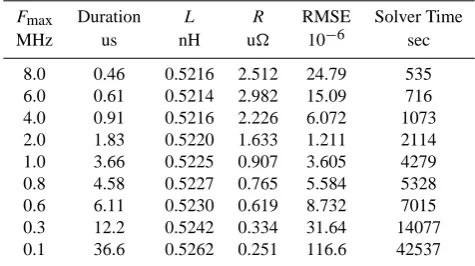
Following the procedure described in the previous para-graph, macromodels for the LEMP transfer function of the canonical tank model have been obtained for nine different Gaussian excitations. The results are given in Tab. 1. The chosen pulse durations vary by a factor of 80, that is, the computation times to computevoutvary by a factor of about
80 as well. The computations were performed on a single PC with 3.0 GHz CPU, 4 GB RAM, using the CST Microwave Studio 2010 software on a 32-bit Windows platform.
In order to judge the resulting parameters L andR one should note that the material of the tank model is mod-elled as highly conducting aluminium (σ=3.72·107S/m). Therefore the voltage response is dominantly inductive, such that the resistive response is somewhat hidden and does not significantly contribute to the voltage response. To judge the quality of the fitted macromodels the relative root mean square error is included in Tab. 1 which quantifies the de-viation between the numerically calculated transfer function
HD−1(k)and the fitted first order LEMP transfer admittance
YR(s). It is seen that this deviation is small, thus justifying the assumption of a simple first order macromodel. Towards shorter pulse durations the fit error increases. This indicates that the possibility to shorten the pulse duration is limited due to numerical inaccuracies that accompany the computation of the Fourier transformation in order to obtainHD−1(k). How-ever, the fit error increases towards longer pulse durations as well. To explain this observation it is noted that for long computation times numerical instabilities tend to build up, at least for the present numerical model which only contains minor losses. The smallest fit error occurs for the Gaussian pulse of time duration 1.83 us.
For further validation, it is of interest to compare the re-sults that were obtained from the Gaussian excitations to an analogous calculation using a standard double exponential pulse as displayed in Fig. 2. However, as it turns out, the long pulse duration leads to strong oscillations that are inter-preted as numerical instabilities and make it not feasible to
Table 1. Resulting macromodels for various Gaussian excitation
pulses of different durations.
Fmax Duration L R RMSE Solver Time
MHz us nH u 10−6 sec
8.0 0.46 0.5216 2.512 24.79 535
6.0 0.61 0.5214 2.982 15.09 716
4.0 0.91 0.5216 2.226 6.072 1073
2.0 1.83 0.5220 1.633 1.211 2114
1.0 3.66 0.5225 0.907 3.605 4279
0.8 4.58 0.5227 0.765 5.584 5328
0.6 6.11 0.5230 0.619 8.732 7015
0.3 12.2 0.5242 0.334 31.64 14077
0.1 36.6 0.5262 0.251 116.6 42537
extract a meaningful LEMP transfer function. As an alter-native, an independent calculation was performed using the Method of Moment code CONCEPT-II which is defined in frequency domain (Brüns et al., 2011). To this end, a surface discretized model of the canonical tank was created and sim-ulations at 161 discrete frequency samples between 1 kHz and 8 MHz were performed. From the resulting data a corre-sponding first order macromodel was obtained with parame-tersL=0.5192 nH,R=2.8887 u, and a relative root mean square error RMSE=0.0023, thus supporting the results of Tab. 1.
4 Conclusions
Standard lightning pulses are characterized by durations of tenths of microseconds, thus leading to long computation times for time domain calculations of lightning current in-duced quantities. However, in order to obtain LEMP transfer functions it is also possible to use shorter excitation pulses, involving less computation time. Typically, LEMP transfer functions are characterized by only a small number of pa-rameters. Therefore the vector fitting procedure is useful to obtain these parameters which, in turn, can be used to quan-titatively compare transfer functions that are obtained from different excitation pulses. This makes it possible to quantify whether a short excitation pulse is sufficient to determine a LEMP transfer function with sufficient accuracy.
References
Apra, M., D’Amore, M., Gigliotti, K., Sarto, M. S. and Volpi, V.: Lightning Indirect Effects Certification of a Transport Aircraft by Numerical Simulation, IEEE Trans. Electromagn. Compat., 50(3), 513–523, 2008.
Antonini, G.: Spice Equivalent Circuits of Frequency-Domain Re-sponses, IEEE Trans. Electromagn. Compat., 45(3), 502–512, 2003.
328 J. Anatzki and F. Gronwald: Accelerating the numerical computation of indirect lightning effects Brüns, H.-D., Freiberg, A., and Singer, H.: CONCEPT-II
Man-ual of the Program System, (Hamburg University of Technology, February 2011), see also http://www.tet.tu-harburg.de/concept/, 2011.
Clemens, M. and Weiland, T.: Discrete electromagnetism with the finite integration technique, Progress In Electromagnetics Re-search, PIER, 32), 65–87, 2001.
Deschrijver, D., Pissoort, D., and Dhaene, T.: Adaptive Stopping Criterion for Fast Time Domain Characterization of Microwave Components, IEEE Microw. Wireless Compon. Lett., 19(12), 765–767, 2009.
Fisher, F. A., Perala, R. A., and Plumer, J. A.: Lightning Protec-tion of Aircraft, (Lightning Technologies, Inc., Pittsfield, USA), 1990.
Gronwald, F.: Classification and quantification of lightning-current induced voltages within aircraft structures, Proc. of the 9th Int. Symp. on EMC, EMC Europe 2010, Wroclaw, Poland, 559–564, 13–17 September, 2010.
Gustavsen, B. and Semlyen, A.: Rational Approximation of Fre-quency Domain Responses by Vector Fitting, IEEE Trans. Power Delivery, 14(3), 1052–1061, 1999.
Gustavsen, B.: Improving the Pole Relocating Properties of Vector Fitting, IEEE Trans. Power Delivery, 21(3), 1587–1592, 2006. Hoffman, J. D.: Numerical Methods for Engineers and Scientists,
2nd ed., (Marcel Dekker Inc., New York), 2001.
Lee, K. S. H. (ed.): EMP Interaction: Principles, Techniques, and Reference Data, revised printing, Taylor & Francis, Washington D.C. 1995.
SAE Aerospace Recommended Practice (ARP) 5412A, Aircraft Lightning Environment and Related Test Waveforms, February 2005.