Research article
Development of a fingerprinting panel using medically relevant
polymorphisms
Deanna S Cross, Lynn C Ivacic and Catherine A McCarty
Address:1Center for Human Genetics, Marshfield Clinic Research Foundation, 1000 N. Oak Avenue, Marshfield, WI, USA
E-mail: Deanna S Cross* - [email protected]; Lynn C Ivacic - [email protected]; Catherine A McCarty - [email protected]
*Corresponding author
Published: 20 April 2009 Received: 11 August 2008
BMC Medical Genomics2009,2:17 doi: 10.1186/1755-8794-2-17 Accepted: 20 April 2009 This article is available from: http://www.biomedcentral.com/1755-8794/2/17
©2009 Cross et al; licensee BioMed Central Ltd.
This is an Open Access article distributed under the terms of the Creative Commons Attribution License (http://creativecommons.org/licenses/by/2.0), which permits unrestricted use, distribution, and reproduction in any medium, provided the original work is properly cited.
Abstract
Background: For population based biorepositories to be of use, rigorous quality control and assurance must be maintained. We have designed and validated a panel of polymorphisms for individual sample identification consisting of 36 common polymorphisms that have been implicated in a wide range of diseases and an additional sex marker. This panel uniquely identifies our biorepository of approximately 20,000 samples and would continue to uniquely identify samples in biorepositories of over 100 million samples.
Methods: A panel of polymorphisms associated with at least one disease state in multiple populations was constructed using a cut-off of 0.20 or greater confirmed minor allele frequency in a European Caucasian population. The fingerprinting assay was tested using the MALDI-TOF mass spectrometry method of allele determination on a Sequenom platform with a panel of 28 Caucasian HapMap samples; the results were compared with known genotypes to ensure accuracy. The frequencies of the alleles were compared to the expected frequencies from dbSNP and any genotype that did not achieve Hardy Weinberg equilibrium was excluded from the final assay.
Results: The final assay consisted of the AMG sex marker and 36 medically relevant polymorphisms with representation on each chromosome, encompassing polymorphisms on both the Illumina 550K bead array and the Affymetrix 6.0 chip (with over a million polymorphisms) platform. The validated assay has a P(ID) of 6.132 × 10⁻¹⁵and a Psib(ID) of 3.077 × 10⁻⁸. This assay
allows unique identification of our biorepository of 20,000 individuals as well and ensures that as we continue to recruit individuals they can be uniquely fingerprinted. In addition, diseases such as cancer, heart disease diabetes, obesity, and respiratory disease are well represented in the fingerprinting assay.
Conclusion: The polymorphisms in this panel are currently represented on a number of common genotyping platforms making QA/QC flexible enough to accommodate a large number of studies. In addition, this panel can serve as a resource for investigators who are interested in the effects of disease in a population, particularly for common diseases.
Background
With the advent of genome wide association studies large bio-banks will become the stepping stones to tomorrow's medicine. The genome wide association study (GWAS) has recently proved its value with replicable findings for diseases such as coronary artery disease, prostate cancer, and diabetes [1], and many more discoveries are expected in the near future. To determine these associations, studies have relied on large populations of well char-acterized cases and controls often combining several study populations in order to approach statistical significance [1]. Once these associations have been found in well characterized target cohorts, the findings must be replicated in a population based cohort before translation into clinical practice [2]. These cohorts will come from the large population based cohorts being collected in places like the Marshfield Clinic [3] and Vanderbuilt [4] and Kaiser Permenente [5].
For these biorepositories to be of use rigorous quality control and assurance must be maintained to minimize sample identification errors. The quality of the nation's biobanks is such a priority that the National Cancer Institute has established an Office of Biorepositories and Biospecimen Research with the specific mission to develop standards and determine the best practices and protocols for the burgeoning field [5]. Erroneous sample identification and mistaken sample handling can stay hidden for many years compromising results; this problem has plagued researchers that work with cell culture for years [6,7].
One strategy for reducing errors in sample identification is to increase the automation of sample acquisition, storage and handling. The PMRP repository used a semi-automated system of sample handling for recruitment in 2001 which included the Marshfield Clinic's practice management and laboratory information systems for subject recruitment and sample collection. PMRP
cur-rently uses the Nautilus® (Thermo Fischer, PA, USA)
biospecimen tracking system with an integrated plate reader for tracking of sample storage [8]. Other larger biorepositories such as the UK biobank have chosen to automate sample collection and storage to a larger degree in order to further reduce the possibility of incorrect sample identification [9]. While automation does rule out some possible sample identification mistakes it does not eliminate all potential error from the process as technicians are still involved in sample acquisition and processing. In addition, automation does not inform the quality of the specimen to help research personnel determine the usefulness of the sample nor does it provide a process for correcting and identifying errors that have occurred during previous
sample collections. Even when samples are collected, processed, and aliquotted with minimal human hand-ling, results from collaborating institutions must be checked to ensure no identification errors occurred in transferring either the samples or the data between institutions. Therefore it is imperative that an initial characterization of a sample includes both unique identifiers and measures of quality. This is particularly true when genotypic and phenotypic information are being combined in large association studies.
One method of identification would be to rely on markers developed for forensic applications. A number of different SNP panels have been developed to identify subjects; these panels range from a 21 SNP multiplex to a 52 SNP multiplex that has been validated in different populations [10-13]. However, the use of forensic panels for sample identification may create ethical and legal challenges. Increasingly biorepositories have also chosen to create their own SNP panels for quality control and assurance. The Wellcome Trust used a 38 SNP panel for quality control of the samples used for the genome wide association study of seven common diseases [14]. While any of these panels could be used for sample identification and tracking, they are not useful in characterizing the population in relation to polymorphisms already known to be associated with disease.
In an effort to balance the needs of quality control and genomic research we have designed and validated a panel of polymorphisms for individual sample identifi-cation that have been implicated in a wide range of diseases. In this paper we describe our process for designing the panel as well as the ability of this panel to uniquely discriminate samples using known allele frequencies. We also demonstrate how this panel may be used in the future by researchers investigating common diseases such as heart disease and obesity.
Methods
SNP panel design
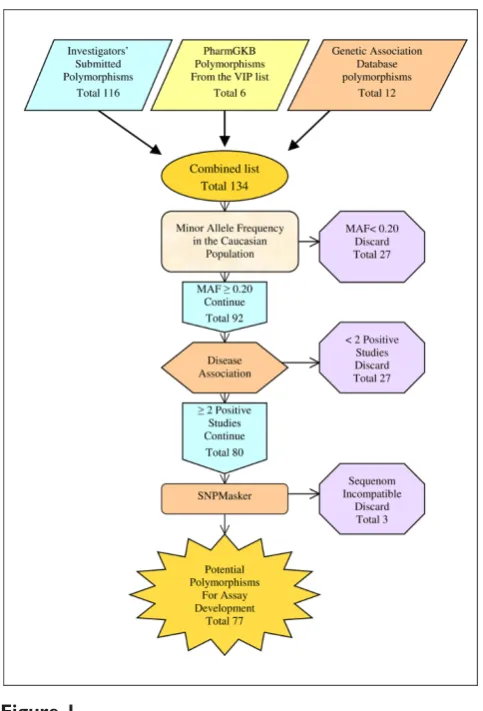
In order to obtain an initial list of potential polymorph-isms all of the investigators within the Marshfield Clinic Research Foundation were asked to submit polymorph-isms that were of interest. Garnering a list of 116 polymorphisms, these were tested with the above criteria before proceeding to assay design. In addition, this list was supplemented with polymorphisms from the PharmGKB [15] and Genetic Association Database [16].
The minor allele frequency in a Caucasian population was then confirmed using the published allele frequen-cies in dbSNP [17] to ensure that the polymorphism was common enough to be considered for inclusion in the panel. A Medline [18] search for disease associations was then performed for each polymorphism that met the frequency requirement. Any polymorphism that had an association with at least one disease in two separate preferably Caucasian populations was then allowed to progress to the next step.
Finally each polymorphism was masked using SNPmas-ker and evaluated for ease of adaptation to the Sequenom platform. The remaining polymorphisms were used in the Sequenom Assay Design 3.1 [19] program to develop a large multiplex assay. Several
assays with between 33–39 polymorphisms as well as
the sex marker AMG were created. A single assay of 40 total polymorphisms with at least one polymorphism on each chromosome was chosen for validation.
This study was reviewed and approved by the Marshfield Clinic Institutional Review Board.
Allele detection
Allele detection was carried out using the MALDI-TOF mass spectrometry method of allele determination on a Sequenom platform. Briefly this method of detection depends on the different molecular weights of the polymorphic regions to determine the allele. A multi-plexed PCR reaction is carried out on genomic DNA to amplify regions of interest. These products are then annealed with primers that are in the region directly adjacent to the polymorphism and a single base pair primer extension reaction is performed to generate the allele specific products. The products are then placed on a proprietary chip and analyzed using MALDI-TOF mass spectrometry and Sequenom Typer 3.4 software [20] to make the allele determination. A list of the PCR and detection primers is provided in additional file 1. Any of the automatic genotype determinations that were flagged as lower confidence or that the program failed to automatically determine were then double checked by a human to determine if manual allele calls could be made.
Assay validation
The 40 polymorphism fingerprinting assay was tested initially on a panel of 28 Caucasian HapMap samples from the CEPH population provided by Coriell. Our fingerprinting assay contained 32 polymorphisms that had been previously genotyped in this population; we compared our results with those released through the dbSNP Genotyping detail [21] or the cancer500 web site [22] to ensure genotyping accuracy. Further validation for accuracy and precision was completed by repeated assays using anonymous DNA extracted with our protocol from a Caucasian population. One final population of a further set of 21 CEPH samples was used to ensure accuracy of both the automated and manual genotype calls. Polymorphisms that were not automatically determined at least 80% of the time were excluded from the assay. The frequencies of the alleles and genotypes obtained with the assay were compared to the expected frequencies from dbSNP. Finally, the polymorphisms in the assay were checked for disagree-ment with Hardy Weinberg equilibrium; any poly-morphism that failed was excluded from the final assay.
Determination of individual discriminatory power
The expected allele frequencies were used to determine the potential power of the assay using the following equations for the probability of identity. We calculated the probability of identity [P(ID)] for the assay using two different equations. The first equation assumes the population is random and uses the product rule with Hardy-Weinberg equilibrium assumptions [23], and the second equation is more conservative and assumes the population is composed of siblings [24]. We performed these calculations assuming independent assortment of the alleles.
P ID pi p p
i
i j j i i
( )=
∑
+∑
∑
( )>
4 2
2 (1)
Psib ID pi p p
i
i i
i i
( )=0 25. +0 5.
∑
2+0 5. (∑
2 2) −0 25.∑
4(2)
Results
Polymorphism selection and assay design
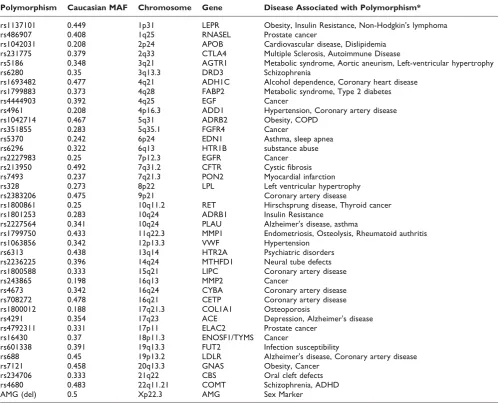
population was below 20%. Another 21 polymorphisms failed to pass the criteria of medical relevance. Finally, three more polymorphisms were eliminated after masking because of incompatibility with the Sequenom system. The remaining 77 polymorphisms were placed in the Sequenom Assay Design program and a single 40 polymorphism assay was created. The assay includes 39 polymorphisms that are medically relevant (see additional file 2 for the references used to determine medical relevance) with at least one polymorphism on each chromosome and the AMG gender marker. The polymorphisms used in the assay as well as the chromosome and associated gene are provided along with at least one associated disease state (Table 1).
Assay validation
A total of 3 polymorphisms (rs1693782, rs4444903, and rs1800012) did not achieve 80% automated call rate and
accuracy in the assay. The finalized validated assay consists of 37 polymorphisms, with the AMG sex marker and 36 medically relevant polymorphisms with repre-sentation on each chromosome (Table 1).
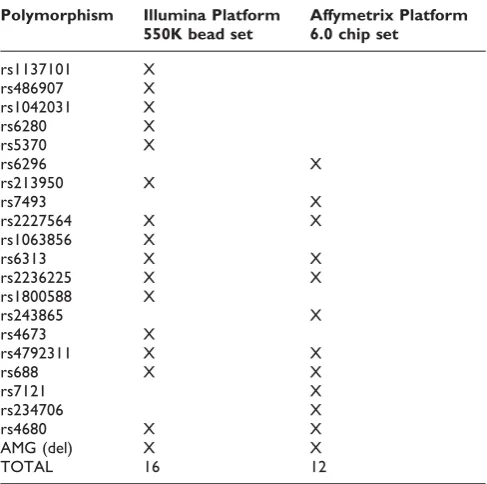
Since one of the goals of this assay is to provide a quality control mechanism for genotyping using a whole genome scan we assessed the panel for polymorphisms that were represented on either the Affymetrix 6.0 chip (with over a million polymorphisms) or the Illumina 550K bead set (with over half a million polymorph-isms). The fingerprint encompasses 16 polymorphisms that are on the Illumina 550K assay and 12 that are on the Affymetrix 6.0 chip assay with 7 polymorphisms in common to both platforms (Table 2).
Power of discrimination
Preliminary analysis of a hypothetical SNP panel suggested that 34 polymorphisms of an average minor allele frequency of 0.20 along with a sex marker would be needed to individually identify a biorepositiory of 20,000 samples. Here we have created a panel of 36 polymorphisms with an average MAF of 0.354667 and a sex marker. For the validated assay we obtained a P(ID) of 6.132 × 10⁻¹⁵and a Psib(ID) of 3.077 × 10⁻⁸.
To further ensure the assay could be used to uniquely identify our population we calculated the P(ID) and
Psib(ID) of the assay assuming that only polymorphisms
located farther than 50 megabases apart segregated independently. Finally we calculated the probability of identity using only the polymorphisms found on the Illumina and Affymetrix platforms, using only the polymorphisms limited to one or the other of these platforms individual identification of samples should be possible. Even using the most conservative Psib(ID) from the polymorphisms on the Affymetrix platform, 3.0 × 10⁻³, meaning 60 individuals in the population may not have unique patterns (Table 3).
Common Disease Coverage
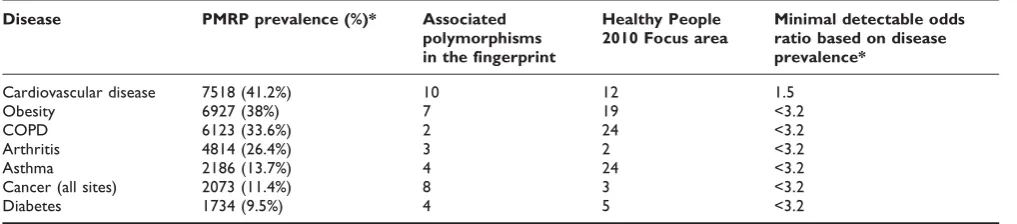
The second goal of the fingerprinting panel is to provide a resource for investigating the genetic components of common diseases. In order to ensure that the fingerprint assay developed here encompasses a wide range of diseases we compared the coverage of the assay with the 28 focus areas from healthy people 2010 [25]. Many of the focus areas such as cancer, heart disease, diabetes, obesity, and respiratory disease are well represented in the fingerprinting assay. Heart disease, the most pre-valent disease in the PMRP population and a high priority disease for healthy people 2010 is represented with 10 polymorphisms that may be important in the development or severity of disease (table 4). Based on
Figure 1
Schematic representation of the development the DNA fingerprinting assay. Schematic representation of the inclusion criteria for a polymorphism to be considered for the fingerprinting assay and the number of
the prevalence of these diseases in the population, the minimal detectable odds ratio for these polymorphisms is between 1.5 and 3.2 with the most prevalent disease (heart disease) having the lowest detectable odds ratio of 1.5 [26] (table 4).
As would be expected from a collection of medically relevant polymorphisms many of the genes represented in the assay share common pathways or substrates. Examples of pathways with more than one represented gene include the renin-angiotensinogen pathway with three genes (ACE, AGTR1, EGF), and the cholesterol maintenance pathway with four genes in the assay (APOB, CETP, LDLR, LPL, and FABP2). In addition, neurotransmitter pathways are represented by four
different genes; two serotonin receptors (COMT, DRD3) and two genes in the dopamine pathway (HTR2A, HTR1B). Furthermore three genes in the assay use folate as a substrate (MTHFD1, ENOSF1, CBS).
Discussion
As we usher in the era of genomic medicine, population based biorepositories linked to growing medical records will become important for translating genetic discoveries into medical practice. For these repositories to be of use, stringent quality control and assurance mechanisms must be established. Furthermore these repositories become the ideal place to test genetic associations that have been discerned in case control cohorts to determine
Table 1: Initial design of unique fingerprint assay using medically relevant polymorphisms
Polymorphism Caucasian MAF Chromosome Gene Disease Associated with Polymorphism*
rs1137101 0.449 1p31 LEPR Obesity, Insulin Resistance, Non-Hodgkin's lymphoma
rs486907 0.408 1q25 RNASEL Prostate cancer
rs1042031 0.208 2p24 APOB Cardiovascular disease, Dislipidemia rs231775 0.379 2q33 CTLA4 Multiple Sclerosis, Autoimmune Disease
rs5186 0.348 3q21 AGTR1 Metabolic syndrome, Aortic aneurism, Left-ventricular hypertrophy
rs6280 0.35 3q13.3 DRD3 Schizophrenia
rs1693482 0.477 4q21 ADH1C Alcohol dependence, Coronary heart disease rs1799883 0.373 4q28 FABP2 Metabolic syndrome, Type 2 diabetes
rs4444903 0.392 4q25 EGF Cancer
rs4961 0.208 4p16.3 ADD1 Hypertension, Coronary artery disease
rs1042714 0.467 5q31 ADRB2 Obesity, COPD
rs351855 0.283 5q35.1 FGFR4 Cancer
rs5370 0.242 6p24 EDN1 Asthma, sleep apnea
rs6296 0.322 6q13 HTR1B substance abuse
rs2227983 0.25 7p12.3 EGFR Cancer
rs213950 0.492 7q31.2 CFTR Cystic fibrosis
rs7493 0.237 7q21.3 PON2 Myocardial infarction rs328 0.273 8p22 LPL Left ventricular hypertrophy
rs2383206 0.475 9p21 Coronary artery disease
rs1800861 0.25 10q11.2 RET Hirschsprung disease, Thyroid cancer rs1801253 0.283 10q24 ADRB1 Insulin Resistance
rs2227564 0.341 10q24 PLAU Alzheimer's disease, asthma
rs1799750 0.433 11q22.3 MMP1 Endometriosis, Osteolysis, Rheumatoid authritis
rs1063856 0.342 12p13.3 VWF Hypertension
rs6313 0.438 13q14 HTR2A Psychiatric disorders rs2236225 0.396 14q24 MTHFD1 Neural tube defects rs1800588 0.333 15q21 LIPC Coronary artery disease
rs243865 0.198 16q13 MMP2 Cancer
rs4673 0.342 16q24 CYBA Coronary artery disease rs708272 0.478 16q21 CETP Coronary artery disease rs1800012 0.188 17q21.3 COL1A1 Osteoporosis
rs4291 0.354 17q23 ACE Depression, Alzheimer's disease rs4792311 0.331 17p11 ELAC2 Prostate cancer
rs16430 0.37 18p11.3 ENOSF1/TYMS Cancer
rs601338 0.391 19q13.3 FUT2 Infection susceptibility
rs688 0.45 19p13.2 LDLR Alzheimer's disease, Coronary artery disease
rs7121 0.458 20q13.3 GNAS Obesity, Cancer
rs234706 0.333 21q22 CBS Oral cleft defects
rs4680 0.483 22q11.21 COMT Schizophrenia, ADHD
AMG (del) 0.5 Xp22.3 AMG Sex Marker
the disease burden in an unselected population. In this paper we described the development of a single assay of 36 medically relevant polymorphisms and a sex marker that will be used to uniquely identify samples in the Personalized Medicine Research Project cohort and simultaneously provide investigators with information on medically relevant polymorphisms for a wide array of diseases. Furthermore we determined which of these polymorphisms were present on the two most popular platforms used for whole genome association, Illumina and Affymetrix, to ensure the panel would be adequate for determining sample handling errors in shipping and genotyping.
Quality control and assurance of biorepositories involves an integrated program of both minimization of potential errors and testing for potential sample problems to quickly rectify errors. The PMRP bioreposi-tory incorporates automation through an in house
developed system for specimen acquisition and the
Nautilis® system for specimen tracking. However,
auto-mation is only one aspect of a comprehensive sample assurance program. This newly developed assay will be used for determining the ability of the DNA to be used for genotyping. In addition it will allow us to determine an estimate of error rates in our sample acquisition. We will compare the genotyped sex with the expected sex from the medical record to ensure a match. In addition, we will use known trios and pedigrees to compare individual samples for instances of non-maternity and non-paternity as potential indicators of sample identifi-cation error. Because of the unique ability of PMRP to re-contact subjects, as samples are exhausted or potential errors are identified, new samples can be acquired and verified using existing information to confirm sample identity. This ensures that each sample can be correctly attributed to an individual each time a new sample is drawn.
The number of polymorphisms used for our assay compares favourably to panels that have been used for other applications. In order to ensure that our goal of using the fingerprinting assay for individual identifica-tion of the PMRP cohort was met, we determined the
P(ID) and Psib(ID) of the assay. Even using the most
conservative estimates of the assay we can correctly identify approximately three million samples. SNP panels used for forensic applications have ranged from 20 to 52 SNPs [10,11,13]. A test of SNP panels used to identify cell lines included panels of 80, 60, 40, and 20 SNPs with the conclusion that 20 SNPs did not discriminate adequately however any of the most frequent 40 polymorphisms would provide adequate power of discrimination. From this assumption an assay of 34 polymorphisms with individual identification ability was developed [12].
Our assay is unique not only because we used only medically relevant polymorphisms but also because we developed the assay with a polymorphism on every chromosome and included polymorphisms on a number of popular genotyping platforms. Even using the most
Table 2: Fingerprinting polymorphisms on either the Illumina or Affymetrix platform
Polymorphism Illumina Platform 550K bead set
Affymetrix Platform 6.0 chip set
rs1137101 X
rs486907 X
rs1042031 X
rs6280 X
rs5370 X
rs6296 X
rs213950 X
rs7493 X
rs2227564 X X
rs1063856 X
rs6313 X X
rs2236225 X X
rs1800588 X
rs243865 X
rs4673 X
rs4792311 X X
rs688 X X
rs7121 X
rs234706 X
rs4680 X X
AMG (del) X X
TOTAL 16 12
Table 3: Probability of identity for the validated fingerprinting assay
Polymorphism group Total number of Polymorphisms
Probability of identity P(ID)
Probability of identity (siblings) Psib(ID)
Validated fingerprinting assay 37 6.132 × 10⁻¹⁵ 3.077 × 10-08
Conservative validated fingerprinting assay* 32 4.906 × 10⁻¹³ 2.947 × 10-07 Polymorphisms on the Illumina platform (550K) 16 5.844 × 10-07 4.075 × 10-04 Polymorphisms on the Affymetrix platform (6.0 chip) 12 2.649 × 10-05 3.004 × 10-03
conservative estimate of Psib(ID) and only the poly-morphisms on the Affymetrix platform we would have few potential incorrectly identified samples, and these samples could easily be further identified by ascertaining the genotype calls polymorphisms in linkage disequili-brium with polymorphisms that are on the fingerprint-ing assay. This ensures that any sample handlfingerprint-ing errors that are potentially introduced in shipping the samples or receiving data from other laboratories can be detected when genotyping results are entered into our database. By comparing returned genotypes with previously determined genotypes provides a quality check for any data that is generated externally. Using the assay in this manner provides an opportunity to correct sample errors or questionable calls from genotyping before samples are linked with phenotypic medical information.
Because of the dual nature of the assay several potential limitations arise. The stringent dual criteria of medical relevance and high minor allele frequency have the potential to limit the usefulness of the assay for both goals. One of the limitations of the assay we developed is that only the European Caucasian MAF was considered as a selection criterion. The PMRP biospecimens are overwhelmingly Caucasian therefore this is appropriate for our application, however this emphasis may decrease the applicability of this assay to other populations. Using the allele frequencies for Asian and African populations from dbSNP 6 polymorphisms in the assay fell below 10% MAF in Africans and 2 polymorph-isms were below 10% in Asian populations. Identifica-tion panels developed for forensic applicaIdentifica-tions generally consider a large number of different ethnicities when creating the panel to ensure correct identifications across populations [10,11,13]. At this time, we have no reason to believe that the choice of medically relevant poly-morphisms inherently biased the assay toward the Caucasian population and preliminary analysis of estimated allele frequencies in other populations would suggest the fingerprinting assay to be robust for other populations. Myles et al. [27] recently tested allele
frequencies across populations for disease associated SNPs and determined they vary no more across popula-tions than randomly chosen SNPs. However any poly-morphism can have varying allele frequencies among different populations and until the allele frequencies for our polymorphisms are verified in other populations we cannot determine how useful it would be for non-Caucasians.
Another limitation for the assay is that the medical relevance of the assay could be limited. Many medically relevant polymorphisms are less frequent in the popula-tion than 20%. For instance polymorphisms in the ApoE alleles are highly medically relevant with many pleio-tropic effects on disease [28], however they have a minor allele frequency of 0.18 and 0.02 [21], and therefore were excluded from consideration. In addition, because of the evolving nature of gene disease discovery it is possible that some of the polymorphisms we included in the assay will later be determined to have little medical value. For instance, the polymorphism chosen in the RET gene while associated with disease, has only been associated in small studies [29,30]. Furthermore, newly associated medically relevant polymorphisms such as the cancer susceptibility locus on chromosome 8q24 [31] were not included in the assay because assay construc-tion began before this region was known. Finally, because we focused on including polymorphisms from a range of diseases, it is likely that investigators will need to perform more genotyping for any comprehensive study of disease-gene interactions.
By using a limited number of commonly occurring polymorphisms as an identification panel and main-taining strict access to individual genotyping results, the panel avoids the potential legal and ethical burden of using a forensic panel, does not expose the population to increased identification risk, and may provide insight into population wide allele frequencies. As with any population wide genotyping, the manner of reporting the genotypes must be taken into consideration to
Table 4: Common diseases in the PMRP cohort and polymorphism coverage of these diseases
Disease PMRP prevalence (%)* Associated polymorphisms in the fingerprint
Healthy People 2010 Focus area
Minimal detectable odds ratio based on disease prevalence*
Cardiovascular disease 7518 (41.2%) 10 12 1.5
Obesity 6927 (38%) 7 19 <3.2
COPD 6123 (33.6%) 2 24 <3.2
Arthritis 4814 (26.4%) 3 2 <3.2
Asthma 2186 (13.7%) 4 24 <3.2
Cancer (all sites) 2073 (11.4%) 8 3 <3.2
Diabetes 1734 (9.5%) 4 5 <3.2
minimize the risk of unintended identification. The genotypes created by this fingerprinting assay will be publicly reported only as population wide allele frequencies. Disease associated polymorphisms have been reported in this manner for a number of different populations, most recently the NHANES III population [32] and the CLUE I and CLUEII populations [33]. Even with the recent revelations regarding the ability to discern individual DNA contribution to a mixture, the number of potentially reported polymorphisms from this assay, 36, is well under the smallest estimate of 10,000 needed to discern an individual in a mixture of 0.1%[34]. Individual genotypes are stored in a secure server and not publically available. The PMRP consent form and study guidelines require any investigator that requests indivi-dual genomic information for any reason to have an IRB approved protocol before data is released [3].
Despite the potential limitations of the panel, we have demonstrated that an identification panel can be created using only medically relevant polymorphisms. Such panels could be created with disease specific polymorph-isms and used in the future not only to identify samples but potentially to access an individual's genetic risk of a disease We are currently using this panel for QA/QC purposes on the DNA samples in the PMRP repository. In the future we intend to test these polymorphisms for association with disease in the entire PMRP population to determine their medical relevance in our population. In the future this panel or other rationally designed panels can be used on large populations not only as a quality control measure but also to begin to translate the results from the large genome wide studies into clinical practice. Because this panel includes polymorphisms that are relevant in a wide range of diseases the information gained from genotyping the entire PMRP population will be used to help facilitate population based research.
Conclusion
We created a single panel of 36 somatic polymorphisms and a sex marker with the ability to discriminate individuals in a large biorepository (of potentially over 100,000,000 samples) using only common medically relevant polymorphisms. These polymorphisms are currently represented on a number of common genotyp-ing platforms makgenotyp-ing QA/QC flexible enough to accommodate a large number of studies. In addition this panel can serve as a resource for investigators who are interested in the effects of disease in a population particularly for common diseases.
Competing interests
The authors declare that they have no competing interests.
Authors' contributions
DC – Was responsible for determining polymorphism
allele frequencies, determining polymorphism medical relevance, supervising the project, approving the assay
design, and writing the manuscript. LI–Was responsible
for designing the assay, Sequenom implementation, and
validation. CM–Was responsible for project conception,
advice for project implementation. All authors have read and approved the final manuscript.
Additional material
Additional file 1
List of all primers used with the Sequenom assay. Excel file of the PCR primers and extension primers used for the Sequenom fingerprinting assay.
Click here for file
[http://www.biomedcentral.com/content/supplementary/1755-8794-2-17-S1.xls]
Additional file 2
Annotated bibliography for all of the polymorphisms used in the fingerprinting assay. Annotated bibliography used to determine medical relevance of the polymorphisms in the fingerprinting assay. Each polymorphism must be associated with disease in two independent populations.
Click here for file
[http://www.biomedcentral.com/content/supplementary/1755-8794-2-17-S2.doc]
Acknowledgements
This study was supported by grant 1UL1RR025011 from the Clinical and Translational Science Award (CTSA) program of the National Center for Research Resources, National Institutes of Health
The authors would like to acknowledge the Genetics Core Laboratory of the Marshfield Clinic Research Foundation, Elisha Bergmann, Sherri Reisner, and Valerie Roehrs for their sample handling, preparation, and support. In addition we would like to thank Yvonne Cerne for her graphics support.
References
1. Seng K and Seng C: The success of the genome-wide association approach: a brief story of a long struggle.Eur J Hum Genet2008,16:554–64.
2. Personalized Health Care: Opportunities, Pathways, Resources. Department of Health and Human Services, U.S.A.; 2007 http://www.hhs.gov/myhealthcare/news/phc-report.pdf. 3. McCarty CA, Wilke RA, Giampietro PF, Wesbrook SD and
Caldwell MD: Marshfield Clinic Personalized Medicine Research Project (PMRP):design, methods and recruitment for a population-based biobank.Personalized Med2005,2:49–79. 4. Roden D, Pulley J, Basford M, Bernard G, Clayton E, Balser J and Masys D:Development of a Large-Scale De-Identified DNA Biobank to Enable Personalized Medicine.Clin Pharmacol Ther 84:362–369.
5. Compton C: The biospecimen as the key to personalizing medicine.Personalized Med2007,4:385–387.
6. Lacroix M:Persistent use of "false" cell lines.Int J Cancer2008, 1:1–4.
8. McCarty CA, Peissig P, Caldwell MD and Wilke RA: The Marshfield Clinic Personalized Medicine Research Project: 2008 scientific update and lessons learned in the first 6 years. Personalized Med2008,5:529–541.
9. Elliott P and Peakman TC: The UK Biobank sample handling and storage protocol for the collection, processing and archiving of human blood and urine. Int J Epidemiol 2008, 37:234–44.
10. Pakstis AJ, Speed WC, Kidd JR and Kidd KK:Candidate SNPs for a universal individual identification panel. Hum Genet 2007, 121:305–17.
11. Kidd KK, Pakstis AJ, Speed WC, Grigorenko EL, Kajuna SL, Karoma NJ, Kungulilo S, Kim JJ, Lu RB, Odunsi A, Okonofua F, Parnas J, Schulz LO, Zhukova OV and Kidd JR:Developing a SNP panel for forensic identification of individuals.Forensic Sci Int 2006,164:20–32.
12. Demichelis F, Greulich H, Macoska JA, Beroukhim R, Sellers WR, Garraway L and Rubin MA: SNP panel identification assay (SPIA): a genetic-based assay for the identification of cell lines.Nucleic Acids Res2008,36:2446–56.
13. Sanchez JJ, Phillips C, Børsting C, Balogh K, Bogus M, Fondevila M, Harrison CD, Musgrave-Brown E, Salas A, Syndercombe-Court D, Schneider PM, Carracedo A and Morling N: A multiplex assay with 52 single nucleotide polymorphisms for human identi-fication.Electrophoresis2006,27:1713–24.
14. Wellcome Trust Case Control Consortium: Genome-wide association study of 14,000 cases of seven common diseases and 3,000 shared controls.Nature2007,447:661–78.
15. Thorn CF, Klein TE and Altman RB: PharmGKB: the pharma-cogenetics and pharmacogenomics knowledge base.Methods Mol Biol2005,311:179–91 http://www.pharmgkb.org/index.jsp. 16. Becker KG, Barnes KC, Bright TJ and Wang SA: The genetic
association database. Nat Genet 2004, 36(5):431–2 http:// geneticassociationdb.nih.gov/.
17. Sherry ST, Ward M and Sirotkin K:dbSNP-database for single nucleotide polymorphisms and other classes of minor genetic variation. Genome Res 1999, 9:677–9 http://www.ncbi. nlm.nih.gov/projects/SNP/.
18. PubMed. http://www.ncbi.nlm.nih.gov/sites/entrez/.
19. MassARRAY®Assay Design Software 3.1.Sequenom corp. San Diego, California; .
20. MassARRAY®Typer 3.4 Software.Sequenom corp. San Diego, California; .
21. Genotype Query Form – Beta. http://www.ncbi.nlm.nih.gov/ projects/SNP/snp_gf.cgi?pg=2&RSPick=1&tax_id=9606&RS-list=486907.
22. Cancer Genome Anatomy Project SNP500Cancer Data-b a s e . h t t p : / / s n p 5 0 0 c a n c e r . n c i . n i h . g o v / h o m e _ 1 . c f m ? CFID=2111817&CFTOKEN=11851595.
23. Li CC:First Course in Population GeneticsBoxwood, Pacific Grove, CA; 1976.
24. Evett IW and Weir BS:Interpreting DNA Evidence: Statistical Genetics for Forensic ScientistsSinauer, Sunderland; 1998.
25. Data 2010... the healthy people 2010 database. http://www. cdc.gov/nchs/about/otheract/hpdata2010/2010fa28.htm.
26. McCarty CA, Mukesh BN, Giampietro PF and Wilke RA:Healthy People 2010 disease prevalence in the Marshfield Clinic Personalized Medicine Research Project cohort:opportu-nities for public health genomic research.Personalized Medicine 2007,4:183–190.
27. Myles S, Davison D, Barrett J, Stoneking M and Timpson N: Worldwide population differentiation at disease-associated SNPs.BMC Med Genomics2008,1:22.
28. Jofre-Monseny L, Minihane AM and Rimbach G: Impact of apoE genotype on oxidative stress, inflammation and disease risk. Mol Nutr Food Res2008,52:131–45.
29. Severskaia NV, Saenko VA, Il'in AA, Chebotareva IV, Rumiantsev PO, Isaev PA, Medvedev VS and Iasmita S:[RET and GFRA1 germline polymorphisms in medullary thyroid cancer patients].Mol Biol (Mosk)2006,40:425–35.
30. Sangkhathat S, Kusafuka T, Chengkriwate P, Patrapinyokul S, Sangthong B and Fukuzawa M: Mutations and polymorphisms of Hirschsprung disease candidate genes in Thai patients. J Hum Genet2006,51:1126–32.
31. Ghoussaini M, Song H, Koessler T, Al Olama AA, Kote-Jarai Z, Driver KE, Pooley KA, Ramus SJ, Kjaer SK, Hogdall E, DiCioccio RA, Whittemore AS, Gayther SA, Giles GG, Guy M, Edwards SM, Morrison J, Donovan JL, Hamdy FC, Dearnaley DP, Ardern-Jones AT, Hall AL, O'Brien LT, Gehr-Swain BN, Wilkinson RA, Brown PM, Hopper JL, Neal DE, Pharoah PD, Ponder BA, Eeles RA,
Easton DF, Dunning AM and UK Genetic Prostate Cancer Study Collaborators/British Association of Urological Surgeons' Section of Oncology; UK ProtecT Study Collaborators: Multiple loci with different cancer specificities within the 8q24 gene desert.J Natl Cancer Inst2008,100:962–6.
32. Chang MH, Lindegren ML, Butler MA, Chanock SJ, Dowling NF, Gallagher M, Moonesinghe R, Moore CA, Ned RM, Reichler MR, Sanders CL, Welch R, Yesupriya A, Khoury MJ and CDC/NCI NHANES III Genomics Working Group: Prevalence in the United States of selected candidate gene variants: Third National Health and Nutrition Examination Survey, 1991– 1994.Am J Epidemiol2009,169:54–66.
33. Huang HY, Thuita L, Strickland P, Hoffman SC, Comstock GW and Helzlsouer KJ: Frequencies of single nucleotide polymorph-isms in genes regulating inflammatory responses in a community-based population.BMC Genet2007,8:7.
34. Homer N, Szelinger S, Redman M, Duggan D, Tembe W, Muehling J, Pearson JV, Stephan DA, Nelson SF and Craig DW: Resolving individuals contributing trace amounts of DNA to highly complex mixtures using high-density SNP genotyping microarrays.PLoS Genet2008,4:e1000167.
Pre-publication history
The pre-publication history for this paper can be accessed here:
http://www.biomedcentral.com/1755-8794/2/17/prepub
Publish with BioMed Central and every
scientist can read your work free of charge
"BioMed Central will be the most significant development for disseminating the results of biomedical researc h in our lifetime."
Sir Paul Nurse, Cancer Research UK
Your research papers will be:
available free of charge to the entire biomedical community
peer reviewed and published immediately upon acceptance
cited in PubMed and archived on PubMed Central
yours — you keep the copyright
Submit your manuscript here:
http://www.biomedcentral.com/info/publishing_adv.asp