https://doi.org/10.5194/gmd-11-3447-2018 © Author(s) 2018. This work is distributed under the Creative Commons Attribution 4.0 License.
Portable multi- and many-core performance for finite-difference or
finite-element codes – application to the free-surface component of
NEMO (NEMOLite2D 1.0)
Andrew R. Porter1, Jeremy Appleyard2, Mike Ashworth1, Rupert W. Ford1, Jason Holt3, Hedong Liu3, and Graham D. Riley4
1Science and Technology Facilities Council, Daresbury Laboratory, Warrington, UK 2NVIDIA Corporation, Green Park, Reading, UK
3National Oceanography Centre, Liverpool, UK
4School of Computer Science, University of Manchester, Manchester, UK Correspondence:Andrew Porter ([email protected])
Received: 23 June 2017 – Discussion started: 13 July 2017
Revised: 11 October 2017 – Accepted: 17 July 2018 – Published: 27 August 2018
Abstract. We present an approach which we call PSyKAl that is designed to achieve portable performance for paral-lel finite-difference, finite-volume, and finite-element earth-system models. In PSyKAl the code related to the underlying science is formally separated from code related to paralleliza-tion and single-core optimizaparalleliza-tions. This separaparalleliza-tion of con-cerns allows scientists to code their science independently of the underlying hardware architecture and for optimiza-tion specialists to be able to tailor the code for a particular machine, independently of the science code. We have taken the free-surface part of the NEMO ocean model and cre-ated a new shallow-water model named NEMOLite2D. In doing this we have a code which is of a manageable size and yet which incorporates elements of full ocean models (input/output, boundary conditions, etc.). We have then man-ually constructed a PSyKAl version of this code and inves-tigated the transformations that must be applied to the mid-dle, PSy, layer in order to achieve good performance, both serial and parallel. We have produced versions of the PSy layer parallelized with both OpenMP and OpenACC; in both cases we were able to leave the natural-science parts of the code unchanged while achieving good performance on both multi-core CPUs and GPUs. In quantifying whether or not the obtained performance is “good” we also consider the lim-itations of the basic roofline model and improve on it by gen-erating kernel-specific CPU ceilings.
1 Introduction
The challenge presented to the developers of scientific soft-ware by the drive towards exascale computing is consider-able. With power consumption becoming the overriding de-sign constraint, CPU clock speeds are falling and the com-plex multi-purpose compute core is being replaced by mul-tiple simpler cores. This philosophy can be seen at work in the rise of so-called accelerator-based machines in the Top 500 List of supercomputers (http://www.top500.org/, last ac-cess: June 2017): six of the top-ten machines in the Novem-ber 2016 list make use of many-core processors (Intel Xeon Phi, NVIDIA GPU, or NRCPC SW26010). Two of the re-maining four machines are IBM Blue Gene/Qs, the CPU of which has hardware support for running 64 threads.
these different technologies require different programming approaches.
In a previous paper (Porter et al., 2016) we introduced a possible approach to tackling this problem which we term PSyKAl (discussed below). In that work we consid-ered the implications for serial performance of the extensive code restructuring required by the approach when applied to the “Shallow” shallow-water model (https://puma.nerc.ac. uk/trac/GOcean, last access: June 2017). We found that al-though the restructuring did initially incur a sizeable perfor-mance penalty, it was possible to transform the resulting code to recover performance (for a variety of CPU/compiler com-binations) while obeying the PSyKAl separation of concerns. In this work we move to look at portable parallel perfor-mance within the PSyKAl approach.
1.1 The PSyKAl approach
The PSyKAl approach attempts to address the problems de-scribed in the previous section. It separates code into three layers: the Algorithm layer, the PSy layer, and the Ker-nel layer. The approach has been developed in the GungHo project (Ford et al., 2015), which is creating a new dynami-cal core for the UK Met Office, and its design has been influ-enced by earlier work on OP2 (Bertolli et al., 2012; Rathge-ber et al., 2012) – see Sect. 1.2 for more details.
While the PSyKAl approach is general, we are currently applying it to atmosphere and ocean models written in For-tran where domain decomposition is typically performed in the latitude–longitude dimension, leaving columns of ele-ments on each domain-decomposed partition.
The top layer, in terms of calling hierarchy, is the Algo-rithm layer. This layer specifies the algoAlgo-rithm that the sci-entist would like to perform (in terms of calls to kernel and infrastructure routines) and logically operates on full fields. We say logically here as the fields may be domain decom-posed; however, the Algorithm layer is not aware of this. It is the scientist’s responsibility to write this Algorithm layer.
The bottom layer, in terms of calling hierarchy, is the Ker-nel layer. The KerKer-nel layer implements the science that the Algorithm layer calls, as a set of subroutines. These kernels operate on fields that are local to the process doing the com-putation. (Depending on the type of kernel, these may be a set of elements, a single column of elements, or a set of columns.) Again the scientist is responsible for writing this layer and there is no parallelism specified here, but, depend-ing on the complexity of the kernels, there may be input from an High Performance Computing (HPC) expert and/or some coding rules to help ensure that the kernels compile into effi-cient code.
The PSy layer sits in-between the Algorithm and Kernel layers and its functional role is to link the algorithm calls to the associated kernel subroutines. As the Algorithm layer works on logically global fields and the Kernel layer works on local fields, the PSy layer is responsible for iterating over
columns. It is also responsible for including any distributed-memory operations resulting from the decomposition of the simulation domain, such as halo swaps and reductions.
As the PSy layer iterates over columns, the single-core performance can be optimized by applying transformations such as manipulation of loop bounds (e.g. padding for sin-gle instruction multiple data (SIMD) instructions) and ker-nel in-lining. Additionally, the potential parallelism within this iteration space can also be exploited and optimized. The PSy layer can therefore be tailored for a particular hardware (such as multi-core, many-core, GPUs, or some combination thereof) and software (such as compiler, operating system, message passing interface (MPI) library, etc.) configuration with no change to the Algorithm or Kernel layer code. This approach therefore offers the potential for portable perfor-mance. In this work we apply optimizations to the PSy layer manually. The development of a tool to automate this process will be the subject of a future paper.
Clearly the separation of code into distinct layers may have an effect on performance. This overhead – how to get back to the performance of a parallel, hand-optimized code, and potentially improve on it – will be discussed in the remainder of this paper.
1.2 Related approaches
This paper is concerned with the implications of PSyKAl as a design for code architecture. The implementation of an as-sociated tool (which we have named “PSyclone”) for gener-ating the middle, PSy, layer will be the subject of a future pa-per. However, comparison with other approaches necessarily involves discussing other tools rather than simply architec-tures.
As already mentioned, our approach is heavily influenced by the OP2 system (Bertolli et al., 2012; Rathgeber et al., 2012). In common with OP2, the PSyKAl approach sepa-rates out the science code and the performance-related code into distinct layers. The calls that specify parallelism in both approaches are similar in terms of where they are placed in the code and in their semantics. However, the PSyKAl ap-proach supports the specification of more than one kernel in a parallel region of code, compared with one for OP2, giv-ing more scope for optimization. In addition, the metadata describing a kernel is included with the kernel code in the PSyKAl approach, whereas it is provided as a part of the ker-nel call in OP2.
in the case of GridTools, support both CPU and GPU archi-tectures. This ability to generate kernels specific to a given computer architecture is a powerful feature. However, with this power comes the responsibility of providing domain sci-entists with the necessary functionality to describe all con-ceivable kernel operations as well as a programming inter-face with which they are comfortable.
The PSyKAl, GridTools, and Firedrake approaches are all based on the concept of (various flavours of) a domain-specific language (DSL) for difference and finite-element applications. This is distinct from other, lower-level abstractions such as Kokkos (Edwards et al., 2014) and OCCA (Medina et al., 2015) where the aim is to provide a language that permits a user to implement a kernel just once and have it compile to performant code on a range of multi-and many-core devices. One could imagine using such ab-stractions to implement kernels for the PSyKAl, GridTools, and Firedrake approaches rather than using, for example, OpenMP or CUDA directly. A summary of all of these ap-proaches is presented in Table 1.
1.3 The NEMOLite2D programme
For this work we have used the NEMOLite2D pro-gramme, developed by ourselves (https://puma.nerc.ac.uk/ trac/GOcean). NEMOLite2D is a vertically averaged ver-sion of NEMO (Nucleus for European Modelling of the Ocean; Madec, 2014), retaining only its dynamical part. The whole model system is represented by one continuity equa-tion (Eq. 1; for the update of the sea-surface height) and two vertically integrated momentum equations (Eq. 2; for the two velocity components).
∂ζ
∂t +∇·(Uh)=0, (1)
∂Uh
∂t +U·∇(Uh)= −gh∇ζ−2h×u+νh1U, (2)
whereζ andUrepresent the sea-surface height and horizon-tal velocity vectors, respectively;his the total water depth;
is the Earth rotation velocity vector;gis the acceleration due to gravity; andνis the kinematic viscosity coefficient.
The external forcing includes surface wind stress, bottom friction, and open-boundary barotropic forcing. A lateral-slip boundary condition is applied along the coast lines. The open boundary condition can be set as a clipped or Flather’s radi-ation condition (Flather, 1976). The bottom friction takes a semi-implicit form for the sake of model stability. As done in the original version of NEMO, a constant or Smagorin-sky horizontal viscosity coefficient is used for the horizontal viscosity term.
The traditional Arakawa C structured grid is employed here for the discretization of the computational domain. A
two-dimensional integer array is used to identify the differ-ent parts of the computational domain; it has the value of 1 for ocean, 0 for land, and−1 for ocean cells outside of the computational domain. This array enables the identification of ocean cells, land cells, solid boundaries, and open bound-aries.
For the sake of simplicity, the explicit Eulerian forward-time-stepping method is implemented here, except that the bottom friction takes a semi-implicit form. The Coriolis force can be set in explicit or implicit form. The advection term is computed with a first-order upwind scheme.
The sequence of the model computation is as follows: 1. Set the initial conditions (water depth, sea surface
height, velocity);
2. integrate the continuity equation for the new sea surface height;
3. update the different terms in the right hand side of the momentum equations; advection, Coriolis forcing (if set in explicit form), pressure gradient, and horizontal vis-cosity;
4. update the velocity vectors by summing up the values in (3), and implicitly with the bottom friction and Coriolis forcing (if set in implicit form);
5. apply the boundary conditions on the open- and solid-boundary cells.
Since any real oceanographic computational model must output results, we ensure that any PSyKAl version of NEMOLite2D retains the Input/Output capability of the orig-inal. This aids in limiting the optimizations that can be per-formed on the PSyKAl version to those that should also be applicable to full oceanographic models. Note that although we retain the I/O functionality, all of the results presented in this work carefully exclude the effects of I/O since it is compute performance that interests us here.
In the Algorithm layer, fields (and grids) are treated as logically global objects. Therefore, as part of creating the PSyKAl version of NEMOLite2D, we represent fields with derived types instead of arrays in this layer. These types then hold information about the associated mesh and the ex-tents of “internal” and “halo” regions as well as the data ar-rays themselves. This frees the natural scientist from hav-ing to consider these issues and allows for a certain degree of flexibility in the actual implementation (e.g. padding for alignment or increasing array extent to allow for other opti-mizations). The support for this is implemented as a library (which we term the GOcean Infrastructure) and is common to the PSyKAl versions of both NEMOLite2D and Shallow.
Table 1.An overview of the functionality of similar approaches. Static compilation here means that all code is compiled before programme execution is begun.
Approach DSL MPI Threading Data layout Kernels Language Compilation PSyKAl Yes Yes Yes Fixed User-supplied Fortran Static GridTools Yes No Yes Flexible Generated C++ Static Firedrake Yes Yes No Fixed Generated C with Python interface Runtime Kokkos No No Yes Flexible User-supplied C++ Static OCCA No No Yes Fixed User-supplied C (Python & Fortran interfaces) Runtime
Figure 1.A schematic of the top-level of the PSyKAl version of the NEMOLite2D code. The kernels listed as arguments to theinvoke
call specify the operations to be performed.
the potential for optimization of the PSy layer. This restruc-turing gave eight distinct kernels, each of which updates a single field at a single point (since we have chosen to use point-wise kernels). With a little bit of tidying and restruc-turing, we found it was possible to express the contents of the main time-stepping loop as a single invoke (a call to the PSy layer) and a call to the I/O system (Fig. 1). The sin-gle invoke gives us a sinsin-gle PSy-layer routine which consists of applying each of the kernels to all of the points requir-ing an update on the model mesh. In its basic unoptimized (“vanilla”) form, this PSy-layer routine then contains a dou-bly nested loop (over the two dimensions of the model grid) around each kernel call.
As with any full oceanographic model, boundary condi-tions must be applied at the edges of the model domain. Since NEMOLite2D applies external boundary conditions (e.g. barotropic forcing), this is done via user-supplied ker-nels.
2 Methodology
Our aim in this work is to achieve portable performance, es-pecially between multi-core CPU and many-core GPU sys-tems. Consequently, we have performed tests on both an Intel Ivy Bridge CPU (E5-2697 at 2.7 GHz) and on an NVIDIA Tesla K40 GPU. On the Intel-based system we have used the Gnu, Intel, and Cray Fortran compilers (versions 4.9.1, 15.0.0.090, and 8.3.3, respectively). The code that made use of the GPU was compiled using version 15.10 of the PGI compiler.
We first describe the code transformations performed for the serial version of NEMOLite2D. We then move on to the
Table 2.The compiler flags used in this work.
Compiler Flags
Gnu -Ofast -mtune=native -finline-limit=50000 Intel -O3 -fast -fno-inline-factor -xHost Cray -O3 -O ipa5 -h wp
PGI -acc -ta=tesla,cc35,nordc
-Mcuda=maxregcount:80,loadcache:L1
construction of parallel versions of the code using OpenMP and OpenACC. Again, we describe the key steps we have taken in this process in order to maximize the performance of the code. In both cases our aim is to identify those trans-formations which must be supported by a tool which seeks to auto-generate a performant PSy layer.
2.1 Transformations of serial NEMOLite2D
In Table 2 we give the optimization flags used with each com-piler. For the Gnu and Intel compilers, we include flags to encourage in-lining of kernel bodies. The Intel flag “-xHost” enables the highest level of SIMD vectorization supported by the host CPU (AVX in this case). The Intel flag “-fast” and Cray flags “-O ipa5” and “-h wp” enable inter-procedural op-timization.
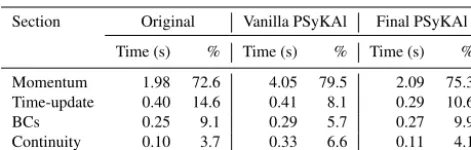
Table 3.The performance profile of the original and PSyKAl ver-sions of NEMOLite2D on the Intel Ivy Bridge CPU (for 2000 time steps of the 1282domain and the Intel compiler).
Section Original Vanilla PSyKAl Final PSyKAl Time (s) % Time (s) % Time (s) % Momentum 1.98 72.6 4.05 79.5 2.09 75.3 Time-update 0.40 14.6 0.41 8.1 0.29 10.6 BCs 0.25 9.1 0.29 5.7 0.27 9.9 Continuity 0.10 3.7 0.33 6.6 0.11 4.1
Beginning with the vanilla PSyKAl version, we then apply a series of code transformations while obeying the PSyKAl separation of concerns, i.e. optimization is restricted to the middle, PSy, layer and leaves the kernel and algorithm layers unchanged. The aim of these optimizations is to recover, as much as is possible, the performance of the original version of the code. The transformations we have performed and the reasons for them are described in the following sections. 2.1.1 Constant loop bounds
In the vanilla PSy layer, the lower and upper bounds for each loop over grid points are obtained from the relevant com-ponents of the derived type representing the field being up-dated by the kernel being called from within the loop. In our previous work (Porter et al., 2016) we found that the Cray compiler in particular produced more performant code if we changed the PSy layer such that the array extents are looked up once at the beginning of the PSy routine and then used to specify the loop bounds. We have therefore applied that transformation to the PSy layer of NEMOLite2D.
2.1.2 Addition ofsafe_addressdirectives
Many of the optimizations we have performed have been in-formed by the diagnostic output produced by either the Cray or Intel compilers. Many of the NEMOLite2D kernels con-tain conditional statements. These statements are there to check whether, for example, the current grid point is wet or neighbours a boundary point. A compiler is better able to op-timize such a loop if it can be sure that all array accesses within the body of the loop are safe for every trip, irrespec-tive of the conditional statements. In its diagnostic output the Cray compiler notes this with messages of the form:
A loop starting at line 448 would benefit from "!dir$ safe_address".
Originally, all fields were only allocated the bare mini-mum of storage and the conditional statements within ker-nels prevented out-of-bounds accesses, e.g. at the edge of the simulation domain. We subsequently altered the GOcean infrastructure to allocate all field-data arrays with extents greater than strictly required. This enabled us to safely add thesafe_addressbefore all of the loops where the Cray
compiler indicated it might be useful (the Momentum loops and some of the boundary condition (BC) loops).
2.1.3 In-line Momentum kernel bodies into middle layer
The profiling data in Table 3 shows that it is the Momentum section that accounts for the bulk of the model runtime. We therefore chose to attempt to optimize this section first. In-keeping with the PSyKAl approach, we are only permitted to optimize the middle (PSy) layer, which for this section com-prises calls to two kernels, one for each of thexandy compo-nents of momentum. These kernels are relatively large; each comprises roughly 85 lines of Fortran executable statements. From our previous work (Porter et al., 2016) on a simi-lar code, we know that kernel in-lining is critical to obtain-ing performance with both the Gnu and Intel compilers. For the Gnu compiler, this is because it cannot perform in-lining when routines are in separate source files. In our previous work we obtained an order-of-magnitude speedup simply by moving subroutines into the module containing the middle layer (from which the kernels are called). A further perfor-mance improvement of roughly 30 % was obtained when the kernel code was manually inserted at the site of the subrou-tine call.
Although the Intel compiler can perform in-lining when routines are in separate source files, we have found (both here and in our previous work; Porter et al., 2016) that the extent of the optimizations it performs is reduced if it first has to in-line a routine. For the Intel-compiled Shallow code, man-ually inserting kernel code at the site of the subroutine call increased performance by about 25 %.
In fact, in-lining can have a significant effect on the Intel compiler’s ability to vectorize a loop. Taking the loop that calls the kernel for theucomponent of momentum as an ex-ample, before in-lining the compiler reports
LOOP BEGIN at time_step_mod.f90(85,7) inlined into nemolite2d.f90(86,11) remark #15335: loop was not vectorized:
vectorization possible but seems inefficient.
begin vector loop cost summary ---scalar loop cost: 1307
vector loop cost: 2391.000
estimated potential speedup: 0.540 ...
end vector loop cost summary ---LOOP END
After we have manually in-lined the kernel body, the com-piler reports
begin vector loop cost summary ---scalar loop cost: 1253
vector loop cost: 521.750
estimated potential speedup: 2.350 ...
end vector loop cost summary ---LOOP END
Looking at the “estimated potential speedup” in the piler output above, it is clear that the way in which the com-piler vectorizes the two versions must be very different. This conclusion is borne out by the fact that if one persuades the compiler to vectorize the first version (through the use of a di-rective), then the performance of the resulting binary is worse than that when the loop is left unvectorized. In principle this could be investigated further by looking at the assembler that the Intel compiler generates but that is outside the scope of this work.
For the best possible performance, we have therefore cho-sen to do full, manual inlining for the two kernels making up the Momentum section.
2.1.4 Force SIMD vectorization of the Momentum kernels using directives
It turns out that the Cray-compiled binaries of both the orig-inal and PSyKAl versions of NEMOLite2D perform consid-erably less well than their Intel-compiled counterparts. Com-parison of the diagnostic output from each of the compilers revealed that while the Intel compiler was happy to vectorize the Momentum loops, the Cray compiler was choosing not to.
99. do ji = 2, M-1, 1
A loop starting at line 99 was blocked with block size 256.
A loop starting at line 99 was not vectorized because it contains conditional code which is more
efficient if executed in scalar mode.
Inserting the Crayvector alwaysdirective persuaded the compiler to vectorize the loop:
99. !dir$ vector always 100. do ji = 2, M-1, 1
A loop starting at line 100 was blocked with block size 256.
A loop starting at line 100 requires an estimated 17 vector registers at
line 151; 1 of these have been preemptively forced to memory.
A loop starting at line 100 was vectorized.
This gave a significant performance improvement. This behaviour is in contrast to that obtained with the Intel com-piler: its predictions about whether vectorizing a loop would be beneficial were generally found to be reliable.
2.1.5 Work around limitations related to derived types
Having optimized the Momentum section as much as per-mitted by the PSyKAl approach, we turn our attention to the three remaining sections of the code. The profile data in Ta-ble 3 shows that these regions are all comparaTa-ble in terms of cost. What is striking, however, is that the cost of the Conti-nuity section increases by more than a factor of 3 in moving to the PSyKAl version of the code.
Comparison of the diagnostic output from the Cray and Intel compilers revealed that the Cray compiler was vector-izing the Continuity section while the Intel compiler reported that it was unable to do so due to dependencies. After some experimentation we found that this was due to limitations in the compiler’s analysis of the way components of Fortran de-rived types were being used. Each GOcean field object, in ad-dition to the array holding the local section of the field, con-tains a pointer to a GOcean grid object. If a kernel requires grid-related quantities (e.g. the grid spacing) then these are obtained by passing it a reference to the appropriate array within the grid object. Although these grid-related quantities are read-only within a compute kernel, if they were refer-enced from the same field object as that containing an ar-ray to which the kernel writes then the Intel compiler iden-tified a dependency preventing vectorization. This limitation was simply removed by ensuring that all read-only quantities were accessed via field objects that were themselves read-only for the kernel at hand. For instance, the call to the con-tinuity kernel, which confused the Intel compiler, originally looked like this:
call continuity_code(ji, jj, &
ssha%data, &
sshn_t%data, &
..., &
ssha%grid%area_t)
wheresshais the only field that is written to by the kernel. We remove any potential confusion by instead obtaining the grid-related (read-only) quantities from a field (sshn_tin this case) that is only read by the kernel:
call continuity_code(ji, jj, &
ssha%data, &
sshn_t%data, &
..., &
sshn_t%grid%area_t)
2.1.6 In-line the Continuity kernel
requires that a kernel be manually in-lined at its call site. We do this for the Continuity kernel in this optimization step. 2.1.7 In-line remaining kernels (BCs and Time-update)
Having optimized the Continuity section we finally turn our attention to the Boundary Condition and Time-update sec-tions. The kernels in these sections are small and dominated by conditional statements. We therefore limited our opti-mization of them to manually in-lining each of the kernels into the PSy layer.
2.1.8 In-line field-copy operations
The Time-update section includes several array copies where fields for the current time step become the fields at the pre-vious time step. Initially we implemented these copies as “built-in” kernels (in the GOcean infrastructure) as they are specified in the Algorithm layer. However, we obtained bet-ter performance (for the Gnu and Intel compilers) by simply manually in-lining these array copies into the PSy layer. As discussed in Sect. 2.1.3, it is unclear why in-lining should im-prove performance, particularly for the Intel compiler. How-ever, a detailed investigation of this issue is outside the scope of this paper.
We shall see that the transformations we have just de-scribed do not always result in improved performance. Whether or not they do so depends both on the compiler used and the problem size. We also emphasize that the aim of these optimizations is to make the PSy layer as compiler-friendly as possible, following the lessons learned from our previous work with the Shallow code (Porter et al., 2016). It may well be that transforming the code into some other structure would result in better performance on a particular architecture. However, exploring this optimization space is beyond the scope of the present work.
We explore the extent to which performance depends upon the problem size by using square domains of dimension 64, 128, 256, 512, and 1024 for the traditional cache-based CPU systems. This range allows us to investigate what happens when cache is exhausted as well as giving us some insight into the decisions that different compilers make when opti-mizing the code.
2.2 Construction of OpenMP-parallel NEMOLite2D
For this part of the work we began with the optimized PSyKAl version of the code, as obtained after applying the various transformations described in the previous section. As with the transformations of the serial code, our purpose here is to determine the functionality required of a tool that seeks to generate the PSy layer.
2.2.1 Separate PARALLEL DOs
The simplest possible OpenMP-parallel implementation con-sists of parallelizing each loop nest in the PSy layer. This was done by inserting an OpenMP PARALLEL DO directive be-fore each loop nest so that the iterations of the outermost or
j loop (over the latitude dimension of the model domain) are shared out amongst the OpenMP threads. This leaves the innermost (i) loop available for SIMD vectorization by the compiler.
The loop nest dealing with the application of the Flather boundary condition to the y component of velocity (v) has a loop-carried dependency injwhich appears to prevent its be-ing executed in parallel.1This was therefore left unchanged and executed on thread 0 only.
2.2.2 Single PARALLEL region
Although very simple to implement, the use of separate PAR-ALLEL DO directives results in a lot of thread synchroniza-tion and can also cause the team of OpenMP threads to be repeatedly created and destroyed. This may be avoided by keeping the thread team in existence for as long as possi-ble using an OpenMP PARALLEL region. We therefore en-closed the whole of the PSy layer (in this code, a single sub-routine) within a single PARALLEL region. The directive preceding each loop nest to be parallelized was then changed to an OpenMP DO. We ensured that thev-Flather loop nest was executed in serial (by the first thread to encounter it) by enclosing it within an OpenMP SINGLE section.
2.2.3 First-touch policy
When executing an OpenMP-parallel programme on a non-uniform memory access (NUMA) compute node it becomes important to ensure that the memory locations accessed by each thread are local to the hardware core upon which it is executing. One way of doing this is to implement a so-called “first-touch policy” whereby memory addresses that will generally be accessed by a given thread during pro-gramme execution are first initialized by that thread. This is simply achieved by using an OpenMP-parallel loop to initial-ize newly allocated arrays to some value, e.g. zero.
Since data arrays are managed within the GOcean infras-tructure, this optimization can again be implemented without changing the natural-science code (i.e. the Application and Kernel layers).
2.2.4 Minimize thread synchronization
By default, the OpenMP END DO directive includes an im-plicit barrier, thus causing all threads to wait until the slowest 1Only once this work was complete did we establish that
has completed the preceding loop. Such synchronization lim-its performance at larger thread counts and, for the NEMO-Lite2D code, is frequently unnecessary. For example, if a ker-nel does not make use of the results of a preceding kerker-nel call, then there is clearly no need for threads to wait between the two kernels.
We analysed the interdependencies of each of the code sec-tions within the PSy layer and removed all unnecessary barri-ers by adding the NOWAIT qualifier to the relevant OpenMP END DO or END SINGLE directives. This reduced the num-ber of barriers from 11 down to 4.
2.2.5 Amortize serial region
As previously mentioned, thev-Flather section was executed in serial because of a loop-carried dependence inj. (In prin-ciple we could choose to parallelize the inner i loop but that would inhibit its SIMD vectorization.) This introduces a load-imbalance between the threads. We attempt to miti-gate this by moving this serial section to before the (parallel)
u-Flather section. Since these two sections are independent, the aim is that the thread that performs the serial v-Flather computation then performs a smaller share of the following
u-Flather loop. In practice, this requires that some form of dynamic thread scheduling is used.
2.2.6 Thread scheduling
In order to investigate how thread scheduling affects per-formance we used the “runtime” argument to the OpenMP SCHEDULE qualifier for all of our OpenMP parallel loops. The actual schedule to use can then be set at runtime us-ing the OMP_SCHEDULE environment variable. We exper-imented with using the standard static, dynamic, and guided (with varying chunk size) OpenMP schedules.
2.3 Construction of OpenACC-parallel NEMOLite2D
The advantage of the PSyKAl restructuring becomes appar-ent if we wish to run NEMOLite2D on differappar-ent hardware, e.g. a GPU. This is because the necessary code modifications are, by design, limited to the middle PSy layer. In order to demonstrate this and to check for any limitations imposed by the PSyKAl restructuring, we had an expert from NVIDIA port the Fortran NEMOLite2D to GPU. OpenACC directives were used as that approach is similar to the use of OpenMP directives and works well within the PSyKAl approach. In order to quantify any performance penalty incurred by tak-ing the PSyKAl/OpenACC approach, we experimented with using CUDA directly within the original form of NEMO-Lite2D.
2.3.1 Data movement
Although the advent of technologies such as NVLink are alleviating the bottleneck presented by the connection of
the GPU to the CPU, it remains critical to minimize data movement between the memory spaces of the two process-ing units. In NEMOLite2D this is achieved by performprocess-ing all computation on the GPU. The whole time-stepping loop can then be enclosed inside a single OpenACCdataregion and it is only necessary to bring data back to the CPU for the purposes of I/O.
2.3.2 Kernel acceleration
Moving the kernels to execute on the GPU was achieved by using the OpenACCkernelsdirective in each Fortran rou-tine containing loops over grid points. (In the PSyKAl ver-sion this is just the single PSy layer subroutine). This direc-tive instructs the OpenACC compiler to automatically create a GPU kernel for each loop nest it encounters.
2.3.3 Force parallelization of Flather kernels
The PGI compiler was unable to determine whether the loops applying the Flather boundary condition in thexandy direc-tions were safe to parallelize. This information therefore had to be supplied by inserting aloop independent Ope-nACC directive before each of the two loops.
2.3.4 Loop collapse
When using the OpenACCkernelsdirective the compiler creates GPU kernels by parallelizing only the outer loop of each loop nest. For the majority of loop nests in NEMO-Lite2D, all of the iterations are independent and the loop bodies consist of just a handful of executable statements. For small kernels the loop start-up cost can be significant and therefore it is beneficial to generate as many threads as will fit on the GPU and then reuse them as required (i.e. if the data size is greater than the number of threads). For this approach to be efficient we must expose the maximum amount of parallelism to the GPU and we do this by in-structing the compiler to parallelize both levels (i.e.iandj) of a loop nest. This is achieved using the OpenACCloop collapse(2)directive for all of the smaller kernels in NEMOLite2D.
2.3.5 Shortloop
through the use of the (PGI-specific) loop shortloop
directive which tells it that there is not likely to be much thread reuse in the following loop. This directive was applied to both theiandjloops in both of the Momentum kernels. 2.3.6 Kernel fusion
Both of the Momentum kernels read from 16 double-precision arrays and thus require considerable memory band-width. However, the majority of these arrays are used by both the u and v kernels. It is therefore possible to reduce the memory-bandwidth requirements by fusing the two kernels together. In practice, this means fusing the two doubly nested loops so that we have a single loop nest containing both the
uandvkernel bodies or calls. 2.3.7 CUDA
We also experimented with using CUDA directly within the original form of NEMOLite2D in order to quantify any per-formance penalty incurred by taking the PSyKAl/OpenACC approach. To do this we used PGI’s support for CUDA For-tran to create a CUDA kernel for the (fused) Momentum ker-nel. The only significant code change with this approach is the explicit set-up of the grid- and block-sizes and the way in which the kernel is launched (i.e. use of thecall kernel <<<gridDim1, blockDim1 >>>(args)syntax).
3 Results
We first consider the performance of the code in serial and examine the effects of the transformations described in Sect. 2. Once we have arrived at an optimized form for the serial version of NEMOLite2D we then investigate its paral-lel performance on both CPU- and GPU-based systems. 3.1 Serial performance
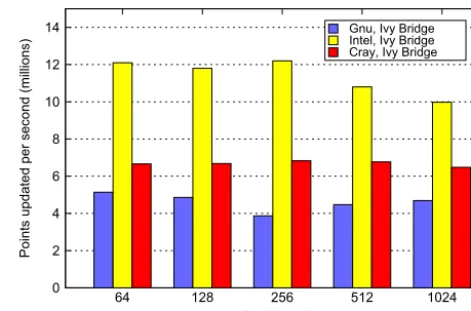
In Fig. 2 we plot the serial performance of the original ver-sion of the NEMOLite2D code for the range of compil-ers considered here. Unlike the Shallow code (Porter et al., 2016), the original version of NEMOLite2D has not been op-timized. Although it is still a single source file it is, in com-mon with NEMO itself, logically structured with separate subroutines performing different parts of the physics within each time step. This structuring and the heavy use of con-ditional statements favour the Intel compiler which signifi-cantly out-performs both the Gnu and Cray compilers. Only when the problem size spills out of cache does the perfor-mance gap begin to narrow. The reason for the perforperfor-mance deficit of the Cray-compiled binary comes down to (a lack of) SIMD vectorization, an issue that we explore below.
Moving now to the PSyKAl version of NEMOLite2D, Fig. 3 plots the performance of the fastest PSyKAl version for each of the compiler and problem-size combinations.
0 2 4 6 8 10 12 14
64 128 256 512 1024
Points updated per second (millions)
Problem size
Gnu, Ivy Bridge Intel, Ivy Bridge Cray, Ivy Bridge
Figure 2.Summary of the performance of the original version of the NEMOLite2D code on an Intel Ivy Bridge CPU for the range of compilers under consideration.
0 2 4 6 8 10 12 14
64 128 256 512 1024
Points updated per second (millions)
Problem size
Gnu, Ivy Bridge Intel, Ivy Bridge Cray, Ivy Bridge
Figure 3. Summary of the best performance achieved by any PSyKAl version of NEMOLite2D for each of the compilers under consideration.
While the Intel compiler still produces the best-performing binary, the Cray-compiled binary is now a very close second. In fact, the performance of both the Gnu- and Cray-compiled PSyKAl versions is generally significantly greater than that of their respective original versions. We also note that best absolute performance (in terms of grid points processed per second) with any compiler is obtained with the 2562domain. The performance of the Gnu-compiled binary is consistently a factor of 2 slower than those of the other compilers. This is due to the fact that it only SIMD vectorizes the loop perform-ing the Continuity calculation and, unlike Cray and Intel, it does not have an intrinsic to make vectorization of a loop mandatory. (When using OpenMP 4.0, the SIMD directive could be used but even then that is only taken as a hint.)
0 5 10 15 20 25 30 35 40 45
64 128 256 512 1024
Speed-up c.f. original (%)
Problem size Gnu, Ivy Bridge Intel, Ivy Bridge Cray, Ivy Bridge
Figure 4.Comparison of the performance of the best PSyKAl ver-sion with that of the original verver-sion of the code. A negative value indicates that the PSyKAl version is slower than the original.
the 642domain that is slower with the PSyKAl version of the code (and then only by some 3 %). For all other points in the space, the optimized PSyKAl version of the code performs better. The results for the Cray compiler, however, are some-what skewed by the fact that it did not SIMD vectorize key parts of the original version (see below).
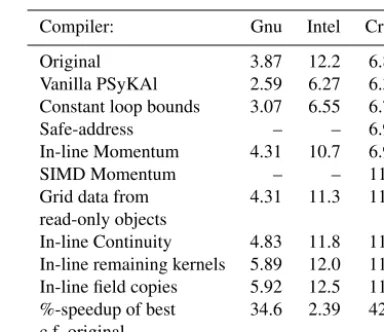
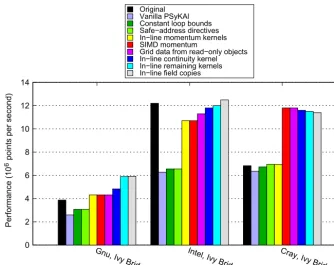
Having shown that we can recover, and often improve upon, the performance of the original version of NEMO-Lite2D, the next logical step is to examine the necessary code transformations in detail. We do this for the 2562case since this fits within (L3) cache on the Ivy Bridge CPUs we are us-ing here. Table 4 shows detailed performance figures for this case after each transformation has been applied to the code. The same data are visualized in Fig. 5.
Looking at the results for the Gnu compiler (and the Ivy Bridge CPU) first, all of the steps up in performance corre-spond to kernel in-lining. None of the other transformations had any effect on the performance of the compiled code. In fact, simply in-lining the two kernels associated with the Mo-mentum section was sufficient to exceed the performance of the original code.
With the Intel compiler, the single largest performance in-crease is again due to kernel in-lining (of the Momentum ker-nels). This is because the compiler does a much better job of SIMD vectorizing the loops involved than it does when it first has to in-line the kernel itself (as evidenced by its own diag-nostic output – see Sect. 2.1.3). However, although this gives a significant performance increase it is not sufficient to match the performance of the original version. This is only achieved by in-lining every kernel and making the lack of data depen-dencies between arrays accessed from different field objects more explicit.
The Cray compiler is distinct from the other two in that kernel in-lining does not give any performance benefit and in
Table 4.Performance (millions of points updated per second) on an Intel Ivy Bridge CPU for the 2562case after each code transforma-tion. Where an optimization uses compiler-specific directives then performance figures for the other compilers are omitted.
Compiler: Gnu Intel Cray Original 3.87 12.2 6.83 Vanilla PSyKAl 2.59 6.27 6.35 Constant loop bounds 3.07 6.55 6.73 Safe-address – – 6.95 In-line Momentum 4.31 10.7 6.93 SIMD Momentum – – 11.8 Grid data from 4.31 11.3 11.8 read-only objects
In-line Continuity 4.83 11.8 11.6 In-line remaining kernels 5.89 12.0 11.5 In-line field copies 5.92 12.5 11.4 %-speedup of best 34.6 2.39 42.2 c.f. original
fact, for the smaller kernels, it can actually hurt performance. Thus the key transformation is to encourage the compiler to SIMD vectorize the Momentum section via a compiler-specific directive (without this it concludes that such vec-torization would be inefficient). Of the other transforma-tions, only the change to constant loop bounds and the addi-tion of the compiler-specificsafe_addressdirective (see Sect. 2.1.2) were found to (slightly) improve performance. 3.2 Parallel performance
We now turn to transformations related to parallelization of the NEMOLite2D code; the introduction of OpenMP and OpenACC directives. In keeping with the PSyKAl approach, we do not modify either the Algorithm- or Kernel-layer code. Any code changes are restricted to either the PSy (middle) layer or the underlying library that manages, for example, the construction of field objects.
3.2.1 OpenMP
As with the serial optimizations, we consider the effect of each of the OpenMP optimization steps described in Sect. 2.2 for the 2562domain. For this we principally use a single Intel Ivy Bridge socket which has 12 hardware cores and support for up to 24 threads with hyperthreading (i.e. two threads per core). Figures 7, 8, and 9 show the performance of each of the versions of the code on this system for the Gnu, Intel, and Cray compilers, respectively.
0 2 4 6 8 10 12 14
Gnu, Ivy Bridge Intel, Ivy Bridge Cray, Ivy Bridge
P
er
fo
rm
an
ce
(
10
6 p
oi
nt
s
pe
r
se
co
nd
)
Original Vanilla PSyKAl Constant loop bounds Safe−address directives In−line momentum kernels SIMD momentum
Grid data from read−only objects In−line continuity kernel In−line remaining kernels In−line field copies
Figure 5.Serial performance of the PSyKAl version of NEMOLite2D for the 2562domain at each stage of optimization. The first (black) bar of each cluster gives the performance of the original version of NEMOLite2D for that compiler/CPU combination.
parallel efficiency (%),E(n), onnthreads, as
E(n)=100 P (n)
nP (1), (3)
whereP (n)is the performance of the code onnthreads, e.g. grid-points updated per second. For a perfect linearly scaling code,E(n)will be 100 %.
Since the space to explore consists of three different com-pilers, six different domain sizes, five stages of optimization and six different thread counts, we can only consider a slice through it in what follows. In order to inform our choice of domain size, Fig. 6 shows the scaling behaviour of the most performant Intel-compiled version of NEMOLite2D. Although it is common for production runs of NEMO to use MPI sub-domains of 20×20, it is clear from Fig. 6 that the limited quantity of parallelism in the 32×32 domain inhibits scaling. (Recall that we are only parallelizing the outer loop – Sect. 2.2.1.) Therefore, to fully test the performance of our OpenMP implementations we have chosen to examine results for the 256×256 domain and these are shown in Figs. 7, 8, and 9.
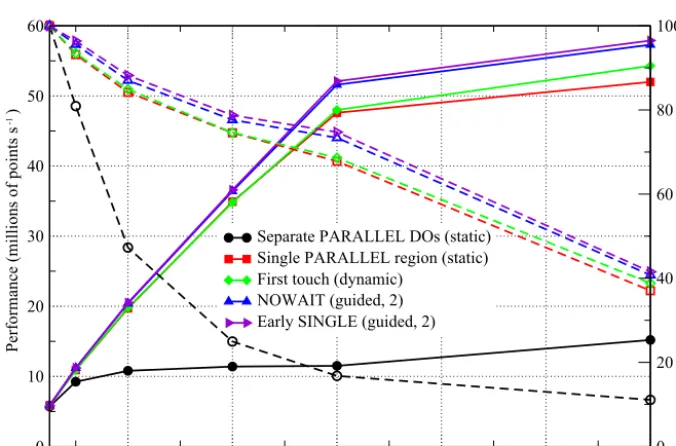
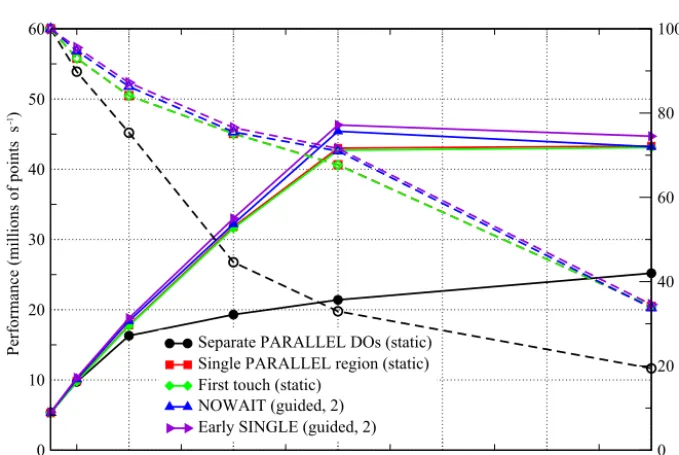
The simplest OpenMP implementation (black lines, circle symbols) fails to scale well for any of the compilers. For the Intel and Gnu versions, parallel efficiency is already less than 50 % on just four threads. The Cray version, however, does better and is about 45 % efficient on eight threads (right axis, Fig. 9).
With the move to a single PARALLEL region, the situation is greatly improved with all three executables now scaling out to at least 12 threads with∼70 % efficiency (red lines, square symbols).
In restricting ourselves to a single socket, we are keep-ing all threads within a skeep-ingle NUMA region. It is therefore surprising that implementing a “first-touch” policy has any effect and yet, for the Gnu- and Intel-compiled binaries, it appears to improve performance when hyperthreading is em-ployed to run on 24 threads (green lines and diamond sym-bols in Figs. 7 and 8).
The final optimization step that we found to have any sig-nificant effect is to minimize the amount of thread synchro-nization by introducing the NOWAIT qualifier wherever pos-sible (blue lines and upward-triangle symbols). For the Gnu compiler, this improves the performance of the executable on eight or more threads, while, for the Intel compiler, it only gives an improvement for the 24-thread case. Moving the SINGLE region before a parallel loop is marginally ben-eficial for the Gnu- and Cray-compiled binaries and yet re-duces the performance of the Intel binary (purple lines and right-pointing triangles).
4 8 12 16 20 24 Number of OpenMP threads
0 20 40 60 80 100
Performance (millions of points s ) 3264 128 256 512 1024
0 20 40 60 80 100
Parallel efficiency (%)
-1
Figure 6.The scaling behaviour of the most performant OpenMP-parallel version of PSyKAl NEMOLite2D for the full range of domain sizes considered on the CPU. Results are for the Intel compiler on a single Intel Ivy Bridge socket. The corresponding parallel efficiencies are shown using open symbols and dashed lines. The 24-thread runs employed hyperthreading.
4 8 12 16 20 24
Number of OpenMP threads 0
10 20 30 40 50 60
Performance (millions of points s )
Separate PARALLEL DOs (static) Single PARALLEL region (static) First touch (dynamic)
NOWAIT (guided, 2) Early SINGLE (guided, 2)
0 20 40 60 80 100
Parallel efficiency (%)
-1
Figure 7.Performance of the OpenMP-parallel version of PSyKAl NEMOLite2D for the 2562domain with the Gnu compiler on a single Intel Ivy Bridge socket. The corresponding parallel efficiencies are shown using open symbols and dashed lines. The 24-thread runs employed hyperthreading and the optimal OpenMP schedule is given in parentheses.
points per second) for the Gnu, Intel, and Cray compilers, respectively. This serves to emphasize the democratization that the introduction of OpenMP has had; for the serial case the Cray- and Intel-compiled executables were a factor of 2 faster than the Gnu-compiled binary (Fig. 5). In the OpenMP version, the Gnu-compiled binary is only 6 % slower than
se-4 8 12 16 20 24 Number of OpenMP threads
0 10 20 30 40 50 60 70 80 90 100
Performance (millions of points s )
Separate PARALLEL DOs (static) Single PARALLEL region (static) First touch (static)
NOWAIT (static) Early SINGLE (guided, 2)
0 20 40 60 80 100
Parallel efficiency (%)
-1
Figure 8.Performance of the OpenMP-parallel version of PSyKAl NEMOLite2D for the Intel compiler on a single Intel Ivy Bridge socket. The corresponding parallel efficiencies are shown using open symbols and dashed lines. The 24-thread runs employed hyperthreading and the optimal OpenMP schedule is given in parentheses.
4 8 12 16 20 24
Number of OpenMP threads 0
10 20 30 40 50 60
P
er
fo
rm
an
ce
(
m
il
li
on
s
of
p
oi
nt
s
s
)
Separate PARALLEL DOs (static) Single PARALLEL region (static) First touch (static)
NOWAIT (guided, 2) Early SINGLE (guided, 2)
0 20 40 60 80 100
Parallel efficiency (%)
-1
Figure 9.Performance of the OpenMP-parallel version of PSyKAl NEMOLite2D for the Cray compiler on a single Intel Ivy Bridge socket. The corresponding parallel efficiencies are shown using open symbols and dashed lines. The 24-thread runs employed hyperthreading and the optimal OpenMP schedule is given in parentheses.
rial optimization work. This deficiency has been reported to Cray.
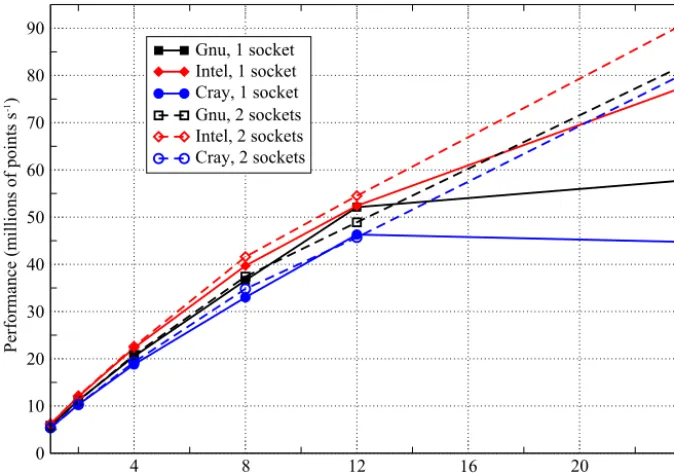
Since NEMO and similar finite-difference codes tend to be memory-bandwidth bound, we checked the sensitivity of our performance results to this quantity by benchmarking using two sockets of Intel Ivy Bridge (i.e. using a complete node of
perfor-4 8 12 16 20 24 Number of OpenMP threads
0 10 20 30 40 50 60 70 80 90
Performance (millions of points s )
Gnu, 1 socket Intel, 1 socket Cray, 1 socket Gnu, 2 sockets Intel, 2 sockets Cray, 2 sockets
-1
Figure 10.Performance of the OpenMP-parallel version of PSyKAl NEMOLite2D on one and two sockets of Intel Ivy Bridge. The 24-thread runs on a single socket used hyperthreading and the two-socket runs had the threads shared equally between the sockets.
mance – the two-socket performance figures track those from a single socket very closely. The only significant difference in performance is at 24 threads, where, in addition to the differ-ence in available memory bandwidth, the single-socket con-figuration is using hyperthreading while the two-socket case is not. The discrepancy in the performance of the Cray- and Intel-compiled binaries at this thread count is under investi-gation by Cray.
A further complication is the choice of scheduling of the OpenMP threads. We have investigated the perfor-mance of each of the executables (and thus the associated OpenMP runtime library) with the standard OpenMPstatic, dynamicandguidedscheduling policies. For the Intel com-piler/runtime, static loop scheduling was found to be best for all versions apart from that where we have attempted to amortize the cost of the SINGLE section. This is to be expected since that strategy requires some form of dynamic loop scheduling in order to reduce the load imbalance intro-duced by the SINGLE section.
In contrast, some form of dynamic scheduling gave a per-formance improvement with the Gnu compiler/runtime even for the “first-touch” version of the code. This is despite the fact that this version contains (implicit) thread synchroniza-tion after every parallel loop. For the Cray compiler/runtime, some form of dynamic scheduling became optimal once inter-thread synchronization was reduced using the NOWAIT qualifiers.
3.2.2 OpenACC
In contrast to the CPU, we only had access to the PGI com-piler when looking at OpenACC performance. We therefore investigate the effect of the various optimizations described in Sect. 2.3 for the full range of problem sizes. All of the reported performance figures were obtained on an NVIDIA Tesla K40m GPU running in “boost” mode (enabled with the commandnvidia-smi -ac 3004,875).
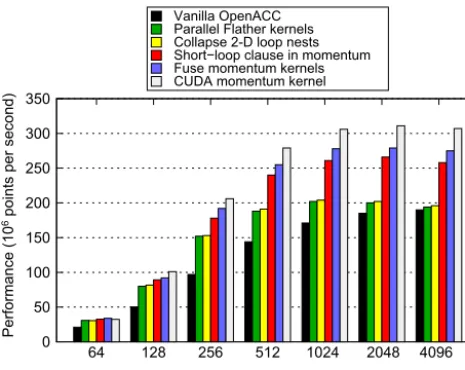
The performance of the various versions of the code is plotted in Fig. 11. We do not show the performance of the OpenACC version of the original code as it was identical to that of the vanilla PSyKAl version.
The smallest domain (642) does not contain sufficient par-allelism to fully utilize the GPU and only the paralleliza-tion of the Flather kernels has much effect on performance. In fact, this is a significant optimization for all except the largest domain size where only changes to the Momentum kernel yield sizeable gains. Collapsing the 2-D loop nests has a small but beneficial effect for the majority of problem sizes. The gains here are small for two reasons: first, the automatic CUDA kernel generation performed by the compiler (as in-structed by thekernelsdirective) is working well for this code; and second, this optimization was only beneficial for the non-Momentum kernels and these account for just 30 % of the runtime.
0 50 100 150 200 250 300 350
64 128 256 512 1024 2048 4096
Performance (
10
6 points per second)
Problem size Vanilla OpenACC Parallel Flather kernels Collapse 2-D loop nests Short−loop clause in momentum Fuse momentum kernels CUDA momentum kernel
Figure 11. Performance of the PSyKAl (OpenACC) and CUDA GPU implementations of NEMOLite2D. Optimizations are added to the code in an incremental fashion. The performance for the Ope-nACC version of the original code is not shown since it is identical to that of the vanilla PSyKAl version.
mains of 5122and greater. Fusing the two momentum kernels gives a further boost of around 5 %.
Note that all of the previous optimizations are restricted to the PSy layer and in most cases are simply a case of adding directives or clauses to directives. However, the ques-tion then arises as to the cost of restricting optimizaques-tions to the PSy layer. In particular, how does the performance of the OpenACC version of NEMOLite2D compare with a version where those restrictions are lifted? Figure 11 also shows the performance of the version of the code where the (fused) Mo-mentum kernel has been replaced by a CUDA kernel. For domains up to 2562the difference in the performance of the two versions is less than 5 %, and for the larger domains it is at most 12 %.
In order to check the efficiency of the CUDA implemen-tation, we profiled the code on the GPU. For large prob-lem sizes this showed that the non-Momentum kernels are memory-bandwidth bound and account for about 40 % of the runtime. However, the Momentum kernels were latency lim-ited, getting∼103 GB s−1of memory bandwidth. Although fusing these kernels reduced the required memory bandwidth (and produced a performance improvement), doing so re-sulted in a fairly large kernel requiring a large number of registers. This in turn reduces the occupancy of the device which exposes memory latencies.
All of this demonstrates that the performance cost of the PSyKAl approach in utilizing a GPU for NEMOLite2D is minimal. The discrepancy in performance between the CUDA and OpenACC versions has been fed back to the PGI compiler team.
In Fig. 12 we compare the absolute performance of the OpenMP and OpenACC implementations of NEMOLite2D
0 50 100 150 200 250 300
64 128 256 512 1024 2048 4096
P
er
fo
rm
an
ce
(
10
6 p
oi
nt
s
pe
r
se
co
nd
)
Problem size Gnu, Ivy Bridge
Intel, Ivy Bridge Cray, Ivy Bridge
NVIDIA Tesla K40
Figure 12. Performance of the best OpenMP-parallel version of PSyKAl NEMOLite2D (on a single Intel Ivy Bridge socket) com-pared with the PSyKAl GPU implementation (using OpenACC).
across the range of problem sizes considered. The OpenMP figures are the maximum performance obtained from a whole Intel Ivy Bridge socket by any version of the code on any number of threads for a given compiler or runtime. For the smallest domain size (642), the OpenMP version signifi-cantly outperforms the GPU because there is insufficient par-allelism to fully utilize the GPU and one time step takes only 80 µs. The execution of a single time step is then dominated by the time taken to launch the kernels on the GPU rather than the execution of the kernels themselves.
Once the problem size is increased to 1282, a single time step takes roughly 200 µs and only the Intel-compiled OpenMP version is comparable in performance to the Ope-nACC version. For all of the larger problem sizes plotted in Fig. 12, the GPU version is considerably faster than the CPU. For problem sizes of 10242and greater, the 30 MB cache of the Ivy Bridge CPU is exhausted and performance becomes limited by the bandwidth to main memory. At this stage the OpenACC version of the code on the GPU is some 3.4 times faster than the best OpenMP version on the CPU.
3.3 Performance analysis with the Roofline model
or-0.5 1 2 4 8 16 32
0.125 0.25 0.5 1 2 4 8
Perfect ILP, no SIMD 512 1024 SSE No SIMD 0.5 1 2 4 8 16 32
0.125 0.25 0.5 1 2 4 8
Perfect ILP, no SIMD
No ILP, no SIMD 512 1024 SSE No SIMD 0.5 1 2 4 8 16 32
0.125 0.25 0.5 1 2 4 8
Perfect ILP, no SIMD
No ILP, no SIMD Perfect ILP+SSE 512 1024 SSE No SIMD 0.5 1 2 4 8 16 32
0.125 0.25 0.5 1 2 4 8
Perfect ILP, no SIMD No ILP+SSE Perfect ILP+SSE 512 1024 SSE No SIMD 0.5 1 2 4 8 16 32
0.125 0.25 0.5 1 2 4 8
Main memory
Perfect ILP, no SIMD No ILP+SSE Perfect ILP+SSE 512 1024 SSE No SIMD 0.5 1 2 4 8 16 32
0.125 0.25 0.5 1 2 4 8
Peak FP performance (LINPACK)
L3 mem bandwidth
Main memory
Perfect ILP, no SIMD No ILP+SSE Perfect ILP+SSE
Nemolite2d, momentum
Shallow, loop 1
512
1024
SSE
No SIMD
GigaFLOPS
Floating-point operations per byte
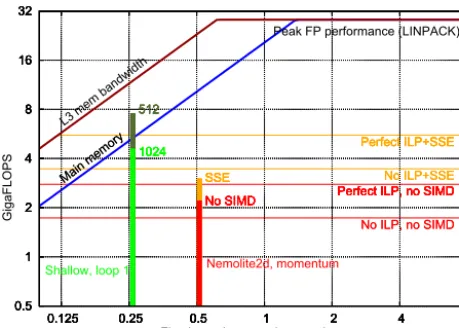
Figure 13. Comparison of the performance achieved by kernels from NEMOLite2D and Shallow on a roofline plot for the E5-1620 CPU. Results for the former are for the 2562domain since that gave the best performance. See the text for a discussion of the different CPU ceilings (coloured, horizontal lines).
der to obtain appropriate upper bounds on the memory band-width and floating-point operations per second (FLOPS), re-spectively. Since we are using an Intel Ivy Bridge CPU, we used the Intel Math Kernel Library implementation of LIN-PACK.
A key component of the Roofline model is the operational or arithmetic intensity (AI) of the code being executed: AI=No. of floating-point operations
Bytes fetched from memory .
We calculated this quantity manually by examining the source code and counting the number of memory references and arithmetic operations that it contained. In doing this counting we assume that any references to adjacent array el-ements (e.g. u(i, j )andu(i+1, j )) are fetched in a single cache line and thus only count once.
In Fig. 13 we show the performance of kernels from both Shallow and NEMOLite2D on the Roofline model for an In-tel E5-1620 CPU. This demonstrates that the Shallow ker-nel is achieving a performance roughly consistent with satu-rating the available memory bandwidth. In contrast, the ker-nel taken from NEMOLite2D is struggling to reach a per-formance consistent with saturating the bandwidth to main memory. We experimented with reducing the problem size (so as to ensure it fitted within cache), but that did not sig-nificantly improve the performance of the kernel. This then points to more fundamental issues with the way that the ker-nel is implemented, which are not captured in the simple Roofline model.
In order to aid our understanding of kernel performance, we have developed a tool, “Habakkuk” (https://github.com/ arporter/habakkuk, last access: 1 August 2018), capable of parsing Fortran code and generating a directed acyclic
graph (DAG) of the data flow. Habakkuk eases the labori-ous and error-prone process of counting memory accesses and FLOPs as well as providing information on those oper-ations that are rate-limiting or on the critical path. Using the details of the Intel Ivy Bridge microarchitecture published by Fog (2016b, a), we have constructed performance estimates of the NEMOLite2D kernel. By ignoring all instruction-level parallelism (ILP), i.e. assuming that all nodes in the DAG are executed in serial, we get a lower-bound performance estimate of 0.6391×CLOCK_SPEED FLOPS, which gives 2.46 GFLOPS (gigaflops) at a clock speed of 3.85 GHz.
Alternatively, we may construct an upper bound by assum-ing the out-of-order execution engine of the Ivy Bridge core is able to perfectly schedule and pipeline all operations such that those that go to different execution ports are always run in parallel. In the Ivy Bridge core, floating-point multiplica-tion and division operamultiplica-tions go to port 0 while addimultiplica-tion and subtraction go to port 1 (Fog, 2016a). Therefore, we sum the cost of all multiplication and division operations in the DAG and compare that with the sum of all addition and subtraction operations. The greater of these two quantities is then taken to be the cost of executing the kernel; all of the operations on the other port are assumed to be done in parallel. This gives a performance estimate of 1.029×CLOCK_SPEED FLOPS or 3.96 GFLOPS at 3.85 GHz.
These performance estimates are plotted as CPU ceil-ings (coloured, horizontal lines) in Fig. 13. The perfor-mance of the Momentum kernel is seen to fall between these two bounds which demonstrates that its performance is not memory-bandwidth limited, as might have been assumed by its low AI. Therefore, although the performance of this kernel is well below the peak performance of the CPU, this is due to the balance of floating-point operations that it contains and in particular, the number of division operations. (Division costs at least 8 times as much as a multiplication in the Ivy Bridge core; Fog, 2016a.) For instance, a fragment of the most costly part of the momentum kernel is shown below:
...
! -pressure gradient
hpg = -g * (hu(ji,jj) + sshn_u(ji,jj)) * e2u(ji,jj) * &
(sshn(ji+1,jj) - sshn(ji,jj))
! -linear bottom friction ! (implemented implicitly.)
ua(ji,jj) = (un(ji,jj) * (hu(ji,jj) + sshn_u(ji,jj)) + rdt * & (adv + vis + cor + hpg) / e12u(ji,jj)) / &
(hu(ji,jj) + ssha_u(ji,jj)) / (1.0_wp + cbfr * rdt)
the PSyKAl separation of concerns and the introduction of parallelism in the PSy layer.
Enabling SIMD vectorization for this kernel does not sig-nificantly improve its performance (Fig. 13); and in fact, limiting it to SSE instructions (vector width of two double-precision floating-point numbers) rather than AVX (vector width of four) was found to produce a slightly more perfor-mant version. We attribute this performance deficit to the low efficiency of the vectorized code combined with the higher trip-counts of the peel- and remainder loops required for the greater vector width of AVX. The poor efficiency of the SIMD version is highlighted by the fact that the correspond-ing kernel performance no longer falls within the bounds of the performance estimates produced by Habakkuk. This is because we have incorporated the effect of SSE into that es-timate by simply assuming perfect vectorization which gives a performance increase of a factor of 2. Further investigation of this issue revealed that, as mentioned above, several of the NEMOLite2D kernels make frequent use of floating-point division. Although SSE and AVX versions of the division operation are available, on Ivy Bridge they do not provide any performance benefit (Fog, 2016a). A straightforward op-timization then would be to alter the kernels in order to re-duce the number of division operations. However, again, ker-nel optimization is outside the scope of this paper since it breaks the PSyKAl separation of concerns.
4 Conclusions
We have investigated the application of the PSyKAl separa-tion of concerns approach to the domain of shared-memory, parallel, finite-difference shallow-water models. This ap-proach enables the computational-science-related aspects (performance) of a computer model to be kept separate from the natural-science aspects (oceanographic).
We have used a new and unoptimized two-dimensional model extracted from the NEMO ocean model for this work. As a consequence of this, the introduction of the PSyKAl separation of concerns followed by suitable transformations of the PSy layer is actually found to improve performance. This is in contrast to our previous experience (Porter et al., 2016) with tackling the Shallow code which has been opti-mized over many years. In that case we were able to recover (to within a few percent) the performance of the original and in some cases exceed it, in spite of limiting ourselves to trans-formations which replicated the structure of the original, op-timized code.
Investigation of the absolute serial performance of the NEMOLite2D code using the Roofline model revealed that it was still significantly below any of the traditional roofline ceilings. We have developed Habakkuk, a code-analysis tool that is capable of providing more realistic ceilings by analysing the nature of the floating-point computations per-formed by a kernel. The bounds produced by Habakkuk are
in good agreement with the measured performance of the principal (Momentum) kernel in NEMOLite2D. In future work we aim to extend this tool to account for SIMD op-erations and make it applicable to code parallelized using OpenMP.
The application of code transformations to the middle, PSy, layer is key to the performance of the PSyKAl version of a code. For both NEMOLite2D and Shallow we have found that for serial performance, the most important transforma-tion is that of in-lining the kernel source at the call site, i.e. within the PSy layer. (Although we have done this in-lining manually for this work, our aim is that, in future, such trans-formations will be performed automatically at compile-time and therefore do not affect the code that a scientist writes.) For the more complex NEMOLite2D code, the Cray com-piler also had to be coerced into performing SIMD vector-ization through the use of source-code directives.
In this work we have also demonstrated the introduction of parallelism into the PSy layer with both OpenMP and Ope-nACC directives. In both cases we were able to leave the natural-science parts of the code unchanged. For OpenMP we achieved a parallel efficiency of∼70 % on 12 threads by enclosing the body of the (single) PSy layer routine within a single PARALLEL region. Removal of unnecessary syn-chronization points through the use of the NOWAIT clause boosted 12-thread performance by approximately 10 % with the Gnu and Cray compilers. The PSyKAl restructuring of this (admittedly small) code was not found to pose any prob-lems for the introduction of performant OpenMP. Similarly, we have also demonstrated good GPU performance using OpenACC in a PSyKAl version of the code.
This paper demonstrates that the PSyKAl separation of concerns may be applied to 2-D finite-difference codes with-out loss of performance. We have also shown that the result-ing code is amenable to efficient parallelization on both GPU and shared-memory CPU systems. This then means that it is possible to achieve performance portability while maintain-ing smaintain-ingle-source science code.
Our next steps will be, first, to consider the automatic gen-eration of the PSy layer and, second, to look at extending the approach to the full NEMO model (i.e. three dimensions). In future work we will analyse the performance of a domain-specific compiler that performs the automatic generation of the PSy layer. This compiler (which we have named “PSy-clone”, see https://github.com/stfc/psyclone, last access: Au-gust 2018) is currently under development.
Code availability. The NEMOLite2D Benchmark
Author contributions. HL wrote the original NEMOLite2D, based on code from the NEMO ocean model. AP and RF restructured NEMOLite2D following the PSyKAl separation of concerns. AP performed the CPU performance optimizations. JA ported NEMO-Lite2D to OpenACC and optimized its GPU performance. AP pre-pared the manuscript with contributions from all co-authors.
Competing interests. The authors declare that they have no conflict
of interest.
Acknowledgements. This work made use of the ARCHER UK
National Supercomputing Service (http://www.archer.ac.uk, last access: June 2017) and Emerald, a GPU-accelerated High Performance Computer, made available by the Sci-ence and Engineering South Consortium operated in part-nership with the STFC Rutherford Appleton Laboratory (http://www.ses.ac.uk/high-performance-computing/emerald/, last access: June 2017). This work was funded by the NERC “GOcean” project, grant number NE/L012111/1.
Edited by: Adrian Sandu
Reviewed by: Carlos Osuna and two anonymous referees
References
Andreolli, C., Thierry, P., Borges, L., Skinner, G., and Yount, C.: Characterization and Optimization Methodology Applied to Stencil Computations, in: High Performance Parallelism Pearls Volume One: Multicore and Many-core Programming Approaches, edited by: Reinders, J. and Jeffers, J., Elsevier, chap. 23, 377–396, 2015.
Bertolli, C., Betts, A., Mudalige, G., Giles, M., and Kelly, P.: Design and Performance of the OP2 Library for Unstruc-tured Mesh Applications, in: Euro-Par 2011: Parallel Processing Workshops, edited by: Alexander, M. E. Q., Lecture Notes in Computer Science, Springer Berlin Heidelberg, 7155, 191–200, https://doi.org/10.1007/978-3-642-29737-3_22, 2012.
Dongarra, J.: The LINPACK Benchmark: An Explanation, in: Pro-ceedings of ICS: Supercomputing, 1st International Conference, edited by: Houstis, E. N., Papatheodorou, T. S., and Poly-chronopoulos, C. D., Springer, 456–474, 1987.
Edwards, H. C., Trott, C. R., and Sunderland, D.: Kokkos: Enabling manycore performance portability through polymorphic mem-ory access patterns, J. Parallel Distrib. Comput., 74, 3202–3216, 2014.
Flather, R. A.: A tidal model of the north-west European continen-tal shelf, Memoires de la Societe Royale des Sciences de Liege, Series 6, 10, 141–164, 1976.
Fog, A.: 4. Instruction tables: Lists of instruction latencies, through-puts and micro-operation breakdowns for Intel, AMD and VIA CPUs, Tech. rep., Technical University of Denmark, 2016a. Fog, A.: 3. The microarchitecture of Intel, AMD and VIA CPUs:
An optimization guide for assembly programmers and compiler makers, Tech. rep., Technical University of Denmark, 2016b.
Ford, R., Glover, M., Ham, D., Pickles, S., and Riley, G.: GungHo Phase 1: Computational Science Recommendations, UK Met Office technical report, available at: https://www.metoffice.gov. uk/binaries/content/assets/mohippo/pdf/8/o/frtr587tagged.pdf, 2013.
Ford, R., Appleyard, J., Porter, A., and Liu, H.: NEMOLite2D Benchmark Suite 1.0, https://doi.org/10.5286/edata/707, 2017. Gysi, T., Osuna, C., Fuhrer, O., Bianco, M., and Schulthess, T.:
STELLA: a domain-specific tool for structured grid methods in weather and climate models, SC ’15: Proceedings of the Interna-tional Conference for High Performance Computing, Network-ing, Storage and Analysis, Austin, TX, USA, 15–20 November 2015, https://doi.org/10.1145/2807591.2807627, 2015.
Logg, A., Mardal, K.-A., and Wells, G. N. (Eds.): Automated So-lution of Differential Equations by the Finite Element Method, Springer, https://doi.org/10.1007/978-3-642-23099-8, 2012. Luporini, F., Varbanescu, A. L., Rathgeber, F., Bercea, G.-T.,
Ra-manujam, J., Ham, D. A., and Kelly, P. H. J.: COFFEE: an Op-timizing Compiler for Finite Element Local Assembly, ACM T. Archit. Code. Op., 11, 57, https://doi.org/10.1145/2687415, 2014.
Madec, G.: NEMO ocean engine (Draft edition r6039), Tech. Rep. 27, Institut Pierre-Simon Laplace (IPSL), France, 2014. McCalpin, J. D.: Memory Bandwidth and Machine Balance in
Current High Performance Computers, IEEE Computer Soci-ety Technical Committee on Computer Architecture (TCCA) Newsletter, 19–25, 1995.
Medina, D., St-Cyr, A., and Warburton, T.: High-Order Finite-Differences on Multi-threaded Architectures Using OCCA., in: Spectral and High Order Methods for Partial Differential Equa-tions ICOSAHOM 2014, edited by Kirby, R., Berzins, M., and Hesthaven, J., Lecture Notes in Computational Science and En-gineering, Springer, 106, 365–373, 2015.
Porter, A. R., Ford, R. W., Ashworth, M., Riley, G. D., and Modani, M.: Towards Compiler-Agnostic Performance in Finite-Difference Codes, in: Parallel Computing: On the Road to Exas-cale, edited by: Joubert, G. R., Leather, H., Parsons, M., Peters, F., and Sawyer, M., IOS Press, Amsterdam, New York, Tokyo, 27, 647–658, 2016.
Rathgeber, F., Markall, G. R., Mitchell, L., Loriant, N., Ham, D. A., Bertolli, C., and Kelly, P. H. J.: PyOP2: A High-Level Frame-work for Performance-Portable Simulations on Unstructured Meshes, in: Proceedings of the 2012 SC Companion: High Per-formance Computing, Networking Storage and Analysis, SCC ’12, IEEE Computer Society, Washington, DC, USA, 1116– 1123, https://doi.org/10.1109/SC.Companion.2012.134, 2012. Rathgeber, F., Ham, D. A., Mitchell, L., Lange, M., Luporini,
F., McRae, A. T., Bercea, G.-T., Markall, G. R., and Kelly, P. H.: Firedrake: automating the finite element method by composing abstractions, ACM T. Math. Software, 43, 24, https://doi.org/10.1145/2998441, 2015.