J. Phys. Chem. Solids Pergamon Press 1961. Vol. 19, Nos. l/2, pp. 35-50. Printed in Great Britain.
THE KINETICS OF PRECIPITATION
FROM
SUPERSATURATED SOLID SOLUTIONS*
I.
M. LIFSHITZ and V. V. SLYOZOVPhysico-Technical Institute, Kharkov, U.S.S.R. (Received 10 October 1959)
Abstract-An analysis is made of the process whereby diffusion effects can cause the precipitation of grains of a second phase in a supersaturated solid solution. The kinetics of this type of grain growth are examined in detail. Some grains grow, only to be later dissolved; others increase in size and incorporate further grains that they encounter in so doing. This latter phenomenon of coalescence is discussed in a new “kinetic” approximation. Formulae are given for the asymptotic grain size distribution, for the number of grains per unit volume and for the supersaturation as a function of time. The effects of anisotropy, strain, crystalline order and the finite size of the specimen are allowed for. It is pointed out that for a material that can be said to be “supersaturated with vac- ancies”, the discussion can be applied to the vacancies as solute “atoms” which cluster together to form internal cavities. The practical case of a real, finite crystal is here important, because the vacancies can in general also escape to the surface. A special analysis is made of this example, and the results are applied to the theory of sintering.
1. FORMULATION OF THE PROBLEM IN A supersaturated solid solution, diffusion effects may bring about the formation of grains of a new phase. Two stages of this process may be distin- guished. In the first, concentration fluctuations produce nuclei of the new phase, which grow directly from the supersaturated medium. The second stage may be considered to begin when the grains thus formed have reached an appreciable size and the degree of supersaturation of the matrix has become very slight. In such circumstances the determining process is that of coalescence, i.e. the growth of large grains of the new phase by the incorporation of small ones. Fluctuation effects play a negligible part in the second stage, as new nuclei, to be of any importance, would need to be of macroscopic proportions.
The kinetics of this coalescence process are con- sidered in what follows. Some years ago, TODES(U) discussed a similar phenomenon and correctly arrived at various qualitative conc1usions.t Un- fortunately his quantitative argument is in error
* Translated by R. D. Lown~.
t A similar problem has also been considered by GREENWOOD(~) but not to the same extent.
and the results contain meaningless logarithmic divergencies. A satisfactory solution was first given in our paper of 1958, (4) in which the mode of arrival of the system at the asymptotic distribution of grain sizes was analysed in detail. The results of this earlier study are rederived herein by a rather different method, using the more accurate “kinetic approximation” which allows the stability of the asymptotic solutions to be examined. We also con- sider the effect on coalescence of various factors such as anisotropy and internal strain.
In the first instance we shall simplify matters by ignoring anisotropy and considering the grains to be spherical. The actual shape of real grains may be taken into account by adjusting certain numer- ical constants in the relevant formulae.
Fundamental equations
If c, is the concentration of the saturated solution, and LY = (2a/K”)wC, is a parameter containing the inter-phase surface tension Q and the atomic volume w of the solute, the equilibrium concentration CR at the boundary of a grain is related to the grain radius by the usual formula:
CR =
cm-,+
;.
(1)
36 I. M. LIFSHITZ a The degree of supersaturation is small, so that C-C,=A<l, and for the present we may ignore the interaction between grains since their dimensions are small compared with” the mean distance between them. Then the diffusion current of solute across the grain boundary is given, per unit area, by*
The radius R of the grain therefore varies with time as?
dR 23
dt=z ( A-%. 1
Thus for every value A of the supersaturation there exists a critical radius R, = u/A with which a grain is in equilibrium with the solution. If R > Rc the grain grows, if R < Rc it dissolves. This obvious mechanism also explains why large grains can “devour” small ones by incorporation. Both A and &themselves vary with time.
Writing ha for the initial supersaturation, R,o = a/A0 for the initial critical radius, and
T = Rio/&, we now go over to dimensionless re- duced magnitudes
R
p=R co t’ = .L T’ Dropping the prime on
t, we
obtain(3)
in which
x(t)
is a dimensionless critical radius such that x(0) = 1. We now introduce a function f(pa, t) which with in a factor +r is the volume distribution function of the grains, and the rate VR = dp3/dt of growth of the grains in dimension* The equation contains the stationary value aC/ar of the concentration gradient at the grain boundary. It is easily shown that this procedure is valid if the initial supersaturation is small (Ao < 1).
t If the grains are aspherical, but in the later stages of the process grow in such a way as to preserve their shape due to an anisotropy in c(, then equation (2) and all quantitative deductions from it remain correct so long as
R is interpreted as (3 VJ~T~)~!~, with V the grain volume, and a, CL and .$@ are modified to the extent of numerical factors depending on the shape in question.
nd V. V. SLYOZOV
space. The unknown functions
f(p3,
t)
and x(t) may be determined as follows : from the equation of con- tinuity in dimension space,while from the conservation of matter
Qo =
Ao+qo = A+q.Qo is the total initial supe~aturation, making allowance through a term
qo
for the volume of material initially in the grains. We have4 = +rrRto
;f
p3
dp3.0
Bearing in mind that x = Ae/A, it follows that
K = @rR;oQ,?
A normalization to unit volume has here been per- formed, so that
12 --
s
*fdp3
0is the number of grains per unit volume. It follows that the distribution function F(p, t) over the dimension
p
is related tof(p3,
t)
byi.e. F(P, 4 4~ =
f
tpf
t)
dp3, JTP, 9 = 3p2f(p3, 6.2. TIME VARIATION OF THE CRITICAL DIMEN- SIONS AND THE ASYMPTOTIC FORM OF THE DISTIUBUTION IWNCTION IN HYDRODYNAMIC
APPROXIMATION
THE KINETICS OF P~CIPITATION FROM S~ERSATU~TED SOLID SOLUTIONS 37
right; but as the degree of supersaturation falls, X3(t) increases and successively overtakes points that in the first instance were to the right of it. After being overtaken, such points begin to move in the opposite direction and finally also disappear into the origin. The motion is throughout regular in the sense that the initial order of a set of points is preserved.
Both the form of equation (3) and the physical meaning of x(t) suggest that it would be more natural to express equations (3)-(5) in terms of a reduced volume
Z=L,
XV)
x(0) = 1that compares p3 with the critical volume d.
Moreover, as t + co, A -+ 0, so that x(t) -+- co; thus x(t) may be used as a measure of time. It now appears that (3), (4) and (5) take on canonical form if time is introduced through the variable
7 = ln.S(t) (7)
and a new volume distribution function 46 is em- ployed such that
d(z, T) dz = f(p3, t) dp3. (8)
Using (6), (7) and (8), equations (3), (4) and (5) become respectively
dz
- = ??(z, y) = (x1/3-- l)y(T)--x,
dr
v(T)=3$;
(9
Ao
001 = Z e-*/a+ Ker o &s, T)X dx,
s
\ (11)
#fw-0
=.I$@),
+-0 =
p3.ff the solution of (10) under the initial condition ~17-0 = y be written z(y, T), then (11) may be
expressed in terms of the initial distribution func- tion f$z) thus :
co
l- -e-r/s Ao Ed: KeT
Qo
J fo(r)z(r, T) dr. (12)Yom
Here yo(~) is the solution of xLyo(~), ~1 = 0, i.e. the lower limit of the range of starting volumes appropriate to grains that are still undissolved at time 7.
The u~~~~o~~G soh&nz
As it will be shown that C&Z, T) is asymptotically independent of fob(y), the unknown functions are now r&r, T) and y(7).
The supersaturation A(t) decreases monotonic- ally with time, and therefore l/x(t) does the same. There are therefore only three possibilities for the asymptotic behaviour of y(7) as T -+ co, viz.
y(T) + CO, 0 or constant. We shall show that the
first two do not apply.
(i) T(T) -+ CO as T --j. co. In this case, x3(t) varies more slowly than t. The ultimate number of grains
per unit volume is associated with a rate &/dT > 0,
which implies a,
s 4(x, T)X dz > const. (13)
0
The amount of matter in grain form at T -+ co will therefore be
q > const.eT---t co, 7-fm
so that (11) is not satisfied.
(ii) y(7) --f 0 as 7 -+ ot3, i.e. g(t) varies more quickly than t. At sufficiently large times the solution of (10) in this case is
; = (N+-- l)y-2 S --y(T)--x,
7 z = ye-7 - 8-7
s e”y(T’) d+.
0
From the condition ztyO(~), T] = 0,
38 I. N. LIFSHITZ and V. V. SLYOZOV
the amount of matter in grain form at T 4 co is ultimate phase of change of a; for otherwise
9 = eT i ~~Y)~(Y, 4 dY G fmfdyfY dY 2o-)oo- 0.
Y&T) 3t 7-)co
Thus equation (12) cannot be satisfied [nor indeed equation (ll)].
It follows that Y(T) must tend ~~pt~tic~ly to
some constant value ~0, and this we now proceed to dete~ne~ together w&h the asymptotic form of
#(AX, 7). We first remark that at such times as y(t)
may be put constant in equation (9), the general solution of (9) is
co
s @z dz
0
would be logarithmically divergent, irrespective of the detailed nature of (0. For such a solution to exist and to be continuous and finite over the whole range of changing z, it would appear sufhci- ent that @ and its first derivative go to zero at some point x = .ZO and beyond this point join onto a constant zero. Solutions of this type can formally be found, and correspond to values of y > ~0.
and x an arbitrary function. Substituting this result into (11) it will be seen that if the first part is to be asymFtotic~ly time-inde~ndent, x must have the form
Thus +(x, T) must tend asymptotically to
#@, 4 = f?-7dt)(x, r).
So far we have examined only the asymptotic dependence of # on 7. We now turn to the deter- mination of y, for which we write out the asymp-
totic forms of equations (9~(11):
RG. 1.
However, in Section 3 it will be shown that these
solutions are unstable when the encounters be- tween different grains are taken into account. It turns out that the only stable solution is that far which #@, y) and all its derivatives go to zero at xs, so that to the right of za the solution is identic- ally zero. Further inspection of equation (15) now shows that the stable solution corresponds to a value of y = ye such that th e rate of change a(g, ~0) has a second order zero at z = ~0, Using, therefore, the conditions
W
d2 -=
dr v(2, 5-1 = (G/3- l)y -z, with y = const; WI
Examination of equation (15) shows that to satisfy
(171, @(9(a, r) can be different from zero only in the
THE KINETICS OF PRECIPITATION FROM S~~~ATU~TE~ SOLID SOLUTIONS 39
The present results may be interpreted in the light of Fig. 1, which shows w(z, r) as a function of 2 for various values of y. If y < ys, the representa- tive points of all grains move to the left and dis- appear into the origin. The grains in existence at any given time comprise asymptotically a volume distribution in the form of an infinitely long “tail” to the initial distribution function, falling off with 1 faster than a-2; therefore, the total amount of material in grain form tends to zero:
instead of to a constant value. If on the other hand y > ‘yo, all grains to the right of a point a?l move towards the point 22, with the result* that
- const. e7 --+ co,
7’u.J
this again contradicting the conditions of the problem, Thus only the case y = ys remains valid,
@(.a, ~0) has the form
I
A s-&=t Y*) -, 2,<zs=q
@(z, ‘yo) = &* */o)
0, z&X0=+$
(1% in which
d% YO)
=
-f&“/o)
20;
(20)
*
Even if ME, yo) = 0 for 2 2 21 fit the outset, tbeemounters between grains treated in Section 3 praiuce grains in the region a > a, to which this con&&on then
applies.
$ln(zl/s+3)+9 Ix@--d/3)+
-I- (1 - !&Z1/s)-1 - ln(332-5/se); (21)
A =
K-l
3Qoh = ~~o(l.ll~
+ 0.22;.
r zdz co
3
e-e0
& YO)
From a general point of view, we have found $(s, 4 and r(r) only in the zero approximation, this being the most interesting in practice. More accurate expressions for these quantities are de- rived in the appendices. Here we remark only that in the accurate equation y = ~0, all points lying to the right of the point of contact zs = v and mov-
ing to the left are found to be unable to pass across
2s; they are, so to speak, %aught” there with the result that the quantity of matter
q-e7-co T-)W
and equation (11) cannot be satisfied. The con- clusion is that Y(T) tends to ys from below:
It follows that the “leakage” across zs of points approaching ,za from the right takes place more and more slowly with the passage of time, the exact rate depending on 8, which like r(r) itself must be determined from equation (11) and the equation of motion (10).
In the next approximation, 4(2,~) is not zero to
the right of the “blocking” point 20, but is some
function governed by the initial distribution func-
tion fO(2). However, as T + co, it is increasingly
dominated by its infinitely long tail and its total contribution in equation (11) tends to zero. We now see that in the region of the blocking point zs, every initial distribution function is transformed
into a unique universal function, 20 becoming a
sink for points with .V > as and a source for points
with I < 20. (The latter set of points have their
40 I. M. LIFSHITZ and V. V. SLYOZOV
The res&s ~rn~r~ed is the probabili~ that a grain shall have a reduced The basic results of this section may now be volume between z and a+-&. Fig. 2 shows written out explicitly. The complete volume dis- P*(s1’3~ YO ) = p(zz, ~0) . (~~/~~1’3), the probability tribution function has the form that a grain has mean dimension between ~1’3 =
e-e (R/X) and (R/X) + @lx), as a function of 23’3.
i Ae-7 -
g(a, YO) = n(T)& YO), .z G zo
a Further, from the fact that
Y&5 YO) = ax
where
0, s 2 a0
-& = a--0(x1/3-1) we find
(22) 2.
.&I-l -_ e-V+ x1/3_ 1
~(7) = [$(z, 7) da = Ae-7 s
-ddz = [y;re--3’x]gO = 0, s(s* W)
(23) 0 (25)
0 from which it follows that
is the number of grains per unit volume, and 13 = #3X = x(t). - (26)
l
- e-* -_ 332-5/3e. (21/3+3)-7/3($-x1/3)-11/8 exp -(1-$,$/3)-l,3 < 20
p@, yo) =
d% Yd
0;
2 3.iro
m
u
p(z, “to) AZ =
f$J(K
YO)
& =
1)
(24)0 0
To obtain the distribution function relating to the absolute dimension p of the grains, we need only replace x in (22) by [p3/X3(t)] and divide by
x3(t) = $t. (27) Inserting the original parameters, and remember- ing that according to (26), z = R3/R3, we obtain
P’ f(Rf t) = ~(t)~(R~~)~-3,
I.0
n(t) = flQ&-3 = @t-l, with
(28)
ti
0 0.5
[image:6.506.51.467.62.602.2]z ‘/3 FIG. 2.
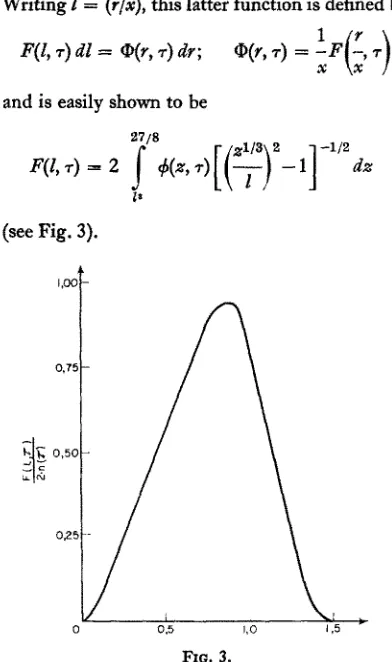
Writing I = (Y/S), this latter function is defined by 1 r
F(Z, T) dE = @(r, T) dr;
@(r, T) = -F -, T
i
1
x
x
and is easily shown to be
THE KINETICS OF PRECIPITATION FROM SUPERSATURATED SOLID SOLUTIONS 41
if at the outset the mean grain dimensions are of the order of the critical size (Rs N lied)), then this latter dimension must appear in the condition. However, if 7s $
Rd,
then the first stage of development consists in a growth of grains directly from the solution, which goes on until the degree of supersaturation has so fallen that the critical radius has caught up with the mean grain size (X N &I) ; thereafter, strictly speaking, coal- escence supervenes. In this case,Rcl
plays the part of an initial dimension. The critical size is governed not only by the initial supersaturation, but also byF(Z, T) =
2(see Fig. 3).
LO0 -
0.75 -
cr 0,50- =:r
i LLti
ops --
The degree of supersaturation at time t is given by
the number of grain nuclei (where this can be con-
0 0.5 IlO I.5 t sidered a fixed quantity). Thus if there are to Fxc. 3. begin with no nuclei, and -0 B
Rco =
a/Ao,growth from the solution takes place until
4_ Ao
-rrR13x -.
3 710
In this first stage, dR2
- = Z-B(Ao- +rrzOR3) = 2SAo 1
dt t -(~!1 I
* 0
[image:7.504.42.238.63.394.2]t FIG. 4.
Range
of
vahi-iity of thefmmdae
The above formulae completely determine the asymptotic distribution as a function of grain dimension and time. As shown in the appendix, they are valid when
and this development occupies a time tl N R;s/BAs.
1 <5-Z = (InX3)2 = 9[ln(R/R~)]a, R&R&.
The initial processes of the second stage (coal- escence) have a characteristic time
tr, - @/Bz IV
tl(ir;/Reo)
when, as in the situation discussed, ??I @
Rco,
i.e. i. $- tl. Fig. 4 shows schematically the mean dimensions as a function of time for this case. In this inequality,Rco =
u/Ao is the initial42 I. M. LIFSHITZ and V. V. SLYOZOV
Infueme of other @et& as above, except that 9 is further replaced by
We have so far ignored a number of second-
order effects such as that of grain shape, crystalline order, and the elastic strain that results from a difference between the specific volumes of the grains and the matrix. These matters are examined
in detail in a companion paper in the Journal of
Solid State Physics,@) in which we show that the
qualitative conclusions of the present study are unaffected.
the suffixes 1 and 2 referring to the individual sub-
lattices separately.
For instance, if the grains initially have a variety of shapes, we find that at sufficiently great times the only shape to survive is the most favour- able one, which gives the greatest growth rate. All the conclusions of this Section still apply in the asymptotic situation.
These second-order effects, therefore, call for no more than a re-expression of certain parameters in the theory. They do not alter the asymptotic grain size distribution function or influence its stability; our present solution, therefore, is universal.
Again, if the growth of a grain produces an elastic deformation of its surroundings, there will be an effect on the diffusion rate. We find@) that this may be taken into account merely by replacing C,, 9 and a by certain effective values:
3. ENcouNmRS BETWEEN GRAINs,INKINETIc APPROXIMATION
Equations (1) and (3) are characteristic results
CL = Cc&r; a’ = ueY; 9 = L@?
respectively, where
of applying the “hydrodynamic” approximation to our problem, while equation (10) expresses the
rate of volume change (&/dT) = -g(z, T) at any
time as a function of the mean supersaturation A(T). These equations, however, make no allow- ance for the concentration gradient near a grain that is in a state of changing volume. In fact, due to local variations of concentration the rates of volume change are not exactly equal to the mean value -g.
cm0
P
= 3[(1+0)+2n(l-u)]
Here 81 is the elastic energy per atom in the grain, brr the same quantity in the surroundings;
E is Young’s modulus, and n = E~EII; c is
Poisson’s ratio; V is the volume per atom in the
grain, and AV the difference between the volumes
per atom of the grain and the surrounding medium. The possibility of order in the atomic arrange- ment we allow for in the case where the energy required to jump an atom from one sublattice to the other is rather large, so that there can be said to exist two essentially unrelated difhrsion fluxes. The flux of particles to the grain is then treated exactly
The complication thus introduced can be over- come, using the idea of “encounters” between grains. An encounter is a situation in which two or more grains fmd themselves separated by a distance that is less than their mean linear dimension, and either unite directly or at least undergo a diffusion interaction. The discussion may be said to in- troduce a “kinetic approximation”.
In the treatment of Section 2, the stable asymptotic volume distribution was derived by an argument which revolved round the leaking of representative points B across a blocking point
za = 9. Now encounters have the effect of
carrying representative points across this barrier, and so the whole problem of their influence on the asymptotic distribution must be examined closely. This is true even if the over-all supersaturation is small and encounters are a rare phenomenon.
Treatment of encounters
THE KINETICS QF PRRCIP~TATION FROM S~ERSA~~D SOLID SOLUTIONS 43
vector g =
r/&(t). Although the centres of the other grains are fixed in the lattice, the fact that I?&) -c- cx, means that in reduced coordinates all grains draw closer together and move radially towards the selected one. Of course, the majority of the grains disappear before reaching the origin and do not have encounters.We also employ a reduced distribution function f and a reduced grain density ..&” which refer to a
unit of volume such that 55 = 1. They are related to the earlier quantities C# and n through:
Since practically the whole excess of the dissolved material eventually collects into grains such that n N e-7, Jtr approaches a constant value as E -+ CO. It follows that the probability per unit time of an encounter in a reduced unit of volume be- comes time-independent. Writing the number of encounters, per unit time per reduced volume unit, between grains of dimension in the range x to a+ d;r and grains of dimension z’ as
an encounter-probabiii~ distribution function p(.s, s’) is defined.
p{s, z’} may be expressed in the form p = w(.s, ,s’)/~~, with 78 a characteristic time for en- counters, and w(z, a’) a reduced volume centred around a grain z, over which the interaction with one of the grains z’ may be held to occur, It is not difficult to show that to order of magnitude, ZJ w t-f-~‘~ i.e. is given by the over-all reduced volume of the m grains. T* must be of the order of unity, inasmuch as all the parameters are of the order of unity both in the initial condition .;rlP = s = zs and in the equation
l&z -s --y-s a7
that describes the dissolution of the lesser grain. When two grains meet, the greater of them absorbs the lesser, and their total vohnne is ap- proximately conserved. A certain fraction of the material may in fact go back into solution, but it will be obvious that nothing is essentially changed if we ignore this detail. For if the effects of en- counters are to be allowed for, the first approximate
equality in (18) must contain a term corresponding to the total “encounter integral”
(The factor 6 is necessary, because without it each encounter would be reckoned twice.) Taking ad- vantage of the fact that w(z, 2’) is symmetric with respect to a transposition of its arguments, it is easy to show that although the number of grains is reduced by encounters, the volume is conserved:
Returning for the moment to equation f17), it will be observed that f is dependent on the small parameter l/x. To bring out more clearly its dependence on the small parameter Qs we intro- duce the function
Qi = Xf.
Using this variable, a complete set of equations controlling the system can now be written out with full allowance for encounters. The equations have the asymptotic form:
3Qo
= - x~;l’” ] ~(a--z’, z’)@(x-z’)@(d) dz’-
44 I. M. LIFSHITZ and V. V. SLYOZOV
00
1=
s
(92 dx, y = const. (32) 0They may be solved by successive approximation, using the fact that Xas is small.
At this point we may usefully notice that both from the analysis of Section 2 and directly from physical arguments one must expect that the new considerations reduce y below ys. For in the terms of the earlier discussion, grains that are carried
so that for (3~s)~s+.ye > y > ye a solution of the type mentioned is possible; it is, however, unstable in respect of the first term in equation (31), since in the next higher approbation it is
@(& r) = --&+ j YfU(x’,
rw dx’1
and diverges at x = 2s. This also shows that (19) is the only stable solution of (15).
Taking, therefore, (19) as the zero-order solu- tion, the encounter integral becomes
3Qo
Y&I)] = $,[@o(x, ro)] = ~T;lXa(~), (33)
40(z) = i * J’ W(Z-Z’, Z’)a>o(x-x’)%(z’) dz’-@s(x) I+, 0 0 z’)ciDo(z’) dz’, s < 2zo
across the barrier-point 2s by encounters have a The method of successive approximation must non-zero probability of leaking back, and this consist in refining the value of
implies y < 7s. We shall now show that the zero-
order approximation is equivalent to taking the -$I%g1+% = - ~r#IJol, solution of (31) without the first part and with
Y = ys, and that this is equation (19). Indeed, the 00 solution of the homogeneous equation with y < ys 1 =
does not satisfy (32), as 0 j @1X&.
03 In general this will lead to
is then logarithmically divergent.
If y > ys, a solution may be constructed that is continuous and has a continuous first derivative
03 1 = $&zb,
j 0 over the whole range of z, and which is different
from zero only for s < .sl. g(z, y) = 0 for 2 = zl g?8 = g@, y% (34)
and zs, zs > ~1, otherwise so that
00 j @,x dz
@l = &O+ ~~&.@0(~, ro>le* W; z
0
the convergence of will diverge at zs. In the neighbourhood of z = ~1, m @(.a, r) behaves like
THE KINETICS OF PRECIPITATION FROM SUPERSATURATED SOLID SOLUTIONS 45
requires c = 0. A refined value of y is found from The next approx~ation to the distribution
the condition function may be obtained by substituting (36) back
00 into the encounter integral; by iteration, the
f ~zdz = 1. distribution function can be determined to any
0 desired accuracy.
The desired solution of (34) is accordingly
szo
@(s, Y) = e-@g-l s z cla,[@,(z’, ~O)]C?@ dx’,
(35) may be confirmed without difficulty if one remembers thatf(z, y) and its first derivative go to zero at z = %a, so that the first equation in (34) is satisfied over the whole range of x.
Explicitly, we have shown that in first approxi- mation
!
-r,lleAAe-@g-l, 3Qo47r
~e~~~e on the in&zl ~persat~ration
It is interesting to see that if in each interval wxo < x < (n+ 1)~s we retain only the terms in the lowest power of Qs, the solution may be written (37)
___
z < zo
i
A=
I
e@l*Xo(z’) dz’ ; CD=?
%
(36)
-7-;le-!b*g--li
3Qo
4T e**,lbo(z’) dz’ ;
.z
‘0.
These formulae take into account the fact that where Ay G$ 1, S,!J increases sharply in the neighbourhood of ze and thereafter varies smoothly, with +*(z, r) = $(z, ~0); in this condi- tion A = +r(QAyfys)-l/a. Xt follows that where z > zs, f(s) N Qs. There is, of course, a smooth transition between the two regions z c za and S > zs.
zo < z < 2ze
a > 2x0
/
can be determined within each interval; 9(z) in (37)
for instance, in the range 0 < z Q 2~s we deter- mined it above. Physically, this type of dependence on Qe may be traced to the fact that the number of grams of magnitude z is continually augmented by the agglomeration of smaller grains having total
VohUUe &?a+ xb = Z.
46 I. M. LIFSHfTZ and V. V. SLYOZOV
order of accuracy Qsl the principal ~ntribu~on in equation (34a) comes from the ~st~bu~on func-
tion in the region RX= u 30. Using this fact, we can
determine the asymptotic dependence of Ay on Qs as foliows:
Now because y = rs--Ar differs little from ye,
(38) may be rewritten
whence
-hy=l27$ 2ln 4W ---1np
1 -2
z-..---- 3~23/o 3Qo (in Qd2
AND THE THl3GRY GF S-G
The su~~at~ated cry&al studied in Sections
1-3 was by implication ~nr~st~cted in size, and therefore contained no gross diffusion currents on a macroscopic scale. If we now remove the con- dition of over-all spatial uniformity, the problem is altered. The most important practical example of this more complicated situation is provided by an interphase boundary between the solution and some other phase, which might be, for instance, a crystal of pure solute, or more generally perhaps a crystal of the same phase whose precipitation is being considered. At such a boundary, the super-
saturation Ajg _ 0 = 0 and ma~rwcopic diffusion
currents exist.
Vacancies
An important special case is that of a crystal supersaturated with vacancies, in which our dis- cussion can be applied to the vacancies as salute “atoms” which cluster together to form cavities playing the part of our grains. ff such a crystal has
free SurfaCe, two ~~~~ng processes will take
place. Far from the surface, cavities will grow and coalesce according to the scheme developed in the earlier se&ions; on the other hand, near the border the cavities will tend to dissolve and the vacancies to diffuse to the surface. (The surface can be re- garded as a cavity of infinite radius.) This dis- lodgment of cavities is also connected with the phenomenon of sintering.
In the remainder of this section we often refer expressly to the particular example of vacancy difksion, although it is to be understood that the
results are equally applicable to the more general
case of a s~lpersaturat~ solution,
Consider the situation in a half-space. Equation (3) for the grain growth and the ~strib~~o~ func- tion (4) will still apply, and so will their equivalents (9) and (10). However, the conservation law Qs =: A+9 that underlies equations (5) and (12) must be replaced by a diffusion equation. Each point of coordinate I is now a source or sink of intensity c?@t, and 4 is now @, $1 because the cavities are on the whole dissolving. The complete set of equations is properly
in which a+(~, t) satisges (10) and itself determines the form of A@, t).
It will be remembered from Section 2 that the analysis led to a unique law for the decay of
supersaturation [equation (29)] :
A = &+a.
THE KINETICS OF P~CIPITATION FROM S~ERSATU~~D SOLID SOLUTIONS 47
quickly result in the total dissolution of all grains @ + 0). The mechanism of sintering is obviously related to this fact, and at least asymptotically must admit of the following discussion.
Reduction of the problem
There are, asymptotically, three fairly sharply defined regions in a supersaturated half-space:
(a) the farthest from the boundary, in a range is < I < CO. Here the influence of the boundary is negligible, and as with an infinite medium the supersaturation is given by (29);
(b) a region & < I < 12 in which the cavities
(grains) have a general tendency to dissolve ; and
(c) the region 0 < I < Zl in which there are no cavities (grains) at all, but an over-all diffusion of vacancies to the side.
The Siting distances II(~) and la(t) are situated
well inside the crystal, and the skin layer that is free from cavities thickens continually.
Strictly speaking, equations (41) and (42) should be applied only to the intermediate region Zr < 1~ Z2. However, it will be shown below that (&-Zr)/~-@ 1. For a first approximation we shall accordingly, consider an average depth c(r) =
#t-22), and by imposing some suitable boundary
condition at 5 shall evaluate its magnitude and the vacancy concentration in the surface layer 0 < 1 < 5(t). For this purpose the intermediate region may effectively be replaced by a source of strength Qs(&/&) at 5, beyond which all the excess vacancies may be said to be in the cavities. Then we may say:
%A @A
-&= -@z;
(44
A solution of (38) is now required subject to the
condition A
1
I.. 0 = 0.
On seeking it in the formA = 2 a&)& i&--l
(39) gives
Before imposing the other two boundary condi- tions it is helpful to notice that al(t) is the flux of particles at the surface:
cl@) =
53%
i
.
ai
I-oAsymptotically, therefore, it must be a decreasing function of time, which suggests using the
asymptotic form al(t) =
BJts, (s > 0).
Applicationof (42) now yields
As will appear shortly, P(t) is o(t), that is to say
It follows that at large t the principal term in (45)
isthatwithn = 0;
A =:---.z B1
ta al(t) * I.
Substituting now (41) into (39) we find
al{ = M-1/3,
Qo
db
al=--,
9
atand therefore
R
(Bxt)~‘~ 5 = 3~/2(f$W.--. -_ m _, ;QW Ql/2
0
A =
At-W/{ = ~mQ~k&V(9t)-!W;
m I 31/2(#)U3 X+ 2.
(47)Order$ of magnitude
It remains to determine the width of the inter-
mediate region. By (43),
8s: at Ta(t) --_-=;
48 1. M, LIFSHITZ and V. V. SLYOZOV
where !!‘a is the time xequired to dissolve the largest grain to be found on the boundary at time t.
Now &,, = +I-&, and As N t2. A simple calcula-
tion shows that in the equation of motion (lo),
y = 3(dt/d‘+) < -*j < yo. The largest grain has
3s = 7, and we deduce that it dissolves in a time
Ta + $t. Thus
84 1
-
z -.5 9
By the same token,
and
al:
1
-=---$1,
L 3Q;ie (50)
with L the mean distance between grains, Con-
sequently
sg 9 L g z?.
Although, therefore, the intermediate region is much thinner than the surface layer its width is considerably greater than both the mean cavity size and the mean distance between cavities (grains). The assumptions we made for equations
(43) and (44) are therefore justified post facto.
The characteristic times associated with equa- tion (47) are the same as those for the asymptotic equations describing coalescence in an infinite medium.
A
further
restrictionIf the discussion for a half-space is now taken over to a specimen of finite size, as of course in practice, it must be realized that there is another condition to satisfy. For example, consider a plate- shaped layer of thickness a. Three characteristic times may be defined: that for the escape of vac-
ancies to the surface, TO N a2/9; that for the
growth of cavities from solution, TIN &2[9Ao (as
shown in Section 2) ; and the characteristic time for
coalescence, TC N @/Z@u. For our picture to
apply, TO must necessarily be much greater than
T,, so that a2 $- Ri/rx; the inequality is written in
this form because the mean cavity dimensions must be those appropriate to the situation after coal- escence has set in, i.e. R $ Rx. In the opposite
limiting case, when Ts < TX, the vacancies are lost
to the surface before cavities can be formed with any appreciable probability. In the intermediate
situation where a2 N R3,fa, the exact course of
events will be heavily influenced by the initial distribution function and is not amenable to a general discussion.
5. SUMMARY
1. An investigation is made of the way in which,
in a supersaturated solid solution, grains of a new phase grow as the result of diffusion processes. The final stage of the process is examined in particular. A critical dimension x is determined
such that large grains having dimension p > x
grow at the expense of small ones with p < x.
2. At large times f the critical dimension x tends
asymptotically to depend on time as Pa, The degree of supersaturation correspondingly falls as t-113 and the number of grains as t-1.
3. A detailed picture of the law of grain growth is provided by the distribution function of grain dimensions. With the passage of time this distri- bution approaches a certain universal function [equations (22-24)] irrespective of the initial distribution. This function is remarkable in that the tail of the distribution towards infinity has disap- peared, leaving a maximum grain size one-and-a-
half times the critical dimension (pmax = $3).
4. The effects of anisotropy and of the non- spherical nature of the original grain nuclei, like the effect of internal strain set up during the decay of the supersaturated solution, can all be taken into account simply by the use of “effective” parameters in place of certain quantities in the expression for the critical size. The form of the distribution function is unaffected by these con- siderations.
5, The process herein demonstrated for the coalescence of grains can also be applied to the study of “crust sintering”. Each microscopic cavity in a specimen before sintering may be regarded as a crystal composed of vacancies. The cavities near the surface tend to dissolve as a result of their vacancies moving outwards to the boundary of the specimen, while in the depth of the material a process of coalescence goes forward essentially as in an infinite medium. The thickness
of the “crust” increases with time as 5 N t113
THE KINETICS OF P~CIPITATION FROM SUPERSATURATED SOLID SOLUTIONS 49
APFENDE 1. AN ACCURATE EXPRESHON FOR
THE ASYMPTOTIC BFZLAVIOUR OF ~(7) As shown in Section 2, Y(T) < yo, so that we may write it
E(T) may be determined from the equation of motion (10):
dx
- = (&3--1)y(+-2
dr
The Iatter term on the right has been so written because it is important only near z = 20 = y. Put now for con- venience a = u3. Near z = so or u = uo = Q the equation becomes
du
- = -$(u-#)2-+(T). dr
Changing variable toy = (u-+)/C(T) we may write this:
3 dy --= 2 Ed7
For the same reasons as those given in the text, the existence of a stable solution requires that in this ap- proximation there should be a “blocking” point on the z axis and that the rate of change of s should have a second order zero at this point. This yields
3
---1/o’
dT E2(7) 4 - 472 , T-+-cc);from which
3 dy
2 d -+ r3+-tu”(3)32‘
Evidently dy/dr does have a second order zero at the blocking point y = ys = &/3.
It is now apparent that at sufficiently great times,
Y(T) = Y0(1- p2>.
The expression for the blocking point has been refined to
$)‘3 = g+gy’(3)+) = g+$-l*
By continuing with this procedure, an asymptotically accurate expansion for y(r) can be derived:
and correspondingly
X3 =#t
E
l+-&u+ .
..I].
The expansions may be broken off at any point at which the succeeding term is su&iently small; in particular, the basic approximations ~(7) = ~0 and x” = (4/g)t are justified if
72 = (In&)2 = (ln$t)2 $- 1.
The fractional correction to ys decreases swiftly with time, so that the first appro~mation becomes more and more accurate. It is a rather curious fact that the be- haviour of the solution near the blocking point neverthe- less continues to depend on just this correction.
APPENDIX 2. THE DYSTRIBUMON FUNCTION IN THE REGION z > zs, AND IN THE
NETGHBOURHOOD OF zo (i) Introduce the variable
if= I-$
and notice that as z + co, g(z) -+ z and z -+ eQ, i.e. zxs -+ er+dr. The form of the distribution function to the right of zs must be related to the initial distribution fo(p3) over p3:
x6 + $1~
fo(P”
W)
-+fo(=+W3*This being the case, we may determine the distribution function for z > 80 from
x(7+$) -+fo(e7*+7+*,
or,
#(2x,7) =fO(e7+*)e~+!Q-1(z).
Because
W
s
.h@)z dz 0
exists, fo(z) falls off certainly faster than z-s, and in fact normally is exponential in z. It follows that in the zero- order approximation, the volume probability density to the right of zo is zero. For
p(x, T) =
+$. =:
fo(eT+~)~(“ne-~gg-l(z)= f0(p)p2e-~g-1(x) 4 0 (p =
ey**
s co).50 1. M. LIFSHITZ and V. V. SLYOZOV (ii) To derive a more accurate distribution function in
the
vicinity
of z = IO = 9.Write= again for convenience H = u3. Near as the equation of continuity may be expreased as
Changing the variable to
y = $@+-@r, d(% 7) &J = f(r, lfl T) dY
yields
g(r) =
(Y-4)2.
The solution must be of the form f = f [Ln (T 6 JrwA a)].
We now observe that
g-l(u) -+ ~~l(y~2 e fg-*(glf @,
given that 1 > [u-z > @{T). In fact
Tf jg-‘(U)dU = <l-[~(u”+]-1) 0
Moreover at the same point I = a”” the original distri- bution function must be given in zero order approxima- tion by
dY
fz+& exp -(T-[@-#)]-l),
from which we at once obtain
f E Ag-f(y)~ e IQ-W) dfi e-7 em f~-%4~Y.
(iii) To show that as 7 + co, the integral contribution from the neighbourbood of zs becomes neghgibly small. The quantity of material accounted for in this region is
Now from the equation of conduit,
because to the right of as the distribution is in the form of an infinitely long drawn out t&I, which may be ignored. Thus
Evidently B must be zero, since matter must be con- served. Consequentiy the amount of material represented in the vicinity of zs as r + Q) is
REFERENCXS
1. TOD~S 0. M., Zkfk khim. 20,7,630 (1946).
2. TODB 0. AI. and K~~~usncnnv V. V., Zh. _fk.
khiar. 21, 3, 301 (1947).
3. GRT&XXXJ G. W., Actu. .Sfet. 4,243 (1956). 4. LXFSSTZ I. M. and SLYOZOV T.V., Zh. eksp. tear,
fizx. 35, 2(8) (1958).
5. Lrvarrrrz I. M. and SLYOZOV V. V., Zk. Jfz.