www.ann-geophys.net/28/789/2010/
© Author(s) 2010. This work is distributed under the Creative Commons Attribution 3.0 License.
Annales
Geophysicae
Magnetic guide field generation in collisionless current sheets
W. Baumjohann1, R. Nakamura1, and R. A. Treumann2,*
1Space Research Institute, Austrian Academy of Sciences, Graz, Austria
2Department of Geophysics and Environmental Sciences, Munich University, Munich, Germany *present address: International Space Science Institute, Bern, Switzerland
Received: 30 December 2009 – Revised: 19 February 2010 – Accepted: 9 March 2010 – Published: 16 March 2010
Abstract. In thin (1 <fewλi) collisionless current sheets in
a space plasma like the magnetospheric tail or magnetopause current layer, magnetic fields can grow from thermal fluctua-tion level by the acfluctua-tion of the non-magnetic Weibel instabil-ity (Weibel, 1959). The instabilinstabil-ity is driven by the counter-streaming electron inflow from the “ion diffusion” (ion iner-tial Hall) region into the inner current (electron ineriner-tial) re-gion after thermalisation by the two-stream instability. Under magnetospheric tail conditions it takes∼50 e-folding times (∼100 s) for the Weibel field to reach observable amplitudes
|bW| ∼1 nT. In counter-streaming inflows these fields are of guide field type.
Keywords. Space plasma physics (Magnetic reconnection)
1 Introduction
In this communication we investigate the self-consistent gen-eration of a so-called magnetic guide field in a thin collision-less current layer that initially lacks the presence of any guide field. Guide fields are believed – and have been shown by numerical simulations (see e.g. Drake et al., 2006; Pritchett, 2005; Cassak et al., 2007, and others) – to be of prime im-portance in collisionless reconnection. The reason for their presence in a thin collisionless current sheet is not evident. For this we render responsible the Weibel (“current filamen-tation”) instability (Weibel, 1959). It may be capable of gen-erating a guide field that could become a non-negligible frac-tion of the undisturbed external fieldB0 being of strength Bg/B0<1 and directed along the current layer.
Magnetic guide fields have two implications which, in a thin current sheet with unmagnetised ions, affect basically only the electrons:
Correspondence to: R. A. Treumann ([email protected])
– that the centre of the current sheet is not free of mag-netic fields, and
– that the sheet current J attains a guide-field-aligned component Jk which becomes important in reconnec-tion scenarios.
2 Weibel scenario
The Weibel instability (Weibel, 1959) produces stationary magnetic fields under conditions when the plasma exhibits certain anisotropies in flow and/or temperature. It is driven either by electrons or ions with the ion instability being much weaker than the electron instability.
The original proposal by Weibel (1959) referred to a tem-perature anisotropy in the unmagnetised electron distribution providing the free energy for a stationary (very low frequency ω∼0) magnetic instability. Anisotropies in flow refer to streaming or beams. So far application was mostly intended in either laser (inertial) plasma fusion or violent conditions present in astrophysical systems.
Figure 1 sketches the “ion-diffusion region” (convention-ally called so even though there is no diffusion) of a thin collisionless plane current sheet. The ions become non-magnetic here. The electrons continue their inwardE× B-drift motion transporting the magnetic field to the centre of the thin current sheet. Close to the centre in a region of size of fewλe the electrons become demagnetised while
maintaining their inward velocity V= ±Vbˆz (withVb.Vn)
on both sides of the current sheet. The two flows pass across each other without (direct) interaction thereby realis-ing a counter-streamrealis-ing electron-beam configuration which according to Weibel (1959) and Fried (1959) may become electromagnetically unstable.
The Weibel instability generates a non-oscillating (ω∼
Δ
~ 4
λ i
~ 4
λe
Plasma inflow
Plasma inflow
-B
+B
ù ù
J +Vb -V +V -V J
+Vn
-Vn
b b b
Harris field
Harris field
magnetic pile-ups
B
Deformed Harris profile with pile-ups
[image:2.595.101.498.67.223.2]z Central field-free region
Fig. 1. Sketch of a homogeneous collisionless current sheet with plasma inflow from both sides and central electron inertial region. The central sheet current J is crossed by two (symmetric counter-streaming) electron flows which are unstable against the termal-anisotropic Weibel mode. On the right the magnetically deformed Harris profile is shown.
perpendicular to the electron beams (k⊥kk, subscripts re-fer to the direction of V) or temperature anisotropy A=
Tk/T⊥−1>0. In space plasma this instability is non-relativistic and weak. Under certain conditions its effect may be not negligible. Investigating beam instability we work in the fluid approximation of cold (Tb< Te)
symmet-ric beams of density Nb/2 (the cold beam approximation
being justified because the lobe electron inflow is indeed substantially colder than the background plasma), also for simplicity assuming that the plasma is cold as well, even though the centre of the reconnecting current layer contains a denserN > Nbthermal plasma of temperatureT =Te+Ti
(to which we will return when estimating the thermal fluctua-tion level of the instability). At very low frequencies the elec-tromagnetic dispersion relation factorises (Yoon and David-son, 1987; Achterberg and Wiersma, 2007, and others).
In the slab geometry of Fig. 1, the factor describing plane electromagnetic fluctuations of frequencyω≈0 becomes
DxxDzz− |Dxz|2=0 (1)
where Dij are the components of the dispersion tensor
D(ω,k)=k2c2I−(ω,k), with plasma dielectric tensor function(ω,k). Under the assumed symmetric conditions Dxz≡0, and the dispersion relation simplifies to
Dzz=n2−1+
X
s sχ
zz=0, n2=k2c2/ω2 (2)
where n is the refraction index, k wave number, ω wave frequency, and sχij the susceptibility tensor of species
s the only surviving component which, in a symmetric electron/electron-beam plasma configuration, is given by χzz=
k2Vb2
ω2 ωb2
ω2+ ωe2 ω2
1+me
mi −1
(3) Subscriptseandbindicate background and beam param-eters, respectively, ωb is the beam plasma frequency for
symmetric beam density N±=Nb/2, and in the last term
the (negligibly small) neutralising background-ion contri-bution to the plasma frequency is taken into account for correctness in the electron-to-ion mass ratio term me/mi.
When the background plasma is at rest, the “wave” becomes non-oscillating withω= ±iγW(otherwise when the plasma moves at velocity V0 the wave frequency will be Doppler shifted by the amount k·V0, a case that may be realised un-der magnetopause conditions, there with V0being the mag-netosheath flow velocity tangential to the magnetopause).
Solving forγW>0 yields the non-evanescent growth rate γW
ωb =Vb
c (
1+ ω 2 b
k2c2 "
1+2N
Nb
1+me
mi
−1#)− 1 2
(4)
It maximises when the second term in the braced expression becomes small
kλeb[1+(2N/Nb)]
1
2 >1 (5)
which is the case at relatively short wavelengths and yields γW,max≈ωbVb/c∼0.6 s−1 (6)
when we useVb∼10 km/s, andNb∼0.1N∼105m−3.
The Weibel instability thus leads to comparably small-scale magnetic structures populating the beam-electron in-ertial range of size λ∼2π λeb=2π c/ωb. Since the beam
density is substantially less than the density of the ambient plasma in the centre of the current sheet, one hasλeb> λe,
the condition thatk−1.λe is thus not in contradiction with
the condition of maximum growth.
Becausekc/ω >1, the unstably generated magnetic struc-tures are of mixed polarisation, with longitudinal electric “wave” field component e`||k which in the symmetric beam
slow inflow ion inertial
“diffusion” region
electron inertial region
ù
ù
ù
ù
ù
ù
ù
ù
ù
ù
ù
ù
ù
ù
ù
ù
ù
ù
⊗
k
k
J
B
wB
wB
wJ
electron ‘beams’
Weibel guide field
-B
+B
x
z
slow inflow ion inertial
“diffusion” region
electron inertial region
ù
⊗
ù
⊗
⊗
⊗ ⊗
⊗ ⊗ ⊗
⊗ ⊗ ⊗ ⊗
⊗ ⊗
⊗
k
k
J
J
B
wB
wB
welectron ‘beams’
Weibel guide field
-B
+B
y
[image:3.595.48.293.65.452.2]z
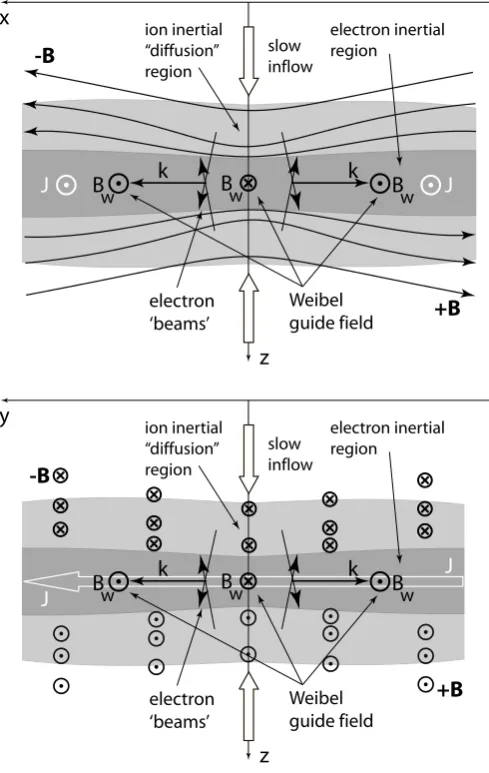
Fig. 2. Conditions inside a local electron inertial region. Inside the inertial region the electron components form two oblique beams which become smeared out by the two-stream instability. The re-sulting thermal-anisotropic Weibel instability generates a magnetic vortex of field bWwith wavenumber k⊥Vbperpendicular to the
beam configuration. These vortices close in the current plane(x,y). The sense of the magnetic vortices alternates along the current di-rection. Shown is the part of the lowest order vortex where the field is along the sheet current J. At a phase ofπ/2 along the current the Weibel fields point along the ambient magnetic field causing wobbling of the current layer.
magnetic field b satisfies the solenoidal condition b·k=0, k⊥Vb, andωb=k×eT, the Weibel magnetic field lies in the plane perpendicular to the inflow into the current sheet (cf. Fig. 2).
The beam-excited Weibel-mode model might not be real-istic. The two counter-streaming electron flows should read-ily thermalise due to the action of the high-frequency elec-trostatic two-stream instability which has large maximum growth rate
γt s
ωe '
√
3 N
b
2N 13
≈0.6 (7)
under conditions ofNb∼0.1Nwithk∼ωe/Vb∼6kW∼ ωe/c. This growth rate is much faster than the above
es-timated Weibel growth rate γW,max. Hence within one e-folding time of the Weibel field it smears out the beams into a flat-top distribution equivalent to heating the electrons and producing a weak temperature anisotropyTk> T⊥.
After this happens, the original thermal-anisotropic Weibel mode (Weibel, 1959) takes over. It grows forkλe<
k0λe= √
Aeat maximum growth rate
γw
ωe 'A
5 2
e s
8 27π
Te⊥ mec2
≈4×10⁻⁶ (8)
which holds for a weak anisotropyAe∼0.1 andTe⊥∼10 eV. With plasma density ofN∼1 cm−3this yields slow growth γw∼0.2 s−1of the Weibel field at maximum growing wave
number km=λ−e1 √
Ae/3∼3.5×10−5m−1 which
corre-sponds to wavelengthsλw∼200 km.
The Weibel magnetic field is directed either parallel or anti-parallel to the sheet current J=Jy while being con-ˆ
fined to the electron inertial zone. Such a field has the re-quired properties of a guide field. Since it cannot be stronger than the magnetic fieldB0in the external inflow region, the Weibel instability generates weak guide fields only satisfying bW/B0<1.
The above smallness condition on its wavelength implies that the Weibel guide field forms a comparably short-scale wavy magnetic structure along the sheet current, thereby structuring the current sheet magnetically in the direction of the current flow. Its transverse electric field eT||Vb
com-ponent along the electron beam inflow direction is confined to the electron inertial region, while the longitudinal electric field is in the direction e`⊥Vb.
The condition that the magnetic field be free of divergence forces the Weibel magnetic field to form closed magnetic vortices in the(x,y)-plane. Along the sheet current they pe-riodically amplify and weaken the external magnetic field on one side of (above or below) the current layer producing a spatial oscillation around the symmetry plane of the current layer of wavelength of the Weibel magnetic vortices.
3 Thermal Weibel level
The magnetic spectral energy density hbibjikω of
ther-mal fluctuations in an isotherther-mal plasma is determined from Eq. (2.52) in Sitenko (1967) as
hbibjikω=
µ0T n2 ω
δij−
kikj
k2
Im
⊥(ω,k) |⊥−n2|2
(9) In a thermally anisotropic plasma the temperature T is replaced by the effective temperature T⊥Tk/(T⊥+Tk) in this expression.The transverse dielectric response function ⊥(ω,k)in the anisotropic case reads
⊥=1− ω2e
ω2
1−Tk
T⊥ h
1−8(z)+iπ12ze−z2 i
−ω 2 i
ω2 (10) Here z=ω/
√
2kve⊥ is a variable that vanishes with ω→ 0, n2≡(kc/ω)2=⊥ is the refraction index of transverse fluctuations, and the real function8(z)≈2z2forz1.
With the help of these expressions the spectral energy den-sityh|b|2ikωcan be brought into the form
h|b|2ikω=µ0
ωe √
2π (c/vek)T⊥[θ/(1+1/θ )]κe−z 2
[κ2− ˜ω2+1−θ (1−8)]2+π θ2z2e−2z2 (11) where κ≡kλe,ω˜≡ω/ωe,θ≡Tk/T⊥=Ae+1, and λe=
c/ωe is the background plasma electron inertial scale. This
holds forω'0.
The spectral energy density of the Weibel field is obtained in the limitz=ω=0, which yields
h|b|2ik0=µ0
ωe s
π T⊥ mec2
mec2(Ae+1)2κ
(Ae+2)[κ2−Ae−µ]2
(12) Here the ion contribution has been retained in the termµ≡
me/mi. It prevents the fluctuations to diverge at κ→0 in
the isotropic caseθ=1 which scales ask−3. (The pole at κ2=Ae+µdisappears if full ion dynamics is included.)
In a current sheet of density N∼106m−3, tempera-tureT∼0.1 keV which implies electron inertial and Debye lengthsλe≈6 km andλD≈7.5 m, respectively, presumably
corresponding to conditions in the near-Earth magnetotail current sheet, the Weibel spectral energy density at maximum growing wave numberkmbecomes
h|b|2ikm0≈1.6×10⁻²⁷A 3 2
e
(Ae+1)2
Ae+2 p
T[eV] V2s3
m (13)
whereT[eV] is the background plasma electron temperature in eV.
4 Growth time in the magnetotail current layer
We are interested in the time required for the Weibel instabil-ity to grow to measurable guide magnetic field values under conditions in the magnetotail reconnection region. The max-imum growth rate of the thermal-anisotropic Weibel instabil-ity was found to
γW,max∼0.2 s−1 (14)
Instability growth implies for the time evolution of the spec-tral energy density of the magnetic field
h|b(t,k,0)|2i ≈D|b2(k,0)|E
W,thexp(2γWt ) (15) where on the left is the linearly growing spectral density at timet, and on the right the thermal level from where the instability starts growing. (No nonlinear saturation effects are included at this time.) An observable magnetic field in the magnetotail should be roughly of orderb∼1 nT, a value which one may use to find the growth timeτW required to reach this field strength
τW≈ 1 2γw
ln h|b 2(k,τ
w)|i h|b2(k,0)|i
W,th
(16)
Inserting for the thermal energy density|
b2(k,0)|
W,thfrom h|b|2ikm0and using the spectral energy density of ab∼1 nT magnetic field, hb21nTik0≈4.3×10⁻¹²V2s3/m, the typical growth time to reach this magnetic field level at a weak anisotropy of justAe∼0.1 becomes
τW,max∼92 s (17)
corresponding to∼50 e-folding times. This time of roughly τ∼1.5 min is not unreasonable for the processes in the mag-netotail current sheet.
5 Conclusions
The result of this investigation is that inside the electron iner-tial region (of transverse size of a fewλe) in the current sheet,
the inflow of electrons into the sheet from its two sides (in the geomagnetic tail from the lobes) may well be capable of self-consistently generating a weak magnetic guide field via the thermal-anisotropic Weibel instability. Given sufficient time of, say, 50 e-foldings weak guide fields will evolve on wavelengths the order of a few 100 km.
The Weibel-guide fieldBg is limited to be weaker than
the ambient external magnetic field B0. In the symmetric magnetospheric tail current sheet it may reach up to.10% of the ambient field unless nonlinear effects set on earlier to saturate the field on a lower level. Such nonlinear processes have not been investigated here. They can in principle be treated by assuming a stationary final state and calculating the thermal saturation level of the Weibel instability.
sheet. The role of guide fields in collisionless magnetic re-connection and the various effects it may cause have in the past decade been thoroughly investigated in numerical simu-lations both for guide fields perpendicular (e.g., Ricci et al., 2003) and parallel (e.g., Pritchett, 2005; Cassak et al., 2007; Egedal et al., 2008; Le et al., 2009) to the sheet current.
Acknowledgements. This research is part of a Visiting Scientist
Programme at ISSI, Bern, executed by RT. Hospitality of the ISSI staff and directors, in particular Andr´e Balogh, is thankfully recog-nised. The valuable comments of the two referees have been highly appreciated.
Topical Editor I. A. Daglis thanks A. Vaivads and another anonymous referee for their help in evaluating this paper.
References
Achterberg, A. and Wiersma, J.: The Weibel instability in relativis-tic plasmas. I. Linear theory, II. Nonlinear theory and stabiliza-tion mechanism, Astron. Astrophys., 475, 1, doi:10.1051/0004-6361:20065365, 2007.
Cassak, P. A., Drake, J. F., and Shay, M. A.: Catastrophic onset of fast reconnection with a guide field, Phys. Plasmas, 14, 054502, doi:10.10 63/1.2734948, 2007.
Drake, J. F., Swisdak, M., Che, H., and Shay, M. A.: Electron accel-eration from contracting magnetic islands during reconnection, Nature, 443, 553, doi:10.1038/nature05116, 2006.
Egedal, J., Fox, W., Katz, N., Porkolab, M., Øieroset, M., Lin, R. P., Daughton, W., and Drake, J. F.: Evidence and theory for trapped electrons in guide field magnetotail reconnection, J. Geophys. Res., 113, A12207, doi:10.1029/2008JA013520, 2008.
Fried, B. D.: Mechanism for instability of transverse plasma waves, Phys. Fluids, 2, 337, doi:10.1063/1.1705933, 1959.
Le, A., Egedal, J., Daughton, W., Fox, W., and Katz, N.: Equa-tions of state for collisionless guide-field reconnection, Phys. Rev. Lett., 102, 085001, doi:10.1103/PhysRevLett.102.085001, 2009.
Nakamura, R., Baumjohann, W., Asano, Y., Runov, A., Balogh, A., Owen, C. J., Fazakerley, A. N., Fujimoto, M., Klecker, B., and R`eme, H.: Dynamics of thin current sheets associated with magnetotail reconnection, J. Geophys. Res., 111, A11206, doi:10.1029/2006JA011706, 2006.
Nakamura, R., Baumjohann, W., Fujimoto, M., Asano, Y., Runov, A., Owen, C. J., Fazakerley, A. N., Klecker, B., R`eme, H., Lucek, E. A., Andr´e, M., and Khotyaintsev, Y.: Cluster obser-vations of an ion-scale current sheet in the magnetotail under the presence of a guide field, J. Geophys. Res., 113, A07S16, doi:10.1029/2007JA012760, 2008.
Pritchett, P. L.: Onset and saturation of guide-field magnetic re-connection, Phys. Plasmas, 12, 062301, doi:10.1063/1.1914309, 2005.
Ricci, P., Lapenta, G., and Brackbill, J. U.: Electron acceleration and heating in collisionless magnetic reconnection of a guide field, Phys. Plasmas, 10, 3554, doi:10.1063/1.1598207, 2003. Runov, A., Nakamura, R., Baumjohann, W., Treumann, R. A.,
Zhang, T. L., Volwerk, M., V¨or¨os, Z., Balogh, A., Glassmeier, K.-H., Klecker, B., R`eme, H., and Kistler, L.: Current sheet structure near magnetic X-line observed by Cluster, Geophys. Res. Lett., 30, 1579, doi:10.1029/2002GL016730, 2003. Sitenko, A. G.: Electromagnetic Fluctuations in Plasma, Academic
Press, New York, 1967.
Weibel, E. S.: Spontaneously growing transverse waves in a plasma due to an anisotropic velocity distribution, Phys. Rev. Lett., 2, 83, doi:10.1103/PhysRevLett.2.83, 1959.
Yoon, P. H.: Spontaneous thermal magnetic field fluctuations, Phys. Plasmas, 14, 064504, doi:10.1063/1.2741388, 2007b.