www.ann-geophys.net/30/1099/2012/ doi:10.5194/angeo-30-1099-2012
© Author(s) 2012. CC Attribution 3.0 License.
Annales
Geophysicae
Spatio-temporal structure of Alfvén waves excited by a sudden
impulse localized on an L-shell
D. Yu. Klimushkin1, P. N. Mager1, and K.-H. Glassmeier2
1The Institute of Solar-Terrestrial Physics of Siberian Branch of Russian Academy of Sciences, P.O. Box 291, 664033 Irkutsk, Russia
2Institut für Geophysik und Extraterrestrische Physik, Mendelssohnstrasse 3, 38106 Braunschweig, Germany Correspondence to: D. Yu. Klimushkin ([email protected])
Received: 27 March 2012 – Revised: 25 June 2012 – Accepted: 3 July 2012 – Published: 25 July 2012
Abstract. This paper is concerned with the spatial structure and temporal evolution of the azimuthally small scale Alfvén wave generated by a sudden impulse concentrated on a given magnetic shell. At the outset, both poloidal and toroidal com-ponents are present in the wave’s magnetic field. The oscil-lation in the poloidal component on a given magnetic shell is a superposition of two monochromatic oscillations, one with the local resonance frequency on this shell, and the other with the frequency corresponding to the resonance frequency on the source surface. The superposition of these two oscil-lations leads to beating. Due to phase mixing, the poloidal component of the oscillation decreases with time down to zero, transferring its energy to the toroidal component. Beat-ing in the toroidal component is less pronounced. As time elapses, energy concentration near the source magnetic shell occurs with the frequency of the oscillation corresponding to the Alfvénic resonance frequency on this surface. Out-side this thin region wave amplitudes become rather small at oscillation frequencies corresponding to the local resonance frequency of the respective magnetic shell.
Keywords. Magnetospheric physics (MHD waves and in-stabilities)
1 Introduction
A general framework for the interpretation of ultra-low fre-quency (ULF) wave phenomena in planetary magnetospheres is the concept of the field line resonance: a fast magne-tosonic wave is generated on the magnetopause and prop-agates into the inhomogeneous magnetosphere generating an Alfvén mode on a surface where the wave frequency
equals the local Alfvén frequency (for a more comprehen-sive overview see Glassmeier et al., 1999). As a result, the toroidal Pc5 Alfvén wave is observed in the magnetosphere and on the ground (e.g. Agapitov et al., 2009). This pro-cess is effective only in the case of the low-m initial per-turbation (wheremis the azimuthal wave number), since in the opposite case the magnetosphere is opaque for the fast magnetosonic wave. The initial fast mode can be generated by a process on the surface of the magnetosphere, e.g. by Kelvin-Helmholtz or Kruskal-Schwarzschild instability (e.g. Mishin, 1993; Fujita et al., 1996; Plaschke and Glassmeier, 2011; Mazur and Chuiko, 2011).
Surface perturbations on the magnetopause are also sup-posed to generate traveling convection vortices in the iono-sphere (Kivelson and Southwood, 1991; Glassmeier, 1992; Chi et al., 2006). In this case the perturbation is highly local-ized in the azimuthal direction, which means that it mainly consists of the high-m harmonics. Therefore, this kind of perturbations must have Alfvénic character, being mostly the parallel current disturbances (Glassmeier, 1992). Neverthe-less, a compressional magnetic field perturbation can appear due to finite plasma pressure and field line curvature effects (e.g. Mager and Klimushkin, 2002).
evolution the wave field structure is governed by a phe-nomenon known as phase mixing. At the initial onset of the perturbation, all field lines oscillate with the same phase and the wave field is characterized by a predominantly poloidal polarization. However, since each field line oscillates with its own eigenfrequency, the oscillations on neighboring mag-netic shells rapidly acquire significant phase differences. As a consequence, the wave acquires a very small spatial scale across magnetic field shells and, hence, becomes toroidally polarized to preserve the source-free nature of the magnetic field.
However, since the initial disturbance is often viewed as a surface wave on the magnetopause, it is of interest to con-sider a case when the Alfvén wave is excited by an impulsive source concentrated on a specific magnetic shell. For this special case, Hasegawa et al. (1983) found features similar to those of the case with a source widely distributed across L-shells. In our present study, we reexamine the problem as the solution obtained by Hasegawa et al. (1983) does not take into account surface wave features.
In Sect. 2 we formulate an equation describing the spatio-temporal structure of a high-mwave generated by a sudden impulse concentrated on a given magnetic shell. In Sect. 3 we perform a Fourier-transform of the equation over time obtain-ing as a result an integral solution for a spatial structure of a harmonic with a definite frequency. In Sect. 4 we perform an inverse Fourier-transform, that is, we integrate the obtained monochromatic solution over frequency. In Sect. 5 we apply a saddle-point method to the integral found in the previous section which allows us to find an asymptotic solution of our problem. In Sect. 6 we discuss some consequences of our solution. Section 7 presents the principal results of the paper.
2 Initial equations
In this study the magnetosphere is approximated and repre-sented as a rectangular box. A field-aligned Cartesian coor-dinate system is used: the z-coorcoor-dinate is directed along the field lines, the x-coordinate is directed across the magnetic field lines and takes the role of the radial coordinate in the magnetosphere, and the y-coordinate is directed both across field lines and magnetic shells, completing the triad and tak-ing the role of the azimuthal coordinate. Plasma parameters are assumed to vary only in the x-direction; thus, all per-turbed quantities on the azimuthal and longitudinal coordi-nates vary aseikyy+ikzz.
The equilibrium values of the magnetic field and plasma density are designated asB andρ, respectively;ξ denotes the displacement of plasma from its equilibrium position,E, bandj are the electric field, magnetic field, and electric cur-rent density of the wave, respectively.
The wave is assumed to be excited by a sudden impulse of an azimuthal current densityJ=(0, Jy,0)with
Jy=J0δ(x−x0)δ(t−t0) (1)
witht0denoting the onset time at the surface with radial co-ordinatex0. Following Akhiezer et al. (1975), this driving ex-ternal currentJ should be considered as an additional term in Ampere’s law:
∇ ×b=4π c j+
4π
c J. (2)
The linearized equation of motion for small oscillations takes the form
ρ∂ 2ξ
∂t2 − 1
cj×B=0 (3)
where ∇ ×E= −1
c ∂b
∂t (4)
and E=1
c ∂ξ
∂t ×B. (5)
Using these equations, one obtains the equation for the wave electric fieldE(x, t ):
1 A2
∂2E
∂t2 − ∇ × ∇ ×E= − 4π
c2 ∂J
∂t , (6)
whereA=B/√4πρis the Alfvén speed.
Let us suppose that the region under investigation lies in the opaque region for the fast mode. For example, it is pos-sible when a high-m perturbation is considered. Then the only propagating wave mode is the Alfvén mode. Assuming an infinite plasma conductivity in the magnetic field direc-tion, the parallel electric field component may be neglected; thus, the wave’s electric field lies on surfaces orthogonal to the field lines. According to the Helmholtz theorem (Morse and Feshbach, 1953), an arbitrary vector field can split into the sum of potential and vortical components. By applying this theorem to the two-dimensional fieldE, we use the rep-resentationE= −∇⊥8+ ∇⊥×e||9, wheree||=B/B and
∇⊥is the transverse nabla-operator. The “potentials”8and 9 represent the electric field of the Alfvén wave and fast mode, respectively (Klimushkin, 1994; Fedorov et al., 1998). As we are considering a region lying deep within the fast mode opaque region, the fast mode contribution9can be ne-glected, and the electric field of the wave can be represented in the form
E= −∇⊥8. (7)
Let us substitute Eq. (7) into Eq. (6) and apply the opera-tor∇⊥on the expression obtained by this substitution. As a
result, we find the equation ∂
∂x "
− 1 A2
∂2
∂t2−k 2 z #
∂8 ∂x −k
2 y "
− 1 A2
∂2
∂t2−k 2 z #
8
= −4π iky c2
∂Jy
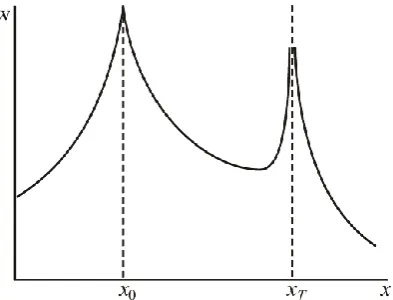
Fig. 1. A surface wave with superposed field line resonance. Here
wis the wave energy density.
As a boundary condition for the solution of this partial dif-ferential equation we use the condition
8|x→±∞=0. (9)
3 Solution for a single Fourier-harmonic
Performing a Fourier-transform over time, we have ∂
∂x "
ω2 A2−k
2 z #
∂8ω
∂x −k 2 y "
ω2 A2−k
2 z #
8ω
=qδ(x−x0)ωeiωt0, (10) where8ωis a Fourier-transformed8(t )value, and
q= −4π J0ky/c.
This is a differential equation describing a monochromatic Alfvén oscillation generated by the external current in the ap-proximation when the fast mode can be neglected. The same equation can be obtained as an exact one by assuming the plasma to be an incompressible fluid (Hasegawa and Uberoi, 1982).
Let us introduce the resonance (toroidal) eigenfrequency as (x)=kzA(x). Then the resonance surface xT can be
determined as a surface where the equalityω=(x)holds. Assuming the linear profile for the resonance frequency, =0·
l−x l ,
the coordinate of the resonance surface is xT(ω)=l·
0−ω 0
. (11)
Near this surface, an approximate equality ω2−2≈ 2ω(ω−)holds, and Eq. (10) can be rewritten in the form
∂
∂x[x−xT(ω)] ∂8ω
∂x −k 2
y[x−xT(ω)]8ω
=q l 20
eiωt0δ(x−x0).
The solution of this equation can be written in the integral form
8ω=q
l 20
eiωt0
+∞
Z
−∞
dke
ik(x−xT)
q k2
y+k2 k
Z
−∞
dk0e
ik0(xT−x0)
q k2
y+k
02 (12)
(Leonovich and Mazur, 1999). This expression describes a surface wave exponentially decreasing from the surface of the sourcex0with a field line resonance superposed on this background (Fig. 1). It should be noticed that it is a differ-ent kind surface wave than considered by, e.g. Hasegawa and Chen (1974), DeKeyser et al. (1999), or Plaschke and Glass-meier (2011), since it is not related to a sharp inhomogeneity in the medium where wave propagation is considered; how-ever, this surface wave is due to the highly localized source described by the azimuthal current density J=(0, Jy,0). In cases where perturbations are caused by magnetospheric buffeting (e.g. Kivelson and Southwood, 1991; Glassmeier, 1992), the localized source would be located right at the mag-netopause.
4 Inverse Fourier-transform over time
Performing the inverse Fourier-transform of Eq. (12) over time, we find a solution in the form
8(x, t )= lq 20
∞
Z
−∞
dωe−iω(t−t0)
∞
Z
−∞
dke
ik[x−xT(ω)]
q k2y+k2
· k
Z
−∞
dk0e
ik0[xT(ω)−x0)]
q k2y+k02
.
Taking into account the linearxT(ω)dependence of Eq. (11),
this expression can be rewritten as
8= lq 20
∞
Z
−∞
dk e
ik(x−l)
q k2
y+k2 k
Z
−∞
dk0e
−ik0(x
0−l)
q k2
y+k
02
·
∞
Z
−∞
dωe−iω[(t−t0)−
l 0(k−k
0
)]
.
Noting that the integral overωhere is an integral representa-tion of the delta-funcrepresenta-tion,
∞
Z
−∞
dωe−iω[(t−t0)−
l 0(k−k
0)]
=2π δ[(t−t0)− l 0
(k−k0)],
the integration overk0can be easily performed. Finally, we obtain the following solution:
8(x, t )=qπ 2(t−t0)ei(t−t0)
0
where I= ∞ Z −∞ dk e
ik(x−l)−ik(x0−l)
q k2
y+k2 q
k2 y+ [k−
0
l (t−t0)]2
. (14)
Thus, only the integration overkhas yet to be performed.
5 Asymptotic solution
Let us represent the integral in Eq. (14) in the form
I=
∞
Z
−∞
dk eS(k)
where the “phase” is
S=ik(x−x0)− 1 2ln(k
2 y+k2)−
1 2ln[k
2 y+(k−
0
l (t−t0)) 2].
To find an asymptotic solution atky|x0−x| 1, we can use the saddle-point method. The saddle-point is determined as a point where the derivativedS/dkvanishes:
dS
dk =i(x−x0)− k
k2 y+k2
− k
−0 l (t−t0)
k2 y+ [k−
0
l (t−t0)]2 =0.
A large value ofky|x−x0|implies that the denominator of either the second or the third term is small. That is, there are four saddle-points,
k1≈ +iky
k2≈ −iky
k3≈ +iky+ 0
l (t−t0)
k4≈ −iky+ 0
l (t−t0)
If we are searching the solution in the regionx < x0, then the path of the integration should go though the pointsk2andk4. Correcting for a finiteky|x−x0|value yields
k2= −iky+ i 2(x0−x) and
k4= −iky+ 0
l (t−t0)+ i 2(x0−x)
.
In the vicinity of these two points, the “phase” can be ap-proximated as
S≈S(k2,4)+ 1 2
d2S(k2,4)
dk2 (k−k2,4) 2,
where
S(k2)= −ky(x0−x)−ln s
ky
x0−x
−ln s
20
l2 (t−t0) 2+2ik
y 0
l (t−t0),
S(k4)= −ky(x0−x)+i 0
l (t−t0)(x−x0)−ln s
ky x0−x
−ln s
20
l2 (t−t0) 2−2ik
y 0
l (t−t0),
and d2S(k2)
dk2 =
d2S(k4)
dk2 = −2(x−x0) 2.
Now the integral I can be approximately represented as a sum of two integrals near the two saddle-points,
I=I2+I4
with
I2,4=
∞
Z
−∞
d(k−k2,4)eS(k2,4)−(x−x0) 2(k−k2
,4)2
= √
π p
ky(x0−x)
e−ky(x0−x) r
20
l2(t−t0)2±2iky 0
l (t−t0)
.
Finally, we have for the wave electric field potential
8(x, t )=qπ3/22(t−t0)
e−ky(x0−x) p
ky(x0−x)
[Fx(t )+F0(t )], (15) where
Fx(t )=
e−i(x)(t−t0)
r
20
l2 (t−t0)2−2iky 0
l (t−t0)
,
F0(t )=
e−i(x0)(t−t0)
r
20
l2 (t−t0)2+2iky0l (t−t0) ,
6 Analysis of the solution
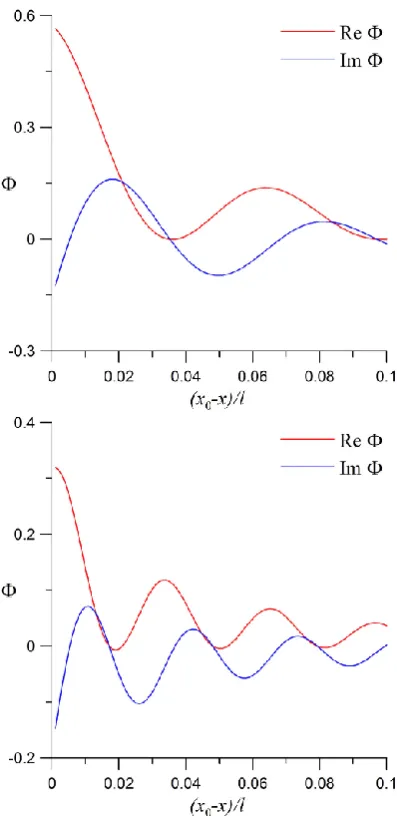
The factor exp[−ky(x0−x)]in Eq. (15) shows that the so-lution possesses the features of a surface wave localized on the magnetic shell of the sourcex0. On this “background” surface wave an additional spatial oscillation is imposed de-scribed by the factor exp[−i(x)(t−t0)]in the termFx(t ). This spatial modulation is displayed in Fig. 2, representing the result of a numerical determination of the integral (14).
The characteristic radial wave vector can be determined as kx=
∂(x) ∂x (t−t0).
The increase of the radial wave vector with time (which can also be inferred from Fig. 2) implies a transformation from a predominantly poloidal Alfvén mode (largeEycomponent) into a toroidally polarized Alfvén mode (large Ex compo-nent) since the wave the electric fields components are deter-mined byEy= −iky8andEx= −∂8/∂x. The decrease of the radial wave length as well as the polarization change is due to the phase mixing and is required to keep the magnetic field perturbation source-free.
Let us consider the temporal evolution of the wave field in more detail. For this we calculate the azimuthal electric field of the wave:
Ey= −ikyqπ3/22(t−t0)
e−ky(x0−x) p
ky(x0−x)
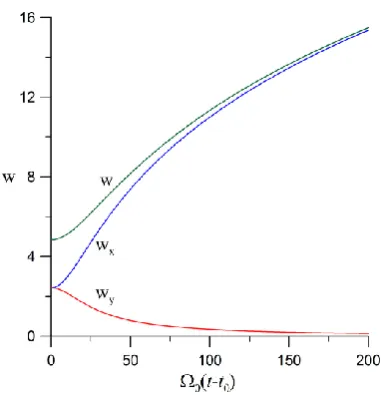
[Fx(t )+F0(t )]. (16) The first term in this expression,Fx(t ), corresponds to the os-cillation with the local resonance frequency, as in the theory of the wave excited by the impulse widely distributed across magnetic shells (below, this theory is referred to as the wide impulse theory). However, there is the second term,F0(t ), describing the oscillation with a frequency corresponding to the resonance frequency on the source surface, which does not have an analogy in the wide impulse theory. As both, the local resonance frequency and the resonance frequency of the source surface are different, beating occurs as seen in Fig. 3. Due to the presence of the square roots in the denom-inators ofFx(t )andF0(t ), the amplitude of the oscillation in theEycomponent decreases with time, which is also ev-ident from Fig. 4, where the wave electric field energy den-sitywy= |Ey|2/8π is displayed as a function of time. The poloidal mode wave energy decreases much as in the case of the wide impulse situation.
The spatio-temporal behaviour of the radial electric field component,Ex, is given by the expression
Ex=qπ3/22(t−t0)e−ky(x0−x) · nqky(x0−x)[Fx(t )+F0(t )]
+ i(t−t0) p
ky(x0−x) d(x)
dx Fx(t ) )
[image:5.595.328.527.60.469.2](17)
Fig. 2. Spatial structure of the wave at two times:0(t−t0)=100 (top panel) and0(t−t0)=200 (bottom panel).
Fig. 3. Temporal evolution of Ey far from the source, (x0−x)/ l=0.1.
Fig. 4. Temporal evolution of wave energy density,w, and its com-ponents,wxandwy, far from the source,(x0−x)/ l=0.1.
are equal to each other. This implies that the newborn wave exhibits a mixed polarization, poloidal and toroidal.
Another difference in comparison with the wide impulse theory is the total energy density,w=wx+wyon the given magnetic shell is not constant (see Fig. 4). However, if the en-ergy density decreases somewhere, it must grow somewhere else. Numerical calculations show that this happens on the surface of the impulse x0; the energy increase is shown in Fig. 6. Because of this the total electric energy integrated over the whole plasma volume,
Fig. 5. Temporal evolution of Ex far from the source,
[image:6.595.331.521.61.254.2](x0−x)/ l=0.1.
Fig. 6. Temporal evolution of wave energy density,w, and its com-ponents,wxandwy, on the surface of the impulsex0.
W= 1 8π
∞
Z
−∞
ExEx∗+EyEy∗
dx=1 4π
3qk y,
is conserved. To prove this one only needs to expressExand Eyusing Eqs. (13), (14), change an order of integration and use the integral representation of the delta-function.
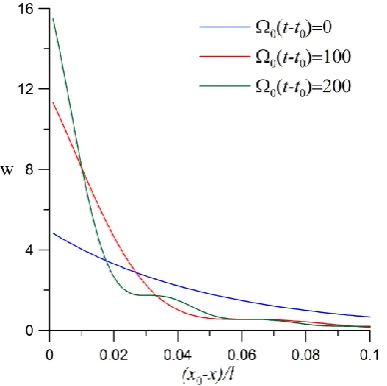
[image:6.595.332.526.297.495.2] [image:6.595.69.269.306.510.2]Fig. 7. Wave energy density,w, at different distances from the sur-face of the impulsex0for different times.
seen from the figure, the width of the kernel decreases with time.
7 Conclusions
This paper investigates the spatio-temporal structure of the high-mULF waves generated by a sudden impulse concen-trated on a given magnetic shell in a rectangular box. Due to the assumed small spatial variation in the azimuthal coor-dinate, the contribution of the fast mode is negligibly small, and the wave is represented by the Alfvén mode. At the out-set, both poloidal and toroidal components are present in the wave’s magnetic field. The wave amplitude exponentially de-creases with the distance from the source. The poloidal com-ponent oscillates in the beating regime. Due to phase mix-ing, its amplitude decreases with time down to zero. Beating is less pronounced in the toroidal component. Its amplitude grows with time, reaching some constant amplitude. The to-tal energy, integrated over the entire plasma volume, is con-served. As time elapses, a thin kernel and a wide tail of oscil-lations are formed: the energy density near the source mag-netic shell grows, while far from the source it is significantly decreasing, finally reaching some small constant value. That is, the Alfvén wave on the surface of the source with the lo-cal Alfvénic frequency on this surface grows. Each field line in the low amplitude tail oscillates with the local Alfvénic frequency on its magnetic shell.
The retreat of the wave energy onto the magnetic shell of the source is a rather peculiar finding. The initial poloidal wave spreads across field lines and excites local oscillations, decaying by phase mixing. The small radial scales generated in this way require a mode transformation towards toroidal oscillations. The amplitude of these oscillations decays with time, and energy conservation requires the wave energy to
accumulate at the source magnetic field shell. The system behaves by not supporting wave energy transport in the ra-dial direction in the long run. But this can only be achieved by coupling the initial poloidal wave energy into toroidal wave energy using the non-uniform background plasma and its wave dispersion properties as a kind of catalytical agent.
Many features of the solution derived here have analogies in the theory of the temporal evolution of an initial distur-bance widely distributed across magnetic shells considered in several earlier publications. Among them are phase mix-ing, the transformation into toroidally polarized wave, and oscillations with the local Alfvénic frequency. These features were also described in the previous study of Hasegawa et al. (1983) dealing with wave generation by a surface impulse.
Other features, such as the beating on the poloidal com-ponent for a short time interval after the onset of the oscil-lations, the change of the mode polarization from a mixed to predominantly toroidal mode, the concentration of power near the surface of the source with the local Alfvénic fre-quency have no analogies in the theory of the initial distur-bance widely distributed across the magnetic shells. These features were not revealed by the earlier study of Hasegawa et al. (1983). We suppose that such features can be used as observational marks of ULF waves generated by sudden im-pulses localized on some magnetic surface.
A factor which can prevent the concentration of power near the surface of the source is the dissipation of the wave energy due to the finite conductivity of the ionosphere. How-ever, as is seen from Figs. 6 and 7, the power concentration becomes evident as soon as ten wave periods; since usual Pc4–5 pulsations are observable for the longer time, we do not expect the power concentration to be prevented by the dissipation. Second, our consideration is applied to the high-mwaves, which are the subject of the various kinds of the wave-particle interactions and associated kinetic instabilities. These instabilities lead to the suppression of the dissipation on the earlier stages of the wave evolution (Klimushkin and Mager, 2004; Klimushkin, 2007).
study, since the coupling with the fast mode greatly exagger-ates a situation.
Acknowledgements. The work by D.K. and P.M. is supported by
RFBR grants 12-02-00305-a and 12-05-98522-vostok-a, and by the Program of presidium of Russian Academy of Sciences #22. D.K. was also supported by DAAD Research Fellowship program under grant A1104370. K.H.G. was financially supported by the German Ministry of Economy and Technology and the Deutsches Zentrum für Luft- und Raumfahrt under contract 50 OC 1001.
Topical Editor I. A. Daglis thanks P. Chi and W. J. Hughes for their help in evaluating this paper.
References
Agapitov, O., Glassmeier, K.-H., Plaschke, F., Auster, H.-U., Con-stantinescu, D., Angelopoulos, V., Magnes, W., Nakamura, R., Carlson, C. W., Frey, S., and McFadden, J. P.: Surface waves and field line resonances: A THEMIS case study, J. Geophys. Res., 114, A00C27, doi:10.1029/2008JA013553, 2009.
Akhiezer, A. I., Akhiezer, I. A., Polovin, R. V., Sitenko, A. G., and Stepanov, K. N.: Plasma electrodynamics. Vol. 1: Linear theory, International Series of Monographs in Natural Philosophy, Vol. 68, Pergamon Press, Oxford, UK, 1975.
Chen, L. and Hasegawa, A.: A theory of long period magnetic pul-sation. 2. Impulse excitation of surface eigenmode, J. Geophys. Res., 79, 1033–1037, 1974.
Chi, P. J., Lee, D.-H., and Russell, C. T.: Tamao travel time of sudden impulses and its relationship to iono-spheric convection vortices, J. Geophys. Res., 111, 1033–1037, doi:10.1029/2005JA011578, 2006.
DeKeyser, J., Roth, M., Reberac, F., Rezeau, L., and Belmont, G.: Resonant amplification of MHD waves in realistic subsolar mag-netopause configurations, J. Geophys. Res., 104, 2399–2409, doi:10.1029/1998JA900060, 1999.
Fedorov, E., Mazur, N., Pilipenko, V., and Yumoto, K.: MHD wave conversion in plasma waveguides, J. Geophys. Res., 103, 26595– 26605, 1998.
Fujita, S., Glassmeier, K.-H., and Kamide, K.: MHD waves generated by the Kelvin-Helmholtz instability in a nonuni-form magnetosphere, J. Geophys. Res., 101, 27317–27326, doi:10.1029/96JA02676, 1996.
Glassmeier, K.-H.: Traveling magnetospheric convection twin-vortices – Observations and theory, Ann. Geophys., 10, 547–565, 1992.
Glassmeier, K.-H., Othmer, C., Cramm, R., Stellmacher, M., and Engebretson, M.: Magnetospheric field line resonance: a com-parative approach, Surveys Geophys., 20, 61–109, 1999. Hasegawa, A. and Chen, L.: Theory of magnetic pulsations, Space
Sci. Rev., 16, 347–359, 1974.
Hasegawa, A. and Uberoi, C.: The Alfvén wave, US Dept. of En-ergy, Washington, 1982.
Hasegawa, A., Tsui, K. N., and Assis, A. S.: A theory of long pe-riod magnetic pulsations. 3. Local field line oscillations, Geo-phys. Res. Lett., 10, 765–767, 1983.
Kivelson, M. G. and Southwood, D. J.: Ionospheric traveling vor-tex generation by solar wind buffeting of the magnetosphere, J. Geophys. Res., 96, 1661–1667, doi:10.1029/90JA01805, 1991.
Klimushkin, D. Y.: Method of description of the Alfvén and magne-tosonic branches of inhomogeneous plasma oscillations, Plasma Phys. Rep., 20, 280–286, 1994.
Klimushkin, D. Y.: How energetic particles construct and destroy poloidal high-m Alfvén waves in the magnetosphere, Planet. Space Sci., 55, 722–730, doi:10.1016/j.pss.2005.11.006, 2007. Klimushkin, D. Yu. and Mager, P. N.: The spatio-temporal
struc-ture of impulse-generated azimuthalsmall-scale Alfvén waves interacting with high-energy chargedparticles in the magneto-sphere, Ann. Geophys., 22, 1053–1060, doi:10.5194/angeo-22-1053-2004, 2004.
Klimushkin, D. Y., Podshibyakin, I. Y., and Cao, J. B.: Az-imuthally small-scale Alfvén waves in magnetosphere excited by the source of finite duration, Earth, Planets, Space, 59, 951–959, 2007.
Leonovich, A. S. and Mazur, V. A.: Standing Alfvén waves in an axisymmetric magnetosphere excited by a non-stationary source, Ann. Geophys., 16, 914–920, doi:10.1007/s00585-998-0914-z, 1998.
Leonovich, A. S. and Mazur, V. A.: Standing Alfvén waves in the magnetosphere from a localized monochromatic source, J. Geo-phys. Res., 104, 2411–2420, 1999.
Mager, P. N. and Klimushkin, D. Y.: Theory of azimuthally small-scale Alfvén waves in an axisymmetric magnetosphere with small but finite plasma pressure, J. Geophys. Res., 107, A11, doi:10.1029/2001JA009137, 2002.
Mager, P. N. and Klimushkin, D. Y.: Generation of Alfvén waves by a plasma inhomogeneity moving in the Earth’s Magnetosphere, Plasma Phys. Rep., 33, 391–398, doi:10.1134/S1063780X07050042, 2007.
Mager, P. N. and Klimushkin, D. Yu.: Alfvén ship waves: high-mULF pulsations in the magnetosphere generated by a mov-ing plasma inhomogeneity, Ann. Geophys., 26, 1653–1663, doi:10.5194/angeo-26-1653-2008, 2008.
Mann, I. R. and Wright, A. N.: Finite lifetimes of ideal poloidal Alfvén waves, J. Geophys. Res., 100, 23677–23686, 1995. Mazur, V. A. and Chuiko, D. A.: Excitation of a magnetospheric
MHD cavity by Kelvin-Helmholtz instability, Plasma Phys. Rep., 37, 913–934, doi:10.1134/S1063780X11090121, 2011. Mishin, V. V.: Accelerated motions of the magnetopause as a trigger
of the Kelvin-Helmholtz instability, J. Geophys. Res., 98, 21365– 21371, doi:10.1029/93JA00417, 1993.
Morse, P. M. and Feshbach, H.: Methods of Theoretical Physics, Part I, McGraw-Hill, New York, 1953.
Plaschke, F. and Glassmeier, K.-H.: Properties of standing Kruskal-Schwarzschild-modes at the magnetopause, Ann. Geophys., 29, 1793–1807, doi:10.5194/angeo-29-1793-2011, 2011.
Radoski, H. R.: A theory of latitude dependent geomagnetic mi-cropulsations: the asymptotic fields, J. Geophys. Res., 79, 595– 613, 1974.
Yeoman, T. K., M., J., Mager, P. N., and Klimushkin, D. Y.: SuperDARN observations of high-m ULF waves with curved phase fronts and their interpretation in terms of trans-verse resonator theory, J. Geophys. Res., 117, A06231, doi:10.1029/2012JA017668, 2012.