NON POTABLE WATER REUSE- QUALITY AND COSTS
Marie Marguerite Bourbigot, Bruce Durham, Tom Pankratz VIVENDI Water Vivendi Water, 52 rue d’Anjou
75008 Paris, Cedex 08, France
Introduction
Once limited to sites with extreme water deficits or effluent disposal constraints, reuse of reclaimed water has become an increasingly strategic water management option for growing communities worldwide. Because of increasing public acceptance, health protections, and comprehensible regulatory guidance, non-potable water reuse applications have been widely practiced. Communities considering a non-potable reuse program are nevertheless still faced with institutional, legal, and liability issues inherent to reclaimed water service. Furthermore, because of these unique jurisdictional and market constraints, it is important to optimize the economic benefits and financial performance of non-potable reuse projects.
The economic analysis provides the basis for justifying a water reuse project in monetary terms. It makes a comparison of the total costs and benefits associated with the project against those of alternatives developed to provide additional water supply and/or additional wastewater disposal. In the case studies presented below, the economic analysis have demonstrated the benefit of the reuse projects.
Concerning the total cost that includes capital construction and operation and maintenance costs, it has been largely optimized during the last five years. Innovative approaches are proposed both in term of the reduction of energy consumption and optimization of pretreatment prior to reverse osmosis (RO) or nanofiltration (NF). This is important when there is a need for advanced treatment due to regulation or because of specific applications (presence of too high salt content for use in irrigation, need for high quality industrial water or aquifer recharge application). This paper will focus more specifically on this type of design.
Water quality comparison and effectiveness: MF/ UF to conventional pretreatment prior to reverse osmosis
(TFC) membrane, and their ability to withstand high chlorine dosages. Unfortunately, cellulose acetate (CA) membranes require significantly higher feed pressures to achieve the same production rate, thereby resulting in high operating costs (24 bar for CA v 9 – 13 bar for TFC)[1]. By reducing the fouling potential on variable quality feed water, the use of thin film composite has been reliably proven to reduce the power cost for the RO portion of the plant by up to 60%[1]. Microfiltration (MF) or ultrafiltration (UF) pretreatment prior to RO can reduce this fouling potential over the conventional pretreatment processes.
Numerous full-scale water reclamation and reuse installations, pilot and demonstration plants have been undertaken in recent years to compare the conventional pretreatment system with either MF or UF, followed by RO. The Advanced water treatment process based on microporous membranes such as microfiltration and ultrafiltration followed by reverse osmosis have become the industry standard for the treatment of municipal wastewater in indirect potable reuse projects [2].
The effectiveness of MF/UF systems compared to conventional systems can be evaluated in terms of:
The quality and variability of the feed water The capacity of the system and the space available
The quality of the MF/UF product water which is largely independent of the feed quality
The amount of cleaning or maintenance required for the pretreatment system The reliability, capital and operating costs of the NF or RO system
In reuse plants, the feed water to the pretreatment system is often secondary municipal wastewater effluent. This can have a variable and at times high suspended solids load and a high proportion of colloidal material and bacteria. These constituents can cause critical failure to the downstream RO system, if not successfully removed during pretreatment.
A number of studies have been undertaken to evaluate the effectiveness of MF/UF pretreatment. The largest of these has been the long-term study (> 53,000 hrs) and demonstration undertaken at the world-renowned Water Factory 21 (WF 21), at the Orange County, California Water District so that they can design their 336 Ml/d system.
increased the demand for water resulting in the need to import water. Reclaiming secondary sewage consumes only 50% of the energy to import water from North California and 66% of the energy costs from the Colorado River. The reclamation of wastewater will also delay by 10 years a $150 Million investment in a new ocean outfall. The uncertainty over the price and availability of imported water adds to the many strong incentives to maximize the recovered water at WF21. Orange County is now undertaking the design phase of a major expansion at WF21 so that they can reclaim 336 Ml/d by 2020.
The result of earlier piloting work has led to operation of a 113 m3/h MF/RO demonstration project running since 1994 to generate water quality data, develop detailed costs, and refine design criteria for the full-scale system [1]
The water produced from the Memcor CMF plant (continuous microfiltration) contains exceptionally low numbers of microorganisms, suspended solids and significantly reduced turbidity (see table below)
Water quality Influent Lime treated CMF treated
Turbidity NTU 2-5 1 <0.1
[3]
Suspended solids mg/L 5-10 2-3 <1
[3] Total Organic Carbon
mg/l 10-12 8-10 8-10 [3]
Silt Density Index >6 5-6 1-2
[3] Bacteria CFU/100ml 105 – 106 3-4 log
reduction 5-6 log reduction[3]
Organics removal
(1997) 50% GAC, 50% RO 100% RO [1]
Process performance
(TOC) (1999) - 2 mg/l ( blended 50 %
GAC + 50% RO)
0.3 mg/l [1]
(100% MF/RO) Process performance
(TOC) - 2 mg/l 0.3 mg/l [1]
Space required 500 gal/
ft2/day 21 m3 / d / m2
2500 gal/ft2/day [1]
106 m3/ d / m2
RO cleaning interval - 4-6 weeks 8-12 months
[1]
Operating and
maintenance costs (Chemicals, power, gas, membranes, UV
- $320 per
$0.26 per m3 $0.15 per m3
Note that MF pretreatment provided an approximate 60-70% improvement in reduction of turbidity of the pretreated water compared to conventional pretreatment; and a 70-80% improvement in SDI measurements. The CMF pretreated water always produced SDI results significantly below the cut-off value of 3 as recommended by the RO manufacturers, while the conventional system could only produce pretreated water with measured SDI’s 5 to 7.
A number of key design decisions have been made during the pilot studies that started in the early 1990’s.
Outside to inside flow through hollow fiber membranes appear to be relatively less sensitive to high influent turbidities than inside to outside membranes [4]. (No lumen blockage risk). This has also been supported by other long-term pilot studies comparing MF v UF when pretreating TFC RO [5]. 60 of the 74 membrane water and wastewater applications in the USA use out to in hollow fiber designs (81%) [12]
High porosity membranes to maximise productivity [6]
Symmetrical membrane for strength and filtration efficiency [6]
Centrifugal potting of fibers or the use of soft resins to prevent the problem of fiber breakage at the resin interface due to resin wicking [6]
Direct filtration rather than cross flow to maximise efficiency [6] Proven and efficient backwash [6]
Other excellent examples are the multiple installations as part of the West Basin Water Recycling Plants in El Segundo LA, California [7]
These wastewater reuse projects were also started with a water injection project to control saline ingress into the fresh water aquifer. Secondary sewage from the Hyperion Wastewater plant is now used in a variety of ways. The initial construction of the reuse plant was completed in June 1995 and consisted of conventional pretreatment. Microfiltration was pilot tested for nine months prior to its implementation under a phase 2 plant expansion. A 470 m3/h Memcor MF plant is now used as pretreatment for RO to provide water used for injection in a barrier scheme to control saline ingress operational since 1997. Four CMF/RO systems have been installed by West Basin Municipal Water District [12] at 50% less than a comparable conventional pretreatment cost and are now used to supply nearby Mobil (17Ml/d), Arco (19Ml/d) and Chevron (19Ml/d) refineries with feed for their high-pressure boilers and cooling water.
Conventional Microfiltration
Feed Turbidity NTU 4.5 - 7.5 4.5 - 7.5
Filtrate Turbidity NTU 0.13 - 0.33 0.05 - 0.10
A very real issue particularly for applications in the reuse market is the integrity of the membrane systems. MF/UF technologies must be capable of maintaining integrity over the life of the membrane element. Membrane integrity refers to leakage of the reject stream into the product through breaks or inadequate sealing in a membrane system. For example, these leakage areas can result from defects during manufacturing and through damaged inter-connector O-rings. If the MF/UF membrane is to be considered a barrier for bacteria, then the users must be able to depend on the integrity of the membrane system.
The oldest CMF system at West Basin has 5 skid mounted units each with 90 modules containing approximately 20,000 hollow fibers per module. The 9 million membrane fibers are regularly checked using the automatic membrane integrity test as part of the operating procedure since April 1997.
The integrity test is a standard system, which holds air pressure across the membrane to identify any broken fibers. The test sensitivity is one broken fiber in the 9 million per test. The integrity test has been qualified to 4.5 log sensitivity. Modules with broken fibers can be easily identified acoustically and then individual modules can be isolated so that the unit can be returned to service without maintenance shutdown. Damaged modules can be easily and quickly removed (15-30 minutes) from the unit when convenient and are then pin repaired onsite and returned to stock.
Two sub-modules have been repaired in the last two years of operation. This represents the pin repair of 2 out of 450 sub-modules and represents probable 10 individual fibers repaired out of a total of 9 million fibers. This is supported by similar reliability results from Eraring Power Station in Australia. Eraring Energy has a CMF/RO system that has been treating secondary sewage for super critical boiler feed since 1995. This has enabled the 2640 MW coal fired plant to operated as a zero discharge station. They have not replaced any membranes to date (Aug 2000) and pin repairs have been minor. The 160 m3/h CMF system protects the CA -RO membranes that have not been cleaned in the last 12 months [9]
Another example is project in Korea for Samsung General Chemical Co Ltd, Daesan [10].
A shortage of water has forced industry in the Daesan region to use polluted local rivers as a source of industrial water. Local industry has been using reverse osmosis to produce high quality industrial water from these surface supplies since the early eighties. However the conventional pretreatment systems used on these early plants were not able to reduce SDI to less than 3 reliably and the downstream Reverse Osmosis systems were subject to membrane fouling. There are now two different systems on this site, both using RO to desalinate surface water, one uses conventional pretreatment and the other uses a 1,250 m3/h MF system in operation since 1996. The RO chemical cleaning frequency with conventional pretreatment is 10 days compared with MF pretreatment of 30 days.
Parameter Influent MF
Turbidity 200 NTU O.5 NTU(max)
Suspended
Solids 50 mg/l (max) <1mg/l
Total Fe 1 mg/l (max)
Total Silica 5.5 mg/l(max) Total
Coliforms 10cfu/ml
SDI 3(max)
Backwash
interval 22 mins
Feed Pressure 150kPa
MF chemical
cleaning 7days
In evaluating the effectiveness of MF/UF compared to conventional pretreatment it is important to consider the level of cleaning, backwashing, and maintenance required by the MF/UF system.
The MF/UF systems clearly provides pretreated water of a higher quality than conventional systems when protecting RO or NF, but can require more extensive cleaning, backwashing or maintenance compared to conventional systems unless designed correctly. Water Factory 21 strongly believe from their operating experience that membrane systems are easier to maintain and operate than their conventional system [2].
The membrane systems process risk is different to conventional depth filtration technology. Membranes reliably produce the treated water quality, as they do not unload suspended solids into the filtrate. They are more sensitive however to the efficiency of backwash and periodic chemical cleaning, as the production will stop if these stages do not operate correctly.
Pilot studies are critical to the success of a project. They can save up to 30% in capital cost by understanding the variability and nature of the feed water, optimising the design and minimising chemical cost. Recent pilot studies for very large reuse systems required chemical cleaning of the MF system on highly fouling estuary and canal water every 5 to 10 days and on good quality secondary sewage every 6 to 8 weeks. Secondary sewage is often more consistent and is less fouling than a polluted and variable surface water.
Cost Comparison : MF/UF to conventional pretreatment For Water Factory 21, the MF system has been found to [1]:
Occupy 1/5 less space than the conventional system, for the same effluent capacity
Is easily automated and less maintenance intensive
Improves the performance of the downstream RO process, allowing for the change to thin film composite RO membranes over cellulose acetate membranes, resulting in a reduction of the power cost by 60%
Overall cost benefit of 41% savings in operation and maintenance cost, from $0.26/m3 to 0.15/m3 resulting from changing from conventional pretreatment with cellulose acetate membrane, to MF with thin film composite RO membranes
The same trend is found in the West Basin Water Recycling Plant in El Segundo, California [10]. Cost considered in the study included capital, O&M labor, chemical cost, sludge handling and disposal, power cost, and replacement parts and supplies. The plant utilizes cellulose acetate RO membranes. The following table compares the cost for the conventional pretreatment versus the MF pretreatment, based on the actual historic capital cost data, and operating cost over the period July, 1997 to October, 1998 :
Cost Description Conventiona
l Pretreatmen
t $/m3
MF Pretreatment
$/m3
Fixed costs
Capital costs 0.22 0.13
O&M Labor 0.04 0.02
Replacement Parts & supplies 0.01 0.02
Subtotal Fixed Costs 0.27 0.17
Variable Costs
Chemical Costs 0.09 0.03
Sludge Production & Handling 0.06 0.003
Power 0.02 0.02
Subtotal Variable Costs 0.17 0.05
Total Fixed & Variable Costs 0.43 0.22
This data indicates that MF pretreatment for the reuse application is approximately 45% less expensive than the conventional pretreatment trains.
Benefits associated with the reuse projects
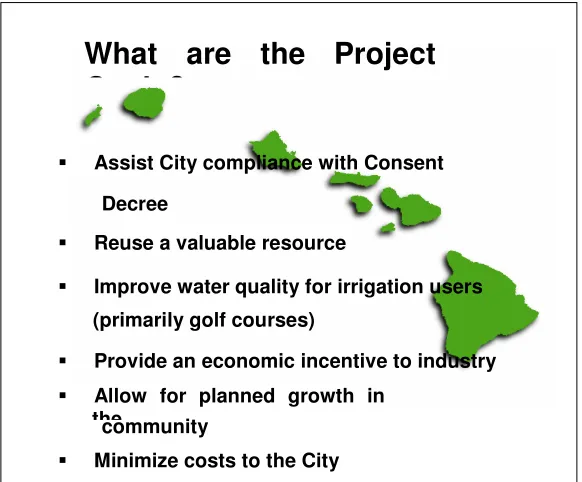
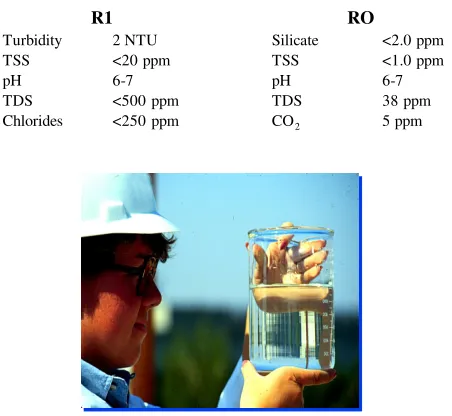
Another example is the project in Hawaii. The City of Honouliuli is faced with improving their wastewater discharge level to the Bay and at the same time they had to deal with water conservation (Fig. 1). The VIVENDI Water project for the City is to renovate the secondary effluent from the wastewater plant and use for both municipal and industrial use. The municipal use is for irrigation of golf courses managed by the City. Through the use of recycled wastewater the pollutant load to the Bay is reduced and the water resources is preserved for other domestic use. The industrial use will be to treat the secondary effluent to the level purity in order for it to be used as feed-water for boiler operations for some of the Power station. This level of purity will be achieved through the use of membranes in a reverse osmosis process (Fig. 2 and 3). The industrial user will have minimal treatment of the water before its use in the boiler. (Currently the industrial user must pump groundwater or purchase potable water and treat it to removed silica and other dissolved salts in order to be acceptable for use in the boiler).
Figure 2 - The
Figure 1 - The Honouliuli reclaim project
Assist City compliance with Consent Decree
Reuse a valuable resource
Improve water quality for irrigation users (primarily golf courses)
Provide an economic incentive to industry Allow for planned growth in
thecommunity
Minimize costs to the City
Figure 2 - Honouliuli reclaim project - The project water Flow
Figure 3 - The Honouliuli reclaim project - Water Quality
R1 Treatment : Hydroclean Filters, UV disinfection (Trojan medium pressure) RO Treatment includes Memcor microfiltration and RO
Another example is the Durban project. In Durban, as in the rest of South Africa, the availability of drinking water is critical. The Durban city authorities have decided to
Honoluliuli WWTP Secondary Treatment U.S. Filter R1 Treatment U.S. Filter RO Treatment Campbell Industrial Park City Uses (Phase I)
Golf Courses and Others (Phase II) 4 mgd 6 mgd Ocean Outfall 34 mgd 13mgd 13 mgd 3 mgd 2.0 mgd 1. 0 m gd re je ct 10 mgd 9 m gd 1 m gd R ec yc le S tre am R1
Turbidity 2 NTU TSS <20 ppm
pH 6-7
TDS <500 ppm Chlorides <250 ppm
RO
Silicate <2.0 ppm TSS <1.0 ppm
pH 6-7
TDS 38 ppm
[image:9.595.115.341.401.609.2]Decarbonating
Settlers Dual-media filtration
Used water tank
Filtered water tank for filters upwash Activated sludge
Secondary sedimentation
tanks
48.5 Ml/d 49.2 Ml/d 97.9 Ml/d
49.9 Ml/d
Ozonation filtration GAC
47.5 Ml/d 47.7 Ml/d 47.7 Ml/d Chlorination
0.7 Ml/d 0.5 Ml/d 0.3 Ml/d
0.6 Ml/d
1.5 Ml/d 48 Ml/d
0.8 Ml/d
0.3 Ml/d
0.5 Ml/d
47.5 Ml/d From primary
sed. tanks
Treated water 0.1 Ml/d
Clarified Water
Sludges
[image:11.595.123.734.41.528.2]0.2 Ml/d For DMWWM
A reclamation plant is now under construction following the recent signature by VIVENDI Water of the first BOOT (build, own, operate and transfer) contract in the water sector in South Africa. The recycled water is to be used for the complete production of high quality white paper. The main customer, a paper manufacturer, has laid down the following maximum characteristics : 61 mS/m conductivity, 30 mg/l COD and 5°H colour. In addition, its ammonia content must be less than 1 mg/l and its turbidity less than 1 NTU. This is virtually the equivalent of juxtaposing a wastewater treatment plant and a water treatment plant with a capacity of 47,000 m3/day, including liming, dual media filters, ozonation, activated carbon biological filters and chlorination. (Fig. 4)
The new plant will significantly reduce the pollution flowing into the environment around Durban and the manufacturers supplied will make savings of more than 30 % on the price of potable water for an average annual volume of 42,500 m3/day. The project
is also proving the viability of wastewater reuse by industry even when the price of potable water is low -2.53 rand/m3 or around € 0.38 in Durban- providing there is a wastewater treatment plant near the industrial zone concerned.
Submerged Membranes – the way forward ?
It may be argued that water reclamation begins in the sewer [4]. A holistic, integrated, sustainable approach needs to be considered so that we can continuously achieve more cost effective solutions at less environmental cost.
The pilot studies on Orange County’s Integrated Membrane Anaerobic Stabilisation treatment, IMANS [4] is combining the series process treatment stages to produce a more compact dual membrane system by treating settled primary sewage.
The objective is to reduce the traditional process steps at Water factory 21 from : 12 stage (conventional)
(Including screening, activated sludge & digestion, lime clarification, sand filtration, GAC, RO)
7 stage (conventional polished with MF/RO - similar to over 50 systems globally) (Including screening, clarification, activated sludge, secondary clarifier & sludge digester, MF/RO)
4 stage IMANS system
Screening, MF,RO with high rate anaerobic digestion of RO concentrate [4] 3 stage
Screening, Immersed membrane/ activated sludge, RO [12][14]
Submerged MF membrane systems are being operated and large systems are currently being built to take advantage of the latest developments in membrane technology for lower cost. Over twenty systems are now installed globally (excluding small industrial plants) and have the following benefits on small as well as very high flowrate systems [12] for RO protection.
Proven membrane filtration in a simpler and lower cost configuration Identical treated water reliability for RO pretreatment
Similar membrane integrity test
50% reduction in membrane system footprint
Ability to increase output 6 fold from existing footprint by retrofitting existing plant
The 4 stage IMANS system is operating CMF/RO on settled primary sewage [4] and demonstrates lower power requirements, no secondary activated sludge, greater biogas production as well as lower sludge production. The comparison of the MF/RO preliminary estimated costs is as follows:
Parameter Estimated annual cost ($millions)
MF/RO as 7 stage
add on IMANS
Net power consumed 4.5 3.2
Biosolids production and disposal 5 4.1
Total 9.5 7.3
Conclusions
Clearly the future will be dominated by unrelenting demands for increasing reuse water quantity and quality produced at decreasing costs. The largest application has been to provide water for irrigation where pathogen risk minimization is the primary consideration. However, the need for membrane filtration to produce a high quality water source for either industrial use or aquifer recharge has emerged as a major application over the last ten years. Underlying the development of non potable water reuse is the economic value of treated water, the quality of which is driven by regulations and technology. Reclaimed water, as shown in this paper, can be a competitive water resource to satisfy growing, and predominantly non-potable, urban and industrial water demands.
Besides generating a new water resource, and limiting effluent discharges to the environment, water reclamation and reuse permit conserving freshwater resources for the highest quality need, i.e. drinking water supply.
[1] Thomas M Dawes et al, Meeting the demand for potable water in Orange County in the 21st Century. The role of membrane processes, AWWA membrane technology Conference, Long Beach, California, 28 February 1999
[2] Current issues in membrane applications and research. Membrane system design issues - Full scale applications AWWA membrane technology conference. Preconference workshop February 1999
[3] Status of research on the use of microfiltration for reclamation, OCWD 1997
[4] Graham JG Juby et al, A novel membrane-Anaerobic digestion approach for wastewater treatment and water reclamation. AWWA Conference June 2000
[5] Emmanuel van Houtte, Reuse of wastewater effluent for artificial recharge in the Flemish dunes., IQPC Water Recycling & Effluent reuse Conference, Gatwick, April 1999
[6] B Durham , WF21 site visit April 1999
[7] Wyatt Won et al, Comparative life cycle costs for operation of full scale conventional pretreatment/RO and MF/RO systems, AWWA membrane technology Conference, Long Beach, California, 28 February 1999
[8] Van Hoof et al, The effect of ultrafiltration as pretreatment to reverse osmosis in waste water for further desalination and the environment, Norit Membrane Technology, Addur SWRO, Bahrain 1999
[9] G.Craig , personnal communication,.25 August 2000
[10]Bruce Durham, Long term operating experience of wastewater reuse for industry, IQPC Water Recycling & Effluent reuse Conference, Gatwick, April 1999
[11]Jankel et al , personnal communication 5 October 1999
[12]Scott Freeman et al,. Experiences with submerged and encased microfiltration and ultrafiltration membranes for surface water treatment. Appendix TableA-1 MF/UF membrane plants in North America (installed, under construction or in design). AWWA Conference June 2000
[13]GL Leslie et al, Performance and economic Evaluation of membrane processes for Reuse applications. 1997
[14]Pierre Cote et al, Immersed membrane activated sludge for the reuse of municipal wastewater. Anjou Recherche, Metcalf & Eddy, Desalination 113 (1997), p 189-196, Workshop on Membranes in Drinking Water Production - Technical Innovation and Health Aspects : l'Aquila, Italy, June 1-4, 1997
[15]Brian Birkenhead et al. Microporous separation technologies. Principles and economics. Microporus membrane filtration technology, Improving drinking water quality, AMGA Workshop, Genova October 1999