
Ruben D. Cohen
, Citigroup, London E14 5LB, UK.
the Yield Curve*
Among other features of the model are that it is able to explain, qualitatively if not quantitatively, the existence of (1) a normal yield curve at times of “normal eco-nomic growth”, (2) an inverted curve during periods of “high uncertainty”, “high in-terest rates” or “low economic growth”,1(3) a flat yield curve in more certain times
and (4) a liquidity trap when economic growth is expected to be negative.
Abstract
An intuitive model for the yield curve, based on the notion of value-at-risk, is present-ed. It leads to interest rates that hedge against potential losses incurred from holding an underlying risky security until maturity. This result is also shown to tie in directly with the Capital Asset Pricing Model via the Sharpe Ratio. The conclusion here is that the normal yield curve can be characterised by a constant Sharpe Ratio, non-dimen-sionalised with respect to √T, where Tis the bond maturity.
1. Introduction
The yield curve, which is a graphical depiction of interest rates plotted against the maturities of the underlying fixed income instrument—most commonly treasury bonds—constitutes an important area of economics and finance, and its determination has proven to be one of the most challenging endeavours undertaken in both theoretical and practical re-search. Constructing original framework models to predict these curves lies at the forefront of activities in every major financial institution, as any successful trading strategy that originates from these is guaranteed to generate vast amounts of profits.
Although interest in the shape of yield curves began as early as 1913 with work on the business cycle (Mitchell, 1913), it was Kessel (1965) who first focused specifically on the behaviour of the term spreads. Since then, work, both theoretical and empirical, has advanced to cover the use of term spreads to forecast the economy, as it was always recognised that the yield curve is not only affected by economic policies and shocks (Evans & Marshall, 2001) but that it could also serve as a leading indicator for a vari-ety of economic parameters, including changes in GDP, GNP, consumption, investment, etc. (Diebold et al, 2005; Ang et al, 2006; among others).
Bearing in mind the above, as well as other criteria [such as the real rate, inflation premium and interest rate risk premium] that go into forming the yield curve and many of which are widely discussed in the literature [see, for example, Esterella (2005) for a literature review], it is accepted that two independent schools of thought lie behind what shapes the curve. These are the (aa) market segmentation hypothesis and (bb) ex-pectations hypothesis (Fabozzi, 1996 & 1999). Whereas in the former the
shape of the yield curve is determined by the supply and demand for se-curities within each maturity sector, assuming that neither investors nor borrowers are willing to shift from one maturity sector to another, in the latter, broadly speaking, it is presumed that the underlying for-ward rates signal the market’s expectations of future actual rates.
These two hypotheses together lead to the following three attributes, namely (ii) interest rates for different maturities move together in time, (iiii) yield curves tend to slope upward when short rates are low and down-ward when short rates are high and, finally, (iiiiii) yield curves are typical-ly upward sloping. However, since the expectations hypothesis explains only points ii and iiii above and segmentation only iiiiii, a combined theory, being the liquidity premium, was later put in place to account for all three observations. In summary, this theory states that investors prefer to hold shorter bonds to long, owing to a liquidity premium that increases with maturity. This rather subjective characterisation leads to the third behaviour that yield curves are typically upward sloping.
While the preceding paragraphs collectively reflect the quasi-static or quasi-equilibrium nature of yield curves and ignore their time-dependent movements, a whole new quantitative area, emphasising specifically on the dynamics, has developed within the past 2 to 3 decades. This field, which has attracted great attention from theoreticians and practitioners alike, centres on the time-dependent stochastic nature of the yield curve and has found its niche in the pricing of fixed-income instruments in a dynamic setting. As this area is out of the scope of this work, we shall not delve into it any further and, instead, refer the interested reader to some background literature, including, among many others, Brace et al(1997), Benninga & Wiener (1998) and references therein.
I express these views as an individual, not as a representative of companies with which I am connected.
one limit the VaRlevels to ±1σ and not another value? Purely for conven-ience, as any other specification would produce a consistent outcome.
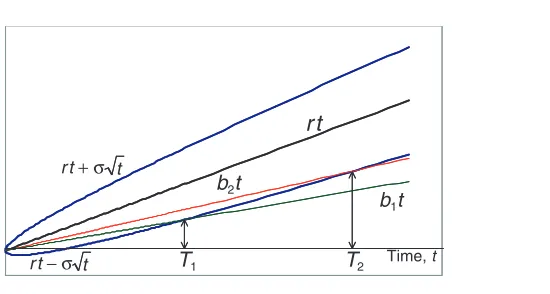
The bounds of ±1σ are also shown, moving at rt+σ√tand rt−σ√t, respectively, and yield values, b1and b2, intersecting the lower line [i.e.
rt−σ√t] at times T1and T2, respectively. In view of the above, therefore, we write
bTT≤rT−σ
√
T (1)
which, when limited to the equality5, gives
bTT=rT−σ
√
T (2)
or
bT =r−
σ √
T (3)
after dividing both sides by T. Equation 3, therefore, expresses the yield,
bT, as a function of maturity, T, with the expected rand σremaining
con-stant over the time horizon. This behaviour, as illustrated in Figure 2, por-trays an upward sloping curve, typical of a normal yield curve.
With reference to earlier works, we should mention Siegel and Nelson (1988), who, through a totally different approach, derived a similar rela-tionship, but with a maturity dependence of 1/T instead of 1/√T. This was obtained by assuming that the yield decays as 1/Taround an asymp-totic value reached at T→ ∞.
Returning to Equation 3, an alternative way of plotting, which might be more useful for testing purposes, is to represent bT as a function of
1/√T. This leads to a straight line with a y-intercept of rand slope of −σ, as demonstrated in Figure 3. The advantage to this type of representation is that the expected return of the underlying security, along with its im-plied volatility, could be easily extracted.
2B. Scenario II—Investing in a Risky Security with
Expected Return Lower than the Interest Rate
This scenario, as depicted in Figures 4a–b, differs from the previous in that the expected average return of the security is “low”. Here “low” means ei-ther low enough to cause the lower bound, rT−σ√T, of the quasi-parabola
^
TECHNICAL ARTICLE
1
Thus, given the various aspects of the yield curve, especially in the light of the quasi-equilibrium models, along with the different governing theo-ries summarised above, we now proceed to develop the framework for an alternative approach. The model that results from this should, hopefully, provide us with not only an intuitive explanation for why a yield curve as-sumes a certain shape—be it normal, inverted or flat—it will also, among other things, open up a direct link with the Capital Asset Pricing Model (CAPM), placing the yield curve well within the confines of classical risk-re-turn principles in portfolio management theory.
2. Methodology
The framework for the model is derived here by considering investing in a risky security, or portfolio of securities, taking into account three different scenarios. These securities are not pre-defined. Rather, they are “underlying”, similar in context to option-pricing methodologies, where characteristics such as “implied” return and volatility are ex-tracted from market data. In addition, as with any other model, certain simplifying assumptions are made. As we construct the model and in-troduce these assumptions, every attempt is made to rationalise and justify them.
2A. Scenario I—Investing in a Risky Security with
Expected Return Higher than the Interest Rate
Consider the more common scenario2of investing in a risky security with expected returns higher than the interest rate. For this, one needs to:
a. first take a view on the total return, r, and volatility or standard de-viation, σ, of the security going forward.
b. Plan to hold the security for a certain length of time, T.
c. Borrow sufficient funds to purchase the security, with intent to sell it back at time Tand pay off the interest with the proceeds. Issuing a zero bond with maturity Tand yield to maturity bTcould do this.
d. The yield could be selected such that the cumulative interest paid at time T—i.e. bTT—is set at less than or equal to rT−σ
√
T,3which is the security’s total return at time Tat risk level −1σ. It is understood that, although at maturity the net expected return, (r−bT)T, is
posi-tive owing to r>bT, as per the definition for Scenario I, there is still
some likelihood, due to the security’s risk, that the investment may under perform and produce a return of less than bTT.
Note that Step 4 is analogous to a value-at-risk (VaR)approach, whereby the quantity bTTis set at 1σ below the mean of the distribution of the T
-year return from the risky security, i.e. rT−σ√T. This, effectively, repre-sents a level of risk aversion where the resulting interest rate, bT, acts as a
hedge against potential losses incurred from holding the underlying risky security until maturity.
The situation is exemplified in Figure 1, which illustrates the movement of the security’s return along ±1σ in the total return vs. time plane. The di-agram basically portrays something similar to, but not exactly, a parabola4 enveloping the time-varying mean, rt, the latter moving linearly with re-spect to time. In addition, two yield values, b1and b2, are included, matur-ing at T1and T2, respectively. These maturity times denote the points where lines b1tand b2tintersect the lower VaRlevel, being rT−σ√T. Why should
Time, t
r t − σ
T
1T
2b
1t
b
2t
r t
r t +σ t
[image:2.793.413.688.83.230.2]t
Figure 1: Movement of the risky security in time, with
to fall entirely in the negative territory, as illustrated in Figure 4a [i.e. this could be caused by a large σ], or that the interest rates are higher than the security’s expected return, as shown in Figure 4b. The latter may happen even when σ is not sufficiently large to cause the bottom portion to fall in the negative region. It is, never the less, important to emphasise that the “low-growth” scenario does not necessarily mean expected security returns that are [or an economic growth rate that is] negative.6
In either case above, although one must again first take a view on the total expected return, r, and standard deviation, σ, of the risky security going forward, as in Scenario I, the rules of borrowing the cash to invest in the security, as outlined there, do not apply. Instead, one must
a. raise the cash by selling the underlying security, with intent to buy it back at time T, and
b. use the cash to long a bond with yield and maturity bT and T,
respectively.
This approach is illustrated in both Figures 4a and 4b, where, in con-trast to the previous scenario, the yield line, bTT, intersects the topcurve,
rT+σ√T, at time T. Therefore, to profit from this investment, the follow-ing criterion must be met:
bTT≥rT+σ
√
[image:3.793.106.372.67.541.2]T (4)
Figure 3: Equation 3 plotted as bTvs. 1/
√
T. Theoutcome is a straight line with slope –σand
inter-cept r, equal to the implied [negative] volatility and mean return, respectively, of the underlying security.
ter falling completely in the negative territory. The yields, b1 and b2, intersecting the upper line [i.e. rt + σ
√
t] at times T1 and T2, respectively, are also shown.(b)
Figure 4b: Investing in a risky security with returns lower
than the interest rate. Again, the bounds of ±1σare also
[image:3.793.465.696.91.243.2] [image:3.793.465.696.384.551.2]where, again, the equality shall be used to give:
bTT=rT+σ
√
T (5)
Equation 4 depicts a net positive return of (bT−r)Tto the portfolio, but
with a VaRlimited to +1σ.
Once more, dividing both sides of Equation 5 by Tleads to
bT =r+
σ √
T (6)
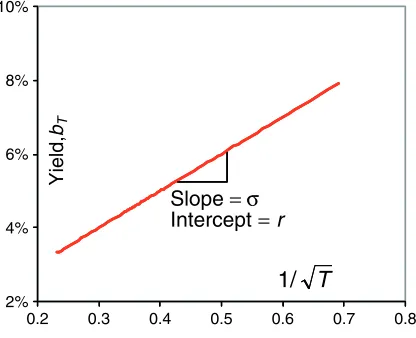
which represents the yield curve for Scenario II. This is illustrated in Figures 5 and 6, where the yield, bT, is plotted against Tand 1/
√ T, re-spectively. The curve in Figure 5 is downward sloping, consistent with an inverted yield curve.
With regards to inverted yield curves, it is accepted that they general-ly occur when a recession is anticipated, although it is still widegeneral-ly debat-ed as to what exactly causes the inversion. For instance, while some say that an expectation of falling short rates leads to the inversion, others argue that growing uncertainties about the future is what causes it. We note here that both explanations fall within the scope of Scenario II. To illustrate, falling short rates are expected when interest rates are simply deemed to be too high. This situation, which reflects the behaviour of the treasury yield curves during the early part of the 1980s decade, is clearly portrayed in Figure 4b. In contrast, the case of growing uncertainties about the future is displayed in Figure 4a, where σ, which proxies the de-gree of uncertainty, is large enough to force an investor to follow the hedging strategy consistent with that of Scenario II.
2C. Scenario III—Investing in a Risky Security With
Negative Expected Returns
This situation is illustrated in Figure 7, where the risky security is expect-ed to have a negative mean return. Here, also, in anticipation of falling returns, the investor is likely to follow the strategy of selling the security and longing the bond, as outlined in Section 2B. Consequently, the driver of the yield curve is, once more, similar to that in Scenario II, namely the upper curve rt+σ√t. What is notably different, however, is that, owing to the security’s return, r, being negative, the investor is able to maximise profits by selecting a specific maturity, T, corresponding to a yield of b˜, as illustrated in Figure 7. Ignoring the trivial details, one could demonstrate that, with rnegative, rt+σ√t is maximised at some maturity T, where
T= σ 2
4r2 (7a)
which coincides with an interest rate b˜ equal to the negative of the secu-rity’s return, i.e.
˜
b= −r (7b)
What this suggests, therefore, is that, in anticipation of a declining market or economy, investors will concentratetheir investments around a single, well-defined maturity, T, which could be relatively short, depending
^
TECHNICAL ARTICLE
1
2% 4% 6% 10%
5 15
Yield,
bT
8%
0 10 20
[image:4.793.107.315.517.686.2]Maturity,T
Figure 5: An illustration of the yield curve pertaining to Scenario II, represented by Equation 6 and plotted as bTvs. T. Note that this is an inverted yield curve.
2% 4% 6% 8% 10%
1/
0.2 0.3 0.4 0.5 0.6 0.7 0.8
Slope
= σ
Intercept
=
r
Yield,
b
T [image:4.793.425.628.553.689.2]T
Figure 6: Equation 6 plotted as bTvs. 1/
√
T. The out-come is a straight line with slope σand intercept r, equal to the implied volatility and mean expected re-turn, respectively, of the underlying security.sistent with the notion of the liquidity trap, where short-term savings are the norm, all in anticipation of improving conditions and, ultimately, in-creasing interest rates.
3. Limitations
A limitation that immediately comes to attention here concerns Scenario I. Returning to Figure 1, it is observed that a portion of the lower curve,
rT−σ√T, becomes negative, with no positive yield identifiable at or below the −1σ VaRboundary. This region, which is defined by character-istic time scale, τ, can be shown to fall within
0≤τ ≤ σ 2
r2
or
1
√ τ ≥
r σ
according to Equation 3. This implies that the maturities associated with the yield curves for Scenario I, as described in Section 2A, must satisfy the condition of T> τ, thus allowing one to express the above as
T> σ 2
r2 (8a)
or
0≤ √1
T ≤ r
σ (8b)
If we let σ2/r2∼1 represent a conservativeorder-of-magnitude estimate of
the realistic cases detailed in Section 4A below, we conclude that what leads to the normal yield curves of Scenario I is limited strictly to debt maturities Tgreater than 1 year.
4. Observations
This part consists of certain observations, both empirical and theoretical, which deal with the model’s validity, as well as some of its characteris-tics. The empirical observations, which comprise a summary comparison of the results with data, are included in Section 4A. The remaining sec-tions, in contrast, focus on the theoretical aspects by (ii) establishing a link with the CAPM, (iiii) discussing how the underlying security’s risk pre-mium manifests itself here and why it could possibly be associated with the equity premium puzzle and, finally, (iiiiii) addressing the implications of the no-arbitrage principle.
4A. Empirical
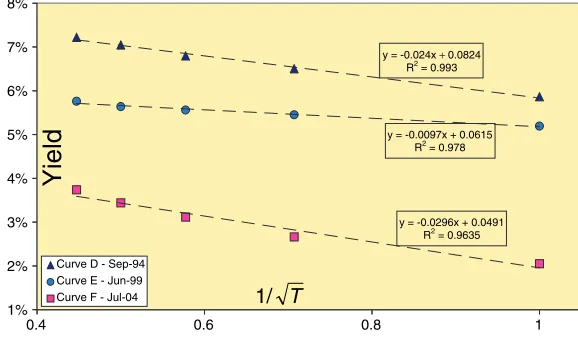
To examine the empirical validity of this model, it is helpful to plot the yield curves as bT vs. 1/
√
T, in accordance with Figures 3 and 6. Figures 8 and 9 are such plots, representing the US government [discount bond] yields at different dates. Each curve has a best-fit straight line passing
through it, specifying the impliedreturn, r, and volatility, σ, of the under-lying security, as well as the value of the R2. These properties are
sum-marised in Table 1.
[image:5.793.438.729.99.269.2]For interest, we have provided a selection of different economic regimes—e.g. when interest rates were relatively high [Curves A], as in Scenario II, which led to inverted curves, as well as eras of relatively high market returns and/or low volatility [Curves B-F]8, as in Scenario I, which subsequently produced normal curves. It should be noted that while the above do not represent an exhaustive sample of the curves that behave ac-cording to the model, there are others that are inconsistent with the model’s predictions. In addition, the limitations discussed in Section 3 above constrain the curves in Figures 8 and 9 to maturities longer than one year.
Figure 8: Samples of yield curves, illustrating time regimes of normal and in-verted yield curves and their linearity when plotted against 1/
√
T, where Tis the maturity in years. These data are from McCulloch and Kwon (1993),spanning from Jan-52 to Feb-91 and extending to T= 10 years.
y = -0.0245x + 0.0875 R2
= 0.9671 y = -0.0212x + 0.1166
R2
= 0.9943
6% 7% 8% 9% 10%
0.2 0.4 0.6 0.8 1
T
/
1
Yi
el
d
y = -0.0245x + 0.0875 R2
= 0.9671 y = -0.0212x + 0.1166
R2
= 0.9943
T
/
1
Yield
1% 2% 3% 4% 5% 6% 7% 8%
0.4 0.6 0.8 1
T
/
1
y = -0.024x + 0.0824 R2 = 0.993
y = -0.0097x + 0.0615 R2 = 0.978
y = -0.0296x + 0.0491 R2 = 0.9635
Curve D - Sep-94 Curve E - Jun-99
Curve F - Jul-04
1
/
T
Yield
Figure 9: Samples of yield curves, illustrating time regimes of normal yield
curves and their linearity when plotted against 1/
√
T, where Tis thematuri-ty in years. These are the Fama—Bliss7data, spanning from Jan-74 to
[image:5.793.436.725.341.510.2]Furthermore, an order of magnitude comparison of the implied re-turns places the underlying security at somewhere between a typical US-based index [returning about 10% per year, as estimated from a risk-free rate of about 5% plus a risk premium of roughly 5%] and the annual, nominal GDP growth rate, which normally lies at around 4%. Lastly, none of the data consisted of a negative implied return, which could have po-tentially led to a liquidity trap.
4B. The Sharpe Ratio
Further to the above, we now demonstrate that the model ties in neatly with the CAPM. This link comes via the Sharpe Ratio, which appears here in a “dimensionless” form, as opposed to its classical, dimensional counterpart.
Generally speaking, the Sharpe Ratio, Sh, is expressible by
Sh≡r−b
σ (9)
where rand σ are, as defined earlier, the expected return and standard deviation, respectively, of the underlying security and bis some risk-free rate. As to what exactly bshould be has been widely debated since the in-ception of the CAPM.For instance, some insist that it must be the shortest available government treasury rate, while others argue that it must be the government rate, i.e. bT, with a maturity that matches the
invest-ment’s holding period. All in all, these arguments tend to be subjective, to the point that the use of the risk-free rate in CAPMstill happens to be a matter of personal preference.
It is suggested here that the root of this problem lies in how the Sharpe Ratio is defined. Acquiring a dimension of [1/√time],9as indicated by Equation 9, rather than being dimensionless, effectively means that the measurement time scale or frequency of r, σand b—i.e. whether these parameters are measured monthly, quarterly, annually, etc.—can consid-erably affect the magnitude of Sh. A non-dimensional depiction of Sh
should, never the less, be able to eliminate this problem.
To illustrate, we introduce a maturity-adjusted Sharpe Ratio, ShT, such
that
ShT ≡
[r−bT]T
σ√T (10a)
or
ShT ≡
[r−bT]
√ T
σ (10b)
which, in effect, characterises the Sharpe Ratio as a function of the maturity of the investment. For instance, if r, bT and σ were
all annualised parameters and T the maturity of the investment given in number of years, then the products rTand bTT, which
ap-pear in the numerator of Equation 10a, are, respectively, the cu-mulativeor totalexpected return and interest paid at the end of T
years and σ√T [in the denominator] the expected T-year-based standard deviation of the returns. The expression in 10, there-fore, extends the measurement time scale of the Sharpe ratio from its classical, annualised form given in Equation 9, which is 1 year, to Tyears.
Let us now return to Equation 3 and re-write it as
r−bT
σ =
1
√
T (11a)
or simply
[r−bT]
√ T
σ =1 (11b)
Comparison of the above with Equation 10b leads to us to conclude that along the yield curve produced by the present model, the maturity-ad-justed Sharpe Ratio remains constant, in this case being 1.10
The above, in effect, carries with it two important messages. First, any yield curve generated by the proposed model is characterisable by a con-stant [risk] preference, bearing in mind the relationship between in-vestor’s preference and Sharpe Ratio. The constantpreference here signifies a yield curve that is determined by moving along rT−σ√T, which is the lower portion of the quasi-parabola depicted in Figure 1. Second, the risk-free rate to be implemented when defining the Sharpe Ratio must be such that the maturity, T, of the borrowing should match the holding pe-riod of the investment. This makes sense because a borrowing rate with a maturity of Tyears is indeed risk free, owing to the fact that it remains unchanged throughout the time period Tand provided that the security is also held over the same length of time.
4C. The Risk Premium of the Underlying Security
It is useful now to refer to the risk premium of the underlying security in the context of this work and see how it relates to the equity risk premium (ERP) and the associated puzzle. This is important because, as noted earlier (Cohen, 2002), even though there is little argument that the risk-free rate should be based on a government-issued security, questions still abound on what maturity it should take. We shall try to address this issue here.
Let us begin by expressing Equation 3 as
r−bT=
σ √
T (12)
which is the yield-vs.-maturity relationship for a normal yield curve and recall that, if Twere to be given in number of years, r and σ must be in
^
[image:6.793.65.395.164.280.2]TECHNICAL ARTICLE
1
TABLE 1: CLASSIFICATION AND IMPLIED [ANNUAL]
PROPERTIES [
R
,
σ
AND
R
2] OF THE YIELD CURVES
DE-PICTED IN FIGURES 8 AND 9. NOTE THAT ALL THE
IM-PLIED EXPECTED RETURNS ARE POSITIVE.
Curve Time Classification Implied, expected Implied R2
frame mean annual expected annual return, r(%) volatility, σ(%)
A Dec-80 Inverted 11.32 1.80 0.9816
B Jun-83 Normal 11.66 2.12 0.9943
C Apr-89 Normal 8.75 2.45 0.9671
D Sep-94 Normal 8.24 2.40 0.9930
E Jun-99 Flat to Normal 6.15 0.97 0.9780
the fact that the typical, empirical measure of roughly 5% for the ERP, based on the historical S&Pindex, is an order of magnitude or so higher than that which can be explained by any economic or financial theory. This value, it must be noted, is generally calculated with respect to short-er-term government treasuries—namely, 1 year or even less. The measured equity return, r, on the other hand, is typically averaged over dozens of years, which makes it a long-runparameter.
The common practice of measuring the long-runview of the security’s return against a short-terminterest rate could point to an inconsistency in how the ERPis obtained. To demonstrate, let us return to Equation 12 and note that with rrepresenting an infinite-horizon view of the underlying security’s average return, its difference relative to the 1-year risk-free rate, proxied here by the 1-year government yield, would be σ.An estimate of this based on the values of σ presented in Table 1, therefore, leads to a risk premium of about 2%, which is, by order of magnitude, consistent with the ERPpuzzle. In light of this, as the tenor, T, of the risk-free rate in-creases, the security’s risk premium declines with 1/√T. Subsequently, the risk premium, and hence the puzzle, can be eliminated if the under-lying security’s return were to be compared against a risk-free rate with maturity T→ ∞.
Finally, how effective in practice is this approach in reducing the sever-ity of the ERPpuzzle? Perhaps quite effective, if we were dealing with val-ues for σ on the order of those presented in Table 1 and recognising that the highest maturity for a US government bond is 30 years. The reason is that with a σof about 2%, as per those in Table 1, if the risk premium were to be based on a 30-year yield, it would then be roughly 2%/√30≈0.35%. Although this is still higher than what the ERPshould be in theory12, it does represent a significant improvement over the original 2% calculated otherwise on the basis of the 1-year risk-free rate.
4D. The No-arbitrage Principle
The no-arbitrage principle plays an important role in every security-pric-ing model. The literature on this subject is extensive, but for bonds and bond yields, in general, it can be divided into two areas (Fisher, 2001): (ii) equilibrium and (iiii) dynamic. Since the model proposed here is equi-librium, we shall avoid going into the details of the latter and, instead, refer the interested reader to the literature [e.g. Benninga & Wiener (1998) and Fisher (2001) and references therein].
Whether equilibrium or not, the no-arbitrage principle manifests it-self in bond-pricing and yield-curve models through the expectations hy-pothesis, which has already been discussed in the Introduction section. The main point here is that the forward rates that result from the yield curve must be such that they satisfy the no-arbitrage condition at every point along the different tenors on the curve.
In reference to the present model, however, the theoretical issue that arises applies particularly to the normal curves, which are derivable in the way outlined in Section 2A. As portrayed in Figure 1 and re-iterated later in Section 3, the problem with this model is that shorter yields [i.e.
bitrage that crops up here. This relates to a flat yield curve in the manner discussed in Benninga & Wiener (1998). Briefly, the problem here is that if one were to construct a portfolio of bonds with different maturities based on a flat term structure at, say, time t, then the price of the same portfolio at a later time, say t+t, assuming the curve remains flat, al-ways goes up regardless of whether the interest rate increases or decreas-es. This, subsequently, creates an unambiguous arbitrage opportunity, independent of which direction the rate moves.
How is this reflected in the current model? In reference to Equations 3 and 6, setting the expected volatility, σ, equal to zero leads to a flat yield curve. This makes sense because, by definition, a flat yield curve, in asso-ciation with the expectations hypothesis, implies no uncertainty about the future and, thus, no anticipated rate changes going forward. But, never the less, the very fact that the model can generate a flat curve, albeit under the constraint of σ =0, makes it vulnerable to arbitrage, provided that the curve is flat and expected to remain flat going forward.
One, however, could argue against this vulnerability in two ways. Firstly, how likely is it to see a flat yield curve in practice, let alone a flat curve that maintains its shape over time? Secondly, a flat curve under the expectations hypothesis implicitly rules out any changes in the forward rates. Therefore, the arbitrage scenario described in the preceding para-graph is self-contradictory and, thus, cannot be supported.
In view of the above, therefore, we conclude that the only area of con-cern with regards to not satisfying the no-arbitrage principle is that this model cannot provide shorter rates, owing to the limitation discussed in Section 3. Other than that, forward rates that satisfy no arbitrage could be easily derived for this model, given Equation 3 and the standard meth-ods that are described in the literature [e.g. see Fisher (2001)].
5. Practical Applications
The model, as it stands now, is perhaps at best a framework in its most basic form, but, never the less, it can potentially lead to an approach that is different from, and more intuitive than, what is now available. To be more useful in practice, it will, of course, need some major calibration. One possible way to achieve this is to relax the risk-aversion constraint of moving strictly along the lower portion of the quasi-parabola—i.e. along the −1σ line for all the maturities—as one generates the normal yield curve from it. This calibration could, for example, be undertaken by in-troducing an error term at each tenor to account for the differences be-tween theory and data. A comprehensive historical analysis of this error could form the basis of this calibration.
Another type of calibration could involve a historical mapping of the empirical values of rand σ, such as those in Table 1, onto, let’s say, GDP
a projected yield curve. The outcome of this could possibly be used to trade futures in bonds, swap rates, etc., or for trading interest rates and swaps across currencies if forecasts of relevant economic data are avail-able for both currencies.
A further potential application is sensitivity analysis. For instance, how is the term structure impacted as economic projections of, let’s say,
GDPand uncertainty are changed or revised?
And last, but not least, the question might arise on whether or not this model has any applicability to option pricing. One way, for instance, might be to substitute the risk-free rate that comes out of here directly into an option-pricing model, such as the Black-Scholes. This has the ben-efit of reducing the number of exogenous inputs into the equation. The answer to this question, however, is no, simply because, owing to the lim-itations discussed in Section 3 here, this model works for maturity time scales longer than one year, which is above the practical range of most typical vanilla options, such as calls and puts.
6. Conclusions
An intuitive model for the yield curve has been presented. Based on the notion of VaR, the approach leads to interest rates that hedge against po-tential losses incurred from holding a risky security until maturity.
Several simplifying assumptions are made, one of which is that the normal, symmetric diffusion process governs the stochastic behaviour of the underlying security—namely that the expected return grows linearly with time [i.e. constant mean] and a volatility that widens as the square root of time [i.e. constant variance]. Although severe, this assumption is common to virtually all practical stochastic models. Nonetheless, the re-striction could be relaxed by utilising more realistic features of security returns distributions, which are asymmetric and with fat tails.
Another assumption is that the VaRis bounded by ±1σ. It is noted that changing these arbitrary limits of risk aversion would in no way alter the overall qualitative outcome of the model. The model would still produce both normal and inverted yield curves that progress linearly with 1/√T, as suggested by Equations 3 and 6, respectively, the only dif-ference being slopes that are different from ±1σ. This, of course, is quite limiting and could perhaps, along with the previously mentioned as-sumptions, explain the failure of the model in some instances.
In view of the above assumptions, several conclusions have been reached. One is that the model theoretically leads to three types of shapes for the yield curve, which, in all cases, relate directly to 1/√T. The nor-mal curve is predicted to occur under nornor-mal conditions when interest rates are lower than the expected return of the underlying security, which is generally higher owing to the security’s risk premium. The in-verted curve is found to show up in periods of high interest rates, as ex-plained in Section 2B, or when uncertainties, as proxied by the standard deviation of the risky security, are relatively large. Finally, a flat yield curve is predicted during times of low expected uncertainty or as σ →0 There are, in addition, other findings. One is that the model fits in tightly with the CAPM, linking the interest rates and their respective ma-turities to the risk and return of the underlying security via the Sharpe Ratio, Sh. Basically, after adjustingShfor maturity, the yield curve would be describable by a constant Sh. In view of the relationship between Sh
and investor preference in classical CAPM, one could, subsequently, argue that a yield curve that follows this model belongs to a risk preference that is characterised by VaRlimited to −1σ; i.e. moving along the lower portion of the quasi-parabola shown in Figure 1. The second finding sim-ply identifies the risk-free rate for use in the Sharpe Ratio and defines it as the yield to maturity, bT. The logic here is that with the interest rate,
bT, remaining constant and, essentially, free of any rollover-related risks,
it should then truly represent the risk-free rate for the borrowing, which has a maturity that matches the holding period of the security.
A further finding involves the well-known ERPpuzzle. The conclusion here is that comparing an infinite-horizon view of the underlying securi-ty’s [e.g. an equity index] return against a short-term risk-free rate may be a potential cause. The puzzle could, in theory, be explained and/or elimi-nated if one were to compute the risk premium based on a risk-free rate that has an infinite maturity. However, as this is not practical, one could, at least, reduce the severity of it by focusing more on the longer maturity government rates [e.g. 30 years] rather than the shorter ones [e.g. 1 year or less].
As for practical applications, it is suggested that the model undergo some calibration in order to be useful. This calibration could take the form of an error analysis, as well as a mapping of the model’s outputs of the implied rand σ onto measured economic or market variables, such as GDPor market growth rates and volatility.
We finally conclude here by reiterating that this is only a model, which, like any other, has its advantages and disadvantages. One disad-vantage is that that it is not dynamic, although it has the potential for serving as a platform for a more sophisticated dynamic or stochastic set-ting. Moreover, although several examples of its validity have been pro-vided that illustrate the predicted linearity in 1/√T[e.g. in Figures 8 and 9], other situations [although none has been provided here in the interest of space] can be shown not to follow suit. Among the advantages, notwith-standing, are that (i) it is intuitive, (ii) it explains the typical variations in yield curves—i.e. normal, inverted and flat, (iii) it predicts the existence of the liquidity trap and, lastly, (iv) it links the yield curve with CAPM—all these achieved within a single framework.
^
TECHNICAL ARTICLE
1
FOOTNOTES & REFERENCES
1.Terminology such as “high uncertainty”, “high interest rates” and “low growth” will be defined in due course.
2.This scenario, which leads to the “normal” yield curve, is more common than the one discussed later in Scenarios II and III. The reason for the margin between the security’s expected mean return and the risk-free rate is the security’s risk premium, which is ad-dressed in more detail in Section 4C.
3.Obviously, we are assuming here that the risky security follows the simple diffusion process. Although this is a rough assumption, it happens to be the most common and forms the foundation of almost every pricing methodology that revolves around stochastic behaviour.
4.The shape becomes a parabola as r approaches zero.
W
it as long as it fits within his preference criteria. Admittedly, this is debatable, but we shall proceed, leaving it outside the scope of this paper.
6.The negative expected security return is, of course, characteristic of a declining econom-ic performance.
7.The Fama-Bliss data come from Section 4.3 of CRSP Monthly US Treasury Database Guide[Version CA90.200502.1], Center for Research in Security Prices, University of Chicago Graduate School of Business.
8.Curve D suggests a low implied volatility compared to the others and can, therefore, be considered nearly flat.
9.This is because rand bboth have dimension [1/time], while σacquires dimension [1/
√
time].10.The number of standard deviations determines the value of the constant that one chooses to limit the VaR.
11.Likewise, if Twere to be given in number of quarters, for instance, then rand σmust be quarterly in frequency.
12.This gets worse for an equity index, such as the S&P, whose annual volatility is around 10% or so.
■Ang, A., Piazzesi, M. and Wei, M. (2006) “What does the Yield Curve tell us about GDP
growth?” Journal of Econometrics131, pp. 359–403.
■Benninga, S. and Z. Wiener (1998) “Term Structure of Interest Rates” Mathematica in Education and Research 7, pp. 13–21.
■Brace, A., D. Gatarek and M. Musiela (1997) “The Market Model of Interest Rate Dynamics,” Mathematical Finance 7, pp. 127–147.
■Cohen, R.D. (Nov. 2002) “The Relationship Between the Equity Risk Premium, Duration and Dividend Yield,” Wilmott Magazine, pp. 84–97.
■Diebold, F.X., Piazzesi, M., Rudebusch, G. (2005) “Modeling Bond Yields in Finance and Macroeconomics” American Economic Review P&P, pp. 415–420.
■Esterella, A. (2005) “The Yield Curve as a Leading Indicator: Frequently Asked Questions” Federal Reserve Bank of New York Web Article, pp. 1–23.
■Evans, C.L. and D. Marshall (2001) “Economic Determinants of the Nominal Treasury Yield Curve,” Unpublished paper, Federal Reserve Bank of Chicago.
■Fabozzi, F.J., Bond Markets, Analysis and Strategies, 3rdEd., Prentice-Hall Int., 1996. ■Fabozzi, F.J., Investment Management, 2ndEd., Prentice-Hall Inc., 1999.
■Fisher, M. (Q1 2001) “Forces That Shape the Yield Curve,” Economic Review, Federal Reserve Bank of Atlanta, pp. 1–15.
■Kessel, R.A. (1965) “The Cyclical Behaviour of the Term Structure of Interest Rates,”
National Bureau of Economic Research Occasional Paper No. 91.
■McCulloch, J.H. and Kwon, H.C. (1993) “U.S. Term Structure Data, 1947–1991” Ohio State University Working Paper # 93-6 [see also http://www.econ.ohio-state.edu/jhm/ts/ mcckwon/mccull.htm].

![TABLE 1: CLASSIFICATION AND IMPLIED [ANNUAL]PROPERTIES [R, σ AND R2] OF THE YIELD CURVES DE-PICTED IN FIGURES 8 AND 9](https://thumb-us.123doks.com/thumbv2/123dok_us/8125269.240714/6.793.65.395.164.280/table-classification-implied-annual-properties-curves-picted-figures.webp)
