www.biogeosciences.net/11/3397/2014/ doi:10.5194/bg-11-3397-2014
© Author(s) 2014. CC Attribution 3.0 License.
How important is diversity for capturing environmental-change
responses in ecosystem models?
A. E. F. Prowe1,2, M. Pahlow2, S. Dutkiewicz3, and A. Oschlies2
1Centre of Ocean Life, National Institute of Aquatic Resources, Technical University of Denmark, Jægersborg Allé 1,
2920 Charlottenlund, Denmark
2GEOMAR Helmholtz Centre for Ocean Research Kiel, Düsternbrooker Weg 20, 24105 Kiel, Germany 3Department of Earth, Atmospheric, and Planetary Sciences, Massachusetts Institute of Technology,
77 Massachusetts Avenue, Cambridge, MA 02139, USA
Correspondence to: A. E. F. Prowe ([email protected])
Received: 4 July 2013 – Published in Biogeosciences Discuss.: 31 July 2013 Revised: 14 February 2014 – Accepted: 30 April 2014 – Published: 27 June 2014
Abstract. Marine ecosystem models used to investigate how global change affects ocean ecosystems and their functioning typically omit pelagic plankton diversity. Diversity, however, may affect functions such as primary production and their sensitivity to environmental changes. Here we use a global ocean ecosystem model that explicitly resolves ton diversity by defining subtypes within four phytoplank-ton functional types (PFTs). We investigate the model’s abil-ity to capture diversabil-ity effects on primary production under environmental change. An idealized scenario with a sudden reduction in vertical mixing causes diversity and primary-production changes that turn out to be largely independent of the number of coexisting phytoplankton subtypes. The way diversity is represented in the model provides a small number of niches with respect to nutrient use in accordance with the PFTs defined in the model. Increasing the number of phyto-plankton subtypes increases the resolution within the niches. Diversity effects such as niche complementarity operate be-tween, but not within PFTs, and are constrained by the vari-ety of traits and trade-offs resolved in the model. The number and nature of the niches formulated in the model, for example via trade-offs or different PFTs, thus determines the diversity effects on ecosystem functioning captured in ocean ecosys-tem models.
1 Introduction
Ocean ecosystems are under pressure from global environ-mental change and an increasing human demand for natu-ral resources. As a consequence of often ultimately anthro-pogenic perturbations, a loss of diversity has been observed in a variety of different ecosystems including marine envi-ronments (Butchart et al., 2010). Increasing evidence sug-gests that such a diversity loss coincides with a reduction in ecosystem functioning such as primary production or nutri-ent use (Cardinale et al., 2011; Reich et al., 2012). Losses in functioning are small in highly diverse systems and tend to increase with decreasing diversity. Diversity might thus po-tentially aid in sustaining an ecosystem’s established func-tioning through periods of environmental change.
3398 A. E. F. Prowe et al.: Diversity effects under reduced mixing intercomparison of 10 ecosystem models to 21st century
cli-mate change (Bopp et al., 2013) showed very different re-gional responses in primary production even though they all showed regional warming trends that were almost every-where robust among the different models. These models only agreed on the sign of primary production change in very few locations. How much the change was related to the differ-ence in complexity of the ecosystem models, and how much to different assumptions about the biogeochemical and graz-ing environments, is not clear.
The majority of such studies of marine ecosystem changes with an altered climate have employed at most a hand-ful of phytoplankton functional types (PFTs). Here we in-stead employ a novel global coupled ocean ecosystem mod-elling approach (Follows et al., 2007) which resolves phy-toplankton diversity within four PFTs and allows investi-gating some aspects of diversity effects on ecosystem func-tioning without observational and experimental limitations. Plankton diversity in this model is represented by variability in nutrient-, light- and temperature-dependent phytoplankton growth. This approach clearly reduces natural plankton di-versity to a limited number of traits in the model. Models in-corporating other aspects of diversity, however, such as algal mixotrophy (Ward et al., 2011) or spectral light use (Hick-man et al., 2010), have not yet been applied to the global scale. Our model is thus representative of global biogeo-chemical ocean circulation models currently used for inves-tigating biogeochemical fluxes on large spatial and temporal scales (e.g. Bopp et al., 2013).
We examine whether the magnitude of changes in primary production arising from environmental change depends on the level of phytoplankton diversity as indicated by the num-ber of phytoplankton subtypes and PFTs in the model. We relate our findings to the underlying structure of ecological niches implicit in the model formulation, and thereby as-sess the model’s inherent ability to capture diversity effects such as niche complementarity (Tilman et al., 1997; Loreau, 1998) and selection effects (Aarssen, 1997; Huston, 1997). Niches in the classical sense are created by variability in ecological factors and can be identified by the species fit-ness as a function of the magnitude of the respective ecolog-ical factor (Hutchinson, 1957; MacArthur and Wilson, 1967; Schoener, 1988). In plankton communities, in addition to this environmental dimensionality the traits of the species – for example regarding resource uptake, tolerance width to en-vironmental conditions or mobility – shape further niches, thereby creating trait dimensionality (Ptacnik et al., 2010). Within this framework, diversity effects are thus constrained by both environmental and trait dimensionality.
One of the predicted consequences of global change on the upper ocean is an increased stratification and an associ-ated reduction in mixing processes, and thus nutrient supply to the surface mixed layer (e.g. Sarmiento et al., 2004). Here we impose an instantaneous reduction in vertical mixing for nutrients and plankton as idealized environmental change to
examine its consequences for diversity and productivity in a model ocean. We employ simulations with different levels of prescribed phytoplankton diversity and different numbers of PFTs in order to examine if diversity and the way to re-solve it affects the simulated primary production changes.
2 Methods
The model employed is the Darwin ocean ecosystem model coupled to the MITgcm general circulation model (Follows et al., 2007) in the configuration used by Prowe et al. (2012a). In the standard setup, the model simulates the dynamics of four nutrients (phosphorus, nitrogen, iron, silica), 78 phy-toplankton subtypes, two zooplankton functional types, and dissolved and particulate organic matter. Phytoplankton sub-types are assigned to one of four PFTs (large diatom and small Prochlorococcus analogues, other large and other small phytoplankton). Cell size determines sinking speed, palata-bility, maximum growth rate and the basic level of the half-saturation concentration for nutrient uptake of the different PFTs. Within each PFT, subtypes are further distinguished by randomly assigned parameter values for nutrient-, light- and temperature-dependent growth. Half-saturation constants for phosphorus uptake are randomly assigned within a given range around a basic value characteristic of the PFT. Corre-sponding half-saturation concentrations are adopted for the other nutrients using the same fixed stoichiometric ratios for all phytoplankton subtypes. Temperature dependencies of in-dividual subtypes are characterized by different optimal tem-peratures chosen at random from a range of −2 to 30◦C.
Grazing on phytoplankton by a small and a large zooplankton functional type is formulated as a Holling type 3 functional response. Details can be found in Dutkiewicz et al. (2009) and Prowe et al. (2012a).
Phytoplankton diversity or richness is measured at each grid point at each time step as the number of phytoplankton subtypes exceeding a low threshold concentration ofPth=
10−8mmol P m−3. As the standard simulation we select one member of the ensemble of simulations withn=78 initial phytoplankton subtypes used by Prowe et al. (2012a). Three simulations with reduced initial diversity are obtained by randomly selecting subpopulations ofn=30 subtypes from this setup. A configuration with each PFT represented by only one phytoplankton subtype (n=4) with the optimum-temperature function replaced with a simpler optimum-temperature de-pendence (represented by a factor of 1.04T[◦C]) allows
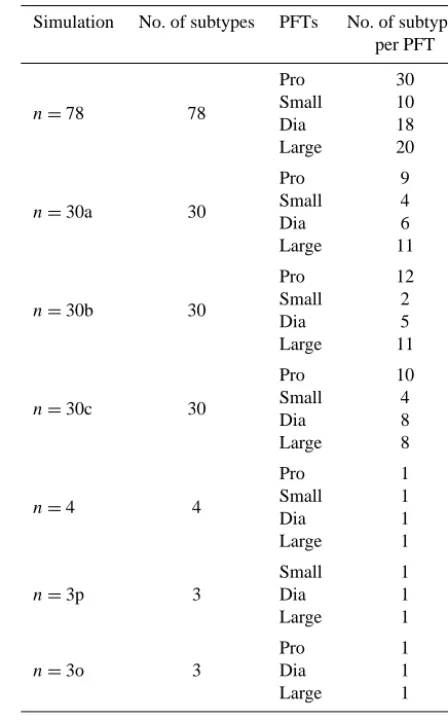
et al., 2002), preliminary studies indicate that PFT distribu-tion is not influenced significantly in this model. The use of the Eppley curve thus allows us to focus our attention on the nutrient uptake aspect rather than on environmental tempera-ture changes (see below). Two companion simulations – one without the Prochlorococcus and one without the other-small PFT (n=3p andn=3o, respectively) – reveal consequences of reducing PFT diversity, which indicates functional diver-sity in the model. An overview of the different configurations is shown in Table 1.
Simulations are run offline for 20 yr with physical forc-ing from the ECCO-GODAE state estimates (Wunsch and Heimbach, 2007). Environmental changes are prescribed as a sudden reduction in mixing (vertical eddy diffusivityke
re-duced by 50 %) after 10 yr of simulation. The change inkein
the offline model does not affect temperature, stratification or the depth of the mixed layer, but only the mixing of nu-trients, phytoplankton and the other biogeochemical tracers. Excluding physical ocean changes allows us to separate di-rect effects on the ecosystem from more complex responses driven by physical feedbacks. This idealized setup also al-lows us to simulate diverse phytoplankton communities ex-plicitly without compromising spatial or temporal resolution. Annual average diversity and primary production in the up-per 100 m are compared to simulations with no reduction in mixing after another 10 yr of simulation. Primary production is estimated from phosphate uptake using a fixed molar C : P ratio of 106 : 1.
3 Results
The reduction in ke leads to an overall decrease in nutrient
supply, and thus in primary production (PP) and net com-munity production in the lower latitudes and increases in the Southern Ocean and the North Atlantic where PP is limited by light during large parts of the seasonal cycle (Fig. 1). Figure 2 shows the corresponding absolute and relative dif-ferences of diversity and PP in year 20 between the simula-tions with reducedkeand the respective simulations with
un-changedke. For the standard setup withn=78
phytoplank-ton subtypes, diversity measured as the number of coexist-ing subtypes overall changes by less than 5–10 % upon re-ducing ke, with increases at higher latitudes and decreases
from roughly 40◦S to 40◦N. Relative PP changes are larger, with reductions around 10 % in the tropics and subtropics and reductions exceeding 20 % around 30◦S and 30◦N where
PP is lowest. At higher latitudes, PP changes are generally small and, in the zonal average, positive only in the Southern Ocean.
[image:3.612.308.546.105.660.2]Higher PP under global warming in this region has been inferred both from observations (Behrenfeld et al., 2006) and from coupled ocean ecosystem models (e.g. Bopp et al., 2001). In these studies, it can be explained by higher light availability for photosynthesis in a shoaling surface mixed
Table 1. Simulations with plankton functional types (PFTs; Pro: Prochlorococcus; Small: other small; Dia: diatoms; Large: other large) and number of subtypes in each PFT.
Simulation No. of subtypes PFTs No. of subtypes per PFT
n=78 78
Pro 30
Small 10
Dia 18
Large 20
n=30a 30
Pro 9
Small 4
Dia 6
Large 11
n=30b 30
Pro 12
Small 2
Dia 5
Large 11
n=30c 30
Pro 10
Small 4
Dia 8
Large 8
n=4 4
Pro 1
Small 1
Dia 1
Large 1
n=3p 3
Small 1
Dia 1
Large 1
n=3o 3
Pro 1
Dia 1
Large 1
[image:3.612.316.540.112.472.2]3400 A. E. F. Prowe et al.: Diversity effects under reduced mixing
BGD
11, 1–25, 2014
Diversity e
ff
ects
under reduced
mixing
A. E. F. Prowe et al.
Title Page
Abstract Introduction
Conclusions References
Tables Figures
J I
J I
Back Close
Full Screen / Esc
Printer-friendly Version
Interactive Discussion
Discussion
P
a
per
|
D
iscussion
P
a
per
|
Discussion
P
a
per
|
Discuss
ion
P
a
per
[image:4.612.307.549.387.569.2]|
Fig. 2.
Zonal averages of diversity as number of subtypes exceeding threshold biomass
P
th(
a
–
c
), and of primary production (PP;
d
–
f
) in the simulations without reduction in mixing (
a
,
d
), and
as absolute (
b
,
e
) and relative (
c
,
f
) di
ff
erence between scenarios with and without reduced
mix-ing 10 yr after mixmix-ing reduction. Results are shown for one simulation with
n
=
78 phytoplankton
subtypes, the average of three simulations using di
ff
erent subpopulations of the
n
=
78
simu-lation with
n
=
30 subtypes with minimum and maximum values indicated by the grey shaded
area, and three simulations with all four generic phytoplankton functional types (
n
=
4), and
with three PFTs omitting the
Prochlorococcus
and the other-small PFT (
n
=
3
p
and
n
=
3
o
,
respectively). See panel
(c)
for colour code.
21
Figure 2. Zonal averages of diversity as number of subtypes exceeding threshold biomassPth(a–c), and of primary production (PP; d–f) in
the simulations without reduction in mixing (a, d), and as absolute (b, e) and relative (c, f) difference between scenarios with and without reduced mixing 10 yr after mixing reduction. Results are shown for one simulation withn=78 phytoplankton subtypes, the average of three simulations using different subpopulations of then=78 simulation withn=30 subtypes with minimum and maximum values indicated by the grey shaded area, and three simulations with all four generic phytoplankton functional types (n=4), and with three PFTs omitting the
Prochlorococcus and the other-small PFT (n=3pandn=3o, respectively). See panel (c) for colour code.
layer. The effect of higher light availability at higher latitudes is reflected at least partly by lower phytoplankton losses due to mixing in the short-term simulations presented here. This increases PP (Fig. 1) and also the potential for export of or-ganic matter to the deep ocean, particularly in regions that do not become nutrient depleted during the seasonal cycle. A PP decrease in the remaining ocean reflects aggravated nutrient limitation and closely corresponds to a decline in export pro-duction.
In the model, PP (=P
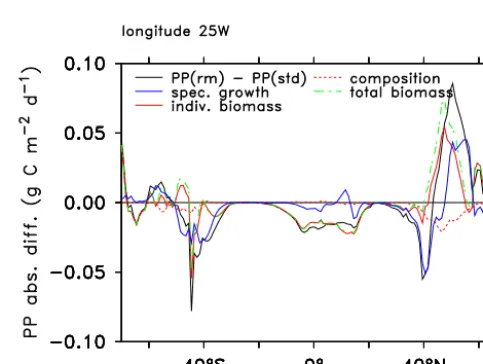
iµiPi) may change because of
changes in the specific growth rate (µi) and/or the biomass
(Pi) of the individual phytoplankton subtypesi. Growth rate
changes reflect the direct effect of changed nutrient con-centrations or changed light conditions for each individual subtype. Biomass changes in turn reflect both changes of total biomass across all phytoplankton subtypes as well as shifts in the community composition. Biomass changes indi-cate a shift in the balance between gains and losses, whereas changes in community composition point towards a shift in competition between subtypes. In the oligotrophic low lati-tudes (about 30◦S to 30◦N; here shown for an Atlantic sec-tion), PP changes are almost entirely driven by a reduction in total phytoplankton biomass (Fig. 3). Community compo-sition shifts and changes in the individual growth rates have only negligible effects. In these regions, the reduced supply of nutrients from deeper layers into the productive surface layer decreases gains in relation to losses for all phytoplank-ton subtypes alike without large changes in individual growth
rate. At higher latitudes, changes in growth rate dominate the PP signal. Biomass effects are evident from 40 to 50◦S on
the global average and in the North Atlantic. Here, follow-ing the mixfollow-ing reduction two dominatfollow-ing large phytoplank-ton subtypes are partly replaced by two small subtypes with lower growth rate, hence the negative composition effect in Fig. 3. The lower growth rate is more than compensated by an overall increase in biomass.
We find no pronounced difference in the response of sim-ulated PP and diversity to a reduction ofkebetween the
sim-ulations withn=78 subtypes and the three simulations with n=30 subtypes. Although the former simulation has overall higher PP at higher latitudes (cf. Prowe et al., 2012b), rela-tive changes in both properties are of similar order of mag-nitude and display similar zonal patterns among the simula-tions. Global average PP changes vary by only 1 % among the model runs employing different levels of diversity. Dif-ferences within the ensemble of three simulations with simi-lar initial (n=30) diversity are comparable with differences between simulations with different initial diversity (Fig. 2). “Diversity” in the generic simulation with each PFT repre-sented by just one subtype (n=4) is affected by mixing changes only in the Southern Ocean. In all other regions all PFTs are present (i.e. they exceed the biomass thresh-old for diversity of Pth=10−8mmol P m−3), although
typ-ically one or two PFTs dominate a region. Changes in PP in response to reduced mixing are generally comparable to changes predicted for the simulations resolving diversity within the PFTs. Southern Ocean PP increases more strongly in the simulation with low diversity (Fig. 2e, f). Here, sur-face nutrients tend to be higher in the low-diversity simula-tion compared to the more efficient nutrient utilizasimula-tion in the high-diversity runs. This leaves more potential for a PP in-crease upon a mixing reduction in the lower-diversity simula-tions. In the oligotrophic lower latitudes, PP decreases more strongly in the low-diversity runs, although the essentially al-ways complete drawdown of surface nutrients is not affected by the reduction in mixing. In contrast to the simulation with four PFTs, then=3psimulation with three PFTs and
Prochlorococcus omitted shows higher relative PP changes
between 20 and 50◦N, i.e. in regions where
Prochlorococ-cus dominates in the other simulations.
The fact that all model communities with the same num-ber of PFTs react in a similar way to the mixing reduction independent of diversity within the PFTs reflects the dimen-sion of the trait space resolved by the assemblages, which is relevant in these reduced-nutrient-supply simulations. The biogeography of each subtype is limited by the optimum tem-perature for growth, which defines suitable habitats on the global scale independent of PFT assignment. However, the half-saturation concentrations for nutrient uptake (e.g.KPO4
for phosphate) are assigned randomly within each PFT so that lowest values distinguish Prochlorococcus analogues, slightly higher values characterize the other-small PFT, and both large PFTs have high half-saturation concentrations.
This pattern is the basis for PFTs in the genericn=4 simu-lation, and is generally maintained in all other simulations (Fig. 4). The relative biomass fraction indicates that each assemblage fills only two main niches in terms of nutri-ent uptake traits with one or few dominant subtypes, with low-KPO4 subtypes at high temperatures and low light (deep
chlorophyll maxima in oligotrophic low latitudes) and high-KPO4 subtypes mostly at lower temperatures and high light
(spring-bloom conditions in higher latitudes). This demon-strates that the warm, oligotrophic regions select for subtypes with lowestKPO4 (“gleaners”; Dutkiewicz et al., 2009) via
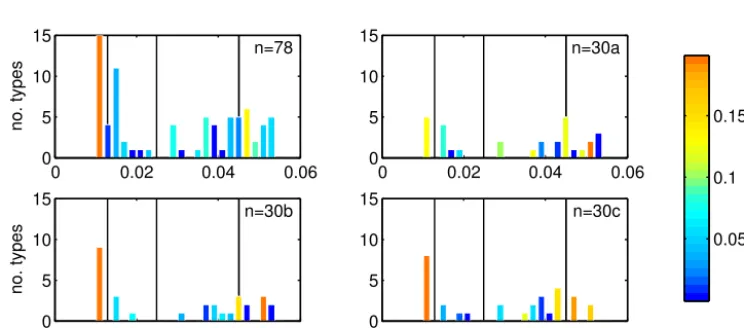
resource competition, while in the colder seasonally mixed oceans high growth rates identify dominant “opportunist” subtypes. The number of subtypes per bin and fraction of total biomass emphasizes that all assemblages can by model design only resolve a few nutrient niches with similar charac-teristics given by the PFT definition (Fig. 5). In the low-KPO4
niche, the assemblage is strongly skewed towards subtypes with lowestKPO4, while in the high-KPO4 niche such a shift
is not found.
Contrary to then=4 simulation, omitting the
Prochloro-coccus PFT, which has lowest KPO4 levels, in the n=3p
simulation reduces the trait space resolved in the model by lifting its lower boundary for nutrient uptake. This reduction is most relevant in the oligotrophic regions (Fig. 2), which now are populated by other subtypes with higherKPO4. In
contrast, omitting the PFT representing other small phyto-plankton (n=3o), which has intermediateKPO4 levels, does
not affect the lower boundary of the trait space and agrees well with both then=4 simulation and the simulations re-solving diversity within PFTs. Consequently, a reduction in nutrient supply caused by reduced mixing affects PP changes more strongly in then=3p run compared to the other simu-lations.
4 Discussion
3402 A. E. F. Prowe et al.: Diversity effects under reduced mixing
BGD
11, 1–25, 2014
Diversity e
ff
ects
under reduced
mixing
A. E. F. Prowe et al.
Title Page
Abstract
Introduction
Conclusions
References
Tables
Figures
J
I
J
I
Back
Close
Full Screen / Esc
Printer-friendly Version
Interactive Discussion
Discussion
P
a
per
|
D
iscussion
P
a
per
|
Discussion
P
a
per
|
Discuss
ion
P
a
per
|
0 0.02 0.04 0.06 0
10 20
30 P Sn=78 D/L a
T opt
(
oC)
0 0.02 0.04 0.06 0
10 20
30 P Sn=30a D/L b
ave. biomass fraction
0 0.02 0.04 0.06 0.08 0.1 0.12 0.14 0.16 0.18 0.2
0 0.02 0.04 0.06 0
10 20
30 P Sn=30b D/L c
T opt
(
oC)
0 0.02 0.04 0.06 0
10 20
30 P Sn=30c D/L d
ave. biomass fraction
0 0.02 0.04 0.06 0.08 0.1 0.12 0.14 0.16 0.18 0.2
0 0.02 0.04 0.06 0 500 1000 D/L P/S e D/L n=78 S P Iopt ( µ Ein m −2 s −1 )
0 0.02 0.04 0.06 0 500 1000 D/L P/S f D/L n=30a S P
ave. biomass fraction
0 0.02 0.04 0.06 0.08 0.1 0.12 0.14 0.16 0.18 0.2
0 0.02 0.04 0.06 0 500 1000 D/L P/S g D/L K
PO4 (mmol P m −3) n=30b S P Iopt ( µ Ein m −2 s −1)
0 0.02 0.04 0.06 0 500 1000 D/L P/S h D/L K
PO4 (mmol P m −3)
n=30c S P
ave. biomass fraction
0 0.02 0.04 0.06 0.08 0.1 0.12 0.14 0.16 0.18 0.2
Fig. 4.
Position of individual phytoplankton subtypes in the trait space given by optimum
tem-perature (
T
opt;
a
–
d
) and optimum light intensity (
I
opt;
e
–
h
) vs. half-saturation concentration for
phosphate uptake (
K
PO4
) for the simulation with
n
=
78 types (
a
,
e
) and the three simulations
with
n
=
30 types (
b
–
d
,
f
–
h
). Downward and upward pointing triangles identify
Prochlorococcus
and other small subtypes, respectively. Circles and diamonds identify diatoms and other large
subtypes, respectively. Color shading indicates the global average fraction of total biomass for
each subtype. Grey symbols indicate subtypes with 0 biomass fraction in the global average.
Vertical and horizontal lines indicate
K
PO4
and
I
opt, respectively, of the PFTs in the
n
=
4 and
n
=
3 simulations, i.e.
Prochlorococcus
(P) analogues, other small phytoplankton (S), other
large phytoplankton (L) and diatom analogues (D).
23
Figure 4. Position of individual phytoplankton subtypes in the trait space given by optimum temperature (Topt; a–d) and optimum light
intensity (Iopt; e–h) vs. half-saturation concentration for phosphate uptake (KPO4) for the simulation withn=78 types (a, e) and the three simulations withn=30 types (b–d, f–h). Downward and upward pointing triangles identify Prochlorococcus and other small subtypes, respectively. Circles and diamonds identify diatoms and other large subtypes, respectively. Colour shading indicates the global average fraction of total biomass for each subtype. Grey symbols indicate subtypes with 0 biomass fraction in the global average. Vertical and horizontal lines indicateKPO4 andIopt, respectively, of the PFTs in then=4 andn=3 simulations, i.e. Prochlorococcus (P) analogues, other small phytoplankton (S), other large phytoplankton (L), and diatom analogues (D).
0 0.02 0.04 0.06 0 5 10 15 no. types n=78
0 0.02 0.04 0.06 0
5 10 15
n=30a
0 0.02 0.04 0.06 0
5 10 15
K
PO4 (mmol P m −3
)
no. types
n=30b
0 0.02 0.04 0.06 0
5 10 15
K
PO4 (mmol P m −3
) n=30c
fraction of total biomass
[image:6.612.112.484.491.655.2]0.05 0.1 0.15
The model setup employed here provides two main niches for nutrient uptake, which agree with the characteristics of the two small and large PFTs: one low-nutrient high-temperature niche and one high-nutrient niche mostly re-alized at lower temperatures. These niches are resolved by different phytoplankton subtypes characterized by a random combination of trait values for temperature, light and nutrient use within the boundaries of the niches according to the as-signed PFT. The Holling type 3 grazing will facilitate diver-sity within the two niches (Prowe et al., 2012b). Additional sensitivity experiments have shown that results are qualita-tively similar for simulations employing a Holling type 2 grazing functional response which promotes competitive ex-clusion. This emphasizes that more diverse assemblages do not occupy more niches, because there are only two main global niches defined by nutrient use resolved in the model.
On regional scales, silicate requirements for diatoms and nitrate availability for other small phytoplankton
(Prochloro-coccus in these simulations are assumed to not be able to
as-similate nitrate) can generate additional niches. Temperature creates geographical niches as the optimum temperature of each subtype determines whether positive net growth is pos-sible or not under a given temperature regime. In any given region, however, the temperature traits do not create comple-mentary niches in terms of nutrient uptake, as they do not in-volve a trade-off in our model. Similarly, the Holling type 3 grazing functional response does not shape complementary niches because the susceptibility to grazing is, in our current model, not linked to any costs, for example related to graz-ing defences. Consequently, one should pose the question of what actually defines different niches in an ocean ecosystem model and in the real world, and how these relate to the PFTs and trade-offs resolved in the model.
Reducing PFT diversity may correspond to a reduction in the relevant trait space resolved and demonstrates that in cur-rent ocean ecosystem models the variety of PFTs determines the niches resolved. In the framework of Ptacnik et al. (2010), here it is the trait dimensionality resolved in the phytoplank-ton community that governs diversity effects on PP against the background of environmental dimensionality simulated by the model. Higher trait dimensionality, for example re-lated to cell size (Ward et al., 2012), might potentially allow larger diversity effects, if the traits give rise to coexistence or competition along an axis of environmental dimensionality. In any given location, i.e. in a given physical and ecologi-cal environment, this condition would require model formu-lations based on trade-offs between different traits. Further-more, while niches may change dominance under changing environmental conditions, the rigid structure of this mod-elling approach does not allow for new niches to be popu-lated.
Small diversity effects on PP changes are evident from the differences between simulations with n=30 subtypes, and are related to the identity of subtypes present. The n=30c simulation reacts to the mixing reduction in a way more
sim-ilar to the standard simulation withn=78 subtypes than to the other simulations with same nominal diversity. This indi-cates that in this model type identity plays a more important role than overall diversity and raises the question of whether the number of coexisting phytoplankton subtypes is the most appropriate measure for relating diversity to ecosystem func-tions. While there is a higher probability in more diverse as-semblages that a specifically suited type is present (Aarssen, 1997; Huston, 1997), our experimental setup is not aimed at identifying this effect.
The similarity of responses among the simulations with different diversity also reflects the fact that the diversity of the phytoplankton community is formulated in terms of a small number of traits that might not include the most relevant traits under changing environmental conditions. In-cluding, for example, nitrogen fixation as an additional trait adding PFT diversity may become more relevant in future compared to current conditions and alter our results. More-over, our model setup does not take into account coexistence through trade-offs in stoichiometric ratios for nutrient re-quirements (Göthlich and Oschlies, 2012), and thus omits po-tential effects of stoichiometrically imbalanced nutrient sup-ply on both diversity and productivity (Gross and Cardinale, 2007; Cardinale et al., 2009). Also, other aspects of plankton diversity such as algal mixotrophy (Hartmann et al., 2012; Ward et al., 2011) or spectral light use (Stomp et al., 2007; Hickman et al., 2010) may play different roles in current and future climates. Future investigations covering an extended diversity range and employing a larger variety of traits, trade-offs and different random phytoplankton assemblages may help to confirm or revise our findings.
3404 A. E. F. Prowe et al.: Diversity effects under reduced mixing behaviour in terms of potential diversity effects. However,
they do not take into account the temperature changes that will accompany the environmental change. Warming may en-hance PP (Taucher and Oschlies, 2011; Dutkiewicz et al., 2013), possibly mitigating some of the decrease from a re-duction in nutrient supply.
5 Conclusions
Appendix A: Decomposition of primary production changes
The effect of a mixing reduction on total primary produc-tion (PP) can be decomposed into effects of changes in to-tal biomass, biomass of individual subtypes, or community composition (cf. Fig. 3) according to the following equa-tions. Here, P
PPstd and P
Pstd denote the total PP and total phytoplankton biomass, respectively, and ppstdi is the specific growth rate (in d−1) of phytoplankton subtype i in the standard run. Consequently, for example P
PPstd=
P
i
ppstdi Pistd. Superscript rm refers to the reduced mixing run.
1PP=XPPrm−XPPstd
sum of all effects (A1)
1PPgro=
X
i
h
pprmi Pistd
i
−XPPstd
specific growth rate (A2)
1PPphy=
X
i
h
ppstdi Pirmi−XPPstd
individual biomass (A3)
≈1PPbm+1PPcomp
total biomass and composition (A4)
1PPbm=
X
PPstd
PPrm
P
Pstd−
X
PPstd
total biomass (A5)
1PPcomp=
X
i
ppstdi XPstd P
rm
i
P
Prm
−XPPstd
composition (A6)
In the model simulations, the individual effects to very good approximation sum up to the total effect, so that 1PP≈1PPgro+1PPphy≈1PPgro+1PPbm+1PPcomp.
3406 A. E. F. Prowe et al.: Diversity effects under reduced mixing
Acknowledgements. We would like to thank Heiner Dietze for
helpful discussions and the MIT Darwin group, in particular Mick Follows for support and Oliver Jahn for technical assistance. Constructive comments by Andy Ridgwell and three anony-mous reviewers helped to improve the study and manuscript. A. E. F. Prowe was funded by the Kiel Cluster of Excellence “The Future Ocean” and by the VKR Centre of Excellence “Ocean Life” at the National Institute of Aquatic Resources of the Technical University of Denmark. S. Dutkiewicz was supported in part by grant DE-FG02-94ER61937 from the U.S. Department of Energy, Office of Science, by the industrial and foundation sponsors of the MIT Joint Program on the Science and Policy of Global Change, and by the National Science Foundation.
The service charges for this open access publication have been covered by a Research Centre of the Helmholtz Association.
Edited by: J. Middelburg
References
Aarssen, L.: High productivity in grassland ecosystems: effected by species diversity or productive species?, Oikos, 80, 183–184, 1997.
Behrenfeld, M. J., O’Malley, R. T., Siegel, D. A., McClain, C. R., Sarmiento, J. L., Feldman, G. C., Milligan, A. J., Falkowski, P. G., Letelier, R. M., and Boss, E. S.: Climate-driven trends in contemporary ocean productivity, Nature, 444, 752–755, doi:10.1038/nature05317, 2006.
Bopp, L., Monfray, P., Aumont, O., Dufresne, J., Le Treut, H., Madec, G., Terray, L., and Orr, J.: Potential impact of climate change on marine export production, Global Biogeochem. Cy., 15, 81–99, 2001.
Bopp, L., Resplandy, L., Orr, J. C., Doney, S. C., Dunne, J. P., Gehlen, M., Halloran, P., Heinze, C., Ilyina, T., Séférian, R., Tjiputra, J., and Vichi, M.: Multiple stressors of ocean ecosys-tems in the 21st century: projections with CMIP5 models, Biogeosciences, 10, 6225–6245, doi:10.5194/bg-10-6225-2013, 2013.
Butchart, S. H. M., Walpole, M., Collen, B., van Strien, A., Scharle-mann, J. P. W., Almond, R. E. A., Baillie, J. E. M., Bomhard, B., Brown, C., Bruno, J., Carpenter, K. E., Carr, G. M., Chanson, J., Chenery, A. M., Csirke, J., Davidson, N. C., Dentener, F., Fos-ter, M., Galli, A., Galloway, J. N., Genovesi, P., Gregory, R. D., Hockings, M., Kapos, V., Lamarque, J.-F., Leverington, F., Loh, J., McGeoch, M. A., McRae, L., Minasyan, A., Morcillo, M. H., Oldfield, T. E. E., Pauly, D., Quader, S., Revenga, C., Sauer, J. R., Skolnik, B., Spear, D., Stanwell-Smith, D., Stuart, S. N., Symes, A., Tierney, M., Tyrrell, T. D., Vie, J.-C., and Watson, R.: Global biodiversity: indicators of recent declines, Science, 328, 1164– 1168, doi:10.1126/science.1187512, 2010.
Cardinale, B. J., Hillebrand, H., Harpole, W. S., Gross, K., and Ptacnik, R.: Separating the influence of resource “avail-ability” from resource “imbalance” on productivity–diversity relationships, Ecol. Lett., 12, 475–487, doi:10.1111/j.1461-0248.2009.01317.x, 2009.
Cardinale, B. J., Matulich, K. L., Hooper, D. U., Byrnes, J. E., Duffy, E., Gamfeldt, L., Balvanera, P., O’Connor, M. I., and
Gon-zalez, A.: The functional role of producer diversity in ecosys-tems, Am. J. Bot., 98, 572–592, doi:10.3732/ajb.1000364, 2011. Dutkiewicz, S., Follows, M. J., and Bragg, J. G.: Modeling the coupling of ocean ecology and biogeochemistry, Global Bio-geochem. Cy., 23, GB4017, doi:10.1029/2008GB003405, 2009. Dutkiewicz, S., Scott, J. R., and Follows, M. J.: Winners and losers: ecological and biogeochemical changes in a warming ocean, Global Biogeochem. Cy., 27, 463-477, doi:10.1002/gbc.20042, 2013.
Follows, M. J. and Dutkiewicz, S.: Modeling diverse communi-ties of marine microbes, Annu. Rev. Mar. Sci., 3, 427–451, doi:10.1146/annurev-marine-120709-142848, 2011.
Follows, M. J., Dutkiewicz, S., Grant, S., and Chisholm, S. W.: Emergent biogeography of microbial communities in a model ocean, Science, 315, 1843–1846, 2007.
Friedrichs, M. A. M., Hood, R. R., and Wiggert, J. D.: Ecosys-tem model complexity versus physical forcing: Quantification of their relative impact with assimilated Arabian Sea data, Deep-Sea Res. II, 53, 576–600, doi:10.1016/j.dsr2.2006.01.026, 2006. Friedrichs, M. A. M., Dusenberry, J. A., Anderson, L. A., Arm-strong, R. A., Chai, F., Christian, J. R., Doney, S. C., Dunne, J., Fujii, M., Hood, R., J. McGillicuddy, Jr., D., Moore, J. K., Schartau, M., Spitz, Y. H., and Wiggert, J. D.: Assessment of skill and portability in regional marine biogeochemical models: Role of multiple planktonic groups, J. Geophys. Res., 112, C08001, doi:10.1029/2006JC003852, 2007.
Göthlich, L. and Oschlies, A.: Phytoplankton niche generation by interspecific stoichiometric variation, Global Biogeochem. Cy., 26, GB2010, doi:10.1029/2011GB004042, 2012.
Gross, K. and Cardinale, B. J.: Does species richness drive commu-nity production or vice versa? Reconciling historical and contem-porary paradigms in competitive communities, Am. Nat., 170, 207–220, 2007.
Hartmann, M., Grob, C., Tarran, G. A., Martin, A. P., Burkill, P. H., Scanlan, D. J., and Zubkov, M. V.: Mixotrophic basis of Atlantic oligotrophic ecosystems, P. Natl. Acad. Sci. USA, 109, 5756– 5760, 2012.
Hickman, A. E., Dutkiewicz, S., Williams, R. G., and Follows, M. J.: Modelling the effects of chromatic adaptation on phyto-plankton community structure in the oligotrophic ocean, Mar. Ecol. Prog. Ser., 406, 1–17, doi:10.3354/meps08588, 2010. Huston, M.: Hidden treatments in ecological experiments:
re-evaluating the ecosystem function of biodiversity, Oecologia, 110, 449–460, 1997.
Hutchinson, G. E.: Concluding remarks, Cold Spring Harbor Sym., Quant. Biol., 22, 415–427, 1957.
Loreau, M.: Biodiversity and ecosystem functioning: a mechanistic model, P. Natl. Acad. Sci. USA, 95, 5632–5636, 1998.
MacArthur, R. and Wilson, E.: The Theory of Island Biogeography, Princeton University Press, Princeton, NJ, 1967.
Moisan, J. R., Moisan, T. A., and Abbott, M. R.: Modelling the ef-fect of temperature on the maximum growth rates of phytoplank-ton populations, Ecol. Model., 153, 197–215, 2002.
Prowe, A. E. F., Pahlow, M., Dutkiewicz, S., Follows, M., and Os-chlies, A.: Top-down control of marine phytoplankton diversity in a global ecosystem model, Prog. Oceanogr., 101, 1–13, doi:10.1016/j.pocean.2011.11.016, 2012a.
ecosystem model, Ecol. Model., 225, 167–176, doi:10.1016/j.ecolmodel.2011.11.018, 2012b.
Ptacnik, R., Moorthi, S. D., and Hillebrand, H.: Hutchinson re-versed, or why there need to be so many species, Adv. Ecol. Res., 43, 1–43, doi:10.1016/S0065-2504(10)43001-9, 2010.
Reich, P. B., Tilman, D., Isbell, F., Mueller, K., Hobbie, S. E., Flynn, D. F. B., and Eisenhauer, N.: Impacts of biodiversity loss esca-late through time as redundancy fades, Science, 336, 589–592, doi:10.1126/science.1217909, 2012.
Sarmiento, J., Slater, R., Barber, R., Bopp, L., Doney, S., Hirst, A., Kleypas, J., Matear, R., Mikolajewicz, U., Monfray, P., Solda-tov, V., Spall, S., and Stouffer, R.: Response of ocean ecosys-tems to climate warming, Global Biogeochem. Cy., 18, GB3003, doi:10.1029/2003GB002134, 2004.
Schoener, T.: The ecological niche, in: Ecological Concepts: The Contribution of Ecology to an Understand of the Natural World, edited by: Cherrett, J., Blackwell Scientific, Oxford, chap. 4, 79– 113, 1988.
Steinacher, M., Joos, F., Frölicher, T. L., Bopp, L., Cadule, P., Cocco, V., Doney, S. C., Gehlen, M., Lindsay, K., Moore, J. K., Schneider, B., and Segschneider, J.: Projected 21st century de-crease in marine productivity: a multi-model analysis, Biogeo-sciences, 7, 979–1005, doi:10.5194/bg-7-979-2010, 2010. Stomp, M., Huisman, J., Vörös, L., Pick, F. R., Laamanen, M.,
Haverkamp, T., and Stal, L. J.: Colourful coexistence of red and green picocyanobacteria in lakes and seas, Ecol. Lett., 10, 290– 298, 2007.
Taucher, J. and Oschlies, A.: Can we predict the direction of marine primary production change under global warming?, Geophys. Res. Lett., 38, L02603, doi:10.1029/2010GL045934, 2011. Tilman, D., Lehman, C., and Thomson, K.: Plant diversity and
ecosystem productivity: theoretical considerations, P. Natl. Acad. Sci. USA, 94, 1857–1861, 1997.
Ward, B. A., Dutkiewicz, S., Barton, A. D., and Follows, M. J.: Biophysical Aspects of Resource Acquisition and Competition in Algal Mixotrophs, Am. Nat., 178, 98–112, doi:10.1086/660284, 2011.
Ward, B. A., Dutkiewicz, S., Jahn, O., and Follows, M. J.: A size-structured food-web model for the global ocean, Lim-nol. Oceanogr., 57, 1877–1891, doi:10.4319/lo.2012.57.6.1877, 2012.
Ward, B. A., Schartau, M., Oschlies, A., Martin, A. P., Fol-lows, M. J., and Anderson, T. R.: When is a biogeochemical model too complex? Objective model reduction and selection for North Atlantic time-series sites, Prog. Oceanogr., 116, 49– 65, doi:10.1016/j.pocean.2013.06.002, 2013.