Mrozkowiak Mirosław, Sokołowski Marek, Posłuszny Mariusz, Kaiser Alicja. Sexual dimorphism of the incidence of significant relationships between selected parameters of feet and characteristics of trunk in adolescents aged 14 – 18 years . Journal of Education, Health and Sport. 2018;8(3):253-266. eISNN 2391-8306. DOI http://dx.doi.org/10.5281/zenodo.1194069
http://ojs.ukw.edu.pl/index.php/johs/article/view/5352 https://pbn.nauka.gov.pl/sedno-webapp/works/859197
The journal has had 7 points in Ministry of Science and Higher Education parametric evaluation. Part b item 1223 (26/01/2017). 1223 Journal of Education, Health and Sport eissn 2391-8306 7
© The Authors 2018;
This article is published with open access at Licensee Open Journal Systems of Kazimierz Wielki University in Bydgoszcz, Poland
Open Access. This article is distributed under the terms of the Creative Commons Attribution Noncommercial License which permits any noncommercial use, distribution, and reproduction in any medium, provided the original author (s) and source are credited. This is an open access article licensed under the terms of the Creative Commons Attribution Non commercial license
(Http://creativecommons.org/licenses/by-nc/4.0/) which permits unrestricted, non commercial use, distribution and reproduction in any medium, provided the work is properly cited. This is an open access article licensed under the terms of the Creative Commons Attribution Non commercial License (http://creativecommons.org/licenses/by-nc/4.0/) which permits unrestricted, non commercial
use, distribution and reproduction in any medium, provided the work is properly cited. The authors declare that there is no conflict of interests regarding the publication of this paper.
Received: 05.02.2018. Revised: 10.02.2018. Accepted: 08.03.2018.
Sexual dimorphism of the incidence of significant relationships
between selected parameters of feet and characteristics of trunk in
adolescents aged 14 – 18 years
MirosławMrozkowiak1, Marek Sokołowski2, Mariusz Posłuszny3, Alicja Kaiser4
1 Kazimierz Wielki University, Bydgoszcz, Poland 2Kręg-Clinic, 192 Strzeszyńska Str., Poznań, Poland
3University of Physical Education, Poznań, Poland, 4WSB University in Poznań
Key words: relationships, dimorphism, parameters of body posture, feet, sex
Summary
Introduction. Symmetry, asymmetry, mutual relationships and concomitance have become a subject of interest of numerous researchers. The analysis of the findings obtained in the own study conducted among adolescents aged 14-18 years revealed an incidental nature and randomness of the distribution of significant correlations in each age and gender range, which made it impossible to show any regularities or dependencies between the measured parameters.
Findings
1. The number of feet parameters revealing significant relationships with trunk parameters which differentiated the female gender from the male one was greater; likewise, the features in women revealed a more frequent relationship. Additionally, female sex was differentiated by morphological traits, the abnormal positioning of toes and the longitudinal arch of feet. 2. The number of trunk parameters correlating with foot parameters was observed to be bigger in the female gender than in the male one. The parameters in female subjects showed more relationships and the parameters which differentiated female sex included the frontal plane and the sagittal plane to a lesser extent, whereas male gender was characterized by the sagittal plane.
1. Introduction
spacing of internal organs. The right body half is usually characterized by bigger mass, longer right limbs, larger circumference of typical locations of the upper right limb, more muscular left shin and the right side of the shoulder girdle [4, 5, 6]. Therefore, symmetry, asymmetry, mutual relationships and concomitance have become a subject of interest of numerous researchers [7-12]. The analysis of 2,343 observations obtained in the study conducted among adolescents aged 14-18 years revealed that the distribution of significant correlations in each age and gender range, their incidental nature and randomness, which impended a demonstration of any regularities and dependencies between the measured parameters at all. Only their concomitance can be actually determined.
Among the parameters describing the spine-pelvis complex and most frequently correlating with foot parameters observed at the age of 14-18 years, the features of the frontal and sagittal planes prevail and the transverse plane to a lesser extent. In the examined age ranges, the most frequent and the strongest relationships and concomitance with the parameters of feet were observed in 18-year-old girls and in boys aged 15 and 18 years [13].
The main objective of the study was to prove sexual dimorphism with regard to the incidence of significant correlations of the selected parameters of feet and the features of trunk in adolescents aged 14-18 years. The analysis of the research findings headed in two directions. The first one was to provide an answer to the question: which parameters of the foot reveal a significant relationship with the parameters of trunk within sexual dimorphism? The second one was to give an answer to the question: with which parameters of trunk do the parameters of the foot most often reveal a significant correlation also within sexual dimorphism?
2. Material and method
features considering age ranges, gender and environment. The relationships and their significance were assessed using p-value and frequency expressed in percentage.
The fundamental assumption of the study was to assess the habitual posture as a relatively constant individual characteristic of a human being. This posture reflected an individual emotional, psychical and social condition of the subject. Moreover, the posture provided the most reliable description of the subject’s silhouette at a given time and in a place. The conducted diagnostics did not determine whether an individual’s posture was correct or not, it only identified the condition of its ontogenetic development.
Objectified and comparable test results ensured that the postural parameters adopted for the analysis were recorded with possible to determine compensations. The combined assessment of the trunk and feet allowed to objectively determine the quality of the postural model applied in a given environment, gender and age category. The measuring instrument used in the study determined several tens of parameters describing body posture. The statistical analysis covered 89 angular and linear parameters of the spine, pelvis, trunk and feet in the sagittal, frontal and transverse planes, see Table 1. Obtaining the spatial picture was possible thanks to displaying the line of strictly defined parameters on a teenager’s back and feet. The lines falling on the skin of a person got distorted depending on the configuration of the surface. The applied lens ensured that the imaging of a subject could be received by a special optical system with a camera, then transmitted to the computer monitor. The distortions of the line imaging recorded in the computer memory were processed through a numerical algorithm on the topographic map of the investigated surface. When conducting the study, one should be aware of the fact that the taken photo records an image of the silhouette displayed on an individual’s skin [14].
Table 1.
List of parameters measured for trunk and foot system Trunk parameters
No. Symbol Parameters
Unit Name Description
3 Gamma degree Inclination of upper thoracic region
4 DCK mm Total length of
the spine
Distance between C7 and S1, measured in vertical axis
5 KPT degree Angle of
extension Defined as a deviation of the C7-S1 line from vertical position (backwards) 6 KPT - degree Angle of body
bent Defined as a deviation of the C7-S1 line from vertical position (forwards)
7 DKP mm Thoracic
kyphosis length
Distance between LL and C7
8 KKP degree Thoracic
kyphosis angle
KKP = 180 – (Beta+Gamma)
9 RKP mm Thoracic
kyphosis height
Distance between points C7 and PL
10 GKP mm Thoracic
kyphosis depth Distance measured horizontally between the vertical lines passing through points PL and KP
11 DLL mm Lumbar lordosis
Length
Distance measured between points S1 and KP
12 KLL degree Angle of lumbar
lordosis KLL = 180 – (Alfa + Beta)
13 RLL mm Lumbar lordosis
Height
Distance between points S1 and PL
14 GLL - mm Lumbar lordosis
depth Distance measured horizontally between the vertical lines passing through points PL and LL Frontal plane
15 KNT - degree Angle of body
bent to the side Defined as deviation of the C7-S1 line from the vertical axis to the left
16 KNT degree Defined as deviation of the C7-S1 line from the
vertical axis to the right
17 LBW - mm Right shoulder
up
Distance measured vertically between horizontal lines passing through points B2 and B4
18 LBW mm Left shoulder
higher
19 KLB degree Shoulder line angle, right shoulder up
Angle between the horizontal line and the straight line passing through points B2 and B4
21 LŁW mm Left scapula up Distance measured vertically between horizontal lines passing through points Ł1 and Łp
22 LŁW mm Right scapula up
23 UL degree Angle of scapula line, right
scapula up
Angle between the horizontal line and the straight line passing through points Ł1 and Łp
24 UL - degree Angle of scapula line, left scapula up
25 OL mm Lower angle of
left scapula more distant
Difference of the distance of lower angles of scapulas from the line of spinous processes measured horizontally along the lines passing through points Łl and Łp
26 OL - mm Lower angle of
right scapula more distant
27 TT mm Left waist
triangle up
Difference of the distance measured vertically between points T1 and T2, T3 and T4.
28 TT – mm Right waist
triangle up
29 TS mm Left waist
triangle wider
Difference of the distance measured horizontally between straight lines passing through points T1 and T2, T3 and T4
30 TS - mm Right waist
triangle wider 31 KNM degree Pelvis tilt, right
ilium up
Angle between the horizontal line and the straight line passing through points M1 and Mp
32 KNM - degree Pelvis tilt, left ilium up
33 UK mm Maximum
inclination of the spinous process to the right
Maximal deviation of the spinous process from the line from S1. The distance is measured in
horizontal line.
34 UK - mm Maximum
inclination of the spinous process to the left. 35
NK-NK
_ Number of the vertebra maximally distanced to the
left (NK-) or to the right (NK)
If the arithmetic mean takes the value e.g. from 12.0 to 12.5, it is Th5, if from 12.6 to 12.9 it is Th6.
Transverse plane
36 ŁB - mm Lower angle of
the right scapula more convex
Difference of the distance of lower scapula angles from the surface of the back
37 ŁB mm Lower angle of
the scapula more convex
38 UB – degree Angle of projection line of lower scapula angles, the left one more convex
Difference in the angles UB1 – UB2. Angle UB2 between: the line passing through point Łl and at the same time perpendicular to the camera axis and the straight line passing through points Łl and Łp. Angle UB1 between the line passing through point Łp and perpendicular to the camera axis and the straight line passing through points Łp and Łl. 39 UB degree Angle of projection
line of lower scapula angles, the right one more convex
40 KSM degree Pelvis rotated to the right
Angle between the line passing through point M1 and perpendicular to the camera axis and the straight line passing through points M1 and MP 41 KSM - degree Pelvis rotated to
the left
Angle between the line passing through point Mp and perpendicular to the camera axis and the straight line passing through points Ml and MP
Foot parameters
Symbol Parameters
No. Unit Name Description
42 DL p mm Length of the right
foot (p), left foot (l)
Distance between points acropodion and pterion in a plantogram
43 DL l
44 Sz p Width of the right
foot (p), left foot (l)
Distance between points metatarsal fibular and metatarsal tibial in a plantogram
45 Sz l
46 W p “W” Indicator
(Wejsflog indicator) of the right foot (p),
The relationship of foot length to its width
DL p/Sz p = W p, DL l/Sz l = Wl
47 W 1 of the left foot (l)
48 Alfa P
m degree Valgity angle of big toe of the right foot: Alfa p p, of the left foot: Alfa l p. Angle of varus deformity in the right foot:
Angle between the straight line passing through points metatarsal tibial and the most inner one on the medial edge of the heel and the straight line passing through points metatarsal tibial and the most inner one on the medial edge of the great toe
49 Alfa P p 50 Alfa L
Alfa p m, left foot: Alfa l m.
52 Beta p m
Angle of varus deformity of the 5th
toe of the right foot: Beta p p, of the left foot: Beta l p.
Valgity angle of the fifth toe of the right foot: Beta p m, left foot: Beta l m.
Angle between the straight line passing through points metatarsal fibular and the most outer
one on the lateral edge of the heel and the straight line passing through points metatarsal fibular and the most outer one on the lateral edge of the fifth toe in a plantogram
53 Beta p p 54 Beta l
m 55 Beta l p
56 Gamma
P (Gam.P)
Heel angle of right foot (p), of left foot (l)
Angle between the straight line passing through points metatarsal tibial and the most inner one on the medial edge of the heel and the straight line passing through points metatarsal fibular and the most outer one on the lateral edge of the heel in a plantogram
57 Gamma
l (Gam. L)
58 PS p mm2 Plantar surface of
right foot (p), left foot (l)
Plantar surface of the foot
59 PS 1
60 DP 1 mm Length of
longitudinal arch 1, 2, 3, 4, and 5 of right foot (P), left foot (L)
Length of the arch from 1, 2, 3, 4 and 5 metatarsal foot to point pterion
61 DP 2
62 DP 3
63 DP 4
64 DP 5
65 DL 1
66 DL 2
67 DL 3
68 DL 4
69 DL 5
70 WP 1 Height of arch 1, 2,
3, 4 and 5 of right foot (P), left foot (L)
Distance from the bottom to the highest point of arch 1, 2, 3, 4 and 5.
71 WP 2
72 WP 3
73 WP 4
74 WP 5
75 WL 1
76 WL 2
77 WL 3
78 WL 4
79 WL 5
80 SP 1 Width of arch 1, 2,
3, 4 and 5 of right foot (P), left foot
Bowstring of the distance of arch 1, 2, 3, 4 and 5.
81 SP 2
(L)
83 SP 4
84 SP 5
85 SL 1
86 SL 2
87 SL 3
88 SL 4
89 SL 5
[image:9.595.67.528.182.514.2]Source: author’s own research 3. Results
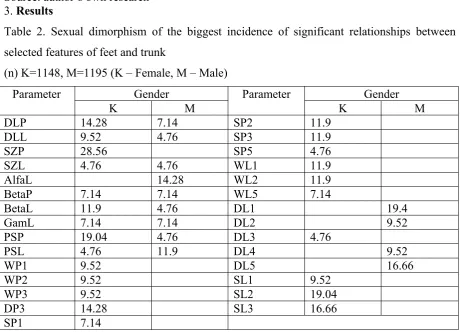
Table 2. Sexual dimorphism of the biggest incidence of significant relationships between selected features of feet and trunk
(n) K=1148, M=1195 (K – Female, M – Male)
Parameter Gender Parameter Gender
K M K M
DLP 14.28 7.14 SP2 11.9
DLL 9.52 4.76 SP3 11.9
SZP 28.56 SP5 4.76
SZL 4.76 4.76 WL1 11.9
AlfaL 14.28 WL2 11.9
BetaP 7.14 7.14 WL5 7.14
BetaL 11.9 4.76 DL1 19.4
GamL 7.14 7.14 DL2 9.52
PSP 19.04 4.76 DL3 4.76
PSL 4.76 11.9 DL4 9.52
WP1 9.52 DL5 16.66
WP2 9.52 SL1 9.52
WP3 9.52 SL2 19.04
DP3 14.28 SL3 16.66
SP1 7.14
Source: author’s own research
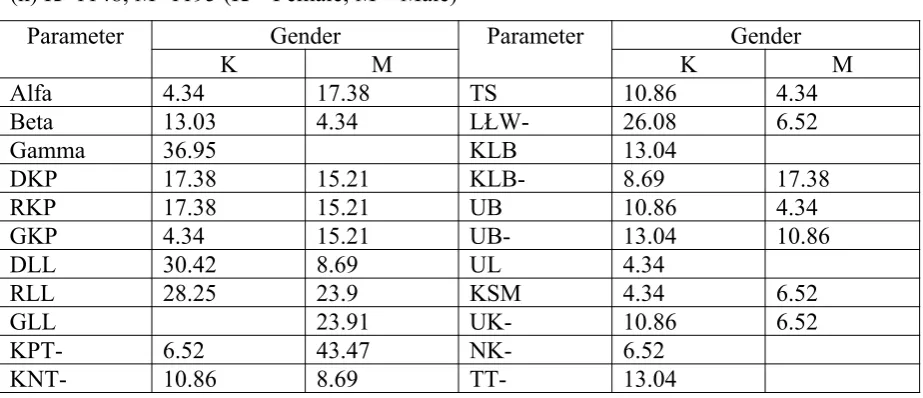
Table 3. Sexual dimorphism of trunk parameters having the biggest incidence of significant relationship with the features of feet
(n) K=1148, M=1195 (K – Female, M – Male)
Parameter Gender Parameter Gender
K M K M
Alfa 4.34 17.38 TS 10.86 4.34
Beta 13.03 4.34 LŁW- 26.08 6.52
Gamma 36.95 KLB 13.04
DKP 17.38 15.21 KLB- 8.69 17.38
RKP 17.38 15.21 UB 10.86 4.34
GKP 4.34 15.21 UB- 13.04 10.86
DLL 30.42 8.69 UL 4.34
RLL 28.25 23.9 KSM 4.34 6.52
GLL 23.91 UK- 10.86 6.52
KPT- 6.52 43.47 NK- 6.52
KNT- 10.86 8.69 TT- 13.04
Source: author’s own research
The analysis of the study results with regard to sexual dimorphism concerning foot parameters with which trunk parameters most often correlated, revealed the following parameters in girls: upper thoracic inclination (Gamma), thoracic kyphosis length (DKP), asymmetric height of waist triangles with right waist triangle up (TT-), asymmetric shoulder line angle with the right shoulder up (KLB), asymmetric scapula line angle with the right scapula up (UL). The following parameters were revealed in boys: lumbar lordosis depth (GLL), Table 3, Fig. 2.
5. Findings
References
1. Małgorzata Proszkowiec, Karina Słonka, Lidia Hyla-Klekot, Formation of body posture in the 2nd critical stage of posturogenesis with regard to sexual maturation of the subject, Physiotherapy 2011, 19, 1, 10-19
2. Edward Saulicz, Janusz Nowotny, Mirosław Kokosz, Mariola Saulicz, George Banot, Dimorphic differentiation of body posture in the sagittal plane during pubescence period, AWF Katowice, Zeszyty Metodyczno-Naukowe, Katowice 1996, No. 8, 15-24.
3. Ewa Zeyland-Malawka, Selected morphological and functional parameters of body as modifiers of anteroposterior curvatures, Sports Medicine, V. 20, No. 6, 2004, 289-294.
4. Reicher M., Łasiński M., Symmetry and asymmetry of body, [W] Human anatomy, PZWL, Warsaw, 1990, 175-177.
5. Drozdowski Z., Biological human development, AWF Poznań, 1977, 79-84. 6. Wolański N., Biological human development, PWN, Warsaw, 1983, 381-391.
7. Mięsowicz I., 1965, Statodynamic interdependencies within hip region in ontogenetic development. Scientific works and materials IMD, No 5.
8. Mięsowicz I., 1966, Statodynamic interdependencies within foot region in ontogenetic development. Scientific works and materials IMD, No. 8.
9. Mięsowicz I., 1972, Developmental changes of strength and bioelectric activity of selected muscle groups. Issues of developmental age medicine, No. 1.
10. Drzał-Grabiec J., Snela S., 2012, Spinal curvatures and foot defects in children: an experimental study, Spine.
11.Mrozkowiak M., Sokołowski M., Kaiser A.: Relationships and influence of pelvis–spine and feet complex features in population of boys and girls aged 14–18 years. Issues of family medicine, September 2012, XIV, No. 3, p. 28-36.
12. Mrozkowiak M., Jazdończyk P., Relationships in the spine-pelvis system and feet in girls and boys aged 4 to 18 years. Journal of Education, Health and Sport. 2015;5(7):226-250. 13. Mrozkowiak M., Szurmik T., Hadlich R., 2017, Relationships and coincidence of parameters describing body posture and feet in boys and girls aged 14-18 years.
(Description of the Figures)
Fig. 1 Sexual dimorphism of significant relationships of the parameters of trunk with the parameters of feet in adolescents aged 14 – 18 years (n) K=1148 M=1195
Incidence (%)
Parameters of feet K (female) M (male)
Fig. 2 Sexual dimorphism of significant relationships of the parameters of feet with the parameters of trunk in adolescents aged 14 – 18 years (n) K=1148 M=1195
Incidence (%)
Ryc. 1. Dymorfizm płciowy istotnych związków cech tułowia z cechami stóp wśród 14 - 18-letniej młodzieży (n) K=1148, M=1195
0 5 10 15 20 25 30 35 40
DCK Alfa Beta Gam
ma KKP DKP RKP GKP KLL DLL RLL GLL KNT
KNT- KPT- LŁW ŁB OL UB
-UB UL KLB KLB- TT- TS
KNM KSM UK
-NK
Cechy tułowia
C
zę
st
o
ść
(
%
)
K M
Ryc. 2. Dymorfizm płciowy cech stóp o najczęstszym istotnym związku z cechami tułowia wśród młodzieży 14 - 18-letniej obojga środowisk (n) K=1148,M=1195
0 5 10 15 20 25 30 35 40
DLP DLL SZP SZL AlfaL Beta
P Gam
P Gam
L
PSP PSL WP1 WP2 WP4 WP5 DP1 DP2 DP3 SP1 SP3 SP5 WL1 WL2 WL4 DL1 DL4 SL1 SL3 SL5
Cechy stóp
C
zę
st
o
ść
(
%
)
K M