www.theoryofgroups.ir
ISSN (print): 2251-7650, ISSN (on-line): 2251-7669 Vol. 5 No. 1 (2016), pp. 37-51.
c
⃝2016 University of Isfahan
www.ui.ac.ir
A NOTE ON THE AFFINE SUBGROUP OF THE SYMPLECTIC GROUP
JAMSHID MOORI∗AND BERNARDO RODRIGUES∗∗
Communicated by Saeid Azam
Abstract. We examine the symplectic group Sp2m(q) and its corresponding affine subgroup. We
construct the affine subgroup and show that it is a split extension. As an illustration of the above we study the affine subgroup 25:Sp
4(2) of the groupSp6(2).
1. Introduction
An affine subgroup of a classical group acting on a vector space is the stabilizer of a nonzero
vector. Gow in [4] used Clifford theory to establish the existence of complex irreducible characters of
certain degrees of affine subgroups of the general linear, symplectic and unitary groups. It is proved in
particular that these characters remain irreducible as modular characters modulo any prime distinct
from the characteristic of the defining field. Using the underlying theory described in [4], here we
prove the following theorem:
Theorem 3.10. Let q be a power of an odd prime p. ThenA(m) is a split extension of P(m) by H
where H ∼=G(m−1)=∼Sp2m−2(q),i.e.,A(m) =P(m):H =P(m):Sp2m−2(q).
The proof of the theorem will follow from a series of lemmas proved in Section 3. In Section 4
we construct the group A(3), the affine subgroup of Sp6(2) as an illustrative example of the theory
outlined in Section 3 and in Section 5 using GAP we construct its conjugacy classes.
MSC(2010): Primary: 20E22; Secondary: 20D25. Keywords: Group extensions, symplectic groups. Received: 2 April 2014, Accepted: 12 November 2014. ∗∗Corresponding author.
∗Support of the NRF through incentive and competitive grants is acknowledged.
∗∗This work is based on the research supported by the National Research Foundation of South Africa (Grant Numbers 84470 and 91495).
2. Background and terminology
For a finite dimensional vector space V over a field F, a function f from the set V ×V of ordered
pairs in V toFis called a bilinear form on V if for eachv∈V, the functions f(v, ) andf(, v) are
linear functionals on V.In this case we say that (V, f) is aninner product space.
A bilinear form f onV such that for each non-zerox∈V,there exists y∈V for whichf(x, y)̸= 0,
then f is said to be non-degenerate. A bilinear form f is called alternating orsymplecticon V
if f(x, x) = 0 for all x ∈ V. If char(F) ̸= 2 then we obtain that for all x, y ∈ V, f(x, x) = 0. If a
bilinear form f :V ×V −→F onV satisfies:
(i) f(x, x) = 0, ∀x∈V
(ii) f(x, y) =−f(y, x), ∀ x, y ∈V we say that (V, f) is a symplectic space over the fieldF. If
char(F)̸= 2, then the properties (i) and (ii) are equivalent.
Let (V, f) and (U, g) be symplectic spaces over F, then we say that V ∼= U if there exists an
isomorphism T ∈L(V, U) such that∀x, y∈V we havef(x, y) =g(T(x), T(y)).
If W is a subspace of V then the orthogonal complement of W is defined by W⊥ = {y ∈ V | f(x, y) = 0, ∀ x ∈ W}. If {v1, v2, . . . , vm} is an ordered basis of V, then the inner product
matrix of f relative to this basis is given by an m×m matrix A = [f(vi, vj)]m×m . Clearly f is
completely determined by an inner product matrix, for if u=∑αivi and v=
∑
βjvj then f(u, v) =
∑
i,jαiβjf(vi, vj).
An isometry of a non-degenerate space (V, f) is a linear transformation T :V −→ V, such that
f(T(x), T(y)) = f(x, y) for all x, y ∈ V. If (V, f) is a non-degenerate space, then every isometry is
non-singular, and so the set of all isometries denoted by Isom(V, f) forms a subgroup ofGL(V).
A non-degenerate symplectic space (V, f) has even dimension 2m over a field F, and the group
Isom(V, f) is denoted by Sp2m(F), and is called the symplectic group of degree 2m over F. If
F=GF(q) is a Galois field ofq elements, whereq=pkfor somekwithpa prime, we denoteSp 2m(F)
by Sp2m(q). We further obtain that Isom(V, f) = Sp2m(F) ≤ GL2m(F). Within isomorphism this
group is independent of the choice of f.
If V is a non-degenerate symplectic space over a field F, and Sp2m(F) is the symplectic group of
isometries ofV, then the centreZ(Sp2m(F)) ofSp2m(F) consists of the transformationsT =kI, where
k=±1. The factor groupSp2m(F)/Z(Sp2m(F)) is called theprojective symplectic groupand is denoted
byP Sp2m(F). The projective symplectic groups are simple except forP Sp2(2) =P SL2(2),P Sp2(3) =
P SL2(3) and P Sp4(2). If F=GF(q), is the Galois field of q elements, then Sp2m(q) andP Sp2m(F)
are denoted by Sp2m(q) and P Sp2m(q) respectively, and we haveZ(Sp2m(q)) ={I} if char(F) =
2 and Z(Sp2m(q)) ={I,−I} if char(F)̸= 2. We also have |P Sp2m(q)|= (2,q1−1) × |Sp2m(q)|= qm2
(2,q−1)
∏m
i=1(q2i−1).
Let (V, f) be a non-degenerate symplectic space. LetB ={x1, y1, x2, y2, . . . , xm, ym}be a basis for
V such that{xi, yi}is a hyperbolic pair for all 1≤i≤m withf(xi, xj) = 0 =f(yi, yj) for alli, j and
a hyperbolic basisforV.It is clear that all inner product are 0 exceptf(xi, yi) = 1 =−f(yi, xi) for
all i.
The following results which could be found in [9] are relevant in the proof of the main theorem,
Lemma 2.1. [9] If (V, f) is a non-degenerate symplectic space, then the following occur,
(i) V has a hyperbolic basis{x1, y1, x2, y2, . . . , xm, ym}.
(ii) The inner product matrix A of f relative to this ordered basis is the matrix J which is the direct
sum of 2×2 blocks (
0 1
−1 0 )
.
(iii) If u=∑i(αixi+βiyi) and v=
∑
i(λixi+µiyi), thenf(u, v) =
∑
i(αiµi−βiλi).
(iv) All non-degenerate symplectic forms on V are equivalent and the symplectic group Isom(V, f),
up to isomorphism, do not depend on the choice of f.
Remark 2.2. Property (iii) in Lemma 2.1 implies that the symplectic forms are sums of 2 ×2
determinants. If a hyperbolic basis is reordered so that all thexi precede all theyi,then the matrixJ
is congruent to (
0 Im
−Im 0
)
.In this case we say that{x1, x2, . . . , xm, y1, y2, . . . , ym}is areordered
hyperbolic basis of V.
Lemma 2.3. [9] Let (V, f) be a non-degenerate symplectic space.
Let T ∈ GL(V), and let {x1, x2, . . . , xm, y1, y2, . . . , ym} be a reordered hyperbolic basis of V. If the
matrix Q of T with respect to this basis is decomposed into m×m blocks Q = (
A C
B D
)
then T∗
exists and has a matrix Q∗= (
Dt −Ct −Bt At
)
, moreover, Q∈Sp2m(q) if and only if Q∗Q=I2m.
Remark 2.4. For a p-group G we have that the derived subgroup G′ ≤ Φ(G). G is said to be a special p-group if Z(G) =G′ = Φ(G) is elementary abelian.
3. The affine subgroup of the symplectic group
SinceSp2m(q) is transitive on the non-zero vectors ofV, we consider the subgroup ofSp2m(q) which
is a stabilizer of a non-zero vector ofV and study its structure. Following a series of lemmas we prove
Theorem 3.7.
Let (V, f) be a non-degenerate symplectic space over F = GF(q), where q is a power of a prime.
LetB ={e1, e2, . . . , e2m} be a basis forV andf :V ×V −→Fdefined byf(ei, ej) =δ(i,2m+ 1−j),
where i≤j. LetT be an isometry of (V, f) and
G(m) =Sp2m(q) ={T |f(T(x), T(y)) =f(x, y) ∀x, y∈V}.
Since G(m) acts transitively on V − {0V}, let α∈V − {0V}and A(m) be the stabilizer ofαinG(m)
then we have that A(m) ={T ∈G(m)|T(α) = α}. Thus A(m)≤ G(m). The group A(m) is called
Note 3.1. Since A(m) is the stabilizer of α ∈ V − {0V} in G(m), we have that [G(m):A(m)] =
|V − {0V}| = q2m −1. Now since G(m) acts transitively on V − {0V}, then we let A(m) to be the
stabilizer in G(m) of the non-zero vector e1 of V − {0V}. That is A(m) ={T ∈G(m)|T(e1) =e1}.
Lemma 3.2. Let a ∈ GF(q), with char(GF(q)) = p and (n, p) = 1, n ∈ N. Then there exists
b∈GF(q) such that nb=a.
Proof. If a = 0, then let b = 0. Suppose a ̸= 0. Let (GF(q))∗ = ⟨x⟩ where o(x) = q −1. Then
a ∈ (GF(q))∗ implies that a = xr′,1 ≤ r′ ≤ q−1. Since (n, p) = 1, nx ̸= 0. Thus nx ∈ (GF(q))∗ and hence nx=xr where 1≤r ≤q−1.Let b= xr′−r+1. Then b∈ (GF(q))∗ and nb= nxr′−r+1 =
(nx)xr′−r =xr.xr′−r =xr′ =a. □
Remark 3.3. Now we defineP(m) to be the subgroup of A(m) consisting of elements
T ∈G(m), such that
T(e1) =e1
T(ei) =αie1+ei, 2≤i≤2m−1
and
T(e2m) = 2m
∑
i=1
βiei
with β2m = 1 and
αj =
{
−β2m+1−j 2≤j≤m
β2m+1−j m < j≤2m−1.
If T ∈P(m), then T is represented by the following matrix, with respect to the basis B given above:
1 −β2m−1 −β2m−2 · · · β2 β1
0 1 0 · · · 0 β2
. . .
. . .
. .
. · · · . . .
. . . 0 0 0 · · · 1 β2m−1
0 0 0 · · · 0 1
.
It is convenient to describe P(m) as an abstract groupP in the following manner: Let (V, f) be a
non-degenerate symplectic space of dimension 2m−2 overGF(q) and consider the pairs [v, a], where
v∈V and a∈GF(q).Define a multiplication on such pairs by [v, a][u, b] = [u+v, a+b+f(v, u)].It
is clear that|P|=q2m−2×q =q2m−1.
Lemma 3.4. [4] If char(F) =p where p is an odd prime, then the group P is a non-abelian special
p-group of order q2m−1 isomorphic toP(m).
Proof. It is not difficult to see thatP is a non-abelian group of order q2m−1 under the multiplication defined above, with [0V, 0] = 1P and [v, a]−1= [−v ,−a].
(i) P is non-abelian: Since
it suffices to show thatf(u, v)̸=f(v, u). Now, sincef is symplectic we have thatf(u, v) =−f(v, u)̸=
f(v, u),thusP is non-abelian.
(ii) P is special: We need to show thatZ(P) =P′ = Φ(P).Now
[v, a]∈Z(P) ⇔ [v, a][u, b] = [u, b][v, a] ∀u∈V and ∀a, b∈GF(q)
⇔ f(u, v) =f(v, u) ∀u∈V
⇔ f(u, v) =f(v, u) =−f(u, v) ∀u∈V ⇔ 2f(u, v) = 0 ∀u∈V
⇔ f(u, v) = 0 ∀u∈V ⇔ v= 0V.
Thus Z(P) ={[0V, a]|a∈GF(q)} ∼=GF(q) and|Z(P)|=|GF(q)|=q. Now
P′ = ⟨[v, a],[u, b]|u, v∈V, a, b∈GF(q)⟩
= {[v, a][u, b][v, a]−1[u, b]−1 |u, v∈V, a, b∈GF(q)} = {[v, a][u, b]([u, b][v, a])−1 |u, v∈V, a, b∈GF(q)} = {[0V, 2f(u, v)]|u, v∈V, a, b∈GF(q)}.
Hence P′ ⊆ Z(P). Conversely we need to show that Z(P) ⊆ P′. By Lemma 3.2, if [0V, a] ∈ Z(P),
with a ∈ GF(q) we can find b ∈ GF(q) such that 2b = a. Now let v = e1 and u = be2m, then
f(v, u) = f(e1, be2m) = bδ11 = b, so 2f(v, u) = 2b = a. Hence [0V, a] = [0V, 2f(v, u)] ∈ P′, which
implies thatZ(P)⊆P′.ThusP′ =Z(P).ThereforeP′ ={[0V, a]|a∈GF(q)}.SinceP ={[v, a]|v∈
V, a∈GF(q)},we have
Pp = ⟨Tp |T ∈P ⟩ = ⟨[v, a]p |v∈V, a∈GF(q)⟩.
But
[v, a]p = [ pv, pa+f(v, v) +· · ·+f(v, v)
| {z }
(p−1)−times
]
= [ 0V, f|(v, v) +· · ·{z +f(v, v}) (p−1)−times
] = [0V, c]∈P′, wherec=|f(v, v) +· · ·{z+f(v, v}) (p−1)−times
,
implies that [v, a]p∈P′ and hence Pp ⊆P′.Since Φ(P) =P′Pp,we have that Φ(P) =P′Pp =P′.Thus P is a specialp-group.
(iii) P(m) is isomorphic toP : Defineϕ:P(m)−→P given byϕ(T) = [v, a],whereT ∈P(m) has the form
T =
1 −β2m−1 −β2m−2 · · · β2 β1
0 1 0 · · · 0 β2
. . .
. . .
. .
. · · · . . .
. . . 0 0 0 · · · 1 β2m−1
0 0 0 · · · 0 1
andv= (−β2m−1,−β2m−2,· · ·, β3, β2) witha=β1. We need to show that ϕis a one to one and onto
homomorphism.
ϕis a homomorphism: Let T1, T2 ∈P(m) such that
T1 =
1 −β2m−1 −β2m−2 · · · β2 β1
0 1 0 · · · 0 β2
. . .
. . .
. .
. · · · . . .
. . . 0 0 0 · · · 1 β2m−1
0 0 0 · · · 0 1
and
T2 =
1 −β2m′ −1 −β2m′ −2 · · · β′2 β′1 0 1 0 · · · 0 β′2 .
. .
. . .
. .
. · · · . . .
. . . 0 0 0 · · · 1 β′2m−1
0 0 0 · · · 0 1
.
If v = (−β2m−1,−β2m−2,· · ·, β3, β2) and v′ = (−β2m′ −1,−β′2m−2,· · · , β′3, β2′) then we have that
ϕ(T1, T2) = [v+v′, β1−β2m−1β2′ −β2m−2β3′ − · · ·+β3β2m′ −2+β2β2m′ −1+β1′ ].Sinceϕ(T1) = [v, β1]
and ϕ(T2) = [v′, β1′], we have ϕ(T1)ϕ(y) = [v +v′, β1+β1′ +f(v, v′)]. So it suffices to show that
−β2m−1β2′−β2m−2β3′−· · ·+β3β2m′ −2+β2β2m′ −1 =f(v, v′).Now direct calculations show thatf(v, v′) =
−β2m−1β2′ −β2m−2β3′ − · · ·+β3β2m′ −2+β2β2m′ −1,and hence we have that ϕ(T1, T2) =ϕ(T1)ϕ(T2).
ϕis one-to-one:
ϕ(T1) =ϕ(T2) ⇒ [v, β1] = [v′, β1′]
⇒ v=v′ and β1=β1′
⇒ βi =βi′ and β1 =β1′ 2≤i≤2m−1
⇒ βi =βi′ ∀i 1≤i≤2m−1
⇒ T1=T2.
Now
Im(ϕ) ={ϕ(T)|T ∈P(m)} = {[v, β1]|v∈V, β1 =a∈GF(q)}
= {[v, a]|v∈V, a∈GF(q)}=P.
Hence ϕis onto, so P(m)∼=P.
We know that
P(m) =
1 −β2m−1 −β2m−2 · · · β2 β1
0 1 0 · · · 0 β2
. . .
. . .
. .
. · · · . . .
. . .
0 0 0 · · · 1 β2m−1
0 0 0 · · · 0 1
, βi∈GF(q), i= 1,2· · ·,2m−1
.
Since the entries above the main diagonal are arbitrary elements of GF(q) and there are exactly
Note 3.5. If p= 2,then P(m) is an elementary abelian2-group. LetT ∈P, then T = [v, a] where
v ∈V and a∈GF(q). Since p= 2 we have that T2 = [v, a]2 = [2v,2a] = [0V,0] = 1P. ThusP is an
elementary abelian 2-group. Since P(m)∼=P, thenP(m) is also an elementary abelian 2-group.
Lemma 3.6. [8] Let H be the subgroup of A(m) which fixes e2m. ThenH fixes both e1 and e2m and
acts on W =⟨e2, e3, . . . , e2m−1⟩ as G(m−1).Moreover H ∼=G(m−1)∼=Sp2m−2(q).
Theorem 3.7. P(m)∩H={IA(m)}.
Proof. LetT ∈P(m) thenT(e2m) =β1e1+β2e2+· · ·+β2m−1e2m−1+e2m.IfT ∈H,thenT(e2m) =e2m
and hence we must have βi = 0 1≤i≤2m−1 and β2m = 1.Henceαi = 0, 2≤i≤2m−1.Thus
T(ei) =ei ∀i,so that T =IA(m). □
Theorem 3.8. P(m)·H=A(m).
Proof. Since G(m) acts transitively onV − {0V}, we have that|G(m)|=|V∗||A(m)|.
So
|A(m)| = q
m2
(q2m−2−1)(q2m−4−1)· · ·(q4−1)(q2−1)(q2m−1)
q2m−1
= qm2(q2m−2−1)(q2m−4−1)· · ·(q4−1)(q2−1).
Now |P(m)·H|= ||PP(m)(m)∩||HH|| =|P(m)||H|.Since H∼=SP(2m−2, q), we have that
|H|=q(m−1)2(q2m−2−1)(q2m−4−1)· · ·(q4−1)(q2−1).
Thus
|P(m)||H| = q2m−1q(m−1)2(q2m−2−1)· · ·(q4−1)(q2−1) = qm2(q2m−2−1)· · ·(q4−1)(q2−1)
= |A(m)|.
Since P(m)·H⊆A(m),we must haveP(m)·H=A(m). □
Lemma 3.9. P(m)⊴A(m).
Proof. If A∈ A(m), thenA =P0T0 where P0 ∈P(m) andT0 ∈H. To show thatP(m)⊴A(m), let
P ∈P(m).ThenP0T0P(P0T0)−1=P0T0P T0−1P− 1
0 =P0(T0P T0−1)P0−1.Hence it suffices to show that
T P T−1∈P(m), ∀T ∈H, ∀P ∈P(m).
If B′ = {e1, e2,· · · , em, e2m, e2m−1, e2m−2,· · · , em+2, em+1} is the ordered basis obtained from B,
then the action ofT ∈H on the vectors ofB′ is described by
T(e1) =e1, T(e2m) =e2m
and
T(ei) = m
∑
j=1
λjiej + 2m
∑
j=m+1
T(ei) = m
∑
j=1
λj3m+1−iej+ 2m
∑
j=m+1
λj3m+1−ie3m+1−j, m < i≤2m−1.
Hence T can be represented by the following matrix, with respect to B′
1 λ1 2 · · · λ1m 0 λ1m+2 · · · λ1 2m 0 λ2 2 · · · λ2m 0 λ2m+2 · · · λ2 2m
. . .
. . . · · ·
. . .
. . .
. .
. · · · . . . 0 λm2 · · · λm m 0 λm m+2 · · · λm2m 0 λm+1 2 · · · λm+1m 1 λm+1m+2 · · · λm+1 2m
. . .
. . . · · ·
. . .
. . .
. .
. · · · . . . 0 λ2m2 · · · λ2m m 0 λ2m m+2 · · · λ2m2m
= (λij)2m×2m.
SinceT is an isometry, then the adjoint of T exists and its action on the vectors ofB′ is given by
T∗(e1) =e1, T∗(e2m) =e2m
and
T∗(ei) = m
∑
j=1
µjiej+ 2m
∑
j=m+1
µjie3m+1−j, 2≤i≤m,
T∗(ei) = m
∑
j=1
µj3m+1−iej+ 2m
∑
j=m+1
µj3m+1−ie3m+1−j, m < i≤2m−1.
Using the definition of adjoint of T, we find the entries of the first and the (m+ 1)-th rows of the
matrix ofT∗ with respect toB′.For example, entries in the first row of the matrix ofT∗ are obtained as follows:
f(T(e2m), e1) = f(e2m, T∗(e1)) =f(e2m, e1) = 1, soµ1 1=λm+1m+1 = 1
f(T(e2m), e2) = f(e2m, T∗(e2)), soµ1 2 =λm+2m+1= 0
.. .
f(T(e2m), em) = f(e2m, T∗(em)), soµ1m =λ2m m+1= 0
f(T(e2m), e2m) = f(e2m, T∗(e2m)) =f(e2m, e2m) = 0, soµ1m+1 =λ1m+1= 0
.. .
f(T(e2m), em+1) = f(e2m, T∗(em+1)), so µ1 2m=λm m+1 = 0.
toB′) respectively
1 0 · · · 0 0 0 · · · 0
0 λ2 2 · · · λ2m 0 λ2m+2 · · · λ2 2m . . . . . . · · · . . . . . . . . . · · · . . . 0 λm2 · · · λm m 0 λm m+2 · · · λm2m
0 0 · · · 0 1 0 · · · 0
0 λm+2 2 · · · λm+2m 0 λm+2m+2 · · · λm+2 2m . . . . . . · · · . . . . . . . . . · · · . . . 0 λ2m2 · · · λ2m m 0 λ2m m+2 · · · λ2m2m
= ( A C B D ) and
1 0 · · · 0 0 0 · · · 0
0 λm+2m+2 · · · λ2m m+2 0 −λ2m+2 · · · −λm m+2 . . . . . . · · · . . . . . . . . . · · · . . . 0 λm+2 2m · · · λ2m2m 0 −λ2 2m · · · −λm2m
0 0 · · · 0 1 0 · · · 0
0 −λm+2 2 · · · −λ2m2 0 λ2 2 · · · λm2 . . . . . . · · · . . . . . . . . . · · · . . . 0 −λm+2m · · · −λ2m m 0 λ2m · · · λm m
= (
Dt −Ct −Bt At
)
.
Since T ∈ H ⊆ Sp2m(q), by Lemma 2.3 we have that T∗T = I2m. Using this fact we obtain
the following relations ∑mk=2(λm+k m+iλkj −λk m+iλm+k j), 2 ≤ i ≤ m, 2 ≤ j ≤ 2m, and
∑m−2
k=0 (−λi+k i−mλlj+λl i−mλi+k j), m+ 2≤i≤2m, 2≤j≤2m, 2≤l≤m.
Now if P ∈P(m),thenP can be represented (with respect to B′) by the following matrix
1 −β2m−1 −β2m−2 · · · −βm+1 β1 · · · βm
0 1 0 · · · 0 β2 · · · 0
0 0 1 · · · 0 β3 · · · 0
. . . . . . . . . · · · . . . . . . · · · . . .
0 0 0 · · · 1 βm · · · 0
0 0 0 · · · 0 1 · · · 0
0 0 0 · · · 0 β2m−1 · · · 0 . . . . . . . . . · · · . . . . . . · · · . . .
0 0 0 · · · 0 βm+1 · · · 1
.
Using the above relations obtained for the entries ofT we deduce thatT−1P T has the following matrix representation
1 −β2m′ −1 −β2m′ −2 · · · −βm+1′ β1′ · · · β′m 0 1 0 · · · 0 β2′ · · · 0 0 0 1 · · · 0 β3′ · · · 0 . . . . . . . . . · · · . . . . . . · · · . . . 0 0 0 · · · 1 βm′ · · · 0
0 0 0 · · · 0 1 · · · 0
0 0 0 · · · 0 β2m′ −1 · · · 0 . . . . . . . . . · · · . . . . . . · · · . . . 0 0 0 · · · 0 βm+1′ · · · 1
ThusT−1P T ∈P(m),so that P(m)⊴A(m). □
Theorem 3.10. Let q be a power of an odd prime p. ThenA(m) is a split extension of P(m) by H
where H ∼=G(m−1)=∼Sp2m−2(q),i.e.,A(m) =P(m):H =P(m):Sp2m−2(q).
Proof. Follows from Lemma 3.4 to Lemma 3.9 above. □
4. The group A(3) = 25:Sp4(2)
Here as an illustrative example of the theory described in Section 3 we construct the group A(3),
the affine subgroup ofSp6(2).It is the subgroup ofSp6(2) fixing the non-zero vectore1inV6(2), where
V6(2), is the symplectic vector space of dimension six overGF(2). From Theorem 3.8 we have that
A(3) = [Sp6(2)]e1 =P(3) :H= 25:Sp4(2)
where H = [Sp6(2)][e1,e6] ∼= Sp4(2), by Lemma 3.6. We constructed H ∼= Sp4(2) and P(3) inside
Sp6(2).Using the construction of P(m) as outlined in Remark 3.3 withm= 3 we have that
T(e1) = e1,
T(e2) = α2e1+e2 =−β5e1+e2,
T(e3) = α3e1+e3 =−β4e1+e3,
T(e4) = α4e1+e4 =β3e1+e4,
T(e5) = α5e1+e5 =β2e1+e5,
T(e6) = β1e1+β2e2+β3e3+β4e4+β5e5+e6.
So an element T of P(3) has the following matrix form T =
1 −β5 −β4 β3 β2 β1
0 1 0 0 0 β2
0 0 1 0 0 β3
0 0 0 1 0 β4
0 0 0 0 1 β5
0 0 0 0 0 1
where
βi∈ {0,1}.
Now by giving appropriate values to the βi′s we determined all the 32 elements of P(3). We also observed that the group P(3) is generated by P1, P2, P3, P4, P5,where
P1 =
1 1 1 1 1 1 0 1 0 0 0 1 0 0 1 0 0 1 0 0 0 1 0 1 0 0 0 0 1 1 0 0 0 0 0 1
, P2=
1 0 1 1 1 1 0 1 0 0 0 1 0 0 1 0 0 1 0 0 0 1 0 1 0 0 0 0 1 0 0 0 0 0 0 1
, P3=
1 0 0 1 1 1 0 1 0 0 0 1 0 0 1 0 0 1 0 0 0 1 0 0 0 0 0 0 1 0 0 0 0 0 0 1
,
P4 =
1 0 0 0 1 1 0 1 0 0 0 1 0 0 1 0 0 0 0 0 0 1 0 0 0 0 0 0 1 0 0 0 0 0 0 1
, P5=
1 0 0 0 0 1 0 1 0 0 0 0 0 0 1 0 0 0 0 0 0 1 0 0 0 0 0 0 1 0 0 0 0 0 0 1
withPi2=I6, for 1≤i≤5.We also have H=⟨α, β, γ⟩where
α=
1 0 0 0 0 0 0 1 0 1 0 0 0 0 1 1 1 0 0 0 0 1 0 0 0 0 0 0 1 0 0 0 0 0 0 1
, β=
1 0 0 0 0 0 0 1 1 0 1 0 0 0 0 1 1 0 0 0 1 0 0 0 0 0 0 0 1 0 0 0 0 0 0 1
, γ=
1 0 0 0 0 0 0 0 0 1 1 0 0 1 1 0 1 0 0 0 0 1 0 0 0 1 0 1 0 0 0 0 0 0 0 1
witho(α) = 2, o(β) = 4 ando(γ) = 2.
Clearly A(3) = ⟨P1, P2, P3, P4, P5, α, β, γ⟩. Now using GAP we can generate A(3) by five 6×6
matrices over GF(2), which we list below.
x1 =
1 0 0 0 0 0 0 1 0 1 0 0 0 0 1 1 1 0 0 0 0 1 0 0 0 0 0 0 1 0 0 0 0 0 0 1
, x2=
1 0 1 0 0 1 0 1 0 0 0 0 0 0 1 0 0 0 0 0 0 1 0 1 0 0 0 0 1 0 0 0 0 0 0 1
, x3=
1 1 1 0 0 1 0 1 0 0 0 0 0 0 1 0 0 0 0 1 0 1 0 1 0 1 1 0 1 1 0 0 0 0 0 1
,
x4 =
1 0 0 0 1 0 0 1 0 0 1 1 0 0 1 0 0 0 0 0 0 1 0 0 0 0 0 0 1 0 0 0 0 0 0 1
, x5=
1 1 1 1 0 1 0 1 0 0 0 0 0 1 0 1 0 1 0 0 1 0 0 1 0 1 1 0 1 0 0 0 0 0 0 1
whereo(xi) = 2 for 1≤i≤4 and o(x5) = 4.
5. The conjugacy classes of A(3) = 25:Sp4(2)
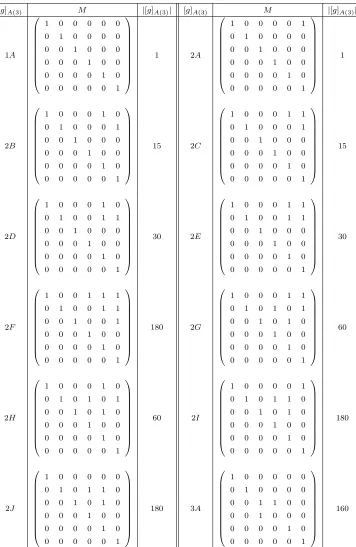
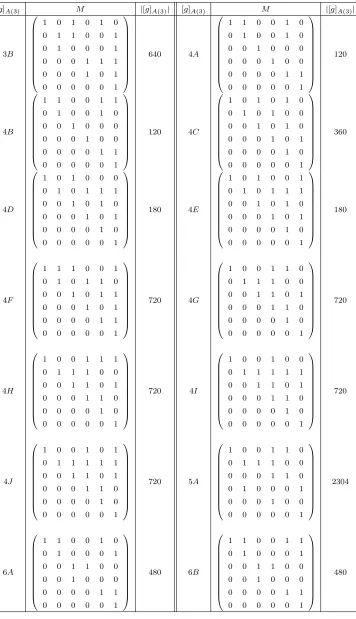
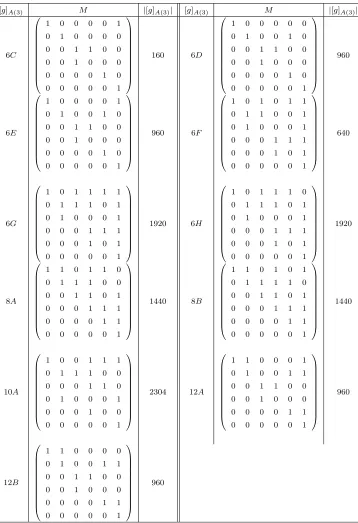
We have used GAP4 [5] to compute the conjugacy classes of the group A(3), and we found that
A(3) has 37 conjugacy classes. Following Atlas [3] notation, in Table 1 we list class representatives for
each g∈A(3) in terms of 6×6 matrices overGF(2),where [g]A(3) is the class containinggand M is
the matrix that represents that particular conjugacy class. Note that P(3) = [1A]∪[2A]∪[2B]∪[2C]
Table 1: The conjugacy classes of elements of 25:Sp4(2)
[g]A(3) M |[g]A(3)| [g]A(3) M |[g]A(3)|
1A
1 0 0 0 0 0 0 1 0 0 0 0 0 0 1 0 0 0 0 0 0 1 0 0 0 0 0 0 1 0 0 0 0 0 0 1
1 2A
1 0 0 0 0 1 0 1 0 0 0 0 0 0 1 0 0 0 0 0 0 1 0 0 0 0 0 0 1 0 0 0 0 0 0 1
1 2B
1 0 0 0 1 0 0 1 0 0 0 1 0 0 1 0 0 0 0 0 0 1 0 0 0 0 0 0 1 0 0 0 0 0 0 1
15 2C
1 0 0 0 1 1 0 1 0 0 0 1 0 0 1 0 0 0 0 0 0 1 0 0 0 0 0 0 1 0 0 0 0 0 0 1
15 2D
1 0 0 0 1 0 0 1 0 0 1 1 0 0 1 0 0 0 0 0 0 1 0 0 0 0 0 0 1 0 0 0 0 0 0 1
30 2E
1 0 0 0 1 1 0 1 0 0 1 1 0 0 1 0 0 0 0 0 0 1 0 0 0 0 0 0 1 0 0 0 0 0 0 1
30 2F
1 0 0 1 1 1 0 1 0 0 1 1 0 0 1 0 0 1 0 0 0 1 0 0 0 0 0 0 1 0 0 0 0 0 0 1
180 2G
1 0 0 0 1 1 0 1 0 1 0 1 0 0 1 0 1 0 0 0 0 1 0 0 0 0 0 0 1 0 0 0 0 0 0 1
60 2H
1 0 0 0 1 0 0 1 0 1 0 1 0 0 1 0 1 0 0 0 0 1 0 0 0 0 0 0 1 0 0 0 0 0 0 1
60 2I
1 0 0 0 0 1 0 1 0 1 1 0 0 0 1 0 1 0 0 0 0 1 0 0 0 0 0 0 1 0 0 0 0 0 0 1
180 2J
1 0 0 0 0 0 0 1 0 1 1 0 0 0 1 0 1 0 0 0 0 1 0 0 0 0 0 0 1 0 0 0 0 0 0 1
180 3A
1 0 0 0 0 0 0 1 0 0 0 0 0 0 1 1 0 0 0 0 1 0 0 0 0 0 0 0 1 0 0 0 0 0 0 1
Table 1: The conjugacy classes of elements of 25:Sp4(2)(continued) [g]A(3) M |[g]A(3)| [g]A(3) M |[g]A(3)|
3B
1 0 1 0 1 0 0 1 1 0 0 1 0 1 0 0 0 1 0 0 0 1 1 1 0 0 0 1 0 1 0 0 0 0 0 1
640 4A
1 1 0 0 1 0 0 1 0 0 1 0 0 0 1 0 0 0 0 0 0 1 0 0 0 0 0 0 1 1 0 0 0 0 0 1
120 4B
1 1 0 0 1 1 0 1 0 0 1 0 0 0 1 0 0 0 0 0 0 1 0 0 0 0 0 0 1 1 0 0 0 0 0 1
120 4C
1 0 1 0 1 0 0 1 0 1 0 0 0 0 1 0 1 0 0 0 0 1 0 1 0 0 0 0 1 0 0 0 0 0 0 1
360 4D
1 0 1 0 0 0 0 1 0 1 1 1 0 0 1 0 1 0 0 0 0 1 0 1 0 0 0 0 1 0 0 0 0 0 0 1
180 4E
1 0 1 0 0 1 0 1 0 1 1 1 0 0 1 0 1 0 0 0 0 1 0 1 0 0 0 0 1 0 0 0 0 0 0 1
180 4F
1 1 1 0 0 1 0 1 0 1 1 0 0 0 1 0 1 1 0 0 0 1 0 1 0 0 0 0 1 1 0 0 0 0 0 1
720 4G
1 0 0 1 1 0 0 1 1 1 0 0 0 0 1 1 0 1 0 0 0 1 1 0 0 0 0 0 1 0 0 0 0 0 0 1
720 4H
1 0 0 1 1 1 0 1 1 1 0 0 0 0 1 1 0 1 0 0 0 1 1 0 0 0 0 0 1 0 0 0 0 0 0 1
720 4I
1 0 0 1 0 0 0 1 1 1 1 1 0 0 1 1 0 1 0 0 0 1 1 0 0 0 0 0 1 0 0 0 0 0 0 1
720 4J
1 0 0 1 0 1 0 1 1 1 1 1 0 0 1 1 0 1 0 0 0 1 1 0 0 0 0 0 1 0 0 0 0 0 0 1
720 5A
1 0 0 1 1 0 0 1 1 1 0 0 0 0 0 1 1 0 0 1 0 0 0 1 0 0 0 1 0 0 0 0 0 0 0 1
2304 6A
1 1 0 0 1 0 0 1 0 0 0 1 0 0 1 1 0 0 0 0 1 0 0 0 0 0 0 0 1 1 0 0 0 0 0 1
480 6B
1 1 0 0 1 1 0 1 0 0 0 1 0 0 1 1 0 0 0 0 1 0 0 0 0 0 0 0 1 1 0 0 0 0 0 1
Table 1: The conjugacy classes of elements of 25:Sp4(2)(continued) [g]A(3) M |[g]A(3)| [g]A(3) M |[g]A(3)|
6C
1 0 0 0 0 1 0 1 0 0 0 0 0 0 1 1 0 0 0 0 1 0 0 0 0 0 0 0 1 0 0 0 0 0 0 1
160 6D
1 0 0 0 0 0 0 1 0 0 1 0 0 0 1 1 0 0 0 0 1 0 0 0 0 0 0 0 1 0 0 0 0 0 0 1
960 6E
1 0 0 0 0 1 0 1 0 0 1 0 0 0 1 1 0 0 0 0 1 0 0 0 0 0 0 0 1 0 0 0 0 0 0 1
960 6F
1 0 1 0 1 1 0 1 1 0 0 1 0 1 0 0 0 1 0 0 0 1 1 1 0 0 0 1 0 1 0 0 0 0 0 1
640 6G
1 0 1 1 1 1 0 1 1 1 0 1 0 1 0 0 0 1 0 0 0 1 1 1 0 0 0 1 0 1 0 0 0 0 0 1
1920 6H
1 0 1 1 1 0 0 1 1 1 0 1 0 1 0 0 0 1 0 0 0 1 1 1 0 0 0 1 0 1 0 0 0 0 0 1
1920 8A
1 1 0 1 1 0 0 1 1 1 0 0 0 0 1 1 0 1 0 0 0 1 1 1 0 0 0 0 1 1 0 0 0 0 0 1
1440 8B
1 1 0 1 0 1 0 1 1 1 1 0 0 0 1 1 0 1 0 0 0 1 1 1 0 0 0 0 1 1 0 0 0 0 0 1
1440 10A
1 0 0 1 1 1 0 1 1 1 0 0 0 0 0 1 1 0 0 1 0 0 0 1 0 0 0 1 0 0 0 0 0 0 0 1
2304 12A
1 1 0 0 0 1 0 1 0 0 1 1 0 0 1 1 0 0 0 0 1 0 0 0 0 0 0 0 1 1 0 0 0 0 0 1
960 12B
1 1 0 0 0 0 0 1 0 0 1 1 0 0 1 1 0 0 0 0 1 0 0 0 0 0 0 0 1 1 0 0 0 0 0 1
960
Using the technique of coset analysis, Mpono in [7] has determined the conjugacy classes of A(3)
given in terms of 5×5 matrices and using the theory of Fischer-Clifford matrices constructed its
character table. In a similar fashion Ali in [1] has constructed the group A(4) = 27 : Sp6(2) which
sits maximally in Sp8(2) in terms of 7×7 matrices and found its character table. Recent work of
Basheer and Moori [2], and Moori and Seretlo [6] make considerable use of the principles outlined in
References
[1] F. Ali,Fischer-Clifford Theory for Split and Non-Split Group Extensions, Ph. D. thesis, University of Natal, Pieter-maritzburg, 2001.
[2] A. Basheer and J. Moori, On the non-split extension group 26·Sp(6,2),Bull. Iranian Math. Soc.,39(2013) 1189– 1212.
[3] J. H. Conway, R.T. Curtis, S. P. Norton, R. A. Parker and R. A. Wilson,Atlas of Finite Groups, Oxford University Press, Oxford, 1985.
[4] R. Gow, Some characters of affine subgroups of classical groups,J. London Math. Soc. (2),2(1976) 231–236. [5] The GAP Group,GAP-Groups, Algorithms, and Programming, Version 4.4, .
[6] J. Moori and T. Seretlo, On the Fischer-Clifford matrices of a maximal subgroup of the Lyons group Ly, Bul. of Iranian Math Soc.,39(2013) 1037-1052.
[7] Z. E. Mpono,Fischer Clifford Theory and Character Tables of Group Extensions, Ph. D. thesis, University of Natal, Pietermaritzburg, 1998.
[8] B. G. Rodrigues,On the Theory and Examples of Group Extensions, Master’s thesis, University of Natal, Pieter-maritzburg, 1999.
[9] J. J. Rotman,An Introduction to the Theory of Groups, Fourth ed., Springer-Verlag, New York, Inc., 1995.
Jamshid Moori
School of Mathematical Sciences, North-West University, Mmabatho 2735, Mafikeng, South Africa Email: [email protected]
Bernardo Rodrigues
School of Mathematics, Statistics and Computer Science, University of KwaZulu-Natal, Durban 4041, South Africa