The Islamic Scale of Arrogance and Humility (ISAH): Factor structure
in a non-clinical sample
Abbas-Ali Haratiyan1, Sayyed-Abbas Saturian2, Ali Fathi-Ashtiani3, Saeed Salari4, Mobin Salehi5
1PhD Student, Department of Behavioral Sciences, Research Institute of Hawzah and University,
Qom, Iran
2PhD Student, Department of Psychology, Imam Khomeini Education & Research Institute, Qom,
Iran
3Professor, Behavioral Sciences Research Center, Baqiyatallah University of Medical Sciences,
Tehran, Iran
4MA of Psychology, Department of Psychology, Imam Khomeini Education & Research Institute,
Qom, Iran
5PhD of Psychology, Department of Behavioral Sciences, Research Institute of Hawzah and
University, Qom, Iran
Submitted: 13 September 2017
Accepted: 19 December 2017
Int J Behav Sci. 2017; 11(3): 107-113
Corresponding Author: Abbas-Ali Haratiyan, PhD Student,
Department of Behavioral Sciences, Research Institute of Hawzah and University,
Qom, Iran
E-mail: [email protected]
Abstract
Introduction: The main purpose of this study was to test the factor structure of the Islamic Scale of Arrogance and Humility.
Method: The current research was conducted through a correlational method. A sample of 922 university and seminary students was selected through convenience sampling method. The participants completed the Islamic Scale of Arrogance and Humility (ISAH). To investigate the reliability and construct validity of the scale Cronbach’s alpha and factor analysis was used. Data were analyzed through the Pearson correlation and split-half methods.
Results: The results showed that the revised form of arrogance and humility scale included six factors: religious emotion and knowledge, self-sufficiency- approval seeking, truthcentricity – egocentricity, altruism - behavioral self-exhibition, interpersonal optimism - interpersonal pessimism, and self-worth - self-worthless. The high coefficient alpha (0.83) showed good reliability of this scale.
Conclusion: Based on these results, the scale’s reliability and validity is high and its integrated factors can be used to study arrogance and humility of the individuals in future researches.
Keywords: Moral Measurement, Arrogance, Humility, Factor Analysis, Islamic Recourses
Introduction
Ethical issues are among the most important roots for psychological researches in Islam. Meanwhile, characteristics which may cause impairment of individual or social functions and even sometimes put mental and physical health of an individual in danger (vices), also characteristics which would increase the level of mental and physical health and reinforce the social adjustment of the individual (virtues), are of special importance. ʺArroganceʺ and ʺHumilityʺ are among those characteristics [1].
In the Ethics, arrogance is the opposite of humility and is to be unpleasantly proud and behaving as if you are more important than, other people and humiliate them [2, 3, 4]. The main feature of arrogance is that the individual feels relieved by seeing himself superior to others. Therefore, arrogance consists of three elements: first to see a position for yourself, second to see a position for other people, and third to see your position superior to others’ and feel happy and relieved [5].
Narcissistic Personality Disorder. Narcissism is a type of personality marked with traits such as grandiosity, extreme fantasies of unlimited success, power, or beauty, excessive sensitivity to criticism and the feeling of being unique [6]. Despite being an old issue of psychology, no appropriate measurement instrument was invented for narcissism until 1979 [7]. The Narcissistic Personality Inventory (NPI) is the first self-report questionnaire for assessing narcissistic characteristics in non-clinical samples [8, 9]. The NPI was initially a 54-item inventory. Raskin and Hall conducted a factor analysis of the 54-item version revealing four components which was termed
Leadership/Authority, Superiority/Arrogance,
Self-Absorption/Self-Admiration, and
Exploitativeness/Entitlement [10]. The NPI continued to evolve to its current form as Raskin and Terry (1988) performed a principal-components analysis, leading them to further reduce the NPI to a parsimonious 40-item, seven-factor version. In addition to the NPI full-scale score, these factors constitute the seven component subscales of the NPI: authority, exhibitionism, superiority, entitlement, exploitativeness, self-sufficiency, and vanity [10]. Kubarych et al. studied a 338 sample and used exploratory principal components analysis. They indicated that the NPI had a two- or three-factor structure. They further stated that as a whole, the NPI is measuring a general narcissism construct, with two or three separable, correlated factors relating to ‘power’, ‘exhibitionism’, and being a ‘special person’ [7].
The scientific study of humility had been neglected until the last decade and was put outside the area of empirical science, due to either the relationship of this concept with values and religion or lack of appropriate scale to measure this trait. Thus, we can say that the lack of measurement instrument is considered as a gap in research literature, since without reliable measurement instrument, science is rather stopped. Scientific study of the nature and implications of humility is still in its infancy and a review of the empirical literature from the last 20 years yields only a handful of research studies that have included any consideration of this long-revered construct [11]. The first steps in studying virtues were taken in Personality Psychology and the Traits Approach. Costa & Mc Crae presented a five-factor model of NEO Personality Inventory in which humility is a trait of the fourth factor
agreeableness[12]. Seligman counts out 6 human virtues:
Wisdom and knowledge, Courage, Love and humanity, Justice, Temperance, and Spirituality and transcendence. The virtue of temperance can be exhibited by modesty and humility, disciplined self-control, or prudence and caution [13]. In explaining the first steps in measuring humility, it should be reminded that the vocabulary approach to the personality structure was based on the assumption that the most important personality traits were encoded in words [14]. During the 1990s, lexical researches were conducted in languages other than English, which revealed the difference between languages and led to the emergence of a sixth factor in personality assessment, which did not emerge in English in the early studies. This factor is called "Honesty-Humility" and is characterized by such terms as honest, fair, humble and
unknowingly [14]. Lee and Ashton considered this factor as including 4 traits of honesty, fairness, avoidance of greed and humility [15]. The next step was taken in the traits approach that introduced humbleness among agreeableness factor in (NEO) personality inventory [12]. This attribute represents individuals who have the ability to ignore their own interests and do not necessarily lack self-esteem. People with low scores in this section of the questionnaire are arrogant people who think they are exceptional [15]. Emmons [16] recently attempted to develop a self-report measure of humility. Emmons' initial analyses of the measure's reliability (internal consistency) were reportedly disappointing [11]. Further attempts to build self-reporting scales [17, 11] were lacking in validity and credibility [18]. One difficulty in assessing humility is the result of divergent opinions on a precise understanding of humility. In addition, self-report inventories of humility have struggled with social desirability response sets. After all, if one expresses high levels of self-reported humility, could he/she truly be humble? [18]. Exline et al. (recited from Tangney, 2002) provided an empirical technique for measuring humility. By creating a ready-made position to stimulate sense of humility, they asked participants to distinguish between "feeling of humbleness" and "sense of self-importance". The problems found in the initial results were that the perception of many people from two situations was very different. Meanwhile, often, the position of choosing humility was a situation in which a person felt humiliated or shameful. There were, of course, correct but few answers, in which the position of humility was rightly recognized, such as where Self-denial or seeing self was created as part of a vast whole.
According to Elliott [18] the first study [19], is included due to its influence in the development of the current humility measure. The researchers employed open-ended questions for better understanding people’s perceptions of humility. The second [20] and third [21] studies are related attempts at measuring humility using implicit methods. They are included because they are representative of the few attempts of assessing dispositional humility. Modesty is often associated with humility and the fourth study [22] is a recent attempt of its measurement. The fifth review is that of an article by Neff [23] that presents the development and validation of the Self-Compassion Scale.
Since humility is hard to measure by its presence, some have proposed assessing it based on what it is not [24]. One example of this strategy measures narcissism. According to Exline et al. [19], narcissism is primarily characterized by a grandiose and inflated sense of self. Narcissists score high on measures of competitiveness [25], dominance [16], and superiority [26]. These characteristics of narcissism would seem to be the antithesis of humility, as previously defined.
no instrument with proper credibility and validity has been developed to measure humility. In his doctoral dissertation, he first designed a 60-item form and after conducting it on 251 undergraduate students and analysis of the results, reduced the number to 32 and finally 13 items. Meanwhile, he found the four factors of "openness", "forgetfulness ", "modest self-assessment” and "focus on others" in his analysis of the scale [18].
The review of indigenous researches in these two subjects (arrogance and humility) showed that these rich sources were not explained psychologically, and before the design of Islamic scale for arrogance-humility [1], a scale to measure the two factors from the perspective of Islam was not designed.
The Islamic Scale of Arrogance and Humility was used in several scientific researches as a research tool. For example, Rezaeian et al. [27], examined the mediating role of the trait of greed in the relationship between arrogance and jealousy. In his study, Satourian [28] also examined the role of the moral traits of arrogance, greed and jealousy in the prediction of neuroticism.
Several issues necessitated revising the items of the scale, repeated implementation and review of its psychometric properties: First, the repetition of research in different statistical samples and populations, improves the qualitative and quantitative levels of scales. Second, there is a general tendency nowadays to use shorter questionnaires to measure these psychological structures. Hence, the question of the present research is whether the removal of some items of the Arrogance-Humility Scale, which are less correlated with the rest of the items, can produce a scale that will yield new factors in the exploratory factor analysis? Do the aggregate factors extracted in this study explain a higher variance of the whole scale than the previous research?
Method
This descriptive research is of correlation type. The statistical population consisted of all students of Khomein, Qom and Damqan branches of the Islamic Azad University and Al-Zahra seminary students who studied at these centers during the academic year of 2015.
From among the statistical population, 444 students of the Khomein branch of the Islamic Azad University and Al-Zahra seminary (for Exploratory Factor Analysis) and 478 students of the Qom and Damqan branches of the Islamic Azad University (for Confirmatory Factor Analysis) were
selected using convenience sampling. According to the literature on the best sample size of such studies (10 to 20 times the visible variables [29], this sample size is appropriate. The age range of the participants was between 17 to 45 years old with a mean of 27.04 and a standard deviation of 5.48.
The instrument for the research was the Islamic Scale of Arrogance and Humility (ISAH). This scale was developed by Haratian et al. [1]. The four factors in this 23-item questionnaire are as follows: First factor: non-acceptance / acceptance of others, second factor: emotion and religious knowledge, third factor: feeling humiliated / self-esteem and the fourth factor: need for social approval / self-sufficiency. The response form consists of a 4-option array ("totally agree" to "totally disagree"). The scale's validity was confirmed by experts.
The split half coefficient of 0.78 represents the validity of this scale. The Cronbach's alpha coefficient of the whole scale was calculated as 0.837, which indicates the proper internal consistency of this scale. The Cronbach's alpha coefficients for the four factors was calculated to be 0.658, 0.670, 0.759, and 0.632 respectively. The fitness indexes in the confirmatory factor analysis confirmed the proper fitting of the model of this scale.
Among the 460 distributed questionnaires, due to the elimination of some of them because of incompleteness, 444 questionnaires finally went their way to the analysis stage. To analyze the data in this research, the SPSS software utilizes statistical methods of correlation and exploratory factor analysis.
Results
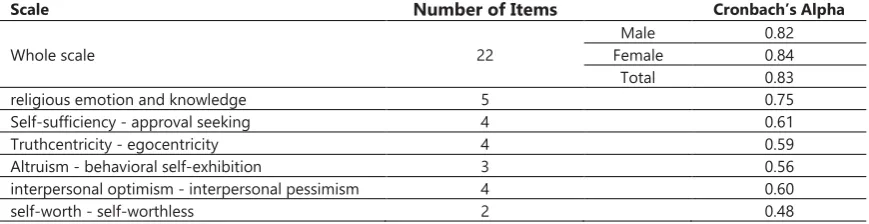
The validity of the content of the Arrogance-Humility scale has been obtained by Haratian et al. (2013). Due to the lack of a change in the form of the items, its results can be extended to a new form of the scale. This characteristic was inferred from the existence of a high agreement among the majority of experts (94.38%) about the content of the questions [1]. Cronbach's alpha coefficient was used to assess the internal consistency of the scale items. This study showed that by deleting 1 item, the internal validity of the scale reaches its maximum. The internal consistency of the scale and its factors based on the alpha value are shown in Table 1.
As shown in Table 1, the Cronbach's alpha coefficient in the research sample is 0.83. The coefficient for the first factor is 0.75, for the second factor 0.61, for the third factor 0.59, the fourth factor 0.56, for the fifth factor is 0.60 and for the sixth factor is 0.48.
Table 1. Cronbach's alpha coefficient for the revised version of the Arrogance-Humility scale and its factors
Scale Number of Items Cronbach’s Alpha
Whole scale 22
Male 0.82
Female 0.84
Total 0.83
religious emotion and knowledge 5 0.75
Self-sufficiency - approval seeking 4 0.61
Truthcentricity - egocentricity 4 0.59
Altruism - behavioral self-exhibition 3 0.56
interpersonal optimism - interpersonal pessimism 4 0.60
Also, to determine the validity of the scale structure, the correlation of each item was calculated with the total questionnaire. The results showed that all the items had a significant correlation with the total scale scores. The range of this correlation is from 0.35 to 0.57.
In order to investigate the factor structure of the scale, exploratory factor analysis was performed using principle components and varimax rotation methods.
Sampling adequacy index showed that appropriate sampling was performed for factor analysis (KMO = 0.86). The results of Bartlett's test of sphericity also show a significant correlation between the scale items. In fact, the significance of Bartlett's test of sphericity is the least necessary condition for performing factor analysis. As shown in Table 2, the results of this test with a degree of freedom of 231 and a chi-square of 2150.979 are significant at P <0.0001.
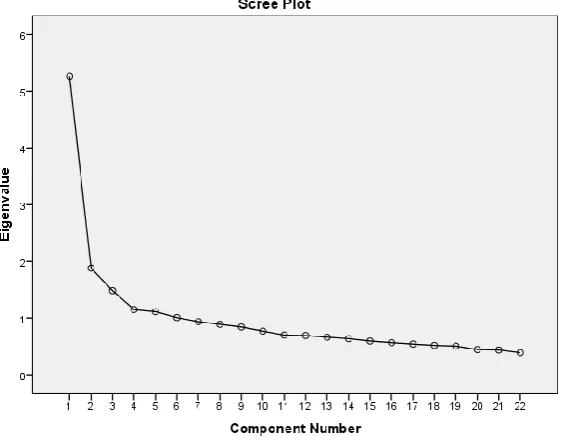
In order to determine the number of factors, the criterion of special values greater than 1 was first used. In order to avoid the low accuracy in the output results, and also with respect to the Scree plot, which shows the
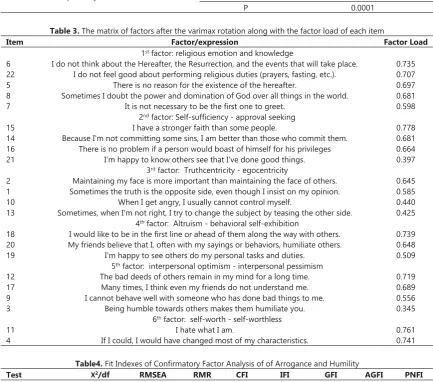
special value in the downward slope with a steep slope and before turning to the horizontal surface slightly above the value of 1, the value in the second phase was selected to be greater than 1. Table 3 shows the factor matrix after rotation, along with the factor load of each item.
All scale items at this stage had a factor load greater than 0.3. The factor load domain of items in the first factor ranged from 0.68 to 0.73 and in the second factor from 0.40 to 0.78, in the third factor from 0.37 to 0.64, in the fourth factor from 0.51 to 0.74, in the fifth factor from 0.34 to 0.70 and in the sixth factor from 0.74 to 0.76.
The first factor 13.21%, the second factor 8.60%, the third factor 8.4%, the fourth factor was 8.36%, the fifth factor was 8.31%, the sixth factor 7.20% and the sum of all six factors estimated 54.05% of the total variance of the revised form of the Arrogance-Humility scale.
The model fits the data and proposed a six-factor model of Arrogance and Humility (Table 4 & Figure 2). The results of the overall model, however, indicated a good fit between the proposed model and the observed data.
Table 2.Bartlett's test of sphericity and sampling adequacy
Statistics Results
sampling adequacy (KMO) 0.858
Bartlett's test of sphericity
chi-square 2150.979
df 231
P 0.0001
Table 3. The matrix of factors after the varimax rotation along with the factor load of each item
Factor Load Factor/expression
Item
1st factor: religious emotion and knowledge
0.735 I do not think about the Hereafter, the Resurrection, and the events that will take place.
6
0.707 I do not feel good about performing religious duties (prayers, fasting, etc.).
22
0.697 There is no reason for the existence of the hereafter.
5
0.681 Sometimes I doubt the power and domination of God over all things in the world.
8
0.598 It is not necessary to be the first one to greet.
7
2nd factor: Self-sufficiency - approval seeking
0.778 I have a stronger faith than some people.
15
0.681 Because I'm not committing some sins, I am better than those who commit them.
14
0.664 There is no problem if a person would boast of himself for his privileges
16
0.397 I'm happy to know others see that I've done good things.
21
3rd factor: Truthcentricity - egocentricity
0.645 Maintaining my face is more important than maintaining the face of others.
2
0.585 Sometimes the truth is the opposite side, even though I insist on my opinion.
1
0.440 When I get angry, I usually cannot control myself.
10
0.425 Sometimes, when I'm not right, I try to change the subject by teasing the other side.
13
4th factor: Altruism - behavioral self-exhibition
0.739 I would like to be in the first line or ahead of them along the way with others.
18
0.648 My friends believe that I, often with my sayings or behaviors, humiliate others.
20
0.509 I'm happy to see others do my personal tasks and duties.
19
5th factor: interpersonal optimism - interpersonal pessimism
0.719 The bad deeds of others remain in my mind for a long time.
12
0.689 Many times, I think even my friends do not understand me.
17
0.556 I cannot behave well with someone who has done bad things to me.
9
0.345 Being humble towards others makes them humiliate you.
3
6th factor: self-worth - self-worthless
0.761 I hate what I am.
11
0.741 If I could, I would have changed most of my characteristics.
4
Table4. Fit Indexes of Confirmatory Factor Analysis of of Arrogance and Humility
Test Χ2/df RMSEA RMR CFI IFI GFI AGFI PNFI
Figure1. The Scree plot to determine the factors
Discussion
This study was conducted among university and seminary students to review the psychometric properties of Arrogance-Humility scale. The research results show that this scale has a good internal consistency (0.83) in the research sample. This finding is consistent with the previous findings of the researcher in the study of the psychometric properties of the 23-item form of the same scale. The results of exploratory factor analysis show that the factor structure in this study is six-factor. In the previous research [1], four factors were obtained. The six-factor structure is more in line with religious texts.
The strength of emotion and religious knowledge, as the first factor of humility, represent those who have no doubt in their religious beliefs and who have strong fundamental religious thoughts and experience a positive and effective emotion in their religious behaviors. The weakness of emotion and religious knowledge, as the first factor of arrogance, describes those who have defects in their religious fundamental beliefs (including theology and epistemology). These people do not have a positive effective emotional excitement when performing religious duties, and they are entangled in doubts in their religious beliefs.
Self-sufficiency, as the second factor of humility, describes those who are God-centered (not ego-centered), see piety and the combination of faith and good practice as the touchstone for values and proximity, they do not seem to care for the exterior and are not hypocrites. Approval seeking, as the second factor of arrogance, is a descriptor of those who are entangled with vanity, and seek external confirmations sickly, consider themselves more pious than others, consider religious demonstrations as a sufficient measure for assessment of personality and proximity, consider the apparent privileges important and are hypocrites.
Truthcentricity as the third factor of humility, describes those who act God-centeredly in the way of thought and behavior. Without committing self-oppression, they care about the property and reputation of others. They have strong emotional stability and are properly flexible. Egocentricity, as the third factor of arrogance, represents those who use maladjusted methods to protect themselves. To maintain their social character, they are ready to ignore others. These people are obstinate and fallacious and have a weak emotional stability.
Altruism, as the fourth factor of humility, describes those who do not know themselves superior to other servants, so their behavior does not show any striving for superiority. They do not humiliate others and have social humility. They consider themselves obliged to carry out their own personal responsibilities and have no expectations in this regard from others. Behavioral self-exhibition, as the fourth factor of arrogance, is a descriptor of people who display their superiority in their behaviors. Sometimes they humiliate others. They tend to put their own tasks on others in order to experience a sense of superiority.
Interpersonal optimism, as the fifth factor of humility, is a feature of people who are optimistic in social
relationships. Have a high capacity for forgiveness and passing, and often have hope for God, themselves, others and the future.
Interpersonal pessimism, as the fifth factor of arrogance, is a characteristic of people who usually hold a grudge and have poorly positive attitudes. They seldom forgive. They have no hope for God, themselves, the future, and social relationships.
Self-worthless, as the sixth factor of the arrogance, describes individuals whose self-blaming in individual areas causes decrease in self-esteem and dignity, and in social areas, causes self-centered defense and premature defense mechanisms. Their inconsistent identity brings about lack of self-acceptance and the constant desire for change.
Conclusion
The findings of the research confirmed the validity and reliability of the revised version of the Arrogance and Humility scale. At the same time, the factors which are clearer and closer to the Islamic teachings compared to the original form are presented. This tool can be used in clinical situations and ethical and psychological researches.
Acknowledgement
The authors would like to thank the Khomein branch of the Islamic Azad University and also the Al-Zahra seminary for helping this research and their students for participating in this research.
References
1. Haratian AA, Agah M, Mousavi E. Designing and validating of Islamic scale for arrogance-humility. Psychology and religion;2013, 6(24): 5-22.
2. Odai Y. Morality refinement, (correcting and translating by Mohammad Damadi). Tehran. Cultural Studies and Researches Institute; 1986.
3. Moghadasi IGh. A brief of methods of intent people. Damascus, Sho’aib; 1977.
4. Naraghi M. Comprehensive of prosperity. Najaf, Mohammad kalantar; 2008.
5. Makarem Shirazi N. Ethics in the Qur’an. Qom, Emam Ali ibn Abi Talib; 1999.
6. American Psychiatric Association. Diagnostic and Statistical Manual of Mental Disorders, Fifth Edition. Arlington, VA, American Psychiatric Association; 2013.
7. Kubarych TS, Deary IJ, Austin EJ. The narcissistic personality inventory: Factor structure in a non- clinical sample. Personality and Individual Differences. 2004; 36: 857-72.
8. Raskin RN, Hall CS. A narcissistic personality inventory. Psychol Rep.1979; 45: 590-8.
9. Raskin R, Terry H. A principal-components analysis of the narcissistic personality inventory and further evidence of its construct validity. J Pers Soc Psychol. 1988;54 (5):890-2.
10. Rosario PM, White RM. The narcissistic personality inventory: Test– retest stability and internal consistency. Pers Individ Dif.2005; 39: 1075–81.
11. Tangney JP. Humility: Theoretical perspectives, empirical findings and directions for future research. Journal of Social and Clinical Psychology. 2000; 19: 70-82.
Tangney JT. Humility. In Snyder, C.R. and Lopez, S.J. The handbook of positive psychology. New York: Oxford University Press; 2002: 411-419.
12. Fathi-Ashtiani A. Psychological tests, personality assessment and mental health. Tehran, Bethat;2009.
Psychology to Realize Your Potential for Lasting Fulfillment. New York: Free Press/ Simon and Schuster; 2002.
14. Aghababaei N. Relationship between Honesty and Humility with personality, religion, and subjective-well-being. Psychology and religion.2012; 5 (3):25-40.
15. Davis DE. Relational Humility. Degree of doctor of philosophy, Department of Psychology, University of California; 2011. 16. Emmons RA. Factor analysis and construct validity of the
Narcissistic Personality Inventory. Journal of Personality Assessment, 1984; 48: 291–300.
17. Exline JJ. Taming the wild ego. In J.A. Bauer and H.A. Wayment (Eds.), Transcending self-interest: Psychological explorations of the quiet ego (p. 53-62), Washington, DC: American Psychological Association; 2008.
18. Elliott JC. Humility: Development and analysis of a scale. Doctor of philosophy degree, The University of Tennessee; 2010.
19.Exline JJ, Geyer AL. Perceptions of Humility: A Preliminary Study. Self and Identity. 2004; 3: 59-114.
20. Rowatt WC, Ottenbreit A, Nesselrode KPJr, Cunningham PA. On being holier-than-thou or humbler-than-thee: A social psychological perspective on religiousness and humility. Journal for the Scientific Study of Religion. 2002; 41: 227-37.
21. Rowatt WC, Powers C, Targhetta V, Comer J, Kennedy S, Labouff J. Development and initial validation of an implicit measure of humility relative to arrogance. Journal of Positive Psychology .2006;1: 198-211.
22. Gregg AP, Hart CM, Sedikes C, Kumashiro M. Everyday conceptions of modesty: A prototype analysis. Personality and Social Psychology Bulletin.2008; 34, 978-92.
23. Neff KD. Development and validation of a scale to measure self-compassion. Self and. Identity. 2003; 2: 223-50.
24. Exline JJ, Baumeister RF, Bushman BJ, Campbell WK, Finkel EJ. Too proud to let go: Narcissistic entitlement as a barrier to forgiveness. Journal of Personality and Social Psychology.2004; 87: 894-912.
25. Watson PJ, Morris RJ, Miller L. Narcissism and the self as continuum: Correlations with assertiveness and hypercompetitiveness. Imagination, Cognition and Personality.1997; 17: 249-59.
26. Bushman BJ, Baumeister RF. Threatened egotism, narcissism, self- esteem, and direct and displaced aggression: Does love or self-hate lead to violence? Journal of Personality and Social Psychology. 1998; 75: 219-29.
27. Rezaeian H, Saturian SA, Haratian AA, Hosini Motlagh SM. Mediating role of the trait of greed in the relationship between arrogance and jealousy. Islam and psychological research.2016; 2 (4): 85-98.
28. Satourian SA. Role of the moral traits of arrogance, greed and jealousy in the prediction of neuroticism. Psychology and religion. 2016; 9 (34): 55-72.