University of New Orleans University of New Orleans
ScholarWorks@UNO
ScholarWorks@UNO
University of New Orleans Theses and
Dissertations Dissertations and Theses
8-10-2005
Business Process Outsourcing: An Exploratory Study
Business Process Outsourcing: An Exploratory Study
David Johnson
University of New Orleans
Follow this and additional works at: https://scholarworks.uno.edu/td
Recommended Citation Recommended Citation
Johnson, David, "Business Process Outsourcing: An Exploratory Study" (2005). University of New Orleans Theses and Dissertations. 283.
https://scholarworks.uno.edu/td/283
BUSINESS PROCESS OUTSOURCING: AN EXPLORATORY STUDY
A Thesis
Submitted to the Graduate Faculty of the University of New Orleans in partial fulfillment of the requirements for the degree of
Master of Arts in
The Department of Sociology
by
David R. Johnson
B.S. Business Administration, 2000
ACKNOWLEDGEMENTS
I acknowledge, with great appreciation, my professors and fellow graduate
students in the Department of Sociology at the University of New Orleans. Each of these individuals has made my experience here greater than I could have ever anticipated.
Three professors deserve very special recognition for the profound impact they have had on my graduate studies and this thesis. I feel particularly indebted to Vern Baxter, my thesis committee chair and mentor, for the wisdom he has imparted me and his unique ability to reveal what is extraordinary about the ordinary. I am equally grateful for the support that Susan Mann and Francis Adeola have provided me
throughout this endeavor. Each of these individuals have gone above and beyond what any student could ask for and for this I am most thankful.
Finally, I would be remiss if I did not acknowledge my friends and family. Were it not for the love and life experience we have all shared along the way, none of this would have ever been possible. Thank you.
TABLE OF CONTENTS
List of Figures ...v
List of Tables ... vi
Abstract... vii
Introduction...1
Literature Review...7
Theory...20
Methodology...26
Analysis...31
Conclusion ...64
References...73
Appendix...78
LIST OF FIGURES
LIST OF TABLES
Average Salaries of Computer Programmers ...33
Hourly Wages for Selected Occupations, US and India 2002/2003...33
Projected Offshored Jobs, Forrester Research ...55
ABSTRACT
This study examines the emergence of Business Process Outsourcing (BPO) in
white collar occupations. Recent BPO practices are compared to the offshore
outsourcing of production in the context of the shift from Fordist to flexible production.
The study considers BPO in light of Harry Braverman’s theory of work degradation and
whether or not BPO extends the traditional division of labor between conception and
execution to higher skilled white collar occupations. An exploratory qualitative approach
comprised of informant interviews, a focus group, and literature review was used to
analyze how BPO occurs, why it happens, and where it takes place. I discuss the role of
politics and corporate culture in outsourcing white collar jobs and examine the practice of
transitioning workers from client to BPO service providers. The study concludes with a
skill-based typology of BPO services and suggestions for policy and future research.
INTRODUCTION
Outsourcing to low-cost labor markets has recently become a controversial
political and business topic. While advanced industrialized nations have been
outsourcing manufacturing to the developing world for decades, the practice in the
service sector presents a threat to higher skilled jobs previously considered insulated from
global competition. Offshore outsourcing of white collar service sector work has
traditionally been limited to low-value added tasks such as processing credit card
payments or call center work. Recent headlines, however, suggest that higher skilled
service occupations such as accounting and computer programming are going offshore in
large numbers. One evolving area of the outsourcing market that suggests a greater
number of professional occupations are now at risk is business process outsourcing
(BPO). BPO allows businesses the opportunity to have a wide array of common
corporate functions previously performed and internally executed by third party service
providers, including human resources, finance and accounting, and supply-chain
management. While discrete tasks within each of these areas (e.g. payroll processing)
have been outsourced in the past, the continued integration of business processes and
information technologies has fundamentally transformed the extent to which parts of the
production process can be divided and relocated.
The suggestion that outsourcing will eliminate these jobs seems to have extended
public skepticism of free trade policy beyond lower and middle class workers to more
affluent professionals. A February 2004 University of Maryland poll corroborates this
sentiment, finding that support of free trade among Americans earning more than
2004). Outsourcing became the topic of considerable political debate during the 2004
presidential election, reflecting national concern over the loss of both low and high
skilled jobs. John Kerry wanted to “repeal the tax loopholes and benefits that reward
Benedict Arnold CEOs and companies for shipping American jobs overseas" (Weisman
2004), while chief economist Gregory Mankiw brushed off outsourcing as “just a new
way of doing international trade” (Stokes 2004). State-level political backlash in New
Jersey, Connecticut, Missouri, Maryland, and Wisconsin among 33 other states
considering restrictive legislation has also focused a great deal of attention on
outsourcing. However, the majority of attention outsourcing has received comes from
business literature, news media, and the internet. One study found that during the five
months between January and May 2004, 2,634 U.S. newspaper articles addressed
outsourcing and job loss fear (Amiti and Wei 2004). According to a study by Deloitte
consulting, negative media sentiment outpaced positive coverage by 30 percent during
2004 in survey of articles in Business Week, Fortune, Washington Post, The Economist,
Forbes, and The Wall Street Journal (Landis 2005).
While there exists a great deal of provocative literature on outsourcing, treatment
of the topic tends to be concerned with domestic job loss resulting from foreign
competition. A June 2003 Business Week article entitled “American Legislators Are
Accusing India of Stealing US Jobs”, illustrates a popular emphasis along these lines.
Nonetheless, analysis of outsourcing evidently centers on proving or disproving the
notion that free trade is a win-win situation. In fact, the first scholarly reaction to the new
round of outsourcing surfaced in The Journal of Economic Perspectives and addressed
salience of the debate is demonstrated by the fact that economist Paul Samuelson, whose
work in international trade theory earned him the Nobel Prize in 1970, reversed his
position arguing that U.S. national income would be negatively affected if a country such
as China or India achieved higher productivity in common exports.
Yet, economists have generally argued that during the first wave of outsourcing
displaced blue collar job would be offset by creation of higher value added service jobs
and cheaper goods. Underlying this logic is Joseph Schumpeter’s idea that the
continuous application of knowledge by entrepreneurs results in “creative destruction”
whereby new markets, products, and therefore, jobs are created at the expense of one
another. Specifically for the U.S., Daniel Bell (1973) emphasized the central importance
of knowledge as a source of innovation when describing the shift from a labor intensive
industrial economy to one based on information-driven services. Bell forecasted that a
new dominant class would form the core of the post-industrial occupational structure,
made up of professional, managerial, and technical workers (i.e. scientists and engineers).
Critics, however, have argued that this characterization misrepresents the new
occupational structure. They argue that alongside the rise of well-paid knowledge
workers, there is a proliferation of low-wage, unskilled, white collar and service
occupations. Thus an increasingly polarized social structure may more accurately
represent the occupational transformation Bell forecast (Bluestone and Harrison 1984;
Sayer and Walker 1992).
Clearly, the lack of consensus and limited scholarship on the current wave of
especially questions concerning whether or not high skilled jobs are indeed moving
overseas and whether this is good or bad for the U.S. economy.
While the focus on offshoring is a critical aspect of this thesis, this study also will explore
whether or not the blue collar vs. white collar distinction is relevant to the type of work
that is being outsourced offshore. That is, it may be the specific attributes of
commodities or services that are important to determining what jobs get outsourced,
rather than the blue collar vs. white collar distinction.
In particular, I will focus on whether the division between the conception and
execution of a production process or service is a key feature of BPO. To this end, I will
use Harry Braverman’s theoretical framework in his seminal work, Labor and Monopoly
Capital (1979) to examine this hypothesis. Braverman was one of the first analysts of the
similarities between the process of deskilling of both blue collar and white collar work.
He argued that management appropriates control from workers by deepening the division
of labor, specifically the division between conception and execution. Braverman
demonstrated this idea by showing how the application of Taylorist scientific
management principles to both manual and white collar work impacted the autonomy and
skill of craftworkers.
Braverman viewed the labor process and worker exploitation as the core of
Marxist theory, and thus sought to extend Marx’s analysis of manual labor to white-collar
and service occupations. Using the example of clerical workers, Braverman argued that
white-collar occupations are subjected to the same processes of control as manual
results in managers, engineers, and technicians performing the mental aspects of work,
while clerical workers are responsible for manual tasks such as keypunching.
However, Braverman penned his thesis before the intense period of globalization
and technological change. Hence, this thesis will explore whether his deskilling
argument maintains its relevancy today, particularly in regard to outsourcing. In turn, by
exploring the contemporary relevance of Braverman’s thesis to offshore outsourcing, this
study will also provide a more sociological focus to current research on outsourcing.
Beyond a small handful of panel discussions and conference roundtables, the outsourcing
of white collar and service jobs has yet to provoke a substantial response in sociology.
An editorial in Contemporary Sociology argues that “outsourcing is only one cause of job
loss for U.S. workers” and “one of the latest innovations in corporate profit making”
(Miller and Perucci 2004). Although sociologists have analyzed many of the conditions
which have facilitated the emergence of outsourcing services, such as economic
restructuring, globalization, and flexible production, they rarely have specifically
addressed offshore outsourcing itself. Indeed the lack of sociological research on this
topic is rather surprising, considering the impact outsourcing manufacturing has had on
blue-collar manufacturing, as well as the implications the increased outsourcing of white
collar office processes suggests for the organization of work in a global and information
based society.
Because limited sociological research has been conducted on business process
outsourcing, and because the trend in increased outsourcing shows little sign of
diminishing, the objective of this study is to explore the impact of technology on the
interviews, and data compiled from recent outsourcing studies, this paper addresses three
basis research questions: (1) What is BPO? (2) Why and where is it happening? and (3)
what are its consequences?
The study begins with a closer examination of BPO that draws upon the existing
sociological literature on globalization and economic restructuring. BPO is compared to
outsourcing manufacturing in light of the larger issue of the relationship between
technology and the spatial location and division of labor. Next, theory is introduced as a
framework for directing attention to the predominant features of the relationship between
technology and labor control. This, in turn, may serve as basis for understanding more
about the types of work processes being outsourced and why they may be more amenable
to outsourcing. Following this section, methods are presented with a discussion of their
advantages and disadvantages. This study employs an exploratory method that utilizes
informant interviews, focus group, and secondary data to investigate the types of jobs
outsourced and the effects of BPO on the division of labor. Following the presentation of
methods, my analysis begins that examines what drives BPO, where it occurs, and its
consequences. The study concludes with a discussion of the main findings and
LITERATURE REVIEW
The first appearance of the term outsourcing surfaced in a 1979 article in the
Journal of Royal Society of Arts that references the use of German engineers by the
British automobile industry: “We are so short of professional engineers in the motor
industry that we are having to outsource design work to Germany”1. This comment
highlights the fact that the current wave of outsourcing is not the first instance in which
skilled white collar labor from abroad has been integrated into the production process.
While this and other examples (from the use of foreign scientists by high-tech companies
to offshore call centers) indicate that the globalization of white collar work has been
underway for a few decades, the predominant practice in offshore outsourcing until now
has been concentrated in the production of goods.
Outsourcing occurs when a firm delegates the production of a good, component
part, or performance of a service to another company. Automakers, for example, rely on
thousands of suppliers to produce components from rearview mirrors to stereos that make
up a car. Likewise, many firms outsource services such as advertising, building
maintenance, or call center work. While companies may outsource domestically and
internationally (commonly referred to as offshoring), the general goal of cost reduction
has typically led companies to foreign countries abundant in cheap labor.
BPO represents the continuation of these trends in the service sector, though the
extent to which outsourced business processes are relocated offshore remains unclear.
What is evident, however, is that a substantially greater number of work processes can be
outsourced. This broader scope of outsourcing opportunities across the organization is
one of the major distinctions between BPO and the outsourcing of manufacturing
(McKinsey 2003). For example, while corporations such as Nike have in the past been
able to conduct their entire production operations offshore, the business services that
support their products have been performed domestically. What BPO now demonstrates
is that an increasing number of these services can be performed abroad. The use of
offshore call centers and data entry operations has foreshadowed this trend, but what is
fundamentally different is that entire business processes can now be outsourced as
opposed to individual functions such as payroll.
Furthermore, while the outsourcing of production primarily impacted low skilled
workers, BPO can be applied to higher tiers on the organizational chart. At the lowest
level of “back office” operations are basic data entry functions such as data conversion or
transaction processing. Customer contact operations include consumer oriented call
centers handling tasks such as collections, telemarketing, or credit card applications. On
the level of corporate functions requiring more skills, a number of functions in IT
services, finance and accounting, human resources, and supply chain management can
also be outsourced. Further, a number of outsourcing vendors are increasingly targeting
knowledge services and decision analysis, such as customer analysis, portfolio analysis,
or credit underwriting. Finally, certain research and development operations such as
engineering or design (i.e. architecture, automobile design, etc.), testing, and content
development are possible to outsource.
BPO represents a continuation of technology driven restructuring in the wider
outsourcing now is that it occurs in an increasingly information driven global economy in
which the production of services can be moved more easily than any aspect of the
production of goods. This implies that the division of labor that has traditionally been
limited to low value added tasks such as data entry or billing can be extended to more
professional work such as accounting or computer programming. To more fully
investigate whether BPO is extending the division between conception and execution, it
is useful to examine how this organizational strategy fits into the wider transition from
Fordist to flexible organization of production. This shows how outsourcing has played a
fundamental role in the transformation of work and allows similarities and differences
between BPO and outsourcing manufacturing to emerge that demonstrate how the
application of technology to the division of labor may be occurring differently in the
current context.
Fordism to Flexible Production
The organization of all phases of automobile production at Henry Ford’s River
Rouge industrial complex symbolized the vertically integrated mass production system
that defined the U.S. economy throughout the 20th century. Under this model,
“corporations sought to control their economic environments by constructing massive,
vertically integrated structures that essentially internalized strategic sources of raw
materials, machinery, and labor power” (Vallas 1999:90). The Rouge complex
accomplished this by locating all aspects of production from rolling steel and making
glass to building engine blocks in one place. Fordism entailed a Taylorist labor process
complex division of labor that divided the labor process into minute routinized tasks that
required little need for craft skills. While this increased profits by lowering labor costs, it
also decreased worker control over the design and pace of work. The displacement of
craft production and the deskilling of labor resulted in the rise of unionization and
collective bargaining that tied increases in wages to increases in productivity. Thus, the
standard of living of the working class could rise despite intensified worker exploitation.
This logic spread to other sectors of the economy as a new era emerged after WWII in
which mass production combined with mass consumption allowed sustained economic
growth until the 1960s.
The rigidity of Fordist production would ultimately be revealed during the 1970s
by intensified globalization and technological change as more flexible methods of
production challenged the logic of the vertically integrated organization. Increased
competition from Western European economies and the development of just-in-time
inventory and total quality management throughput Japanese automobile production
significantly reduced the time necessary for production and assembly, and transformed
competition through product differentiation and reduced price. The collapse of the
postwar economic boom "forced corporations into a period of rationalization,
restructuring, and intensification of labor control" to lower production costs (Harvey
1990:145). As corporations sought more flexible work regimes and labor contracts,
strikes and labor disruptions revealed the conflict of interest between capital and the
working class. According to David Harvey, the inability of corporations to overcome
“It rests on flexibility with respect to labor processes, labor markets, products, and patterns of consumption. It is characterized by the emergence of entirely new sectors of production, new ways of providing financial services, new markets, and above all, greatly intensified rates of technological and organizational innovation.”(Harvey 1990:147). (italics added)
Offshore outsourcing of production became the predominant organizational innovation
that utilized new technologies in a way that allowed corporations to cut labor costs and
maintain profit margins in a period of stagnant growth by contracting with cheaper
offshore labor. Thus, the shift from Fordism to flexible production involved the
externalization of resources that had previously been maintained within the vertically
integrated organization.
Offshore Outsourcing of Production
This shift to offshore production may be best understood in the context of global
production networks, often referred to as commodity chains or global value chains
(GVC) (Gereffi and Korzeniwicz 1994; Gereffi 2004). Hopkins and Wallerstein
(1986:159) define the commodity chain as “a network of labor and production processes
whose end result is a finished commodity.” GCCs or GVCs are useful frameworks for
analysis of offshore outsourcing of services as they capture the spatial and organizational
features of dispersed economic activity. According to world systems theory (Wallerstein
1974), countries are incorporated into a hierarchy of core, semiperipheral and peripheral
levels unified by a single division of labor within one world market. The establishment
of the world capitalist system created an international division of labor in which different
geographic areas specialize in specific occupational tasks. The movement of goods
through this system follows raw materials extraction and labor intensive production in
Companies in the US first began outsourcing to GVCs during the 1960s and
1970s, primarily the production of consumer electronics and apparel (Gereffi 2004).
Technological improvements in transportation and communication and the elimination of
trade barriers such as tariffs and import quotas created an interconnected global market
that facilitated this first wave of outsourcing. Satellite communication, airplanes, and
containerization brought far away distances closer together while increasing the potential
to separate production and consumption. Harvey argues that the use of these
technologies has resulted in the acceleration of economic processes and the shrinking
experience of space, or “time-space compression”:
“…the time horizons of both private and public decision-making have shrunk, while satellite communication and declining transport costs have made it increasingly possible to spread those decisions immediately over an ever wider and variegated space.” (1990:47)
This increased reach allowed companies to take advantage of abundant low-cost labor
and raw materials in developing countries in addition to establishing new product
markets. Lower cost labor, “business friendly” environments, and a fluid supply chain
increased the reliance on foreign producers of intermediate inputs and entire products.
Between 1987 and 1997, foreign inputs used in US manufacturing goods increased from
10.5% to 16.2%, while foreign inputs in high-tech manufacturing, such as computers and
electronics, increased to 38% from 26% (Bardhan and Kroll 2003). The movement of
blue-collar work from the US to Mexico, Southeast Asia, and elsewhere directly
impacted manufacturing jobs in specific industrial sectors. More than 3 million jobs in
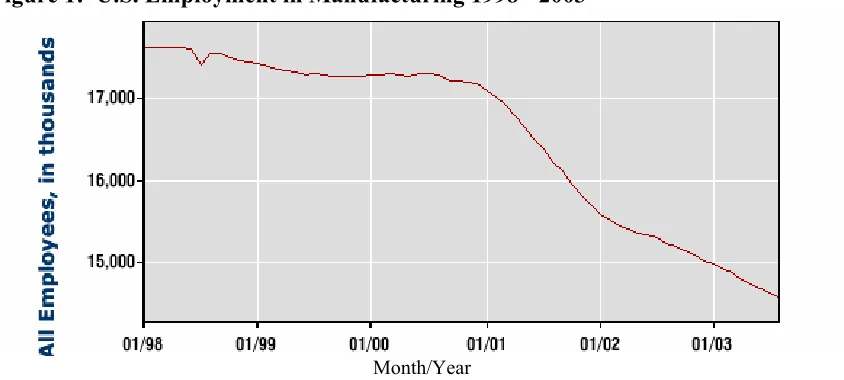
Figure 1: U.S. Employment in Manufacturing 1998 - 2003
Month/Year
Source: Bureau of Labor Statistics/AFL-CIO
The offshore production of consumer electronics, apparel, and automobiles
demonstrates how the distribution of economic functions across space depends upon the
nature of a firm's product and how it is produced. Consumer electronics, a highly
globalized industry, utilizes small, lightweight, standardized components that are easy to
ship. Thus, cost effective transportation and communication technologies allow
companies in advanced industrialized nations to relocate labor intensive production
processes to peripheral countries in the GVC. US reliance on subcontractors in Taiwan,
South Korea, and Singapore for provision of components and basic manufacturing, and
the growth of extensive production networks between US affiliates and local
manufacturers created an extensive supply chain of consumer electronics goods from
subassemblies to complete electronics products. Global contract manufacturers such as
Flextronics, Solectron, and Celestica represent the pinnacle of the outsourcing trend in
manufacturing, having built their business on the outsourcing of electronics
offered through bundles of standardized value chain activities and their global presence
demonstrates how the electronics industry has vertically disintegrated as global suppliers
provide manufacturing while domestically firms focus on R&D and marketing
Likewise, the lightweight nature of apparel facilitates cost-effective shipping and
the relocation of production to lower cost areas in the GVC. Patterns of apparel trade in
the GVC are also shaped by industry sector and regulation. The fast nature of trends in
high fashion retail results in a higher value on speed to market than is necessary in basic
apparel items (e.g. underwear and socks). Thus, some production processes will stay
close to or remain within product markets that change rapidly while more basic
commodities are outsourced offshore to where they can be produced cheapest. The
extensive global sourcing network for apparel has until 2005 been regulated by quotas
and import restrictions of the Multifiber Arrangement (MFA) that protects textile
producers in over 30 developing nations. The phasing out of the MFA will force out
many smaller producers in developing nations and further undermine apparel jobs in the
U.S. while concentrating apparel production in China, Mexico, and India.
While consumer electronics and apparel illustrate the basic spatial features of outsourcing
production, it is useful to revisit the example of automobile production to add scope to
the extent to which these dimensions have changed since production of the Model T.
Richard Hill’s (1989) analysis of the automobile industry in the USA and Japan
demonstrates the complexity of the organization of automobile production across space
and the extent to which the organization of work has been transformed since centralized
production at the Rouge River. The transnational production system of the automobile
locations by using technology to integrate various tiers (layers) of production and
assembly processes across the globe. While auto makers specialize in engine and final
assembly, the remainder of production is organized spatially across specialized tiers
arranged according to their value-added and transactional distance to the parent company.
Thus, parent companies such as Toyota and Nissan maintain greater control over high
value-added processes organized and located in a concentrated core that culminates in
final-assembly. Tiered specialization resembled Fordist production but mostly
metaphorically, as the symbol of the conveyor belt was extended from a “system of
factory production within plants to a regional production system tying together assembly
plants and suppliers” (468).
The division of labor that once existed within the factory has taken on a
geographical dimension as technology has reduced spatial and temporal barriers to
relocation, which results in increased distance between conception and execution based
on the value-added nature of the production process. In manufacturing this has meant
that repetitive, lower skilled, lower value-added jobs have been relocated offshore while
higher value-added jobs closer to the conception of work continue to be performed
domestically. However, relocation of production of material objects to low-cost labor
zones still requires physical movement through space despite the ability of technology to
accelerate this process. When the nature of the labor process shifts to the performance of
services that increasingly involve information or knowledge, the spatial features of the
The Emergence of Outsourcing Service Work
The transition to flexible organization sent the production of goods offshore, but
the outsourcing of services previously amassed within vertically integrated organizations
was until recently primarily a domestic affair. This is directly related to the speed at
which information and communication technologies have evolved and been integrated
into business processes. In fact, the earliest instances of outsourcing service work were
not motivated by the goal of labor cost reductions but instead were enacted to take
advantage of new computer technologies. While this has remained true to some extent
today, as computer and information technologies standardize an increasing number of
services or tasks, outsourcing of white collar service sector work has slowly followed the
pattern of outsourcing production.
Outsourcing of services began over 50 years ago as mainframe computers were
increasingly used by companies to support business processes such as payroll. During
the 1950s, Automatic Data Processing (ADP) employees received payroll information
over the phone from other businesses which keypunch operators then typed onto cards
and fed into a mainframe computer system. Similarly, Electronic Data Systems (EDS)
got started during the 1960s with a contract with Frito-Lay in which EDS assumed
responsibility for their technology assets. It was in response to creation of Medicare and
Medicaid (Social Security Act of 1965) that EDS became the first IT company to
organize by industry, focusing on insurance health claims processing with initial
contracts in Texas, Kansas, and California. The ability to process information rapidly
and its application to business processes quickly spread to other industries. In the
financial services industry, IT outsourcing got underway during the 1970s and 1980s
(at the time this was often referred to as “facilities management”). During the late 1980s,
U.S. banks began outsourcing data processing to technology service providers such as
ADP and EDS as a way to manage the high costs and uncertainty of a rapidly changing
IT infrastructure.
The advances in telecommunications that permit offshore outsourcing of
production during the 1970s also facilitated the first instances of offshoring of services,
though it was not until the mid-1990s that this trend got underway as jobs in claims
processing, call center, and basic software coding went to countries such as India,
Canada, and Ireland. These services have thus far followed the trend in manufacturing in
that the majority of work moved offshore has been labor intensive, repetitive
task-oriented, and motivated by the drive to reduce costs and capital expenditures while
focusing on core competencies. The assembly-line worker and the data entry keyer both
demonstrate how principles of scientific management can be applied to the production of
goods and the performance of services. Each follows a series of routine tasks in a
confined space that can be reduced to a set of instructions. However, the fundamental
difference between manufacturing and services outsourcing now is that information has
replaced material goods as the object to be manipulated (Castells 2000). This is a critical
distinction because of the central role of data in business processes. While data has
always supported business operations, the development of sophisticated information
technologies and the ability to electronically capture data previously recorded on paper
has transformed its role and facilitated almost instantaneous information flows.
In the same manner that falling transport and communications costs enabled
growing global IT infrastructure has rapidly increased the ease with which service
operations can be coordinated across the globe. If offshore outsourcing of production
was triggered by the reduction of spatial barriers to low cost and regulation free
production zones in the developing world, then business process outsourcing is triggered
by the collapse of time and space as boundaries to global information flows. Global
diffusion of high powered computers and the internet circumvent distance as email,
instant-messaging, faxes, and videoconferences facilitate the exchange of data across
national and organizational boundaries. Between 2000 and 2003 alone, the cost per
minute of a phone call between India and the US decreased by 80 percent.2 Furthermore,
improvements in telecommunications bandwidth, namely advances in routing and
switching technologies, have rapidly increased the cost-effectiveness of data transmission
in addition to enhancing the quality and reliability of communication. Finally, universal
network protocols have improved the ability of systems to communicate with one another
through standardization of business applications such as SAP, Oracle and Peoplesoft.
These packages are examples of enterprise resource planning (ERP) software, one of the
critical technologies underlying business process outsourcing. In effect, ERP takes IT
supported business processes of different departments and integrates them into one
software package.
From this vantage point, we have a retrospective view of the process Braverman
first described amongst clerical workers. The global and information based economy
facilitates both the division and spatial reorganization of discrete office processes such as
dividing the opening of envelopes and data entry from the actual use or application of
scale, but the ability to relocate them to lower cost labor areas and the development of
new technologies such as optical scanners that digitize paper processes rationalizes them
further by reducing and relocating human intervention. It was only recently that the
convergence of such technologies would grant management the ability to automate and
offshore many paper processes.
This brings to the fore a critical implication concerning the application of
computer and telecommunication technology to the division of labor: In an economy
driven by the performance of services that involve information and knowledge, aspects of
the labor process may be divided and relocated much easier than aspects of the
production of goods. If the application of these technologies to the production of goods
resulted in spatial and organizational relocation and frequently the deskilling of blue
collar and increased the divide between core and peripheral workers, what happens when
THEORY
The current round of outsourcing can be viewed as the latest advance of the
division of labor. Smith (1776) made the first major attempt to demonstrate the potential
of a complex division of labor using the example of an English pin factory, describing
how task specialization in the production process (i.e. cutting and straightening of wire,
the sharpening of tip, grinding the head, etc.) achieves significant labor productivity gains
through the reduction of the time passing from one activity to another and improvement
through focus on a single function. Extending the logic of the division of labor from the
factory to the nation, Smith was optimistic about the societal benefits of a complex
division of labor, viewing it as a mechanism to facilitate higher standards of living.
However, he also noted that the emerging industrial mode of production led to the
erosion of artisan skills through the coordination of several workers performing specific
simplified tasks.
Ricardo applied this logic to international trade in his proposition that countries
can increase their standard of living through specialization and trade. According to
Ricardo (1817), each country “distributes labor most effectively and most economically:
while increasing the general mass of productions, it diffuses general benefits, and binds
together by one common tie of interest and intercourse, the universal society of nations
throughout the civilized world”. Ricardo’s model of comparative advantage, the
underlying rationale of free trade, claims that even when one nation can produce goods
more efficiently than other countries, concentrating production in the good in which it
maintains the highest relative advantage and importing the rest permits mutually
Marx distinguishes between division of labor in society and the factory. Societal
division of labor is the result of physiological differences such as sex or age, while the
division of labor in production is considered the cardinal aspect of capitalism. Marx
(1978) did not share the same optimism of the division of labor as Smith and Ricardo,
maintaining that "as the division of labor increases, labor is simplified. The special skill
of the worker becomes worthless. He becomes transformed into a simple, monotonous
productive force that does not have to use intense bodily or intellectual faculties. His
labor becomes a labor anybody can perform.” (1978: 214) The Marxist critique of work
degradation argues that capitalists exploit the division of labor to reduce labor to the
lowest possible denominator. Marx refutes the inevitability that Smith attributed to the
division of labor, using the distinction between society and the factory to emphasize the
contingency of capitalism.
Braverman extended the Marxist critique of work degradation in his seminal
Labor and Monopoly Capital, arguing that the organization of work under capitalism
rests heavily upon the application of Taylorist principles of scientific management -
deskilling, and separating the conception and execution of work. Capitalists achieve this,
according to Braverman, through managerial control over “each step of the labor process
and its mode of execution” (1974:119) by monopolizing the planning process in
production. Braverman illustrates how occupations are deskilled and routinized through
automation and mechanization. Skills and decision making processes are removed from
the worker and reconstituted by capitalist driven technologies and procedures of
production. Rationalization of work processes into simplified tasks dissolves
Critics have questioned Braverman’s thesis along a number of issues. Some
authors criticize Braverman’s conception of skill, arguing that it is too heavily based in a
manual labor context and is therefore not applicable to the service economy. Feminist
critics contend that his analysis is based on male notions of skill and ignores female skills
or work in the home which is very unspecified (see Beechey 1982). Littler (1982) claims
that Braverman “romanticized” craftwork, arguing that even before scientific
management, craftworkers were subject to different means of control by employers and
were not entirely autonomous. Similarly, some critics have argued that while scientific
management fundamentally transformed work during the 20th century, it is only one
strategy of controlling labor. Piore and Sabel (1984) for example, argue that new forms
of work organization that allegedly empower workers have replaced scientific
management techniques.
The most contested issue in the body of labor process research generated by
Braverman is his description of the long-term trend in capitalism towards the
rationalization and simplification of work. Critics contend that Braverman’s theory of
work degradation ignores the persistence of craftwork and underestimates the ability of
these workers to resist managerial control. Some critics argue that there exists no clear
trend towards deskilling. In his criticism of the Braverman thesis, Attewell (1987)
claimed that no empirical evidence exists to support the "notion that deskilling is the
dominant tendency across the whole economy" (325). Studying the effects of
computerization and automation in three British paper mills, Penn and Scattergood
(1985) found that “technical change did generate positive effects on skill but not much in
for example, argued that post-industrial skill would demand worker involvement in “the
process of active learning, direct intervention in the machine system, and progressive
widening of their knowledge" (p. 163). Finally, in a thesis that attempts to resolve the
dispute between Bell and Braverman, Zuboff (1988) acknowledges that while the profit
motive continues to drive organizational structure and management, the “computer
mediated” workplace will require the abandonment of centralized hierarchical structures
and the implementation of more participatory workplaces.
Alternatively, research from other social scientists has supported the Braverman
thesis. Studying the impact of IT on computer programming, Kraft (1979) found that
“programming has experienced a steady process of fragmentation and routinization while
programmers as a group have experienced rapid deskilling” (14). Aronowitz and Defazio
(1994) also concluded that the increasing sophistication of computer software threatens
an increasing number of white collar workers:
“each generation of technological change makes some work more complex and interesting and raises the level of training or qualification required by a (diminishing) fraction of intellectual and manual labor, for the overwhelming majority of workers, this process simplifies tasks or
eliminates them…” (20)
Shaiken (1985) argues that while the introduction of technology does not
necessarily degrade work, it significantly increases the ability of management to monitor
and control the work process. One of the potential effects of increased managerial
control, according to Shaiken, is the ability to relocate production abroad: “If an
unexpected labor dispute holds up tooling scheduled to be built say in Germany, the jobs
can be completed in England or Spain by transmitting all the relevant data to numerically
controlled machines in those countries” (55). The increased control of the labor process
technology, that companies are currently capable dividing higher skilled tasks or entire
work processes and relocating them to where they can be performed cheaper supports the
continued relevancy of Braverman’s thesis. Furthermore, the division of mental and
manual labor Braverman described within the office and factory is now accompanied by
the ability of management to place geographic distance between conception and
execution.
Greenbaum (1999) argues that despite the global, technological, and economic
changes that have occurred since Braverman wrote, the tendency of management to
control and coordinate the labor process remains pervasive in the information economy.
Her central thesis is that control and coordination of labor are increasingly embedded in
software and the internet, not as the result of some concealed technological force but
through the development of information and communication systems that reinforce
managerial control across space:
“Not only the predictability, control, and cost of these information systems support new divisions of labor, management’s change in technical design principles has shifted from an emphasis on automation – a hallmark period when rationalization was the dominant strategy – to design principles of “coordination and communication,” which foster faster changes in labor process management.” (Greenbaum 1999:80)
Greenbaum emphasizes that managerial control of the labor process has been
incorporated in the design of information technologies according to the need to conduct
business operations across greater geographic distances. IT-enabled outsourcing of
business processes indicates a greater capacity to divide higher value added and high
skilled work and relocate them where they can be performed cheaper. This suggests that
IT can be used to divide tasks in such a way that strengthens the divide between
that increases geographic distance between workers who control the planning and design
METHODOLOGY
While this study asserts that the traditional division between conception and
execution is strengthened by BPO and extended to include higher skilled and professional
occupations, it is not the primary objective to confirm this assertion. This hypothesis is
used to explore data and to elaborate theoretical issues, rather than an empirical test of
proof. In order to assess these issues, this paper draws upon an exploratory qualitative
methodology. John Creswell (2003:30) notes that qualitative studies are often conducted
because the topic is exploratory: “This means that not much has been written about the
topic…and the researcher seeks to listen to participants and build an understanding based
on their ideas.” According to Babbie, exploratory research is often conducted “for the
purpose of exploring a topic to familiarize the researcher and his subsequent audiences
with it. This would be the case especially when the researcher is just beginning his
studies of a given topic or when the topic itself is new” (Babbie 1975: 49-50). To a great
extent, both of these claims hold true in the context of this study. Not only does this
thesis represent my first sociological research endeavor, but BPO itself is an emergent
phenomenon that has not yet been extensively studied. Thus, one of the obstacles I
initially faced was the lack of an established sociological literature on BPO or the
outsourcing of services in general to guide my research.
Furthermore, while it seems clear that offshore outsourcing is becoming more
pervasive in white collar occupations, measuring the extent to which BPO is occurring
and its consequences is difficult to determine for a few reasons. First, government data
do not measure the global mobility of service processes in the same way that the flow of
that emerges is incomplete. This is the result of both methodological shortcomings of
existing data collection and the fact that BPO is an emergent trend. Thus, I eliminated the
possibility of a quantitative approach during the early stages of planning my research.
Second, the politically unpopular nature of offshoring implies that some qualified
informants could potentially be reluctant to discuss the topic. I found this to be true
throughout my research. The majority of individuals I attempted to include (business
executives at outsourcing vendors or firms engaged in such contracts) for interviews
declined or never responded. The final challenge I faced in this study resulted from the
fact that BPO is an emergent global phenomenon that is challenging to research within
the time and financial framework of a masters thesis. There were two primary obstacles
in this respect. First, some studies cited in news articles on outsourcing were in fact
research reports conducted by consulting firms with the purpose of sales. Second, the
lack of corporate activity in New Orleans practically eliminated local research
opportunities.
However, a bit of coincidence and luck aided my ability to surpass this latter
obstacle. Throughout my graduate studies I have worked as a server in a fine dining
restaurant frequented by business executives and other professionals. To my good
fortune, I discovered that a table I was serving one evening consisted of managers from
Science Application International Company (SAIC) whose local team provides IT
outsourcing services for Entergy, a New Orleans based utility company (the only Fortune
500 firm in Louisiana). I later approached the host of the table and explained my interest
in using the SAIC-Entergy contract as the focus of a case study of the emerging trend in
not grant me sufficient access necessary to reach the depth of detail of a case study (e.g.
company documents, specific job reduction numbers).
For these reasons, I found it necessary to employ an exploratory qualitative
methodology. Studies of this nature can be formal or informal, relying on secondary
data, literature review, or casual discussions with informants or more formal research
approaches that involve in-depth interviews, focus groups, or case studies. This study
brings together both aspects, utilizing a focus group, in-depth informant interviews, and a
review of secondary research to direct and verify key arguments. Morgan (1997) argues
that focus groups are especially useful in exploratory research “when the basic issues are
poorly understood or existing knowledge is based on researcher-imposed agendas” (40).
While this is consistent with my study of BPO, the main reason I utilized a focus group
was because SAIC was only able to allot me limited time. Thus, a focus group provided
the opportunity to gather information from a number of individuals at once. Prior to
meeting I studied the SAIC website and searched the Lexus Nexis Database for articles to
establish a base knowledge of the company and some initial questions. The group I met
with consisted of the offshore coordinator, a service delivery manager, and two software
engineers. I opened the meeting with a brief presentation of the nature of my study and
discussed my existing knowledge of outsourcing. This was followed by a group
discussion which lasted approximately one hour. Because this was my initial attempt at
gathering data and I was somewhat uncertain about what questions to ask, I employed a
less-structured approach and to allowed participants to talk openly about their views and
their work. The meeting concluded with a presentation by the offshore coordinator that
The focus group became a source of preliminary data that I also used to generate
questions for future interviews, one of which was a follow up interview with a service
delivery manager3 who oversees local projects and works with teams in SAIC United
Kingdom and SAIC India. Beyond New Orleans, I searched websites of outsourcing
consultants, companies known to outsource, and interest groups in search of participants
to interview. Potential informants received an email that described my study and their
proposed role in it. Four telephone interviews were conducted with individuals uniquely
situated to illuminate the emergence of business process outsourcing. Two informants
are chief executive officers (CEOs) of US companies with global operations who have
pioneered different avenues: one an outsourcing vendor that has offered data and
programming outsourcing since 1990, and the other the first outplacement company in
the US (a career transition consultant). One informant is president of a major trade
association that has lobbied for the information technology industry since 1961. An
interview was also conducted with a marketing representative of one of the three largest
outsourcing vendors in India. Each of these interviews was conducted over the telephone
and lasted between 40 and 60 minutes. Following Hermanowicz (2002), I read verbatim
an introduction during each telephone interview that again described the study and their
role in it. This was an effective way of moving quickly from greeting pleasantries to
focusing on the interview. The interviews included circumstantial questions to establish
background information, and a basic set of questions that I followed in an open-ended
each individual was associated with. All interviews were recorded and later transcribed
for analysis.
A literature review of research that has attempted to quantify the outsourcing
phenomenon serves as a supplementary source of data for this study. The literature
review is often introduced at the beginning of a study to frame the research problem or
advance a hypothesis, though in qualitative research it can be presented at the end,
“where it is used to compare and contrast with the results (or themes or categories) that
emerged from the study” (Creswell 2003, p31). I placed the literature review at the end
of my analysis for this reason but also because I felt the existing data on outsourcing
services are tentative at best. The impact of outsourcing in the service sector is difficult
to extract from other sources of employment variation. Furthermore, as noted above,
current governmental data collection is incapable of accurately measuring these trends.
These data collection methods are used together in the following section to
empirically investigate where BPO occurs, why it happens, and its potential
consequences. Two other purposes for the exploratory research method described by
Babbie (1975:50) are “to test the feasibility of undertaking a more careful study, and to
develop the methods to be employed in a more careful study.” Through the following
analysis, I will formulate propositions that can be investigated in future research and their
ANALYSIS
Will the capabilities of new technologies lead to a deskilling process among
higher skilled white collar service workers similar to the deskilling of blue collar labor
during the first round of outsourcing production? The answer to this question is elusive
at this early stage of BPO, though a closer look at why BPO occurs points to signs that
suggest there is credence to the argument that it will. The first of which is the basic
nature of competition in a globalized marketplace. Global competition and market
volatility intensify pressure on companies to remain competitive and profitable.
Outsourcing provides an operating model in which companies pursue the most
advantageous cost structure that can mitigate market uncertainty. Ron Edwards, a sales
consultant for Wipro, one of the three largest Indian outsourcing companies, says this:
“One of the forces is just the intense, competitive nature of our marketplace, quarter to quarter pressure on earnings and stock. Our market, which I think is the real growth engine for this globalization in general, has forced all kinds of sectors - manufacturing, health care, life sciences, IT companies, literally almost every sector, energy companies, to drive out costs and gain efficiencies. That’s what offshoring is all about, putting a lot of energy into IT infrastructure around efficiency, and the labor arbitrage to drive costs down.” (Interview 1)
Mr. Edward’s concluding remark about offshoring utilizing IT infrastructure and labor
arbitrage to drive down costs captures the basis of outsourcing - the use of technology to
draw from a larger global labor pool and reap the benefits of cheaper labor costs.
However, one must revisit the distinction between outsourcing and offshoring here as
outsourcing offers cost reductions even without going abroad. Simply outsourcing to an
external provider allows companies to shift from fixed labor costs to a variable rate
through the contract. According to John Challenger, CEO of the outplacement firm
Businesses go in cycles, and having easier mechanisms to keep your workforce just in time is one of the driving forces behind the outsourcing…One of the advantages of contracting it out is you can just cut the contract.” (Interview 2)
The delegation of work to a contractor creates a contingent labor force at arm’s length
that can be used according to demand. This provides a reserve of workers who can be
augmented when business intensifies or downsized when the market is slow. Cost
savings are achieved because companies no longer have to recruit, manage, or maintain
employees internally.
This, however, parallels the offshoring of production with the exception that
aspects of information driven services can be more easily divided and relocated than the
production of things. The significance of this is the implication that higher value added
services can also be outsourced. A greater cost savings incentive exists among skilled
occupations because these workers are more expensive to maintain. A comment by
Harris Miller, president of the Information Technology Association of America (ITAA)
underscores this fact:
“There is much more pressure on users of information technology to cut costs. The cost of hardware has come down, the cost of software has come down, but IT services have not come down. And you’re not going to cut the rates of most U.S. IT workers so it gives the opportunity for some work to be done outside the U.S.” (Interview 2)
While the degree to which IT workers are affected by the use of offshore labor is
somewhat unclear, what is evident is the increased incentive to offshore among these
occupations. This is most clearly demonstrated by the disparity in pay between U.S. and
foreign IT workers. As Table 1 shows, computer programmers in the US are much more
expensive than their foreign counterparts. This partially explains why so much of the
Table 1: Average Salaries of Computer Programmers (U.S. Dollars)
Sources: CIO Magazine, November 2002; Smart Access Survey, Merrill Lynch as reported in Bardhan and Kroll (2003)
While the difference in computer programmer salaries demonstrates one reason why this
category has been significantly affected by outsourcing, wage differentials in other jobs
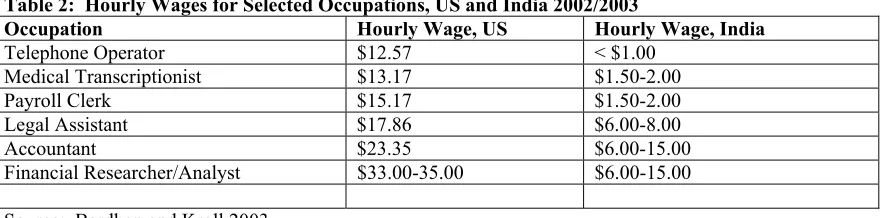
show that the cost savings incentive is shared across a broad spectrum of work. Table 2
compares U.S. and Indian hourly wages in service occupations considered threatened by
offshoring.
Table 2: Hourly Wages for Selected Occupations, US and India 2002/2003
Occupation Hourly Wage, US Hourly Wage, India
Telephone Operator $12.57 < $1.00
Medical Transcriptionist $13.17 $1.50-2.00
Payroll Clerk $15.17 $1.50-2.00
Legal Assistant $17.86 $6.00-8.00
Accountant $23.35 $6.00-15.00
Financial Researcher/Analyst $33.00-35.00 $6.00-15.00
Source: Bardhan and Kroll 2003
Although some of the categories such as telephone operators and payroll clerks have
commonly been relocated offshore, higher skilled jobs in accounting and financial
analysis appear equally vulnerable by comparison of wage. Both the low-cost of living
and the sheer abundance of foreign labor influence these contrasts, but the lack of other
cost drivers such as employee health insurance and pension funds creates an even more
favorable business climate.
Country Salary Range
India $4,800-8,000 Philippines $5,880-11,000 Malaysia $7,200
Russian Federation $5,000-7,500
China $8,952 Canada $28,174 Ireland $23,000-34,000 Israel $15,000-38,000
United States $60,000-80,000
It would incorrect to assume that wage differentials alone explain why or what
jobs may be relocated offshore. The rising tide of skilled jobs moving offshore is also
encouraged by the increasing number of highly skilled workers in the global labor pool.
Again, Ron Edwards very succinctly makes the business case:
“India is cranking out advanced degree people who speak reasonably good English and in some cases very good English to do lots of things. You know, politicians and everybody harp like, gosh, it’s a terrible trend and why are we sending all these jobs offshore. One of the reasons is that we can’t produce them to the extent or quality that the Indian firms have. It’s a free market right? So people are going to go where this stuff’s available for the right price.” (Interview 1)
This supports a common claim by proponents in the outsourcing debate that companies
are currently looking offshore because of shortage of skilled workers in certain math and
science related occupations. Many countries such as Russia have long traditions of
expertise in math and engineering, but rapid growth in higher education trends in India
and China and other emergent economies have created large concentrations of workers
with skills in a wider variety of areas such as IT, engineering, mathematics, accounting,
and law. China, for example, produced science and engineering doctorates at an average
annual growth rate of 36.5 percent between 1989 and 1999, while engineering graduates
represented 44.3 percent of undergraduate degrees in 1999 (NSF 2002). Thus, the greater
availability of a less-expensive but highly skilled labor may further accelerate the number
and range of job migration.
The explanation of why BPO occurs primarily involves the consideration of cost
and the possibilities of technology. Computer technologies facilitate an increased
number of services to be divided and relocated to domestic or foreign outsourcing
companies. Doing so allows firms to focus on core competencies and reduce labor costs
through outsourcing contracts. This is encouraged by the availability of skilled and often
new spatial distribution of work in which jobs that have typically been closer to the
design of work are relocated abroad. However, this process is not simply an outcome of
technological determinism but is instead an organizational process that involves
individuals, politics, and culture.
It is useful, therefore, to consider the example of the IT outsourcing contract
between Entergy and SAIC to reveal more about how this process unfolds. The $400
million, five-year contract began in 1999 and outsourced Entergy’s IT application
development and maintenance, data center management and operations, desktop support
services, and infrastructure management. According to Entergy CEO Wayne Leonard:
“No company can expect to be premier in all aspects of the value chain, particularly in an area like information technology where the change is exponential. This alliance allows us to achieve the benefits of scale and specialization without adding physical mass or making substantial financial investments…SAIC’s unique system of employee ownership will provide greater opportunities for IT employees.”4
Entergy’s 900-person IT staff was given the option of staying at Entergy or working for
SAIC on the project. Transitioning staff is mutually beneficial for both companies.
Entergy is relieved of expensive labor costs, while SAIC benefits from the proprietary
knowledge transitioned employees maintain about existing information utilities.
The practice of IT outsourcing falls into two principal areas: infrastructure and
applications management. Information infrastructure refers to the portfolio of hardware
and software applications that underlie business processes or transactions, while
applications management refers the software platforms that support a business process.
SAIC performs these services on a single integrated global model, bringing skills of
different employees from locations in the U.S., India, and the United Kingdom to manage
aspects are sent to offshore facilities. Only recently did SAIC establish captive
operations in India, hiring about 200 employees to serve its clients (including Entergy).
According to Jason Miller, SAIC service delivery manager, how outsourcing contracts
are organized depends on the corporate philosophy of the client:
JM: One of the things that works well for us is that we avoid staff displacement. So we generally acquire most of the IT staff of our clients as SAIC employees to ease the transition. We don’t just come in and gut your IT, though we have done it before.
DJ: What would be a reason why you would take that approach?
JM: That decision depends on the client. If they want to get rid of their IT staff than obviously we’re going to do it. But normally our experience in the utility industry has been to take on employees. (Interview 5)
The corporate philosophy of individual clients to a large extent determines how
outsourcing is organized. In the case of Entergy, it is evidently a combination of the
value they place on employees and risk. According to Nitin Mehra, offshore coordinator:
We [SAIC and Entergy] operate as an integrated team. We manage the work that goes offshore, and we transfer the cost savings to Entergy. Risk is tremendously lower than if you were to directly give it to an offshore company. Our costs are higher, but our risks are lower. Many clients don’t want to take that risk.” (Focus Group)
Companies can encounter a number of risks through overseas operations. One general
risk results from unforeseen business expenses such as software licenses or travel
expenses. The stability of a country’s legal and contract enforcement system and its
physical infrastructure are other potential sources of risk. Even in Bangalore, the heart of
the BPO market, the roads and energy system have led several companies to build self
sufficient campuses. Finally, cultural differences may pose a risk.
A number of outsourcing contracts have failed as a result of cultural differences
between consumers and foreign customer service representatives. Both Dell Inc. and
Delta Airlines have brought certain call center operations back to the US as a result of
operations as a result of consumer dissatisfaction. Most media attention has pointed to
heavy foreign accents as the source of backlash, but one report (McCracken 2004)
suggests it is may also be the result of a “Buy American” mentality. According to the
study, 65% of respondents indicated they would likely discontinue or decrease their
interaction with a company who utilizes overseas call centers, 48% of which cited
nationalism as the underlying reason.
The politically unpopular nature of outsourcing may therefore make some
companies reluctant to implement the strategy. This highlights how politics influences
the application of technology to the organization of work. Harris Miller says that:
“Companies are always going to be looking for ways to increase productivity and cut costs, as long as they are not at the same time alienating their customers and producing a lower quality product” (Interview 4).
The Dell and Delta examples are customer-facing business processes, whereas most
offshore BPO services are conducted between firms and service providers such as
Entergy and SAIC. Nevertheless, businesses are not immune to the political unpopularity
of outsourcing due to the threat of job elimination. How companies mitigate political risk
depends on corporate culture or philosophy. Not only did this theme surface in my
research of SAIC, but also in two other interviews:
DJ: Once a company has made the decision to outsource, what then determines the work that will go offshore?
WR: Well, it’s a corporate philosophy, number one, and then number two it has to do with how much leeway companies give their operational managers. (Interview 3)
DJ: If the capability is there, the technology is there, and only negligible business risk, why aren’t companies in the utilities industry pursuing BPO more rapidly?