University of New Orleans University of New Orleans
ScholarWorks@UNO
ScholarWorks@UNO
University of New Orleans Theses and
Dissertations Dissertations and Theses
1-20-2006
Job Satisfaction on the U.S.S. John F. Kennedy: The Impact on
Job Satisfaction on the U.S.S. John F. Kennedy: The Impact on
First Term Sailors' Decisions to Leave the U.S. Navy
First Term Sailors' Decisions to Leave the U.S. Navy
Alex Clarence Baker University of New Orleans
Follow this and additional works at: https://scholarworks.uno.edu/td
Recommended Citation Recommended Citation
Baker, Alex Clarence, "Job Satisfaction on the U.S.S. John F. Kennedy: The Impact on First Term Sailors' Decisions to Leave the U.S. Navy" (2006). University of New Orleans Theses and Dissertations. 1036.
https://scholarworks.uno.edu/td/1036
This Thesis is protected by copyright and/or related rights. It has been brought to you by ScholarWorks@UNO with permission from the rights-holder(s). You are free to use this Thesis in any way that is permitted by the copyright and related rights legislation that applies to your use. For other uses you need to obtain permission from the rights-holder(s) directly, unless additional rights are indicated by a Creative Commons license in the record and/or on the work itself.
JOB SATISFACTION ON THE U.S.S. JOHN F. KENNEDY:
THE IMPACT ON FIRST TERM SAILORS’ DECISIONS TO LEAVE THE U.S. NAVY
A Thesis
Submitted to the Graduate Faculty of the University of New Orleans in partial fulfillment of the requirements for the degree of
Master in Public Administration
in
The College of Urban and Public Affairs
by
Alex Clarence Baker
B.A., Morehead State University, 1985
ACKNOWLEDGEMENTS
During my first tour of duty onboard the U.S.S. Saratoga (CV 60) the Executive Officer
of the ship, a senior officer of over 22 years in the Navy once told me, “If you are in the Navy for
the money, you are in the wrong career.”
Fifteen years, three Navy ships and five tours of duty later, those words still ring true for
me, and form the basis for my major research question - Does job satisfaction play the most
significant role in determining an individual sailor’s decision to leave the Navy?
Although there have been many pay raises over the years, the fact remains that those who
join the Navy are looking for something more than a paycheck. It is a job that demands much,
but rewards those who are willing to dedicate themselves to the Navy’s core principles of Honor,
Courage and Commitment, a most gratifying life experience.
Further, I would like to thank Dr. Robert Whelan for his patience and invaluable
assistance over the past seven years who never stopped believing I would complete this task.
Finally, I would like to thank my wife Susanne who has endured and stood by me
TABLE OF CONTENTS
Abstract ………...iv
Chapter 1 Introduction...1
Chapter 2 Literature Review...10
Chapter 3 Methodology...15
Chapter 4 Results and Discussion ...21
Chapter 5 Conclusion ...77
References...83
Appendices Appendix A: Organizational diagram of the U.S.S. John F. Kennedy ...86
Appendix B: Navy Retention / Separation Questionnaire (OPNAV 1910/5)...88
Appendix C: Evaluation Report / Counseling Record (E1-E6) ...91
Appendix D: Military Pay Rates and Tables (January 1, 2000) ...94
Appendix E: Military Pay Rates and Tables (July 1, 2000) ...97
Appendix F: Military Pay Rates and Tables (January 1, 2001)...100
Appendix G: Military Pay Rates and Tables (July 1, 2001) ...103
ABSTRACT
The retention of sailors is paramount to the viability of the United States Navy. While
numerous aspects, including pay, benefits, family issues, etc., factor into the decision of each
sailor to leave the Navy, job satisfaction is one of the most important. This study examines the
extent job satisfaction played in sailors’ decisions to leave after their initial enlistment. The
Navy’s own survey instrument was utilized to gather the data from sailors who were separating
from the U.S.S. John F. Kennedy (CV-67) at the end of their first enlistment contract. The
survey questions were broken down into three general areas: Job Satisfaction, Pay and Benefits,
and Quality of Life, to measure the level of satisfaction within each of these areas. The
relationship between gender, martial status and ethnic group were key components in analyzing
CHAPTER 1
INTRODUCTION
PURPOSE OF THE STUDY
On the morning of September 11, 2001, the citizens of the United States of America were
once again reminded of the dangerous world in which we live. Not since the attack on Pearl
Harbor almost sixty years before, had Americans experienced the sudden, shocking jolt of a
surprise attack on their home soil by a foreign foe. Over 3,000 Americans died that
day…forever altering this generation’s view of the world.
In the aftermath of the attack, the nation called upon a military that had undergone a
significant transformation in the years after the fall of the Soviet Union and Operation Desert
Storm. Our armed forces had been significantly downsized by nearly one million personnel
(Ryan, 2001) and the Base Realignment and Closure (BRAC) commission, in conjunction with
the President and Congress had closed a number of bases across the country.
Many believed that the end of the Soviet Union ended the need to field a large military;
however the strategic and economic well-being of America and its allies in the world are
constantly being threatened by terrorist organizations like Al Qaeda and other Muslim extremist
groups. China’s military modernization program and growth as an economic power are all
reminders that the United States must maintain a strong military if it is to continue to determine
its own destiny. To that end, the United States government spends billions of dollars annually in
the recruitment, training, equipage, pay and deployment of military personnel to defend its
The “tip of the proverbial spear” in this effort is the men and women deployed on the
aircraft carriers of the United States Navy. These four and one half acres of sovereign territory
can travel within range, and launch a devastating air strike upon nearly every country on Earth.
It is not only a powerful instrument of war, but perhaps the most powerful instrument of peace
the President of the United States has at his disposal. Because of this flexibility, the nation’s
aircraft carriers have been called upon many times to complete extended operations in areas of
regional tension around the world.
These deployments and the overall high tempo of operations that are necessary to keep
aircraft carriers operationally and materially ready for these deployments present a unique
challenge to the retention efforts of the Navy’s leadership. The demands that these requirements
put upon the sailors, including long arduous working hours in port, extended time at sea during
the training cycle leading up to and including deployment of six-months or more, family
separations, low pay for doing the same tasks in comparison to their civilian counterparts, are
key factors in determining the ultimate decision of each sailor as to whether or not he will stay in
the Navy.
The major focus of this study will be to examine some of the relative influences on those
personnel who leave the United States Navy. It will focus primarily on the internal issues
surrounding the personnel assigned to sea duty aboard the aircraft carrier U.S.S. John F.
Kennedy (CV-67), and specifically on how much “Job Satisfaction” affects their decision to
leave the Navy.
The study will examine the individual sailor’s perception of their experience in the Navy
and how that perception weighs in their decision to leave the Navy and return to civilian life.
(2) to what extent job satisfaction played in their decision, (3) to what extent the quality of Navy
life factored into their decision to leave the Navy, and (4) how the perception of pay/benefits
played in their decision.
RATIONALE
During the time of this study, the Navy was losing approximately sixty-four percent of
the personnel who were recruited into the organization by the end of their first enlistment (a
period of four to six years) (Chief of Naval Personnel, 2000). This represents a significant
investment by the Navy in the recruiting and initial training phase of a sailor. As the United
States military relies more and more on the Navy to respond to an ever-increasing number of
contingency operations, the retention of highly skilled, properly trained personnel becomes an
issue of national importance.
The aircraft carrier, as the Navy’s largest and most recognizable sea command is also one
of its most diverse in terms of age, race, sex, rating, rank, and mission requirements. Further,
those who serve aboard an aircraft carrier are considered assigned to “arduous sea duty” and
present an even more difficult challenge to the Navy’s retention efforts verses those who are
assigned to shore commands and are not subject to the same rigors of sea duty.
The Navy’s primary mission is accomplished by “ships at sea” and all other functions
support this mission. If all of the Navy’s jobs were assigned ashore, the dynamic would be
completely altered. Indeed, one of the Navy’s most valuable retention tools is the transfer of
personnel to “shore duty” for periods of time as an enticement to stay in the Navy. It is because
of these unique challenges that the aircraft carrier U.S.S. John F. Kennedy (CV-67) provides the
BACKGROUND
As the problems of recruiting and retention in all branches of the armed forces continue
to make headlines in national news stories, the pressure on everyone involved to take action
increases, from Congress and the President, to the street level bureaucrat. The pressure has
become especially acute on the Navy, as a recent Pentagon survey found that the percentage of
young men between 16 and 21 who were likely to consider joining the Navy had declined to nine
percent, the lowest of the four services, (Vistica 28). With interest in a career in the military
continuing to decrease and many high school graduates choosing to go to college, the Navy is
faced with a shortage of personnel to fill some 10,000 vacancies in the fleet.
With the decrease in the number of prospects to recruit and larger numbers of sailors
leaving the fleet for opportunities in the private sector, the actions taken by the human resource
managers of the Navy now, and in the near future, are critical to sustaining the Navy’s ability to
meet its global commitments. The Secretary of the Navy, and the Chief of Naval Operations,
(the Senior Admiral of the Navy and the Navy’s representative on the Joint Chiefs of Staff)
recently instituted numerous changes in the way the Navy conducts its everyday business to meet
this challenge. From increasing the budget for retention bonuses (a special bonus pay that is
offered to sailors with critical job skills to reenlist in the Navy for a specific number of years that
can range from $10,000 to $30,000, depending upon the skill and the length of the enlistment),
drastically reducing the number of inspections sailors must prepare for and endure, to making
email available to every sailor onboard a ship, the Navy’s leadership is using every option at its
disposal to stem the tide of personnel losses (Commander-In-Chief, Atlantic Fleet, 1999). In spite
these personnel losses vary in scope and complexity depending upon the views and level of
dissatisfaction of each individual. This study will focus on one set of these factors.
ORGANIZATION OF THE U.S.S. JOHN F. KENNEDY (CV-67)
The U.S.S. John F. Kennedy is one of the nation’s twelve aircraft carriers. It was
commissioned in 1968 and has been on numerous deployments over the years, including action
in the Vietnam War, Desert Storm, Operation Southern Watch and most recently Operation
Noble Eagle in Afghanistan. Its crew of over 2,500 includes men and women, seaman recruits
(E-1, the lowest rank) who are as young as eighteen years old and have as little as three months
in the Navy, to the Commanding Officer who has over twenty years of extensive experience in
numerous facets of Naval operations. However, with an average age of twenty, the large
majority of the crew is college age young adults who perform their jobs in what is considered
one of the most dangerous working environments in the world (Kennedy Information Book
2000).
Onboard the USS John F. Kennedy, as on all other Navy Ships, the Commanding Officer
is inescapably responsible and accountable for the operation of the ship (U.S. Regulations,
1990). Appointed to this position by the Navy after a career of rigorous training and outstanding
performance spanning more than twenty years, the Captain has been well prepared for his
posting.
The aircraft carrier commanding officer has the whole crew at his disposal to accomplish
the mission of the ship, but the officer he relies on most heavily is the Executive Officer. He is
for the organization, performance of duty and good order and discipline of the entire command,
(Standard Operation and Regulations Manual, 1990).
The primary subdivision of responsibilities aboard a navy ship is the department. On the
Kennedy, there are a total of sixteen departments. They include the four which are found on
smaller ships: Operations, Combat Systems, Engineering and Supply, plus the departments of
Administration, Air, Aviation Intermediate Maintenance Department (AIMD), Deck, Safety,
Legal, Weapons, Navigation, Medical, Dental, Religious Ministries, and Maintenance
Management. Each of these departments is led by an officer selected for his experience and high
performance marks in his/her previous tours of duty. Because of the complexity of the tasks of
the Operations, Air, and Navigation departments, these positions are filled by former
commanding officers of aircraft squadrons who bring not only a vast array of knowledge to the
position, but the valuable experience of leadership gained through command (See Appendix A).
Each department is further subdivided into divisions. These divisions are responsible for
the equipment and mission of one area within the department. Each division is headed by a
Division Officer, who reports directly to the Department Head for all matters concerning
activities within the division. Division Officers onboard aircraft carriers are officers who have
varying degrees of experience. Some are former enlisted personnel with many years of
experience within their area of responsibility. Others are officers in their second tour of duty
who have served aboard smaller ships and are assigned to the aircraft carrier to gain more
experience prior their assignment as Department Heads on smaller ships.
Working for the Division Officers are the Division Leading Chief Petty Officers (LCPO),
experienced technical advisors in their field of expertise and provide the necessary training and
guidance to their personnel to continue their personal and professional development.
RETENTION FACTORS ONBOARD U.S.S. JOHN F. KENNEDY
The major focus of this research is to determine to what extent job satisfaction affects the
decision of sailors onboard the U.S.S. John F. Kennedy to leave the Navy. This research will
consist of a cross-sectional survey using all personnel who are at the end of their first term of
obligated service and decide to leave the Navy. As this survey includes enlisted sailors from
every department of the ship; married and single sailors, various ratings and number of years in
the Navy, it will give the widest possible view of the role job satisfaction plays in the
non-retention of sailors aboard the U.S.S. John F. Kennedy.
At the end of their four-year contract, each sailor must make the decision as to whether
they want to continue their commitment to the Navy. The hypotheses below set forth the
rationale that the sailor’s decision to stay in the Navy will be based on three general factors: job
satisfaction, pay and benefits and quality of life, with job satisfaction being the most influential
on the sailor’s ultimate decision.
Factors in the Retention of Personnel
There are numerous factors that affect the decision of individual sailors to discontinue
their service in the Navy. In its efforts to retain as many sailors as possible, the Navy designed
the Navy Retention/Separation Questionnaire to measure the satisfaction level of various aspects,
both personal and professional, of sailor’s life (See Appendix B). The forty-five questions of the
opportunities. For the purposes of this study, these forty-five questions will be grouped into
three areas of consideration:
(1) Pay and Benefits – covering areas including retirement, medical and dental
coverage.
(2) Quality of Life – including the quality and availability of government housing.
(3) Job Satisfaction – including the amount of respect from superiors, advancement
opportunity, and performance evaluation.
MAJOR RESEARCH QUESTION
Was the lack of job satisfaction the primary reason for first-term sailors onboard the
U.S.S. John F. Kennedy leaving the United States Navy?
HYPOTHESIS 1
A majority of sailors onboard the U.S.S. John F. Kennedy who do not reenlist at the end
of their first-term have a low level of job satisfaction.
HYPOTHESIS 2
Sailors onboard the U.S.S. John F. Kennedy who do not reenlist at the end of their
first-term will have a higher level of approval with pay and benefits than with job satisfaction.
HYPOTHESIS 3
Sailors onboard the U.S.S. John F. Kennedy who do not reenlist at the end of their first-
BASIS FOR HYPOTHESES
After years of observation of sailors and their work environment, the researcher formed a
hypothesis that those sailors who do not decide to commit another two to six years of their life to
the Navy make that decision based more on their lack of job satisfaction than with their level of
pay and benefits or quality of life.
While many join the Navy as a way of obtaining valuable training that they can someday
use in the civilian world, or as an avenue for money for college, the appeal of the Navy has
always been for the adventure, the challenge of doing something different. In short, they want to
do a job from which they can draw a great deal of satisfaction.
While the initial hypothesis was drawn from first hand observations, it was cultivated
through the review of the work of a number of researchers in the field going back over the last
thirty years. Researchers Maslow and Herzberg theorized that job satisfaction is caused by an
individual’s desire to satisfy personal needs (Maslow 1968), while K. A. Kovach found that
interesting work was ranked the highest of ten values in his study nearly twenty years later
(Kovach 1987). Karl and Sutton completed a follow on study a decade later that determined
public sector employees still held interesting work as the most important determinant of job
CHAPTER II
LITERATURE REVIEW
Since the inception of the all-volunteer force in the wake of the Vietnam War, one of the
most important aspects of military human resource management has been the recruiting of new
volunteers. Each branch of the armed forces spends millions of dollars per year in advertising in
every form of media to attract the attention of its 17 to 21 year old target audience. The Navy
alone has doubled its advertising budget to $67 million, and is opening 123 new recruiting
stations (Vistica, 1999) to attract new recruits.
In a study published in Monthly Labor Review in August 1985, the problems associated
with Army recruiting during a period of economic expansion were examined. The study found
that a drop in the rate of unemployment of one percent was estimated to cause a decline of
almost six hundred contracts per quarter for the highest qualified recruits (Horne, 1985). These
numbers, combined with a general decline in the willingness of potential recruits to endure
military hardships and meager military pay, make the task of those charged with retention of the
Navy’s manpower that much more difficult.
While this study will not look in depth at the issue of recruiting, its influence on retention
can’t be overlooked. If the personnel that are recruited are not of sufficient caliber to make their
training and service a viable investment for the Navy, they will become a burden on the Navy’s
division, department and command level leadership and could be a corrupting influence on those
THE IMPORTANCE OF JOB SATISFACTION IN RETENTION
While many aspects of the military are very different from those in the civilian sector, the
importance of job satisfaction to each individual in the military is not. As the primary focus of
this research, the issues directly related to job satisfaction in the military will be compared with
those of the private sector.
Conditions of the job environment that interfere with employee job performance are
called organizational constraints. These constraints come from many aspects of the job,
including other people and the physical work environment. (Peters, O’Connor, and Rudolf,
1980). While these constraints were originally designed to measure job performance, they were
adapted in a later study to measure job satisfaction. This study reported a correlation of
organizational constraints with five facets of job satisfaction (coworker = -.30, pay = -.26,
promotion = -.28, supervision = -.42, and work itself = -.31). (O’Conner, Peters, Rudolf and
Pooyan, 1982) The largest negative correlation with job satisfaction in this study associated to
be with supervisors.
In his book, Job Satisfaction, Paul E. Spector, explored the theory of role ambiguity in
the job satisfaction model. He defined role ambiguity as the degree of certainty the employee
has about what his or her functions and responsibilities are (Spector 1997). Role ambiguity was
assessed with questionnaires by Jackson and Schuler (also cited in Spector) and found to have a
mean correlation with global job satisfaction of -.30.
Another study done by Yuan Ting; Determinants of Job Satisfaction of Federal
Government Employees, proposed that job satisfaction is determined by three sets of variables.
individual’s belief and trust in organizational goals and values, and affections toward the
organization, and Relationships with Co-Workers and Supervisors. The second is Individual
Characteristics; based on the factors of race, age, gender, and education. While Organizational
Characteristics and Individual Characteristics are comprised of important factors in the retention
model, it is the third; the Job Characteristics set of variables, which are most germane to this
study.
Ting, using the variables – pay satisfaction and career growth, task clarity, skill
utilization, and task significance, determined that job characteristics had the strongest effects on
job satisfaction. Of all the independent variables within the study, skill utilization was found to
have the strongest effect on job satisfaction (Ting, 1997).
Early organizational theorists Abraham Maslow and Frederick Herzberg believed that job
satisfaction is caused by an individual’s desire to satisfy personal needs, which include both
intrinsic and extrinsic needs (Maslow 1968). Other researchers adopting this philosophy have
taken it a step further by stating that an individual’s job satisfaction is determined by the level to
which job characteristics will meet the person’s needs (Hackman & Lawler, 1971).
Katherine A. Karl and Cynthia L. Sutton in their study “Job Values in Today’s
Workforce,” compared the values of public and private sector employees with the results of a
study published by K.A. Kovach in the 1980’s. Kovach found that interesting work was ranked
the highest of ten values (Kovach, 1987). Karl and Sutton hypothesized that workers of today
placed a higher value on good wages and job security. While they determined that private sector
employees of today did place the highest value on good wages and job security, they also found
that public sector employees still held interesting work as the most important determinant of job
THE IMPORTANCE OF QUALITY OF LIFE
The role that a sailor’s perception of their quality of life plays in their decision to stay in
the Navy is also crucial to the retention issue. Upon assumption of his duties as the Chief of
Naval Operations (The Navy’s Top Admiral) in July 2000, Admiral Vernon Clark emphasized
the importance of maintaining quality of service (defined as the balanced treatment of quality of
personal life and quality of work) to enhance mission and combat readiness (Clark, 2000).
Campbell, Converse and Rogers conducted the first in depth studies on the quality of life
in 1976, introducing measures of domain satisfaction that included satisfaction with work,
housing, health, neighborhood, friendships, marriage, family life, amount of education and
savings (Campbell, 1976). Following this study, Andrews and Withey developed a
questionnaire, identifying a number of life concerns they divided into seven categories
comprised of: Family (marriage, family activities), Relations with other people (fair treatment,
acceptance), Economics (income, living standard, job, taxes), The local area (safety, security
from theft, community), personal life (personal time, leisure, health), The larger society
(standards, national government, mass media) and Other (religious faith, fulfillment) (Andrews,
1976).
The first significant research conducted on the Quality of Life in the United States Navy
was through a 1993 study by Booth-Kewley and Thomas. The study revealed that respondents
were most satisfied with their relationships with children, their marriage/romantic relationship
and their health and most dissatisfied with pay, standard of living, neighborhood and the way the
by Gerry Wilcov that revealed that work satisfaction, opportunities for personal development and
outside interests, relationships with friends (for those who did not have children) and living
quarters were the areas that accounted for the greatest amount of variance in the overall
perceptions of the Quality of Life (Wilcov, 1996).
In 1999, Wilcov and Schwerin conducted a study using a model in which (a) life domains
are divided into non-work or personal domains and work domains, (b) personal domains are
linked to reenlistment intention and (c) work domains are linked to reenlistment intention
through organizational commitment (Wilcov and Schwerin, 1999).
The 1999 Navy Quality of Life (QOL) Survey (comprised of four sections: background,
global QOL, life domains and their aspects and outcomes), was used as the instrument for the
study. The background information included both personal demographic variables such as
gender, age, racial and ethnic background, marital status, and parental status. Career background
CHAPTER III
METHODOLOGY
The Navy defines retention as the decision of a sailor, at the end of his/her enlistment, to
either extend their current enlistment contract for twenty-four to forty-eight months, or sign a
new contract obligating them to serve for a period of between two and six years (Retention Team
Manual, 2000). The enlisted retention statistics are followed closely at the highest levels of the
Navy’s leadership, and many of their manpower policies are guided by the individual decisions
made by sailors throughout the fleet.
The United States Navy used a survey questionnaire during the time period of this study
to determine the reasons for individual sailor’s decisions to stay in the Navy, or for their reason
to terminate their employment with the Navy. Since these individual decisions play such a vital
role in determining the future viability of the United States Navy, the study examined three
essential elements in the sailor’s decision making process: (1) the level of job satisfaction of each
sailor, (2) their perception of pay and benefits, and (3) the level of satisfaction with their quality
of life. This study attempted to determine if there was a correlation between sailor’s decisions to
leave the Navy and their level of job satisfaction.
In developing the construct for this study, the researcher reviewed each of the forty-five
previously tested questions of the Navy developed and tested survey. While the Navy did not
specify, or group the questions into any specific categories in this study, it did design its
The questions of the survey addressing “Job Satisfaction” were determined by using
aspects of job satisfaction found in the literature review. Questions dealing with superiors,
leadership and management, recognition, job security, advancement opportunity, job assignment,
and performance evaluation were all placed in the “Job Satisfaction” area of concentration based
on previous research findings. While an argument (supported by research) can be made that pay
and benefits have a direct bearing on job satisfaction, the survey asked the subject separate
questions about their satisfaction with pay and benefits.
In addressing Pay and Benefits, the questions dealing directly with amount of basic pay,
special pay, compensation for Permanent Change of Station (PCS) moves, retirement benefits,
medical and dental care, commissary/exchange, support/recreational services and
education/training are all considered compensation or “Pay and Benefits” and are governed by
Federal law. Sailors are approached with all of these items as a “total compensation package”
that must be included when comparing “Navy Pay” with “Civilian Pay.” It is only logical that
these questions are considered under the “Pay and Benefits” area of concentration when sailors
have been told since before they joined the Navy that these were how they were to be
compensated for their work.
The Quality of Life area of concentration questions were grouped again, by using areas
from previous research by Campbell, Converse and Rogers who conducted the first in depth
studies on the quality of life in 1976, introducing measures of domain satisfaction that included
satisfaction with work, housing, health, neighborhood, friendships, marriage, family life, amount
POPULATION
Specifically, this study focused on one command in the United States Navy, the U.S.S.
John F. Kennedy (CV-67). There are approximately 2,500 sailors assigned to the Kennedy, in
sixteen separate departments (Kennedy Information Book, 2000). Of these, approximately 148
sailors completed their initial enlistment during the time frame of this study (September 2000 to
August 2001) and decided to leave the Navy. The survey population included all sailors who, as
part of their required processing for discharge from the Navy, completed the Navy
Retention/Separation Questionnaire.
The John F. Kennedy was chosen for this study for five reasons: 1) It is one of the largest
afloat commands in the United States Navy, 2) It has one of the most diverse populations in
terms of different ratings assigned to one afloat Navy command, 3) It has one of the largest
female populations of any Navy afloat command, 4) because the primary mission of the Navy is
“at sea”, the effects of the most challenging employment environment in the Navy can be
measured, and 5) as a member of the crew of the John F. Kennedy, I had personal and unlimited
access to the environment during the timeframe of the study.
A request was made to the Command Career Counselor’s Office to obtain the data from
the Navy Retention/Separation Questionnaire administered to personnel coming to the end of
their enlistments for the previous one-year period. Basic demographic information including:
level of education, ethnic group, sex, marital status, length of service, number of dependents,
paygrade, rating, number of times reenlisting, and if spouse was working or in school, was
provided as part of the existing survey instrument. The identity of the survey participants was
never disclosed as these surveys were completed over the preceding year, without their names
required to complete this survey as part of their processing for discharge, it is assumed that the
survey produced a one hundred percent response rate.
SURVEY INSTRUMENT
The Navy’s own survey instrument; The Navy Retention/Separation Questionnaire (See
Appendix B), was used to gather the data by measuring the sailors’ level of satisfaction.
Forty-five closed-ended questions stated in short phrases and based on the personal experiences were
divided into three areas of concentration for this study: (1) Job Satisfaction, (2) Pay/Benefits, and
(3) Quality of Life. The questionnaire contained nine questions designed to gather demographic
data from the participants including; sex, level of education, ethnic group, marital status, length
of service, number of dependents, paygrade, rating, number of times reenlisting, and if the
spouse is working or in school.
The Navy views quality control review mechanisms as essential as survey results often
influence policy decisions affecting members’ welfare and the allocation of Navy resources. As
poorly designed surveys may produce erroneous results and faulty policy decisions, the Navy
established review procedures to ensure that only technically sound surveys are supported and
approved (OPNAV 5300.8B).
The Navy Personnel Research and Development Center is the Navy’s depository of all
survey information and, through the Navy Survey Resource Center (NSRC), provides detailed
assistance in the design, execution, and/or analysis of authorized personnel surveys. Further, the
NSRC provides technical review and makes recommendations for survey approvals.
The NSRC’s requirements, set forth in the Office of the Chief of Naval Operations
technical merit; their cost/benefit to the Navy analyzed; their quality of design, administration
and analysis be approved; review the NSRC’s data bases for existing questions for use in the
survey; pretest survey on members of the representative population; develop cost-effective
analysis, sampling, and administrative plans; submit final form of survey to the Chief of Naval
Personnel for approval; and provide final survey results to NSRC for review.
PROCEDURES FOR DATA COLLECTION
A request was made to the Executive Officer of the U.S.S. John F. Kennedy (CV-67), to
have access to the surveys for the purpose of this research project. The nature of the study and
the proposed uses of the data were explained to him in a personal interview. As the final
authority for requests of this nature, he gave his consent to use the existing completed surveys.
He then directed the Command Career Counselor to release the completed surveys for use in the
study. (Zecchin, 2001)
The U.S.S. John F. Kennedy’s Command Career Counselor administered the
questionnaires to the respondents on an individual basis per the guidance set forth in the Navy’s
Command Career Counselor Guidance Instruction Manual to personnel being processed for
separation from the Naval service or their reenlistment as the individual case dictated. The
Command Career Counselor gave the respondents as much time as needed to completed the
survey and then collected the survey upon completion. (Mobley, 2001)
These data were gathered over the course of one year, from September 1, 2000 to August
31, 2001 and included all sailors at the end of their first enlistment, who were being processed
for separation from the United States Navy. This timeframe was selected as it covered the latest
four percent of the personnel who were recruited into the organization by the end of their first
enlistment (a period of four to six years) and the Navy was doing everything from increasing
reenlistment bonuses to making email available to every sailor on every ship to stem the tide of
personnel losses. (Chief of Naval Personnel, 2000). A copy of the instrument is attached.
STUDY POPULATION
There were no risks to the participants in the study at anytime. All information gathered
was recorded to ensure that the anonymity of the respondents was maintained throughout. The
participants were required to complete the questionnaire as part of their processing for separation
per the direction of the Chief of Naval Personnel.
DATA ANALYSIS
Demographic data, including paygrade, gender, ethnic group and marital status were
analyzed using descriptive statistics.
The responses were coded from one (1) to five (5) for all survey questions, (excluding
demographic questions), with a “none response” being coded as nine (9).
The demographic data and survey results were entered into a database and analyzed
through the use of SPSS, a computer software statistical program. The survey responses were
analyzed according to the three paygrades, which made up the survey population. Further, some
demographic data frequencies and percentages were calculated by hand.
Responses to the primary question in each element of the survey (job satisfaction,
pay/benefits and quality of life) were correlated. Correlation statistics were used to analyze the
relationship between demographic variables in the demographic data (gender, marital status and
CHAPTER IV
RESULTS AND DISCUSSION
While the total population of the U.S.S. John F. Kennedy is in excess of 2500 sailors, the
population for this study was confined to those sailors whose first term of enlistment was ending
and they had made their decision to voluntarily separate from the United States Navy and return
to civilian life. Of this group, 148 (100%) participated during the one-year time frame of this
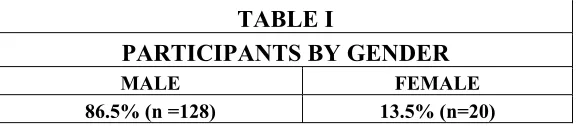
study. Analysis of the demographic data yielded the following results: 148 total participants, 128
(87.5%) were male, 20 (13.5%) were female, with all participants providing a response to this
question (See Table I).
TABLE I
PARTICIPANTS BY GENDER
MALE FEMALE
86.5% (n =128) 13.5% (n=20)
The gender distribution is slightly skewed in that the Navy has only detailed
females to aircraft carriers since 1995, and the Kennedy was still in the process of adapting its
berthing spaces to accommodate the growing population of females being assigned to the ship.
However, the sample is in line with the percentage of women in the Navy – 14.7 percent.
(Bureau of Naval Personnel, 2005) According to the ship’s Command Career Counselors Office,
approximately 500 females had been assigned to the John F. Kennedy by the end of the period in
which the surveys were conducted, or approximately twenty percent of the crew of 2,500
(Mobley, 2001).
It is inherent in the Navy culture to closely track the ethnic makeup and gender of its
the 21st century defines diversity as the “creativity, culture, ethnicity, gender, race, religion, skills
and talents of Sailors and civilians that enhance the mission readiness of the Navy.” Further, it
establishes a vision statement that “A Navy that continually invests in the strength of America’s
diversity, where Sailor and civilian can prosper and contribute to mission readiness and ensure
mission success in an environment that encourages and enables all to reach their personal and
professional potential.” (Navy’s Strategic Plan for Diversity, 2004) To meet these diversity
goals, it is imperative that the Navy continues to closely track the makeup of its commands,
including its ships, and the responses to its surveys to ensure that it can address diversity issues
in a timely fashion.
As the standard enlistment contract is for a period of four years, it is reasonable to expect
the largest percentage of the survey group will be in the paygrade of E-4. Reaching the level of
Petty Officer Third Class (paygrade E-4 and a first level supervisor) is a milestone in an enlisted
sailor’s career and is reached after a designed period of time and their selection for advancement
based on the results of the Navy-wide advancement examination. (Naval Military Personnel
Manual, 1998) (See Table II)
TABLE II
PARTICIPANTS BY PAYGRADE
PAYGRADE
Frequency Percent Valid Percent
E-3 33 16.3% 18.1%
E-4 99 53.8% 59.6%
E-5 16 13.9% 15.4%
PAY- GRADE
The Department of Defense’s pay scale is broken down by paygrade and years of service
(Appendix D-G). Paygrade, more than any other variable, has a direct bearing on the level of
pay and responsibilities each member has in their day-to-day duties and therefore indispensable
as the dependent variable.
A breakdown of the participants by ethnic group revealed that a 87 (58.8%) identified
themselves as White, 34 (23.0%) as Black, 27 (18.2%) as Hispanic, Asian, American Indian or
“Other.” (See Table III)
TABLE III
PARTICIPANTS BY ETHNIC GROUP
Frequency Percent
White 87 58.8
Black 34 23.0
Hispanic/Asian 27 18.2
Amer. Ind. /Other
Total 148 100.0
A review of the survey group by the marital status of the 148 participants revealed that 90
(60.8%) identified themselves as single, 51 (34.4%) as married, while seven (4.7%) responded
TABLE IV
PARTICIPANTS BY MARITAL STATUS
PAYGRADE (Dep. Variable)
3 4 5
Count Column % Count Column % Count Column %
Single 19 57.6% 61 61.6% 10 62.5%
Married 12 36.4% 33 33.3% 6 37.5%
Divorced 0 .0% 4 4.0% 0 .0%
Other 2 6.1% 1 1.0% 0 .0%
MARITAL STATUS
Total 33 100.0% 99 100.0% 16 100.0%
Marital status also has a direct bearing on the pay of a service member as a married sailor
is compensated more through the Basic Allowance for Housing (BAH) than a single sailor living
in the same geographic area of the country. Further, a married sailor has the opportunity to
utilize quality of life benefits such as family health care coverage and on base child care services.
These quality of life services that have no tangible benefit to a single sailor.
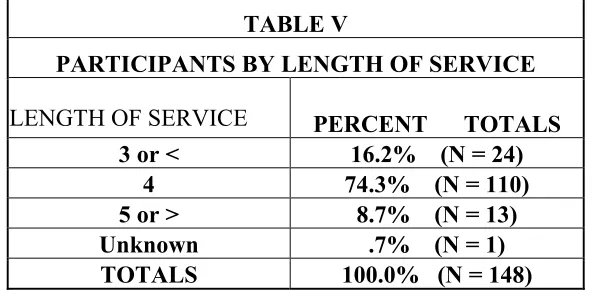
By length of service, of the 148 participants, there were 24 (16.2%) with three years or
less of service, 110 (74.3%) with four years of service, and 13 (8.7%) with five years or more of
service. Finally, one survey (0.7%) was unknown. (See Table V).
TABLE V
PARTICIPANTS BY LENGTH OF SERVICE
LENGTH OF SERVICE PERCENT TOTALS
3 or < 16.2% (N = 24)
4 74.3% (N = 110)
5 or > 8.7% (N = 13)
Unknown .7% (N = 1)
Responses by length of service were analyzed and revealed that 110 (74.3%) of the
sailors completing the surveys were completing their fourth year of service. This correlates with
the completion of the standard initial enlistment contract of four years. As the Navy assigns
numerous sailors who have completed only the initial phase of their Navy training (eight weeks
of Recruit Training) to the U.S.S. John F. Kennedy for a tour of sea duty of up to five years, it is
logical that the largest group would be at their initial reenlistment point while serving onboard
the Kennedy. The second largest group, with 24 (16.2%) sailors participating in the survey, was
those with three years or less of service. The Navy has a number of enlistment contracts that are
available to recruiters, some of these contracts allow sailors to enlist for a term of active duty
from two to three years, and complete the remaining service requirement in the Naval Reserve.
Analysis of the data by paygrade indicated that 99 (66.9%) of the sailors were in the
paygrade of E-4. This paygrade, (designated as Petty Officer Third Class and considered the
first level of supervisor) is attained through time in service, positive performance evaluation
marks and the successful completion of an extensive written examination. This factor correlates
closely with length of service as it is the normal professional progression expected of a sailor
during their initial four-year enlistment.
The data further revealed that 33 (22.3%) of the sailors were in the paygrade of E-3. This
paygrade, (designated as a Seaman, Fireman, or Airman) is attained through time in service and
no negative marks on the performance evaluation. A sailor reaching this paygrade, but not
progressing to E-4 can still be considered a successful performer, but because the Navy centrally
manages the advancement of personnel, his rating (job specialty) maybe overmanned at the E-4
level. As a result, he may not be able to advance at the same pace as his contemporaries in other
Finally, the data disclosed that 16 (10.8%) of the sailors completing the survey were in
the paygrade of E-5. This paygrade (designed as Petty Officer Second Class and considered a
second level supervisor) if attained during the first enlistment indicates that the sailor has
attained a high level of knowledge within their rating and has performed well both as a
supervisor and a technician.
JOB SATISFACTION
HYPOTHESIS 1 (JOB SATISFACTION)
A majority of sailors onboard the U.S.S. John F. Kennedy who do not reenlist at the end
of their first-term have a low level of job satisfaction. This hypothesis required measurement of
the level of job satisfaction of sailors who decided to leave the Navy and return to civilian life.
Responses to Question 2 “Based on your Naval experience, rate your satisfaction with the
level of job fulfillment/challenge” were used to test this hypothesis. Reviewing the responses
from all sailors in the survey, 94 (63.5%) of the sailors responded they were satisfied or very
satisfied, while only 53(35.8%) indicated that they were dissatisfied with their level of job
fulfillment.
Responses to the question on the level of job fulfillment were then reviewed and analyzed
by gender, marital status and ethnic group. Female sailors responded overwhelmingly 17 (85%)
that they were satisfied with their level of job fulfillment, while only 3 (15%) indicated they
satisfied with the level of job fulfillment whereas 50 (39.1%) of the males indicated that they
were dissatisfied or very dissatisfied. One male sailor indicated “Not applicable”.
Next, the subject of the level of job fulfillment was analyzed by the marital status of the
sailors. Those sailors identifying themselves as single responded by a measure of 28 (31.1%)
that they were either dissatisfied or very dissatisfied, against 61 (67.7%) who indicated that they
were satisfied or very satisfied with the level of job fulfillment.
Of those who indicated that they were married, 29 (56.7%) responded that they were
satisfied or very satisfied, while 22 (43.3%) indicated that they were dissatisfied or very
dissatisfied with their level of job fulfillment while a part of the United States Navy. Further,
those who identified themselves as being divorced or “other” (a total of seven) responded with
four (57.1%) indicating that they were satisfied, while three (42.9%) responded that they were
dissatisfied with their level of job fulfillment.
Finally, the question of the level of job fulfillment was analyzed by ethnic group. Of
those sailors who identified themselves as White, 52 (59.7%) listed their level of job fulfillment
as satisfied (five responded as very satisfied) while 34 (39.3%) indicated that they were
dissatisfied or very dissatisfied. One responded “Not Applicable”. Further,African-Americans
responded that they were satisfied or very satisfied by a margin of 24 (70.5%) over the 10
(29.5%) who said that they were dissatisfied or very dissatisfied with the level of job fulfillment.
Eighteen (66.6%) of the sailors who identified themselves as Hispanic/Asian/American Indian or
“Other” indicated that they were either satisfied or very satisfied, while nine (33.3%) said they
Job fulfillment by ethnic group indicated that African-American sailors had a higher level
of job fulfillment than White or Hispanic/Asian/American Indian and sailors who identified
themselves as “other.” (See Table VI)
TABLE VI
Hypothesis # 1
Dependent Variable – Job Fulfillment
Independent Variable Chi-Square
Gender 5.292*
Marital Status 6.269*
Ethnic Group 10.639*
*p > .05
The survey contained twenty questions that measured different aspects of job satisfaction.
These questions give a comprehensive view of the many factors that influence the job
satisfaction level of sailors serving onboard Navy ships.
In Table VII, of the sailors in the E-3 paygrade, 51.5% (12.1% very dissatisfied; 39.4%
dissatisfied) indicated they were dissatisfied with the amount of respect from their superiors.
While 48.5% indicated they were satisfied with the amount of respect from their superiors.
Sailors in the E-4 paygrade 35.3% signified that they were dissatisfied with the amount of
respect they received from superiors, whereas 63.7% felt that they were satisfied with the respect
they received. Further, of the sailors who had reached the E-5 paygrade, only 26.6% were
dissatisfied with the amount of respect from superiors, while 73.4% were satisfied or very
What effect did the amount of respect from superiors have on the job satisfaction of sailors in each paygrade?
TABLE VII
PERCEPTION OF JOB SATISFACTION BY AMOUNT OF RESPECT FROM SUPERIORS
PAYGRADE (Dep. Variable)
3 4 5
Column % Count Column % Count Column % Count
Not Applicable .0% 0 .0% 0 .0% 0
Very Dissatisfied 12.1% 4 13.1% 13 13.3% 2
Dissatisfied 39.4% 13 23.2% 23 13.3% 2
Satisfied 45.5% 15 57.6% 57 60.0% 9
Very Satisfied 3.0% 1 6.1% 6 13.3% 2
AMOUNT OF RESPECT FROM SUPERIORS
Total 100.0% 33 100.0% 99 100.0% 15
chi-square = 6.057, p < .05, df = 6
The findings indicate that sailors felt they received more respect from their superiors the
higher rank they attained.
On the question of level of job fulfillment, the E-5 paygrade had the highest level of
satisfaction, with 93.8% indicating they were either satisfied or very satisfied, versus only 6.3%
who were dissatisfied. Among E-4 personnel, 62.6% indicated satisfaction with their level of job
fulfillment, while 37.1% were not satisfied. For the E-3 paygrade, a majority (51.5%) signified
that they were satisfied with their job fulfillment; however 45.4% demonstrated that they were
dissatisfied or very dissatisfied, while 3.0% indicated that job fulfillment was not applicable.
What effect did the level of job fulfillment have a on the job satisfaction in each paygrade?
TABLE VIII
PERCEPTION OF JOB SATISFACTION BY LEVEL OF JOB FULFILLMENT
PAYGRADE (Dep. Variable)
3 4 5
Column % Count Column % Count Column % Count
Not Applicable 3.0% 1 .0% 0 .0% 0
Very
Dissatisfied 12.1% 4 8.1% 8 .0% 0
Dissatisfied 33.3% 11 29.3% 29 6.3% 1
Satisfied 51.5% 17 58.6% 58 68.8% 11
Very Satisfied .0% 0 4.0% 4 25.0% 4
LEVEL OF JOB
FULFILLMEN T
Total 100.0% 33 100.0% 99 100.0% 16
chi-square = 22.616, p < .05, df = 8
While the majority in all three paygrades indicated they were satisfied, those sailors in
the E-5 paygrade had by far the highest level of job fulfillment. As E-5 sailors are given more
responsibility and more authority over sailors in the E-3 and E-4 paygrades, it follows that they
would have a higher sense of accomplishment than those in the lower paygrades.
In Table IX, those in the E-5 paygrade again showed the highest level of satisfaction with
the enjoyment of their job, with 68.8% indicating they were satisfied or very satisfied, while only
31.3% signified dissatisfaction. Those in the E-4 paygrade had almost as high a level of job
enjoyment with 61.7% signifying they were satisfied whereas 38.3% indicated dissatisfaction.
Finally, the E-3 paygrade’s answers disclosed a much lower level of job enjoyment, with 60.6%
indicating they were dissatisfied or very dissatisfied, while only 39.4% signifying that they were
What effect did the level of job enjoyment have on the job satisfaction of sailors in each paygrade?
TABLE IX
PERCEPTION OF JOB SATISFACTION BY LEVEL OF JOB ENJOYMENT
PAYGRADE (Dep. Variable)
3 4 5
Column % Count Column % Count Column % Count
Not Applicable .0% 0 .0% 0 .0% 0
Very Dissatisfied 24.2% 8 14.1% 14 6.3% 1
Dissatisfied 36.4% 12 24.2% 24 25.0% 4
Satisfied 36.4% 12 55.6% 55 50.0% 8
Very Satisfied 3.0% 1 6.1% 6 18.8% 3
AMOUNT OF ENJOYMENT FROM JOB
Total 100.0% 33 100.0% 99 100.0% 16
chi-square = 9.95, p < .05, df = 6
These results continue to uncover a trend that those in the lowest paygrade have the
lowest level of job satisfaction. Sailors in the E-3 paygrade are usually assigned the most menial
tasks, (because they are the lowest paygrade and have to take their turn doing the menial tasks as
their shipmates did before they were advanced) such as the cleaning of work and berthing spaces,
trash removal, and the refurbishment, including the sanding of metal decks (floors) and
bulkheads (walls) and painting of spaces owned by their division or department. These tasks can
be extensive and require a large number of junior personnel, depending on the size of the
division and number of spaces that must be maintained. While working these types of work
details don’t give sailors a high very sense of accomplishment, it has the ancillary affect of
keeping them from working with the equipment and gaining the knowledge to help them be
successful on the next advancement examination.
According to Table X, it is the E-4 paygrade that had the highest level of job satisfaction
they were satisfied amount of regulations with 53.1% responding with satisfied or very satisfied,
whereas 46.9% indicated they were dissatisfied. The E-5 paygrade had a response of 56.3%
indicating they were satisfied with the amount of regulations. Further, they indicated that 18.8%
were dissatisfied and 25.0% were very dissatisfied.
What effect did the amount of regulations have on the job satisfaction of sailors in each paygrade?
TABLE X
PERCEPTION OF JOB SATISFACTION BY AMOUNT OF REGULATIONS
PAYGRADE (Dep. Variable)
3 4 5
Column % Count Column % Count Column % Count
Not Applicable .0% 0 .0% 0 .0% 0
Very Dissatisfied 12.5% 4 10.1% 10 25.0% 4
Dissatisfied 34.4% 11 27.3% 27 18.8% 3
Satisfied 50.0% 16 59.6% 59 56.3% 9
Very Satisfied 3.1% 1 3.0% 3 .0% 0
AMOUNT OF REGULATIONS
Total 100.0% 32 100.0% 99 100.0% 16
chi-square = 4.356, p < .05, df = 6
The level of dissatisfaction with the amount of regulations by E-5 sailors could be
attributed to the fact that they are in a more responsible position and therefore are required to be
more familiar with a larger volume of regulations than E-4 sailors. Further, they are responsible
and held accountable for enforcing regulations to a larger degree than E-4 sailors.
For the E-3 sailors, they have very little responsibility to enforce regulations; however,
they also have the most supervisors above them to ensure that they follow all of the regulations.
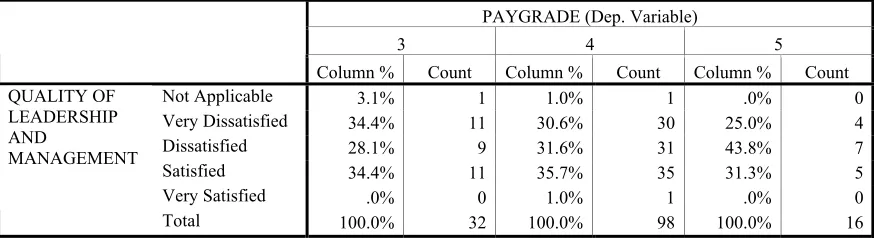
Table XI demonstrates a high the level of dissatisfaction with job satisfaction by the
quality of leadership and management, regardless of paygrade. E-5 sailors (Petty Officer Second
Class) had the highest level of dissatisfaction with the quality of leadership and management,
Officer Third Class) and E-3 (Seaman) following close behind with 62.2% and 62.5%
respectfully.
What effect did the quality of leadership and management have on the job satisfaction of sailors in each paygrade?
TABLE XI
PERCEPTION OF JOB SATISFACTION BY QUALITY OF LEADERSHIP AND MANAGEMENT
PAYGRADE (Dep. Variable)
3 4 5
Column % Count Column % Count Column % Count
Not Applicable 3.1% 1 1.0% 1 .0% 0
Very Dissatisfied 34.4% 11 30.6% 30 25.0% 4
Dissatisfied 28.1% 9 31.6% 31 43.8% 7
Satisfied 34.4% 11 35.7% 35 31.3% 5
Very Satisfied .0% 0 1.0% 1 .0% 0
QUALITY OF LEADERSHIP AND
MANAGEMENT
Total 100.0% 32 100.0% 98 100.0% 16
chi-square = 2.744, p < .05, df = 8
These numbers reveal a very low opinion of the quality of leadership and management
exhibited by those in leadership positions onboard the U.S.S. John F. Kennedy (CV-67). This
measurement of job satisfaction has one of the highest levels of agreement between the three
paygrades and reveals that the quality of leadership and management aboard the Kennedy is not
perceived by the majority to be meeting its expectations. One possible reason for this level of
dissatisfaction could be the stress of a heavy operational schedule, causing the ship’s leadership
to drive the crew to work that much harder.
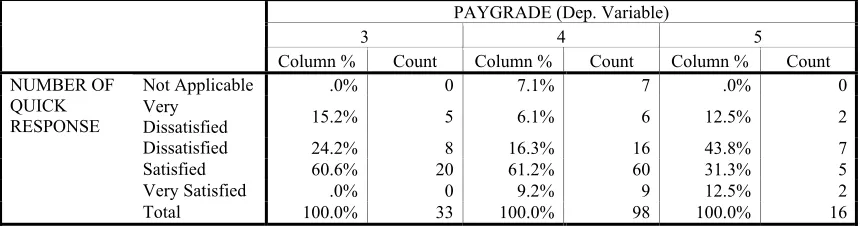
In Table XII, the perception of job satisfaction number of quick response tasks was
measured. Again, the Second Class Petty Officers (E-5) had the highest level of dissatisfaction,
of quick response tasks assigned with a significant number (7.1%), indicating Not Applicable.
Further, 60.6% of the Seamen (E-3) indicated that they were satisfied.
What effect did the number of quick response tasks have on the job satisfaction of sailors in each paygrade?
TABLE XII
PERCEPTION OF JOB SATISFACTION BY NUMBER OF QUICK RESPONSE TASKS
PAYGRADE (Dep. Variable)
3 4 5
Column % Count Column % Count Column % Count
Not Applicable .0% 0 7.1% 7 .0% 0
Very
Dissatisfied 15.2% 5 6.1% 6 12.5% 2
Dissatisfied 24.2% 8 16.3% 16 43.8% 7
Satisfied 60.6% 20 61.2% 60 31.3% 5
Very Satisfied .0% 0 9.2% 9 12.5% 2
NUMBER OF QUICK RESPONSE
Total 100.0% 33 100.0% 98 100.0% 16
chi-square = 16.734, p < .05, df = 8
As with the number of regulations, Second Class Petty Officers (E-5), bear a larger
responsibility of ensuring that quick response tasks are completed correctly and within the
allowed time limit.
Perception of job satisfaction by level of recognition was measured in Table XIII.
Seamen (E-3) had the highest level of dissatisfaction with 62.4%, with Third Class Petty
Officer’s (E-4) being nearly as dissatisfied with 61.3%. On the other hand, Second Class Petty
What effect did the level of recognition have on the job satisfaction of sailors in each paygrade?
TABLE XIII
PERCEPTION OF JOB SATISFACTION BY LEVEL OF RECOGNITION
PAYGRADE (Dep. Variable)
3 4 5
Column % Count
Column
% Count
Column
% Count
Not Applicable .0% 0 .0% 0 .0% 0
Very Dissatisfied 28.1% 9 31.3% 31 20.0% 3
Dissatisfied 34.4% 11 30.3% 30 20.0% 3
Satisfied 34.4% 11 35.4% 35 53.3% 8
Very Satisfied 3.1% 1 3.0% 3 6.7% 1
LEVEL OF RECOGNITION
Total 100.0% 32 100.0% 99 100.0% 15
chi-square = 3.021, p < .05, df = 6
These findings are consistent with the fact that sailors who reach the level of Second
Class Petty Officer are by definition, more successful than the Seamen (E-3) and Third Class
Petty Officers (E-4) by virtue of their Rank. By reaching the E-5 level during their first
enlistment, Second Class Petty Officers would be recognized at a minimum, with good
evaluation reports. Further, they would be recognized by being trusted with more important and
more difficult tasks to complete.
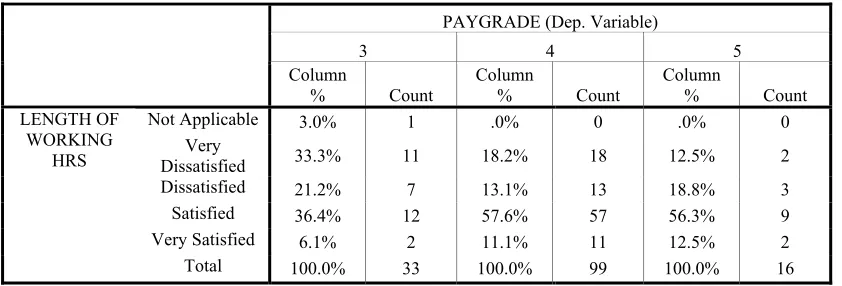
In Table XIV, perception of job satisfaction by length of working hours was measured.
Second Class Petty Officers (E-5) and Third Class Petty Officers (E-4) responded that they both
were satisfied or very satisfied with the length of working hours by a near identical 68.8% for
E-5 and 68.7% for E-4. However, E-54.E-5% of the E-3s responded that they were dissatisfied or very
What effect did the length of working hours have on the job satisfaction of sailors in each paygrade?
TABLE XIV
PERCEPTION OF JOB SATISFACTION BY LENGTH OF WORKING HOURS
PAYGRADE (Dep. Variable)
3 4 5
Column
% Count
Column
% Count
Column
% Count
Not Applicable 3.0% 1 .0% 0 .0% 0
Very
Dissatisfied 33.3% 11 18.2% 18 12.5% 2
Dissatisfied 21.2% 7 13.1% 13 18.8% 3
Satisfied 36.4% 12 57.6% 57 56.3% 9
Very Satisfied 6.1% 2 11.1% 11 12.5% 2
LENGTH OF WORKING
HRS
Total 100.0% 33 100.0% 99 100.0% 16
chi-square = 10.845, p < .05, df = 6
Considering the amount of working hours that are required of sailors at sea, (most are
required to work 18 hours a day) there appears to be little negative affect on the job satisfaction
of Second and Third Class Petty Officers.
Table XV, the perception of job satisfaction by the amount of paperwork sailors were
required to complete, revealed that a large majority (75.7%) of E-3 sailors were satisfied. A high
level of E-4 and E-5 sailors also responded that they were satisfied or very satisfied, with 67.4%
What effect did the amount of paperwork have on the job satisfaction of sailors in each paygrade?
TABLE XV
PERCEPTION OF JOB SATISFACTION BY AMOUNT OF PAPERWORK
PAYGRADE (Dep. Variable)
3 4 5
Column % Count Column % Count Column % Count
Not Applicable 18.2% 6 7.1% 7 6.3% 1
Very Dissatisfied 3.0% 1 9.2% 9 6.3% 1
Dissatisfied 3.0% 1 16.3% 16 18.8% 3
Satisfied 72.7% 24 63.3% 62 62.5% 10
Very Satisfied 3.0% 1 4.1% 4 6.3% 1
AMOUNT OF PAPERWORK
Total 100.0% 33 100.0% 98 100.0% 16
chi-square = 8.837, p < .05, df = 8
However, 25.5% of E-4 and 25.1% of E-5 sailors reported they were dissatisfied with the
amount of paperwork. This factor can be attributed to the fact that as sailors advance in rank, the
amount of paperwork increased as their responsibilities increase. From the proper keeping of log
books, to the processing of repair part orders and maintenance logs, E-4 and E-5 sailors handle a
large percentage of the initial paperwork generated onboard a Navy ship.
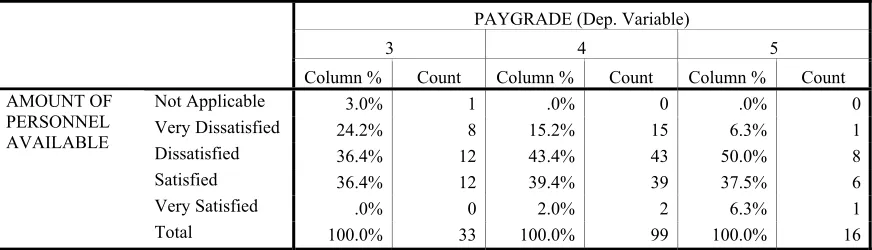
According to Table XVI, sailors in all paygrades had a high level of dissatisfaction with
the amount of personnel available to do the job. 56.3% of sailors in the E-5 paygrade, 58.6% in
the E-4 paygrade and 60.6% in the E-3 paygrade responded that they were either dissatisfied or
What effect did the amount of personnel available to do the job have on the job satisfaction of sailors in each paygrade?
TABLE XVI
PERCEPTION OF JOB SATISFACTION BY AMOUNT OF PERSONNEL AVAILABLE TO DO THE JOB
PAYGRADE (Dep. Variable)
3 4 5
Column % Count Column % Count Column % Count
Not Applicable 3.0% 1 .0% 0 .0% 0
Very Dissatisfied 24.2% 8 15.2% 15 6.3% 1
Dissatisfied 36.4% 12 43.4% 43 50.0% 8
Satisfied 36.4% 12 39.4% 39 37.5% 6
Very Satisfied .0% 0 2.0% 2 6.3% 1
AMOUNT OF PERSONNEL AVAILABLE
Total 100.0% 33 100.0% 99 100.0% 16
chi-square = 8.509, p < .05, df = 8
A number of factors influence the number of personnel available to accomplish the
numerous tasks that sailors must complete onboard a Navy ship. These include first and
foremost, their watchstanding responsibilities. These duties require every sailor to take a
proactive interest in completing the qualifications necessary to operate everything from the 1MC
(the ship’s general announcement system that is audible in every space on the ship) to radars and
radar consoles, missile systems, massive boilers and steam engines to the steam catapults and
aircraft arresting gear. Each one of these complex systems has numerous operators that must act
in concert with each other to make the ship work. If there is a shortage of qualified personnel
onboard, then those who are qualified will have to step in to stand the watches for which there
are no qualified watchstanders. This shortage can occur through the undermanning of the ship,
which is handled through the Bureau of Navy Personnel, (a process to expansive to be discussed
here) or through the lack of proper training of personnel onboard. While some of the most
of the four engine rooms, take months for senior petty officer to qualify to perform, others
require less training but a larger number of personnel to perform. If the training process breaks
down, or personnel do not actively complete their training assignments, it will result in the lack
of qualified personnel available to do the job, thereby having a negative impact on job
satisfaction.
The results of Table XVII, the perception of job satisfaction by level of competence of
supervisors, revealed a nearly even split across all three paygrades of those who satisfied with
their supervisors level of competence and those who were dissatisfied. One measurement of
interest, 22.2% of E-4 sailors reported that they were very dissatisfied with the level of
competence of supervisors.
What effect did the level of competence from superiors have on the job satisfaction of sailors in each paygrade?
TABLE XVII
PERCEPTION OF JOB SATISFACTION BY LEVEL OF COMPETENCE OF SUPERVISORS
PAYGRADE (Dep. Variable)
3 4 5
Column % Count Column % Count Column % Count
Not Applicable .0% 0 .0% 0 .0% 0
Very Dissatisfied 15.2% 5 22.2% 22 .0% 0
Dissatisfied 36.4% 12 27.3% 27 50.0% 8
Satisfied 42.4% 14 44.4% 44 50.0% 8
Very Satisfied 6.1% 2 6.1% 6 .0% 0
LEVEL OF COMPETENCE
Total 100.0% 33 100.0% 99 100.0% 16
chi-square = 7.585, p < .05, df = 6
Due to the disbursement of the those completing the survey of all areas of the ship, the