University of New Orleans University of New Orleans
ScholarWorks@UNO
ScholarWorks@UNO
University of New Orleans Theses and
Dissertations Dissertations and Theses
8-7-2008
Critical Events, Commitment, and the Probability of Civil War
Critical Events, Commitment, and the Probability of Civil War
Ursula E. Daxecker University of New Orleans
Follow this and additional works at: https://scholarworks.uno.edu/td
Recommended Citation Recommended Citation
Daxecker, Ursula E., "Critical Events, Commitment, and the Probability of Civil War" (2008). University of New Orleans Theses and Dissertations. 825.
https://scholarworks.uno.edu/td/825
This Dissertation is protected by copyright and/or related rights. It has been brought to you by ScholarWorks@UNO with permission from the rights-holder(s). You are free to use this Dissertation in any way that is permitted by the copyright and related rights legislation that applies to your use. For other uses you need to obtain permission from the rights-holder(s) directly, unless additional rights are indicated by a Creative Commons license in the record and/ or on the work itself.
“Critical Events, Commitment, and the Probability of Civil War”
A Dissertation
Submitted to the Graduate Faculty of the University of New Orleans
in partial fulfillment of the requirements for the degree of
Doctor of Philosophy in
Political Science
by
Ursula E. Daxecker
B.A.Equivalent Leopold-Franzens Universität Innsbruck, 2001 M.A. University of New Orleans, 2003
ii
Acknowledgements
I have been fortunate to receive the support and assistance of many throughout the writing of this dissertation. I am grateful for having had Michael Huelshoff as an advisor for my thesis. He provided invaluable advice through numerous drafts and did so with very short turnaround time. I also want to thank the remaining dissertation committee members for their time and energy. Christine Day, David Lektzian, Brandon Prins, and Marc Rosenblum offered generous advice on numerous versions of the manuscript. I owe a great deal of thanks to my committee.
I am indebted to many current and former faculty members and graduate students at the
University of New Orleans. Michael Hess, Robert Montjoy, Amy Poteete, and Sondra Venable offered useful comments on all or parts of the manuscript and helped me clarify the arguments. I am very grateful for the support received by the University of New Orleans and the Department of Political Science. Former department chair Charles Hadley and current chair Christine Day deserve particular mention for their continued support.
I am especially thankful to Del Brennan who proofread every version of this manuscript and improved its English with great patience and thoroughness.
And last but in no way least, special thanks go to my family and friends for much-needed emotional and social support. I am most grateful to my husband Nick for supporting me
iii
Table of Contents
List of Tables ...iv
Abstract ...v
Chapter 1: Introduction ...1
Chapter 2: Literature Review...11
Economic Theories of Civil War ...15
Ethnicity and Civil War ...18
Political Explanations of Civil War ...20
Bargaining Theories of War...32
Toward a Dynamic Theory of Civil War...36
Chapter 3: Critical Events and the Commitment Problem...44
Identifying Critical Events...44
The Two-Sided Commitment Problem...46
Making Credible Commitments...50
Leadership Type...53
The Cohesiveness of Opposition Actors...57
The Distance between Government and Opposition ...61
Chapter 4: Empirical Test I: Critical Events and the Threat of Civil War ...66
Summary of Findings...67
A Probit Model of Critical Events and Civil War...68
A Selection Model of Critical Events and Civil War ...79
Chapter 5: Empirical Test II: Critical Events, Opposition Cohesion, and Civil War in Algeria and Chile ...95
Political Liberalization in Algeria...100
Opposition Cohesion and the Probability of Civil War in Algeria...104
Chile’s Transition to Democracy ...113
Opposition Cohesion and the Probability of Civil War in Chile ...116
Chapter 6: Conclusion...128
References...136
Appendix...147
iv List of Tables
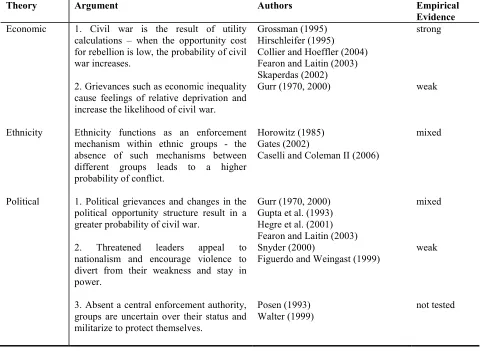
Table 1: Main Theoretical Arguments on Civil War Onset...39
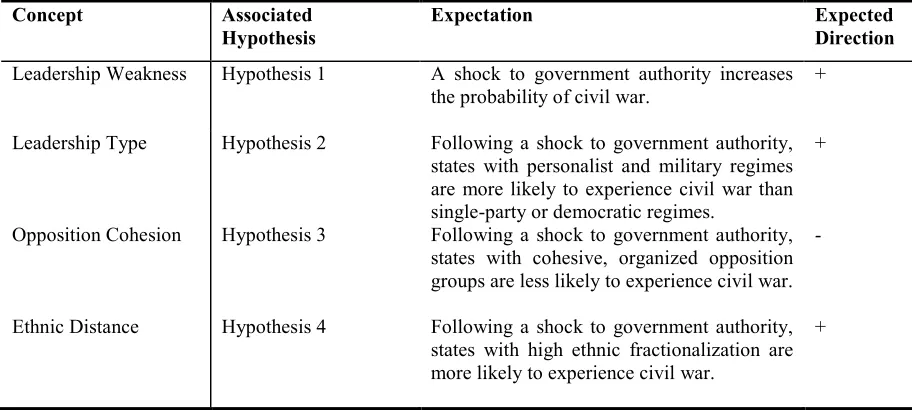
Table 2: Summary of Hypotheses...65
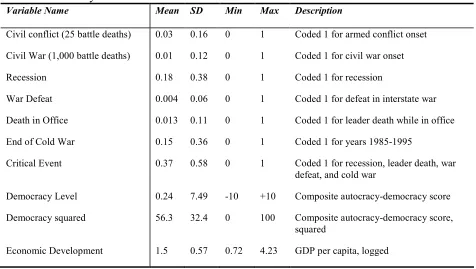
Table 3: Summary Statistics for Variables in the Probit Model ...74
Table 4: Probit Model of Critical Events and Civil War (25 battle-deaths) ...75
Table 5: Summary Statistics for Variables in the Heckman Selection Model...85
v Abstract
This dissertation investigates how political instability is related to the probability of civil war. According to the literature in comparative politics, regime breakdown is caused by critical events such as economic decline, defeat in interstate war, death of a leader in office, or changes is the international balance of power. Drawing on Powell (2004, 2006), I conceptualize such critical events as shifts in the domestic distribution of power that can lead to a bargaining breakdown and, in consequence, military conflict. Following a shock to government capabilities, current leaders and the opposition are bargaining for a share of authority. The government has incentives to grant concessions to other groups within the state, yet such promises are not credible given that the leadership may regain its strength. Similarly, opposition groups lack the ability to make credible commitments as they expect to be more powerful in the future. Both the government and opposition groups could benefit from striking bargains, but cannot credibly commit because of incentives to renege on agreements in the future. Unable to commit, both actors may use force to achieve their preferred outcome. The dissertation then shifts the focus to solutions to such commitment problems. I expect that (1) the institutional structure of government and opposition groups and (2) the distance between groups have important consequences on the range of
feasible agreements during this bargaining process. The arguments are tested in a statistical study of all countries for the 1960-2004 time period and in a small-sample analysis of democratization processes in Algeria and Chile. Findings show that critical events increase the probability of civil war as hypothesized and empirical evidence also provides strong support for the proposed
solutions to the commitment problem.
1 Chapter 1: Introduction
Over the course of his 28-year stay in power, Zimbabwe’s president Robert Mugabe has led his country to the verge of economic collapse. Zimbabwe’s economy has shrunk by one-third since 1999, and disastrous economic policies have resulted in inflation rates exceeding 100,000 percent in early 2008.1 Mugabe’s continued rejection of international pressure for reform turned the country into a pariah in international relations. Amid these destabilizing conditions,
presidential elections were held in March 2008. The contest pitted long-serving autocrat Mugabe against the leader of the main opposition party, Morgan Tsvangirai. Following the election, local democracy advocates projected an election victory for the opposition candidate. The country’s electoral commission, however, failed to publish official results for more than three weeks after the election. Mugabe’s party then offered that he would participate in a runoff election with the opposition leader if neither candidate received an absolute majority in the elections.2 This proposal was swiftly rejected by opposition leaders, who argued that Mugabe’s past history of election rigging made such promises incredible, as the offer was simply a tool to buy more time to distort election results. Over the next few days, reports of violence against opposition
supporters spread in Zimbabwe, seemingly confirming the opposition’s fears.3 Lacking
credibility to negotiate with opposition groups for future influence, the government used force to secure its continued power.
In late 2007, Pakistani opposition leader Benazir Bhutto was killed in a suicide bombing at an election rally. Her death occurred only two weeks before Pakistan’s first democratic
elections since President Pervez Musharraf’s military coup in 1999. With her party leading in the polls, her assassination unleashed street violence and riots with over 50 deaths. Throughout his
1
Angus Shaw, “Zimbabwe Inflation Passes 100,000 Percent,” The Guardian, February 22, 2008.
2
Celia W. Dugger, “Leaders of Ruling Party Say Mugabe Will Fight On,” New York Times, April 5, 2008.
3
2
leadership, Musharraf had repeatedly promised to hold elections and return power to a civilian government, but never put reforms into practice. In November 2007, he proclaimed emergency rule, dismissed all Supreme Court justices, and replaced them with followers when the court challenged his quest for a third term as president. Intended as an attempt to strengthen his waning power, the declaration of emergency rule triggered intense domestic and especially international pressure by Pakistan’s allies, and Musharraf eventually agreed to hold elections in January of 2008. His regime’s credibility, however, was severely tainted, and many doubted his true commitment to reform.4 Immediately following Bhutto’s assassination, supporters of opposition parties instantly blamed members of the military regime for her death. While
responsibility for the attack has not been determined, Bhutto and other observers have criticized her security protection by the government as insufficient in the past.5
The above discussion of recent events in Pakistan and Zimbabwe shows how political instability contributes to the eruption of violence. In both countries, the regimes’ past actions and subsequent credibility problems seemingly contributed to the occurrence of violence at election time. It is the goal of this dissertation to demonstrate that the current events in Zimbabwe and Pakistan are examples of a more general class of events. To develop a general explanation of the consequences of political instability on the occurrence of violence within states, the dissertation asks two key questions.
First, why does political instability increase the probability of civil war? The argument developed here expects that critical events weaken the government’s capabilities and result in bargaining over the future distribution of power. When a shock or critical event weakens the
4
Ironically, Musharraf’s campaign used the slogan “confidence and credibility.”
5
Randall Mikkelsen, “Musharraf: Bhutto Bears Responsibility for Her Death,” Reuters, January 5, 2008,
3
government’s capabilities, neither the current regime nor the opposition can credibly commit to a regime with shared powers. Once domestic authority is challenged through a shock to its strength (such as a change in the international balance of power, economic crisis, war defeat, or the death of a leader), uncertainty over the future distribution of power dominates, and relevant groups in society will compete for a piece of the domestic pie. Although a regime challenged by a shock has incentives to provide concessions to other groups in society, such promises lack credibility, as the regime has incentives to renege since it may regain its strength in the future. Equally, an opposition group can expect to be more powerful in a future government, thus also having incentives to renege on agreements in the future. Commitment problems experienced by government and opposition groups thus increase the risk for bargaining failure and, in consequence, civil war.
Second, how can actors solve the commitment problem caused by political instability? To develop solutions to the commitment problem, variations in the type of government and
opposition group are analyzed. In particular, it is expected that (1) the institutional structure of the government, (2) the cohesiveness of opposition groups, and (3) the distance between actors influences their ability to make credible commitments. First, leaders in authoritarian regimes that rely on a small group of supporters and are therefore more likely to be punished when challenged will face greater difficulty in making a commitment to peaceful settlements than other
4
Cohesive, hierarchical organizations are better at in-group policing and can therefore coerce more radical opposition members and enforce compromises (Fearon and Laitin, 1996: 715-35). In addition, linkages with existing social institutions such as the church or unions make it easier for opposition movements to keep extremists at bay (Kalyvas, 2000). Finally, groups with divergent preferences will have greater difficulty at making credible commitments. Ethnic divisions, for example, can result in competing preferences over possible agreements and will therefore reduce the possibility of credible and peaceful negotiation.
The dissertation develops important insights for international organizations and
policymakers engaged in the areas of democracy promotion, state failure, and conflict resolution. Civil wars are the most common form of military conflict today, cause tremendous suffering, and have the potential to undermine regional stability (Sambanis, 2002). In addition, democratization and regime transitions more generally have attracted increasing interest in the international community. The dissertation’s focus on the conflict-exacerbating effects of political instability, therefore, is of great importance for the international community. By demonstrating what types of actors or mechanisms are susceptible to the risk of violence change, this research will help in identifying the set of cases in which political instability will be most dangerous, and
precautionary measures by international actors can be taken.
The arguments developed in the dissertation fit into the broader literature on the relationship between political instability and civil war. Three different arguments can be
5
change represents a change in states’ opportunity structure and thus provides incentives for violent mobilization. A second explanation argues that diversionary tactics prompt leaders’ use of domestic violence (Snyder, 2000; Figuerdo and Weingast, 1999). Threatened leaders incite nationalist violence in order to deflect challenges to their power. Third, the security dilemma has been applied to the domestic sphere (Posen, 1993; Walter, 1999). When domestic authority breaks down, uncertainty and fear trigger militarization and the occurrence of conflict.
The dissertation makes two important improvements to the literature on the political causes of civil war. First, current arguments suffer from endogeneity problems. Regime change, democratization, or the collapse of government authority may already entail the use of force. For example, violence is common in coup d’états, which clearly represent instances of regime change. The critical events (such as economic crisis or leader death) emphasized in the
theoretical argument and operationalized in the empirical section avoid endogeneity problems. While critical events function as triggers of the bargaining process between government and opposition, they do not include the use of force between domestic groups. Second, existing arguments fail to explain why actors choose violence – a costly and risky strategy – over the peaceful negotiation of agreements (Fearon, 1995). The bargaining argument developed here lays out how rapid power shifts can result in bargaining inefficiencies and conflict, thus
demonstrating how instability can lead to violence among rational actors (Fearon, 1995; Powell, 2004).
6
are valuable in the sense that they can tell us which states are expected to have a higher baseline probability of civil war, they do not explain why countries move from peace to war. An analysis of critical shocks (such as economic crisis, the death of a leader, or defeat in interstate war) identifies events that help understand a shift from a stable equilibrium to war.
Second, the argument shows that shocks to government capabilities represent a shift in the domestic distribution of power and thus provide a valuable empirical referent for the commitment problems described in Powell (2004, 2006). Economic decline, the death of a leader, defeat in war, and changes in the international balance of power are identified as events leading to regime weakness, and, in consequence, civil war. Identifying critical events as rapid power shifts helps specify the micro-foundations for the inefficient use of force and avoids “black-boxing” these changes (Powell, 2004: 237).
Third, while work on commitment issues provides a compelling explanation of interstate or intrastate war occurrence, it does not lay out the conditions under which actors can avoid such inefficiency. As outlined above, the dissertation expects that variations in the type of government and opposition group influence actors’ ability to make credible commitments. Identifying
solutions to the commitment problem has important consequences for international organizations and policymakers alike.
The remainder of the dissertation proceeds as follows. Chapter two provides an overview of existing explanations of civil war onset. To place the central questions of this dissertation within previous research, economic, ethnic, political, and bargaining theories on the occurrence of civil war are reviewed in this chapter. Since the dissertation puts forward a political
7
argued to explain the relationship between regime change and conflict. Secondly, research has analyzed situations of government collapse as an intrastate security dilemma. Finally,
diversionary-conflict arguments claim that leaders divert from their temporary weakness by engaging in violence at the domestic level. After assessing the strengths and weaknesses of each approach, I develop an argument based on a commitment problem between the incumbent regime and opposition groups. To place the argument into the larger literature on commitment problems, I assess recent work in this area.
Chapter three presents a detailed account of the two-sided commitment problem that arises following shocks to domestic authority. When a critical event such as economic decline, defeat in interstate war, the death of a leader, or a change in the international balance of power threatens the domestic equilibrium, the incumbent regime and opposition groups will bargain for a share of authority. However, neither the current leadership nor opposition groups can credibly commit to peaceful agreements following such events. The incumbent regime, while having incentives to buy off the opposition, cannot credibly grant concessions since it expects to regain its strength in the future. Opposition groups, on the other hand, may expect to become more powerful in the future, and thus have incentives to renege on agreements. Lacking the ability to credibly commit to negotiated agreements, both actors have the option of using force to achieve their most favorable outcome.
8
commitments. Specifically, I argue that military and personal regimes have smaller winning coalitions than single-party or democratic regimes and are therefore less credible when
threatened in their power. Military and personalist dictators cannot easily extend their circle of supporters and therefore have little to offer when their power is challenged. Unable to credibly grant concessions, leaders of such regimes are therefore more likely to use force. For the
opposition, groups possessing strong, hierarchical organizational structures will better be able to police demands by radicals, thus enhancing their credibility and reducing the potential for
violence. Finally, greater distance between groups in society (arising because of ethnic, religious, or ideological differences) reduces the range of acceptable agreements and thus makes peaceful agreements less likely.
Chapter four provides a statistical test of the commitment problem outlined in the previous chapter. The empirical implications of the hypotheses are tested in a cross-sectional dataset including all leaders for the 1960-2004 period. The dataset includes information on all types of critical events during the time period analyzed, as well as information on the
institutional structure of actors and the distance between them. Results show that critical events increase the risk of civil war as hypothesized, and this result is consistent across different model specifications. Economic decline, war defeat, and changes in the international balance of power lead to an increased probability of civil war onset.
9
established opposition parties have a reduced risk of civil war onset. Finally, countries with greater ethnic diversity have increased probabilities of civil war, confirming the hypothesis on the distance between actors.
Chapter five provides a more detailed historical account of the theoretical expectations by examining transition processes in Algeria and Chile. The case studies focus on variation in the organizational structure of opposition groups for two reasons. First, little research on opposition groups in authoritarian regimes exists, despite the fact that such groups operate in many
noncompetitive regimes. Second, the cohesion of opposition groups is a concept that is difficult to measure in a large-N quantitative analysis. While the statistical results support the theoretical argument, detailed process-tracing of historical cases allows for a more accurate
operationalization of the concept. Therefore, I chose cases that exhibit variation in the
organizational structure of opposition groups, but are similar in the other independent variables emphasized in the theoretical section.
10
was unable to define itself as a unified and credible alternative to the authoritarian regime. Fearful that the opposition movement would renege on its commitment to a democratic regime and establish an Islamist state, the military canceled election results and took up arms against the Islamists. In addition, the FIS failed to establish coalitions with other opposition parties (Roberts, 1994a; Martinez, 2000). Conversely, opposition groups in Chile were able to overcome divisions and polarization that had brought the country to the brink of civil war in the early 1970s.
Socialist groups, long beset by internal tensions, united behind a moderate message after a failed coup attempt on Pinochet’s life. This development opened up the door for negotiations with Christian Democrats. Parties in the center and on the left eventually formed a united, cohesive coalition against the military regime. Moreover, party ties to the Catholic Church and unions also facilitated the emergence of a unified opposition. The Church, while traditionally closer to the Christian Democrats, attracted Socialists because of its engagement in human rights issues. Chile’s peaceful transition to democracy in the late 1980s thus can be credited to the unified appearance of opposition elites, which signaled credibility to the incumbent military leadership.
11 Chapter 2: Literature Review
Do shocks to the government increase the probability of violent internal conflict? If so, how can actors avoid the onset of violence following a weakening of the government? To place the central questions of this dissertation within previous research, existing theoretical
explanations on the occurrence of civil war are reviewed in this chapter. The chapter proceeds in six sections. The first section analyzes the intersection of international relations and comparative politics with respect to the study of civil war. The second section addresses theoretical and methodological challenges in the civil war literature. The subsequent three sections summarize economic, ethnic, and political explanations of civil war.6 Multiple theoretical explanations and a large body of empirical research exist on the causes of civil wars (Sambanis, 2002). Since this dissertation puts forward a political explanation of civil war onset, such theoretical accounts are reviewed in more detail. Bargaining theories and their applicability to the study of internal conflict are the subject of the sixth section of this chapter. A final section summarizes the main theoretical approaches and addresses linkages to the theoretical argument developed in the subsequent chapter.
The Intersection of International Relations and Comparative Politics in the Study of Civil War
Academic interest in civil wars has increased exponentially since the end of the Cold War. While scholars in comparative politics have long studied insurgency and political violence at the domestic level - such as revolutions, social movements, riots, and other forms of protest - the last two decades have witnessed increasing contributions by international relations scholars. Traditionally focused on military conflict between states, international relations researchers have
6
12
extended their research to explanations of violence within states, thereby challenging the traditional distinction between comparative politics and international relations.
Traditionally, the study of international politics has concentrated on relations between sovereign states and their interactions, while comparative politics engages in the comparison of states’ domestic structures. Recent developments within both research areas, however,
increasingly question the validity of this demarcation line. First, international relations scholars today explicitly consider the influence of domestic factors on the relations between states. This shift is evident in research on the democratic peace or economic interdependence, which stresses the influence of domestic political institutions and economic structures on the relations between states (Oneal and Russett, 2001). Similarly, comparative scholars now acknowledge the impact of international factors on the domestic structure in areas as diverse as democratization,
globalization, and the emergence of the state system (Gourevitch, 1978). Second, the anarchy assumption, often argued to be the main primary boundary line separating domestic and international politics, has been questioned by critics such as Milner (1991). Neorealist theory argues that anarchy at the international level results in decentralized competition among sovereign equals, where the absence of centralized control results in a self-help system with states relying on the use of force for survival (Waltz, 1979). Yet this argument neglects the fact that groups - at times violently - compete for power in the domestic sphere. The occurrence of civil wars, for example, demonstrates that anarchy does occur at the domestic level.
13
to address the question of how and why rebel groups emerge and survive (Gates, 2002). Second, anarchy is not a constant condition at the domestic level. This limits the applicability of
international relations theories such as neorealism, which assumes a permanently unregulated environment in the international system (Waltz, 1979). As such, research on civil wars, unlike that on international relations, needs to consider the conditions leading to the breakdown of order.
Theoretical and Methodological Issues in the Study of Civil War
Before proceeding to an evaluation of theories of civil war onset, I present a brief outline of challenging theoretical and methodological issues in the civil war literature. Among
theoretical approaches, one can distinguish between macro- and micro-level explanations, with the main emphasis until recently on macro-level arguments.7 Examples of such macro-level theories of internal conflict are approaches stressing the importance of political or economic grievances or ethnic divisions (Gurr, 2000; Horowitz, 1985). Yet such approaches leave questions on individuals’ motives and actions largely unaddressed – why, for example, do individuals take the risk of joining rebellion, and how is violence sustained over time?
Recent research by Kalyvas (2006) and Gates (2002) has started to fill in these gaps. Kalyvas (2006) explores the logic of violence in civil wars at the individual level. In his
argument, actors use selective violence because it functions as a powerful deterrent, as it creates the perception that actors can monitor and sanction behavior. Using selective violence, however, is costly since it requires verifying of collaborators’ information. Random violence, while less
7
14
difficult and costly to use, cannot induce compliance. It is therefore used only when selective violence is infeasible. A combination of quantitative and qualitative data on the Greek civil war is used to test his arguments, and results show that the type and level of violence used varies as a result of change in actors’ control over territory. Gates (2002) examines (1) why individuals make the costly decision of joining a rebel group and (2) why they remain members of the group despite having to engage in violence and endure personal hardship. Gates concludes that
geographical proximity, shared ethnicity, and a common ideology are mechanisms facilitating compliance and enforcement in rebel organizations.
In addition, bargaining theories of war provide theoretical accounts that help understand individuals’ actions. By emphasizing the strategic nature of civil war, they explicitly focus on the motivations of actors and the interactions between them. Informational approaches, for example, outline how actors in civil war have incentives to misrepresent their own capabilities and resolve to gain a military advantage (Fearon, 1995, 2004). Economic models of civil war have stressed the opportunity costs of rebellion, where the availability of rents (such as natural resources, foreign aid, or donations from diasporas) and the capacity of the state influence individuals’ decisions to rebel (Collier and Hoeffler, 2004; Fearon and Laitin, 2001; Skaperdas, 2002).
two-15
volume collection of case studies that provides a systematic application of the Collier and Hoeffler (2004) model of civil war onset. A focus on individual cases allows for an
understanding of the dynamic and strategic nature of civil war and does not constrain its focus to variables that change little or not at all over time. However, a drawback of this approach is the limited generalizability of case studies.
A second solution would be to use data more appropriate for micro-level arguments. Cunningham et al. (2007), for example, take the strategic nature of civil war seriously when modeling it as a dyadic phenomenon between a state and a rebel actor. The authors investigate the effect of rebel strength, group location, and alternative means of participation on civil war duration. Yet a shortcoming of this approach is that it does not allow studying civil war onset – how can one know ex ante which group will rebel against the state? Also, since the onset and duration of conflict may not be independent events, such analyses may suffer from selection bias (Lemke and Reed, 2001). Data collected by the Minorities at Risk (MAR) project provide
another possible alternative, as they allow one to model empirically interactions between the state and minority groups. Since not all internal conflict is ethnically motivated, however, this approach might leave out a large number of potentially relevant cases.
Economic Theories of Civil War
16
Studies by Grossman (1995) and Hirschleifer (1995) mark the beginning of the use of rational choice theories in the study of civil war. Both see civil war as a result of economic tradeoffs by actors, where the expected utility gained from conflict influences the decision to rebel.
Hirschleifer (1995) argues that parties calculate potential net benefits from a conflict and engage in it when a successful outcome is likely. Grossman (1995) models rebellion as an industry that generates profits from looting and that is motivated by greed. When the opportunity of rebellion seems profitable, it will not be passed up.
Both Collier and Hoeffler (2004) and Fearon and Laitin (2003) argue that the expected gains from rebellion influence actors’ decisions regarding violence. In Collier and Hoeffler’s (2004) model, the opportunity costs of rebellion determine the demand and supply of civil war. Countries with low levels of per capita income have a higher probability of civil war since the opportunity costs for rebellion are small. In addition to income and development levels, the opportunity cost of rebellion is also influenced by the availability of natural resource extortion, donations from diasporas, and subventions to rebel movements from hostile foreign
governments. Testing these expectations against country-level data, the authors find support for their greed-based explanation. Fearon (2004) and Ross (2004), however, are critical of the authors’ measure of natural resources, which is operationalized as the ratio of primary
commodity exports to GDP. As Fearon (2004) points out, oil is the major component of primary commodities. He argues that oil increases the risk of civil war because oil producing states exhibit lower state capacity, and not because it is used to finance rebellion.8
8
17
Fearon and Laitin (2003) expect that the size and likelihood of insurgency is influenced by the opportunity for insurgency and the government’s response to insurgents. Opportunities for rebellion are greater when rebels are able to hide from the government (such as in rough terrain or mountainous areas), when they receive support from foreign actors, or when the local population supports the rebels. The government’s ability to contain insurgencies is a function of its strength, which Fearon and Laitin (2003) see influenced by income levels, the degree of political stability, and whether or not states are oil exporters. Empirical tests show that per capita income strongly increases the probability of civil war. In addition, newly independent states and states experiencing political instability are at greater risk of civil war. Finally, Fearon and Laitin (2003) also show that states in which oil revenue produces more than one-third of all export revenue are more likely to be involved in civil conflict.
18
Apart from economic approaches based on rational-choice theories, scholars have emphasized the importance of economic grievances and their effect on rebellion. Gurr (1970, 2000) sees relative deprivation as a primary cause of violence, and feelings of deprivation are influenced, among other factors, by economic inequality. In this model, relative deprivation results from a discrepancy between perceived rewards and actual rewards. Violence is
subsequently triggered by changes in the perceived level of income compared to people’s actual income level. Empirical evidence for the expected relationship between inequality and civil war is inconsistent at best. Collier and Hoeffler (2004) and Sambanis (2004b) find no support for the conflict-exacerbating effect of inequality on civil war. More recently, research has suggested that this non-finding may be the result of an indirect relationship between economic inequality and internal conflict (Cramer, 2003; Sambanis, 2004b; Alesina and Perotti, 1996). Sambanis argues that inequality may result in greater political instability, which has been shown to influence civil war likelihood and thus indirectly influences the risk of violence. Similarly, Alesina and Perotti (1996) argue that inequality can lead to violence through political effects. In unequal
democracies people push for greater redistribution, which consequently discourages investment, hampers growth, and thereby increases the chances of domestic violence. The evidence
supporting this conjecture remains inconclusive. These expectations, however, have not been subject to thorough empirical testing.
Ethnicity and Civil War
19
the development of trust, and facilitate coordination and enforcement of agreements within the group. A similar argument is developed by Gates (2002), who expects that shared ethnicity contributes to rebel groups’ ability to motivate and sustain participation. While Gates (2002) also considers geographic proximity and shared ideology, he thinks of ethnicity as the strongest mechanism. Ethnic identity cannot be changed easily and thus carries a lower risk of defection. Ethnicity, therefore, facilitates intra-ethnic cooperation, but makes the negotiation of conflicts between different ethnic groups – lacking trust and coordination and enforcement mechanisms - more difficult.
Caselli and Coleman II (2006) provide an explanation of ethnicity and conflict that conceptualizes society as group competition over the control of wealth-creating assets. Groups that succeed in controlling the country’s riches will suffer from infiltration by joiners who attempt to free-ride on the group’s efforts. Absent easy detection of such free-riders, the group faces the dilution of benefits provided to its members. However, in societies with ethnic
heterogeneity, groups and coalitions can be formed along ethnic lines. Ethnicity then functions as a marker for identifying infiltrators and lowers the cost of enforcement. Group competition over resources will therefore be more intense in ethnically diverse societies, resulting in a greater probability of civil war in such countries.
20
Data on ethnic polarization (measuring the size of groups and the nominal distance between them) presented in Reynal-Querol (2002) and Montalvo and Reynal-Querol (2005) show that such societies indeed are at a greater risk of civil war. Their research argues that the greatest risk of conflict occurs at a critical threshold of ethnic polarization, when societies are dominated by two large ethnic groups. Highly fractionalized societies incur a lower risk of civil war as coordination costs for rebellion are higher.
Blimes (2006) presents a different explanation for the inconclusive findings on ethnicity and civil war. He argues that ethnic diversity does not present a constant cause for conflict and affects conflict only indirectly. Ethnicity becomes salient only when other causes of civil war are present, such as a weakening of the state or low economic development. Using a heteroskedastic probit model, Blimes (2006) shows that ethnic fractionalization and ethnic dominance increase the probability of civil war when other variables known to increase the likelihood of civil wars are present. Finally, some authors have argued that non-findings on ethnicity may be a function of a more fundamental difference between ethnic and non-ethnic civil wars (Sambanis, 2001, 2004a). According to this view, ethnic wars arise over issues related to ethnicity. Ethnic diversity lends itself to manipulation and can be used to generate collective action. For this reason, ethnic diversity increases the probability of ethnic wars, but does not affect the likelihood of civil wars lacking an ethnic component.
Political Explanations of Civil War
21
relations literature. Authors have emphasized the role of political grievances and opportunity structures, elite persuasion tactics, and the security dilemma. In addition to research in
international relations, an extensive literature on regime change, revolutions, and other forms of protest exists in the field of comparative politics. While most authors do not explicitly address the issue of violence during these processes, I will review research to the extent that it informs the research questions posed here.
The first group of arguments in the international relations literature highlights political grievances and opportunity structures as determinants of civil war. Focusing on opportunity structures and grievances, Lichbach (1987) expects that dissident groups will substitute violent protest for nonviolent protest depending on the state responses of repression. Groups will pursue the most effective strategy as a function of the state’s response. If the state represses in response to nonviolent behavior, groups will choose violence. If the state, however, represses violent behavior, movements will switch to nonviolent forms of protest. Gupta et al. (1993) add a
22
Building on work by Lichbach (1987) and Gupta et al. (1993), Hegre et al. (2001) argue that the probability of violence will depend on the existing level of grievances within a society. Democratic regimes prevent grievances since the expression of needs and demands is guaranteed in the political process. Regimes in the middle of the autocracy-democracy spectrum, however, do not have similar mechanisms and will therefore have greater chances of civil war occurrence. Authoritarian regimes are able to suppress grievances through repression. Combining these expectations, the authors expect a U-shaped relationship between level of democracy and the probability of civil war. In addition to their argument on the level of democracy, Hegre et al. expect that domestic regime change provides an opportunity for dissatisfied groups to struggle against the regime in power. Finally, while authoritarian regimes can curb grievances through repression, they are also less stable than democratic regimes and therefore more susceptible to violent regime transitions. Hegre et al.’s (2001) expectation on the role of regime change is similar to that of Fearon and Laitin (2003: 81), who argue that conditions for insurgency are favorable in situations of “political instability at the center, which may indicate disorganization and weakness and thus an opportunity for a separatist or center-seeking rebellion.” Gurr (2000) develops a related argument, in which civil war is understood as a function of the salience of ethno-political identity, the level of grievances in society, the capacity for mobilization, and opportunities for action. The level of grievances is approximated by the level of democracy, since groups in democratic societies are provided with nonviolent means of conflict resolution.
23
regarding the effect of level of democracy and instability on conflict receive mixed support in other research. Subsequent research has largely confirmed Hegre et al.’s results on the conflict-exacerbating effects of political instability. Fearon and Laitin (2003), Strand (2006), and Hegre and Sambanis (2006) all demonstrate that political instability increases the probability of civil war, thus demonstrating consistency across different model specifications. Results regarding the conflict proneness of semi-authoritarian regimes, however, are not as consistent. Elbadawi and Sambanis (2002) find that the level of democracy influences the risk of civil war, and Reynal-Querol (2002) shows that greater political rights, especially regarding representation, reduce the probability of civil war. Yet Collier and Hoeffler (2004) and Fearon and Laitin (2003) do not find a significant relationship between the level of democracy and the likelihood of civil war. More recently, Buhaug (2006) has shown that the U-shaped relationship between democracy and civil war holds only for insurgencies that target the state. He argues that group capability relative to the state influences whether rebels will target the state or attempt secession. States that are transitional and politically inconsistent will more often face challenges to the government.
24
opportunity for opposition groups, it is not clear why actors would engage in costly civil war, rather than negotiating with the ruling elite (Fearon, 1995).
A second line of arguments in international relations is the diversionary-conflict argument developed in Snyder (2000) and Figuerdo and Weingast (1999).9 Snyder’s “elite-persuasion” argument maintains that threatened elites in democratizing states use nationalist violence as a tool to generate public support and secure their power. According to this view, ethnic nationalism is usually not developed before a political opening occurs. Democratization creates the opportunity for the promotion of exclusionary nationalism and, in turn, civil or
interstate war. Snyder argues that nationalism allows for generating effective collective action on a national scale, yet can be achieved only through the exclusion and repression of some groups in society. Conflict is thus not caused by inherent tensions or ancient hatreds between groups, but is “constructed” by weakened political elites. De Figuerdo and Weingast (2000) argue that people may act irrationally and support civil war when elites manipulate their latent fears. Threatened leaders will exaggerate citizens’ uncertainty about the probability of victimization by another group, and thus motivate the preemptive use of violence.
Such arguments, however, seem based on the irrationality of the masses and a positive level of victimization (Sambanis, 2002). Why should individuals pay the high price of
mobilization for politicians’ selfish objectives absent any preexisting tensions between groups? Elite persuasion arguments, probably for this reason, are often combined with arguments on ethnicity. It seems that such approaches, in order to be compatible with rational behavior, assume that there is preexisting fear and distrust among groups, which can then be utilized by political
9
25
elites.10 In addition, the use of violence is only one of several options leaders may choose to maintain power, and it is not clear why leaders would engage in a risky gamble rather than using repression or offering concessions (Enterline and Gleditsch, 2000). Finally, while elites’
diversionary motives cannot be empirically observed, the argument nevertheless suggests that such strategies are successful in lengthening an embattled leader’s tenure. This expectation, however, is not borne out in recent research on diversionary war (Chiozza and Goemans, 2003; Chiozza et al., 2006). Snyder (2000) finds empirical support for his argument in several case studies, yet this finding suffers from selection on the dependent variable, since only countries in which conflict occurred are analyzed.
A third political explanation of civil war is developed in research on the domestic security dilemma. Influenced by research on the interstate security dilemma, Posen (1993) compares the collapse of multiethnic states to the problem of anarchy in the international realm. Absent domestic authority, he argues, groups provide for their own security, but greater security is perceived as a threat by nearby groups. Actors strive for territorial integrity and political autonomy, yet because of domestic anarchy, they are not granted sovereign status. Similarly, Walter (1999) argues that the breakdown of domestic authority leads to the absence of enforcement and arbitration mechanisms within the state. Absent a central enforcement
authority, groups are uncertain about the future distribution of power. The parties involved may fear that their status will be challenged, or that others may take advantage of the power vacuum, resulting in an intra-state security dilemma. Even if actors prefer to settle conflicts peacefully, they may feel threatened and militarize to protect themselves (Walter, 1999: 262). Approaches emphasizing this security dilemma, however, have not been subjected to thorough empirical
10
26
testing (Sambanis, 2002: 233). In addition, the analogy to the international system suffers from the problem that anarchy is not a constant in the domestic realm and therefore cannot explain why regimes fail in the first place.
I now turn to a discussion of arguments developed in the field of comparative politics, in which I evaluate the literature on regime change and democratization as it relates to the question of violence. A subsequent section discusses research on revolutions and social movements. A final part assesses the small but informative literature on elections and violence.
While most research on democratization does not focus on the question of violence, authors such as Przeworski (1991) and Colomer (2000) include civil war as one possible outcome in their game-theoretic models of democratization. Przeworski’s (1991) model of democratization processes discusses three potential scenarios that affect the outcome of bargaining in transitional democracies.11 First, the distribution of forces (among actors) can be known and unbalanced. In these cases, institutional choice is usually biased toward the interest of a particular person, party or alliance, and they will consequently fail to maintain long-term stability (Przeworski, 1991: 82). Second, the distribution of forces can be known and balanced. Przeworksi (1991) considers this scenario the most unlikely for democratic consolidation. In this setting, civil war is an option available to the parties. Yet, actors may foresee the instability and danger of such situations and therefore negotiate temporal agreements involving suboptimal outcomes. The final scenario concerns cases in which the relation of forces is not known. Przeworski considers these cases the most promising for democratic stability, since uncertainty
11
27
on actors’ strength will induce all actors to support institutions with checks and balances, institutions that provide guarantees against political adversity.12
Colomer (2000), also using a game-theoretic model, sees two possible outcomes to political liberalization. First, groups may compete for mutual elimination, leading to civil war and an eventual victory of one side. Second, actors may foresee the risk of losing the conflict, as well as the level of destruction involved in civil war, and negotiate intermediate agreements between democracy and dictatorship (Colomer, 2000:1). These intermediate agreements, or “semi-democracies,” are Colomer’s (2000) main focus. He argues that such negotiated transitions fall short of consolidated democracy, yet can be beneficial immediately after authoritarian breakups as they avoid the eruption of violent conflict.The absence of
“maximalist” actors (such as radical opposition or radical hardliners) is crucial for the possibility of peaceful agreements. Colomer (2000) identifies three factors that influence the presence of such extremist factions: Relative deprivation, utopian expectations, and restrictive institutions.13 In addition to the models presented in Przeworski (1991) and Colomer (2000), research on the conditions for successful democratization and consolidation can be informative for the research questions analyzed here. Regimes that successfully transition to a stable democratic regime have presumably avoided the risk of violence. Burton et al. (1992) emphasize the importance of elite settlements for democratization success. The authors contend that such settlements enable peaceful competition among elites and allow for the eventual emergence of stable democracy (Burton et al., 1992: 14). This emphasis on elite settlements is similar to other work focusing on the importance of power-sharing and elite pacts (Lijphart, 1999; O’Donnell and Schmitter, 1986;
12
Uncertainty, however, may well have the opposite effect. If the distribution of power and bargaining strength of actors are not known, parties may miscalculate each other’s strength and pursue institutions that will favor their own estimated position. In addition, uncertainty makes it impossible for actors to credibly commit to a certain outcome, and actors cannot anticipate that institutional choices will be abided by on the part of all actors.
13
28
O’Donnell, 1992; Przeworski, 1992). Lijphart (1999) argues that consociational democracy is the best way to successful consolidation. His work also stresses the need for elite negotiation, but it is narrower in its applicability because of its detailed outline for the necessary institutional arrangements. Lijphart’s model of consociational democracy requires the adaptation of certain institutional mechanisms (such as grand coalitions, minority representation), which limits its scope compared to other research focusing on elite agreements.
O’Donnell and Schmitter (1986) argue that elite pacts are important for democratic consolidation as they lay out “rules governing the exercise of power on the basis of mutual guarantees for the ‘vital interests’ of the actors entering it” (O’Donnell and Schmitter, 1986: 37). The authors support this with evidence on Latin American democracies, where countries with pacted transitions were able to withstand authoritarian reversals. In later work, however, O’Donnell (1992) seems more skeptical of pacts as a means to stable democracy. He sees extensive “accordism” as a threat to democratic competition and successful consolidation and argues that such pacted transitions often lead to the slow death of democracy. Yet he also points out that intense elite competition (following democratic ruptures) bears the danger of immediate reversals to authoritarian rule. Striking the right balance between agreement and competition seems to be the difficult task to manage. Przeworski (1992) sees political pacts as a (short-term) solution to the instability and uncertainty arising in democratic transitions. He acknowledges that pacts can offer short-term stability and the protection of embryonic democratic institutions, yet cautions that the long-term consequences of such pacts contradict democratic values.
29
unanswered remains the question under what circumstances actors can find such negotiated solutions. Przeworski (1991) points to uncertainty as a factor, and Colomer (2000) stresses the absence of extremist factions, yet these scenarios remain underdeveloped.
The extensive literature on revolutions and social movements speaks to the question of violence as a response to political change. Structural theories of revolutions dominated the field up until the 1980s. These arguments, often rooted in Marxist theory, emphasize the role of class struggles, state conflicts with elites, and external military competition (Moore, 1966; Skocpol, 1979). This research defines revolutions as major transformations of socio-economic and political institutions that are accompanied by class upheavals from below, thus focusing on a small set of “great revolutions” in Europe and Asia (Skocpol, 1979). In addition, the occurrence of violence is an important facet of revolution in structural analyses. Skocpol’s (1979) theory of social revolutions, the seminal work in this research tradition, stresses the importance of
international factors in combination with social transformation and its consequences for mobilization.14 Investigating revolutions in China, France, and Russia, Skocpol (1979) sees revolutions as the result of intense competition for military and economic power with other states, forcing them to undertake costly domestic reforms to increase their competitiveness. In cases where the dominant class had an independent economic base, it opposed reforms, leading to splits in the regime. The landed elite in China and France had no interest in supporting costly armies and extensive bureaucracies, and subsequently overthrew the state. In Russia, conflicts with more powerful adversaries simply crushed the infrastructure of the monarchy, creating a
14
30
massive disgruntled peasant class that eventually mobilized against the regime. While the Russian upper class lacked an independent economic base, the existence of autonomous peasant villages explains the occurrence of revolution in this case.
Yet structural theories came under increasing criticism following a number of revolutions from the 1970s through the 1990s. Revolutions in Iran and Afghanistan, Eastern Europe and the former Soviet Union, as well as anticolonial struggles in the Third World, challenged structural analyses in two ways. First, the class-based understanding of revolutions in structural theories was incapable of explaining multi-class coalitions toppling regimes in a variety of these cases (Goodwin, 1989). As a consequence, researchers studying the more recent revolutions
emphasized the role of individuals for revolutionary mobilization and objectives, thus shifting the focus from structural elements to conscious agency. Wood (2003), for example, provides a micro-level analysis of the peasant insurgency during El Salvador’s civil war. She suggests that two path-dependent processes – patterns of past state violence and the proximity of insurgent forces – created the necessary conditions for peasant mobilization in rural El Salvador. However,
campesinos only mobilized when they also developed emotional and moral commitments to the
cause. Wood (2003) finds that participants in the insurgency differed from nonparticipants in their view of participation as a moral commitment to social justice and as a demonstration of their outrage at government authority.
31
label “contentious politics” (McAdam et al., 2001). In this research, scholars of revolutions and social movements are combining insights from both research areas, realizing that many of the processes underlying them are similar (Goldstone, 2001).
More generally, the social movements literature focuses on the causes of movement mobilization, but – as in research on contentious politics - does not usually distinguish between violent and nonviolent movements. Theoretical arguments on movement formation are similar to approaches emphasizing grievances and opportunity structures (Gurr, 1970, 2000). Early
approaches on grievances were later appended by arguments emphasizing the need for opportunities to rebel. The resource mobilization theory argues that movement formation is a result of changes in the opportunity structure (Jenkins, 1983). Liberalization of an authoritarian regime could function as one such change and result in movement formation as a response to the possibility of renegotiation of authority.
32
Based on a sample of Central American countries, groups successful in the military competition are found to be more likely to do well in post-conflict elections. This evidence seems compatible with Ellman and Wantchekon (2000) and Wantchekon (1999), as voters may support these groups out of a fear of continued violence.
Bargaining Theories of War
While political explanations of civil war in the international relations literature have emphasized opportunity structures, the security dilemma, and elites’ diversionary motives, the argument advanced here analyzes regime change as a bargaining process. Bargaining theories of war have generally analyzed inefficient outcomes (such as war) as the result of informational and/or commitment problems (Fearon, 1995).15 After a brief discussion of arguments
emphasizing informational effects, I will evaluate approaches to the commitment problem in more detail.
In a seminal article, Fearon (1995) analyzes three rationalist explanations for war, one of which highlights informational problems. Bargaining inefficiencies arise when actors have private information on their payoffs to prevailing in a conflict and have incentives to hide this information (since it can provide a military advantage during confrontation). These incentives to misrepresent can make bargaining difficult and undermine nonviolent signaling. The use of force, while inefficient, can function as a credible means of revealing private information on capabilities, thereby facilitating a war-ending agreement. Work on informational problems has flourished over the past decade. Yet, as Fearon (2004) and Powell (2004) point out,
informational problems provide a poor account of prolonged conflict. One potential explanation
15
33
for this can be found in Goemans (2000) analysis of war duration and termination. Goemans (2000) argues that battle victories increase leaders’ demands and elites’ expectations therefore fail to converge.
Commitment problems are the second cause for inefficient outcomes in the bargaining literature. Recent research by Powell (2004, 2006) shows that issues as diverse as war,
secessionist conflicts, civil war resolution, public debt, inefficient democratic decision-making, and administrative ineffectiveness can be understood in terms of a commitment problem. In all instances, actors fail to locate more efficient solutions to the bargaining problem at hand and are therefore left with a suboptimal provision of the good, or “pie,” in pursuit. This inefficiency is explained by the inability of involved actors to credibly commit to an agreement, since they may have incentives to renege and thus gain from defection.
In an article focused primarily on conflict between states, Fearon (1995) identifies three types of commitment problems arising in (1) preventive wars, (2) preemptive attacks resulting from first-strike attacks, and (3) wars involving issues that impact future bargaining power.16 In an application to interstate war, Powell (2006: 169) extends this research by indicating a
common mechanism in all three scenarios. Large and rapid shifts in the distribution of power create a commitment problem and therefore increase the risk of war. Following a power shift, a weakened state must offer concessions large enough to deter its strengthened opponent, yet such offers are not credible given that the state may regain its strength in the future. Fearon (1996) shows that commitment problems arise when objects in dispute are determinants of future
16
34
bargaining power. States may prefer fighting in the present if committing to a settlement could decrease their bargaining leverage in the future.
Also focusing on interstate relations, Prins and Daxecker (2008) argue that commitment problems hinder rival states from terminating costly and competitive relationships. Rivalry is characterized by fear and mistrust, and rival states fail to reach mutually beneficial agreements out of fear of reneging. The authors argue that the adoption of liberal institutions such as democracy or membership in international organizations should help overcome fears of future exploitation and solve the commitment problem. Results show that the combined effect of democracy and development, change to democracy, and membership in international organizations that include dispute-settlement mechanisms increase the probability rivalry termination as hypothesized. Research by Bapat (2006) analyzes bargaining between states and terrorist organizations as a commitment problem. He expects that states’ ability to monitor agreements and impose moderate costs on terrorist groups increases the chances for negotiated settlements. In an analysis of terrorist events from 1968 to 1991, he shows that host governments that impose costs that are neither too low nor too high are more likely to form credible
commitments.
35
Analyzing civil war termination, Walter (2002) argues that civil war settlements fail frequently because of an inability of participants to commit to the terms of the agreement. This is because the demobilization of military forces as well as the future distribution of power within the state is not yet consolidated when settlements are signed. Combatants, therefore, have incentives to renege on the terms of a settlement, since they may fear the use of military force or attempts to gain hegemonic control by the opponent. Solutions to the commitment problem, in consequence, will depend on the adoption of power-sharing agreements as well as the presence of third-party actors. Guarantees of power-sharing and third-party support will reduce actors’ fears of exploitation and therefore increase the likelihood of a peaceful civil war settlement. Walter’s (2002) arguments are supported in a quantitative analysis of the post-WWII era and an in-depth study of two cases. Using data on 72 civil wars for the 1940-1992 period, she shows that third-party guarantees and power-sharing pacts were crucial for the peaceful implementation of settlements to the war. An analysis of the negotiating process during Zimbabwe’s and
Rwanda’s civil wars shows that post-treaty security questions played an important role for successful settlements. The UN’s failure to extend third-party support as promised, then, explains the tragic breakdown of the peace process in Rwanda.
Finally, regime change itself has been analyzed as a commitment problem (Nalepa, 2005; Acemoglu and Robinson, 2001). Acemoglu and Robinson’s work on political transitions
36
tax policy. When economic conditions are bad and the poor are in power, they want to offer the rich enough to avoid a coup, but cannot do so since they are unable to commit to future tax rates. The same scenario unfolds when the rich are in power and economic conditions worsen,
resulting in iterations of highly unstable regimes.
A similar picture arises in transitions to democracy and the use of transitional justice against the outgoing authoritarian regime. Nalepa (2005) argues that promises by democrats not to prosecute the old regime are incredible following a transition to democracy, thus resulting in a commitment problem. Once autocrats give up power, they have no guarantee that the new regime will abide by its promises, and such uncertainty should keep them from stepping down in the first place. The above situation can be observed empirically, such as in Hungary’s or Poland’s transition to democracy. Possible sources of credibility, according to the Nalepa (2005), arise from the extent of divisions between Anticommunists and Liberals, collaboration of Liberals with the ancient regime, the likelihood of regime implosion, and public support for transitional justice (Nalepa 2005: 42).
Towards a Dynamic Theory of Civil War
37
2002). While comparative scholars have long studied rebellion, revolutions, or other instances of violence at the domestic level, recent theoretical and empirical contributions by international relations scholars have spurred tremendous development and growth of the field.
Nevertheless, several theoretical and methodological challenges persist. First, unlike wars between states, civil wars lack a stable set of actors. Therefore, researchers need to consider the question of how and why violent opposition emerges, an effort that has begun only recently (Gates, 2002). Second, since the absence of authority is not a permanent condition at the domestic level, the applicability of international relation theories such as neorealism is limited. Finally, a disconnect between theoretical arguments and empirical testing exists. While
economic theories of civil war provide increasingly detailed accounts of individual, i.e. micro-level behavior, much theoretical testing uses states, i.e. macro-units, as the primary units of analysis.
This chapter identifies three distinct explanations of civil war onset. First, economic theories stress the importance of economic cost-benefit calculations or inequality for the onset of civil war. One set of explanations, based on rational-choice approaches, expects that civil war is the result of utility calculations, where actors weigh the opportunity cost of rebellion (Grossman, 1995; Hirschleifer, 1995; Collier and Hoeffler, 2004; Fearon and Laitin, 2003; Skaperdas, 2002). Empirical evidence confirms that countries with low economic development, weak state
38
empirical support, however, has been generated for this argument (Sambanis, 2004b; Collier and Hoeffler, 2004).
Second, ethnic theories argue that while ethnicity functions as a bargaining and
enforcement mechanism facilitating cooperation within groups, the absence of such a mechanism between different ethnic groups increases the probability of conflict (Horowitz, 1985; Gates, 2002; Caselli and Coleman II, 2006). Empirical evidence for a linear relationship between ethnic heterogeneity and civil war, however, is mixed (Fearon and Laitin, 2003; Collier and Hoeffler, 2004). Researchers have developed three explanations to account for this inconsistency. First, Reynal-Querol argues that ethnic polarization rather than diversity in itself increases the
probability of conflict. Secondly, authors have hypothesized a conditional relationship between ethnicity and conflict, where ethnic diversity becomes salient only when other factors increasing conflict propensities are present (Blimes, 2006). Finally, Sambanis (2001, 2004a) expects that a linear relationship between ethnicity and conflict holds only for identity wars, which are believed to be fundamentally different from non-identity civil wars.
39
manipulate people’s fears by appealing to nationalism which in turn leads to violent conflict. While the motives of leaders cannot be subjected to empirical scrutiny, implications of this argument have found little empirical support (Chiozza and Goemans, 2003; Chiozza et al, 2006). Lastly, the security dilemma, prominent in international relations, has been applied to the
domestic sphere (Posen, 1993; Walter, 1999). When domestic authority breaks down, uncertainty among actors triggers militarization and the occurrence of conflict. Such arguments, however, border on tautology as the collapse of the domestic equilibrium is a defining feature of any civil war. One would need to know more on the types of events that cause the breakdown of authority for this approach to be useful.
Table 1: Main Theoretical Arguments on Civil War Onset
Theory Argument Authors Empirical Evidence
Economic 1. Civil war is the result of utility calculations – when the opportunity cost for rebellion is low, the probability of civil war increases.
Grossman (1995) Hirschleifer (1995) Collier and Hoeffler (2004) Fearon and Laitin (2003) Skaperdas (2002)
strong
2. Grievances such as economic inequality cause feelings of relative deprivation and increase the likelihood of civil war.
Gurr (1970, 2000) weak
Ethnicity Ethnicity functions as an enforcement mechanism within ethnic groups - the absence of such mechanisms between different groups leads to a higher probability of conflict.
Horowitz (1985) Gates (2002)
Caselli and Coleman II (2006)
mixed
Political 1. Political grievances and changes in the political opportunity structure result in a greater probability of civil war.
Gurr (1970, 2000) Gupta et al. (1993) Hegre et al. (2001) Fearon and Laitin (2003)
mixed
2. Threatened leaders appeal to nationalism and encourage violence to divert from their weakness and stay in power.
Snyder (2000)
Figuerdo and Weingast (1999)
weak
3. Absent a central enforcement authority, groups are uncertain over their status and militarize to protect themselves.
Posen (1993) Walter (1999)