in the population sciences published by the Max Planck Institute for Demographic Research Doberaner Strasse 114 · D-18057 Rostock · GERMANY www.demographic-research.org
DEMOGRAPHIC RESEARCH
VOLUME 5, ARTICLE 3, PAGES 65-78
PUBLISHED 05 OCTOBER 2001
UPDATED 04 DECEMBER 2001
www.demographic-research.org/Volumes/Vol5/3/
DOI: 10.4054/DemRes.2001.5.3
Demographic trends in Sweden:
Childbearing developments in 1961-1999,
marriage and divorce developments in
1971-1999
Gunnar Andersson
Liu Guiping
Summary A 2
Fluctuating fertility in Sweden… A 2
… and yet another turning point in 1997 A 2
Long-term decline in the propensity to get married - but an unexpected trend reversal in 1999
A 3
Continued increase in Swedish divorce risks A 3
Concerning our investigation A 3
References A 5
Demographic trends in Sweden:
Childbearing developments in 1961-2000,
marriage and divorce developments in 1971-1999.
Gunnar Andersson 1
Liu Guiping 2
Abstract
In the present note, we display the main features of recent trends in family-demographic behavior in Sweden. We update previously published indexes of marriage, divorce, and childbearing risks by calendar year in order to cover the developments up to 1999 (marriage and divorce) and 2000 (childbearing), adding another two and three years of observation to our series.
1 Max Planck Institute for Demographic Research, Doberaner Straße 114, D-18057 Rostock, Germany.
Email: [email protected]
2 Max Planck Institute for Demographic Research, Doberaner Straße 114, D-18057 Rostock, Germany.
Summary
The latest decline in Swedish birth rates, initiated at the beginning of the 1990s, eventually came to a halt at the end of the same decade. For mothers at all parities and for childless women in their 30s, trends were reversed into clear increases in birth propensities in 1998-2000. In 2000, trends were also reversed for childless women at the younger ages. Marriage propensities as well show a trend reversal in the last year of
the 20th century in that they increased for women at all parities and non-married
civil-status categories. The long-term trend of increasing divorce risks continued uninterruptedly in 1998 and 1999.
Fluctuating fertility in Sweden…
Childbearing trends in Sweden have been highly volatile throughout the four last
decades of the 20th century. First-birth fertility of younger women (16-28 years)
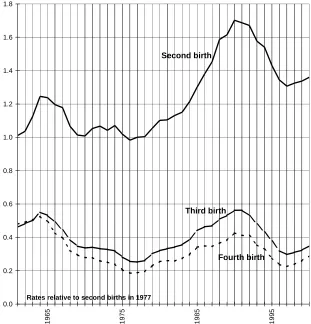
decreased continuously from the mid-1960s to the mid-1980s. This decline was followed by a marked increase in first-birth fertility of older women, together reflecting a general postponement of the entry into motherhood in Sweden (Figure 1). During the baby boom period of the 1980s, birth propensities also increased strongly for mothers at different parities (Figures 2-3) – as well as for the younger childless. By contrast, the 1990s instead display strong declines in birth risks. As in the 1980s, these trends were followed by practically all demographic sub-groups of women. The declines were strongest in first-birth risks of younger women and in third- and fourth-birth risks while the decline in first-birth risks of older women was rather unimportant.
… and yet another turning point in 1997
different subgroups of Swedish women, revealing that important changes have occurred recently in the childbearing dynamics.
Long-term decline in the propensity to get married - but an
unexpected trend reversal in 1999
During the 1970s, the propensity for Swedish women to marry decreased dramatically and it has continued to decline ever since, though at a much more moderate pace (Figure 4). In sharp contrast to this long-term trend, we find a spectacular but temporary increase in marriage-formation risks in 1989 in response to the introduction of new rules concerning the eligibility for a future widow’s pension. Interestingly, we find another trend reversal exactly ten years after 1989 but this time at a much smaller scale. Marriage propensities increased slightly in 1999 for never-married women at all parities (Figure 5) as well as for first-divorced women with different categories of children (Figure 6). We have no idea if it this time merely was the turn of the century that stimulated more people to arrange for a marriage or if this latest trend reversal reflects some other underlying change in behavior.
Continued increase in Swedish divorce risks
The divorce risk increased sharply in 1974 in response to liberalizing changes that became effective in the divorce legislation that year. From the end of the 1980s, divorce risks have increased again but this time on a more regular basis (Figure 7). The increase in 1974 was mainly due to an increased propensity for divorce among childless women, while the increases from the late 1980s onwards instead were due to increasing divorce risks of mothers (Figure 8), who constitute the vast majority of married women. The trend of increasing divorce risks went on also during the last two years of the last decade.
Concerning our investigation
to form a marriage, to divorce, or to give birth in a specific calendar year. The indexes are given relative to a suitable baseline year in the same manner as a price index reflects prices relative to a selected year. A divorce index of 1.20, for example, means that the risk of divorce was 20 percent higher in that year than in the baseline year we use. In our calculations, we standardize for the effect of a number of demographic background variables, which means that we control for the effect of compositional changes among women over the categories of these variables. We focus explicitly on the effect of the number of children on the demographic behavior in that we present separate indexes for women at different parities.
References
Andersson, G., 1997. The impact of children on divorce risks of Swedish women.
European Journal of Population 13: 109-145.
Andersson, G., 1998. Trends in marriage formation in Sweden 1971-1993. European
Journal of Population 14: 157-178.
Andersson, G., 1999a. Childbearing trends in Sweden 1961-1997. European Journal of
Population 15: 1-24.
Andersson, G., 1999b. Trends in childbearing and nuptiality in Sweden, 1961(71)-1997.
Stockholm Research Reports in Demography, No. 133. Stockholm University
Demography Unit. Also in: Andersson, G., Trends in Childbearing and
Nuptiality in Sweden: A Period Analysis. Stockholm University Demography
Figure 1: Annual index of first-birth rates. Swedish childless women, 1961-2000, by group of ages, standardized for exact age.
0.0 0.2 0.4 0.6 0.8 1.0 1.2 1.4 1.6 1.8
1965 1975 1985 1995
Rates relative to rates of younger women in 1977
Ages 31-43
Figure 2: Annual index of second-, third-, and fourth-birth rates. Swedish mothers, 1961-2000, by birth order, standardized for age of mother and age of her youngest child.
0.0 0.2 0.4 0.6 0.8 1.0 1.2 1.4 1.6 1.8
1965 1975 1985 1995
Rates relative to second births in 1977
Third birth
Figure 3: Annual index of second-, third-, and fourth-birth rates. Swedish mothers, 1961-2000, by birth order, standardized for age of mother and age of her youngest child.
0.0 0.5 1.0 1.5 2.0 2.5 3.0
1965 1975 1985 1995
Rates relative to 1977 for each birth order (separate models for each order)
Second birth Third birth
Figure 4: Annual index of marriage-risk level. Never-married Swedish women, 1971-1999, standardized for parity and age.
0 0.5 1 1.5 2 2.5
1971 1975 1979 1983 1987 1991 1995 1999
Figure 5: Annual index of marriage-risk level. Never-married Swedish women, 1971-1999, by parity, standardized for age.
0 0.5 1 1.5 2 2.5
1971 1975 1979 1983 1987 1991 1995 1999
R i s k s r e l a t i v e t o o n e - c h i l d m o t h e r s i n 1 9 8 0
parity 0
parity 1
parity 2
Figure 6: Annual index of remarriage-risk level. First-divorced Swedish women, 1971-1999, by parity, standardized for age and time since divorce.
0 0.5 1 1.5 2 2.5 3 3.5 4
1971 1975 1979 1983 1987 1991 1995 1999
Risks relative to "child from prev. marr. / no new child" in 1980 no child
child from previous marr. / no new child
Figure 7: Annual index of divorce-risk level. First-married Swedish women, 1971-1999, standardized for age at marriage, parity, age of youngest child, premarital birth, and duration.
0 0.2 0.4 0.6 0.8 1 1.2 1.4 1.6 1.8
1971 1975 1979 1983 1987 1991 1995 1999
Figure 8: Annual index of divorce-risk level. First-married Swedish women, 1971-1999, by parity, standardized for age at and duration of marriage. Risks for mothers also standardized for presence of premarital children and age of youngest child.
0 0 . 5 1 1 . 5 2 2 . 5 3
1971 1975 1979 1983 1987 1991 1995 1999
R i s k s r e l a t i v e t o o n e - c h i l d m o t h e r s i n 1 9 8 0
p a r i t y 0
p a r i t y 1
p a r i t y 2
p a r i t y 3