VOLUME NO.6(2016),ISSUE NO.03(MARCH) ISSN 2231-5756
A Monthly Double-Blind Peer Reviewed (Refereed/Juried) Open Access International e-Journal - Included in the International Serial Directories Indexed & Listed at:
VOLUME NO.6(2016),ISSUE NO.03(MARCH) ISSN 2231-5756
CONTENTS
Sr.
No.
TITLE & NAME OF THE AUTHOR (S)
Page
No.
1.
IMPACT OF FACEBOOK USAGE ON STUDENT ACADEMIC PERFORMANCE: THE CASE OF WOLLEGE
UNIVERSITY
V.P.S. ARORA & SARFARAZ KARIM
1
2.
A STUDY ON THE IMPACT OF EMOTIONAL INTELLIGENCE ON QUALITY OF WORK LIFE AMONG WOMEN
EMPLOYEES OF ITES COMPANIES WITH SPECIAL REFERENCE TO SELECTED COMPANIES IN COIMBATORE
DISTRICT
DR. S. GANESAN & SUKANYA.L
7
3.
IMPACT OF VILLAGE INFRASTRUCTURE INITIATED BY KORBA COALFIELDS OF CHHATTISGARH (INDIA) ON
VILLAGERS’ WAY OF LIVING
A S BABU & SUKANTA CHANDRA SWAIN
11
4.
REVENUE MANAGEMENT: A CASE STUDY OF BHARAT SANCHAR NIGAM LIMITED
DR. U. PADMAVATHI
18
5.
DIGITAL MARKETING – WAY TO SIGNIFICANCE
SEMILA FERNANDES & VIDYASAGAR A.
22
6.
PERFORMANCE MANAGEMENT IN SUGAR INDUSTRIES
M. SARADADEVI & K. YASODA
28
7.
FOREIGN DIRECT INVESTMENT INFLOWS, TECHNOLOGICAL INNOVATION, SUSTAINABLE DEVELOPMENT
AND SKILLED HUMAN BEHAVIOR: A MULTIVARIATE GRANGER CAUSALITY STUDY – EVIDENCE FROM
FRANCE
DR. BHUMIKA GUPTA & DR. JASMEET KAUR
32
8.
CONSTRUCTION OF INTER QUARTILE RANGE (IQR) CONTROL CHART USING PROCESS CAPABILITY FOR
STANDARD DEVIATION
DR. C. NANTHAKUMAR & S.VIJAYALAKSHMI
35
9.
EQUITY SHARE PERFORMANCE OF AUTO MOBILE INDUSTRY IN BSE
M. NIRMALA & P. PAVITHRA
39
10.
TURN OF THE MONTH EFFECT IN INDIAN METAL SECTOR WITH SPECIAL REFERENCE TO BSE METAL INDEX
J. SUDARVEL & DR. R. VELMURUGAN
43
11.
ROLE OF MAHILA SAHKARI BANK IN WOMEN EMPOWERMENT
DR. R. P. AGRAWAL & AJITA SAJITH
46
12.
STRESS AMONG IT SECTOR EMPLOYEES
SABARI GHOSH
49
13.
MOBILE BANKING IN INDIA: A COMPARATIVE STUDY ON HDFC BANK AND AXIS BANK
N. NEERAJA
54
14.
LEADERSHIP REQUIREMENTS TO MANAGE GLOBAL BUSINESS
DEEPA NATHWANI
58
15.
A STUDY ON EMOTIONAL INTELLIGENCE AMONG TEACHERS IN PRIVATE SCHOOLS OF DINDIGUL DISTRICT
DR. R. RADHIKA DEVI & SOUNDARYA.N.
63
16.
A STUDY ON CONSUMERS OPINION TOWARDS ECO-FRIENDLY PRODUCTS WITH SPECIAL REFERENCE TO
COIMBATORE CITY
NITHYA M & T. RAHUL PRASATH
67
17.
AN EVALUATION OF SERVICES BY DOCTORS PROVIDED BY PHARMACEUTICAL COMPANIES
MENKA TRIPATHI & DR. PRATIBHA JAIN
74
18.
OPPORTUNITIES AND CHALLENGES TO TOURISM INDUSTRY: A CASE STUDY OF JAMMU AND KASHMIR
MUNEER A KHAN, SHAHNEYAZ A BHAT, SUHAIL A BHAT & MUDASIR AHMAD WAR
79
19.
PERCEPTION OF STUDENT TOWARDS FATE AND LOCUS OF CONTROL AT HIGHER SECONDARY LEVEL: A
STUDY IN PERCEPTION
P. THANGARAJU
83
20.
SOCIO ECONOMIC CONDITIONS OF HANDLOOM WEAVERS: A STUDY OF KARIMNAGAR DISTRICT
ANKAM SREENIVAS & KALAKOTLA SUMAN
85
VOLUME NO.6(2016),ISSUE NO.03(MARCH) ISSN 2231-5756
CHIEF PATRON
PROF. K. K. AGGARWAL
Chairman, Malaviya National Institute of Technology, Jaipur
(An institute of National Importance & fully funded by Ministry of Human Resource Development, Government of India)
Chancellor, K. R. Mangalam University, Gurgaon
Chancellor, Lingaya’s University, Faridabad
Founder Vice-Chancellor (1998-2008), Guru Gobind Singh Indraprastha University, Delhi
Ex. Pro Vice-Chancellor, Guru Jambheshwar University, Hisar
FOUNDER PATRON
LATE SH. RAM BHAJAN AGGARWAL
Former State Minister for Home & Tourism, Government of Haryana
Former Vice-President, Dadri Education Society, Charkhi Dadri
Former President, Chinar Syntex Ltd. (Textile Mills), Bhiwani
FORMER CO-ORDINATOR
DR. S. GARG
Faculty, Shree Ram Institute of Business & Management, Urjani
ADVISORS
PROF. M. S. SENAM RAJU
Director A. C. D., School of Management Studies, I.G.N.O.U., New Delhi
PROF. M. N. SHARMA
Chairman, M.B.A., Haryana College of Technology & Management, Kaithal
PROF. S. L. MAHANDRU
Principal (Retd.), Maharaja Agrasen College, Jagadhri
EDITOR
PROF. R. K. SHARMA
Professor, Bharti Vidyapeeth University Institute of Management & Research, New Delhi
CO-EDITOR
DR. BHAVET
Faculty, Shree Ram Institute of Engineering & Technology, Urjani
EDITORIAL ADVISORY BOARD
DR. RAJESH MODI
Faculty, Yanbu Industrial College, Kingdom of Saudi Arabia
PROF. SANJIV MITTAL
University School of Management Studies, Guru Gobind Singh I. P. University, Delhi
PROF. ANIL K. SAINI
Chairperson (CRC), Guru Gobind Singh I. P. University, Delhi
DR. SAMBHAVNA
VOLUME NO.6(2016),ISSUE NO.03(MARCH) ISSN 2231-5756
DR. MOHENDER KUMAR GUPTA
Associate Professor, P. J. L. N. Government College, Faridabad
DR. SHIVAKUMAR DEENE
Asst. Professor, Dept. of Commerce, School of Business Studies, Central University of Karnataka, Gulbarga
ASSOCIATE EDITORS
PROF. NAWAB ALI KHAN
Department of Commerce, Aligarh Muslim University, Aligarh, U.P.
PROF. ABHAY BANSAL
Head, Department of I.T., Amity School of Engineering & Technology, Amity University, Noida
PROF. A. SURYANARAYANA
Department of Business Management, Osmania University, Hyderabad
PROF. V. SELVAM
SSL, VIT University, Vellore
DR. PARDEEP AHLAWAT
Associate Professor, Institute of Management Studies & Research, Maharshi Dayanand University, Rohtak
DR. S. TABASSUM SULTANA
Associate Professor, Department of Business Management, Matrusri Institute of P.G. Studies, Hyderabad
SURJEET SINGH
Asst. Professor, Department of Computer Science, G. M. N. (P.G.) College, Ambala Cantt.
FORMER TECHNICAL ADVISOR
AMITA
Faculty, Government M. S., Mohali
FINANCIAL ADVISORS
DICKIN GOYAL
Advocate & Tax Adviser, Panchkula
NEENA
Investment Consultant, Chambaghat, Solan, Himachal Pradesh
LEGAL ADVISORS
JITENDER S. CHAHAL
Advocate, Punjab & Haryana High Court, Chandigarh U.T.
CHANDER BHUSHAN SHARMA
Advocate & Consultant, District Courts, Yamunanagar at Jagadhri
SUPERINTENDENT
VOLUME NO.6(2016),ISSUE NO.03(MARCH) ISSN 2231-5756
CALL FOR MANUSCRIPTS
We invite unpublished novel, original, empirical and high quality research work pertaining to recent developments & practices in the areas of Computer Science & Applications; Commerce; Business; Finance; Marketing; Human Resource Management; General Management; Banking; Economics; Tourism Administration & Management; Education; Law; Library & Information Science; Defence & Strategic Studies; Electronic Science; Corporate Governance; Industrial Relations; and emerging paradigms in allied subjects like Accounting; Accounting Information Systems; Accounting Theory & Practice; Auditing; Behavioral Accounting; Behavioral Economics; Corporate Finance; Cost Accounting; Econometrics; Economic Development; Economic History; Financial Institutions & Markets; Financial Services; Fiscal Policy; Government & Non Profit Accounting; Industrial Organization; International Economics & Trade; International Finance; Macro Economics; Micro Economics; Rural Economics; Co-operation; Demography: Development Planning; Development Studies; Applied Economics; Development Economics; Business Economics; Monetary Policy; Public Policy Economics; Real Estate; Regional Economics; Political Science; Continuing Education; Labour Welfare; Philosophy; Psychology; Sociology; Tax Accounting; Advertising & Promotion Management; Management Information Systems (MIS); Business Law; Public Responsibility & Ethics; Communication; Direct Marketing; E-Commerce; Global Business; Health Care Administration; Labour Relations & Human Resource Management; Marketing Research; Marketing Theory & Applications; Non-Profit Organizations; Office Administration/Management; Operations Research/Statistics; Organizational Behavior & Theory; Organizational Development; Production/Operations; International Relations; Human Rights & Duties; Public Administration; Population Studies; Purchasing/Materials Management; Retailing; Sales/Selling; Services; Small Business Entrepreneurship; Strategic Management Policy; Technology/Innovation; Tourism & Hospitality; Transportation Distribution; Algorithms; Artificial Intelligence; Compilers & Translation; Computer Aided Design (CAD); Computer Aided Manufacturing; Computer Graphics; Computer Organization & Architecture; Database Structures & Systems; Discrete Structures; Internet; Management Information Systems; Modeling & Simulation; Neural Systems/Neural Networks; Numerical Analysis/Scientific Computing; Object Oriented Programming; Operating Systems; Programming Languages; Robotics; Symbolic & Formal Logic; Web Design and emerging paradigms in allied subjects.
Anybody can submit the soft copy of unpublished novel; original; empirical and high quality research work/manuscriptanytime in M.S. Word format
after preparing the same as per our GUIDELINES FOR SUBMISSION; at our email address i.e. [email protected] or online by clicking the link online submission as given on our website (FOR ONLINE SUBMISSION, CLICK HERE).
GUIDELINES FOR SUBMISSION OF MANUSCRIPT
1. COVERING LETTER FOR SUBMISSION:
DATED: _____________
THE EDITOR
IJRCM
Subject: SUBMISSION OF MANUSCRIPT IN THE AREA OF .
(e.g. Finance/Mkt./HRM/General Mgt./Engineering/Economics/Computer/IT/ Education/Psychology/Law/Math/other, please specify)
DEAR SIR/MADAM
Please find my submission of manuscript entitled ‘___________________________________________’ for possible publication in one of your journals.
I hereby affirm that the contents of this manuscript are original. Furthermore, it has neither been published elsewhere in any language fully or partly, nor is it under review for publication elsewhere.
I affirm that all the co-authors of this manuscript have seen the submitted version of the manuscript and have agreed to their inclusion of names as co-authors.
Also, if my/our manuscript is accepted, I agree to comply with the formalities as given on the website of the journal. The Journal has discretion to publish our contribution in any of its journals.
VOLUME NO.6(2016),ISSUE NO.03(MARCH) ISSN 2231-5756
NOTES:
a) The whole manuscript has to be in ONE MS WORD FILE only, which will start from the covering letter, inside the manuscript. pdf. version is liable to be rejected without any consideration.
b) The sender is required to mention the following in the SUBJECT COLUMN of the mail:
New Manuscript for Review in the area of (e.g. Finance/Marketing/HRM/General Mgt./Engineering/Economics/Computer/IT/ Education/Psychology/Law/Math/other, please specify)
c) There is no need to give any text in the body of mail, except the cases where the author wishes to give any specific message w.r.t. to the manuscript.
d) The total size of the file containing the manuscript is expected to be below 1000 KB.
e) Abstract alone will not be considered for review and the author is required to submit the complete manuscript in the first instance.
f) The journal gives acknowledgement w.r.t. the receipt of every email within twenty four hours and in case of non-receipt of acknowledgment from the journal, w.r.t. the submission of manuscript, within two days of submission, the corresponding author is required to demand for the same by sending a separate mail to the journal.
g) The author (s) name or details should not appear anywhere on the body of the manuscript, except the covering letter and the cover page of the manuscript, in the manner as mentioned in the guidelines.
2. MANUSCRIPT TITLE: The title of the paper should be bold typed, centeredand fully capitalised.
3. AUTHOR NAME (S) & AFFILIATIONS: Author (s) name, designation, affiliation (s), address, mobile/landline number (s), and email/alternate email address should be given underneath the title.
4. ACKNOWLEDGMENTS: Acknowledgements can be given to reviewers, guides, funding institutions, etc., if any.
5. ABSTRACT: Abstract should be in fully italicized text, ranging between 150 to 300 words. The abstract must be informative and explain the background, aims, methods, results & conclusion in a SINGLE PARA. Abbreviations must be mentioned in full.
6. KEYWORDS: Abstract must be followed by a list of keywords, subject to the maximum of five. These should be arranged in alphabetic order separated by commas and full stop at the end. All words of the keywords, including the first one should be in small letters, except special words e.g. name of the Countries, abbreviations.
7. JEL CODE: Provide the appropriate Journal of Economic Literature Classification System code (s). JEL codes are available at www.aeaweb.org/econlit/jelCodes.php, however, mentioning JEL Code is not mandatory.
8. MANUSCRIPT: Manuscript must be in BRITISH ENGLISH prepared on a standard A4 size PORTRAIT SETTING PAPER. It should be free from any errors i.e. grammatical, spelling or punctuation. It must be thoroughly edited at your end.
9. HEADINGS: All the headings must be bold-faced, aligned left and fully capitalised. Leave a blank line before each heading. 10. SUB-HEADINGS: All the sub-headings must be bold-faced, aligned left and fully capitalised.
11. MAIN TEXT:
THE MAIN TEXT SHOULD FOLLOW THE FOLLOWING SEQUENCE: INTRODUCTION
REVIEW OF LITERATURE
NEED/IMPORTANCE OF THE STUDY STATEMENT OF THE PROBLEM OBJECTIVES
HYPOTHESIS (ES)
RESEARCH METHODOLOGY RESULTS & DISCUSSION FINDINGS
RECOMMENDATIONS/SUGGESTIONS CONCLUSIONS
LIMITATIONS
SCOPE FOR FURTHER RESEARCH REFERENCES
APPENDIX/ANNEXURE
VOLUME NO.6(2016),ISSUE NO.03(MARCH) ISSN 2231-5756
12. FIGURES & TABLES: These should be simple, crystal CLEAR, centered, separately numbered & self explained, and titles must be above the table/figure. Sources of data should be mentioned below the table/figure. It should be ensured that the tables/figures are referred to from the main text.
13. EQUATIONS/FORMULAE: These should be consecutively numbered in parenthesis, horizontally centered with equation/formulae number placed at the right. The equation editor provided with standard versions of Microsoft Word should be utilised. If any other equation editor is utilised, author must confirm that these equations may be viewed and edited in versions of Microsoft Office that does not have the editor. 14. ACRONYMS: These should not be used in the abstract. The use of acronyms is elsewhere is acceptable. Acronyms should be defined on its
first use in each section: Reserve Bank of India (RBI). Acronyms should be redefined on first use in subsequent sections.
15. REFERENCES: The list of all references should be alphabetically arranged. The author (s) should mention only the actually utilised references in the preparation of manuscript and they are supposed to follow Harvard Style of Referencing. Also check to make sure that everything that you are including in the reference section is duly cited in the paper. The author (s) are supposed to follow the references as per the following:
• All works cited in the text (including sources for tables and figures) should be listed alphabetically.
• Use (ed.) for one editor, and (ed.s) for multiple editors.
• When listing two or more works by one author, use --- (20xx), such as after Kohl (1997), use --- (2001), etc, in chronologically ascending order.
• Indicate (opening and closing) page numbers for articles in journals and for chapters in books.
• The title of books and journals should be in italics. Double quotation marks are used for titles of journal articles, book chapters, dissertations, reports, working papers, unpublished material, etc.
• For titles in a language other than English, provide an English translation in parenthesis.
• Headers, footers, endnotes and footnotes should not be used in the document. However, you can mention short notes to elucidate some specific point, which may be placed in number orders after the references.
PLEASE USE THE FOLLOWING FOR STYLE AND PUNCTUATION IN REFERENCES: BOOKS
• Bowersox, Donald J., Closs, David J., (1996), "Logistical Management." Tata McGraw, Hill, New Delhi.
• Hunker, H.L. and A.J. Wright (1963), "Factors of Industrial Location in Ohio" Ohio State University, Nigeria. CONTRIBUTIONS TO BOOKS
• Sharma T., Kwatra, G. (2008) Effectiveness of Social Advertising: A Study of Selected Campaigns, Corporate Social Responsibility, Edited by David Crowther & Nicholas Capaldi, Ashgate Research Companion to Corporate Social Responsibility, Chapter 15, pp 287-303.
JOURNAL AND OTHER ARTICLES
• Schemenner, R.W., Huber, J.C. and Cook, R.L. (1987), "Geographic Differences and the Location of New Manufacturing Facilities," Journal of Urban Economics, Vol. 21, No. 1, pp. 83-104.
CONFERENCE PAPERS
• Garg, Sambhav (2011): "Business Ethics" Paper presented at the Annual International Conference for the All India Management Association, New Delhi, India, 19–23
UNPUBLISHED DISSERTATIONS
• Kumar S. (2011): "Customer Value: A Comparative Study of Rural and Urban Customers," Thesis, Kurukshetra University, Kurukshetra. ONLINE RESOURCES
• Always indicate the date that the source was accessed, as online resources are frequently updated or removed. WEBSITES
VOLUME NO.6(2016),ISSUE NO.03(MARCH) ISSN 2231-5756
PERFORMANCE MANAGEMENT IN SUGAR INDUSTRIES
M. SARADADEVI
PROFESSOR
DEPARTMENT OF COMMERCE & MANAGEMENT STUDIES
ANDHRA UNIVERSITY
VISAKHAPATNAM
K. YASODA
RESEARCH SCHOLAR
DEPARTMENT OF COMMERCE AND MANAGEMENT STUDIES
ANDHRA UNIVERSITY
VISAKHAPATNAM
ABSTRACT
Sugar industry is one of the largest agro based industry in India and plays a major role for the development of the country. The primary objective of the sugar industry is to promote welfare to its members or employees. The present study focuses on the performance management system in sugar industries. The effective human resources utilization and human resource management become very essential. Performance management includes activities which enhances the employee performance towards the organisational goals and objectives. Performance management is the major issue faced by every organisation. it is a key role of the managers to monitor and motivate his subordinates and review their performance in a timely manner for the welfare of the organisation. Thus evaluating the performance of individuals, groups and organisations is a common practice of all societies. Under this performance management we evaluate the not only the performance of the workers but also their potential for development, so performance management is a continuous process in every large scale industries
KEYWORDS
performance management, performance appraisal, human resource, sugar industries, managers.
INTRODUCTION
n present scenario the well-being of an organisation depends upon the performance of the employee belongs to that particular organisation, so the efforts of the employees can determine the success and survival of an organisation.
Performance management is a process by which managers and employees work together to plan, monitor and revive an employees work objectives and overall contribution to the organisation. Performance management is a process of identifying, measuring, managing, and developing the performance of the human resources in an organisation.
Performance appraisal on the other hand is the on-going process of evaluating the employee’s performance. Performance appraisal is the part of performance management process.
Before we implement the performance management system we should better know the HR management practices to support the performance management process, which include
1. Job description 2. Effective supervision
3. Comprehensive employee orientation and training 4. A positive and supportive work environment
The establishment of an effective performance management system requires time and resources and therefore, the support of the board, the executive directors and other senior managers. While developing a new performance management process an organisation can strike up a committee made up of employees, managers and board members.
WHAT IS PERFORMANCE MANAGEMENT?
Performance management is a relatively new term for a sphere of management activity that began to take shape in the 1980’s. It is widely held to have grown out of performance appraisal and also to have absorbed some of the newer techniques used in performance appraisal. Such as an emphasis on setting objectives, standards of performance.
Performance Management began around 60 years ago as a source of income justification and was used to determine an employee’s wage based on performance. Organisations used Performance management to drive behaviours from the employees to get specific outcomes. In practice this worked well for certain employees who were solely driven by financial rewards
This approach of managing performance was developed in the United Kingdom and the United States much earlier than it was developed in Australia.
In recent decades, however, the process of managing people has become more formalised and specialised. Performance management is concerned with improving not only the performance of the individual, but also the performance of the team and the organisation.
PERFORMANCE MANAGEMENT Vs. PERFORMANCE APPRAISAL
In an intelligent economy, organisation mainly depends on their intangible assets to build value. Evaluating individual performance and organisational performance is essential and it should be strong management should put an effort to increase the performance of the employee not only to meet the organisational goals, it also decreases turnover rates.
How do we measure the performance of the employee within the organisation? The most common part and the one which we are familiar with is performance appraisal or evaluation. However, performance appraisal is not the only thing that we use in performance management. “Performance management is a process of identifying, measuring, managing, and developing a performance of the employee’s in an organisation”. Thus performance management is the systematic analysis and measurement of worker performance.
Performance appraisal on the other hand, is the process of evaluating employee performance, so appraisal is a part of the performance management process
VOLUME NO.6(2016),ISSUE NO.03(MARCH) ISSN 2231-5756
FIG. 1
HOW TO EVALUATE THE PERFORMANCE OF THE EMPLOYEE?
The employee performance can be measured or evaluated by performance appraisal method. Performance appraisal is a method of evaluating the behaviour of employees in the work spot, both qualitative and quantitative aspects of job performance. In order to find out whether an employee is worthy of continued employment or not, and if so whether he should receive a bonus, a pay rise or promotion, his performance needs to be evaluate from time to time. Under performance appraisal we evaluate not only the performance of the employee but also his potential for development. Performance appraisal is the systematic description of employee ‘s job related strengths and weaknesses. Performance appraisal is a continuous process in every large scale industry.
According to YAGER (1981) performance appraisal is an important role of manager to train, motivate and modify the behaviours of the employee to meet the organisational goals and objectives.
ADWIN B. FLIFO stated that the performance appraisal is the systematic, periodic, and impartial rating of an employee by his superior officer.
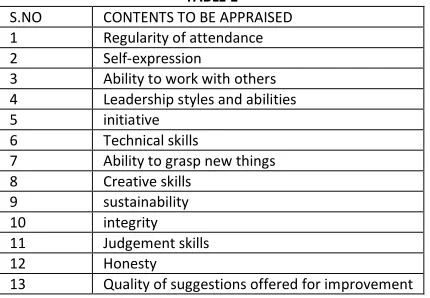
Before apprising the performance of the employee every organisation should decide upon the contents that have to be apprised, the contents to be apprised is determined on the basis of job analysis, the contents are as follows:
TABLE 1
S.NO CONTENTS TO BE APPRAISED 1 Regularity of attendance 2 Self-expression
3 Ability to work with others 4 Leadership styles and abilities 5 initiative
6 Technical skills
7 Ability to grasp new things 8 Creative skills
9 sustainability 10 integrity 11 Judgement skills 12 Honesty
13 Quality of suggestions offered for improvement
APPRAISERS
Every organisation should contain certain levels of employees which they are categorised into different levels at different functional groups; the performance of each and every individual can be measured by one of the following
• 360 DEGREES
In this 360 degrees appraisal the appraiser may be anyone who has an efficient knowledge about the job content, what is to be appraised. the appraiser should be capable to determine what is more important and is what is relatively less important. the appraiser should prepare the reports without bias. The typical appraisers are supervisors, peers subordinates, employee’s themselves, performance appraisal by all these modes is known as 360 degree appraisal.
• SUPERVISORS
Supervisors include the immediate superior of the employee because these immediate superiors are the responsible for managing their subordinates they have the opportunity to observe direct and control their employees continuously.
• PEERS
Peers appraisal may be done and more reliable if the work group is stable over a lon period of time and the task should be interactive.
• SUBORDINATES
Subordinates ratings in such cases can be quite useful in identifying competent superior.
• SELF-APPRAISAL
VOLUME NO.6(2016),ISSUE NO.03(MARCH) ISSN 2231-5756
WHEN TO APPRAISE
Systematic appraisals are conducted on a regular basis, for example every three months (quarterly), for every six months (half yearly), or annually. Informal appraisals can be conducted whenever the managers feel it as necessary.
METHODS OF PERFORMANCE APPRAISAL
TRADITIONAL METHOD 1. GRAPHIC RATING SCALE
It is one of the oldest and widely used method, the judgement about the performance are recorded on a scale. Printed appraisal forms containing behaviour and trait based qualities, skills abilities of the employees are given to the employees, these forms contain rating of scales, this rating scales are of two types continuous rating scale and discontinuous rating scale. In continuous rating scale the order like0, 1,2,3,4 and 5. In discontinuous scale he appraiser assigns the point to each degree
2. RANKING METHOD
In this method all the employees are ranked according to their work from best to worst based upon some characteristics
3. PARED COMPARISON METHOD
In this method the performance of one employee is compared with all other employees in the group ne at a time which can be denoted as follows
4. FORCED DISTRIBUTION METHOD
In this technique the rater rate his employees at the higher or at the lower end of the scale, the appraiser use 5 point rating scale. This technique is mainly developed to prevent the rate rating too high or too low
5. CHECKLIST METHOD
The checklist is a simple rating technique which he supervisor is given a list of statements or words and asked to check statements representing the characteristics and performance of each employees
6. CRITICAL INCIDENT METHOD
Basing on the parameters the employer should maintain a note book which is called black book, in this he employer note the time to time performance according to that they evaluate the performance of the employee
7. GROUP APPRAISAL
In this method an employee is appraised by a group of appraisers. This group contains the immediate supervisor of the employee, who have close contact with the employees work.
8. ESSAY OR FREE FORM APPRAISAL
This method requires the manager to write a short essay describing each employee’s performance during the rating period. The time involved in writing separate essays about each employee can be formidable.
9. CONFIDENTIAL REPORTS
Evaluating the employee’s performance confidentially by a traditional method of performance appraisal. Under this method the superior appraises the performance of his subordinates based on his observations, judgement and intuitions. The superior keeps his report and judgement confidentially
MODERN METHODS
1. BEHAVIOURLY ANCHORED RATING SCALE (BARS)
This method combines he elements of traditional rating scale and critical incident method. However, whereas the BARS is often regarded as a superior performance appraisal method. BARS can be developed using data collected through the critical incident technique or through the use of comprehensive data about the tasks performed by a job incumbent, such as might be collected through a task analysis.
2. ASSESSMENT CENTRE
An assessment centre is a process where candidates are assessed to determine their suitability for specific types of employment, especially management or military command. This method of appraising was first applied in German army in 1930 in this approach individuals from various departments are brought together to spend two or three days, observers rank the performance of each and every participants in order of merit.
3. HUMAN RESOURCE ACCOUNTING
Human resource accounting is the process of identifying and reporting investments made in the human resources of an organization that are presently unaccounted for in the conventional accounting practices. Cost of the employee includes cost of manpower planning, recruitment, selection, induction, placement, training, development, wages and benefits etc.
4. MANAGEMENT BY OBJECTIVES (MBO)
Management by objectives is a process where the superior subordinate managers of the organisation jointly identify its common goals; MBO focuses attention on participatively set goals that are tangible, verifiable, and measurable.
5. PSYCHOLOGICAL APPRAISAL
These appraisals are more directed to assess employee’s potential for future performance rather than the past one. It is done in the form of in-depth interviews, psychological tests, and discussion with supervisors and review of other evaluations. It is more focused on employees emotional, intellectual, and motivational and other personal characteristics affecting his performance. This approach is slow and costly and may be useful for bright young members who may have considerable potential.
EMPLOYEE PERFORMANCE TOWARDS INDUSTRIES
The success and failure of every organisation depends upon the performance of the employee, particularly in the manufacturing industries it is mandatory. It includes the strategic plans and targets need to achieve performance management used to derive results through a focused execution. Performance management as a backbone to the industry as it combines all the functional groups together to attain the organisational goals and objectives collectively.
PERFORMANCE MANAGEMENT IN SUGAR INDUSTRIES
SUGAR INDUSTRY AN OVERVIEW
After Brazil, India is the largest sugar producer in the world and it leads in sugarcane production. Brazil accounts for approximately 22 percent of the global sugar production and India contributes almost 14 percent. India produces 34,818,700 tons of sugar annually. Cultivation of sugarcane is the main source of sugar production in India and it is called cane sugar. 70% of sugar is produced from sugarcane and the remaining 30% of sugar comes from sugar beet. In India, the major sugar producing states are Maharashtra, Gujarat, Uttar Pradesh, Haryana, Tamil Nadu, Punjab, Karnataka, Bihar and Andhra Pradesh. One of the major reasons is the better conditions available for cultivation of sugar cane.
TYPES OF SUGAR INDUSTRIES IN INDIA
The sugar industry can be divided into two sectors including organized and unorganized sector. Sugar factories belong to the organized sector and those who produce traditional sweeteners fall into unorganized sector. Gur and khandsari are the traditional forms of sweeteners.
VOLUME NO.6(2016),ISSUE NO.03(MARCH) ISSN 2231-5756
SUGAR PRODUCTION IN INDIA
In the 2014-15 crushing season, the sugar production of India has seen an increase of 11.5 percent. The Indian Sugar Mills Association (ISMA) says that as of 31st March, India had produced 24.72 million tonnes of sugar and this was an addition of 2.84 million tonnes to the sugar production of 2013-14. It is estimated that in the 2015-16 season, 24.8 million tonnes of sugar will be consumed. It is expected that in 2017, Indians will be consuming almost 28.5 million tonnes of sugar.
SUGAR INDUSTRY IN ANDHRA PRADESH
Andhra Pradesh (AP) abounds in the number of private sector sugar companies in India along with Tamil Nadu and Karnataka. Today, the state of Andhra Pradesh sugar industry ranks 3rd in terms of recovery and 5th in terms of cane crushing. As per production capacity is concerned, Andhra Pradesh stands at the position 5th in India The agricultural labourers who has sugarcane harvesting and cultivation are employed in the sugar industry in the state of Andhra Pradesh. The state of Andhra Pradesh sugar industry can be classified into two parts such as organized sector including sugar mills and unorganized sector including manufacturers of gur (jaggery) and khandsari. The unorganized sector is often referred to as the rural industry. The rural industry plays major role in the level of production.
NEED OF PERFORMANCE MANAGEMENT IN SUGAR INDUSTRY
1. Employee performance evaluation helps the manager to know about his/her employee organisational as well as the individual behaviour, through this the manager can identify the top performers for the further development and establishing a pay for performance compensation plan.
2. By evaluation process the employee turnover can be reduced, because the evaluation process provides the basic parameters which can retain the employee in the organisation for a long period of time.
3. One of the key objectives in an employee performance evaluation is to address any of the areas that are most closely related to the employee's ability to reach his or her personal goals and contribute to the team.
PROBLEMS OF PERFORMANCE EVALUATION
The number of problems may present he appraisal schemes from being as effective as they should be.
1. Organisation not being clear about the purpose of the appraisal.
2. Link with pay, preventing open discussion of problems.
3. Keeping information secret from the employees due to lack of clarity.
SOURCE OF DATA
This study is purely depending on secondary data which is collected through journals magazines, internet, articles, from various text books.
CONCLUSION
The effective performance management system is essential for every organisation for better growth and development, performance evaluations are helpful to the productivity of the organisation. It provides the tools and techniques that are used to derive the results of employee performance, these tools have the ability to make every employee productive toward the organisation. This is the only one process to manage the organisation in right way. Performance evaluation enables the employee to know how well he performing his job. It creates a healthy relation between the employees and employers. Therefore, the performance management system is essential for employee’s development and also for success of organisation.
REFERENCES
BOOKS
1. A.Ksngh., 1955. Personal management.
2. Nadler, L., 1969. The Variety of Training Roles. Industrial & Commercial Training, 1(1).
3. Petridou, E. and N. Glaveli, 2003. Human Resource Development in a Challenging Financial Environment: The Case of a Greek Bank. HRD International, 6(4): 547-558.
4. R. Kenter, “Foreword,” In: M. Effron, R. Gandossy and M. Goldsmith, Eds., Human Resources in the 21st Cen- tury, John Wiley & Sons, Hoboken, 2003. 5. The Frontiers of Management - Peter F. Drucker.
WEBSITES
6. http://business.mapsofindia.com/sugar-industry/ 7. http://pib.nic.in/feature/fe0299/f1202992.html
8. http://www.ccmsrinagar.com/2013/03/cooperative-societies-act-1904.html 9. http://www.gktoday.in/cooperative-credit-societies-act-1904/
10. http://www.peoplestreme.com/what-is-performance-management.shtml 11. http://www.washington.edu/admin/hr/roles/ee/jobperformance/ 12. http://www.workwisellc.com/performance-management-in-manufacturing/ 13. https://en.wikipedia.org/wiki/Assessment_centre
14. https://en.wikipedia.org/wiki/Behaviorally_anchored_rating_scales 15. https://en.wikipedia.org/wiki/Human_resource_accounting
16. https://en.wikipedia.org/wiki/Job_performance#Organizational_goal_relevance
17. https://www.linkedin.com/pulse/20141030184448-208256548-hrm-performance-appraisal-methods 18. https://www.successfactors.com/en_us/lp/articles/employee-performance-evaluations.html
.
VOLUME NO.6(2016),ISSUE NO.03(MARCH) ISSN 2231-5756
REQUEST FOR FEEDBACK
Dear Readers
At the very outset, International Journal of Research in Commerce, IT & Management (IJRCM) acknowledges
& appreciates your efforts in showing interest in our present issue under your kind perusal.
I would like to request you to supply your critical comments and suggestions about the material published
in this issue, as well as on the journal as a whole, on our e-mail
for further
improvements in the interest of research.
If you have any queries, please feel free to contact us on our e-mail
.
I am sure that your feedback and deliberations would make future issues better – a result of our joint effort.
Looking forward to an appropriate consideration.
With sincere regards
Thanking you profoundly
Academically yours
Sd/-
Co-ordinator
DISCLAIMER