Please cite this article as: R. Pilla, A. S. Tummala, M. R. Chintala, Tuning of Extended Kalman Filter using Self-adaptive Differential Evolution Algorithm for Sensorless Permanent Magnet Synchronous Motor Drive, International Journal of Engineering (IJE), TRANSACTIONSB: Applications Vol. 29, No. 11, (November 2016) 1565-1573
International Journal of Engineering
J o u r n a l H o m e p a g e : w w w . i j e . i rTuning of Extended Kalman Filter using Self-adaptive Differential Evolution
Algorithm for Sensorless Permanent Magnet Synchronous Motor Drive
R. Pilla*a, A. S. Tummalaa, M. R. Chintalab
a Department of EEE, GMR Institute of Technology, Rajam, Andhra Pradesh, India
b Department of EEE, Coastal Institute of Technology and Management, Kothavalasa, Andhra Pradesh, India
P A P E R I N F O
Paper history: Received 11 May 2016
Received in revised form 14 July 2016 Accepted 10 October 2016
Keywords:
Permanent Magnet Synchronous Motor PI Controller
Extended Kalman Filter
Self-adaptive Differential Algorithm Integral Square Error
A B S T R A C T
In this paper, a novel method based on a combination of Extended Kalman Filter (EKF) with Self-adaptive Differential Evolution (SaDE) algorithm to estimate rotor position, speed and machine states for a Permanent Magnet Synchronous Motor (PMSM) is proposed. In the proposed method, as a first step SaDE algorithm is used to tune the noise covariance matrices of state noise and measurement noise in off-line. In the second step, the optimized values of above covariance matrices are injected into EKF in order to estimate the rotor speed on-line. The estimated speed is fed back to the PI controller and to minimize the speed error, parameters of PI controller are tuned again using SaDE algorithm. The simulation results show that the tuned covariance matrices Q and R improve convergence of estimation process, quality of estimated states and PI controller improves the settling time and stability of the system.
doi: 10.5829/idosi.ije.2016.29.11b.10
1. INTRODUCTION1
The PMSM is widely used in industrial drive systems due to its compactness, superior power density, high torque density, high efficiency, high power factor and low maintenance cost. They are appropriate for computerized numerical control (CNC) machines and submarine propulsion due to their wide speed ranges. In PMSM, rotor losses are eliminated due to the absence of slip rings for field excitation, which make them ideal for robotic and automatic production systems [1, 2]. In most drive systems, closed loop control is based on the speed or position measurement using optical encoders or Hall Effect sensors. Use of such sensors will increase the complexity and weight of the system, resulting in increased cost and reduced overall reliability of the system [3]. In most applications, due to harsh environmental conditions or excessive wire lengths, it is difficult to get the actual speed/position information from the sensors to the controller. Sensorless speed
1*Corresponding Author’s Email: [email protected]
(Ramana Pilla)
control drive system reduces complexity, weight and cost and improves reliability and dynamic performance of the system [4].
Various control algorithms have been proposed to eliminate the speed and position sensors. Among them, Luenberger observer [5] and Kalman filter [6] are used for linear systems. However, these methods are not applicable for state estimation of non-linear systems. To surmount this, many methods are proposed in literature; such as reduced order observer [7], full order observer [8], Sliding Mode Observer (SMO) [9], Extended Kalman Filter (EKF) [10, 11], Model Reference Adaptive Systems (MRAS) [12], based observers.
increases the manual tuning of these matrices Q & R
becomes hard as the computational time increases. To overcome this problem several algorithms are proposed in literature; such as Genetic algorithm (GA) [13], particle swarm optimization (PSO) [14], Differential evolution (DE) [15], Self-adaptive Differential Evolution (SaDE) [16] and so on. DE is one of the recent powerful population based stochastic search technique, which is an efficient and effective continuous search method proposed by Storn and Price [17]. The DE has been successfully applied in diverse fields and sensitivity of DE depends on population (NP), crossover rate (CR) and scale factor (F). In DE, for setting the best control parameter values, a trial and error method is used; which takes more computational time for setting the best values. To avoid these problems an advanced DE named Self-adaptive Differential Evolution (SaDE) algorithm is employed. In this algorithm, trial vector generation strategies and associated parameter values are self adapted by learning from their previous generating values.
The main objective of this paper is to tune the parameters of covariance matrices Q and R using SaDE algorithm. In the proposed scheme Q and R values are formulated in off-line manner and these values are injected in the corresponding matrices, to estimate the rotor position, speed and machine states in on-line. For closed loop operation, estimated speed is given as feedback and hence the performance of EKF becomes a part of the speed control. The speed error is given to the PI controller and by tuning the parameters of controller; the performance of overall system is improved. The parameters of PI controller can be tuned using Zieglar-Nichols method [18], Particle Swarm optimization (PSO) [19], Differential evolution (DE) [17], Self-adaptive Differential Evolution (SaDE) [20]. In this work, SaDE algorithm is also used for tuning Kp and Ki values of PI controller effectively. Finally the optimum values of PI controller are obtained and these values are injected into the controller, to get the better results.
2. MODELLINGOFPMSM
The voltage equations for a PMSM in the rotor reference frame can be expressed as follows:
d s d d d e q q
V R i L pi L i (1)
q s q q q e d d e f
V R i L pi L i (2)
Where, Vd, Vq are d & q axes stator voltages, id ,iq are
d & q axes stator currents, Rs is stator phase resistance,
d
L ,Lqare d & q axes stator inductances, ψf is Rotor
flux (Permanent magnet flux), ωe is electrical speed in rad/sec.
The electromagnetic torque of PMSM is:
3 2
e n q f q d d
T P i L L i
(3)
Where, Pn number of pole pairs The mechanical equation of the system is:
r
r l e
d
J B T T
dt
(4)
Where, J= moment of inertia, B= friction coefficient and
l
T Load torque
Finally, the above equations are mentioned in the form of state equations as follows:
1
d d
s d e q q
d d
di V
R i L i
dt L L (5)
1 q
s q e d d e f
q q
V diq
R i L i
dt L L (6)
1 3 2 l rn q f q d d r
T
d B
P i L L i
dt J J J
(7)
e n r d P dt (8) l dT dt (9)
3. DESIGN OF EXTENDED KALMAN FILTER
The Extended Kalman filter algorithm is an optimal recursive estimation algorithm for non-linear systems. This method can be used to estimate the rotor position, machine parameters and speed. Motor state variables are estimated by means of measurements of stator line voltages and currents. Due to its rapid delivery, precise and accurate estimation, it is used in research and applications. The feedback gain used in EKF [21] achieves quick convergence and provides stability for the observer. Due to its various feasibilities, EKF is widely used in various sensorless speed control methods.
In this paper, to find the best linear estimation of the state vector xk of PMSM, the discrete-time non-linear dynamics is:
1 ( , , )
k k k k k
x f x u w (10)
( , , )
k k k k k
y h x u v (11)
where: ( , , )
k k k k d k d k k
d s
A I AT
d s
B BT
( , , )
k k k k d k k
h x u v C x v
d
C C
xk is system state vector, uk is input vector, wk is process noise, vkmeasurement noise Ts is sampling time. 3. 1. Algorithm of EKF
Step-1: Initialize the state vector and covariance matrices x(0), P, Q and R.
Step-2: compute the Jacobian matrices for fk,hk
k
k
f F
x
(12)
k
k
h H
x
(13)
Step-3: Prediction state (time update)
To perform the time updating of state estimate and estimation of error covariance
( , ) (0)
k k k
X f x u x (14)
1 T
P FPF Q (15)
Step-4: Correction state (measurement update)
To perform the measurement updating of state estimate and estimation of error covariance by using Kalman gain
Kalman gain matrixK P H1 T /
HP H1 T R
(16)Update state predictionX1XK y
y1
(17) where y1HxkEstimation of error covariance matrix:
1P IKH P (18)
4. TUNING OF PI CONTROLLER AND FILTER VARIABLES BY USING SaDE ALGORITHM
SaDE algorithm was proposed by A. K. Qin and P. N. Suganthan. In this algorithm choice of learning strategies and two control variables F and CR are need not be pre-specified. During the evolution process, these values are gradually self adapted by previous experience. SaDE could be used to minimize non-linear and non-differentiable continuous space functions, which gives better global search and convergence.
4. 1. SaDE Algorithm
i. Initialization Randomly initialize the population (NP), Generation counts (G), Dimension of number of tuning variables (D) and also choose the upper and lower bounds of tuning parameters.
Population for generation, G is given by:
, (NP, D)
j j j j
upper
i G lower lower
x x rand x x (19)
Where, j=0, 1, 2,………, D
ii. Trial Vector Generation Strategies To generate promising and optimum solutions at each generation with respect to each target vector in the present population, one strategy will be chosen among the available trial vector generations.
iii. Generate a new population by using trial vector generation and control parameters (F&CR).
Iv. If any control variable is outside the limits, then reinitialize the trial vector.
v. Selection The trial vector is compared with corresponding target vector in the current population. If the trial vector is less or equal to target vector, the trial vector will be replaced by the target vector value for the next generation. Otherwise, target vector will remain in the population for the next generation.
vi. Increase the generation count G=G+1
vii. Termination When the generation count reached to its maximum value, it will be terminated. 4. 2. Tuning of EKF Parameters Using SaDE The choice of elements of the covariance matrices P,Q
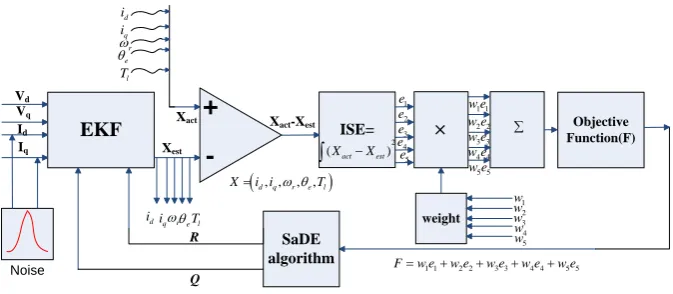
evolutionary algorithm is used to tune the error covariance matrices Q & R. These matrices are tuned using the SaDE algorithm in order to obtain the optimum values at a time after maximum number of iterations. This improves both the transient and steady state stability of the system by eliminating the noise. In this proposed scheme, set the Q & R matrices dimensions as 5 × 5 and 2 × 2, which are assumed as:
1 2 3 4 5
Qdiagonal of q q q q q
1 2
Rdiagonal of r r
The objective function:
1 1 2 2 3 3 4 4 5 5
Fw e w e w e w e w e (20)
where w1,w2,w3,w4,w5 are weights of the corresponding state variables of error covariance matrices Q & R, e1 is integral square error of measured and estimated values of id , e2 is integral square error of measured and estimated values of iq, e3 is Integral square error of actual and estimated values of
r, e4is Integral square error of actual and estimated values ofe
and e5 is Integral square error of actual and estimated values of Tl.Integral square error (ISE) integrates the square of the error over time. But the square of the larger errors will have
higher magnitude when compared to the smaller one. So the errors with higher magnitude are easily identified
and eliminated quickly while the smaller ones persist for longer duration. Therefore, in order to get relatively the same magnitude of the error, each error should be multiplied by weights corresponding to their error magnitudes.
i.e. ISE
u dt2 (21)The selection of weights plays a vital role in tuning of these parameters. Improper selection of these weights leads to estimated values of these parameters doesn’t track the actual values precisely. So the weights are chosen as w1=1, w2=0.5, w3=0.02, w4=0.0027, w5=0.2. Also initialize
Population size (NP) =50, Initial generation (G) =0,
Dimension (D) =7 and number of strategies = 4 Learning generation = 50
Number of evolutions = n*D where n = integer
randomly choose the upper & lower bounds for variable:
1 2 3... D
1 31 31 31 31 31 31 3
lower l l l lX x x x x e e e e e e e
1 2 3... D
20 20 50 50 10 100 100
upper u u u u
X x x x x
control parameters F= [0.3 0.5] and CR = [0 1].
The optimum value of objective function is obtained by selecting proper values of Q & R matrices by using SaDE algorithm.
PI CONTOLLER
PULSE GENERAT
OR
PMSM
EKF Id-est
Iq-est
r-est
r
Iq
Id=0
Va Vb
Vc
Va Vb
Vc pulses
Vq
Vd
Iabc Idq
Te
e +
-e
e
PWM INVERTER
Irabc
est
Tl-est
Iq Id
Vd
Vq
r*
r
Noise
Noise
EKF ISE= Function(F)Objective SaDE algorithm Q R Vd Vq Id Iq Xact Xest
Xact-Xest
2 (XactXest)
1 1 2 2 3 3 4 4 5 5 Fw ew ew ew e w e
d, ,q r, e,l
Xi i T
+
-× weight Noise 1 w 2 w 3 w 4 w 5 w d i e q i r l T d
i iqreTl
1 e 2 e 3 e 4 e 5 e 5 5 w e 4 4 w e 3 3 w e 2 2 w e 1 1 w e
Figure 2. Block-diagram of SaDE-EKF estimation system
TABLE 1. Simulated values of matrices Q & R using SaDE Numberof
iterations Diagonal elementsof Q
Diagonal
elementsof R ISE
100 [8.89 0.29 6.67 3.25
7.51] [6.96 8.38] 2.184e 4
700 [5.18 8.75 8.55 2.14
0.03] [7.96 8.49] 2.173e 4
1050 [16.84 0.24 12.25 3.01
2.64] [43.83 84.72] 2.179e 4
1400 [16.94 0.08 9.50 6.78
0.004] [30.07 37.221] 2.008e 4
4. 3. Tuning of PI Controller Parameters Using SaDE Algorithm After preset number of iterations of SaDE algorithm, optimum parameter values of diagonal elements Q and R matrices are obtained. Finally these optimum values are injected into EKF, and from that the estimated values of state variables are obtained. If the estimated speed is given as feedback, then speed error is given to the PI controller and the parameters of PI controller are obtained by tuning with SaDE algorithm:
Objective function 2
ref est
F
dt (20)Let population size (NP) =50, Initial generation G=0, dimension (D) =2 and randomly choose the upper & lower bounds for variables as:
1 3 1 3
lower
X e e &Xupper
100 100
So here the PI controller minimizes the settling time and also reduces the steady state error.
5. RESULTS AND DISCUSSIONS
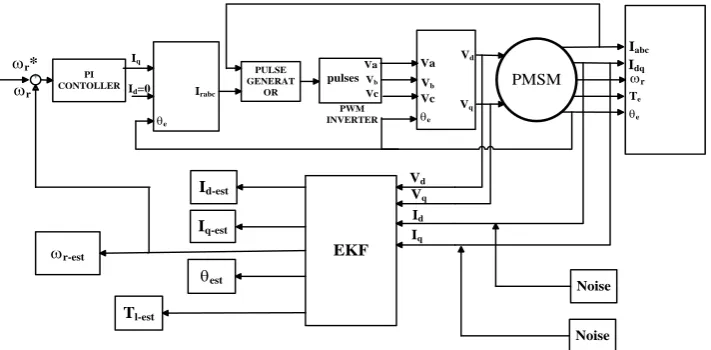
The non-linear equations of motor in d-q model given by Equations (1), (2) & (3) are simulated using MATLAB/SIMULINK software with motor parameters
as presented in Appendix-A to demonstrate the performance of the proposed drive system. Along with this the discrete-time EKF algorithm has been implemented using embedded MATLAB function by using dynamic state equations given in section 2, with sampling period 2×10⁻⁵ secThe embedded MATLAB function block contains vd, vq, id and iq as the input signals for EKF and the state variables are estimated at each iteration using EKF algorithm. In order to imitate the condition of real systems, Gaussian noise of 3×10⁻⁶ added to measured variables id & iq. For the simulation process, initialize the states and error covariance matrices as x(0)=(0,0,0,0,0), P(0) = diagonal of (1,1,1,1,1). The values of covariance matrices Q and R taken form SaDE algorithm as given in the following Table 1.
Better objective function value is obtained by EKF algorithm at 1400 iterations. The corresponding Q and R values for the above obective function are injected into the EKF and run in online to estimate the rotor position , speed and machines states. These results compared with those of trial and error method using optimum Q and R values,
0.4 4 1 2 0.2
Qdiagonal of
2 2
Rdiagonal of
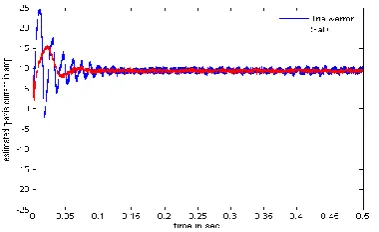
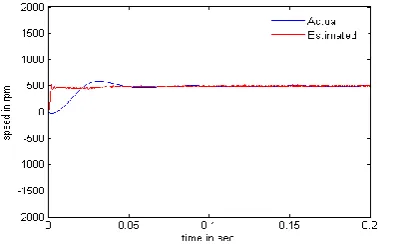
shows the estimated value of load torque using SaDE algorithm has less initial overshoots and converges fastly when compared to trial and error method. The measured and estimated waveforms of id and iq are shown in Figures 8 and 9 respectively. The measured value of id fluctuates between 1.7A to -1.7A and iqsteps from 0A to 10A, fluctuates between 7.5A to 11.5A to generate the required torque to the system. The estimated value of id and iq strictly converges with the measured values and reduces the noise in the measured value. The estimated values of currents having large deviations due to convergence problem of state error covariance matrix at the beginning. After 0.05 sec both the state variables converges and settles. Figure 10 shows the actual & estimated values of rotor position for PMSM drive. The actual rotor angle starts from 0.01 sec, while the estimated rotor angle started from 0.001 sec. In the steady state there is an error between actual and estimated rotor positions due to usage of terminal voltages instead of reference voltages. In Figure 11 the actual and estimated speeds are compared and the reference speed is given as 500 rpm. The estimated speed is tracks the actual speed at 0.001 sec only, so estimated speed is quickly converges due to precise values of matrices Q & R chosen by SaDE algorithm.
Figure 3. Estimated d-axis currents of Trial & error and SaDE methods
Figure 4. Estimated q-axis currents of Trial & error and SaDE methods
Figure 5. Estimated speed of Trial and error and SaDE methods
Figure 6. Estimated rotor angle of Trial and error and SaDE methods
Figure 7. Estimated load torques of Trial & error and SaDE methods
Figure 9. Measured & Estimated waveforms of iq
Figure 10. Actual & Estimated wave forms of rotor angle
Figure 11. Actual & Estimated waveforms of rotor speed
Case 2: SaDE Tuning of PI Controller After tuning with SaDE algorithm the below values are obtained in Table 2. The better values of the table is selected and injected into PI controller and run online. These results compared with those of trial and error method using optimum Kp and Ki values i.e. Kp=7 and Ki =16.
TABLE 2. Simulated values of Kp and Ki using SaDE
No. of Iterations Kp Ki ISE
1400 59.10885 33.82371 18.3194
2000 4.960035 99.15802 12.7781
Figures 12 and 13 show the rotor speed and electromagnetic torque. From Figure 12, it is clear that actual rotor speed having large number of ripples initially due to improper selection of Kp and Ki values in trial & error method, where as the SaDE algorithm, gives optimum gain values of controller and hence ripples are greatly reduced and speed is quickly converged i.e. at 0.001 sec. From Figure 13, it is clear that the electromagnetic torque has initial overshoot in trial & error method; where as initial overshoots are greatly reduced and achieves steady state quickly in SaDE algorithm.
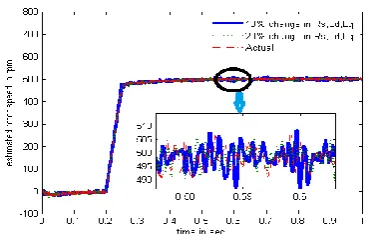
From the Figures 14 and 15, it is observed that even for a 10% and 20% change in both mechanical and electrical parameters, the EKF is robust towards parameter variations.
Figure 12. Actual rotor speed
Figure 13. Electromagnetic Torque
Figure 15. Estimated rotor speed under electrical parameter variations
6. CONCLUSION
In this paper, a novel approach of combining EKF with SaDE algorithm to achieve high performance and accurate rotor speed, machine states and rotor position estimation in PMSM drive has been presented. The proposed SaDE algorithm enables the noise covariance matrices Q and R on which the EKF performance critically depends, to be suitably selected. Since the selection of parameters of PI controller plays a dominant role on the performance of the closed loop system, these parameters are tuned using SaDE algorithm. The performance of basic differential evolution is enhanced using SaDE by adopting the learning strategies and control parameters. In this algorithm learning strategies and control parameters are self adapted by its previous experience. The SaDE tuned EKF is used to estimate the states of PMSM including rotor speed. The simulation results of EKF based sensorless speed control of PMSM shows superior performance in terms of noise reduction, settling time, initial overshoots and overall system stability when compared with the trial and error method.
7. REFERENCES
1. Pillay, P. and Krishnan, R., "Modeling of permanent magnet motor drives", IEEE Transactions on Industrial Electronics, Vol. 35, No. 4, (1988), 537-541.
2. Pillay, P. and Krishnan, R., "Modeling, simulation, and analysis of permanent-magnet motor drives. I. The permanent-magnet synchronous motor drive", IEEE Transactions on Industry Applications, Vol. 25, No. 2, (1989), 265-273.
3. Fateh, M. and Sadeghijaleh, M., "Voltage control strategy for direct-drive robots driven by permanent magnet synchronous motors", International Journal of Engineering-Transactions B: Applications, Vol. 28, No. 5, (2014), 709-716.
4. Ramana, P., Mary, K. A., Kalavathi, M. S. and Swathi, A., "Parameter estimation of permanent magnet synchronous motor-a review", I-Manager's Journal on Electrical Engineering, Vol. 9, No. 2, (2015), 49-59.
5. Bojoi, R., Griva, G. and Profumo, F., "Field oriented control of dual three-phase induction motor drives using a luenberger flux observer", in Conference Record of the Industry Applications
Conference Forty-First IAS Annual Meeting, IEEE, Vol. 3, (2006), 1253-1260.
6. Borsje, P., Chan, T., Wong, Y. and Ho, S., "A comparative study of kalman filtering for sensorless control of a permanent-magnet synchronous motor drive", in International Conference on Electric Machines and Drives, IEEE, (2005), 815-822.
7. Ramana, P., Alice Mary, K., Kalavathi, M. S. and, Phani Kumar, M., "A non-linear speed observer for a high performance pmsm drive", International Journal of Electrical Engineering and Electrical Systems, Vol. 5, No. 1, (2011), 1-6.
8. Ramana, P., Mary, K. A., Kalavathi, M. S. and Kumar, J. H., "Design of non-linear reduced and full order observers for an inverter fed permanent magnet synchronous motor drive",
Indian Journal of Science and Technology, Vol. 9, No. 9, (2016).
9. Soltani, J., Abjadi, N. and Pahlavaninezhad, M., "An adaptive nonlinear controller for speed sensorless pmsm taking the iron loss resistance into account (research note)", International Journal of Engineering-Transactions B: Applications, Vol. 21, No. 2, (2008), 151-160.
10. Bolognani, S., Tubiana, L. and Zigliotto, M., "Extended kalman filter tuning in sensorless pmsm drives", IEEE Transactions on Industry Applications, Vol. 39, No. 6, (2003), 1741-1747. 11. Xu, D., Zhang, S. and Liu, J., "Very-low speed control of
PMSM based on EKF estimation with closed loop optimized parameters", ISA Transactions, Vol. 52, No. 6, (2013), 835-843.
12. Holakooie, M. H., Banna Sharifian, M. B. and Feyzi, M. R., "Sensorless indirect field oriented control of single-sided linear induction motor with a novel sliding mode mras speed estimator", International Journal of Engineering (IJE) Transactions A: Basics, Vol. 28, No. 7, (2015), 1011-1020. 13. Shi, K., Chan, T., Wong, Y. and Ho, S., "Speed estimation of an
induction motor drive using an optimized extended kalman filter", IEEE Transactions on Industrial Electronics, Vol. 49, No. 1, (2002), 124-133.
14. Laamari, Y., Chafaa, K. and Athamena, B., "Particle swarm optimization of an extended kalman filter for speed and rotor flux estimation of an induction motor drive", Electrical Engineering, Vol. 97, No. 2, (2015), 129-138.
15. Qin, A. K., Huang, V. L. and Suganthan, P. N., "Differential evolution algorithm with strategy adaptation for global numerical optimization", IEEE Transactions on Evolutionary Computation, Vol. 13, No. 2, (2009), 398-417.
16. Qin, A. K. and Suganthan, P. N., "Self-adaptive differential evolution algorithm for numerical optimization", in congress on evolutionary computation, IEEE, Vol. 2, (2005), 1785-1791. 17. Storn, R. and Price, K., "Differential evolution–a simple and
efficient heuristic for global optimization over continuous spaces", Journal of Global Optimization, Vol. 11, No. 4, (1997), 341-359.
18. Gude, J. J. and Kahoraho, E., "Modified ziegler-nichols method for fractional pi controllers", in Emerging Technologies and Factory Automation (ETFA), IEEE, (2010), 1-5.
19. Cao, S., Tu, J. and Liu, H., "PSO algorithm-based robust design of PID controller for PMSM", in Sixth International Conference on Natural Computation, IEEE, Vol. 7, (2010), 3513-3517.
20. Brest, J., Greiner, S., Boskovic, B., Mernik, M. and Zumer, V., "Self-adapting control parameters in differential evolution: A comparative study on numerical benchmark problems", IEEE Transactions on Evolutionary Computation, Vol. 10, No. 6, (2006), 646-657.
Appendix A: Machine Ratings and Parameters of PMSM
Parameters Symbol Numerical value
Resistance of stator Rs 0.675 ohm
Direct axis inductance of stator Ld 0.0085 H
Quadrature axis inductance of stator Lq 0.0085 H
Flux linkages ψf 0.12 Wb
Inertia of rotor J 0.0011 Kg/m2
friction coefficient B 0.0014 Nm/s2
Pair of poles Pn 3
Rated speed N 1000 rpm
Tuning of Extended Kalman Filter using Self-adaptive Differential Evolution
Algorithm for Sensorless Permanent Magnet Synchronous Motor Drive
R. Pillaa, A. S. Tummalaa, M. R. Chintalab
a Department of EEE, GMR Institute of Technology, Rajam, Andhra Pradesh, India
b Department of EEE, Coastal Institute of Technology and Management, Kothavalasa, Andhra Pradesh, India
P A P E R I N F O
Paper history: Received 11 May 2016
Received in revised form 14 July 2016 Accepted 10 October 2016
Keywords:
Permanent Magnet Synchronous Motor PI Controller
Extended Kalman Filter
Self-adaptive Differential Algorithm Integral Square Error
ديكچ ه
يولاک رتليف یاٌبه رب ييًَ یشٍر ِلاقه ييا رد (EKF)
یلضافت یلهاکت نتيرَگلا اب ِتفاي شرتسگ قيبطت دَخ
(SaDE)
تيعقَه ييوخت یارب نئاد سيطاٌغه اب ىٍرکٌس رَتَه کي یارب ييشاه یاّ تلاح ٍ تعرس ،رَتٍر
(PMSM) ِئارا
ا لٍا ِلحره رد ُذش ِئارا شٍر رد .تسا ُذش نتيرَگل
SaDE ِب طَبره سيًَ سًايراٍَک یاّ سيرتاه ات ُذش ِتفرگ راکب
ُذش ٌِيْب سًايراٍَک سيرتاه ريداقه مٍد ِلحره رد .ذٌک نيظٌت ار طخزا جراخ تلاح رد سيًَ یريگ ُزاذًا ٍ سيًَ تلاح
ِب لااب EKF رب ترَص ِب ار رَتٍر تعرس ات ُذش لاوعا
-ُذش ُدز ييوخت تعرس.ذًسب ييوخت طخ ُذٌٌک لرتٌک ِب
PI زاب
ُذٌٌک لرتٌک یاّ رتهاراپ تعرس یاطخ ىدرک ٌِيوک یارب ٍ دَش یه رَخ PI
نتيرَگلا اب ُرابٍد SaDE
.دَش یه نيظٌت
ُذش نيظٌت سًايراٍَک یاّ سيرتاه ِک ذّد یه ىاشً یزاس ِيبش جياتً Q
ٍ R تلاح تيفيک ٍ ييوخت ذٌيآرف یيارگوّ
یه دَبْب ار ُذش ُدز ييوخت یاّ ُذٌٌک لرتٌک ٍ ذشخب