A b s t r a c t. Determination of electrical properties is utilized in a wide range of disciplines and industries. A brief compendium of electrical properties utilization of granular and powdery agricultural and food materials is presented in this paper. Electrical properties of granular and powdery materials are influenced by various factors. The most important are moisture content and its distribution in materials, temperature, density, volume or bulk density. The relationships between the resistivity, conductivity, capacitance, relative permittivity and various influencing factors are described.
The electrical conductivity measurements are utilized in the determination of the salinity of soils and irrigation water. Biological material properties are determined from their leachates, too. The conductivity measurements are applied for the determination of various characteristics of agricultural materials and foods (frost sensitivity, chilling and freezing tolerance, moisture content, seed germination, mechanical stress). Investigated materials are very various, for example grains, seeds, meat, sugar, milk, wood, soil, fruit and vegetable, infected food. The utilization of dielectric properties is also described; for example in agricultural materials and food quality sensing (moisture content, maturity of fruit, potential insect control in seeds, radio frequency heating). The classification of permittivity measurement techniques is mentioned.
K e y w o r d s: electrical properties, resistivity, relative permittivity
INTRODUCTION
Granular and powdery materials are very complex in their composition and behaviour, including electrical properties. Biological materials are non-homogeneous on the microscopic level, because the inside of cells is conductive and cell membranes are not conductors. The
alternate arrangement of the different parts creates biological capacitors. Non-homogeneity on the macro-scopic level and influence on the electrical properties of materials are caused by the properties of each type of tissue, by the density and structural arrangement of cells, by the presence of water and by its uneven deployment in the material, by different binding energy in each bound water, by sorption properties, by temperature. For porous materials there are the bulk density, porosity, size and distribution of pores. For loose materials we can name the gappiness, contact surface between the parts, properties of air trapped between the parts or in the pores, its relative humidity and temperature, deployment of the parts in the pack, size of parts (Hlaváèová, 2003).
Measurement of electrical properties is quick and relatively simple and that is why it is exploited in the determination of other characteristics of materials. Electrical properties of materials are utilized in many areas of human activities and most frequently are applied for moisture content measurements.
CONDUCTIVITY MEASUREMENT
Grain and seed properties are determined from their leachates, too. For example, Coutoet al. (1998) measured electrical conductivity of leachates from cut soybean seeds drowned in distilled water. The response of electrical conductivity to variations in the percentage of damage was linear or quadratic and this method can be utilized for quantitative evaluation of mechanical damage. Vermaet al. (2001) determined that the increase in conductivity values of seed leachates was related to the initial degree of deterioration of seed lots. Other authors utilized electrical conductivity measurement for determination of pepper seed
Utilization of electric properties of granular and powdery materials
1,2Z. Hlaváèová
Department of Physics, Slovak University of Agriculture in Nitra, Tr. A. Hlinku 2, 949 76 Nitra, Slovak Republic
Received December 6, 2004; accepted December 23, 2004
© 2005 Institute of Agrophysics, Polish Academy of Sciences Corresponding author’s e-mail: [email protected]
1
This work was supported by research projects VEGA 1/76667/20 and 1/9079/02 of Slovak Grant Agency for Science.
2The paper is published in the frame of activity of the Centre of
Excellence AGROPHYSICS - Contract No. QLAM-2001-00428 sponsored by EU within the 5FP.
w
w
development, for determination of various seeds vigour or, for estimation of seed germination. Panobiancoet al. (1999) used the same method for determination of the correlation between the electrical conductivity of soybean seed and seed coat lignin content.
Prasad and Singh (1999) used the conductivities of diffe-rent sugar crystals to assess the quality of sugars, since con-ductivity decreased with increasing level of the sugar purity. De Andradeet al. (1999) evaluated the mechanical damage to bean seeds using measurement of electrical resistivity.
Malicki and Walczak (1999) used bulk electrical conductivity and permittivity measurement for evaluation of soil salinity by means of time domain reflectometry. They determined the salinity indexxswhich can be calculated
from bulk electric conductivity,s, and permittivity,e, and which appeared to be independent of the moisture content and directly proportional to soil salinity. Conductivity measurements of soil have been used to identify contrasting soil properties in the geological and environmental fields by Lund et al. (1999). Friedman (1998) simulated potential error in determining soil salinity from measured apparent electrical conductivity.
Our measurements were made with variously treated seeds (filed, coated and encrusted) of 9 sugar beet (Beta vulgaris convarieta altissima) cultivars (Hlaváèováet al., 2001). All the seeds had natural moisture content. The current passing through the pack of seed was measured. The method of measurement is described in (Hlaváèová, 2001). The current increased linearly with the voltage according to the relation:
I=kU+Io, (1)
where:kis constant,Iois current at the reference voltage,Uis
reference voltage. The relation had high values of the coefficient of determination. The highest current passed through the sample of filed seeds and the lowest through encrusted seeds (Fig. 1). It was found that the electrical conductivity of seeds is affected by their surface treatment. Average conductivity at the moisture content of 9.39% for cultivar Remona was 1.741 10-10S m-1, for cultivar Polina 2.285 10-10S m-1and for Intera 3.006 10-10S m-1.
It follows that coating and encrusting of seeds increase their resistance. The mode of sugar beet seeds surface treatment could be determined by the measurements of their electric properties.
Knowledge of the temperature distributions and electrical properties dependence on temperature of treated material is necessary in the case of thermal treatment (for example ohmic heating). We found out that the conductivity increases and the resistivity decreases with temperature exponentially for all samples at all moisture contents (Hlaváèová, 2001). The method of measurement is described in this paper. For illustration, Fig. 2 shows the resistivity temperature dependencies for 2 hybrids of corn
(Zea mays) grains at approximately equal moisture content. Displacement of the curves is caused by various properties of two hybrids. The regression equation for resistivity has the form:
r r= o -t to
e k
, (2)
where: ro – resistivity at the reference temperature, t – temperature, k – constant,to= 1 °C. The regression equation
has high coefficients of determination for all samples. The moisture content has an important effect on the values of the conductivity and resistivity and the 40.0 80.0 120.0 160.0 200.0
U , V 0.0E+0
4.0E-10 8.0E-10 1.2E-9 1.6E-9
I,A
Fig. 1.The dependence of current passing through the sample on
voltage, for sugar beet seeds of cultivars: Intera (filed seeds) (¡), Polina (coated seeds) (o) and Remona (encrusted seeds) (¯), at average moisture content of 9.39%.
10.0 20.0 30.0 40.0 50.0
t (°C) 0.0E+0
4.0E+5 8.0E+5 1.2E+6 1.6E+6
Re
si
st
iv
ity
(o
hm
m
)
Fig. 2.The resistivity temperature dependencies for corn grains
hybrids of Fabullis (¡) at the moisture content wet basis of 16.9% and of Raissa (+) at 17.34%.
I(A)
replacement of the temperature dependencies are influenced by this fact.
Our other measurements were done on various varieties of amaranth (Amaranthus) seeds (Hlaváèová, 2001). For illustration, in Fig. 3 we present the dependence of the resistivity on moisture content wet basis for Amaranthus
hypochondriacus. The dependence has the decreasing
power function character whose regression equation is: r r w= o -d (3)
where r is resistivity, ro is resistivity at the reference moisture content,w– moisture content wet basis and d – constant. All regression equations have high coefficients of determinations up to 0.969.
At the moment, the moisture meters for amaranth seeds are not produced and that is why the described dependencies can be utilized for the calibration of present resistance moisture meters for granular materials.
DIELECTRIC PROPERTIES MEASUREMENT Various techniques have been developed to study the dielectric properties (bulk relative permittivity and loss factor) of granular and powdery materials. These have the biggest application in moisture content measurements because of the high dielectric permittivity of liquid water relative to that of solids and of air. Measurement methods for granular and powdery materials can be classified as follows: capacitance measurement, measurement of single kernel of grain, wave guide measurements, cavity measurements, open resonator, coaxial probe, non contact scattering measurements.
For measurement of dielectric parameters of powder and granular materials in radio frequencies based on the capacitance principle, the most appropriate arrangement of the electrodes is either as parallel or juxtaposed plates or concentric cylinders. The parallel plates arrangement has the advantage of providing a uniform electric field but, if the cell is not shielded, influence of external objects on the cell capacitance may introduce appreciable errors in the measurement. The main disadvantage of the concentric cylinders arrangement is associated with the non-uniformity of the electric field between the plates and the advantage is electrical self-screening property of the concentric cylinders, which prevents influence from external objects on the cell capacitance. Berbert et al. (2001) described the construction of a coaxial capacitor for the measurement of dielectric properties of grains.
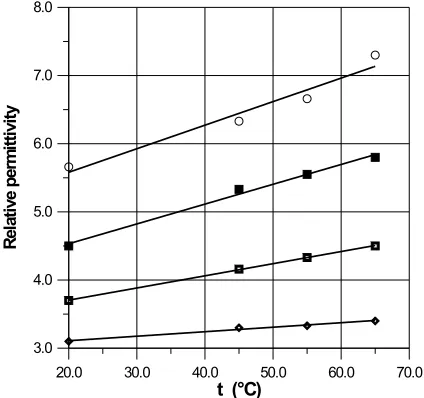
We measured the capacitance of a coaxial capacitor with samples by means of a Q-meter in the frequency range from 2 to 50 MHz (Hlaváèová, 2003). We determined the temperature dependencies of relative permittivity for various samples. Figure 4 presents the temperature dependencies of relative permittivity for wheat (Triticum aestivum) grains of the Jubilejná variety at 2 MHz for 4 moisture contents. These dependencies are needed for electrical heating of material.
The permittivity of samples increases with temperature linearly in this frequency range and the regression equation is:
er=ero+q
t
to, (4)
whereeris relative permittivity,erois relative permittivity at reference temperature, q is constant,tis temperature of sample andto= 1°C. The coefficients of determination have
high values. 10.0 15.0 20.0 25.0 30.0
Moisture content wet basis (%) 1.0E+4
1.0E+5 1.0E+6 1.0E+7 1.0E+8 1.0E+9
Re
si
st
iv
ity
(o
hm
m
)
Fig. 3.The dependence of resistivity on moisture content wet basis
forAmaranthus hypochondriacusat an average bulk density of 760.4 kg m-3.
20.0 30.0 40.0 50.0 60.0 70.0 t (°C)
3.0 4.0 5.0 6.0 7.0 8.0
Re
la
tiv
e
pe
rm
itt
iv
ity
Fig. 4.The temperature dependencies of relative permittivity for
Nelson and Bartley (2001) used an open-ended coaxial-line probe with sample temperature control equipment designed for use with the probe to measure permittivities of some liquid, semisolid, and pulverized food materials as a function of frequency and temperature. Graphical data for the dielectric constant and loss factor of homogenized macaroni and cheese, whey protein gel and ground whole-wheat flour illustrated the diverse frequency-and temperature-dependent behaviour of food materials.
Daschneret al. (2001) determined foodstuffs composi-tion by using microwave dielectric spectra and artificial neural networks. Etheringtonet al. (1998) used time domain reflectometry to monitor the moisture content of grated coconut in real time and its effect on oil production. The moisture content of grated coconut affected the ease and efficiency of oil extraction. Thakur and Holmes (2001) used a three dimensional vector finite element method (FEM) to model the permittivity of rice grain using the scattered far field radiation.
For in-field use there are five well-developed moisture content measurement techniques operating between 10 MHz and 10 GHz in soil:
• time domain reflectometry (TDR), • capacitance (C),
• ground penetrating radar (GPR), • airborne/satellite active radar, • passive microwave methods.
Time domain reflectometry (TDR) and capacitance approaches use probes which convey signal into the soil and thus can measure principally the upper one-meter depth. Ground penetrating radar (GPR) using non-invasive transmitting and receiving antennae possesses the capability to measure to even greater depths without causing soil disturbance. Remote radar and passive microwave methods, operating generally above 1 GHz, derive their information from within a few cm of the ground surface.
Skierucha (2000) described the accuracy of soil moisture measurement by TDR technique. Renet al. (1999) developed a thermo-time domain reflectometry probe to simultaneously measure soil volumetric water content, bulk electrical conductivity, thermal conductivity, heat capacity and thermal diffusivity. Kaya and Fang (1997) used dielectric constant and electrical conductivity to characterize and identify contaminated fine-grained soils.
CONCLUSIONS
1. Electrical properties of granular and powdery mate-rials are utilized in many areas of human activities and most frequently are applied for moisture content measurements.
2. Electrical properties of materials are influenced by various factors. The most important of these factors are moisture content and its asymmetrical distribution in materials, temperature, density, volume or bulk density.
3. The electrical properties measurement is applied for the determination of various characteristics of granular and powdery materials, for example forthe salinity of soils and irrigation water determination, for the evaluation of moisture content, of mechanical damage, forsugar purity determination, for evaluation of seed surface treatment, for the determination of thermal treatment of materials, and for many other purposes.
4. It was found that the electrical conductivity of sugar beet (Beta vulgaris convarieta altissima) seeds is affected by their surface treatment. Average conductivity at the moisture content of 9.39% for cultivar Remona was 1.741 10-10S m-1, for cultivar Polina 2.285 10-10S m-1and for Intera 3.006 10-10 S m-1. It follows that coating and encrusting of seeds increase their resistance. The mode of sugar beet seed surface treatment could be determined by measurements of the electric properties of the seeds.
5. We found out that the conductivity increases and the resistivity decreases with temperature exponentially for all samples at all moisture contents. The permittivity of all samples increases with temperature linearly in frequency range from 2 to 50 MHz. The electrical properties depen-dence on temperature of treated material is necessary in the case of its thermal treatment.
6. The dependence of the resistivity on moisture content wet basis has the decreasing power function character for all amaranth seeds and it can be utilized for the calibration of present resistance moisture meters for granular materials. At the moment, moisture meters for amaranth seeds are not produced.
7. Granular and powdery materials are so complex in their composition and in their dielectric behaviour that it is usually necessary to measure the electrical properties under the particular conditions of interest to obtain reliable data.
REFERENCES
Berbert P.A., Queiroz D.M., Sousa E.F., Stenning B.C., Molina
M.B., and Melo E.C., 2001.Construction and assessment of
a coaxial capacitor for grain dielectric properties measurement. Proc. 4th Int. Conf. Electromagnetic Wave Interaction with Water and Moist Substances, Weimar, Germany, May 13-16, 2001, 403-412.
Couto S.M., Silva M.A., and Regazzi A.J., 1998.An electrical
conductivity method suitable for quantitative mechanical damage evaluation. Transactions of the ASAE, 41, 2, 421-426.
Daschner F., Knöchel R., and Kent M., 2001.Determination of
the composition of foodstuffs using microwave dielectric spectra and artificial neural networks. Proc. 4th Int. Conf. Electromagnetic Wave Interaction with Water and Moist Substances, Weimar, Germany, May 13-16, 2001, 217-223. De Andrade E.T., Correa P.C., Martins J.H., and Alvarenga E.
M., 1999.Evaluation of mechanical damage to bean seeds
Etherington D.M., Zegelin S.J., and White I., 1998.Oil extraction from grated coconut: moisture content measurement and oil production efficiency. Tropical Sci., 38, 1, 10-19.
Friedman S.P., 1998.Simulation of a potential error in
determi-ning soil salinity from measured apparent electrical conductivity. Soil Sci. Soc. Am. J., 62, 3, 593-599.
Hlaváèová Z., 2001.Some electrical properties of plant materials.
Proc. Conf. Physical Methods in Agriculture, Prague, Czech Republic, August 27-30, 2001, 127-132.
Hlaváèová Z., 2003.Low frequency electric properties utilization
in agriculture and food treatment. Res. Agric. Eng., 49, 4, 125-136.
Hlaváèová Z., Molnár ¼., Skovajová L., and Lukáè O., 2001. Electrical conductivity of variously treated sugar beet seeds (in Slovak). Listy cukrovarnické a øepaøské, 117, 1, 15-18.
Kaya A. and Fang H.Y., 1997.Identification of contaminated
soils by dielectric constant and electrical conductivity. J. Environ. Eng., New York, 123, 2, 169-177.
Lund E.D. Colin P.E., Christy D., Drummond P.E., Robert P.C.
(Ed.), Rust R.H. (Ed.), and Larson W. E., 1999.Applying
soil electrical conductivity technology to precision agriculture. Proc. 4th Int. Conf. Precision Agriculture, St. Paul, Minnesota, USA 19-22 July 1998, 1089-1100.
Malicki M.A. and Walczak R.T., 1999.Evaluating soil salinity
status from bulk electrical conductivity and permittivity, European J. Soil Sci., 50, 3, 505-514.
Nelson S.O. and Bartley Jr. P.G., 2001. Frequency and
tem-perature dependence of the permittivities of food materials. Proc. 4th Int. Conf. Electromagnetic Wave Interaction with Water and Moist Substances, Weimar, Germany, May 13-16, 2001, 211-216.
Panobianco M., Vieira R.D., Krzyzanowski F.C., and
Franca-Neto J.B., 1999.Electrical conductivity of soybean
seed and correlation with seed coat lignin content. Seed Sci. Technol., 27, 3, 945-949.
Prasad M. and Singh K., 1999.Electrical conductivity of solid
crystalline sugars. Int. Sugar J., Cane Sugar Edition, 101, 308-312.
Ren T., Noborio K., and Horton R., 1999.Measuring soil water
content, electrical conductivity, and thermal properties with a thermo-time domain reflectometry probe. Soil Sci. Soc. Am. J., 63, 3, 450-457.
Skierucha W., 2000.The accuracy of soil moisture measurement
by TDR technique. Int. Agrophysics, 14, 4, 417-426.
Thakur K.P. and Holmes W.S., 2001.Permittivity of rice grain
from electromagnetic scattering. Proc. 4th Int. Conf. Electromagnetic Wave Interaction with Water and Moist Substances, Weimar, Germany, May 13-16, 203-210. Verma S.S., Tomer R.P.S., Verma U., and Saini S. L., 2001.