self-efficacy measurement tool
for Iranian patients
with myocardial infarction
Soleiman Zand1, Mohammad Rafiei², Tayebeh Khoshkhoutabar3
Abstract
To assess efficacy in patients with heart failure need to have a scientific tool based on psychometric features is evident. The researchers developed a scientific tool based on psychometric principles for assessing self-efficacy beliefs in patients with Myocardial Infarction (MI) as the only tool of its kind; however, Due to the large number of questions in the questionnaire, respondents may not desire to complete it accuracy. The present study was conducted to develop and validate a short form of this tool. This study was conducted on a sample of 311 patients diagnosed with MI by a cardiologist and selected through convenience sampling. The 80-20 rule was used for evaluating the 60 items of the short-form MI Self-Efficacy Measurement Tool (SF-SEMT) and for eliminating items without an adequate sensitivity and accuracy. The factor analysis revealed 5 factors that explained a total of 87.92% the variance; the kaiser-meyer-olkin index was calculated as 0.915 with a probable significance level of 0.001. A total of 22 items and 5 factors were extracted for this short-form tool. The reliability of the tool was confirmed with Cronbach’s alpha coefficients of 0.96 to 0.97 for the factors and 0.97 for the entire tool. The short-form MI self-efficacy measurement tool has better psychometric features than the original long form, as the former was found to have a better factor structure compared to the latter.
Keywords: Factor Analysis, Myocardial Infarction, Self-Efficacy, Reliability
Journal of Research & Health Social Development & Health Promotion
Research Center Vol. 7, No. 5, Sep & Oct 2017
Pages: 981- 987 DOI: 10.18869/acadpub.jrh.7.5.981
Original Article
1. Correspondence to: Department of Nursing, School of Nursing and Midwifery, Arak University of Medical Sciences, Arak, Iran
Email: [email protected] 2. Department of Biostatistics and Epidemiology, School of Medicine, Arak University of Medical Sciences, Arak, Iran 3. Department of Education Districts one of Arak, Central Province Department of Education, Arak, Iran
Received: 23 Agu 2014 Accepted: 14 Mar 2015
How to cite this article: ZandS, Rafiei M, Khoshkhoutabar T. Designing the short form of the self-efficacy measurement tool (SEMT) for patients with myocardial infarction.J Research & Health2017; 7(5): 981- 987.
Introduction
Self-efficacy is a behavioral perception that increases the likelihood of adherence to a work schedule and to promoting health behaviors [1] and that has a crucial role in the acceptance, preservation and persistence of behaviors and is considered the most determining personal factor involved in producing behavioral change [2]. Self-efficacy beliefs determine the amount of time that an individual spends on different
when seeking to solve a problem [3]. A high self-efficacy, on the other hand, helps to promote a feeling of capability in the individual in dealing with difficult tasks and actions [4]. Self-efficacy beliefs create as a result of dealing with different life challenges and taking step-by-step actions for overcoming them. Self-efficacy is therefore a prerequisite to changing any type of behavior, including health behaviors [5]. Improving self-efficacy is vital to behavioral change [6].
Self-efficacy can be considered as an individual’s belief in his ability to organize and arrange situations that may come to his help in the future [7]. Fostering or improving the feelings of self-efficacy can turn a threatening condition into a safe one.
Cardiovascular diseases have become more prevalent in the modern world and MI (MI) now constitutes one of the most common forms of cardiac ischemia [8] that not only entails a high rate of mortality, but it is also associated with a variety of physical, mental and social consequences. MI has been reported as the main cause of death both in Iran and throughout the world [9]. After the incidence of MI, patients tend to believe that they no longer possess the required abilities for confronting different situations and for projecting the appropriate emotional reactions.
The lack of adherence to health behaviors, such as smoking, prescription drugs misuse or abuse, unsupervised diets, poor stress management, poor oral hygiene and low physical activity, can be observed in all groups of a society from the educated to the uneducated and from the rich to the poor. in addition to poor and standard health behaviors form the society’s culture, it is essential to instruct the public on proper lifestyle choices that guide them toward health and thus help them avoid diseases [10].
Bandura believes that the feeling of self-efficacy is an important pre-requisite for behavioral change and that it brings the individual the presence of mind required for performing a specific activity [6]. He maintains that any tool that evaluates self-efficacy should have items that represent the individual’s beliefs about his capacity for performing these specific activities
[11].
The 60-item questionnaire used in the present study possesses the discussed features, describes the individual’s beliefs about performing different activities after the incidence of MI and has a high reliability (Cronbach’s Alpha coefficients were calculated 96.45 to 98.95 for the factors and 99.19 for the entire tool) and can therefore be used as a standard scale for evaluating self-efficacy in MI patients. This questionnaire has 5 sub-scales within 5 separate factors, including 1) the individual’s dietary beliefs, 2) the individual’s physical activity beliefs, 3) the individual’s medical regimen beliefs, 4) the individual’s smoking and drug use beliefs, and 5) the individual’s beliefs about the limitations imposed by mental and psychological stress [12].
The respondents fill out the questionnaire by reading every item and determining his response based on a 5-point Likert scale ranging from 0 (not completely sure) to 4 (completely sure) [12]. The researchers found that the items of this questionnaire is many to run on patients; therefore, they decided to proceed with designing a scientific tool based on psychometric principles for assessing self-efficacy beliefs in patients with MI but with fewer items, so that patients need to spend less time for responding to the questionnaire items and the researchers can also obtain the desired results over a shorter period of time.
Shorter tools are beneficial when respondents or patients have little time or patience to fill out the questionnair. The lack of tools meeting these requirements explains the dearth of information on self-efficacy beliefs in MI patients. The present study was therefore conducted to design the Short Form Self-Efficacy Measurement Tool (SF-SEMT) for patients with MI.
Method
Arak, Iran. Patients were selected through convenience sampling and data were collected through questionnaires. The study inclusion criteria consisted of the willing to participate in the study, being literate, not suffering from skeletomuscular disorders, not suffering from an untreated heart failure or uncontrolled arrhythmia (improper beating of the heart), not experiencing extreme chronic chest pain, not having hearing or speech disorders and intellectual disabilities of any degree and residing in Arak or surrounding towns. The study sample size was considered 311 patients to allow for performing the factor analysis; at least 5 samples were therefore required per each item [13], as statisticians consider a good sample size for studies using factor analysis to be over 300 [14].
The tool used in the present study was a MI Self Efficacy Measurement Tool (MI-SEMT) [12] that contained 60 items, 19 items about the respondent’s dietary beliefs, 9 items about physical activity beliefs, 12 items about medical regimen beliefs, 13 items about smoking and drug use beliefs and 7 items about beliefs on the limitations imposed by mental and psychological stress. The first part of the tool assessed the patients’ demographic information, how and why they were admitted to the hospital and their general health status at the time of admission. The respondent must read each item and determine his response based on a 5-point Likert scale ranging from 0 (not completely sure) to 4 (completely sure). The Cronbach’s alpha coefficients obtained were 96.45 to 98.95 for the factors and 99.19 for the entire tool [12]. The study was then carried out in the following stages.
First Stage: The skewness and kurtosis of the 60 items of the MI-SEMT was measured. If there were problems with the skewness and kurtosis that required conversion, they were converted (skewness and kurtosis values less than 2 were acceptable for all the items as well as for the entire tool).
Second Stage: A factor analysis was used to examine the construct validity of the tool and to extract items for the short form of the tool;
only items that loaded on their own factor and not on any other factors were kept. Although this criterion seems too strict, it is highly beneficial in improving the factor validity and fitting the indices of the tool, especially since the present study seeks to reduce the number of items extracted from the MI-SEMT. However, given that reducing the number of items in a tool may have a negative effect on its Cronbach’s alpha coefficients, improving the factor validity of the tool was given priority in the present study. It should be noted that the reliability of the items was assessed at each step by measuring their Cronbach’s alpha coefficients.
Third Stage: The items of the MI-SEMT were first checked to see if they qualified for factor analysis and the frequency distribution of the responses to all the 60 items of the tool was then calculated to omit those lacking adequate sensitivity and accuracy for measuring individual differences [15]. The 20-80 rules was used in this study [16]; that is, items with responses that were either over 80% or below 20% similar were omitted from the test. Items were then analyzed in SPSS and a principal component factor analysis with oblique and orthogonal Varimax rotation and a minimum factor loading of 0.46 was carried out [17]. The minimum factor loading of 0.46 was determined to help with the main objective of this study, that is, designing a short form of the MI-SEMT with the lowest number of items possible and with a maximum validity and reliability; the variables’ low coefficients of determination (R2<0.30) were analyzed [18].
The number of extractable factors was calculated using the Eigenvalues (i.e. the sum of the factor coefficients of the items in each factor) and the scree test, which determines the number of extractable factors in a set of data.
Oblimin rotation method with six iterations and the Varimax rotation with three iterations to decide the best combination of items and the factor structure.
To determine the validity of the SF-SEMT, it were calculated the correlation coefficients between the scores obtained by respondents in both the short and the long forms of the tool. Data were ultimately analysed in SPSS-20 using descriptive statistics, the Pearson correlation coefficients and Cronbach’s alpha values for evaluating the validity of the tool, the Pearson correlation coefficients and the step regression to examine the convergent validity of the tool, the factor analysis to determine the construct validity of the tool, and the direct oblimin and varimax rotations to extract items with the maximum or minimum factor loading on the components in question.
Results
The present study examined 311 patients with MI and extracted five main dimensions for the concept of self-efficacy in patients with MI. A total of 60 items were extracted in these dimensions. According to the results, 6 items were eliminated during the content validity assessment stage of the study and
based on Waltz and Bausell's content validity index [10] and the written comments of the specialists and MI patients. The face validity of the remaining items was examined.
After evaluating the internal consistency of the items, a factor analysis was carried out on all the 60 items; 5 factors were extracted as described below.
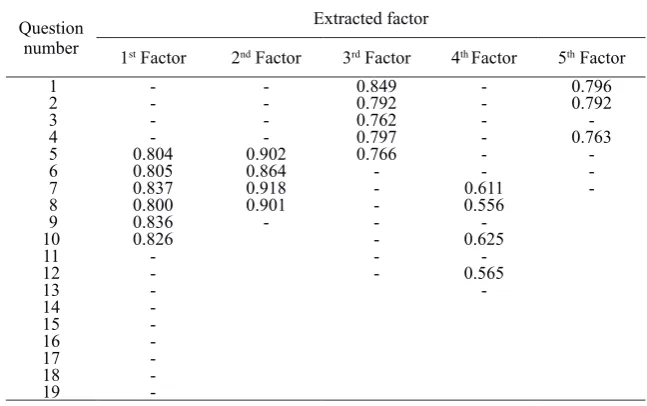
The first factor contained 9 items that explained the individual’s dietary beliefs, the second factor contained 13 items that explained the individual’s physical activity beliefs, the third factor included 11 items that determined the individual’s smoking and drug use beliefs, the fourth factor contained 10 items that explained the individual’s mental and psychological stress beliefs and the fifth factor contained 12 items that explained the individual’s medical regimen beliefs. Five items were omitted at this stage due to the failure to reach the minimum factor loading of 0.40 and the final version of the short form of the MI self-efficacy measurement tool was developed with 22 items. Table 1 presents the factor loading of each item based on its factor rotation matrix and using the principal component factor analysis using the Varimax rotation.
Table 1 The weight of the factors extracted from the exploratory factor analysis using the Varimax rotation at the final stage
Question number
Extracted factor
1st Factor 2nd Factor 3rd Factor 4th Factor 5th Factor
1 - - 0.849 - 0.796
2 - - 0.792 - 0.792
3 - - 0.762 -
4 - - 0.797 - 0.763
5 0.804 0.902 0.766 -
6 0.805 0.864 - -
7 0.837 0.918 - 0.611
8 0.800 0.901 - 0.556
9 0.836 - -
-10 0.826 - 0.625
11 - -
-12 - - 0.565
13 -
-14
-15
-16
-17
-18
-19
-To examine the features of the new short form, the mean, standard deviation, skewness, kurtosis and Cronbach’s alpha coefficient for the entire scale and for its subscales were
had been changed very little compared to the original long form of the scale. Nevertheless, given that the designed short form is a summarized version, comparing the alpha coefficients obtained for the subscales of this
form with those obtained for the original long form should be carried out with caution, as Cronbach’s alpha coefficients decrease in some items with the decrease in the total number of items.
Table 2 Mean, standard deviation, skewness and Cronbach’s alpha coefficient for the long-form MI-SEMT and its subscales
Extracted factor Short Mean Standard deviation Skewness Cronbach’s alpha
form Long form Short form Long form Shortform Long form Short form Long form
Diet 10.53 22.79 3.877 7.900 0.033 0.706 0.979 0.9899
Physical activity 7.49 35.19 3.099 13.509 0.947 0.747 0.972 0.9899
Medical regimen 7.12 21.42 2.877 8.376 1.160 0.937 0.963 0.9860
Mental and psychological
stress 10.15 13.80 4.494 5.757 0.751 0.669 0.977 0.9780
Smoking and
drug use 5.22 15.63 2.183 4.467 1.096 1.060 0.974 0.9645
The results of the exploratory factor analysis revealed five factors that explained 89.24% of the total variance and a KMO index of 0.915 with a probable value of 0.001. Since the closer
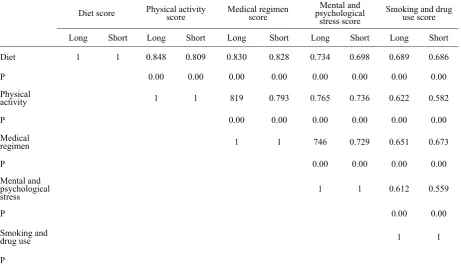
this index is to 1, the more it indicates the adequacy of sample size for performing factor analysis, the results obtained showed that the sample size calculated is adequate (Table 3). Table 3 The results of the correlation analysis between the subscales in the short and long forms of the tool
Diet score Physical activity score Medical regimen score psychological Mental and
stress score Smoking and drug use score
Long Short Long Short Long Short Long Short Long Short
Diet 1 1 0.848 0.809 0.830 0.828 0.734 0.698 0.689 0.686
P 0.00 0.00 0.00 0.00 0.00 0.00 0.00 0.00
Physical
activity 1 1 819 0.793 0.765 0.736 0.622 0.582
P 0.00 0.00 0.00 0.00 0.00 0.00
Medical
regimen 1 1 746 0.729 0.651 0.673
P 0.00 0.00 0.00 0.00
Mental and psychological
stress 1 1 0.612 0.559
P 0.00 0.00
Smoking and
drug use 1 1
P
An initial factor solution was used as a principal factor analysis for calculating the items’ share of the total variance. Theeigen values above 1 were considered suitable. The factor analysis was thus performed on the 60 items of the original questionnaire within 5 main
Table 4 Evaluating the individual factors’ share of the total variance of the items in both the short and long forms of the questionnaire
Extracted factor
Eigenvalue Share of the total variance (%) Cumulative share
Long form Short form Long form Short form Long form Short form
1st factor 41.3 15.3 25.59 30.30 68.96 69.80
2nd factor 4.28 2.01 18.40 24.93 76.11 78.95
3rd factor 2.31 1.23 17.67 20.87 79.97 84.57
4th factor 2.10 1.03 13.43 13.36 83.47 89.27
5th factor 1.65 10.27 86.24
To measure the reliability of internal consistency and Cronbach's alpha was used. Cronbach's alpha of Cronbach's
alpha coefficient of 96.3 to 97.9 to agents and 8.97 for the tool was calculated (Table 5).
Table 5 The correlation, reliability and internal consistency of the five domains of the short form of the MI self-efficacy measurement tool
Domain
Correlation between the domains
Physical
activity Smoking and drug use Medical regimen Diet psychological Mental and stress Cronbach’s alpha% Number of items
Physical activity 1 0.809 0.828 0.698 0.686 97.9 6
Smoking and
drug use 1 0.793 0.736 0.582 97.2 4
Medical regimen 1 0.729 0.673 96.3 5
Diet 1 0.559 97.7 4
Mental and psychological
stress 1 97.4 3
Discussion
The present study was conducted to carry out a factor analysis of the long form of the MI self-efficacy measurement tool (SEMT) and develop its short form (SF-SEMT). The factor analysis can successfully identify and omit the weaker items of the SEMT, as the SF-SEMT (with 28 items) was highly accurate and reliable for determining self-efficacy in patients with MI. The correlation coefficients between the subscales of the SEMT and the SF-SEMT indicate the high validity of the short form of the tool. In other words, the extracted 22 items appear to assess the main constructs of the long form and the secondary constructs (diet, physical activity, medical regimen, mental and psychological stress, smoking and drug use), properly. According to these findings, the short form has a high construct and content validity and its items are a perfect representation of the 60 items of the long form of the questionnaire. According to the Cronbach’s alpha coefficients, the short form has a high internal consistency
and the 22 items are highly correlated. These findings were not unexpected, as the 22 items were extracted only based on their evaluation of a common factor and thus had a high validity and reliability.
In addition to having better psychometric features than the long form, the short form is preferred when the multiplicity of items in the long form deems its use difficult and time-consuming, especially for respondents who have little time or patience to fill out long questionnaires.
index in the evaluation of applicable constructs and concepts.
Conclusion
As, filling out long questionnaires with multiple items may sometimes be too time-consuming for respondents and decrease the accuracy of their responses, shorter questionnaires can be beneficial to both researchers and respondents.. The SF-SEMT was also found to have better psychometric features and a better factor structure compared to the long-form MI-SEMT. Thus, the researchers recommended the use of this short-form questionnaire for assessing self-efficacy in patients with MI.
Acknowledgements
This article is the output of a research by the authors. We express our thanks to all those involved in the writing and publishing of this article especially our colleagues and reviewers in this journal.
Contribution Study design: SZ
Data collection and analysis: MR, TK Manuscript preparation: SZ, TK, MR
Conflict of Interest
"The authors declare that they have no competing interests”
Funding
The authors received financial support for this research (code number: 1108) from Arak university of Medical sciences.
References
1- Choo JE, Burke L, Pyohong K. Improved Quality of Life with Cardiac Rehabilitation for Post-MI Patients in Korea.
Eur J Cardiovasc Nurs2006; 6: 166-71.
2- Glanz K, Rimer B. Theory at a glance: a guide for health promotion practice. U.S.: National cancer institute; 1997. pp:19-20.
3- Rajabi GhR. Reliability and validity of the General Self-Efficacy Beliefs Scale (GSE-10) comparing the psychology students of Shahid Chamran University and Azad
University of Marvdasht. New Thoughts of Education2006;
2(1-2): 111-22.
4- Bandura A. Recycling misconceptions of perceived
self-efficacy. Cognit Ther Res1984; 8(3): 231–55.
5- Schwarzer R, Schmitz GS, Tang C. Teacher burnout in Hong Kong and Germany: A crosscultural validation
of the Maslach burnout inventory. Anxiety Stress
Coping2000; 13(3): 309-26.
6- Rosenstock LM, Strecher VJ, Becker MH. Social
learning theory and the Health belief model. Health Educ
Q1988; 15(2): 175-83.
7- Scholz U, Doٌa BG, Sud S, Schwarzer R. Is general self-efficacy a universal construct? Psychometric
findings from 25 countries. Eur J Psychol Assess2002:
18(3): 242–51.
8- Antman EM, Van De Werf F. Pharmaco-invasive therapy: the future of treatment for ST-elevation MI.
Circulation2004; 109(21): 2480–86.
9- Mc Manus DD, Gore J, Yarzebski J, Spencer F, Lessard D, Goldberg RJ. Recent trends in the incidence, treatment, and outcomes of patients with STEMI and
NSTEMI. Am J Med2011; 124(1): 40-7.
10- Asadi SF. Check the health of women referred to health centers in relation to disease prevention Toxoplasmosis in
Lahijan. Quarterly Nursing & Midwifery2008; 8(4): 4-12.
11- Bandura A. Guide for constructing self-efficacy scales. Available at URL: http://www.emory.edu/EDUCATION/ MFD/bguide.ht ml. Accessed 18 Nov. 2001.
12- Zand S, Rafiei M. The efficacy of aninstrument designed for specific self-afficacy meaurment in patients
with MI. Journal of Urmia Nursing And Midwifery
Faculty2013; 11(6): 468-75.
13- Lo Biondo-Wood G, Hober J. Nursing research, methods and critical appraisal for evidence-based practice. 7th edition. St. Louis: Mosby-Elsevier co; 2010. 14- Boswell C, Cannon S. Introduction to nursing research, incorporating evidence-based practice. 3th edition. Boston: Jones & Bartlett Publishers; 2012. 15- Najarian B. The construction and validation of the short form of children depression scale (CDS-A) by
factor analysis. Psychological Research1994; 2(3-4):
24-44.
16- Cattell RB. The scree test for the number of factors.
Multivariate Behav Res1966; 1(2): 245-76.
17- Ryan JJ, Rosenberg SJ, Heilbronner RL. Comparative relationships of the Wechsler Adult Intelligence Scale— Revised (WAIS-R) and the Wechsler Adult Intelligence
Scale (WAIS) to the Wechsler Memory Scale (WMS). J
Behav Assess1984; 16(1): 37-43.
18- Heidar Ali H. Multivariate data analysis in behavioral research. 2th edition. Tehran: Publications Paik Farhang; 2000.