on psychological well being and marital satisfaction
in divorce applicants couples
Moslem Abbasi1, Shahriar Dargahi2, Zahra Bakhtiari3, Gita Alipour4
Abstract
Divorce is a fact that family institution has been experiencing it in today’s world. In Iran society due to the importance of family, any damage to this institution is unfortunate. The aim of current study was the surveying of effect of acceptance and commitment based training on psychological well being and marital satisfaction in divorce applicants couples. The design of the study is as experimental research with pretest and post test with control group. Statistical population was all clients who exposed to divorce and confer to the courts in Arak city.
Samples were selected at first by available sampling method and
after completing psychological well being questionnaire and marital satisfaction questionnaire, and obtaining score for enter to research, were placement using random sampling method in two experimental and control groups (10 couples in each group). Experimental group were trained during 10 one hour sessions. The results showed that acceptance and commitment based
training could significantly affect psychological well-being and
marital satisfaction of Divorce Applicants Couples. According to these results, the acceptance and commitment training is affective on improving of psychological well being and marital satisfaction of divorce applicants couples.
Keywords: Acceptance, Commitment, Divorce, Psychological, Satisfaction
Journal of Research & Health Social Development & Health Promotion
Research Center Vol. 7, No. 6, Nov & Dec 2017
Pages: 1146- 1153 DOI: 10.18869/acadpub.jrh.7.6.1146
Original Article
1. Correspondence to: Department of Psychology, Faculty of Literature and Human Sciences, Salman Farsi University of Kazerun, Kazerun, Iran
Email: [email protected]
2. Department of Counseling, Faculty of Psychology and Educational Sciences, University of Mohaghegh Ardabili, Ardabil, Iran
3. Department of Counseling, Faculty of Psychology and Educational Sciences, Kharazmi University, Tehran, Iran
4. Department of Psychology, Faculty of Human Sciences, Rasht Branch, Islamic Azad University, Rasht, Iran
Received: 1 Jun 2014 Accepted: 12 Oct 2014
How to cite this article: Abbasi M, Dargahi Sh, Bakhtiari Z, Alipour Chushaly G. Effect of acceptance and commitment based training on psychological well being and marital satisfaction in divorce applicants couples. J Research & Health2017; 7(6): 1146- 1153.
Introduction
In today's world, divorce is one of the facts that the families widely experience it. Of course, this does not mean that the family has not been confronted with this phenomenon in the past, but like all other phenomena in the today’s world, the nature of divorce has changed, and more or less is an optional selection. Due to the importance of the family in the society of Iran,
Marital satisfaction is one of the important variables that in numerous studies have a
significant predictive potentiality about the
tendency towards divorce in individuals. In fact, married couples, who have reported less marital satisfaction, have an increasing possibility of divorce, and suffer from higher
and divorce is a crisis that would break the association [5]. Family is the place for the satisfaction of the physical, intellectual, and emotional needs. The satisfaction of a person's marriage is equal to the family satisfaction, and family satisfaction in a sense results in the life satisfaction, and it is effective for the growth and improvement of family [6]. Marital satisfaction is an overall assessment of the status of marriage or romantic relationship of a
person, which may be a reflection of the joy of
the marriage, or a combination of pleasure with many unique factors of the marital relationship. The marital satisfaction could be considered as a psychological phenomenon that does not come to existence by its own, but by the efforts of both couples [7].
In addition to the marital satisfaction, the
psychological variables can have a major
contribution in the tendency towards divorce as well. Among the important psychological issues, which can play an important role in
marriage is the psychological well-being of couples. Psychological well-being is the
attempt to perfection in order to achieve one's true potential [8]. In fact, the psychological
well-being of individuals is to evaluate and
understand the quality of life [9], and individuals
with a high sense of well-being experience
emotions that are more positive. They have a positive assessment of the past and the future of themselves, others, and the events around them, and the describe them pleasant. On the
other hand, those with a low sense of
well-being assess the above criteria unfavorable, and experience negative emotions such as anxiety
and depression [10]. Psychological well-being
is an important principle that can be detected
through the influence on emotions and all
aspects of human behaviors and development including the physical and mental health, skill and training development, social competence, and positive social relationships [11]. The results of various studies indicate that there is a
significant relationship between psychological well-being and some elements of marriage such
as the quality of marriage, marital satisfaction,
marital conflict, and the tendency towards
divorce [12-14]. The psychological
well-being of individuals can play an important role in marital life and can contribute to the stability or instability of marriage.
One of the treatments that can affect the
psychological well-being and marital
satisfaction, and has been of interest to researchers is the treatment based on Acceptance and Commitment Therapy
(ACT). During the last 10-15 years, the
number of new treatments or expanded forms of Cognitive Behavioral Therapy (CBT)
has been widespread in the field of mental
therapy [15]. The third wave of behavior therapy began in the early 1990s with the development of innovative therapies, which used the principles of mindfulness and emphasized on the awareness of the present moment and its acceptance [16]. The third wave therapy can be divided into two groups: 1) interventions that are based on mindfulness
training such as mindfulness-based stress reduction and mindfulness-based cognitive
therapy, 2) interventions that use mindfulness
as a key component to their work such as
acceptance and commitment-based therapy
and dialectical behavior therapy [17].
Acceptance-based therapy started based on
the hypothesis that the trauma is associated with the attempt to control or avoid negative thoughts and emotions [18]. These treatments emphasize on the change of relationship with the inner experience and stress avoidance [19]. In behavior therapy based on acceptance, the clinical problems are conceptualized based on behavior. Three main problems form the basis of psychological disorders including problems related to awareness, avoidance of internal experiences and the valuable life activities. These problems are considered as intervention
objectives [20]. Empirical evidence about the impact of this treatment on neurotic disorders such as depression [21], social phobia [22], and
high-risk behaviors such as alcohol and drug use [18,23] is specified. The treatment based
on acceptance and commitment is effective in
psychological well-being of individuals
on acceptance and commitment in improving the marriage, researches show that the couples, who had received training based on acceptance and commitment, had more positive emotions and social competence than their counterparts had in the control group [27]. Moreover, in comparison with their counterparts in the control group, the couples showed higher marital satisfaction and mental health [28]. In Iran, in connection with the impact of
cognitive-behavioral interventions on the
increase of the quality of the marital relationship, valuable investigations have been carried out. However, in connection with the treatment based on acceptance and commitment, given the novelty of the treatment, its direct effect on improving the marital relationships has not been studied in any research. However, due to the effect of this treatment in reducing the social and psychological problems, and taking into account the fact that couples facing divorce also has the problems, it is expected that this treatment could be effective in reducing the problems. This study will seek to answer this question whether acceptance and commitment
training is effective on the psychological
well-being and marital satisfaction of the divorcing couples.
Method
This study was a quasi -experimental research and pretest-posttest design with control group
was used. In this study the treatment method with two level is considered as independent variable (acceptance and commitment training and no intervention), and psychological wellbeing and marital satisfaction are considered as dependent variable.
The study population consisted of all couples, who referred to one of the branches of Arak courts in 2013 and requested for divorce. In this study, 20 couples (40 participants), who has referred to divorce court in Arak, and got a low score in marital satisfaction and psychological
well-being questionnaires, were selected
based on accessible method, were chosen as study sample, were divided randomly into the experimental and control groups (each group of
10 couples). The criteria for participating in
the research included having severe conflicts,
literacy, and interest to participate in counseling sessions. In this study, the data were collected using the following instruments:
-
Ryyf’s psychological wellbeing scale: this scale was made by ryyf. This scale has54 items and is a self- assessment on a six
point scale; from strongly agree to strongly disagree. The scale measures six factors of autonomy, environmental mastery, personal growth, positive relations with others, being
purposeful in the life and self-acceptance.
Besides, the sum of these factors produces the total score of psychological wellbeing. In a survey the Cronbach's alpha was reported 0.73 in an Iranian population [29].
-
Enrich’s marital satisfaction scale: This scale is made by Olson in 1989, and consistsof 35 self-reporting items. Each option consists of a 5-point scale that ranges from 1 to 5.
The higher the score, the greater will be his or her marital satisfaction. Asoodeh in 2011 reported the retest reliability of subscales of this questionnaire respectively, 0.86, 0.81,
0.90, and 0.92 that signifies the reliability and
validity of the questionnaire for Iranian culture [30].
After coordination and permission from the court in Arak, by observing moral considerations, expressing the research purposes, and notifying couples, the couples consent to participate in this study. The couples completed questionnaires research according to their characteristics, and due to
their received scores in the psychological
well-being and marital satisfaction questionnaires, the couples who received lower scores were randomly assigned to experimental and
control groups. By justifying and explaining the objectives of the study, the subjects
these meetings, after a week, both groups were tested. Training protocols based on acceptance and commitment: acceptance and commitment Training [31] was taught in 10 sessions of 1 hour as follows.
First session: Introductory remarks, problem Conceptualization, The preparation of clients and implementation of the pretest and also
Preparation A list of enjoyable activities and its
inclusion in the Weekly Schedule.
Second and third sessions: Understanding the implications of ACT treatment (psychological
flexibility, psychological acceptance, mental awareness, cognitive separation,
self-visualize, personal stories, clarify values and act responsibly) in six states; 1) At first, in
this treatment it is tried that the psychological
awareness of individual about subjective
experiences (thoughts, feelings and…) be increased and In contrast, the ineffective control action be reduced. The man learned that any action to prevent or control this unwanted mental experiences is ineffective or they have reverse effect and they would be exacerbated and these experiences should be completely accepted without any internal or external reaction to eliminate them. 2) the mental awareness in
the present moment is added, this means that individual becomes aware of all mental states, thoughts and his or her behavior in the present moment. 3) the individual is taught to
separate himself of herself from the subjective
experiences (Cognitive separation) so they can act independently of theses experience. 4)
Efforts to reduce the excessive focus on
Self-Visualize and Personal stories that Person has made in mind. 5) Help the person to recognize
their personal value and clearly identify them
and make them into specific behavioral goals (clarification of values). 6) Create incentives to
act responsibly namely the activity is focused
on the goals and specified values with the acceptance of subjective experience.
Fourth and fifth sessions: mindfulness training
(emotional and intellectual awareness), Training the clients about what skills are observed and described, How skills are not
judged, are focused, how they works. Also The
use of timeout technic by each of the spouses
during Conflicts and anger that led to the
dispute.
Sixth and seventh sessions: initially the focus is on increasing mental awareness and then the way of responding and suitable dealing
with their subjective experiences and create
purpose and style of social life and Practical commitment to them is taught. Also enumerate the pros and cons of couples by each other
without judgment and emotional reaction.
Eighth Session: distress tolerance Training, Review of previous sessions and giving feedbacks of couples to each other.
Ninth Session: emotion regulation training (Knowing why emotions are important, emotion recognition, Reducing vulnerability and emotional suffering, Increasing positive emotion), Practical practice of lessons, giving feedback by group and therapist
Tenth session: Enhancing interpersonal effect (Develop and maintain of the healthy family relations and etc.), Important interpersonal skills training (Describing and expressing, assertiveness, Explicit trust, negotiation and
self-esteem), Conclusion and implementation
of the posttest.
The gathered data were analyzed by multivariate analysis of covariance (MANCOVA) using software the version of
SPSS-18.
Results
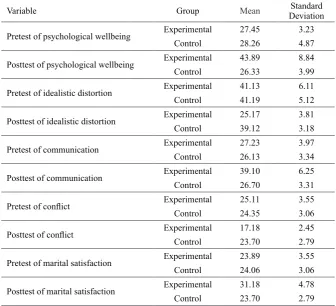
Table 1 The average and standard deviation of pretest and posttest for psychological wellbeing and marital satisfaction in two groups
Variable Group Mean DeviationStandard
Pretest of psychological wellbeing Experimental 27.45 3.23
Control 28.26 4.87
Posttest of psychological wellbeing Experimental 43.89 8.84
Control 26.33 3.99
Pretest of idealistic distortion Experimental 41.13 6.11
Control 41.19 5.12
Posttest of idealistic distortion Experimental 25.17 3.81
Control 39.12 3.18
Pretest of communication Experimental 27.23 3.97
Control 26.13 3.34
Posttest of communication Experimental 39.10 6.25
Control 26.70 3.31
Pretest of conflict Experimental 25.11 3.55
Control 24.35 3.06
Posttest of conflict Experimental 17.18 2.45
Control 23.70 2.79
Pretest of marital satisfaction Experimental 23.89 3.55
Control 24.06 3.06
Posttest of marital satisfaction Experimental 31.18 4.78
Control 23.70 2.79
Table 2 The results of covariance analysis of psychological well-being and marital satisfaction in experimental and control groups
Eta Sig
F MS
Df SS
Dependent variable Sourse
0.63 0.00 65.35
3060.69 1
3060.69 Psychological wellbeing
Groups
0.66 0.00 69.22
1811.22 1
1811.22 Idealistic Distortion
0.65 0.00 61.33
1532.39 1
1532.39 Communication
0.69 0.00 78.36
2214.55 1
2214.55 Conflict resulution
0.61 0.00 125.59
1977.81 1
1977.81 Marital satisfaction
As it can be seen in Table 2, by assuming the control of pretest, the acceptance and commitment training affects the psychological
well-being of couples who apply for divorce at the level of p≤0.01. Also it is seen that by
assuming the control of pretest, the acceptance and commitment training affects the marital satisfaction of couples who apply for divorce
at the level of p≤0.01. it means that acceptance and commitment training significantly increase
the psychological wellbeing and marital satisfaction of divorce applicants couples
Discussion
Based on the results of the present study,
training based on acceptance and commitment is effective on the improving the
psychological well-being of couples at risk of
divorce, which is consistent with the results
of other studies [17,24-27,32], and suggests
that training based on acceptance and commitment is effective on the improving of
the psychological well-being of the couples
facing divorce. It can be said that in the second
and third sessions, which mental flexibility,
effect, and exacerbates it, and the experiences must be accepted without any internal or external response to eliminate them completely. The cognitive separation causes divorcing couples to see their problems from an outside perspective, to be comfortable to talk about their problems, and it helps to know and to clearly identify his original personal values, and convert them into
specific behavioral objectives. In the sixth and
seventh sessions that focus on increasing mental
awareness, the divorcing couples re-evaluate their
positive and negative points and try to make proper
judgments about their problems. Acceptance and
commitment therapy, rather than focusing on elimination and removal harmful agents, helps clients to accept their controlled emotions and
cognitions, to get rid of self-regulated speeches
that cause problems, and to allow them to abandon the struggle with them. Acceptance and commitment therapy is mainly a process, and openly stresses on the promoted acceptance of psychological experience and commitment with
the consistently increase of flexible meaningful
activities, and regardless of the content of the psychological experiences. The goal of treatment methods used in the acceptance and commitment therapy is not to increase the realistic, effective, and reasonable thinking or not to encourage feelings, but the aim of the therapeutic methods is to reduce the psychological experiences, and to increase awareness of them, especially by focusing on the present moment without adopting
any conflict and non-evaluative based method.
The results indicate that training based on acceptance and commitment is effective on the improving of marital satisfaction of divorcing couples, which are consistent with other studies
[33-36], and they suggest that training based on acceptance and commitment in influential
on the improving of marital satisfaction of the divorcing couples. In the case of couples at risk of divorce, what is certain is that they are
not satisfied with their lives and quality of life,
therefore, treatment based on acceptance and commitment tries to increase the satisfaction of the individuals. In fact, couples become aware of all mental states, thoughts, and behavior in the moment and they try to separate themselves from
their mental experiences (cognitive separation). The couples recognize their core personal values (illumination of the values). Finally, they are motivated to solve their problems. At the
fifth session, mindfulness training (emotional
intelligence and rational knowledge) makes that
couples to see their skills and to find motivation
to improve their relations. At the sixth session,
couples find a new purpose for living together, and judge the pros and cons of themselves and
their partners.
One of the limitations of this study is the lack
of follow-up stage and as the result, the lack of
information on the continuity and stability of the results of the present study. The research was done on couples facing divorce in the city of Arak. Therefore, it is suggested that similar research should be applied in other regions
for several months with follow-up sessions to
assess the effect of the treatment.
Conclusion
The findings of this study proved the impact
of training based on the acceptance and commitment in increasing of the psychological
well-being and the marital satisfaction of
the divorcing couples. Since acceptance and commitment are the sense of awareness
without judgment and imbalance, which
help to the clarity of the view and accept of the physical emotions and phenomena as they occur, therefore, training to couples facing divorce causes them to accept their psychological feelings and symptoms, and the acceptance of these feelings and thoughts reduce excessive sensitivity to marital
problems so their well-being and consistency
would be improved.
Acknowledgments
The authors express their most sincere thanks to the authorities of the courts in Arak city and all participating couples whose participate and contribution made conducting this research possible.
Contribution
Data collection and analysis: MA, SHD, ZB, GA
Manuscript preparation: MA, SHD, ZB, GA
Conflict of Interest
"The authors declare that they have no competing interests."
Funding
The author (s) received no financial support for
the research, authorship and/or publication of this article.
Refrences
1- Jafari A, Sanai Zaker B, Pasha Sharifi H, Akrami
A. Comparison the effectiveness of sattir and vitaker communication approaches to reduce the likelihood of
divorce in conflicting couples on the brink of divorce.
Counseling News and Researches2011; 9(34): 425-47. 2- Hirschberger G, Srivastava S, Marsh P, Cown C,
Cown P. Attachment, marital satisfaction, and divorce
during the first fifteen years of years of parenthood. Pers Relatch2011; 16(3): 401-20.
3- Yeh HC, Lorenz FO, Wickrama KA, Conger RD,
Elder GH Jr. Relationships among sexual satisfaction, marital quality, and marital instability at midlife. J Fam Psychol2006; 20(2): 339- 43.
4- Shakerian A, Nazari A, Masoomi M. Inspecting the
relation between sexual satisfaction and marital problems
of divorce seeking women in sanandaj city family
centers. Procedia Social and Behavioral Science2014;
114: 327-33.
5- Kaplan H, Sadocks B. Synopsis of psychiatry. 9th eds.
Philadelphia: Lippincott williams and wilkins 2007.
6- Edalati A, Redzuan M. Perception of women towards
family value s and their marital satisfaction. Journal of American Science2010; 6(4): 132-7.
7- Ahmadi K, Nabipoor SM, Kimiaee SA, Afzali MH.
Effect of family problem solving on marital satisfaction.
J Applied Sci2010; 10(8): 682-7.
8- Ryff CD, Keyes CL. The structure of psychological well-being revisited. J Pers Soc Psychol1995; 69(4): 719–27.
9- Mirzaei P. Build mental well-being and to compare
the effectiveness of this program with the program in reducing depression, happiness Fordyce high school students in Isfahan [dissertation]. Tehran: Alzahra University 2007.
10- Golestanibakht T. Model of subjective well and joy in the population of Tehran [dissertation]. Tehran:
Alzahra University 2007.
11- Bridges LJ, Margie NG, Zaff JF. Background for
community level work on emotional well-being in
Adolescence: Reviewing the literature on contributing factors. Washington, DC: Child Trends; 2001.
12- Proulx CH, Helms H, Buehler C. Marital quality and personal wellbeing: a meta- analysis. Journal Marriage Family2007; 69: 576- 593.
13- Kamp Dush CM, Taylor MG, Kroeger RA. Marital
happiness and psychological wellbeing across the life course. Fam Relat2008; 57(2): 211-26.
14- Kurdek L. The relation between reported wellbeing
and divorce history availability of a proximate adult, and gender. Journal Marriage Family1991; 53(1): 71- 8. 15- Ost LG. Efficacy of the third wave of behavioral therapies: a systematic review and meta-analysis.
Behav Res Ther2008; 46(3): 296-321.
16- Cardaciotto LA. Assessing mindfulness: the development of a bi-dimensional measure of awareness
and acceptance [dissertation]. Philadelphia, PA: Drexel University 2005.
17- Hayes SC. Acceptance and commitment therapy,
relational frame theory, and the third wave of behavioral and cognitive therapies. Behavior Therapy2016; 47(6):
869-85.
18- Hayes SC, Bissett RT, Korn Z, et al. The impact of
acceptance versus control rationales on pain tolerance.
Psychol Rec1999; 49(1): 33-47.
19- Roemer L, Orsillo SM. An acceptance- based
behavior therapy for generalized anxiety disorder.
In: Orsillo SM, Roemer L, Eds. Acceptance- and mindfulness-based approaches to anxiety: conceptualization and treatment. New York, NY:
Springer; 2005.
20- Zargar F, Mohammadi A, Omidi A, Bagherian R.
The third wave of behavioral therapy with emphasis on behavior al therapy based on acceptance. Journal of Behavioral Science Researches2013; 10(5): 383-90. 21- Kanter JW, Baruch DE, Gaynor ST. Acceptance and
commitment therapy and behavioral activation for the treatment of depression: description and comparison.
Behav Anal2006; 29(2): 161–85.
22- Ossman WA, Wilson KG, Storaasli RD, McNeill
JW. A preliminary investigation of the use of acceptance and commitment therapy in group treatment for social phobia [Investigación preliminar del uso de la terapia de aceptación y compromiso en el tratamiento grupal de la fobia social]. Rev Int Psicol Ter Psico2006; 6(3):
397-416.
23- Gifford EV, Kohlenberg BS, Hayes SC, Antonuccio DO, Piasecki MM, Rasmussen-Hall ML.
Acceptance-based treatment for smoking cessation. Behav Ther2004; 35: 689-705.
24- Fincham FD, Hall J, Beach SR. Forgiveness in
25- Linehan MM, Dimeff LA, Reynolds SK, et al.
Dialectical behavior therapy versus comprehensive
validation therapy plus 12-step for the treatment of
opioid dependent women meeting criteria for borderline personality disorder. Drug Alcohol Depend2002; 67(1):
13-26.
26- Baggerly J, Parker M. Child-centered group play
therapy with African American boys of the elementary
school level. J. Couns. Dev2005; 83: 387-96.
27- Lee V, Robin Cohen S, Edgar L, Laizner AM, Gagnon AJ. Meaning-making intervention during breast or colorectal cancer treatment improves self-esteem, optimism, and self-efficacy. Soc Sci Med2006; 62(12): 3133–45.
28- Christensen A, Atkins DC, Berns S, Wheeler J,
Baucom DH, Simpson LE. Traditional versus integrative
behavioral couple therapy for significantly and
chronically distressed married couples. J Consult Clin Psychol2004; 72(2): 176-91.
29- Maddah Z, Elahi T, Fathi-Ashtiani A. Explanation of psychological well-being in students based on spirituality.
Journal of Behavioral Sciences2014; 7(4): 355- 61. 30- Asoodeh M. Factors of successful marriage: accounts
from self-described happy couples [dissertation].
Tehran: University of Tehran 2011.
31- Forman EM, Herbert JD. New directions in
cognitive behavior therapy: acceptance based therapies, chapter to appear. in O’donohue W, Fisher JE, eds. Cognitive behavior therapy: Applying empirically supported treatments in your practice, 2nd
ed. Hoboken, NJ: Wiley; 2008. pp:263-5.
32- Carlson C, Clemmer F, Jennings T, Thompson C,
Page LJ. Organizational development 101: lessons from Star wars. J Individ Psychol2007; 63(3): 425-39. 33- Moradi M, Jafari SE, Abedi MR. Happiness and
personality. J Cogn Sci2005; 7(2): 60-71.
34- Bagherian Nejad Esphehani Z. Comparison of
dissatisfaction marital dimensions in men and women divorce applicant in Esfahan city [dissertation]. Tehran: Tarbiat Moallem university 2002.
35- Shachelford TK, Besser A, Goetz AT. Personality, marital satisfaction, and marital infidelity. Individ Differ Res2007; 6(1): 13-25.
36- Backus LN. Perception of women towards family
value s and their marital satisfaction. J Am Sci2009;
6(4), 132-7.
Copyright© 2016 ASP Ins. This open-access article is published under the terms of the Creative Commons Attribution-NonCommercial 4.0
International License which permits Share (copy and redistribute the material in any medium or format) and Adapt (remix, transform, and build