A Monthly Double-Blind Peer Reviewed (Refereed/Juried) Open Access International e-Journal - Included in the International Serial Directories Indexed & Listed at:
VOLUMENO.3(2013),ISSUENO.11(NOVEMBER) ISSN2231-5756
INTERNATIONAL JOURNAL OF RESEARCH IN COMMERCE, IT & MANAGEMENT
CONTENTS
Sr.
No.
TITLE & NAME OF THE AUTHOR (S)
Page No.
1. EFFICIENT MARKET HYPOTHESIS: A PRIMARY EXPLORATORY STUDY ON RELEVANCE OF INFORMATION BIAS
PRADEEPA.M, VIDYA.R & DR. R.HIREMANINAIK
1
2. COMPARATIVE ANALYSIS OF THE PARAMETERS OF DYNAMIC CHANNEL ALLOCATION FOR COLLISION LESS DATA TRANSMISSION
SUSHANT JHINGRAN & SAOUD SARWAR
5
3. A STUDY OF OVERDUES IN SELECTED PACS’S: WITH SPECIAL REFERENCE TO MANGALAGIRI BRANCH OF GDCCB LTD., TENALI, DURING 2008-‘12
DR. MADDALI ARAVIND & PALUTLA NAGAMANI
8
4. FDI IN AVIATION: WILL IT SERVE AS A GAME CHANGER FOR INDIAN AIRLINES INDUSTRY? P.K. KOTIA & MEENAL LODHA
14
5. FACTORS INFLUENCING THE EMPLOYEES’ INTENTION TO CHANGE JOB FROM PUBLIC TO PRIVATE SECTOR BANKS & VICE VERSA: AN EMPIRICAL STUDY OF BANKING SECTOR EMPLOYEES IN INDIA
DR. RENU SHARMA
19
6. HIGHER EDUCATION IN INDIA: CONFRONTING THE CHALLENGE OF CHANGE
DR. PAWAN KUMAR SHARMA
24
7. A TECHNIQUE WITH DIFFERENTIATED SAMPLING IN ANOMALY DETECTION SYSTEM FOR OUTLIER IDENTIFICATION
SARANYA.C & VEENA.S
27
8. AN IMPROVED APPROACH OF RISK ANALYSIS FOR IT & ITES ORGANIZATIONS CHELLAM SHENBAGAM
31
9. DERIVATIVES MARKET IN INDIA
GHANATHE RAMESH, CHEGU JYOTHI, KONDA SANDEEP KUMAR & GOWLIKAR VINESH KUMAR
37
10. CORPORATE GOVERNANCE IN BRICS: A COMPARATIVE STUDY
MINNY NARANG, DEEPALI MALHOTRA & SWATI SETH
41
11. EFFECT OF INSTITUTIONAL PRESSURES ON THE RELATION BETWEEN FINANCIAL AND SUSTAINABLE PERFORMANCE OF FIRMS
AMOGH TALAN, PRIYANKA PANDEY & GAURAV TALAN
48
12. FOREIGN DIRECT INVESTMENT: ECONOMIC GROWTH AND ISLAMIC BANKING INDUSTRY
MEHDI BEHNAME & MAHDI MOSTAFAVI
52
13. THE EFFECT OF CAPITAL STRUCTURE ON PROFITABILITY: EVIDENCE FROM THE PETROCHEMICAL COMPANIES IN THE KINGDOM OF SAUDI
ARABIA
AHMED AL AJLOUNI & MUNIR SHAWER
56
14. ERA OF KNOWLEDGE MANAGEMENT IN INDUSTRY AND INFORMATION RESEARCH WORLD
G.SANTOSH KUMAR & P.SHIRISHA
63
15. AN APPROACH INTO COMMERCE EDUCATION AFTER GLOBALIZATION-CHALLENGES AND OPPORTUNITIES
RAVINDER KAUR & MANMEET KAUR
66
16. A STUDY ON STRESS LEVEL OF EMPLOYEES OF INFORMATION TECHNOLOGY COMPANIES IN CHENNAI, TAMILNADU
DR. RETHINA BAI.R
70
17. INNOVATIVE FINANCIAL PRODUCTS: A STUDY OF CHALLENGES AND OPPORTUNITIES AT UDAIPUR, INDIA
DR. YOGESH JAIN
73
18. FINANCIAL MEASURES USING Z- SCORES WITH SPECIAL REFERENCE TO BAJAJ AUTO LIMITED
KOKILA H S
84
19. CONSUMER BEHAVIOUR TOWARDS REFRIGERATOR IN MYSORE CITY
ALUREGOWDA
88
20. THE STUDY OF FACTORS RELATED TO VOCATIONAL WEAR IN MUNICIPALITY’S EMPLOYEES
MAJID NILI AHMADABADI & HAMID DEHGHANI
94
21. UTILIZING INTERNET AS ON-LINE SALES TOOL FOR EMPOWERMENT OF BUSINESS EDUCATION GRADUATES IN NIGERIA
TITUS AMODU UMORU
97
22. CONSUMERS’ ATTITUDES TOWARDS THE DAIRY PRODUCT IN THE ETHIOPIAN MARKET: CASE OF ADDIS ABABA
SARFARAZ KARIM, SRAVAN KUMAR REDDY & ELIAS GIZACHEW
100
23. IMPLEMENTATION OF ABC IN BANGLADESH: REQUIRED PREREQUISITES AND THEIR AVAILABILITY
TANZILA AHMED & TAHMINA AHMED
105
24. WIDENING REGIONAL ECONOMIC DISPARITIES IN INDIA
SUSANTA KR. SUR & DR. TOWHID E AMAN
109
25. MODELLING A STACKELBERG GAME IN A TWO STAGE SUPPLY CHAIN UNDER RETURN POLICY CONTRACTS: SOLVING A DECISION PROBLEM FOR A CAPACITY CONSTRAINED MANUFACTURER
SHIRSENDU NANDI
113
26. JOB SATISFACTION IN BANKING: A COMPARATIVE STUDY BETWEEN PUBLIC AND PRIVATE SECTOR BANKS IN DEHRADUN, UTTARAKHAND
RATNAMANI
118
27. PERFORMANCE APPRAISAL SYSTEM FOR SALES FORCE IN FASTENER INDUSTRY: STUDY OF LPS ROHTAK
HARDEEP
124
28. IMPACT OF GLOBAL RECESSION ON INDIAN FINANCIAL MARKET
SHIKHA MAKKAR
129
29. IMPACT OF PRIVATIZATION ON INDIAN BANKING SECTOR IN THE GLOBALIZATION ERA
PRIYANKA RANI, NANCY ARORA & RENU BALA
134
30. POST IMPACT ANALYSIS OF GLOBALIZATION ON TOURISM SERVICES
BIVEK DATTA
139
CHIEF PATRON
PROF. K. K. AGGARWAL
Chairman, Malaviya National Institute of Technology, Jaipur
(An institute of National Importance & fully funded by Ministry of Human Resource Development, Government of India)
Chancellor, K. R. Mangalam University, Gurgaon
Chancellor, Lingaya’s University, Faridabad
Founder Vice-Chancellor (1998-2008), Guru Gobind Singh Indraprastha University, Delhi
Ex. Pro Vice-Chancellor, Guru Jambheshwar University, Hisar
FOUNDER PATRON
LATE SH. RAM BHAJAN AGGARWAL
Former State Minister for Home & Tourism, Government of Haryana
Former Vice-President, Dadri Education Society, Charkhi Dadri
Former President, Chinar Syntex Ltd. (Textile Mills), Bhiwani
CO-ORDINATOR
AMITA
Faculty, Government M. S., Mohali
ADVISORS
DR. PRIYA RANJAN TRIVEDI
Chancellor, The Global Open University, Nagaland
PROF. M. S. SENAM RAJU
Director A. C. D., School of Management Studies, I.G.N.O.U., New Delhi
PROF. M. N. SHARMA
Chairman, M.B.A., Haryana College of Technology & Management, Kaithal
PROF. S. L. MAHANDRU
Principal (Retd.), Maharaja Agrasen College, Jagadhri
EDITOR
PROF. R. K. SHARMA
Professor, Bharti Vidyapeeth University Institute of Management & Research, New Delhi
CO-EDITOR
DR. BHAVET
Faculty, Shree Ram Institute of Business & Management, Urjani
EDITORIAL ADVISORY BOARD
DR. RAJESH MODI
Faculty, Yanbu Industrial College, Kingdom of Saudi Arabia
PROF. SANJIV MITTAL
University School of Management Studies, Guru Gobind Singh I. P. University, Delhi
PROF. ANIL K. SAINI
VOLUMENO.3(2013),ISSUENO.11(NOVEMBER) ISSN2231-5756
INTERNATIONAL JOURNAL OF RESEARCH IN COMMERCE, IT & MANAGEMENT
DR. SAMBHAVNA
Faculty, I.I.T.M., Delhi
DR. MOHENDER KUMAR GUPTA
Associate Professor, P. J. L. N. Government College, Faridabad
DR. SHIVAKUMAR DEENE
Asst. Professor, Dept. of Commerce, School of Business Studies, Central University of Karnataka, Gulbarga
ASSOCIATE EDITORS
PROF. NAWAB ALI KHAN
Department of Commerce, Aligarh Muslim University, Aligarh, U.P.
PROF. ABHAY BANSAL
Head, Department of Information Technology, Amity School of Engineering & Technology, Amity
University, Noida
PROF. A. SURYANARAYANA
Department of Business Management, Osmania University, Hyderabad
DR. SAMBHAV GARG
Faculty, Shree Ram Institute of Business & Management, Urjani
PROF. V. SELVAM
SSL, VIT University, Vellore
DR. PARDEEP AHLAWAT
Associate Professor, Institute of Management Studies & Research, Maharshi Dayanand University, Rohtak
DR. S. TABASSUM SULTANA
Associate Professor, Department of Business Management, Matrusri Institute of P.G. Studies, Hyderabad
SURJEET SINGH
Asst. Professor, Department of Computer Science, G. M. N. (P.G.) College, Ambala Cantt.
TECHNICAL ADVISOR
AMITA
Faculty, Government M. S., Mohali
FINANCIAL ADVISORS
DICKIN GOYAL
Advocate & Tax Adviser, Panchkula
NEENA
Investment Consultant, Chambaghat, Solan, Himachal Pradesh
LEGAL ADVISORS
JITENDER S. CHAHAL
Advocate, Punjab & Haryana High Court, Chandigarh U.T.
CHANDER BHUSHAN SHARMA
Advocate & Consultant, District Courts, Yamunanagar at Jagadhri
SUPERINTENDENT
CALL FOR MANUSCRIPTS
We invite unpublished novel, original, empirical and high quality research work pertaining to recent developments & practices in the areas of Computer Science & Applications; Commerce; Business; Finance; Marketing; Human Resource Management; General Management; Banking; Economics; Tourism Administration & Management; Education; Law; Library & Information Science; Defence & Strategic Studies; Electronic Science; Corporate Governance; Industrial Relations; and emerging paradigms in allied subjects like Accounting; Accounting Information Systems; Accounting Theory & Practice; Auditing; Behavioral Accounting; Behavioral Economics; Corporate Finance; Cost Accounting; Econometrics; Economic Development; Economic History; Financial Institutions & Markets; Financial Services; Fiscal Policy; Government & Non Profit Accounting; Industrial Organization; International Economics & Trade; International Finance; Macro Economics; Micro Economics; Rural Economics; Co-operation; Demography: Development Planning; Development Studies; Applied Economics; Development Economics; Business Economics; Monetary Policy; Public Policy Economics; Real Estate; Regional Economics; Political Science; Continuing Education; Labour Welfare; Philosophy; Psychology; Sociology; Tax Accounting; Advertising & Promotion Management; Management Information Systems (MIS); Business Law; Public Responsibility & Ethics; Communication; Direct Marketing; E-Commerce; Global Business; Health Care Administration; Labour Relations & Human Resource Management; Marketing Research; Marketing Theory & Applications; Non-Profit Organizations; Office Administration/Management; Operations Research/Statistics; Organizational Behavior & Theory; Organizational Development; Production/Operations; International Relations; Human Rights & Duties; Public Administration; Population Studies; Purchasing/Materials Management; Retailing; Sales/Selling; Services; Small Business Entrepreneurship; Strategic Management Policy; Technology/Innovation; Tourism & Hospitality; Transportation Distribution; Algorithms; Artificial Intelligence; Compilers & Translation; Computer Aided Design (CAD); Computer Aided Manufacturing; Computer Graphics; Computer Organization & Architecture; Database Structures & Systems; Discrete Structures; Internet; Management Information Systems; Modeling & Simulation; Neural Systems/Neural Networks; Numerical Analysis/Scientific Computing; Object Oriented Programming; Operating Systems; Programming Languages; Robotics; Symbolic & Formal Logic; Web Design and emerging paradigms in allied subjects.
Anybody can submit the soft copy of unpublished novel; original; empirical and high quality research work/manuscriptanytime in M.S. Word format after preparing the same as per our GUIDELINES FOR SUBMISSION; at our email address i.e. [email protected] or online by clicking the link online submission as given on our website (FOR ONLINE SUBMISSION, CLICK HERE).
GUIDELINES FOR SUBMISSION OF MANUSCRIPT
1. COVERING LETTER FOR SUBMISSION:
DATED: _____________ THE EDITOR
IJRCM
Subject: SUBMISSION OF MANUSCRIPT IN THE AREA OF.
(e.g. Finance/Marketing/HRM/General Management/Economics/Psychology/Law/Computer/IT/Engineering/Mathematics/other, please specify)
DEAR SIR/MADAM
Please find my submission of manuscript entitled ‘___________________________________________’ for possible publication in your journals.
I hereby affirm that the contents of this manuscript are original. Furthermore, it has neither been published elsewhere in any language fully or partly, nor is it under review for publication elsewhere.
I affirm that all the author (s) have seen and agreed to the submitted version of the manuscript and their inclusion of name (s) as co-author (s).
Also, if my/our manuscript is accepted, I/We agree to comply with the formalities as given on the website of the journal & you are free to publish our contribution in any of your journals.
NAME OF CORRESPONDING AUTHOR: Designation:
Affiliation with full address, contact numbers & Pin Code: Residential address with Pin Code:
Mobile Number (s): Landline Number (s): E-mail Address: Alternate E-mail Address:
NOTES:
a) The whole manuscript is required to be in ONE MS WORD FILE only (pdf. version is liable to be rejected without any consideration), which will start from the covering letter, inside the manuscript.
b) The sender is required to mentionthe following in the SUBJECT COLUMN of the mail:
New Manuscript for Review in the area of (Finance/Marketing/HRM/General Management/Economics/Psychology/Law/Computer/IT/ Engineering/Mathematics/other, please specify)
c) There is no need to give any text in the body of mail, except the cases where the author wishes to give any specific message w.r.t. to the manuscript. d) The total size of the file containing the manuscript is required to be below 500 KB.
e) Abstract alone will not be considered for review, and the author is required to submit the complete manuscript in the first instance.
f) The journal gives acknowledgement w.r.t. the receipt of every email and in case of non-receipt of acknowledgment from the journal, w.r.t. the submission of manuscript, within two days of submission, the corresponding author is required to demand for the same by sending separate mail to the journal.
2. MANUSCRIPT TITLE: The title of the paper should be in a 12 point Calibri Font. It should be bold typed, centered and fully capitalised.
3. AUTHOR NAME (S) & AFFILIATIONS: The author (s) full name, designation, affiliation (s), address, mobile/landline numbers, and email/alternate email address should be in italic & 11-point Calibri Font. It must be centered underneath the title.
VOLUMENO.3(2013),ISSUENO.11(NOVEMBER) ISSN2231-5756
INTERNATIONAL JOURNAL OF RESEARCH IN COMMERCE, IT & MANAGEMENT
5. KEYWORDS: Abstract must be followed by a list of keywords, subject to the maximum of five. These should be arranged in alphabetic order separated by commas and full stops at the end.
6. MANUSCRIPT: Manuscript must be in BRITISH ENGLISH prepared on a standard A4 size PORTRAIT SETTING PAPER. It must be prepared on a single space and single column with 1” margin set for top, bottom, left and right. It should be typed in 8 point Calibri Font with page numbers at the bottom and centre of every page. It should be free from grammatical, spelling and punctuation errors and must be thoroughly edited.
7. HEADINGS: All the headings should be in a 10 point Calibri Font. These must be bold-faced, aligned left and fully capitalised. Leave a blank line before each heading.
8. SUB-HEADINGS: All the sub-headings should be in a 8 point Calibri Font. These must be bold-faced, aligned left and fully capitalised.
9. MAIN TEXT: The main text should follow the following sequence:
INTRODUCTION
REVIEW OF LITERATURE
NEED/IMPORTANCE OF THE STUDY
STATEMENT OF THE PROBLEM
OBJECTIVES
HYPOTHESES
RESEARCH METHODOLOGY
RESULTS & DISCUSSION
FINDINGS
RECOMMENDATIONS/SUGGESTIONS
CONCLUSIONS
SCOPE FOR FURTHER RESEARCH
ACKNOWLEDGMENTS
REFERENCES
APPENDIX/ANNEXURE
It should be in a 8 point Calibri Font, single spaced and justified. The manuscript should preferably not exceed 5000 WORDS.
10. FIGURES &TABLES: These should be simple, crystal clear, centered, separately numbered & self explained, and titles must be above the table/figure. Sources of data should be mentioned below the table/figure. It should be ensured that the tables/figures are referred to from the main text.
11. EQUATIONS:These should be consecutively numbered in parentheses, horizontally centered with equation number placed at the right.
12. REFERENCES: The list of all references should be alphabetically arranged. The author (s) should mention only the actually utilised references in the preparation of manuscript and they are supposed to follow Harvard Style of Referencing. The author (s) are supposed to follow the references as per the following:
•
All works cited in the text (including sources for tables and figures) should be listed alphabetically.•
Use (ed.) for one editor, and (ed.s) for multiple editors.•
When listing two or more works by one author, use --- (20xx), such as after Kohl (1997), use --- (2001), etc, in chronologically ascending order.•
Indicate (opening and closing) page numbers for articles in journals and for chapters in books.•
The title of books and journals should be in italics. Double quotation marks are used for titles of journal articles, book chapters, dissertations, reports, working papers, unpublished material, etc.•
For titles in a language other than English, provide an English translation in parentheses.•
The location of endnotes within the text should be indicated by superscript numbers.PLEASE USE THE FOLLOWING FOR STYLE AND PUNCTUATION IN REFERENCES: BOOKS
•
Bowersox, Donald J., Closs, David J., (1996), "Logistical Management." Tata McGraw, Hill, New Delhi.•
Hunker, H.L. and A.J. Wright (1963), "Factors of Industrial Location in Ohio" Ohio State University, Nigeria. CONTRIBUTIONS TO BOOKS•
Sharma T., Kwatra, G. (2008) Effectiveness of Social Advertising: A Study of Selected Campaigns, Corporate Social Responsibility, Edited by David Crowther & Nicholas Capaldi, Ashgate Research Companion to Corporate Social Responsibility, Chapter 15, pp 287-303.JOURNAL AND OTHER ARTICLES
•
Schemenner, R.W., Huber, J.C. and Cook, R.L. (1987), "Geographic Differences and the Location of New Manufacturing Facilities," Journal of Urban Economics, Vol. 21, No. 1, pp. 83-104.CONFERENCE PAPERS
•
Garg, Sambhav (2011): "Business Ethics" Paper presented at the Annual International Conference for the All India Management Association, New Delhi, India, 19–22 June.UNPUBLISHED DISSERTATIONS AND THESES
•
Kumar S. (2011): "Customer Value: A Comparative Study of Rural and Urban Customers," Thesis, Kurukshetra University, Kurukshetra. ONLINE RESOURCES•
Always indicate the date that the source was accessed, as online resources are frequently updated or removed. WEBSITESCOMPARATIVE ANALYSIS OF THE PARAMETERS OF DYNAMIC CHANNEL ALLOCATION FOR COLLISION
LESS DATA TRANSMISSION
SUSHANT JHINGRAN
RESEARCH SCHOLAR
AL-FALAH SCHOOL OF ENGINEERING & TECHNOLOGY
DHAUJ
SAOUD SARWAR
HEAD
DEPARTMENT OF COMPUTER SCIENCE
AL-FALAH SCHOOL OF ENGINEERING & TECHNOLOGY
DHAUJ
ABSTRACT
Channel allocation deals with the allocation of channels to cells in a cellular network. Once the channels are allocated, cells may then allow users within the cell to communicate via the available channels. Channels in a wireless communication system typically consist of time slots, frequency bands and/or CDMA pseudo noise sequences, but in an abstract sense, they can represent any generic transmission resource. In Dynamic Channel Allocation (DCA) frames are transmitted. During the transmission of the frames, collision might be occurring, which make the retransmission of the frames .Transmission of the frames can be done either in continuous time or in a slotted manner. Sensing of the channel is also providing help during the transmission. A single channel is used for the whole communication.
KEYWORDS
Channel acquisition, pseudo noise sequences, offered traffic, frequency reuse, non-uniform.
INTRODUCTION
n this paper we describe a description of channel’s Parameter over Dynamic Channel Allocation. Parameters define about Channel Capacity, sensing, Multiple Channel Connections, Packet Transmission, Frame relay and Congestion over transmission.
In dynamic channel allocation all sufficiently high-quality, un-interfered channels can be allocated to users becoming active [3].The demand for wireless telephony and multimedia services is growing at an increasing rate [2].Access Point is the slot, Which is used to connect the multiple system with the common medium. Frequency allocation is similar for the channel. All APs share the same frequency, which increase collision that should be minimized and avoided if necessary, using parameters of channels. The Channel parameters in use should be tailored to the channel Conditions. In cell manner frequency can be reused so that channel utilization can be improved.
PARAMETERS FOR DCA
1:- STATION MODELThe model consists of N independent stations. Each station generates one frame at a time, and is blocked until the previous frame has been successfully transmitted. That is, a station cannot have multiple frames queued for transmission. In practice, Ethernet, for example, requires a 100 bit transmission time gap between consecutive frames
FRAME TRANSMISSION
Whenever an end station MAC receives a transmit-frame request with the accompanying address and data information from the LLC sub layer, the MAC begins the transmission sequence by transferring the LLC information into the MAC frame buffer.
• The preamble and start-of-frame delimiter are inserted in the PRE and SOF fields.
• The destination and source addresses are inserted into the address fields.
• The LLC data bytes are counted, and the number of bytes is inserted into the Length/Type field.
• The LLC data bytes are inserted into the Data field. If the number of LLC data bytes is less than 46, a pad is added to bring the Data field length up to 46.
• An FCS value is generated over the DA, SA, Length/Type, and Data fields and is appended to the end of the Data field.
After the frame is assembled, actual frame transmission will depend on whether the MAC is operating in half-duplex or full-duplex mode.
The IEEE 802.3 standard currently requires that all Ethernet MACs support half-duplex operation, in which the MAC can be either transmitting or receiving a frame, but it cannot be doing both simultaneously. Full-duplex operation is an optional MAC capability that allows the MAC to transmit and receive frames simultaneously.
2:- SINGLE CHANNEL ASSUMPTION
A single Channel is available for all communication. All stations share one medium. All stations can transmit on it and all can receive from it. The QoS is always a major concern for the services offered through cellular systems and it is observed that there are always trade-offs among various parameters [5].
The increasing number of higher data rate devices clearly states that dynamic channel allocation with some innovative techniques will help solve the problem of spectrum efficiency [6].
3:- COLLISION ASSUMPTION
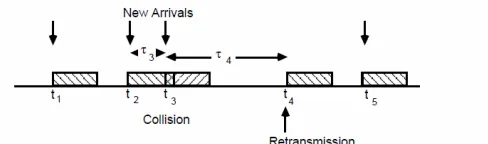
When two or more frames are transmitted at the same time and a collision takes place. Frames involved have to be retransmitted. If two devices send a frame at the same time, the two electrical, optical or radio signals that correspond to these frames will appear at the same time on the transmission medium and a receiver will not be
able to decode either frame. Such simultaneous transmissions are called collisions. A collision may involve frames transmitted by two or more devices attached. If transmitted frames overlap in time, the resulting signal is garbled.Frequency assignment is a major problem in designing wireless networks [4].
4:- TRANSMISSION DISCIPLINE
In computer networking and telecommunication, a frame is a digital data transmission unit that includes frame synchronization, i.e. a sequence of bits or symbols making it possible for the receiver to detect the beginning and end of the packet in the stream of symbols or bits. If a receiver is connected to the system in the middle of a frame transmission, it ignores the data until it detects a new frame synchronization sequence.
CONTINUOUS TIME
Frames can be transmitted at any time Slotted time
VOLUMENO.3(2013),ISSUENO.11(NOVEMBER) ISSN2231-5756
INTERNATIONAL JOURNAL OF RESEARCH IN COMMERCE, IT & MANAGEMENT
Frames can be transmitted at particular time pointsDuring transmission frames may be collide with each other and they find acknowledge with the delivery that either frames are deliver or to be resend. Aloha is a multiple access protocol at the data link layer and proposes how multiple terminals access the medium without interference or collision. There are two different versior.s/types of ALOHA:
(I) PURE ALOHA
• Inpure ALOHA, the stations transmit frames whenever they have data to send.
• When two or more stations transmit simultaneously, there is collision and the frames are destroyed.
• In pure ALOHA, whenever any station transmits a frame, it expects the acknowledgement from the receiver.
• If acknowledgement is not received within specified time, the station assumes that the frame (or acknowledgement) has been destroyed.
• If the frame is destroyed because of collision the station waits for a random amount of time and sends it again. This waiting time must be random otherwise same frames will collide again and again.
• Therefore pure ALOHA dictates that when time-out period passes, each station must wait for a random amount of time before resending its frame. This randomness will help avoid more collisions.
• Figure shows an example of frame collisions in pure ALOHA.
• In fig there are four stations that .contended with one another for access to shared channel. All these stations are transmitting frames. Some of these frames collide because multiple frames are in contention for the shared channel. Only two frames, frame 1.1 and frame 2.2 survive. All other frames are destroyed.
(II) SLOTTED ALOHA
When a node has a packet to send, it waits until the start of the next slot to send it – Requires Synchronization[1].
• Slotted ALOHA was invented to improve the efficiency of pure ALOHA as chances of collision in pure ALOHA are very high.
• In slotted ALOHA, the time of the shared channel is divided into discrete intervals called slots.
• The stations can send a frame only at the beginning of the slot and only one frame is sent in each slot.
• In slotted ALOHA, if any station is not able to place the frame onto the channel at the beginning of the slot i.e. it misses the time slot then the station has to wait until the beginning of the next time slot.
• In slotted ALOHA, there is still a possibility of collision if two stations try to send at the beginning of the same time slot as shown in fig. • Slotted ALOHA still has an edge over pure ALOHA as chances of collision are reduced to one-half.
5:- SENSING CAPABILITY
A collision occurs when two or more workstations listen to the medium at the same moment, hear nothing, and then transmit their data at the same moment. Station cannot sense the channel before trying to use it.
Stations can tell if the channel is in use before trying to use it
Listen while talking! If another transmission is sensed, discontinue the transmission. Send a jamming signal.
A. TIME DIVISION MULTIPLE ACCESS
Time is slotted. A station gets the slot on a round robin fashion. A type of polling scheme (Hub polling as opposed to roll-call polling). If station doesn’t use its slot, it goes idle.
Highly efficient in heavy traffic, poor in low traffic
B. FREQUENCY-DIVISION MULTIPLE ACCESS:
Same as Time-division, but this time on a broadband cable allocating its frequency-bands to different stations on a rent or a lease basis. Poor efficiency if not used.
C. BIT-MAP PROTOCOL
Time is slotted and these slots are to be grabbed. Stations indicate their willingness to grab a slot on a contention-slot train in the order of their ID. After that, they get the time slots in the order of their appearance on the train slot.
When a collision occurs on an Ethernet LAN, the following happens: 1. A jam signal informs all devices that a collision occurred. 2. The collision invokes a random backoff algorithm.
3. Each device on the Ethernet segment stops transmitting for a short time until their backoff timers expire. 4. All hosts have equal priority to transmit after the timers have expired.
CSMA/CD is a set of rules determining how network devices respond when two devices attempt to use a data channel simultaneously (called a collision). Standard Ethernet networks use CSMA/CD to physically monitor the traffic on the line at participating stations. If no transmission is taking place at the time, the particular station can transmit. If two stations attempt to transmit simultaneously, this causes a collision, which is detected by all participating stations. The stations that collided attempt to transmit again after a random time interval. If another collision occurs, the time intervals from which the random waiting time is selected are increased step by step. This is known as exponential back off.
CONCLUSION
Collision can never be halt but we just avoid it. With this paper we would like to show the role of parameters in dynamic channel allocation.
All the parameters work at their different level for the transmission of data. Frames collide some times with high traffic load and have to be retransmitted, so with these parameters DCA shows transmission of data with less collision.
Future work: - In channel allocation methods there are lots of factor which are change with time i.e., noise, load, number of users in limited network and so on. So a wide range of network is needed for the collision free fast transmission.
REFERENCES
1. Packet multiple access and the Aloha protocol, Eytan Modiano Massachusetts Institute of Technology ,Department of Aeronautics and Astronautics . 2. Distributed Dynamic Channel Allocation in Mobile Networks: Combining Search and Update Sandeep K. S. Gupta and Pradip K. Srimani Department of
Computer Science Colorado State University Ft. Collins, CO 80523
3. Channel Allocation for Third-generation Mobile Radio Systems P. Cherriman, F. Romiti and L. Hanzo
4. Dynami Channel Assignment in IEEE 802.11 Networks, Robert Akl ,Dept of Computer Science and Eng,[email protected] Anurag Arepally Dept of Computer Science and Eng. University of North Texas Denton, Texas, 76207 [email protected]
5. Survey of Channel Allocation Algorithms Research for Cellular Systems M.P. Mishra1,*, P. C. Saxena2 1School of Computer and Information Sciences Indira Gandhi National Open University,New Delhi, India 2School of Computer and Systems Sciences Jawaharlal Nehru University, New Delhi, India
6. Dynamic Channel Allocation Considering Random User Distribution and Mobility Rushabh Vora, Sagar Tamboli, Priyanshu Shah & Sukanya Kulkarni,Department of Electronics and Telecommunication, Sardar Patel Institute of Technology, Mumbai, India
VOLUMENO.3(2013),ISSUENO.11(NOVEMBER) ISSN2231-5756
INTERNATIONAL JOURNAL OF RESEARCH IN COMMERCE, IT & MANAGEMENT
REQUEST FOR FEEDBACK
Dear Readers
At the very outset, International Journal of Research in Commerce, IT & Management (IJRCM)
acknowledges & appreciates your efforts in showing interest in our present issue under your kind perusal.
I would like to request you tosupply your critical comments and suggestions about the material published
in this issue as well as on the journal as a whole, on our E-mail
for further
improvements in the interest of research.
If youhave any queries please feel free to contact us on our E-mail
.
I am sure that your feedback and deliberations would make future issues better – a result of our joint
effort.
Looking forward an appropriate consideration.
With sincere regards
Thanking you profoundly
Academically yours
Sd/-
Co-ordinator
DISCLAIMER