VOLUME NO. 2 (2012), ISSUE NO. 1 (JANUARY) ISSN 2231-5756
A Monthly Double-Blind Peer Reviewed Refereed Open Access International e-Journal - Included in the International Serial Directories
Indexed & Listed at:
VOLUME NO. 2 (2012), ISSUE NO. 1 (JANUARY) ISSN 2231-5756
CONTENTS
Sr.
No.
TITLE & NAME OF THE AUTHOR (S)
Page No.
1. THE INTERMEDIATE COMMUNITY: A BEHAVIORAL/BARGAINING APPROACH FOR CONFLICT RESOLUTION AT THE LOCAL LEVEL/BAYESIAN ANALYSIS
DR. LEONIDAS A. PAPAKONSTANTINIDIS
1
2. IMPACT OF NEW REFORM ON PRODUCTIVITY OF ETHIOPIAN COTTON TEXTILE INDUSTRY
DR. BREHANU BORJI AYALEW
7 3. SIGNIFICANCE OF TOTAL QUALITY MANAGEMENT IN ORGANIZATIONAL PERFORMANCE: AN EMPIRICAL ANALYSIS FROM
SMES SECTOR
FAROOQ ANWAR, IRFAN SALEEM & AYESHA ZAHID
13
4. INDEPENDENCE AND IMPARTIALITY OF AUDITORS FROME THR VIEWPOINTS OF INDEPENDENT AUDITORS AND INVESTMENT COMPANIES
MOHAMADREZA ABDOLI
17
5. COMPARATIVE ANALYSIS OF SELECTED HOUSING FINANCE COMPANIES IN INDIA
DR. D. GURUSWAMY
20 6. MUNICIPAL SERVICE QUALITY IN SOUTHERN THAILAND: AN EMPIRICAL INVESTIGATION OF CUSTOMER PERCEPTIONS
SAFIEK MOKHLIS
30 7. THE IMPERATIVES OF LEADERSHIP QUESTION IN MEDIA MANAGEMENT
BELLO SEMIU & KASALI TAOFEEK
36 8. PERCEIVED PURCHASE RISK IN THE TECHNOLOGICAL GOODS PURCHASE CONTEXT: AN INSTRUMENT DEVELOPMENT AND
VALIDATION
IMAM SALEHUDIN
41
9. STUDY ON TRADITIONAL VERSUS CONTINUOUS ACCREDIATION PROCESS & EXPLORING LEADERSHIP DISPARITY
HARINI METHUKU & HATIM R HUSSIEN
49 10. VOLATILITY OF AGGREGATE MARKET INDICES
NALINA K B & B SHIVARAJ
56 11. STUDENT FEED BACK: A TOOL TO ENHANCE QUALITY IN ENGINEERING EDUCATION
VEERANNA.D.K & DR. ANAND.K.JOSHI
63 12. JOB SCHEDULING OF NURSE STAFFING: A DYNAMIC PROGRAMMING APPROACH
KAVITHA KOPPULA & DR. LEWLYN L. RAJ RODRIGUES
66 13. INFLUENCE OF PERSONAL FACTORS ON ORGANISATIONAL CLIMATE IN IT COMPANIES
R. DARWIN JOSEPH & DR. N. PANCHANATHAN
70 14. ANALYSIS OF CUSTOMER SATISFACTION OF THE HOTEL INDUSTRY IN INDIA USING KANO MODEL & QFD
PARUL GUPTA & R. K. SRIVASTAVA
74 15. BEHAVIOUR OF STOCK MARKET VOLATILITY IN DEVELOPING COUNTRIES
DR. S. S. CHAHAL & SUMAN
82 16. FINANCIAL DERIVATIVES IN INDIA: DEVELOPMENT PATTERN AND TRADING IMPACT ON THE VOLATILITY OF NSE
E.V.P.A.S.PALLAVI & DR. P. S. RAVINDRA
89 17. CHANGING FACE OF CAR MARKET: A REVIEW OF MARKET GROWTH AND CHANGING SALES TRENDS IN INDIAN PASSENGER
CAR MARKET
DEEPTHI SANKAR & DR. ZAKKARIYA K.A.
94
18. PERFORMANCE APPRAISAL: ALIGNING PERSONAL ASPIRATIONS TO ORGANIZATIONAL GOALS (A SPECIAL REFERENCE TO DAIRY SECTOR IN RAJASTHAN)
DR. SHWETA TIWARI (MISHRA)
99
19. INDIA’S BANKING SECTOR REFORMS FROM THE PERSPECTIVE OF BANKING SYSTEM
RAJESH GARG & ASHOK KUMAR
103 20. INFORMATION TECHNOLOGY AND COMMUNICATION IN BUSINESS
C. ARUL VENKADESH
108 21. IMPACT OF ORGANIZED RETAIL ON UNORGANIZED SECTOR: A STUDY IN JAMMU REGION
URVASHI GUPTA
112 22. ISLAMIC BANKING IN INDIA: RELIGIOUS AND SOCIO-ECONOMIC PERSPECTIVES AFFECTING MUSLIM INVESTORS OF
AHMEDABAD DISTRICT IN GUJARAT
URVI AMIN
116
23. ICT DEVELOPMENT IN INDIA: A CASE STUDY OF INFOSYS LTD.
MUNISH KUMAR TIWARI
122 24. DATA WAREHOUSING AND TESTING
VENKATESH RAMASAMY & ABINAYA MURUGANANDHAN
130 25. POLITICAL IMPACT OF MICRO FINANCE ON RURAL POOR IN ANDHRA PRADESH
DR. NANU LUNAVATH
135
VOLUME NO. 2 (2012), ISSUE NO. 1 (JANUARY) ISSN 2231-5756
CHIEF PATRON
PROF. K. K. AGGARWAL
Chancellor, Lingaya’s University, Delhi
Founder Vice-Chancellor, Guru Gobind Singh Indraprastha University, Delhi
Ex. Pro Vice-Chancellor, Guru Jambheshwar University, Hisar
PATRON
SH. RAM BHAJAN AGGARWAL
Ex. State Minister for Home & Tourism, Government of Haryana
Vice-President, Dadri Education Society, Charkhi Dadri
President, Chinar Syntex Ltd. (Textile Mills), Bhiwani
CO-ORDINATOR
AMITA
Faculty, Government M. S., Mohali
ADVISORS
DR. PRIYA RANJAN TRIVEDI
Chancellor, The Global Open University, Nagaland
PROF. M. S. SENAM RAJU
Director A. C. D., School of Management Studies, I.G.N.O.U., New Delhi
PROF. M. N. SHARMA
Chairman, M.B.A., Haryana College of Technology & Management, Kaithal
PROF. S. L. MAHANDRU
Principal (Retd.), Maharaja Agrasen College, Jagadhri
EDITOR
PROF. R. K. SHARMA
Professor, Bharti Vidyapeeth University Institute of Management & Research, New Delhi
CO-EDITOR
DR. BHAVET
Faculty, M. M. Institute of Management, Maharishi Markandeshwar University, Mullana, Ambala, Haryana
EDITORIAL ADVISORY BOARD
DR. RAJESH MODI
Faculty, Yanbu Industrial College, Kingdom of Saudi Arabia
PROF. SANJIV MITTAL
University School of Management Studies, Guru Gobind Singh I. P. University, Delhi
PROF. ANIL K. SAINI
Chairperson (CRC), Guru Gobind Singh I. P. University, Delhi
DR. SAMBHAVNA
Faculty, I.I.T.M., Delhi
DR. MOHENDER KUMAR GUPTA
VOLUME NO. 2 (2012), ISSUE NO. 1 (JANUARY) ISSN 2231-5756
DR. SHIVAKUMAR DEENE
Asst. Professor, Government F. G. College Chitguppa, Bidar, Karnataka
MOHITA
Faculty, Yamuna Institute of Engineering & Technology, Village Gadholi, P. O. Gadhola, Yamunanagar
ASSOCIATE EDITORS
PROF. NAWAB ALI KHAN
Department of Commerce, Aligarh Muslim University, Aligarh, U.P.
PROF. ABHAY BANSAL
Head, Department of Information Technology, Amity School of Engineering & Technology, Amity University, Noida
PROF. A. SURYANARAYANA
Department of Business Management, Osmania University, Hyderabad
DR. ASHOK KUMAR
Head, Department of Electronics, D. A. V. College (Lahore), Ambala City
DR. SAMBHAV GARG
Faculty, M. M. Institute of Management, Maharishi Markandeshwar University, Mullana, Ambala, Haryana
DR. V. SELVAM
Divisional Leader – Commerce SSL, VIT University, Vellore
DR. PARDEEP AHLAWAT
Reader, Institute of Management Studies & Research, Maharshi Dayanand University, Rohtak
S. TABASSUM SULTANA
Asst. Professor, Department of Business Management, Matrusri Institute of P.G. Studies, Hyderabad
SURJEET SINGH
Asst. Professor, Department of Computer Science, G. M. N. (P.G.) College, Ambala Cantt.
TECHNICAL ADVISOR
AMITA
Faculty, Government H. S., Mohali
MOHITA
Faculty, Yamuna Institute of Engineering & Technology, Village Gadholi, P. O. Gadhola, Yamunanagar
FINANCIAL ADVISORS
DICKIN GOYAL
Advocate & Tax Adviser, Panchkula
NEENA
Investment Consultant, Chambaghat, Solan, Himachal Pradesh
LEGAL ADVISORS
JITENDER S. CHAHAL
Advocate, Punjab & Haryana High Court, Chandigarh U.T.
CHANDER BHUSHAN SHARMA
Advocate & Consultant, District Courts, Yamunanagar at Jagadhri
SUPERINTENDENT
VOLUME NO. 2 (2012), ISSUE NO. 1 (JANUARY) ISSN 2231-5756
CALL FOR MANUSCRIPTS
Weinvite unpublished novel, original, empirical and high quality research work pertaining to recent developments & practices in the area of Computer, Business, Finance, Marketing, Human Resource Management, General Management, Banking, Insurance, Corporate Governance and emerging paradigms in allied subjects like Accounting Education; Accounting Information Systems; Accounting Theory & Practice; Auditing; Behavioral Accounting; Behavioral Economics; Corporate Finance; Cost Accounting; Econometrics; Economic Development; Economic History; Financial Institutions & Markets; Financial Services; Fiscal Policy; Government & Non Profit Accounting; Industrial Organization; International Economics & Trade; International Finance; Macro Economics; Micro Economics; Monetary Policy; Portfolio & Security Analysis; Public Policy Economics; Real Estate; Regional Economics; Tax Accounting; Advertising & Promotion Management; Business Education; Business Information Systems (MIS); Business Law, Public Responsibility & Ethics; Communication; Direct Marketing; E-Commerce; Global Business; Health Care Administration; Labor Relations & Human Resource Management; Marketing Research; Marketing Theory & Applications; Non-Profit Organizations; Office Administration/Management; Operations Research/Statistics; Organizational Behavior & Theory; Organizational Development; Production/Operations; Public Administration; Purchasing/Materials Management; Retailing; Sales/Selling; Services; Small Business Entrepreneurship; Strategic Management Policy; Technology/Innovation; Tourism, Hospitality & Leisure; Transportation/Physical Distribution; Algorithms; Artificial Intelligence; Compilers & Translation; Computer Aided Design (CAD); Computer Aided Manufacturing; Computer Graphics; Computer Organization & Architecture; Database Structures & Systems; Digital Logic; Discrete Structures; Internet; Management Information Systems; Modeling & Simulation; Multimedia; Neural Systems/Neural Networks; Numerical Analysis/Scientific Computing; Object Oriented Programming; Operating Systems; Programming Languages; Robotics; Symbolic & Formal Logic and Web Design. The above mentioned tracks are only indicative, and not exhaustive.
Anybody can submit the soft copy of his/her manuscript anytime in M.S. Word format after preparing the same as per our submission guidelines duly available on our website under the heading guidelines for submission, at the email addresses: [email protected]or
GUIDELINES FOR SUBMISSION OF MANUSCRIPT
1. COVERING LETTER FOR SUBMISSION:
DATED: _____________ THE EDITOR
IJRCM
Subject: SUBMISSION OF MANUSCRIPT IN THE AREA OF .
(e.g. Finance/Marketing/HRM/General Management/Economics/Psychology/Law/Computer/IT/Engineering/Mathematics/other, please specify)
DEAR SIR/MADAM
Please find my submission of manuscript entitled ‘___________________________________________’ for possible publication in your journals.
I hereby affirm that the contents of this manuscript are original. Furthermore, it has neither been published elsewhere in any language fully or partly, nor is it under review for publication elsewhere.
I affirm that all the author (s) have seen and agreed to the submitted version of the manuscript and their inclusion of name (s) as co-author (s).
Also, if my/our manuscript is accepted, I/We agree to comply with the formalities as given on the website of the journal & you are free to publish our contribution in any of your journals.
NAME OF CORRESPONDING AUTHOR:
Designation:
Affiliation with full address, contact numbers & Pin Code: Residential address with Pin Code:
Mobile Number (s): Landline Number (s): E-mail Address: Alternate E-mail Address:
NOTES:
a) The whole manuscript is required to be in ONE MS WORD FILE only (pdf. version is liable to be rejected without any consideration), which will start from the covering letter, inside the manuscript.
b) The sender is required to mention the following in the SUBJECT COLUMN of the mail:
New Manuscript for Review in the area of (Finance/Marketing/HRM/General Management/Economics/Psychology/Law/Computer/IT/
Engineering/Mathematics/other, please specify)
c) There is no need to give any text in the body of mail, except the cases where the author wishes to give any specific message w.r.t. to the manuscript. d) The total size of the file containing the manuscript is required to be below 500 KB.
e) Abstract alone will not be considered for review, and the author is required to submit the complete manuscript in the first instance.
f) The journal gives acknowledgement w.r.t. the receipt of every email and in case of non-receipt of acknowledgment from the journal, w.r.t. the submission of manuscript, within two days of submission, the corresponding author is required to demand for the same by sending separate mail to the journal.
2. MANUSCRIPT TITLE: The title of the paper should be in a 12 point Calibri Font. It should be bold typed, centered and fully capitalised.
3. AUTHOR NAME (S) & AFFILIATIONS: The author (s) full name, designation, affiliation (s), address, mobile/landline numbers, and email/alternate email
address should be in italic & 11-point Calibri Font. It must be centered underneath the title.
4. ABSTRACT: Abstract should be in fully italicized text, not exceeding 250 words. The abstract must be informative and explain the background, aims, methods,
VOLUME NO. 2 (2012), ISSUE NO. 1 (JANUARY) ISSN 2231-5756
5. KEYWORDS: Abstract must be followed by a list of keywords, subject to the maximum of five. These should be arranged in alphabetic order separated by
commas and full stops at the end.
6. MANUSCRIPT: Manuscript must be in BRITISH ENGLISH prepared on a standard A4 size PORTRAIT SETTING PAPER. It must be prepared on a single space and
single column with 1” margin set for top, bottom, left and right. It should be typed in 8 point Calibri Font with page numbers at the bottom and centre of every page. It should be free from grammatical, spelling and punctuation errors and must be thoroughly edited.
7. HEADINGS: All the headings should be in a 10 point Calibri Font. These must be bold-faced, aligned left and fully capitalised. Leave a blank line before each
heading.
8. SUB-HEADINGS: All the sub-headings should be in a 8 point Calibri Font. These must be bold-faced, aligned left and fully capitalised.
9. MAIN TEXT: The main text should follow the following sequence:
INTRODUCTION
REVIEW OF LITERATURE
NEED/IMPORTANCE OF THE STUDY
STATEMENT OF THE PROBLEM
OBJECTIVES
HYPOTHESES
RESEARCH METHODOLOGY
RESULTS & DISCUSSION
FINDINGS
RECOMMENDATIONS/SUGGESTIONS
CONCLUSIONS
SCOPE FOR FURTHER RESEARCH
ACKNOWLEDGMENTS
REFERENCES
APPENDIX/ANNEXURE
It should be in a 8 point Calibri Font, single spaced and justified. The manuscript should preferably not exceed 5000 WORDS.
10. FIGURES &TABLES: These should be simple, centered, separately numbered & self explained, and titles must be above the table/figure. Sources of data should
be mentioned below the table/figure. It should be ensured that the tables/figures are referred to from the main text.
11. EQUATIONS: These should be consecutively numbered in parentheses, horizontally centered with equation number placed at the right.
12. REFERENCES: The list of all references should be alphabetically arranged. The author (s) should mention only the actually utilised references in the preparation
of manuscript and they are supposed to follow Harvard Style of Referencing. The author (s) are supposed to follow the references as per the following:
•
All works cited in the text (including sources for tables and figures) should be listed alphabetically.•
Use (ed.) for one editor, and (ed.s) for multiple editors.•
When listing two or more works by one author, use --- (20xx), such as after Kohl (1997), use --- (2001), etc, in chronologically ascending order.•
Indicate (opening and closing) page numbers for articles in journals and for chapters in books.•
The title of books and journals should be in italics. Double quotation marks are used for titles of journal articles, book chapters, dissertations, reports, working papers, unpublished material, etc.•
For titles in a language other than English, provide an English translation in parentheses.•
The location of endnotes within the text should be indicated by superscript numbers.PLEASE USE THE FOLLOWING FOR STYLE AND PUNCTUATION IN REFERENCES: BOOKS
•
Bowersox, Donald J., Closs, David J., (1996), "Logistical Management." Tata McGraw, Hill, New Delhi.•
Hunker, H.L. and A.J. Wright (1963), "Factors of Industrial Location in Ohio" Ohio State University, Nigeria.CONTRIBUTIONS TO BOOKS
•
Sharma T., Kwatra, G. (2008) Effectiveness of Social Advertising: A Study of Selected Campaigns, Corporate Social Responsibility, Edited by David Crowther & Nicholas Capaldi, Ashgate Research Companion to Corporate Social Responsibility, Chapter 15, pp 287-303.JOURNAL AND OTHER ARTICLES
•
Schemenner, R.W., Huber, J.C. and Cook, R.L. (1987), "Geographic Differences and the Location of New Manufacturing Facilities," Journal of Urban Economics, Vol. 21, No. 1, pp. 83-104.CONFERENCE PAPERS
•
Garg, Sambhav (2011): "Business Ethics" Paper presented at the Annual International Conference for the All India Management Association, New Delhi, India, 19–22 June.UNPUBLISHED DISSERTATIONS AND THESES
•
Kumar S. (2011): "Customer Value: A Comparative Study of Rural and Urban Customers," Thesis, Kurukshetra University, Kurukshetra.ONLINE RESOURCES
•
Always indicate the date that the source was accessed, as online resources are frequently updated or removed.WEBSITE
VOLUME NO. 2 (2012), ISSUE NO. 1 (JANUARY) ISSN 2231-5756
THE INTERMEDIATE COMMUNITY: A BEHAVIORAL/BARGAINING APPROACH FOR CONFLICT RESOLUTION
AT THE LOCAL LEVEL/BAYESIAN ANALYSIS
DR. LEONIDAS A. PAPAKONSTANTINIDIS
HEAD
DEPARTMENT OF LOCAL GOVERNMENT
ΤΕΙ KALAMATA
GREECE
ABSTRACT
The paper explores the Nash’ equilibrium point and the “Non Cooperative Games Theory” for extension of bargaining solution analyses, applied in the local development field. Social trust and social cohesion conditions (sensitization process) within the Community develop the necessity of building social capital at a local level. That presupposes that the local community builds up a “new local standard,” based on local people’s sensitized instant reflection behaviour. By its turn, sensitized behaviour must be considered in the frame of any “bargain”, between two, taking place inside the Community. “Instrumental rationality” has been proved to be the main obstacle toward the socio-sensitized behaviour in the bargain process. Hence, a scientific dialogue in the socio-philosophical level has been developed on how “instrumental rationality” should co-exist with the “sensitized behaviour” at local levels leading to a “society of citizens.” Nash’ “bargaining solution” is based on binomial probabilities (p, 1-p) distribution, corresponding 1-1 with those utility functions “prices” (disagreement fear factor). In its extension, which may be the paper’s contribution in this academic dialogue, the author hypothesizes that the Intermediate Community (the “C” factor) produces a new behavioural type that converges the interests of both sides at a local level. By converting a binomial distribution (p, 1-p) into a trinomial distribution, (p1, p2, 1-p1-p2) combined with 3 utility function “prices”, the dynamic behavioural sensitization process may converge into the integrated local
development limit–end. Thus, the resulted behaviour leads into the absolute cooperation, which steps on the same rules of globalization. The paper, then, argues that this resulted behaviour reflects the end point of the local development process.
KEYWORDS
Bargain, Behavioral Analysis, Game theory, Intermediate Community, win-win-win papakonstantinidis model.
INTRODUCTION-THE PURPOSE
he purpose of this paper is threefold. First, to point out the interaction between local development, as a part of social capital building in local areas and the games theory, especially, the Nash “non Cooperative Game Theory” including the bargaining problem and focusing on conflict interests within local community, second, to formulate a quick overview on Nash equilibria in the frame of a bargain, as well as Harsanyi’s Nash refinement, i.e games with incomplete information, played by bayesian players (or condition probabilities distributions), highlighting the welfare economics vs normative economics and third, to create a base for alternative local development approach, coming from the above mentioned synthesis, so called the “win-win-win papakonstantinidis model”
LOCAL DEVELOPMENT/WELFARE ECONOMICS AND THE BARGAIN
Over past decades, the concept of local development, as well, as the “equivalent” social capital at the local level seemed to be out of the scientific dialogue, for the reason that Regional Development Science, coming from the decade of 50’s(Isard W, 1956) was the dominant approach of the peripheries economics. Local development, mainly based on social capital building and social networks, has developed in the recent literature. Having its origins in Latin America, current interest in the concept of social capital in the field of national development stems from the limitations of an exclusively economic approach toward the achievement of the basic developmental goals: sustained growth, equity, and democracy Portes A , Landolt P, (2000). The record of application of neoliberal adjustment policies in less developed nations is decidedly mixed, even when evaluated by strict economic criteria. It was the dominant reason that a scientific dialogue open, on Normative and Welfare Economics
In the first half of the twentieth century, most leading economists Pigou A,(1928), Kaldor N,(1939), Samuelson P.A, (1985) etc devoted a significant part of their research effort to normative issues, notably the definition of criteria for the evaluation (Samuelson P.A , 1977) of public policies. The situation is very different nowadays. “Economists do not devote a great deal of time to investigating the values on which their analyses are based. Welfare economics is not a subject which every present-day student of economics is expected to study”, who regrets “the strange disappearance of welfare economics”. Social capital and social cohesion at the local level with respect to physical, architectural and cultural environment, (Wilkinson K, 1991) may be proved to be the key-point for the local development process At the same time, local people have to continuously negotiate (bargain) each-other expected to derive individual profit from this bargain So it is necessary, costs and benefits of these negotiations be measured Gannon A, (1991).
INTERACTION BETWEEN BARGAIN AND BEHAVIOR (BEHAVIORAL APPROACH)
(Dewey J, and BentleyA, (1949) wrote: “A behavior is always to be taken transactionally: ie., never as of the organism alone, any more than of the environment
alone, but always as of the organic-environmental situation, with organisms and environmental objects taken as equally its aspect”.
In this frame, is there any correlation between bargain and behavior in the bargain and during the bargain?
Experiments in Strategic Interaction” Colin F. Camerer,(2003) defines the behavioral games theory:“Behavioral game theory is about what players actually do. It
expands analytical theory by adding emotion, mistakes, limited foresight, doubts about how smart others are, and learning to analytical game theory. Behavioral game theory is one branch of behavioral economics, an approach to economics which uses psychological regularity to suggest ways to weaken rationality assumptions and extend theory. Interaction bargain-behavior is the main assumption in this paper Bargainers behavior, is shaped by many factors, but instrumental rationality may be the dominant criterion. At any case, recent literature provides us with the relation between knowledge and behavior So, an
overview is attempt (Papakonstantinidis L.A: (2005)“, as to find the relation between “knowledge transfer and knowledge creation”, in the frame of the “Modern
Innovation Theory- M.I.T” (Fischer M.M, 2006 Nonaka and others) Behavior thus may resulted from this knowledge types’ synthesis, as the following table.
TABLE: KNOWLEDGE CREATION/ INFORMATION/ TYPES OF BEHAVIOR
Papakonstantinidis, 2003
T
Type of Knowledge-1 Type of Knowledge-2 Synthesis Resulted Behavior
tacit tacit Sympathetic Socialization
tacit codified Conceptual Externalization
codified tacit Procedural Internalization
codified codified Systemic Networking
sympathetic systemic Conceptual Sensitization
VOLUME NO. 2 (2012), ISSUE NO. 1 (JANUARY) ISSN 2231-5756
The different examples of knowledge types synthesis and the resulted 1-1 behavior leads us to understand the bargain-behavior assumption, based on information given. From the other hand, bargainer’s information may be the dominant result of this cross-related knowledge types.
Despite Nash “complete bargainers information” Harsanyi distinguishes between complete and incomplete information, that each player has from the others bargaining behavior. Thus, the hypothesis of bargain-behavior interaction is very important in building the suggested “Intermediate Community” model:
Following the Harsanyi’s Bayesian Theorem original game can be replaced by a game “where nature first conducts a lottery in accordance with the basic
probability distribution” Harsanyi J (1966-revised 1967). Suggested model is mainly based on this point: In my mind, the suggested in the paper “Intermediate Community” and its “win-win-win papakonstantinidis” methodological tool is fully aligned with the “Harsanyi’s transformation”, with a difference: original
bargain between 2 can be replaced by a game, where intermediate community first conducts a lottery in accordance with the basic probability distribution. In
addition, “Intermediate Community” (the “C” factor) should be seen as the result of a “new” suggested bargaining behavior, coming from sensitization process locally Papakonstantinidis L.A:(2005) In this frame, Intermediate Community is given in terms of a continuous sensitization process, tending to sensitization itself, inside the community
ASSUMPTIONS
1. The main hypothesis is that development (especially, local development) may be sighted as the output of the bargaining trends.
2. Social interactions regularly lead to mutually beneficial transactions that are sometimes puzzling
3. Bargaining is strongly correlated with bargainers behavior (as above mentioned)
4. We could imagine the intra-community relations as a continuous bargain between 2- It is rather a dynamic “winning strategies instant reflections” game,
based on competitive interaction relations
5. All players have complete information about the game being played.- J. F. Nah, “instrumental rationality”, 1950
6. Sensitization is a kind of “information”, making the given information complete – Papakonstantinidis L.A , 2002)
7. Each player has a subjective probability distribution over the alternative possibilities – (Harsanyi, 1967),
8. If a type is associated with several states but cannot distinguish between the states, it assigns a probability distribution over the set of types. If a type is
associated with only one state, then that type believes with certainty that it is in that state (Danford B, 2009).
9. The main assumption(Papakonstantinidis, 2004): Introducing the “Intermediate Community”, as the third bargainer in a bargain between 2 ,a new state is
resulted thus converting a binomial probabilities distribution (Nash win-win equilibrium) into trinomial probabilities distribution, so that each of the three(including the community) to win [win-win-win]
10. The assumption that local development is based on a continuous “sensitization process”, trending to the limit end of the process (Papakonstantinidis,
2004), through the bargain: There is an interaction between people’s (involved in each of the bargains) behavior and the bargain itself. A dynamic evolution characterizes the interaction which will pass in next generations by the memes Dawkins R( 1976)
11. The limit of this continuous process may be proved to be the absolute players’ sensitization, leading to the absolute cooperation, which is the best strategy
for all the involved players in the bargain (under the Harsanyi’s condition of a perfect players information)
A QUICK OVERVIEW ON NASH EQUILIBRIA IN THE FERAME OF A BARGAIN
In Social Sciences, we have to define a Rule such as to meet the majority needs, without neglecting the minority needs: In math terms, we have to define a differential equation in a model, setting the “Nature”, “State” in the centre and then finding losses and benefits resulted by deviation from this function-rule This analysis provides us with knowledge in real as well as in non real situation. The bargain is highlighted as a “game”, Decisions are concerned as “instant
reflection winning strategies” Payoffs are weighting by individual probabilities distributions, by taking into consideration that each player has complete
information about the other player’s information conducted their bargaining behavior (Common Knowledge of Rationality- C.K.R, Varoufakis Y, (2001).
THE BARGAIN- NASH THEOREM [Nash J. F. (1951)]
During the decade of 40’s John von Neumann and Oscar Morgenstern had developed the “zero sum two player’s game” theory based on “maximin-minimax” strategic decision, as the reaction to a given winning strategy, coming from the other player: Maximizing the minimum profits and/or minimizing the maximum losses. This was a full competitive idea (win-loose) useful only for the war decision making but not for piece period.
Despite the maximin-minimax Neumann approach (Neumann von J., Oscar Morgenstern, 1944) John Forbs Nash proposed in 1951 (“Non Cooperative Game Theory”-Annals of Mathematic, 1951) a "solution" to the problem of how rational players would play, to win - now called Nash equilibrium. According to Nash,
a priori coalitions must be excluded, as they do not generate “pure individual strategies”. In the opposite, a game (bargain) based on “instant reflection
strategies” may be accepted as it generates pure individual strategies
According to the Bargaining Problem in its math expression “An n –person game is a set of n players or positions, each with an associate finite set of pure
strategies and corresponding to each player i a payoff function pi which maps the set of all n-tuples of pure strategies into the real numbers” ( Kuhun- Nassar, 2000)
A concept of game theory where the optimal outcome of a game is one where no player has an incentive to deviate from his or her chosen strategy after considering an opponent's choice. Overall, an individual can receive no incremental benefit from changing actions, assuming other players remain constant in their strategies. A game may have multiple Nash equilibria or none at all. (invetodedia, 2010)
Following the literature (Kuhn W.H –Nasar S, 2002), Nash's idea, based on the idea of equilibrium in a physical system, was that players would adjust their strategies until no player could benefit from changing. All players are then choosing strategies that are best (utility-maximizing) responses to all the other players' strategies (Colin F. Camerer,( 2003). Nash equilibrium is a solution concept of a game involving two or more players, in which each player is assumed to know the equilibrium strategies of the other players, and no player has anything to gain by changing only his own strategy unilaterally. If each player has chosen a strategy and no player can benefit by changing his or her strategy while the other players keep their unchanged, then the current set of strategy choices and the corresponding payoffs constitute a Nash equilibrium (win- win situation) A game may have multiple Nash equilibria or none at all (Aumann, R. J. 1976). ( each strategy in a Nash equilibrium is a best response to all other strategies in that equilibrium(von Ahn, L. Von 2004)
Formal definition of Nash equilibrium Bernheim B. Peleg .D (2004), B., Whinston M. D. , (1987),
Let (S, f) be a game with n players, where Si is the strategy set for player i, S=S1 X S2 ... X Sn is the set of strategy profiles and f=(f1(x), ..., fn(x)) is the payoff function
for x S. Let xi be a strategy profile of player i and x-i be a strategy profile of all players except for player i. When each player i {1, ..., n} chooses strategy xi
resulting in strategy profile x = (x1, ..., xn) then player i obtains payoff fi(x). Note that the payoff depends on the strategy profile chosen, i.e., on the strategy
chosen by player i as well as the strategies chosen by all the other players. A strategy profile x* S is a Nash equilibrium (NE) if no unilateral deviation in strategy
by any single player is profitable for that player, that is
1
A game can have either a pure-strategy or a mixed Nash Equilibrium, (in the latter a pure strategy is chosen stochastically with a fixed frequency). Nash proved later that if we allow mixed strategies, then every game with a finite number of players in which each player can choose from finitely many pure strategies has, at least, one Nash equilibrium Later (1995) R. Aumann, 1999) and Brandenburger , show that, if players' payoffs are mutually known, their rationality is mutually
known, their beliefs (or "conjectures") about other players' actions are commonly known and they have a common prior, then, for each player j, the conjectures
of all the other players about ;'s action agree and the η-tuple of such conjectures (one conjecture about each player) form a Nash equilibrium when viewed as a mixed strategy profile.
VOLUME NO. 2 (2012), ISSUE NO. 1 (JANUARY) ISSN 2231-5756
If the payoffs are commonly known to all bargainers, then the Common Knowledge of Rationality CKR), is the main Nash assumption. Harsanyi, suggested later
(Harsanyi, 1967) that “Complete information requires that every player knows the strategies and payoffs available to the other players but not necessarily the
actions taken. Games of incomplete information can be reduced, however, to games of imperfect information by introducing "moves by nature”
Bargain may lead either in agreement or disagreement Utility expresses the constraint or the “fear factor”( Papakonstantinidis L.A, (2002,8/14) of disagreement for the negotiator who desires negotiations to be led in agreement more than the other one. Who needs more, negotiation to be led in an agreement expects more utility, but –probably he has to loose in terms of “shares”, due to risk lack In the opposite, who is indifferent about “agreement” or expects less utility /per
unit, has- to win in “shares” under the dogma “the more risk, the more profit” Each of “negotiators” has, therefore to think twice (2-person anticipation)
according to his & the other’s expectations so both to win, maximising the outcome of negotiation (win-win)
JOHN HARSANYI: FROM INCOMPLETE TO IMPRFECT INFORMATION (SUB-GAME)
John Harsanyi made a major contribution to welfare economics by two different interventions:
The first one is often called the “impartial observer argument”. An impartial observer should decide for society as if he had an equal chance of becoming anyone in the considered population. This is a risky situation in which the standard decision criterion is expected utility.
The second Harsanyi’ s argument, worldwide as the “aggregation theorem”, is about a social planner who, facing risky prospects, maximizes expected social
welfare and wants to respect individual preferences about prospects.
The key step in (Harsanyi’s,1955) Harsanyi’s argument, based on Bayesian, or conditional probabilities distribution was the claim “….that expected social welfare would be the weighted sum of expected individual utility functions, assuming that whenever all individuals are indifferent between any two probability
distributions over social states, then so is society..” (Stanford Encyclopedia, (2001) Players have initial beliefs about the type of each player (where a belief is a
probability distribution over the possible types for a player) and can update their beliefs according to Bayes' Rule as play takes place in the game. In a Bayesian game, the incompleteness of information means that at least one player is unsure of the type (and so the payoff function) of another player (see below)
2
Harsanyi grappled with the analysis of “incomplete information’s” games, where the players are uncertain about games situation parameters (or even some of them, as payoff functions, or about the other players’ information about the game situation etc) Harsanyi's approach for modeling a Bayesian game in such a
way, allows games of incomplete information to become games of imperfect information.
Games of “incomplete information” (between C- games and I-games) must not be confused with “games of imperfect information”, although they have have been extensively discussed in the literature:
The first case concerns games where the players are uncertain about some important parameters of the game situation, such as the payoff functions, the strategies available to various players, the information other players have about the game, etc.
The second case concerns games in which the history of the game is not available to all players.
Besides, “complete information” requires that every player knows the strategies and payoffs available to the other players but not necessarily the actions taken. Games of incomplete information can be reduced, however, to games of imperfect information by introducing "moves by nature”
According to Harsanyi, each player has an objective probability distribution over the alternative possibilities: in this framework, probability distributions for each
player is assumed to be mutually consistent or, they can be considered as conditional probability distributions derived from a certain "basic probability
distribution" over the parameters, which are unknown to different players, even if ,it was assumed (by literature) that these probability distributions entertained by the different players are mutually "consistent", in the sense that they can be regarded as conditional probability distributions derived from a certain "basic probability distribution" over the parameters unknown to the various players. However, the theory meets also those cases where the different players' subjective probability distributions fail to satisfy the above assumption (the condition of mutually consistency for the players’ probability distributions).
According to Harsanyi J. ( Harsanyi, (1967), in cases where the consistency assumption holds, the original game can be replaced by a game where nature first
conducts a lottery in accordance with the basic probability distribution, and the outcome of this lottery will decide which particular sub-game will be played. However, every player will know the "basic probability distribution" governing the lottery.
Following Harsanyi's concept, a Bayesian game can be modeled by introducing Nature as a player in a game. Nature assigns a random variable to each player
which could take values of types for each player and associating probabilities, In this nature randomly chooses a type for each player according to the probability
distribution across each player's type space). Finally, Harsanyi utilitarian theorem (Stanford Encyclopedia, 2001) states that the social welfare function is the
weighted sum of individuals’ utility functions if: (i) society maximizes expected social welfare; (ii) individuals maximize expected utility; (iii) society is
indifferent between two probability distributions over social states whenever all individuals are.
Formal definition (Harsanyi, 1967),
The game is defined as: , where: 3
G = game definition
1. N is the set of players.
2. Ω is the set of the states of the nature. For instance, in a card game, it can be any order of the cards.
3. Ai is the set of actions for player i. Let . 4
4. Ti is the types of player i, decided by the function . So for each state of the nature, the game will have different types of players. The
outcome of the players is what determines its type. Players with the same outcome belong to the same type.
5. defines the available actions for player i of some type in Ti. 5
6. is the payoff function for player i 6
PROPOSAL
Starting from the Harsanyi’s refinement concerning the Nash equilibrium, the objective of this paper was to formulate an argument on how it should be possible to provide appropriate tools for local development, taking into consideration the suggested “sensitization process” (behavioral analysis) and its interaction with the bargain and during the bargain. For this purpose, we have to suggest the “Intermediate Community” in a bargain between 2 , but not as the result of transferring a game of incomplete information to a game of imperfect information. According to the paper’s proposal, the “Intermediate Community” (Nature
as a player in the Gamewhich first conducts a lottery in accordance with the basic probability distribution) must be seen as conscious choice, taken by local
people in the frame of sensitization process: Sensitized people should conduct their bargaining behavior in a “new” type of bargain, less competitive, more
VOLUME NO. 2 (2012), ISSUE NO. 1 (JANUARY) ISSN 2231-5756
competitive games of incomplete information to become more cooperative games of perfect information: sensitization, may be one of factors influenced this sep-by-step change at the local level (see the LEADER EU Initiative’s application in Greece (Papakonstantinidis L.A, 2003), during the 1991-1994 period
The limit of the continuous sensitization process defines a new behavioral status, in the bargain between 2, which trends from pure competition to the absolute cooperation, which is the best of all instant reflection, individual winning strategies
The suggested “Intermediate Community model” (see at the triangle relation scheme below) or “win-win-win papakonstantinidis model”( as any of the 3 parts of the negotiation has to win from this) is the end/purpose of this paper’s contribution
Especially,
• Introducing the “Intermediate Community” – (“C” factor) as the THIRD (invisible) part in a bargain between 2 provides us with a “sensitization measure”
to go the local development on Bargaining belief , in that case, should be continuously strengthen, thus tending to the limit of a pure and absolute cooperation, especially in an Inequality Age, due to capital accumulation (Amin Samir , 1970)
• Defining the Intermediate Community in terms of a continuous sensitization process, at the local level with social and endogenous characteristics. These
may be seen as the output of the continuous sensitization process AND perfect information (the sensitization)
lim Pi(&) Qi(&) Ri(&) = max Ua Ub Uc i→∞ 7
Pi(&)..strategy under the Pi,..probabilities distribution,
Ua.. utility functions
or, how to transform a “competition” into the absolute cooperation,taking into account the integrated information, coming from knowledge transfer AND the
sensitization process in the community, thus maximizing bargainers utilities and the Community utility (Uc) (Papakonstantinidis L.A, 2002).
SCHEME OF A 3-PART BARGAINING APPROACH
Α
Β C
Α 2-person bargain [A] &[B]
plus the sensitization
process-in its limit-end- is transferred
in a NEW bargaining form ,
by introducing the
Community –”C” factor in
any bargain between two
‘C” is the invisible third
bargainer, thus leading the in
a 3-person bargain, by the
same expectation, utility and
power as [A] and [B]
Papakonstantinidis, 2002
Now, we have to reproduce the Harsanyi Bayesian game’s formal definition, with some difference which is the paper’s contribution: introducing the
“Intermediate Community” as the 3rd imaginary part of the negotiation between 2, as well as weighting of certain variables with coefficients, it should be
possible to define the suggested “win-win-win papakonstantinidis model”
The sensitized players’ game is defined as:
The sensitized players game is defined as:
G ** = < N, Ω*, < Αi, ui, φTi, τi, pi, Ci> I ϵ N
10
6 papakonstantinidis
VOLUME NO. 2 (2012), ISSUE NO. 1 (JANUARY) ISSN 2231-5756
58
Ideal situation: equal probabilities di
lim Pi(&) Qi(&) Ri(&) = max Ua Ub Uc= i→∞
Papakonstantinidis equations, 2005
papakonstantinidis
3
1
9
1. N is the set of players.
2. Ω* is the set of the states of the “Intermediate Community”, depended on local people bargaining intra-community behavior
3. Ai is the set of actions for player i. Let . 10
4. Ti is the types of player i, decided by the function . So for each state of the nature, the game will have different types of players. The
outcome of the players is what determines its type. Players with the same outcome belong to the same type.
5. defines the available actions for player i of some type in Ti. 11
6. is the payoff function for player i 12
7. φ : the sensitization coefficient of Ti : Each state of the Community (Nature, Local Community, Physical Environment etc) must be (according to model
definition) weighted by the”φ” appropriate sensitization coefficient of Ti, thus providing behavioral convergence towards community prevailing ethos(John Friedman, Clyde Weaver ,1979)
Finally,
• Nash equilibrium is based on binomial probabilities (p, 1-p) distribution, corresponding 1-1 with those utility functions “prices” (disagreement fear factor).
In its extension, the author hypothesizes that the Intermediate Community (the “C” factor) produces a new behavioural type that converges the interests
of both sides at a local level. By converting a binomial distribution (p, 1-p) into a trinomial distribution, (p1, p2, 1-p1-p2) combined with 3 utility function
“prices”, the dynamic behavioural sensitization process may converge into the integrated local development limit–end.
• Paper focus on local level’s behavior by a rural, social and ecological development’s methodological tool, worldwide known as win-win-win
papakonstantinidis model, taking into consideration the memes approach (Blackmore S, 1999) influenced biological and cultural “behavior” for the next generations (Dawkins Richard ,1976)
• Paper adopts the Bayesian Nash equilibrium (Harsanyi) which defines the strategy profile and beliefs specified for each player about the types of the other
players that maximizes the expected payoff for each player given their beliefs about the other players' types and given the strategies played by the other players.
• Sensitization” may be concerned as information, thus changed the 2parts imperfect information, into a complete information as Harsanyi conditional
probabilities claims
• Each of players following his/her best individual instant reflection winning strategy, having perfect information, as well as initial beliefs about the type of
each player where a belief is a probability distribution over the possible types for a player) can update his/her beliefs as play takes place in the game (according to Bayesian Rule)
• Introducing the “Community” as the “third” part in a bargain between 2, we can imagine a “new bargain type” in which the “Community” ( Nature,
common values, ethic etc) is included
• That is reflected in bargainers behaviour, tending to the sensitization, in its limit-end (perfect sensitization, at the local level)
• Coming from the above, the resulted behaviour leads into the absolute cooperation, which steps on the same rules of globalization. The paper, then,
argues that this resulted behaviour reflects the end point of the local development process. That is the end of sensitization process
REFERENCES
Ahn, L. Von; Dabbish, L. (2004). "Labeling images with a computer game". Proceedings of the 2004 conference on Human factors in computing systems - CHI '04.
Aumann, R. (1976). "Agreeing to Disagree".The Annals of Statistics (Institute of Mathematical Statistics) 4 (6): 1236–1239
Aumann R . and Brandenburger (1999) [ Analysis by “Ben Polak work titled “Epistemic Conditions for Nash Equilibrium and Common Knowledge of Rationality”-
Econometrica vol 67 no 3 (may 1999) pp 673-676
Bernheim, B. D. B. Peleg, M. D. Whinston (1987), "Coalition-Proof Equilibria I. Concepts", Journal of Economic Theory 42 (1): 1–12
Blackmore Susan (1999) The Meme Machine, Interview of by Denis Failly (1999) Journal of Memetics
Berry J. W. (1990) “Cross-cultural psychology as a scholarly discipline: On the flowering of culture in behavioral research”. American Psychologist, Vol 53(10), Oct 1998, 1101-1110. doi: 10.1037/0003-066X.53.10.1101
Blackmore, S (1999) Memes Machine Oxford University Press
Colin F. C. (2003) Behavioral Game Theory: Experiments in Strategic Interaction” Princeton University Press, USA
Dawkins R. (1976) Dawkins, Richard (1976). The Selfish Gene. New York City: Oxford University Press. ISBN 0-19-286092-5.
Dewey J, BentleyA, (1949).Knowing and the Known. Beacon Press, Boston. Pp 119-121
Fischer M.M (2002),”Learning in neural spatial intervention models: A statistical perspective” Journal of Geographical Systems, issue 4 (3) p.p 30-38
Fischer M.M. (2006) Knowledge, complexity, and innovation systems Journal of Geographical Systems, 2006)
Fudenberg D. and Tirole J (1991) “Perfect Bayesian equilibrium and sequential equilibrium” Journal of Economic Theory Volume 53, Issue 2, April 1991, Pages 236-260
FriedmanJ, Weaver C (1979) “Territory and function: the evolution of regional planning” University of California Press, 1979
González J and alle (2010) “introductory course on mathematical game theory” –American Mathematical Soc,
VOLUME NO. 2 (2012), ISSUE NO. 1 (JANUARY) ISSN 2231-5756 Harsanyi J. (1967) “Games with incomplete information, played by Bayesian players” contribution (Nobel 1994)Management Science Vol 11 No 3 November, 1967 Printed in U S A
Harsanyi J. (1988)A General Theory of Equilibrium Selection in Games (with Reinhard Selten), Cambridge, MA: MIT-Press. (1988)
Hammond P J(2000), “Harsanyi’s Utilitarian Theorem: A Simpler Proof and Some Ethical Connotations” Dept of Economics European University Institute, Badia Fiesolana Domenico di Fiesole (FI), Italy; and Stanford University, U.S.A.
Isard, . 1956.Location and Space-economy; a General Theory Relating to Industrial Location, Market Areas, Land Use, Trade, and Urban Structure. Cambridge: Published jointly by the Technology Press of Massachusetts Institute of Technology and Wiley
Kaldor N. 1939,“Welfare propositions and interpersonal comparisons of utility”, Economic Journal 49: 549-552
Kuhn H.W and Nasar S (2002) The Essential John Nash -Princeton, NJ: Princeton University Press , , xi–xxv. 4-
Nash J.F, (1950)The Bargaining Problem", Econometrica (18): 155–62, 1950. MR0035977. Nash J.F (1951) "Non-cooperative Games", Annals of Mathematics (54): 286–95, 1951, http://www.jstor.org/stable/1969529.- Post-Doc, Princeton University, 11/10/1950Nash J.F "Equilibrium Points in N-person Games", Proceedings of the National Academy of Sciences (36): 48–9, 1950, http://www.pnas.org/cgi/reprint/36/1/48, MR0031701.
Nash J. F . (1951) "Non-cooperative Games", Annals of Mathematics (54): 286–95, 1951, http://www.jstor.org/stable/1969529.- Post-Doc, Princeton University, 11/10/1950
Nash J.F. (1950) "Equilibrium Points in N-person Games", Proceedings of the National Academy of Sciences (36): 48–9, 1950, http://www.pnas.org/cgi/reprint/36/1/48, MR0031701
Nash J.F (1953)Two-person Cooperative Games", Econometrica (21): 128–40, 1953, MR0053471.
Neumann vοn J, (1959), "Zur Theorie der Gesel1schaftsspiele", Mathematische Annallen, ν. 100, 1928,pp. 295-320; translated by Sonya Bargamann in Α. W.
Tucker and R. D. Luce, editors, "Contributions to the Theory of Games", ν. Ν, Anna1s of Mathematics, Study Νο. 40, Princeton, New Jersey: Prince ton University
Press.
Neumann von J., Morgenstern O, 1947Games Theory and Economic Behaviour, Princeton University Press, 1944
Papakonstantinidis L .A (2004)“Sensitization and Involving the Community. A Rural Development Application of the Win-Win-Win Model” Scientific Review of Economic Sciences (ΑTEI- Epirus Scientific Review) issue 6/2004 pp 177-192
Papakonstantinidis L.A (2003) “Rural Tourism: Win-Win-Win- case study Women Cooperative Gargaliani”, Journal of Hospitality and Tourism Volume 1, issue 2, /2003 pp 49-70, ISSN 0972-7787 www.johat.com
Papakonstantinidis L.A (2002, 8/14)“win-win-win model” 1st presentation in Visby University SW/ Eur-academy European net, proceedings
Papakonstantinidis L,A (2005) Uj Iranyok a Regionalis Politikaban a Terulet-ter Mechatarozasa Haruomszintu Alkufolymatkent- A “Nuer-Nyer-Nyer Modell”
Esettanulmany : A LEADER EU Kezdemenyezes Alkalmazasa Gorogorszagban ( New trends in Regional Policy :Territory-Space Definition by a 3-level Bargaining Approach- The win-win-win model . Case study The LEADER EU Initiative Application in Greece- “Ter es Tarsadalom” (Journal of Space and Society) - Hungarian Academy of Sciences/Regional Studies Dpt - XIX enf 2005 iss 3-4pp 95-109
Peleg D. (2000), Distributed Computing: A Locality-Sensitive Approach, SIAM, ISBN 0-89871-464-8, MR1790362
Pigou A (1920) “The economics of Welfare” Ed. McMillan and Co (3rd edition 1928),
Portes A , Landolt P. 2000“Social Capital: Promise and Pitfalls of its Role in Development” Journal of Latin American Studies2000 (Vol 32, issue 02)
Rawls J. (1971), A Theory of Justice. Cambridge, Mass: Harvard University Press.
Rawls J. (1974), “Some Reasons for the Maximin Criterion,” American Economic Review (Papers and Proceedings), 64: 141–6
Samir, A. (1970) L’accumulation à l’échelle mondiale (translation: Accumulation on a world scale). A critique of the theory of underdevelopment, New York, NY, Monthly Review Press.
Samuelson P.A(1985) “Economics: An Introductory Analysis” McGraw–Hill, ISBN 0-07-074741-5 ; with William D. Nordhaus (since 1985), McGraw–Hill, 18th ed., 2004. ISBN 0-07-287205-5
Samuelson P.A. 1977, “Reaffirming the Existence of ‘Reasonable’ Bergson-Samuelson Social Welfare Functions”,Economica, 44: 81-88.
Selten, R. (1983)Evolutionary stability in extensive two-person games. Math. Soc. Sci. 5:269-363.
Selten, R. (1988) Evolutionary stability in extensive two-person games - correction and further development. Math. Soc. Sci. 16:223–266
Spais G Papakonstantinidis LA PapakonstantinidisS. (2009) “An innovative bargaining solution analysis for vertical cooperative promotion management decisions” (based on win-win-win papakonstantinidis model) - Journal "Innovative Marketing", volume 5 issue #3 2009
Stanford Encyclopedia,(2001) lemma on Economic Justice
Varoufakis Y,and alle,Conflict in Economics, Hemel Hempstead: Wheatsheaf and New York: St Martin's Press, 1990.
Varoufakis Y. (2001) Theory Critical Perspectives, ν. Ι-Ν, London: Routledge, 2001.
VOLUME NO. 2 (2012), ISSUE NO. 1 (JANUARY) ISSN 2231-5756
IMPACT OF NEW REFORM ON PRODUCTIVITY OF ETHIOPIAN COTTON TEXTILE INDUSTRY
DR. BREHANU BORJI AYALEW
DEAN
SCHOOL OF GRADUATE STUDIES
HAWASSSA UNIVERSITY
ETHIOPIA
ABSTRACT
Although the concept of productivity is a widely used subject by politicians, economists, engineers, and media, it is often vaguely defined and poorly understood. In practice, this lack of knowledge results in productivity being ignored by those who are preaching about it in order to influence production process. Thus, the objective of this study is to discuss the basic meaning of the term “productivity” and its relation to employees’ motivation and performance. Moreover, the study attempted to see whether a new reform has brought about any significant change on employees’ performance and resulted in higher productivity than ever before. To this effect, the study employed secondary data collected from various sources as may be shown under methodology. The collected data were substantiated using structured interview to officials at different posts. As the study used two matched samples pre- and pos liberalization periods, a paired t-test is used to verify the set hypothesis using Microsoft Office Excel for computations. Finally, the study results indicated that a new economic reform has brought about a significant change on productivity of employees of Ethiopian Cotton Textile Industry.
KEYWORDS
Productivity, Liberalization, Motivation, A paired t-test.
INTRODUCTION
he current global business arena has become highly competitive and competitiveness has become a major focus area of firms and companies across the globe (Porter, 1990; IMD, 2006; WEF, 2007; Pillania, 2007; Pillania, 2008). Business organizations across the world are under increasing pressure than ever to stay dynamic and responsive in all their competitive frontiers because of a new economic reform called ‘liberalization’. Organizations have to become efficient and effective in their operations in order to survive, sustain and grow in the dynamic environment. They have to become more productive than their rivalries in the market place. It has to design strategy to maintain a competitive advantage in a competitive market.
According to Rastogi (1988), productivity represents decreasing inefficiency and increasing effectiveness of the organization thereby honing a competitive edge. As added by Rastogi, productive efficiency is of crucial importance for managing inflation by lowering costs of goods, services, and commodities consumed by people. Productivity is the essential prerequisite for increasing exports, achieving export led growth, attaining techno-economic development and generating wealth for investment, consumption and social welfare. This research work is an attempt to study the impact of a new economic reform on productivity with particular reference to Ethiopian Cotton Textile Industry.
REVIEW OF LITERATURE
In this part, the study attempted to discuss related literature review written on productivity by different authors.
The concept of productivity, generally defined as the relation between output and input, has been available for over two centuries and applied in many different circumstances on various levels of aggregation in the economic system. It is argued that productivity is one of the basic variables governing economic production activities, perhaps the most important one (H. Singh et al, 2000).
In fact, productivity is frequently discussed by managers but rarely defined, often misunderstood and confused with similar terms, and seldom measured in an appropriate way, leading to productivity being disregarded or even to that contra productive decisions are taken. According to Koss and Lewis, remarkably many
managers who everyday make decisions about improving plant efficiency and effectiveness do not know how to answer the simple question: “what do we really
mean by productivity?”
Nevertheless, if we do not fully understand what productivity is, how can we decide what productivity measures to use? How can we interpret them correctly? How can we know what action to take to improve productivity? Evidently, the confusion surrounding the subject makes it increasingly necessary to further investigate and emphasize the basic meaning of productivity. Hence, an improper definition of productivity will often result in that action is being misdirected (Forrester 1993).
According to Rastogi (1988), productivity is a multifaceted phenomenon. It denotes an increasingly efficient and effective use of resources of land, labour, capital, and technology. It subsumes a number of diverse aspects like: i) optimum utilization of available and potential resources, assets, and capacity, ii) effective management of projects without time and cost escalations iii) waste avoidance in the use of materials, machines, energy, time and other inputs, iv) labour cost and/or higher quality goods and services, v) modernization of plants, and machinery, vi) development of technology and pursuit of innovation, vii) dedicated managerial leadership and viii) full utilization and exercise of human talents, creativity and skills. All these lead to the creation of national wealth. According to Rastogi, productivity and innovation are crucial for the socio-economic development of nations. As argued by him, the grim pressures of unemployment, underdevelopment, inflation and poverty, and the resultant unrest and schisms within a society are largely the consequences of its low and/or declining productivity.
When productivity activities are managed intelligently, diligently, and harmoniously, a nation prospers. The reverse is also true. If resources are not managed and utilized properly and efficiently, the cost of using the resources will be high, which is the contradictory performance to productivity. Thus, the poverty of nation is an outcome of weakness in the organization and management of their production resources (V. Mariappan and K.Chidambaram 2003).
Productivity stands for composite efforts of all the factors contributing to production. So productivity indicates the overall efficiency of the organization. The usefulness of productivity indices has been recognized in all industries around the world. Michael Porter (1992) of Harvard University says the only meaningful concept of competitiveness at the national level is productivity.
Further, he states “the principal goal of a nation is to produce a higher and rising standard of living for its citizens. The ability to do so depends on the Productivity with which a nation’s labour and capital are employed. A nation’s standard of living depends on the capacity of its companies to achieve higher levels of productivity, and to increase productivity over time.
Production, productivity, innovation, organization, management and employment are social processes required to manufacture product. As stated by Rastogi, they involve the participation of social actors, viz, industrialists, businessmen, managers, engineers, technicians, workers, farmers, political leaders, scientists,
planners, policy makers, bureaucrats, administrators, accountants, salesmen, clerks and so on. According to him, productivity is strongly related to the culture of
society and motivation of employees. A motivated employee uses resources economically, efficiently, and effectively with great care for resources and processes. Culture also plays a determinant role in directing workers to work- place and making them to use resources efficiently and effectively. Culture also initiates and motivates society for a higher performance.
“Productivity is the relationship between outputs of goods and services and the inputs of the basic resources- labour, capital and natural resources” (Kendrick, 1980). Change in output per unit of measured inputs is change in productivity (Dension, 1962). Growth in productivity amounts to conservation or saving in the
VOLUME NO. 2 (2012), ISSUE NO. 1 (JANUARY) ISSN 2231-5756
use of scarce resources per unit of output. It serves to moderate inflation by offsetting rising wage-rates and other input prices; and it increases the international competitiveness of domestic production. Krugman (1990) well captures the importance of productivity and economic growth in determining the long-run fates of nations: “Productivity is not everything, but in the long-run it is almost everything. A country’s ability to improve its living standard over time depends almost entirely on its ability to raise output per worker.” The danger of absence of productivity growth in the economy is well explained by Brahmananda (1982: 4). As he puts, “in extreme cases, additional capital accumulation can not help at all if the incremental response of gross output to gross inputs has already fallen so low in ratio sense, as to make incremental accumulation non-viable. In such a context without productivity improvements and of the right sort, sustained over a good length of time, the economy will not be able to depend even upon growth of factor quantities as a source of increasing output. Without productivity improvement such an economy will not grow at all.” As it was already said, productivity measures the total quantity of output per unit of input. Productivity growth indicates the rate of growth of the level of productivity. Slow productivity may stagnate a country’s real income.
In most cases inputs are divided into two, i.e., capital and labour. In some recent studies on Indian manufacturing three inputs approach (capital, labour and materials) is observed. The process that takes the output in relation to each input is named as partial or single factor or average productivity (Tora, 2001). In a situation where capital-labour ratio is rising over time, the analysis of partial productivity changes would overstate the increase in labour productivity and understate the increase in capital productivity. To examine the existence of such phenomena the analysis should be extended to capital-labour ratio (Ahluwalia, 1991: 50).
As stated by Ahluwalia, any growth in output, which is not attributed to some index of input growth, is regarded as due to change in technology, or productivity. According to Kendrick, productivity may be affected by the change in the ratio of utilization of fixed plant or of overhead labour as output rises and falls in the short-run. But in the long -run total factor productivity rises because of improvements in the technology and organization of production including economies of scale.
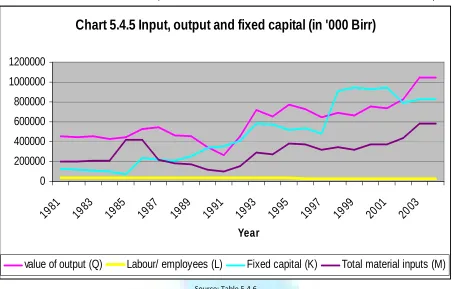
The four groups of arguments that relate liberalization to growth of productivity and output are: a) reduction of inefficiency b) better exploitation of scale of economies c) superior technology embodied in imported inputs, and d) faster rates of technological ‘catch up’ in expanding sectors of comparative advantage (Tora, 2001). According to Tora, partial factor productivity analysis includes labour productivity (Q/L), capital productivity (Q/K), Material productivity (Q/M) and capital intensity (K/L).
According to V. Mariappanand K. Chidambaram, productivity is often confused with increased production, and profitability is also mistaken as a measure of
productivity. Higher production does not mean higher productivity. Higher productivity can be achieved only by better utilization of resources. Though higher productivity results in cost reduction and thus favors profitability and competitiveness, profitability is not a measure of productivity as some times profit can be achieved while resources are inefficiently and ineffectively utilized. They also added that poor capacity utilization, outdated technology and machinery, poor maintenance and excess manpower are indicators of inefficiency in the organization. Inefficient utilization of resources does not lead to productivity.
As many writers do agree to, productivity is the result of the performance of people. Performance of people depends on how they are motivated to perform that specific type of work. Performance is determined by the amount of effort, ability and role perception of the individual. If an individual is lacking ability and/or has wrong role perception, his performance is found to be unsatisfactory in spite of his putting great efforts (Singh and Chhabra, 1996).
Theories of motivation have indicated that people are motivated by various needs. These various needs are motivated by different satisfiers. If the organization is in a position to know what motivates its workers and provides rewards or incentives based on their needs and wants, it will definitely increase their productivity. However, there is an argument among researchers that since there is no guarantee that giving someone a reward will lead to increased effort or that increased effort means better performance that will lead to higher productivity, because productivity is a function of many elements of which reward is only one of the factors.
In most cases it is assumed that job satisfaction and productivity are always interrelated, but some findings revealed that this thought is not necessarily seen a correct one since relationship between satisfaction and productive efficiency can not be taken for granted. Assumption to increase productivity of the employee might be possible through satisfying their needs. However, findings have shown doubt about the possibility of such an assumption.
The public opinion index of May (1974) for industry in the USA reported that only a modest tendency for job satisfaction to be related to productivity. Of the workers low or medium in satisfaction, only 26 percent were in the lower half of productivity and 81 percent in upper half. As Gadel and Krielt (1952) studied among IBM operators, their study showed that only a modest tendency of job satisfaction to be related to working efficiency or performance.
As it is clearly seen from aforementioned discussions, productivity signifies a continual striving towards the economically most efficient mode of production of goods, commodities and services needed by a society. Hence it constitutes an important requirement for raising the living standard of the people in a nation. The higher levels of per capita incomes of developed countries reflect higher levels of pr