UBIR: University of Bolton Institutional Repository
Inclusive & Sustainable Environments:Conference Papers (Peer-Reviewed) - Inclusive and Sustainable Environments (IaSE)
2005
Barriers to disabled students in built environment
degree programmes.
Peter Farrell
University of Bolton, [email protected]
Rosie Middlemass University of Bolton
This Conference Paper is brought to you for free and open access by the Inclusive and Sustainable Environments (IaSE) at UBIR: University of Bolton Institutional Repository. It has been accepted for inclusion in Inclusive & Sustainable Environments: Conference Papers (Peer-Reviewed) - by an authorized administrator of UBIR: University of Bolton Institutional Repository. For more information, please [email protected].
Digital Commons Citation
Farrell, Peter and Middlemass, Rosie. "Barriers to disabled students in built environment degree programmes.." (2005).Inclusive & Sustainable Environments: Conference Papers (Peer-Reviewed) -.Paper 1.
Farrell, P and Middlemass, R (2005) Barriers to disabled students in built environment degree programmes. In: Khosrowshahi, F (Ed.), 21st Annual ARCOM Conference, 7-9 September 2005, SOAS, University of London. Association of Researchers in Construction Management, Vol. 2, 1313-22.
BARRIERS TO DISABLED STUDENTS IN BUILT
ENVIRONMENT DEGREE PROGRAMMES
Peter Farrell1
and Rosie Middlemass2
Department of the Built Environment, The University of Bolton, BL3 5AB, UK
From September 2002 the Special Education Needs Disability Act (SENDA, 2001) requires that reasonable adjustments be made in further and higher education so not to place disabled students at a substantial disadvantage. Academics need to consider the impact of SENDA on all aspects of delivery and assessment in the learning process. Some learning outcomes within built environment curricula cannot be achieved by students with certain disabilities. Consequently, such learning outcomes are ‘barriers’ to disabled students and are likely to deter prospective students from choosing to study this subject area. In addition, disabled students may be unable to graduate or attain Chartered status with construction professional institutions. This research will focus on disabled students with visual, hearing and mobility impairments (VHMI). Detailed examination is undertaken of built environment undergraduate curricula from four UK universities to identify barriers. Compliance with the curriculum consequences of SENDA in the UK needs to be improved. Built environment departments need to audit their provision, and make necessary adjustments.
Keywords: curricula, disabled, learning outcomes, SENDA.
INTRODUCTION AND THE PROBLEM
In the UK, the third and final stage of the Special Educational Needs Disability Act (SENDA, 2001) comes into force in October 2005; the combined stages of the Act require that Higher Education Institutions (HEIs) comply with various standards of providing accessible education for disabled students.
Stage one makes it illegal for HEIs to treat disabled students ‘less favourably’ because of their disability from 1st September 2002. Moreover, ‘reasonable adjustments’ should be made so that they are not placed at a ‘substantial disadvantage’. Stage two came into force on 1st September 2003 and places a duty on HEIs to make adjustments to auxiliary aids and services. Stage three comes into force on 1st September 2005 and will place a duty to make adjustments to physical features (DEMOS, 2002). Further, the Disability Discrimination Act (2005) places a positive equality duty on all of the public sector; it is hoped this will be an excellent tool to substantially ratchet up equality and fairness to disabled people. The Act marks a shift from piecemeal improvements based on taking individual legal cases, to the public sector itself becoming a positive and proactive agent for change (DRC, 2005). The Disability Rights Commission (DRC) is currently consulting public sector chiefs on a draft Code of Practice which will give guidance on the new legislation when it comes into
operation in 2006.
1
2
The disability debate forms part of the widening participation agenda being promoted by government. The UK Government believes economic prosperity will benefit from an increasingly skilled population (Gibbs and Knapp, 2002). To these ends, an objective has been set to widen participation in higher education (HE) to 50% of 18-30 year olds by the end of the decade (DES, 2001). With disabled students being only 40% as likely to go on to university to do a first degree as their non-disabled peers (Curtis, 2002), they represent an important and obvious target group to help meet these aims. In certain subject areas, such as built environment (BE), widening participation is particularly relevant, given the need to increase student numbers (Hamill and Hodgekinson, 2003), and the poor track record of attracting students with certain disabilities (Middlemass and Farrell, 2004). There is anecdotal data that suggests that disabled students disregard construction when choosing their careers, and that academics discourage those disabled people that do apply. Curriculum may contain ‘barriers’ that act as a deterrent to potential students with disabilities, and prevent them from completing built environment degrees. The challenge to meet the requirements of SENDA is being taken up in other practically biased disciplines. Sports science is attractive to some disabled students because they excel in one sport. But to complete a sports science degree, students participate in a wide range of sports. There are many difficulties for disabled students; the SIDESTEP project (2005)
examines some alternative approaches about how learning objectives can be met by students with severe disabilities.
Much work focuses around the concept of ‘barriers’ to disabled students. In a survey by Fuller et al (2004) a high percentage of disabled students report barriers in key delivery and assessment mechanisms i.e. lectures, use of IT, coursework and
examinations. In accordance with SENDA there is an anticipatory duty on HEIs – it is not acceptable to wait for disabled students to arrive and then think about how to make reasonable adjustments. HEIs must consider barriers throughout the process, from first student contact and admissions through to graduation ceremony and alumni. The focus of this work however is the curricula element within the built environment learning process. It concentrates on students with visual, hearing and mobility impairments (VHMI). This does not only imply impairments to extremes; therefore visual impairment includes partial sightedness; hearing impairment includes partial deafness, and mobility impairment includes mobility difficulties as well as wheelchair users. Although SENDA protects the rights of students with other disabilities
including: dyslexia; mental health; diabetes; autism; epilepsy etc, these do not fall within the scope of this study.
Built environment departments in universities usually require that their programmes are accredited by professional bodies, with much of the content of courses being prescribed by these bodies. Professional bodies must also comply with disability legislation. In October 2004, Part II of the Disability Discrimination Act (DDA, 1995) was extended to cover organisations that confer professional qualifications. The Code of Practice ‘Trade Organisations and Qualifications Bodies’ (DRC, 2004) sets out the understanding of the law of the DRC as it applies from October 2004. Construction professional bodies therefore, must not prescribe curricula that would unreasonably disadvantage disabled students.
THE LITERATURE
Barriers to disabled students in built environment degree programmes
1315
and staff is also published through SKILL – The National Bureau for Students with Disabilities and TechDis (Technology for Disabilities).
Case studies are used throughout the literature. The Teachability Project (2000) and Doyle and Robson (2002) provide a framework for academics to think about their own disciplines and provision. They consider the entire student experience within HEIs. Examples of inclusive practice that may meet the needs of disabled students are given. A recurring theme is to provide all lecture material, including assessments,
electronically in advance of study commencing. Such material is particularly useful for partially sighted and dyslexic students, because they are able to digest some knowledge before lectures and they are able to adjust fonts of text to suit their
personal needs. Bennet (2005) has published work to show how electronic provision using Blackboard software can be used to support the learning experience for all students in the built environment.
SWANDS (2002) aims to provide an audit tool and guidance for HEIs in gaining SENDA compliance. The document examines the learning process from admissions through to qualification with professional bodies, and raises questions in many areas. Some potential difficulties are highlighted, and case studies are again used to suggest solutions. But there is a plethora of barriers that may exist given the variables of: disability type; academic or vocational discipline; institutional infrastructure and resources, etc. Case studies cannot be derived for every eventuality. Some suggestions are made for situations common to all HEIs e.g. assessment by
examination, but it is made clear that each individual institution needs to think about its own solutions given its own context.
Turpin-Brooks et al (2003) highlight the extent of the problem in the built environment, and call for HEIs to audit their systems to become more SENDA
compliant. They use three case studies to illustrate how difficult it is for students with disabilities to complete their studies. In engineering, but with relevance to the built environment discipline, the DART Project (Disabilities: Academic Resource Tool, 2005), still at its evaluation stage, will provide a web access facility to academics who may have to deliver to a student with a particular disability for the first time.
Publications in other disciplines have relevance to built environment. Gravestock and Healey (2001) have published a series of six guides about how to enable disabled students to complete fieldwork in geography. Checklists to help audit laboratories, and case studies about how students with visual and mobility impairments can access laboratories are given by the Physical Sciences LTSN (2002). There is advice on the whole placement process for disabled students in a guide by the Department for Education and Skills (DfES, 2002) and the built environment can also draw on placement work by the PEdDS project (2005) in social work. Site visits can be problematic; alternatively virtual facilities are under development (Ellis et al, 2005), which can be used to give disabled students an equivalent learning experience.
Arguably, visually impaired students have more difficulty than students with other disabilities, especially in the architectural field. It is noticeable that a SKILL publication (2002) promoting the positive experiences of disabled students does not include an example of a student with a visual impairment. The best work about the production and reading of drawings for visually impaired students is being done by the National Centre for Tactile Diagrams (NCTD, 2005).
METHODOLOGY
The curricula and preamble documents were assessed from four UK HEIs in 2004. The extent of documentation comprised those normally submitted in the internal validation processes of universities. All four have a well established profile in built environment education. The disciplines covered in the review were architectural technology, civil engineering, construction management, building surveying and quantity surveying. The programmes are all supported by UK professional bodies. Some partial-distance learning provision was included within the portfolio of courses; this type of learning may be more accessible to people with disabilities, because it is implicit that electronic learning material is provided in advance of learning sessions.
In all cases, course documents and syllabi were not written to be SENDA compliant as they were produced in the early 2000s, with students expected to graduate from some of these programmes up to year 2008. They were therefore introduced pre-SENDA implementation in 2002,but they should have been adapted to take account of the legislation.
A qualitative approach is used to identify barriers. Some barriers were found in programme aims, particularly when aims were focused on skill development. However, the focus of the analysis is (i) teaching and learning strategies, (ii) learning outcomes, and (iii) the assessment process. In the discussion section, the barriers are given three classifications:
Type 1 barriers are those which are placed there unwittingly; it may be just a matter of semantics and mere rephrasing of documentation is sufficient to eliminate them.
Type 2 barriers are more substantial; they comprise content that is traditionally part of built environment curricula, but which can be removed without detriment to quality or on the capability of individuals to subsequently act in a professional capacity.
Type 3 barriers cannot be removed; it may be possible to keep barriers in the curricula or professional development programmes (PDPs) of professional bodies if they are there to maintain standards, or if they are material to circumstances and substantial (SWANDS, 2002: 103).
Whether barriers should be classified as type 1, 2 or 3 is an issue for each individual built environment department.
ANALYSIS, RESULTS AND FINDINGS
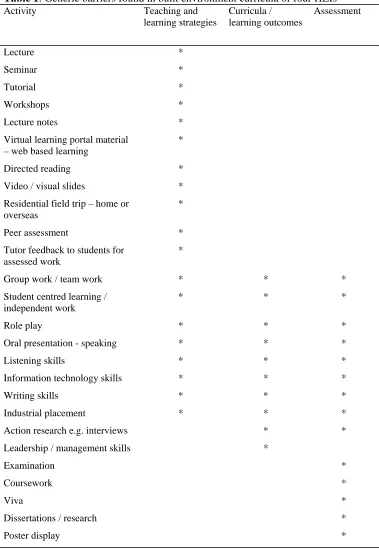
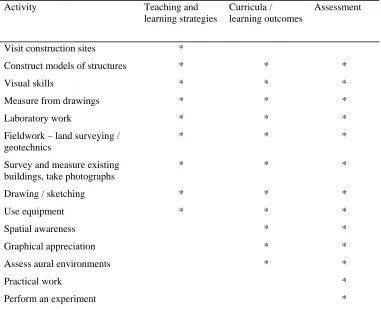
Numerous barriers were located within documentation. These were further classified as (i) generic barriers (a phrase used by Turpin-Brooks et al (2003: 338), included in table 1 –those that appear in most academic disciplines that are delivered in HEIs, and (ii) bespoke barriers, included in table 2 – those that may appear in some other
academic disciplines, but are a particular feature of built environment curricula. The purpose of the distinction between the two is to enable the built environment
Barriers to disabled students in built environment degree programmes
1317
growing expertise in the literature about the generic barriers. In tables 1 and 2, the barriers are noted for relevance to learning outcomes, teaching and learning strategies or assessment; in many cases they impact on all three.
Curricula/learning outcomes in validation documentation
An inconsistency in writing style used by academics was found within documentation, thus being type 1 barriers. Learning outcomes that ask students to ‘do things’ (active verbs) e.g. perform a laboratory experiment, present barriers that may be impossible to overcome for some disabled students. However, outcomes that are expressed in terms of ‘knowledge or understanding of’ (passive verbs) e.g. students shall ‘know how to do a laboratory experiment’ may be achievable.
In many cases, active verbs were found in the learning outcomes of university
programmes, and they may therefore be judged to be not complying with SENDA. It will be argued that a move to compliance can be initiated by adopting a passive writing style; a mere change of semantics.
Removing barriers by changing semantics in modules that require skill development may be more problematic; however, improvement can be made by changing an outcome from ‘developing oral presentational skills’ to ‘developing presentation skills’.
Assessment
The anticipatory responsibility of the legislation means that assessment of learning outcomes must be addressed at an early stage. This represents a greater challenge than changing semantics. It needs innovative thought about a plethora of alternative assessment arrangements. Unfortunately, programme documentation submitted for validation does not give detail about assessment methods; assessment is merely noted as examination, class test, coursework, laboratory experiment etc. For assessment classified as generic, e.g. the examination, an acceptable alternative may simply be coursework. If it is assumed that a learning outcome is to ‘demonstrate knowledge about how to do an experiment’ and the assessment is a laboratory experiment, non-disabled students may demonstrate this knowledge by doing the experiment, but a reasonable adjustment for a visually impaired may be for that student to direct a third person to do the experiment.
Teaching and learning strategies
Similarly, both programme documentation and teaching and learning strategies are merely described as lectures, seminars, tutorials, practicals, laboratory work etc. Details are only written as part of the production of teaching and learning material, lecture notes or module guides. Again, there is an anticipatory responsibility in the legislation requiring HEIs to think how disabled students will be able to participate in the teaching and learning process. What reasonable adjustments can be made? In a generic situation e.g. the lecture, a reasonable adjustment for students with partial hearing impairment may be assistance to take notes, allowing the student to lip read the lecturer. In the case where fieldwork in rough terrain is part of the teaching and learning strategy for a land surveying module, is it reasonable for a wheelchair user to be alternatively taught using surveying equipment in an indoor environment?
Table 1: Generic barriers found in built environment curricula of four HEIs
Activity Teaching and learning strategies
Curricula / learning outcomes
Assessment
Lecture * Seminar * Tutorial * Workshops * Lecture notes *
Virtual learning portal material – web based learning
*
Directed reading * Video / visual slides * Residential field trip – home or
overseas
*
Peer assessment * Tutor feedback to students for
assessed work
*
Group work / team work * * * Student centred learning /
independent work
* * *
Role play * * *
Oral presentation - speaking * * * Listening skills * * * Information technology skills * * * Writing skills * * * Industrial placement * * * Action research e.g. interviews * * Leadership / management skills *
Examination *
Coursework *
Viva *
Dissertations / research *
Barriers to disabled students in built environment degree programmes
1319
Table 2: Bespoke barriers found in built environment curricula of four HEIs
Activity Teaching and learning strategies
Curricula / learning outcomes
Assessment
Visit construction sites *
Construct models of structures * * * Visual skills * * * Measure from drawings * * * Laboratory work * * * Fieldwork – land surveying /
geotechnics
* * *
Survey and measure existing buildings, take photographs
* * *
Drawing / sketching * * * Use equipment * * * Spatial awareness * * Graphical appreciation * * Assess aural environments * *
Practical work *
Perform an experiment *
DISCUSSION AND CONCLUSIONS
Type 2 barriers (those which can be removed without detriment to individuals’ ability to act as industry professionals) may entail much debate and reflection amongst built environment academics and professional bodies. Membership of Chartered
Institutions, after graduation and employment experience, is taken as a licence to practise. But does practice have to be on the ‘front line’? Should disabled students be allowed to qualify to practise as doctors, firemen or chartered constriction
professionals, but within a framework mutually agreed between employers and individuals, (keeping professional ethics at the fore) only undertake ‘backroom’ tasks that are within their capabilities? In a construction context, is it really necessary for example that mobility impaired students need to demonstrate that they can
competently use surveying equipment to be able to practise as construction managers. Are there competent construction managers in the UK who cannot use surveying equipment? Similarly, do visually impaired building surveying students have to survey buildings? In the context that a substantial amount of work in a private practice is management, are there experienced building surveyors who have not done surveys for many years?
An argument to support flexible curricula comes from examples of disabled construction professionals who are enjoying successful careers in the construction industry. Sometimes disabilities will have been present before entering industry; sometimes they arise due to accidents, but most frequently they occur as people reach older age. In this latter case, those individuals who have been with their employers for a long period may change their role in the organisation – perhaps to move from a site based position to a head office post. These people may still retain their
membership of professional bodies. If people who develop a disability later in life are allowed to remain chartered members, professional bodies should be willing to take down barriers to disabled people who aspiring to chartership.
The professional development programmes (PDPs) of professional institutions (the period of time after graduation that candidates gain professional experience, usually in industry) must not contain barriers. It is noted that in the PDP process of one
construction institution, a compulsory one year site based placement is required. It is for reflection whether this is reasonable, or whether alternatives should be offered.
Type 3 barriers (those that cannot be removed); may be very difficult to justify in the courts in the context of construction professionals. The legislation will no doubt accept that some disabilities prevent practice in the workplace, particularly in the crafts; it is necessary for drivers on construction sites to demonstrate they can drive, and that reasonable adjustments cannot be made for visual impairments. It should be noted though that safety cannot be used as an excuse to disadvantage disabled
individuals, without reasonable efforts having being made to make adjustments.
In all of this debate, it is agreed that academic standards must be maintained. A key part of the HEFCE strategic plan is ‘to provide the opportunity of higher education to all those who could benefit from it’ (HEFCE, 2003). It can be argued that HEIs should only admit students that may reasonably be anticipated to succeed; after admitting students, there is a duty to ensure they are successful. Examinations are often included as part of assessments to test speed and flexibility of thought, and ability to work under pressure. These are, after all, attributes required by employers. Assistance is being provided to get disabled students through examinations, including allowing extra time, providing separate rooms with IT equipment or amanuenses etc (Skill, 2004). Is there a possibility that if this assistance becomes too cumbersome and resource intensive, coursework may be offered to disabled students as an alternative? Is there a danger that QAA intellectual and skill based benchmark
statements are being diluted if alternative methods of assessment are designed to allow students to progress in this way?
Some areas for improvement are noted. Progress in meeting SENDA in HEIs ‘is not about resources primarily, but about attitudes’ (Trotter, 2005). The journey to compliance, including nurturing attitudes, may take many years, but every lever should be taken to improve. The legislation is one lever. But greater utilisation needs to be made of university validation systems and the accreditation systems by built environment professional bodies. It is common place for the assessment of individual student needs to be undertaken by specialist disability personnel – less common though is for a construction tutor to be involved in this process, and for the outcomes to be communicated to all teachers. Built environment departments need such tutors (Canter, 2005) to act as mentors and champions. It appears that provision of
Barriers to disabled students in built environment degree programmes
1321
academic reasons? Some may ‘invent’ academic arguments to say why it cannot be done, when possibly the real reason is the time investment required. Built
environment departments need to utilise expertise from other disciplines, and from disability specialists, about how to overcome generic barriers to disabled students in HE as a whole. But there is also great thought and audit required of the bespoke built environment provision in each individual institution.
REFERENCES
Bennet, T (2005) Enhancing learning and teaching through the use of a ‘Learning Journey’ using Blackboard available at http://cebe.cf.ac.uk/BPBN/casestudy/kingston_tla2.htm accessed May 2005
Canter, M (2005) Ladders, Bridges and Nets in Construction Courses
http://cebe.cf.ac.uk/BPBN/casestudy/anglia_ssg2.htm
Curtis, P (2002) “Disabled students ‘less likely’ to go to university”, Education Guardian.co.uk (online) [available via
http://education.guardian.co.uk/universityaccess accessed 29 October 2003]
DEMOS (2002) [available via http://jarmin.com/demos/index.html accessed on 11 November 2003
DDA (1995) The Disability Discrimination Act. The Stationery Office
DDA (2005) The Disability Discrimination Act. The Stationery Office
DfES (2002) Providing work placements for disabled students – DfES guide 2002. http://www.lifelonglearning.co.uk/placements/
Doyle, C and Robson, K (2002) Accessible Curricula – Good Practice for all. University of Wales, Cardiff. pp. 11-27
DRC (2004) Code of Practice; Trade Organisations and Qualifications Bodies. Disability Rights Commission. Available at www.drc.gov.uk
DRC (2005) Disability Rights Commission. www.drc.gov.uk
DART (2005) Disabilities: Academic Resource Tool Project. Engineering Education Centre, Loughborough University. http://dart.lboro.ac.uk/ Accessed May 2005
Department for Education and Skills. (2001) Education and Skills: Delivering Results – a
strategy to 2006, London, DES
Fuller, M, Healey, M, Bradley, A and Hall, T (2004) Barriers to learning; a systematic study of the experience of disabled students in one university. Studies in Higher Education.
Vol 29, No 3. 303 – 318
Gibbs, P and Knapp, M (2002) Marketing Further and Higher Education, London, Kogan Page
Ellis, R, Dickinson, I and Gorse, C (2005) Virtual site – Visualizing the Construction Process,
School of the Built Environment, Leeds Metropolitan University http://www.cebe.heacademy.ac.uk/transactions/pdf/virtualsite.pdf
Gravestock, P and Healey, M (eds) (2001) Providing Learning Support for Disabled Students
undertaking Fieldwork and Related Activities. University of Gloucestershire
Hamill, L and Hodgkinson, L (2003) Civil Engineering’s image in schools – and how to change. Civil Engineering, 156: 78-85 [available online via
HEFEC (2003) HEFEC Strategic Plan 2003-2008, available at www.hefce.ac.uk. Accessed May 2005
Middlemass, R and Farrell, P (2004) Removing Barriers to Disabled Students in Built Environment Education: An Ongoing Challenge. 4th International Postgraduate
Conference in the Built and Human Environment, University of Salford
NCTD (2005) National Centre for Tactile Diagrams. www.nctd.org.uk
PEdDS (2005) Professional education and disability support. Available at www.hull.ac.uk/pedds
Physical Sciences LTSN (2005) http://www.engsc.ac.uk/er/dis/index.asp case studies
SENDA (2001) The Special Educational Needs Disability Act. The Stationery Office
SWANDS (2002) South West Academic Network for Disability Support. SENDA compliance
in higher education. University of Plymouth
SIDESTEP (2005) Available at http://crwnpro2.staffs.ac.uk/sidestep
SKILL (2004) Examination arrangements for disabled students. The National Bureau for Students with Disabilities.
Skill (2002) Into Architecture and Surveying and Building Professions – positive experiences
of disabled people. The National Bureau for Students with Disabilities.
SPACE (2005) Staff- Student partnership for Assessment Change and Evaluation. University of Plymouth. www.space.ac.uk
Teachability (2000) Creating an Accessible Curriculum for Students with Disabilities. The University of Strathclyde
Trotter, J (2005) An Institutional Journey. Keynote speech to: National Disability Team
Conference. Watford. 28 April 2005. Full text available at www.natdisteam.ac.uk
Turpin-Brooks, S, Donohoe, S and Garbett, C (2003) Widening Access in Construction Education Through Student-Centred Learning, Building Education and Research, CIB