VOLUME NO.6(2016),ISSUE NO.10(
OCTOBER
) ISSN2231-5756A Monthly Double-Blind Peer Reviewed (Refereed/Juried) Open Access International e-Journal - Included in the International Serial Directories
Indexed & Listed at:
Ulrich's Periodicals Directory ©, ProQuest, U.S.A., EBSCO Publishing, U.S.A., Cabell’s Directories of Publishing Opportunities, U.S.A., Google Scholar, Open J-Gage, India [link of the same is duly available at Inflibnet of University Grants Commission (U.G.C.)],
Index Copernicus Publishers Panel, Poland with IC Value of 5.09 & number of libraries all around the world.
VOLUME NO.6(2016),ISSUE NO.10(
OCTOBER
) ISSN2231-5756CONTENTS
Sr.
No.
TITLE & NAME OF THE AUTHOR (S)
Page
No.
1
.
A STUDY ON THE JOB SATISFACTION OF THE EMPLOYEES OF BPO SECTOR
V. SAVITHA & DR. E. VIJILA
1
2
.
A PRODUCTIVE ANALYSIS OF REGIONAL INEQUALITY IN AGRICULTURAL DEVELOPMENT: STUDY OF
HARYANA INTER-DISTRICT EMPIRIC
DR. INDERJIT
5
3
.
THE STUDY OF KEY SUCCESS FACTORS IN NEW PRODUCT DEVELOPMENT PROCESS IN TEXTILE
INDUSTRY WITH SPECIAL REFERENCE TO SURAT REGION
RASHVIN TAILOR & DR. MANISHA PANWALA
9
4
.
AN EMPIRICAL STUDY ON MARKETING INFORMATION SYSTEM
DEEPAK S & DR. S. J. MANJUNATH
12
5
.
MOMPRENEURSHIP: A NEW TREND OF ENTREPRENEURSHIP
B. N. LALITHCHANDRA & T. LAVANYA KUMARI
16
6
.
RELATIONSHIP BETWEEN JOB SATISFACTION AND OTHER PSYCHOSOCIAL VARIABLES: A
COMPARATIVE STUDY OF MALE AND FEMALE EMPLOYEES OF BUSINESS PROCESSING OUTSOURCING
(BPO) SECTOR
PRIYANKAR SINGHA & DR. SOUVIK RAYCHAUDHURI
20
7
.
YOGA AND MEDICAL SCIENCE
PRADEEP H. TAWADE
24
8
.
A STUDY ON AN ANALYSIS OF SHORT-TERM LIQUIDITY POSITION OF TATA STEEL LIMITED
R. SATHISHKUMAR
26
9
.
RULES AND VALUES OF CO-OPERATIVE BANKS
DR. SAKSHI TEWARI
30
10
.
CUSTOMERS BUYING BEHAVIOUR IN ASHOK LEYLAND, CHENNAI
DR. R. AMUDHA & K. SRILAKSHMI
34
11
.
IMPACT OF ENGLISH INVASION ON INDIAN CULTURE
SANGEETHA. J
39
12
.
BEST PRACTICES FOR ENHANCING USE OF LIBRARY COLLECTION AND OTHER LIBRARY SERVICES
AJIT VASANTRAO JANUGADE
41
13
.
ENTREPRENEURSHIP DEVELOPMENT EFFORTS AND THE CHALLENGE OF QUALITY EDUCATION AND
HUMAN RESOURCE DEVELOPMENT IN NIGERIA
DR. S.O. ONIMOLE
44
14
.
FACTORS INFLUENCING THE DECISION OF ADOPTING COMPUTERIZED ACCOUNTING SYSTEM (CAS)
BY SMALL AND MEDIUM ENTERPRISES (SMEs) IN KURUNEGALA URBAN AREA IN SRI LANKA
PATHMINI MGS & KARUNADASA MKGPSK
49
15
.
ASSESSMENT OF CUSTOMERS’ ATTITUDE AND BANKS’ GROWTH TOWARDS E- BANKING IN NIGERIA
FAITH ERINMA ONYEBUENYI
55
16
.
IMPLEMENTATION MECHANISM OF MGNREGA IN HIMACHAL PRADESH
KHEM RAJ
60
17
.
EFFECTS OF FDI IN RETAIL SECTOR IN INDIA
NAZEEFA BEGUM MAKANDAR
67
18
.
AN ANALYSIS OF SERVQUAL AND SERVPERF IN INDIAN BANKING CONTEXT
SUDESHNA DUTTA
72
19
.
EFFECT OF MOBILE PHONES ON HUMAN BODY
SUNIL KUMAR TRIVEDI
78
20
.
SELF EFFICACY AND OTHER PERSONAL RESOURCES AS ANTECEDENTS OF EMPLOYEE ENGAGEMENT:
A CRITICAL LITERATURE REVIEW
HARSH VARDHAN KOTHARI
82
VOLUME NO.6(2016),ISSUE NO.10(
OCTOBER
) ISSN2231-5756CHIEF PATRON
PROF. K. K. AGGARWAL
Chairman, Malaviya National Institute of Technology, Jaipur
(An institute of National Importance & fully funded by Ministry of Human Resource Development, Government of India)
Chancellor, K. R. Mangalam University, Gurgaon
Chancellor, Lingaya’s University, Faridabad
Founder Vice-Chancellor (1998-2008), Guru Gobind Singh Indraprastha University, Delhi
Ex. Pro Vice-Chancellor, Guru Jambheshwar University, Hisar
FOUNDER PATRON
LATE SH. RAM BHAJAN AGGARWAL
Former State Minister for Home & Tourism, Government of Haryana
Former Vice-President, Dadri Education Society, Charkhi Dadri
Former President, Chinar Syntex Ltd. (Textile Mills), Bhiwani
FORMER CO-ORDINATOR
DR. S. GARG
Faculty, Shree Ram Institute of Business & Management, Urjani
ADVISORS
PROF. M. S. SENAM RAJU
Director A. C. D., School of Management Studies, I.G.N.O.U., New Delhi
PROF. M. N. SHARMA
Chairman, M.B.A., Haryana College of Technology & Management, Kaithal
PROF. S. L. MAHANDRU
Principal (Retd.), Maharaja Agrasen College, Jagadhri
EDITOR
PROF. R. K. SHARMA
Professor, Bharti Vidyapeeth University Institute of Management & Research, New Delhi
CO-EDITOR
DR. BHAVET
Faculty, Shree Ram Institute of Engineering & Technology, Urjani
EDITORIAL ADVISORY BOARD
DR. RAJESH MODI
Faculty, Yanbu Industrial College, Kingdom of Saudi Arabia
PROF. SANJIV MITTAL
University School of Management Studies, Guru Gobind Singh I. P. University, Delhi
PROF. ANIL K. SAINI
Chairperson (CRC), Guru Gobind Singh I. P. University, Delhi
DR. SAMBHAVNA
VOLUME NO.6(2016),ISSUE NO.10(
OCTOBER
) ISSN2231-5756DR. MOHENDER KUMAR GUPTA
Associate Professor, P. J. L. N. Government College, Faridabad
DR. SHIVAKUMAR DEENE
Asst. Professor, Dept. of Commerce, School of Business Studies, Central University of Karnataka, Gulbarga
ASSOCIATE EDITORS
PROF. NAWAB ALI KHAN
Department of Commerce, Aligarh Muslim University, Aligarh, U.P.
PROF. ABHAY BANSAL
Head, Department of I.T., Amity School of Engineering & Technology, Amity University, Noida
PROF. A. SURYANARAYANA
Department of Business Management, Osmania University, Hyderabad
PROF. V. SELVAM
SSL, VIT University, Vellore
DR. PARDEEP AHLAWAT
Associate Professor, Institute of Management Studies & Research, Maharshi Dayanand University, Rohtak
DR. S. TABASSUM SULTANA
Associate Professor, Department of Business Management, Matrusri Institute of P.G. Studies, Hyderabad
SURJEET SINGH
Asst. Professor, Department of Computer Science, G. M. N. (P.G.) College, Ambala Cantt.
FORMER TECHNICAL ADVISOR
AMITA
Faculty, Government M. S., Mohali
FINANCIAL ADVISORS
DICKIN GOYAL
Advocate & Tax Adviser, Panchkula
NEENA
Investment Consultant, Chambaghat, Solan, Himachal Pradesh
LEGAL ADVISORS
JITENDER S. CHAHAL
Advocate, Punjab & Haryana High Court, Chandigarh U.T.
CHANDER BHUSHAN SHARMA
Advocate & Consultant, District Courts, Yamunanagar at Jagadhri
VOLUME NO.6(2016),ISSUE NO.10(
OCTOBER
) ISSN2231-5756CALL FOR MANUSCRIPTS
We invite unpublished novel, original, empirical and high quality research work pertaining to the recent developments & practices in the areas of Com-puter Science & Applications; Commerce; Business; Finance; Marketing; Human Resource Management; General Management; Banking; Economics; Tourism Administration & Management; Education; Law; Library & Information Science; Defence & Strategic Studies; Electronic Science; Corporate Gov-ernance; Industrial Relations; and emerging paradigms in allied subjects like Accounting; Accounting Information Systems; Accounting Theory & Practice; Auditing; Behavioral Accounting; Behavioral Economics; Corporate Finance; Cost Accounting; Econometrics; Economic Development; Economic History; Financial Institutions & Markets; Financial Services; Fiscal Policy; Government & Non Profit Accounting; Industrial Organization; International Economics & Trade; International Finance; Macro Economics; Micro Economics; Rural Economics; Co-operation; Demography: Development Planning; Development Studies; Applied Economics; Development Economics; Business Economics; Monetary Policy; Public Policy Economics; Real Estate; Regional Economics; Political Science; Continuing Education; Labour Welfare; Philosophy; Psychology; Sociology; Tax Accounting; Advertising & Promotion Management; Management Information Systems (MIS); Business Law; Public Responsibility & Ethics; Communication; Direct Marketing; E-Commerce; Global Business; Health Care Administration; Labour Relations & Human Resource Management; Marketing Research; Marketing Theory & Applications; Non-Profit Or-ganizations; Office Administration/Management; Operations Research/Statistics; Organizational Behavior & Theory; Organizational Development; Pro-duction/Operations; International Relations; Human Rights & Duties; Public Administration; Population Studies; Purchasing/Materials Management; Re-tailing; Sales/Selling; Services; Small Business Entrepreneurship; Strategic Management Policy; Technology/Innovation; Tourism & Hospitality; Transpor-tation Distribution; Algorithms; Artificial Intelligence; Compilers & Translation; Computer Aided Design (CAD); Computer Aided Manufacturing; Computer Graphics; Computer Organization & Architecture; Database Structures & Systems; Discrete Structures; Internet; Management Information Systems; Mod-eling & Simulation; Neural Systems/Neural Networks; Numerical Analysis/Scientific Computing; Object Oriented Programming; Operating Systems; Pro-gramming Languages; Robotics; Symbolic & Formal Logic; Web Design and emerging paradigms in allied subjects.
Anybody can submit the soft copy of unpublished novel; original; empirical and high quality research work/manuscriptanytime in M.S. Word format after preparing the same as per our GUIDELINES FOR SUBMISSION; at our email address i.e. [email protected] or online by clicking the link online submission as given on our website (FOR ONLINE SUBMISSION, CLICK HERE).
GUIDELINES FOR SUBMISSION OF MANUSCRIPT
1. COVERING LETTER FOR SUBMISSION:
DATED: _____________
THE EDITOR
IJRCM
Subject: SUBMISSION OF MANUSCRIPT IN THE AREA OF .
(e.g. Finance/Mkt./HRM/General Mgt./Engineering/Economics/Computer/IT/ Education/Psychology/Law/Math/other, please specify)
DEAR SIR/MADAM
Please find my submission of manuscript titled ‘___________________________________________’ for likely publication in one of your journals.
I hereby affirm that the contents of this manuscript are original. Furthermore, it has neither been published anywhere in any language fully or partly, nor it is under review for publication elsewhere.
I affirm that all the co-authors of this manuscript have seen the submitted version of the manuscript and have agreed to inclusion of their names as co-authors.
Also, if my/our manuscript is accepted, I agree to comply with the formalities as given on the website of the journal. The Journal has discretion to publish our contribution in any of its journals.
NAME OF CORRESPONDING AUTHOR :
Designation/Post* :
Institution/College/University with full address & Pin Code : Residential address with Pin Code : Mobile Number (s) with country ISD code : Is WhatsApp or Viber active on your above noted Mobile Number (Yes/No) : Landline Number (s) with country ISD code :
E-mail Address :
Alternate E-mail Address :
Nationality :
VOLUME NO.6(2016),ISSUE NO.10(
OCTOBER
) ISSN2231-5756 NOTES:a) The whole manuscript has to be in ONE MS WORD FILE only, which will start from the covering letter, inside the manuscript. pdf. version is liable to be rejected without any consideration.
b) The sender is required to mention the following in the SUBJECT COLUMNof the mail:
New Manuscript for Review in the area of (e.g. Finance/Marketing/HRM/General Mgt./Engineering/Economics/Computer/IT/ Education/Psychology/Law/Math/other, please specify)
c) There is no need to give any text in the body of the mail, except the cases where the author wishes to give any specific message w.r.t. to the manuscript.
d) The total size of the file containing the manuscript is expected to be below 1000 KB.
e) Only the Abstract will not be considered for review and the author is required to submit the complete manuscript in the first instance.
f) The journal gives acknowledgement w.r.t. the receipt of every email within twenty-four hours and in case of non-receipt of acknowledgment from the journal, w.r.t. the submission of the manuscript, within two days of its submission, the corresponding author is required to demand for the same by sending a separate mail to the journal.
g) The author (s) name or details should not appear anywhere on the body of the manuscript, except on the covering letter and the cover page of the manuscript, in the manner as mentioned in the guidelines.
2. MANUSCRIPT TITLE: The title of the paper should be typed in bold letters, centeredand fully capitalised.
3. AUTHOR NAME (S) & AFFILIATIONS: Author (s) name, designation, affiliation (s), address, mobile/landline number (s), and email/al-ternate email address should be given underneath the title.
4. ACKNOWLEDGMENTS: Acknowledgements can be given to reviewers, guides, funding institutions, etc., if any.
5. ABSTRACT: Abstract should be in fully Italic printing, ranging between 150 to 300 words. The abstract must be informative and eluci-dating the background, aims, methods, results & conclusion in a SINGLE PARA. Abbreviations must be mentioned in full.
6. KEYWORDS: Abstract must be followed by a list of keywords, subject to the maximum of five. These should be arranged in alphabetic order separated by commas and full stop at the end. All words of the keywords, including the first one should be in small letters, except special words e.g. name of the Countries, abbreviations etc.
7. JEL CODE: Provide the appropriate Journal of Economic Literature Classification System code (s). JEL codes are available at www.aea-web.org/econlit/jelCodes.php. However, mentioning of JEL Code is not mandatory.
8. MANUSCRIPT: Manuscript must be in BRITISH ENGLISH prepared on a standard A4 size PORTRAIT SETTING PAPER. It should be free from any errors i.e. grammatical, spelling or punctuation. It must be thoroughly edited at your end.
9. HEADINGS: All the headings must be bold-faced, aligned left and fully capitalised. Leave a blank line before each heading.
10. SUB-HEADINGS: All the sub-headings must be bold-faced, aligned left and fully capitalised.
11. MAIN TEXT:
THE MAIN TEXT SHOULD FOLLOW THE FOLLOWING SEQUENCE:
INTRODUCTION
REVIEW OF LITERATURE
NEED/IMPORTANCE OF THE STUDY
STATEMENT OF THE PROBLEM
OBJECTIVES
HYPOTHESIS (ES)
RESEARCH METHODOLOGY
RESULTS & DISCUSSION
FINDINGS
RECOMMENDATIONS/SUGGESTIONS
CONCLUSIONS
LIMITATIONS
SCOPE FOR FURTHER RESEARCH
REFERENCES
APPENDIX/ANNEXURE
VOLUME NO.6(2016),ISSUE NO.10(
OCTOBER
) ISSN2231-575612. FIGURES & TABLES: These should be simple, crystal CLEAR, centered, separately numbered & self-explained, and the titles must be above the table/figure. Sources of data should be mentioned below the table/figure. It should be ensured that the tables/figures are referred to from the main text.
13. EQUATIONS/FORMULAE: These should be consecutively numbered in parenthesis, left aligned with equation/formulae number placed at the right. The equation editor provided with standard versions of Microsoft Word may be utilised. If any other equation editor is utilised, author must confirm that these equations may be viewed and edited in versions of Microsoft Office that does not have the editor.
14. ACRONYMS: These should not be used in the abstract. The use of acronyms is elsewhere is acceptable. Acronyms should be defined on its first use in each section e.g. Reserve Bank of India (RBI). Acronyms should be redefined on first use in subsequent sections.
15. REFERENCES: The list of all references should be alphabetically arranged. The author (s) should mention only the actually utilised references in the preparation of manuscript and they may follow Harvard Style of Referencing. Also check to ensure that everything that you are including in the reference section is duly cited in the paper. The author (s) are supposed to follow the references as per the following:
•
All works cited in the text (including sources for tables and figures) should be listed alphabetically.•
Use (ed.) for one editor, and (ed.s) for multiple editors.•
When listing two or more works by one author, use --- (20xx), such as after Kohl (1997), use --- (2001), etc., in chronologically ascending order.•
Indicate (opening and closing) page numbers for articles in journals and for chapters in books.•
The title of books and journals should be in italic printing. Double quotation marks are used for titles of journal articles, book chapters, dissertations, reports, working papers, unpublished material, etc.•
For titles in a language other than English, provide an English translation in parenthesis.•
Headers, footers, endnotes and footnotes should not be used in the document. However, you can mention short notes to elucidate some specific point, which may be placed in number orders before the references.PLEASE USE THE FOLLOWING FOR STYLE AND PUNCTUATION IN REFERENCES:
BOOKS
•
Bowersox, Donald J., Closs, David J., (1996), "Logistical Management." Tata McGraw, Hill, New Delhi.•
Hunker, H.L. and A.J. Wright (1963), "Factors of Industrial Location in Ohio" Ohio State University, Nigeria. CONTRIBUTIONS TO BOOKS•
Sharma T., Kwatra, G. (2008) Effectiveness of Social Advertising: A Study of Selected Campaigns, Corporate Social Responsibility, Edited by David Crowther & Nicholas Capaldi, Ashgate Research Companion to Corporate Social Responsibility, Chapter 15, pp 287-303.JOURNAL AND OTHER ARTICLES
•
Schemenner, R.W., Huber, J.C. and Cook, R.L. (1987), "Geographic Differences and the Location of New Manufacturing Facilities," Jour-nal of Urban Economics, Vol. 21, No. 1, pp. 83-104.CONFERENCE PAPERS
•
Garg, Sambhav (2011): "Business Ethics" Paper presented at the Annual International Conference for the All India Management Asso-ciation, New Delhi, India, 19–23UNPUBLISHED DISSERTATIONS
•
Kumar S. (2011): "Customer Value: A Comparative Study of Rural and Urban Customers," Thesis, Kurukshetra University, Kurukshetra. ONLINE RESOURCES•
Always indicate the date that the source was accessed, as online resources are frequently updated or removed. WEBSITESVOLUME NO.6(2016),ISSUE NO.10(
OCTOBER
) ISSN2231-5756THE STUDY OF KEY SUCCESS FACTORS IN NEW PRODUCT DEVELOPMENT PROCESS IN TEXTILE INDUSTRY
WITH SPECIAL REFERENCE TO SURAT REGION
RASHVIN TAILOR
ASST. PROFESSOR
DEPARTMENT OF MANAGEMENT
UKA TARSAIDA UNIVERSITY
BARDOLI
DR. MANISHA PANWALA
PROFESSOR
DEPARTMENT OF BUSINESS & INDUSTRY MANAGEMENT
VEER NARMAD SOUTH GUJARAT UNIVERSITY
SURAT
ABSTRACT
The idea of key success factors in new product development is dynamic to many organizations’ persistence of business and growth is widely recognized. New products provide many business opportunities for organizations. The importance of key success factors in new product development is key, as corporate purpose and scope sets the guidelines for new product planning. This paper explores the importance of keys success factor of new product development process in the textile organization of Surat. The research findings highlighted the importance of key success factors during Idea generation and concept development stage of new product development phase.
KEYWORDS
new product development, textile industry, key success factors.
INTRODUCTION
he importance of the new products remain to be of key to all organizations. Tough global competition, short product and technology lifecycles, spontaneous consumer buying patterns and possible market immobility makes new product development an important activity in most businesses. New products pro-vide organizations with growth prospects that permit them to highlight their market position. Strategic planning identifies opportunities for new product development and sets new product planning guidelines. Creating the right organizational culture that can encourage innovation is one of the primary tasks for management. Developing successful new products requires systematic planning and integration of various organizational cross-functional activities. Without a clear roadmap from management it is challenging to select the right innovation strategy. Management’s involvement in the new product development process is directly or indirectly responsible for a new product’s success rate in the market.
LITERATURE REVIEW
The literature recommends that the success rate of new products depends on numerous factors, including the technological factors, marketing factors, commercial factors, and managerial factors. The successful new product development requires an involvement from marketing, sales, design, research and development, finance, manufacturing, technical and legal functions. To ensure the continuing interaction among all these functions, it is critical to maintain a continuous flow of communication through one central information point in the organization.
Jifeng Mu et.al. study is to fill the gap by examining the key success factors of NPD in Chinese SMEs. Diverse from the old approach regarding the success factors
in each stage of NPD as standardized, the key success factors in each stage of the NPD process are examined from a managerial perspective. This paper finds Chinese SMEs do not regard financial return as the primary criterion in the idea-generation stage. Although the key success factors are relatively quite different in various stages, technological, marketing, commercial, and managerial factors are important across all stages.
Isidre March-Chorda`et.al, Rapid product development has been treated as a competitive strategy in a global market environment. It is essential to improve the
product development process with the objective of reducing product development cycle time and hence to reach the market as quickly as possible. The main objective of this research is to identify the major determinants that confront the product development. The cost of product development projects that discourages commitment to new product development and the uncertainty of the market acceptance were found to be the major factors. According to the study reported in this paper, the fulfillment of the key success factors as suggested by the literature is, in general, low.
Xueli Huang et.al. This article examines the new product development process (NPDP) in Australian small and medium-sized enterprises (SMEs). Findings from a
sample of 276 innovative Australian SMEs suggest that marketing-related activities were undertaken less frequently and were less well executed than technical activities in developing new products.
Holger Ernst continuous development and market introduction of new products can be an important determinant of sustained company performance.
B.C. Ghosh et.al. The research tries to determine the strategy dynamics and key success factors (KSFs) for excellence in performance of the so-called “tiger” SMEs
in Singapore. In 1995 and 1996, 50 top privately owned and successful enterprises in Singapore were identified. They have shown that they can excel, even in the current highly competitive and high operation cost environment. Their performance can be attributed to their dynamism and a few KSFs that are apparently universal to these successful companies.
Karl T. Ulrich et.al. This paper is a review of research in product development, which defines as the transformation of a market opportunity into a product available
for sale. Review is broad, encompassing work in the academic fields of marketing, operations management, and engineering design. The value of this breadth is in conveying the shape of the entire research landscape. We focus on product development projects within a single firm. Research devotes our attention to the development of physical goods, although much of the work we describe applies to products of all kinds.
Wonseok Choi et.al. Review the nature of new product development and explore diverse NPD processes. Also discussed Introduction of NPD process models and
strategies of companies and products in the textile apparel industry.
Jerry Soldatos, JurateHardy studied the new product development process in Australian Grocery organizations and their research highlighted the importance of
top managements support during new product development phases
RESEARCH METHODOLOGY
The research study involved complete survey of 600 Textiles units who are engaged in dyeing, processing and printing. The list of these organizations was obtained from the South Gujarat Processors Association, Surat and the Federation of Surat Textile Traders Association Surat. The questionnaire was distributed to these
VOLUME NO.6(2016),ISSUE NO.10(
OCTOBER
) ISSN2231-5756organizations and 565 responses were received. The questionnaire consisted of four 4 success factors and 8 criteria in each that covered a wide range of issues in the new product development field.
OBJECTIVES OF THE STUDY
1. To examine new product development process in Textile Manufacturing Unit in Surat Region.
2. To examines importance of key success factors in each stage of new product development process from managerial perspective.
DATA ANALYSIS AND DISCUSSION
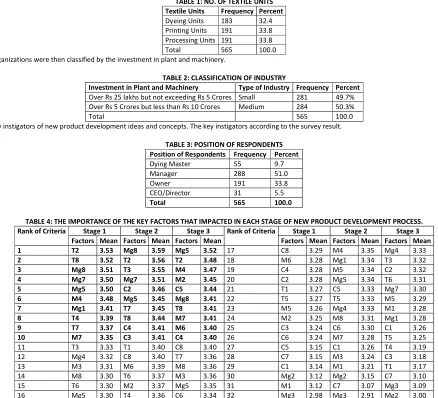
Research findings were based on the responses from the textile manufacturing units representing the following: Dyeing Units (183), Printing Units (191), and Processing Units (191).
TABLE 1: NO. OF TEXTILE UNITS
Textile Units Frequency Percent
Dyeing Units 183 32.4
Printing Units 191 33.8 Processing Units 191 33.8
Total 565 100.0
The organizations were then classified by the investment in plant and machinery.
TABLE 2: CLASSIFICATION OF INDUSTRY
Investment in Plant and Machinery Type of Industry Frequency Percent
Over Rs 25 lakhs but not exceeding Rs 5 Crores Small 281 49.7%
Over Rs 5 Crores but less than Rs 10 Crores Medium 284 50.3%
Total 565 100.0
The key instigators of new product development ideas and concepts. The key instigators according to the survey result.
TABLE 3: POSITION OF RESPONDENTS Position of Respondents Frequency Percent
Dying Master 55 9.7
Manager 288 51.0
Owner 191 33.8
CEO/Director 31 5.5
Total 565 100.0
TABLE 4: THE IMPORTANCE OF THE KEY FACTORS THAT IMPACTED IN EACH STAGE OF NEW PRODUCT DEVELOPMENT PROCESS.
Rank of Criteria Stage 1 Stage 2 Stage 3 Rank of Criteria Stage 1 Stage 2 Stage 3
Factors Mean Factors Mean Factors Mean Factors Mean Factors Mean Factors Mean
1 T2 3.53 Mg8 3.59 Mg5 3.52 17 C8 3.29 M4 3.35 Mg4 3.33
2 T8 3.52 T2 3.56 T2 3.48 18 M6 3.28 Mg1 3.34 T3 3.32
3 Mg8 3.51 T3 3.55 M4 3.47 19 C4 3.28 M5 3.34 C2 3.32
4 Mg7 3.50 Mg7 3.51 M2 3.45 20 C2 3.28 Mg5 3.34 T6 3.31
5 Mg5 3.50 C2 3.46 C5 3.44 21 T1 3.27 C5 3.33 Mg7 3.30
6 M4 3.48 Mg5 3.45 Mg8 3.41 22 T5 3.27 T5 3.33 M5 3.29
7 Mg1 3.41 T7 3.45 T8 3.41 23 M5 3.26 Mg4 3.33 M1 3.28
8 T4 3.39 T8 3.44 M7 3.41 24 M2 3.25 M8 3.31 Mg1 3.28
9 T7 3.37 C4 3.41 M6 3.40 25 C3 3.24 C6 3.30 C1 3.26
10 M7 3.35 C3 3.41 C4 3.40 26 C6 3.24 M7 3.28 T5 3.25
11 T3 3.33 T1 3.40 C8 3.40 27 C5 3.15 C1 3.26 T4 3.19
12 Mg4 3.32 C8 3.40 T7 3.36 28 C7 3.15 M3 3.24 C3 3.18
13 M3 3.31 M6 3.39 M8 3.36 29 C1 3.14 M1 3.21 T1 3.17
14 M8 3.30 T6 3.37 M3 3.36 30 Mg2 3.12 Mg2 3.15 C7 3.10
15 T6 3.30 M2 3.37 Mg5 3.35 31 M1 3.12 C7 3.07 Mg3 3.09
16 Mg5 3.30 T4 3.36 C6 3.34 32 Mg3 2.98 Mg3 2.91 Mg2 3.00
It was found that in stage 1, stage 2 and stage 3 the mean value of top 10 criteria is above two and among them in stage 1; 4 technological factors, 2 Marketing factors, no Commercial factors and 4 Managerial Factors. Though marketing and managerial factors are a primary consideration in this stage, technological factors are among the top priority. In stage 2; 4 Technological factors, no marketing factors, 3 Commercial Factors and 3 Managerial Factors. The results show that, in this stage, firm put emphasis on technological factors, and in stage3; 2 technological factors, 4 marketing factors, 2 commercial factors, 2 managerial factors. It indicates that the results show that, in stage 1, firms put a lot of emphasis on Technological factors and not at all on commercial factors so that firms can concentrate more on Idea generation without financial constraints. As opposed to stage 1 firms are more concentrate on marketing factors than any other so that they can successfully launch the product in market to achieve competitive advantage.
FINDINGS
From finding firms are inviting new ideas in initial stage of NPD process. The table of mean rank that the relative importance of the KSF differs across different stages. Firms pay more attention on technological factors and attentions turns to marketing factors during the commercialization stage.
CONCLUSION
From the analysis it is concluded that the textile firms of Surat are actively involved in NPD. The majority of the SMEs concentrates on technological factors and marketing factors and then other two. As firm giving more importance to technological and marketing factors firms inviting new ideas and competitive advantage for new product and come to know about potential market and cost of new products.
REFERENCES
1. Alberto De Toni et.al. (2003) “Small and medium district enterprises and the new product development challenge.” International Journal of Operation and Production Management, Vol. 23 (6) pp. 678-697.
VOLUME NO.6(2016),ISSUE NO.10(
OCTOBER
) ISSN2231-57563. B.C. Ghosh et.al (2001), “The key success factors, distinctive capabilities and strategic thrusts of top SMEs in Singapore.” Journal of Business Research, Vol. 50 pp. 209-221.
4. Calantone, R.J. and Cooper, R.G. (1981), “New product scenarios: prospects for success”, Journal of Marketing, Vol. 45 No. 2, pp. 48-60.
5. Fu, Yan-Kai (2010), “New Product Success among Small and Medium Enterprises: An Empirical Study in Taiwan.” The Journal of International Management Studies, Vol. 5 (1), pp. 147-153.
6. Ganesh L et.al, “Critcal Failure Factors in enterprise resource planning implementation at Indian SME.” Asian Journal of Management Research.
7. Holger Ernst (2002) “Success Factors of New Product Development: A review of the empirical literature.” International Journal of Management Review, Vol. 4 (1) pp. 1-40.
8. Jifeng Mu et.al, (2007), “New Product Development in Chinese SMEs”, International Journal of Emerging Markets, Vol. 2.
9. John Bessant and David Francis (1997), “Implementing the New Product Development Process.” Technovision Vol. 17(4) pp. 189-197. 10. March Chorada et.al. (2002), “Product Development Process in Spanish SMEs” Technovision, pp. 301-312.
11. Mateja Karničar Šenk et.al (2010), “Development of New Product/Process Development Procedure for SMEs”, Organizacija, Volume 43, Pg. no. 76-86. 12. Nadia Bhuiyan (2011), “A framework for Successful New Product Development”. Journal of Industrial Engineering and Management, pp. 746-770. 13. Wonseok Choi et.al. “New Product Development and Its Applications in Textiles”, Journal of Textile and Apparel, Technology and Management.” Vol. 4(4). 14. Xueli Huang et.al. (2002), “New Product Development Processes in Small and Medium Sized Enterprise: Some Australian Evidence.” Journal of Small Business
Management, vol 40 (1), pp. 22-42.
WEBSITES
15. http://onlinelibrary.wiley.com/doi/10.1111/1540-627X.00036/abstract (Assessed on 31st July 2015)
16. http://citeseerx.ist.psu.edu/viewdoc/summary?doi=10.1.1.473.6215 (Assed on 31st July 2015)
17. https://www.deepdyve.com/lp/emerald-publishing/new-product-development-in-chinese-smes-key-success-factors-from-a-tpKFjZM6BG (Assessed on 1st
January 2015)
18. http://www.sciencedirect.com/science/article/pii/S0166497201000219 (Assessed on 1st January 2015)
19. https://www.questia.com/library/journal/1G1-83039544/new-product-development-processes-in-small-and-medium-sized (Assessed on 7th December
2014)
ANNEXURE
LIST OF KEY SUCCESS FACTORS AND RESPECTIVE CRITERIA
Factors Criteria Code
Technological Factors 1. The technology is new
2. The technology is core or platform 3. The technology is reliable 4. The technology is complex
5. The technology is hard to be substitute 6. The technology is not easy to imitate
T1 T2 T3 T4 T5 T6 Marketing Factors 1. The Product has first-mover advantage
2. The time to reach market is short 3. The market has no entry barrier 4. The target market is clearly defined 5. The market is growing
6. The market is big enough 7. The market demand is stable 8. There exists identifiable market 9. There are no dominant competitors 10. There are few or no competitors 11. There are few or no substitute products 12. The product has unique competitive advantage 13. The production cost is low
14. The product is clearly defined
M1 M2 M3 M4 M5 M6 M7 M8 M9 M10 M11 M12 M13 M14 Commercial Factors 1. There is reasonable pricing strategy
2. There is reasonable market channel plan 3. The product has strong functional attributes 4. The quality of product is reliable
5. There is manufacturing flexibility
6. The firm have relevant manufacturing experience 7. The company has sufficient resources
8. The inventor has experiences in the industry 9. The inventor can support the product development 10. The inventor has good reputation
11. The product can be manufactured at low cost 12. The product can be easily financed
13. The product has recognizable quantitative revenue 14. The product has expected positive return on investment 15. The product has positive return on investment 16. The product has positive present cash value 17. The product can make up the cost of the patenting 18. The company has strong financing capability
C1 C2 C3 C4 C5 C6 C7 C8 C9 C10 C11 C12 C13 C14 C15 C16 C17 C18 Managerial Factors 1. The inventor owns the patent
2. There is good product development team 3. There are managerial expertise in the company 4. There is a good management team
5. The firm has effective incentive mechanism 6. The firm has highly qualified marketing staff 7. The firm has highly qualified production staff 8. The firm has highly qualified technical staff
VOLUME NO.6(2016),ISSUE NO.10(
OCTOBER
) ISSN2231-5756REQUEST FOR FEEDBACK
Dear Readers
At the very outset, International Journal of Research in Commerce, IT & Management (IJRCM) acknowledges
& appreciates your efforts in showing interest in our present issue under your kind perusal.
I would like to request you to supply your critical comments and suggestions about the material published
in this issue, as well as on the journal as a whole, on our e-mail
for further
improve-ments in the interest of research.
If you have any queries, please feel free to contact us on our e-mail
.
I am sure that your feedback and deliberations would make future issues better – a result of our joint effort.
Looking forward to an appropriate consideration.
With sincere regards
Thanking you profoundly
Academically yours
Sd/-
Co-ordinator
DISCLAIMER