A Monthly Double-Blind Peer Reviewed (Refereed/Juried) Open Access International e-Journal - Included in the International Serial Directories
Indexed & Listed at:
VOLUME NO.2(2012),ISSUE NO.10(OCTOBER) ISSN2231-5756
CONTENTS
CONTENTS
CONTENTS
CONTENTS
Sr.No.
TITLE & NAME OF THE AUTHOR (S)
Page No.
1. EFFICIENCY AND PERFORMANCE OF e-LEARNING PROJECTS IN INDIA
SANGITA RAWAL, DR. SEEMA SHARMA & DR. U. S. PANDEY
1 2. AN ADAPTIVE DECISION SUPPORT SYSTEM FOR PRODUCTION PLANNING: A CASE OF CD REPLICATOR
SIMA SEDIGHADELI & REZA KACHOUIE
5 3. CONSTRUCT THE TOURISM INTENTION MODEL OF CHINA TRAVELERS IN TAIWAN
WEN-GOANG, YANG, CHIN-HSIANG, TSAI, JUI-YING HUNG, SU-SHIANG, LEE & HUI-HUI, LEE
9 4. FINANCIAL PLANNING CHALLENGES AFFECTING IMPLEMENTATION OF THE ECONOMIC STIMULUS PROGRAMME IN EMBU
COUNTY, KENYA
PAUL NJOROGE THIGA, JUSTO MASINDE SIMIYU, ADOLPHUS WAGALA, NEBAT GALO MUGENDA & LEWIS KINYUA KATHUNI
15
5. IMPACT OF ELECTRONIC COMMERCE PRACTICES ON CUSTOMER E-LOYALTY: A CASE STUDY OF PAKISTAN
TAUSIF M. & RIAZ AHMAD
22 6. SOCIAL NETWORKING IN VIRTUAL COMMUNITY CENTRES: USES AND PERCEPTION AMONG SELECTED NIGERIAN STUDENTS
DR. SULEIMAN SALAU & NATHANIEL OGUCHE EMMANUEL
26 7. EXPOSURE TO CLIMATE CHANGE RISKS: CROP INSURANCE
DR. VENKATESH. J, DR. SEKAR. S, AARTHY.C & BALASUBRAMANIAN. M
32 8. SCENARIO OF ENTERPRISE RESOURCE PLANNING IMPLEMENTATION IN SMALL AND MEDIUM SCALE ENTERPRISES
DR. G. PANDURANGAN, R. MAGENDIRAN, L.S. SRIDHAR & R. RAJKOKILA
35 9. BRAIN TUMOR SEGMENTATION USING ALGORITHMIC AND NON ALGORITHMIC APPROACH
K.SELVANAYAKI & DR. P. KALUGASALAM
39 10. EMERGING TRENDS AND OPPORTUNITIES OF GREEN MARKETING AMONG THE CORPORATE WORLD
DR. MOHAN KUMAR. R, INITHA RINA.R & PREETHA LEENA .R
45 11. DIFFUSION OF INNOVATIONS IN THE COLOUR TELEVISION INDUSTRY: A CASE STUDY OF LG INDIA
DR. R. SATISH KUMAR, MIHIR DAS & DR. SAMIK SOME
51 12. TOOLS OF CUSTOMER RELATIONSHIP MANAGEMENT – A GENERAL IDEA
T. JOGA CHARY & CH. KARUNAKER
56 13. LOGISTIC REGRESSION MODEL FOR PREDICTION OF BANKRUPTCY
ISMAIL B & ASHWINI KUMARI
58 14. INCLUSIVE GROWTH: REALTY OR MYTH IN INDIA
DR. KALE RACHNA RAMESH
65 15. A PRACTICAL TOKENIZER FOR PART-OF SPEECH TAGGING OF ENGLISH TEXT
BHAIRAB SARMA & BIPUL SHYAM PURKAYASTHA
69 16. KEY ANTECEDENTS OF FEMALE CONSUMER BUYING BEHAVIOR WITH SPECIAL REFERENCE TO COSMETICS PRODUCT
DR. RAJAN
72 17. MANAGING HUMAN ENCOUNTERS AT CLASSROOMS - A STUDY WITH SPECIAL REFERENCE TO ENGINEERING PROGRAMME,
CHENNAI
DR. B. PERCY BOSE
77
18. THE IMPACT OF E-BANKING ON PERFORMANCE – A STUDY OF INDIAN NATIONALISED BANKS
MOHD. SALEEM & MINAKSHI GARG
80 19. UTILIZING FRACTAL STRUCTURES FOR THE INFORMATION ENCRYPTING PROCESS
UDAI BHAN TRIVEDI & R C BHARTI
85 20. IMPACT OF LIBERALISATION ON PRACTICES OF PUBLIC SECTOR BANKS IN INDIA
DR. R. K. MOTWANI & SAURABH JAIN
89 21. THE EFFECTIVENESS OF PERFORMANCE APPRAISAL ON ITES INDUSTRY AND ITS OUTCOME
DR. V. SHANTHI & V. AGALYA
92 22. CUSTOMERS ARE THE KING OF THE MARKET: A PRICING APPROACH BASED ON THEIR OPINION - TARGET COSTING
SUSANTA KANRAR & DR. ASHISH KUMAR SANA
97 23. WHAT DRIVE BSE AND NSE?
MOCHI PANKAJKUMAR KANTILAL & DILIP R. VAHONIYA
101 24. A CASE APPROACH TOWARDS VERTICAL INTEGRATION: DEVELOPING BUYER-SELLER RELATIONSHIPS
SWATI GOYAL, SONU DUA & GURPREET KAUR
108 25. ANALYSIS OF SOURCES OF FRUIT WASTAGES IN COLD STORAGE UNITS IN TAMILNADU
ARIVAZHAGAN.R & GEETHA.P
113 26. A NOVEL CONTRAST ENHANCEMENT METHOD BY ARBITRARILY SHAPED WAVELET TRANSFORM THROUGH HISTOGRAM
EQUALIZATION
SIBIMOL J
119
27. SCOURGE OF THE INNOCENTS
A. LINDA PRIMLYN
124 28. BUILDING & TESTING MODEL IN MEASUREMENT OF INTERNAL SERVICE QUALITY IN TANCEM – A GAP ANALYSIS APPROACH
DR. S. RAJARAM, V. P. SRIRAM & SHENBAGASURIYAN.R
128 29. ORGANIZATIONAL CREATIVITY FOR COMPETITIVE EXCELLENCE
REKHA K.A
133 30. A STUDY OF STUDENT’S PERCEPTION FOR SELECTION OF ENGINEERING COLLEGE: A FACTOR ANALYSIS APPROACH
SHWETA PANDIT & ASHIMA JOSHI
138
CHIEF PATRON
CHIEF PATRON
CHIEF PATRON
CHIEF PATRON
PROF. K. K. AGGARWAL
Chancellor, Lingaya’s University, Delhi
Founder Vice-Chancellor, Guru Gobind Singh Indraprastha University, Delhi
Ex. Pro Vice-Chancellor, Guru Jambheshwar University, Hisar
FOUNDER
FOUNDER
FOUNDER
FOUNDER PATRON
PATRON
PATRON
PATRON
LATE SH. RAM BHAJAN AGGARWAL
Former State Minister for Home & Tourism, Government of Haryana
Former Vice-President, Dadri Education Society, Charkhi Dadri
Former President, Chinar Syntex Ltd. (Textile Mills), Bhiwani
CO
CO
CO
CO----ORDINATOR
ORDINATOR
ORDINATOR
ORDINATOR
AMITA
Faculty, Government M. S., Mohali
ADVISORS
ADVISORS
ADVISORS
ADVISORS
DR. PRIYA RANJAN TRIVEDI
Chancellor, The Global Open University, Nagaland
PROF. M. S. SENAM RAJU
Director A. C. D., School of Management Studies, I.G.N.O.U., New Delhi
PROF. M. N. SHARMA
Chairman, M.B.A., Haryana College of Technology & Management, Kaithal
PROF. S. L. MAHANDRU
Principal (Retd.), Maharaja Agrasen College, Jagadhri
EDITOR
EDITOR
EDITOR
EDITOR
PROF. R. K. SHARMA
Professor, Bharti Vidyapeeth University Institute of Management & Research, New Delhi
CO
CO
CO
CO----EDITOR
EDITOR
EDITOR
EDITOR
DR. BHAVET
Faculty, M. M. Institute of Management, Maharishi Markandeshwar University, Mullana, Ambala, Haryana
EDITORIAL ADVISORY BOARD
EDITORIAL ADVISORY BOARD
EDITORIAL ADVISORY BOARD
EDITORIAL ADVISORY BOARD
DR. RAJESH MODI
Faculty, Yanbu Industrial College, Kingdom of Saudi Arabia
PROF. SANJIV MITTAL
University School of Management Studies, Guru Gobind Singh I. P. University, Delhi
PROF. ANIL K. SAINI
Chairperson (CRC), Guru Gobind Singh I. P. University, Delhi
DR. SAMBHAVNA
Faculty, I.I.T.M., Delhi
DR. MOHENDER KUMAR GUPTA
VOLUME NO.2(2012),ISSUE NO.10(OCTOBER) ISSN2231-5756
DR. SHIVAKUMAR DEENE
Asst. Professor, Dept. of Commerce, School of Business Studies, Central University of Karnataka, Gulbarga
DR. MOHITA
Faculty, Yamuna Institute of Engineering & Technology, Village Gadholi, P. O. Gadhola, Yamunanagar
ASSOCIATE EDITORS
ASSOCIATE EDITORS
ASSOCIATE EDITORS
ASSOCIATE EDITORS
PROF. NAWAB ALI KHAN
Department of Commerce, Aligarh Muslim University, Aligarh, U.P.
PROF. ABHAY BANSAL
Head, Department of Information Technology, Amity School of Engineering & Technology, Amity University, Noida
PROF. A. SURYANARAYANA
Department of Business Management, Osmania University, Hyderabad
DR. SAMBHAV GARG
Faculty, M. M. Institute of Management, Maharishi Markandeshwar University, Mullana, Ambala, Haryana
PROF. V. SELVAM
SSL, VIT University, Vellore
DR. PARDEEP AHLAWAT
Associate Professor, Institute of Management Studies & Research, Maharshi Dayanand University, Rohtak
DR. S. TABASSUM SULTANA
Associate Professor, Department of Business Management, Matrusri Institute of P.G. Studies, Hyderabad
SURJEET SINGH
Asst. Professor, Department of Computer Science, G. M. N. (P.G.) College, Ambala Cantt.
TECHNICAL ADVISOR
TECHNICAL ADVISOR
TECHNICAL ADVISOR
TECHNICAL ADVISOR
AMITA
Faculty, Government H. S., Mohali
DR. MOHITA
Faculty, Yamuna Institute of Engineering & Technology, Village Gadholi, P. O. Gadhola, Yamunanagar
FINANCIAL ADVISORS
FINANCIAL ADVISORS
FINANCIAL ADVISORS
FINANCIAL ADVISORS
DICKIN GOYAL
Advocate & Tax Adviser, Panchkula
NEENA
Investment Consultant, Chambaghat, Solan, Himachal Pradesh
LEGAL ADVISORS
LEGAL ADVISORS
LEGAL ADVISORS
LEGAL ADVISORS
JITENDER S. CHAHAL
Advocate, Punjab & Haryana High Court, Chandigarh U.T.
CHANDER BHUSHAN SHARMA
Advocate & Consultant, District Courts, Yamunanagar at Jagadhri
SUPERINTENDENT
SUPERINTENDENT
SUPERINTENDENT
SUPERINTENDENT
SURENDER KUMAR POONIA
CALL FOR MANUSCRIPTS
CALL FOR MANUSCRIPTS
CALL FOR MANUSCRIPTS
CALL FOR MANUSCRIPTS
We invite unpublished novel, original, empirical and high quality research work pertaining to recent developments & practices in the area of Computer, Business, Finance, Marketing, Human Resource Management, General Management, Banking, Insurance, Corporate Governance and emerging paradigms in allied subjects like Accounting Education; Accounting Information Systems; Accounting Theory & Practice; Auditing; Behavioral Accounting; Behavioral Economics; Corporate Finance; Cost Accounting; Econometrics; Economic Development; Economic History; Financial Institutions & Markets; Financial Services; Fiscal Policy; Government & Non Profit Accounting; Industrial Organization; International Economics & Trade; International Finance; Macro Economics; Micro Economics; Monetary Policy; Portfolio & Security Analysis; Public Policy Economics; Real Estate; Regional Economics; Tax Accounting; Advertising & Promotion Management; Business Education; Management Information Systems (MIS); Business Law, Public Responsibility & Ethics; Communication; Direct Marketing; E-Commerce; Global Business; Health Care Administration; Labor Relations & Human Resource Management; Marketing Research; Marketing Theory & Applications; Non-Profit Organizations; Office Administration/Management; Operations Research/Statistics; Organizational Behavior & Theory; Organizational Development; Production/Operations; Public Administration; Purchasing/Materials Management; Retailing; Sales/Selling; Services; Small Business Entrepreneurship; Strategic Management Policy; Technology/Innovation; Tourism, Hospitality & Leisure; Transportation/Physical Distribution; Algorithms; Artificial Intelligence; Compilers & Translation; Computer Aided Design (CAD); Computer Aided Manufacturing; Computer Graphics; Computer Organization & Architecture; Database Structures & Systems; Digital Logic; Discrete Structures; Internet; Management Information Systems; Modeling & Simulation; Multimedia; Neural Systems/Neural Networks; Numerical Analysis/Scientific Computing; Object Oriented Programming; Operating Systems; Programming Languages; Robotics; Symbolic & Formal Logic and Web Design. The above mentioned tracks are only indicative, and not exhaustive.
Anybody can submit the soft copy of his/her manuscript anytime in M.S. Word format after preparing the same as per our submission guidelines duly available on our website under the heading guidelines for submission, at the email address: [email protected].
GUIDELINES FOR SUBM
GUIDELINES FOR SUBM
GUIDELINES FOR SUBM
GUIDELINES FOR SUBMISSION OF MANUSCRIPT
ISSION OF MANUSCRIPT
ISSION OF MANUSCRIPT
ISSION OF MANUSCRIPT
1. COVERING LETTER FOR SUBMISSION:
DATED: _____________ THE EDITOR
IJRCM
Subject: SUBMISSION OF MANUSCRIPT IN THE AREA OF .
(e.g. Finance/Marketing/HRM/General Management/Economics/Psychology/Law/Computer/IT/Engineering/Mathematics/other, please specify)
DEAR SIR/MADAM
Please find my submission of manuscript entitled ‘___________________________________________’ for possible publication in your journals.
I hereby affirm that the contents of this manuscript are original. Furthermore, it has neither been published elsewhere in any language fully or partly, nor is it under review for publication elsewhere.
I affirm that all the author (s) have seen and agreed to the submitted version of the manuscript and their inclusion of name (s) as co-author (s).
Also, if my/our manuscript is accepted, I/We agree to comply with the formalities as given on the website of the journal & you are free to publish our contribution in any of your journals.
NAME OF CORRESPONDING AUTHOR: Designation:
Affiliation with full address, contact numbers & Pin Code: Residential address with Pin Code:
Mobile Number (s): Landline Number (s): E-mail Address: Alternate E-mail Address:
NOTES:
a) The whole manuscript is required to be in ONE MS WORD FILE only (pdf. version is liable to be rejected without any consideration), which will start from the covering letter, inside the manuscript.
b) The sender is required to mention the following in the SUBJECT COLUMN of the mail:
New Manuscript for Review in the area of (Finance/Marketing/HRM/General Management/Economics/Psychology/Law/Computer/IT/ Engineering/Mathematics/other, please specify)
c) There is no need to give any text in the body of mail, except the cases where the author wishes to give any specific message w.r.t. to the manuscript. d) The total size of the file containing the manuscript is required to be below 500 KB.
e) Abstract alone will not be considered for review, and the author is required to submit the complete manuscript in the first instance.
f) The journal gives acknowledgement w.r.t. the receipt of every email and in case of non-receipt of acknowledgment from the journal, w.r.t. the submission of manuscript, within two days of submission, the corresponding author is required to demand for the same by sending separate mail to the journal.
2. MANUSCRIPT TITLE: The title of the paper should be in a 12 point Calibri Font. It should be bold typed, centered and fully capitalised.
3. AUTHOR NAME (S) & AFFILIATIONS: The author (s) full name, designation, affiliation (s), address, mobile/landline numbers, and email/alternate email address should be in italic & 11-point Calibri Font. It must be centered underneath the title.
VOLUME NO.2(2012),ISSUE NO.10(OCTOBER) ISSN2231-5756
5. KEYWORDS: Abstract must be followed by a list of keywords, subject to the maximum of five. These should be arranged in alphabetic order separated by commas and full stops at the end.
6. MANUSCRIPT: Manuscript must be in BRITISH ENGLISH prepared on a standard A4 size PORTRAIT SETTING PAPER. It must be prepared on a single space and single column with 1” margin set for top, bottom, left and right. It should be typed in 8 point Calibri Font with page numbers at the bottom and centre of every page. It should be free from grammatical, spelling and punctuation errors and must be thoroughly edited.
7. HEADINGS: All the headings should be in a 10 point Calibri Font. These must be bold-faced, aligned left and fully capitalised. Leave a blank line before each heading.
8. SUB-HEADINGS: All the sub-headings should be in a 8 point Calibri Font. These must be bold-faced, aligned left and fully capitalised.
9. MAIN TEXT: The main text should follow the following sequence:
INTRODUCTION
REVIEW OF LITERATURE
NEED/IMPORTANCE OF THE STUDY
STATEMENT OF THE PROBLEM
OBJECTIVES
HYPOTHESES
RESEARCH METHODOLOGY
RESULTS & DISCUSSION
FINDINGS
RECOMMENDATIONS/SUGGESTIONS
CONCLUSIONS
SCOPE FOR FURTHER RESEARCH
ACKNOWLEDGMENTS
REFERENCES
APPENDIX/ANNEXURE
It should be in a 8 point Calibri Font, single spaced and justified. The manuscript should preferably not exceed 5000 WORDS.
10. FIGURES & TABLES: These should be simple, crystal clear, centered, separately numbered & self explained, and titles must be above the table/figure. Sources of data should be mentioned below the table/figure. It should be ensured that the tables/figures are referred to from the main text.
11. EQUATIONS: These should be consecutively numbered in parentheses, horizontally centered with equation number placed at the right.
12. REFERENCES: The list of all references should be alphabetically arranged. The author (s) should mention only the actually utilised references in the preparation of manuscript and they are supposed to follow Harvard Style of Referencing. The author (s) are supposed to follow the references as per the following:
•
All works cited in the text (including sources for tables and figures) should be listed alphabetically.•
Use (ed.) for one editor, and (ed.s) for multiple editors.•
When listing two or more works by one author, use --- (20xx), such as after Kohl (1997), use --- (2001), etc, in chronologically ascending order.•
Indicate (opening and closing) page numbers for articles in journals and for chapters in books.•
The title of books and journals should be in italics. Double quotation marks are used for titles of journal articles, book chapters, dissertations, reports, working papers, unpublished material, etc.•
For titles in a language other than English, provide an English translation in parentheses.•
The location of endnotes within the text should be indicated by superscript numbers.PLEASE USE THE FOLLOWING FOR STYLE AND PUNCTUATION IN REFERENCES: BOOKS
•
Bowersox, Donald J., Closs, David J., (1996), "Logistical Management." Tata McGraw, Hill, New Delhi.•
Hunker, H.L. and A.J. Wright (1963), "Factors of Industrial Location in Ohio" Ohio State University, Nigeria. CONTRIBUTIONS TO BOOKS•
Sharma T., Kwatra, G. (2008) Effectiveness of Social Advertising: A Study of Selected Campaigns, Corporate Social Responsibility, Edited by David Crowther & Nicholas Capaldi, Ashgate Research Companion to Corporate Social Responsibility, Chapter 15, pp 287-303.JOURNAL AND OTHER ARTICLES
•
Schemenner, R.W., Huber, J.C. and Cook, R.L. (1987), "Geographic Differences and the Location of New Manufacturing Facilities," Journal of Urban Economics, Vol. 21, No. 1, pp. 83-104.CONFERENCE PAPERS
•
Garg, Sambhav (2011): "Business Ethics" Paper presented at the Annual International Conference for the All India Management Association, New Delhi, India, 19–22 June.UNPUBLISHED DISSERTATIONS AND THESES
•
Kumar S. (2011): "Customer Value: A Comparative Study of Rural and Urban Customers," Thesis, Kurukshetra University, Kurukshetra. ONLINE RESOURCES•
Always indicate the date that the source was accessed, as online resources are frequently updated or removed. WEBSITESORGANIZATIONAL CREATIVITY FOR COMPETITIVE EXCELLENCE
REKHA K.A
SR. LECTURER
DEPARTMENT OF MANAGEMENT STUDIES & RESEARCH
NAGARJUNA COLLEGE OF ENGINEERING & TECHNOLOGY
BANGALORE
ABSTRACT
Can organizational creativity lead to competitive excellence? The purpose of this paper is to develop a model linking organizational creativity to competitive excellence. Drawing upon existing theoretical evidence the paper develops and presents a conceptual model of the relationship between creativity and competitive excellence. In this era of globalization and competition, creativity is considered to be a key factor for survival, success and excellence of organizations (Peter Cook, 1998). While creativity is generally of three types, viz. individual creativity, group/team creativity and organizational creativity, this study focuses on organizational creativity. The methodology adopted is based on case study. This paper presents a case study to support the Conceptual model and depending on the literature reviews, as well as findings from the case, it is to measure creativity of an organization and to find out the relationship between creativity and competitive excellence.
KEYWORDS
creativity, creative organization, competitive excellence.
INTRODUCTION
n this era of globalization and competition, creativity is considered to be a key factor for survival, success and excellence of organizations (Peter Cook, 1998). More than just a buzzword, creativity is becoming acknowledged as a critical factor in organisational success. Creativity in organizations might be defined as the process by which new ideas that make innovation possible are developed. While creativity is generally of three types, viz. individual creativity, group/team creativity and organizational creativity, this study focuses on organizational creativity.
Creativity comes from the people in the organisation and their ideas or perspective on things. Organisational creativity is where having ideas are promoted, listened to and acted upon. All people have experiences and ideas from outside the work environment, and a way to capture these ideas is essential in allowing this creativity to grow. When boundaries are imposed, such as up-front budget constraints, this will limit the creative flow of ideas and you will lose the ability to harnessing the energy of staff to make break-through advances in the business.
Edward De Bono, considered to be the father of creativity concept, feels that one should get rid of one’s inhibition to be creative, i.e., learning to use the right brain more.
The case study presented at the end, of a small and medium enterprise (SME) in Kerala which bagged the Rajeev Gandhi National Quality Award in 1999 tries to identify the determinants of creativity that lead to organizational excellence.
LITERATURE SURVEY
DEFINITIONS OF CREATIVITY AND EXCELLENCE
Cook (1998) considered creativity as an element of competitive advantage for organizations. The most profitable new products will be those that meet the customer needs more effectively than the competitor’s products, and are therefore preferred by more customers (Mc Adam and McClelland, 2000). Innovation and creativity benefit companies beyond direct sales growth or efficiency improvements. A company that establishes an effective creativity and innovation process is also likely to realize social benefits that arise from team working and employee motivation (Cook, 1998). Creativity is seen as the front end of the innovation process. Amabile (1983, 1997, 1998) defines creativity as the process involved in developing an idea for a new product. Gurteen (1998) defines creativity as generation of ideas whereas innovation is putting these ideas in to actions by sifting, refining and implementing. Hence he believed that creativity required divergent thinking process, while innovation a convergent thinking one. Although the fundamental research on creativity dates back to 1960, by the 90s scholars had started appreciating its value in competitive advantage. The concept of organizational excellence as a topic of academic research and debate originated with Peters and Waterman (1982) in their book “In search of excellence”. European Foundation for Quality Models (EFQM) guidelines (1999) defines excellence as outstanding practice in managing the organization and achieving results, all based on a set of eight fundamental concepts, viz, result orientation, customer focus, leadership and constancy of purpose, management by process and facts, people development and involvement, continuous learning, innovation and improvement, partnership development and public responsibility.
NEED/IMPORTANCE OF THE STUDY
Creativity is an important aspect of today’s organization. This is particularly important as companies are facing continuous changes in the global economy. Change is a continuously phenomenon which happens to the organizations both internally and externally that organizations need to make creative plans and reactions towards predictable or unpredictable challenges.
The organizational environment has been changing rapidly. It is a set of forces and conditions outside the organization’s boundaries that have the potential to affect the way the organization operates. An organization interacts with its immediate task environment and is affected by the general environment. The task environment includes the suppliers, distributors, competitors and customers, while the general environment includes forces that are economic, technological, socio-cultural, demographic, political and legal and global. The external environment has been becoming more turbulent as most companies are now competing in the global market where changes are not only common but substantial. Some changes are catastrophic such as economic depression and introduction of new technology. During poor economic times, managers may need to come up with creative strategy to reduce costs such as reducing the number of employees on the one hand, and to increase the motivation of the remaining employees. Managers may also need to identify ways to acquire and utilize resources more efficiently. Technological forces can have profound implications for organizations that it can make established products obsolete.
Examples such as typewriters, black-and-white televisions, film cameras. The changes force managers to find new ways to satisfy customer.
STATEMENT OF THE PROBLEM
The rapid growth of competition in business and industry is often quoted as a reason for wanting to understand more about the creativity. Many firms are continually experiencing pressure to enhance old systems and products. Growth and survival can be related directly to an organisation’s ability to produce (or adopt) and implement new products or services, and processes. One of the key aspects of any organisation’s success or failure is its ability to stay ahead of the competition in a rapidly changing environment. The modern business, with its emphasis on competition, building larger markets, strategic planning, team working, etc., has created the need for new problem solving and decision making strategies. Hence, there is a need to study organizational creativity which in turn helps to achieve corporate excellence.
VOLUME NO.2(2012),ISSUE NO.10(OCTOBER) ISSN2231-5756
OBJECTIVES OF THE STUDY
• To know the importance of organizational creativity.
• To identify the factors that enhances and/or facilitates organisational creativity. • To identify the barriers to organisational creativity.
• What the organisation is doing to encourage / enhance organisational creativity? • The role of leadership in creating an environment that enhances organisational creativity.
WHY IS CREATIVITY IMPORTANT?
The rational decision maker needs creativity: the ability to produce novel and useful ideas. The ideas are different from what’s been done before but are also appropriate to the problem or opportunity presented. Why is creativity important to decision making? It allows the decision maker to appraise and understand the problem more fully including seeing problems others can’t see. However, creativity’s most obvious value is in helping the decision maker identify all viable alternatives.
Here are some Creative Cues to develop creativity
• Cultivating Creativity: Creativity needs to be enhanced otherwise it dies down. Creativity involves two processes – thinking and producing. Innovation is the production or implementation of an idea. If you have ideas but don’t act on them, you are imaginative but not creative. Generative research shows that everyone has creative abilities. The more diverse is the training greater the potential for creative output. An average adult thinks of three to six alternatives for any given situation. The average child thinks of 60. Organizations can conduct creativity testing at workplace firstly to identify the creativity domains in their employees. They can invite experts from various fields to conduct workshops.
So here are few ways to unleash creativity in a workplace.
Organizational Motivation • Appreciative Inquiry • Experienced facilitators • Motivation and reward • Freedom of expression • Positive Ambience
A STRATEGIC VIEW OF CREATIVITY
LINKING CREATIVITY AND INNOVATION
Organization creativity can be seen as a process where creativity is the input to the processes that lead to innovation, competitiveness and returns on investment.
The time spent in the “pipeline” varies for different industries e.g. in software applications it may be months and in the aerospace industry it may be decades. Any shortening of the pipe “length” or improvements in the number of ideas converted to innovations will produce financial benefit. In not-for-profit organizations, the notion of increased market share or return on investment may be replaced by more appropriate outcomes, such as contribution or enhancement of strategic positioning. To make progress through the pipeline requires that the organization has a strategy for converting creativity into innovation. My own research shows that the creativity in organizations has much more to do with an appropriate “context” and rather less to do with “creativity techniques”. This can be summarized by the 80:20 creativity “formula”.
The 80:20 creativity “formula”
Creativity is 80 per cent context and 20 per cent technique. In reality, the 80:20 “formula” is not a universal recipe. However, it does give the correct emphasis to the balance between “context” and “technique”. In my experience as a research and development leader and consultant, too little emphasis is placed on setting a suitable context for creativity, and this has consequences for the successful exploitation of techniques and tools. This article explores the 80 per cent.
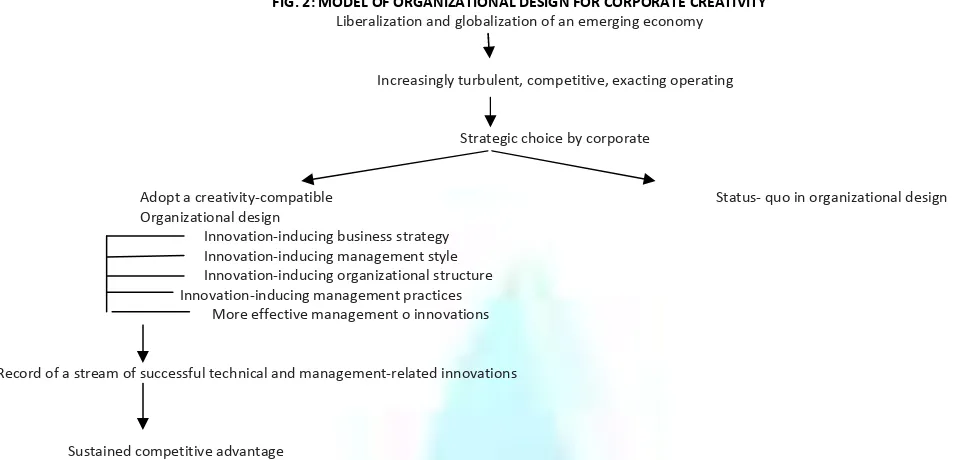
A MODEL OF ORGANIZATION DESIGN FOR CORPORATE CREATIVITY
FIG. 2: MODEL OF ORGANIZATIONAL DESIGN FOR CORPORATE CREATIVITY
Liberalization and globalization of an emerging economy
Increasingly turbulent, competitive, exacting operating
Strategic choice by corporate
Adopt a creativity-compatible Status- quo in organizational design
Organizational design
Innovation-inducing business strategy Innovation-inducing management style Innovation-inducing organizational structure Innovation-inducing management practices
More effective management o innovations
Record of a stream of successful technical and management-related innovations
Sustained competitive advantage
Drawing on the literature survey summarized earlier and the tenets of these three approaches, the above model of organizational design for corporate creativity (i.e., sustained and successful innovativeness) is proposed for the corporate of emerging economies undergoing liberalization and globalization:
As emerging market economies grow more competitive, turbulent, and customer-focused, the greater is the pressure on the organizations to adapt in various ways, including by modifying business strategy, management style, organizational structure, management practices, and effective modes of managing innovations/changes. This is because customary ways of operating do not work well enough and the shelf life of market offerings keeps getting shortened. These pressures are likely to induce decision-makers to search for means for meeting these pressures.
In spite of the environment becoming more competitive, turbulent, and exacting, some organizations choose to change their design in innovation– congruent directions, while others choose not to change in this fashion or to a much lesser extent. This is because the ‘prospector’ types of management would tend to see more opportunities than threats through change and innovation while managements with more conservative mindsets may prefer a wait-and-watch attitude or see more threats than opportunities from change and innovation (Miles and Snow, 1978).
Organizations that do adopt an innovation-friendly organization design tend to display substantial corporate creativity, i.e., they tend to be copiously and successfully innovative. Innovating successfully is a form of learning and once a facilitative organizational design is adopted and the process of innovating successfully is mastered, the management would feel encouraged to try out many more innovations and changes required to operate in a turbulent, competitive, and demanding environment.
Organizations that are copiously and successfully innovative tend to have a strong competitive advantage as evidenced by an above average performance on a variety of effectiveness indicators. This is because there is a time lag between a successful in an organization and its diffusion among its rivals, so that the more numerous the successful innovations, the larger overall would be the performance advantage of the innovating organization.
FIG. 3: DETERMINANTS LEADING TO ORGANIZATIONAL CREATIVITY
Leadership and creativity: - As per Peter Cook (1998), a fundamental challenge leader’s face in the 21st century is how to profit from individual potential and then leverage it so that it produces organizational innovation and excellence. Creative organizations should attract, develop and retain creative talents if they want to remain competitive. Leadership styles conducive to creativity are participative leadership, leader’s vision for creativity and ability to develop effective groups. Cook proposes that leaders must effectively communicate a vision conducive to creativity through any available formal or informal channel of communication and constantly encourage employees. Leaders should also be in a position to balance employee’s freedom and responsibility (Amabile, 1998). Individuals with strong leadership will consider themselves to have more potential for innovation than individuals with weak leadership potential and individuals with strong potential for innovation and creativity will be more likely to practice them when they perceive strong support from work place than weak support (DiLiello and Houghton, 2006). Their model suggests encouraging self-leadership among organizational members while building organizational environment to support innovation and creativity.
WHAT IS CREATIVE CONTEXT?
Creative organizations have strategies that are built on a flexible but firm context, which includes some of the following elements:
Determinants
Strategy Structure Systems Climate Culture Context Leadership Resources & Skills Enhancements & Obstacles Technology Motivations Communication Support – Mechanisms Time, Money & Politics Teams
Individual
Organisational
Group/Team
VOLUME NO.2(2012),ISSUE NO.10(OCTOBER) ISSN2231-5756 • Culture, leadership style and values
• Structure and systems • Skills and resources
Climate, Context, and Culture for Creativity: - Organisational climate could be determined by measuring the level of participation, freedom of expression, performance standards, interaction with small barriers, large number of stimuli, freedom to experiment and building on earlier ideas. Creativity is a key element to competitive advantage. When the context is right, creativity techniques can play their role in raising the level and type of creativity within organization (Peter Cook, 1998). The corporate research foundation lists six key drivers for future success, namely structural flexibility, innovative power, international orientation, human resources, growth markets and quality of management. Creativity is 80% context and 20% techniques (Peter Cook, 1998). Creative strategy can be explained by a three legged stool analogy taking creative strategy on the top, and culture, leadership and values, structure and systems and skills and resources being the three legs of the stool. Organisational culture should be developed to encourage open flow of communication, risk taking, self initiated activity and teamwork. Moreover, management should trust and respect its employees.
FIG. 4: DETERMINANTS LEADING TO COMPETITIVE EXCELLENCE
EVIDENCE FROM SOME AMERICAN STUDIES
An American study on 141 pairs of projects conducted by Teresa Amabile and associates also provides interesting insights (Amabile et al., 1995). In each pair, one project was judged to be high on creativity while the other was judged to be low on creativity. The ‘creative’ projects significantly outscored the ‘uncreative’ projects on six aspects of workplace practices: greater challenge provided in work, greater encouragement to creativity, greater work group support to individuals, greater sense of autonomy as well as of ownership, and greater encouragement provided by superiors to subordinates. In another study, it was found that when people jointly identified work-related problems, there was not only greater feeling of participation but the solutions individuals found to problems tended to be more creative.
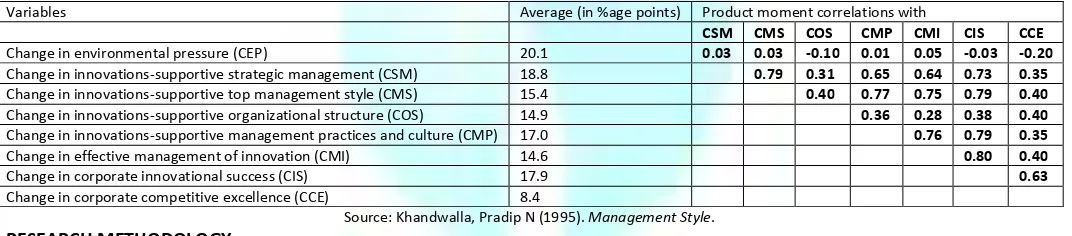
TABLE 1: BASIC STATISTICS OF SOME VARIABLES INFLUENCING CREATIVITY AND ITS CORRELATION
Source: Khandwalla, Pradip N (1995). Management Style.
RESEARCH METHODOLOGY
Organizational creativity is about being different and appropriate. It therefore differs from traditional viewpoints on creativity, which tend to consider ideas for their own value, independent of any commercial application. This paper presents case studies which will illustrate the different view of creativity.
CREATIVE ORGANIZATION IN PRACTICE
Jacob’s study of four pairs of Indian organizations indicates that organizational design for innovativeness is a strategic choice of the management (1998). Each pair shared the same industry or activity or parent organization, and yet one in the pair displayed relatively high innovativeness (corporate creativity) while the other one displayed a distinctly lower innovativeness. A striking difference was within a pair of advertising organizations, both based in Ahmadabad. Mudra Communications was set up in 1980 by the Reliance business group; Bidhan Advertising, started a decade earlier, was a proprietorship. Mudra was highly entrepreneurial; Bidhan found a niche early in its life and stuck to it tenaciously. By 1988, Mudra already had a diversified portfolio of activities — nurturing of small clients that Mudra tried to help grow fast, an example being Pioma Industries, the producer of Rasna line of drinks; market research and advertising support functions; production of videos; a distribution house; and fashion and textile design. In another decade, Mudra added many more activities, such as value-adding information for clients; outdoor media work; public relations assignments; product designing; promotions, exhibitions, road shows, and event management; creation of websites for clients; graphics; sponsored television programmes; creation of corporate brands, etc. All these diversifications catapulted Mudra into one of the four largest communications companies in India. In contrast, Bidhan stuck primarily to producing more or less conventional advertising copy for less than a score of loyal clients; 20 years after it’s founding, it had notched up barely 2 per cent of Mudra’s revenues. Mudra won innumerable awards for communications excellence and creativity; Bidhan simply never entered that race. Organizationally, Mudra was highly divisional zed, had a flat structure, and was regionally decentralized; Bidhan was run as a tight ship, with the proprietor insisting on overseeing every account personally. Mudra aggressively hired creative, dynamic youngsters, many from India’s premier management schools, and gave them autonomy in pursuing challenging assignments; Bidhan had no such policy. Mudra entered into a collaboration with a major American media company; Bidhan never pursued this route. Mudra blended professional management into its entrepreneurship. For example, it carefully studied the long-term prospects of targeted industries, developed high quality communications products based on market research for presentation to actual or potential sophisticated clients looking for quality, and custom-tailored communications services. It targeted not industry leaders but the relatively under-serviced segment of smaller but dynamically managed companies hungry for growth. Mudra also fully computerized its operations and hired a doctorate holder to head the IT function. Mudra’s CEO travelled incessantly, practicing ‘management by moving around’ (Peters and Waterman, 1982); he liked to play the roles of a mentor, coach, and motivator. Bidhan’s CEO primarily played the role of a controller. Mudra developed an internal work climate favoring creativity and innovation. A survey showed that its score on this dimension was 35 versus 16 for
Variables Average (in %age points) Product moment correlations with
CSM CMS COS CMP CMI CIS CCE
Change in environmental pressure (CEP) 20.1 0.03 0.03 -0.10 0.01 0.05 -0.03 -0.20
Change in innovations-supportive strategic management (CSM) 18.8 0.79 0.31 0.65 0.64 0.73 0.35
Change in innovations-supportive top management style (CMS) 15.4 0.40 0.77 0.75 0.79 0.40
Change in innovations-supportive organizational structure (COS) 14.9 0.36 0.28 0.38 0.40
Change in innovations-supportive management practices and culture (CMP) 17.0 0.76 0.79 0.35
Change in effective management of innovation (CMI) 14.6 0.80 0.40
Change in corporate innovational success (CIS) 17.9 0.63
Change in corporate competitive excellence (CCE) 8.4
Determinants Culture Climate Context Resources &Skills Structure & systems Leadership & Empowerment Obstacles Technology Teams & Groups
Creativity
Innovation
C E O X M C P E E L T L I E T N I C V E E
Determinants
Bidhan. Mudra also displayed an altruistic and visionary streak — it set up a pioneering institute of communications to train communications professionals, not just for itself, but for the entire industry. Bidhan stayed away from any such entrepreneurship, strategizing, professional management or altruism.
CASE STUDY ON POPY UMBRELLA MART
Popy umbrella mart, an SME (Small and Medium Enterprise) located at Alleppey (known as Venice of the east) in Kerala is a national leader in umbrella and a success story for creativity and innovation. The mission of Popy is to continually improve its products and services to meet the customer’s needs. Its daily production varies from 9600 to 12000 umbrellas, which represents only half the demand expected in and outside Kerala. Popy removed its website from the internet on account of inability to meet the additional demand created through the internet from India and abroad.
Popy was the first company to be awarded the coveted ISO 9001 certification, for its excellence in the process of umbrella manufacturing. Popy bagged the prestigious “Rajeev Gandhi National Quality Award” in the year 1999 for its continuous innovation for bringing variety of products and its excellent process of umbrella manufacturing. Popy has exhibited exceptional brilliance in bringing quality products, product innovation, marketing of its products, meeting competition and understanding and dealing with culture of customers and employees in Kerala. The long years of experience of V.T.Skariah, the managing director, and modern management inputs from son Davis, an MBA holder, has helped Popy to build up a culture of innovation in their organization. They have diagnosed areas where improvement was necessary, identified parts manufacturers in India and abroad, understood the empowerment requirement of their employees for creativity and innovation, as well as understood the culture of employees and customers of Kerala. Regular interactions with kids and children along with inputs from cartoon films have enabled them to design innovative umbrellas for kids and children. Popy’s creative advertisements have enabled them to capture 50% market share of Indian market for umbrellas. Popy’s product specifications was selected by ISI as a benchmark for Indian umbrellas; as other umbrella manufacturers could not satisfy these specifications, competitors of Popy gradually disappeared from the market. Popy gave full freedom for its employees for nurturing their creativity and innovation. But at the same time each product is given a serial number and a register is maintained on who assembled the product and made the stitching etc. This appears to match Peters and Waterman’s suggestion of freedom with accountability. Popy has its Research and Development department under the guidance of the managing director and general administrator. They collect information about latest cartoon films and cartoon story heroes from children who visit their showrooms. This resulted in an umbrella with cartoon pictures, which has been hugely popular among kids. Some other innovative ideas include the AC umbrella with ultra vibrant coating, water proof umbrella with WPWR coating, light house umbrella which lights up when opened, godfather umbrella which can double up as walking stick, gems umbrella made out of a single piece of cloth without any stitching, Teflon waterproof umbrella, torch umbrella which can be used as a torch light in the night, comic umbrella with cartoon pictures, five fold Nokia umbrella which look like a cellular phone etc. Umbrella manufacturing in Popy is highly labour intensive. Popy has gone for automation under the leadership of Davis but the product quality is yet to reach the level obtained by manual processing.
Popy’s outsourcing to family units satisfies the self-leadership and prestige need of the people of Kerala. The strategy is to provide raw materials and to get back the finished products form these family units. This year Popy has been declared the best liked product in Kerala after Milma (StateMilk Marketing). The presence of a competitor, John’s Umbrella Mart, near Popy keeps them vigilant in terms of innovation and quality. Davis has been given full freedom by his father for experimenting and exploration. Davis introduced the use of computers in designing innovative umbrellas, as well as introduced automation in umbrella manufacturing. Popy is planning to start a factory in Chennai for umbrella manufacturing and intend to increase the number of family production units in Kerala to increase production to meet the demand. Every consumer with a Popy umbrella in his hand is an advertiser. Popy converted umbrella selling in India to an industry of repute. Earlier, the umbrella industry was not considered for recognition and reward. Popy takes good care of its employees, through welfare programs for its employees, financial support at the time of employees’ house construction, marriage of employees’ daughters, children’s education etc. Popy is also involved in a social welfare society for mentally retarded children. For Popy, the manner in which they accomplish their mission is as important as the mission itself. Popy considers its employees as its source of strength in providing corporate intelligence and determine their reputation and vitality. Commitment and teamwork are their core human values.
RESULTS AND DISCUSSIONS
This case study illustrates the following themes about creativity: Giving tangible example to the need for tolerance of failure.
Integration of functions that need to communicate and the tolerance of conflict. Using diversity to produce ideas.
The need for ambiguity tolerance and opportunity spotting (seeing the glass half full rather than half empty) Passion and persistence in action.
CONCLUSION
The paper presents fairly strong evidence that redesigning organizations for creativity both technical as well as non-technical can provide a powerful edge to organizations regardless of the pressures of their operating environments. It is noteworthy that only one in three corporate in environments that had got a lot tougher and a minority of corporate in environments that had not changed much had learnt how to adopt creativogenic organizational designs. As environmental pressures mount through further liberalization and global competition, the non-adopters could suffer gravely.
Whilst there is no universal prescription for encouraging organizational creativity, a number of factors may be identified that make creativity more probable. Broadly speaking these subdivide into the following areas: Setting an appropriate culture, leadership style, focusing more on informal structures and communications than trying to formalize these features and also encouraging diversity of people and skills. Tolerating the conflict that may result, provided that this is over ideas rather than being of a corrosive nature. At times many organizations have is. So take necessary steps and let the employees be at their creative best!
REFERENCES
BOOKS
1. Andriopoulos, C. (2001), “Determinants of organizational creativity: a literature review”, Management Decision, Vol. 39, No. 10, pp. 834- 840.
2. Andriopoulos, C. and Lowe, A. (2000), “Enhancing organizational creativity: the process of perpetual challenging”, Management Decision, Vol. 38, No. 10, pp. 734-742.
3. Khandwalla, P. N. and Mehta, K. (2004), “Design of corporate creativity”, Vikalpa, Vol. 29, No. 1, pp. 13-28.
4. Khandwalla, Pradip N (1985). “Pioneering Innovative Management: An Indian Excellence,” Organization Studies, 6(2), 161-183. 5. Khandwalla, Pradip N (2003). Corporate Creativity: The Winning Edge, New Delhi: Tata McGraw-Hill.
JOURNAL AND OTHER ARTICLES
6. Ahmed, P. K.(1998), “Culture and climate for innovation”, European Journal of Innovation Management, Vol. 1, No.1, pp.30-43.
7. Amabile, Teresa M; Conti, Regina; Coon, Heather, Lazenby, Jeffrey and Herron, Michael (1995). “Assessing the Work Environment for Creativity,” Academy of ManagementJournal, 39(5), 1154-1184.
8. Cook, P. (1998), Best Practice Creativity, Gower, Aldershot.
VOLUME NO.2(2012),ISSUE NO.10(OCTOBER) ISSN2231-5756
REQUEST FOR FEEDBACK
Dear Readers
At the very outset, International Journal of Research in Commerce, IT and Management (IJRCM)
acknowledges & appreciates your efforts in showing interest in our present issue under your kind perusal.
I would like to request you to supply your critical comments and suggestions about the material published
in this issue as well as on the journal as a whole, on our E-mail i.e.
for further
improvements in the interest of research.
If you have any queries please feel free to contact us on our E-mail
.
I am sure that your feedback and deliberations would make future issues better – a result of our joint
effort.
Looking forward an appropriate consideration.
With sincere regards
Thanking you profoundly
Academically yours
Sd/-