Vol. 1, No. 1, (2011), 135-160
Willingness to Communicate in the Second
Language Acquisition: A Case Study on Iranian
2-Year Old Kids
Parviz Maftoon Department of Foreign Languages
Associate Professor Science and Research Branch
Islamic Azad University Tehran, Iran
Abstract
Individual’s first language (L1) and second language (L2) communication could be affected by Willingness to Communicate (WTC) which is considered an influential factor affecting one’s second language development. Studying various aspects of WTC has been the home of choice for the researchers in the SLA domain (e.g., Clement, Dornyei, and Noels, 1998; McCroskey, & Baer, 1985; Kang, 2005; MacIntyre,;MacIntyre, 2007, Yashima, 2002). Yet, WTC is poor in terms research in the area of kids’ SLA. The present research is a qualitative attempt focusing on the concept of WTC among kids in an Iranian context. The review of the literature revealed that no valid instrument for measuring the kid’s WTC exists. Thus, a qualitative WTC study was designed to evaluate “the WTC construct”(cf. Mcroskey& Baer, 1985) in the kids developing an L2. The assumption based on which the study was framed was that WTC is both a personality trait as well as a socio- culturally oriented factor. Therefore the WTC scale designed by Mcroskey& Baer (1985) was modified to fit the kid’s situation and a WTC measuring instrument was developed to measure WTC in kids, presupposing that in case
Received:May, 2011; Accepted: November, 2011
*Corresponding author
Mehrdad Amiri* Department of Foreign Languages
Ph.D Candidata in TEFL Science and Research Branch
WTC is a personality trait it should be fairly consistent in various situations and contexts. The scale designed included four communication contexts: classroom, family settings, Iranian out of home context, and travelling to foreign countries and two types of receivers: stranger, acquaintance. The situations selected based on the scale were presented to the parents to select the most likely behavior and choices of the kids distinctly. The participants of the study were two 21- month-old sisters (non-identical twins) whose parents were willing to make them bilingual. They were trained for 7 months based on the Mom & Baby method of English language learning program developed by Amiri (2008).Films of classroom, interviews with parents, and observations were analyzed and classified through the frequency tables. The results of the study revealed that WTC could be considered both a personality factor and a social characteristic which affects L2 development among kids.
Keywords: Willingness to Communicate (WTC), Second language development, Kids, Personality trait, Bilingual, Social chatacteristics, L2 development.
Willingness to communicate (WTC) is defined as the extent to which learners are prepared to initiate communication when they have a choice. It constitutes a factor believed to lead to individual differences in language learning. A lot of WTC issues have been researched and documented in the SLA and FLA domains(e.g., Birjandi&Amiri, 2011; Burgoon, 1976, cf. McCroskey, et al, 1985; Kang, 2005; McCroskey& Baer, 1985; McCroskey, 1992; McCroskey& Richmond, 1987; MacIntyre, et al, 1998; MacIntyre, 2007, Yashima, 2002)). Since willingness to communicate (WTC) is considered an influential factor affecting individual’s first language (L1) and second language (L2) communication, its survey considering the second language kid’s context could be an interesting topic presenting new grounds of research in the domain of SLA. The present study is a qualitative attempt which reveals how personality factors and styles such as introversion/extraversion,
impulsivity/ responsiveness, and tolerance affect kids’ willingness to communicate both in the first and second language development.
1.1 Context of the study
Within the body of SLA research an emerging, propensity factor that has attracted recent attention is willingness to communicate (WTC), which is defined as ‘the intention to initiate communication, given a choice’ (MacIntyre, Baker, Clement, and Conrad 2001, p. 369).
English is learned in Iran as a foreign language, therefore attempts to make children true bilinguals, seems to be very difficult, if not impossible. Some families, especially from among the educated class of the nation, in Iran today, however prefer to have their kids trained to be bilinguals. Rarely, meanwhile, are parents themselves able to speak English fluently, though they are interested ones. Willingness to communicate in the L2 is also a very crucial factor in the promotion of L2 in the kids experiencing the training thereof. In case of Kids’ SLA a qualitative study might be more prolific than a quantitative one since observing the real language developmental behavior of the learner could be taken into consideration more profoundly.
2. Literature Review
unwillingness to communicate scale, except that the construct is worded in positive terms and assumes the respondent is self aware of his/her own approach/avoidance tendencies. McCroskey, however, applied his earlier framework of Communication Apprehension, which is roughly defined as fear or anxiety in oral communication and which is regarded as one of the main issues underlying WTC, into the second language context, including Japan (McCroskey, Gudykunst, & Nishida, 1985). McCroskey, Fayer, & Richmond (1985) used the scale in studying the levels of Communication Apprehension as well. Birjandi and Amiri(2011) used a modified version of WTC to study the concept, better say construct of WTC in kid’s FLA.
language development of Japanese nursing students.
As presented in Macintyre (2007) WTC is a complex construct, influenced by a number of other individual difference factors such as ‘communication anxiety’, ‘perceived communication competence’ and ‘perceived behavioral control’. Macintyre, Clement, Dornyei, and Noels (1998) presented a schematic model of the WTC construct showing multiple layers of variables (such as those just mentioned) that feed into WTC. In other words WTC is seen as a final-order variable, determined by other factors, and the immediate antecedent of communication behavior. Considerable research effort has gone into the attempt to validate this model.
It is very likely, however, that the precise pattern of factors influencing WTC is not fixed but situation-dependent. As Yashima (2002) noted ‘a careful examination of what it means to learn a language in a particular context is necessary before applying a model developed in a different context’ (p. 62). Yashima’s own study investigated the WTC model in Japanese EFL context. Using structural equation modeling, Yashima showed that WTC figured in both an indirect path between other ID variables (international posture, motivation, self-confidence in communication) and language proficiency, and a direct path (i.e., international posture was directly related to WTC). The key variable influencing WTC in this context therefore was ‘international posture’, defined as ‘a general attitude towards the international community that influences English learning and communication among Japanese learners’ (pp. 62-3).
stresses the importance of contact, L2 confidence, and identity in acquiring a L2 and WTC, which concerns with the functions of L2 use. The aim of their study was to consider both contextual and individual difference variables in L2 use. Participants of their study were both Anglophone and Francophone students attending a Canadian bilingual university. Path analyses supported a model in which context, individual, and social factors were all important determinants of L2 use, although patterns of relations differed depending on the ethno linguistic vitality of the group.
Kang (2005) reported a qualitative study of the situated WTC of four adult male Korean learners of English in the United States. The learners were paired off with native speakers and invited to engage in free conversation. In this context ‘international posture’ did not appear to play any role. Rather ‘the participants’ situational WTC in their L2 appeared to emerge under psychological conditions of excitement, responsibility and security’ (p. 282). Situated nature of WTC also has been investigated by Cao and Philp (2006).They found no statistically significant relationship between the eight adult learners of English self-reported WTC and their actual WTC as evidenced through observation of three interactional classroom contexts (whole class, pair work, and group work). Nor was there a clear relationship among manifested WTC in these three contexts.
traditional instructional approaches. Interestingly, MacIntyre et al. reported that WTC inside the classroom correlated strongly with WTC outside in Anglophone learners of L2 French in Canada, demonstrating that WTC is a stable, trait-like factor. Dornyei and Kormos (2000) found that Hungarian students’ WTC in the classroom was influenced by their attitudes to the instructional-task, Strong, positive correlations were found between a measure of WTC and the amount of English produced while performing a communicative task in the case of learners who expressed positive attitudes to the task but near zero correlations in the case of learners with low task attitudes. It would seem then that learners’ willingness to communicate depends in part, on their personality and in part on their intrinsic motivation to perform specific classroom activities.
Ellis (2008) contends that work on WTC is in its infancy and it is a promising construct in several respects. WTC constitutes an obvious link between other, more thoroughly investigated constructs (such as learner attitudes and motivation) and language proficiency. It is also a construct of obvious relevance to language teaching. Dornyei (2005) suggested that developing WTC is ‘the ultimate goal of instruction’. (p. 210)
in time can be conceptualized as a volitional (freely chosen) process. The result is a degree of willingness to communicate (WTC) with the potential to rise and fall rapidly as the situation changes. Dornyei (2005) presents that research based on both qualitative and quantitative methodologies demonstrates the complexity of the processes involved in creating WTC. It is argued that methodologies must be adapted to focus upon the dynamic process of choosing to initiate or avoid second language communication when the opportunity arises.
WTC offers the opportunity to integrate psychological, linguistic, educational, and communicative approaches to L2 research that typically have been independent of each other. WTC may be seen as both an individual difference factor facilitating L2 acquisition, especially in a pedagogical system that emphasizes communication, and as a nonlinguistic outcome of the language learning process (MacIntyre, 2007).
Among the variety of factors affiliated to WTC as MacIntyre (2007) puts it, anxiety and motivation are of paramount importance. These two factors are briefly presented here through covering the most notable works published.
2.1 Motivation
Krashen 1981; Gardner & Tremblay, 1994) and motivation has been widely accepted by teachers and researchers as one of the key factors influencing the rate and success of second/foreign language (L2) learning . Oxford &Shearin (1996) and Williams & Burden (1997) have focused on the relationship between motivation and the factors that compensate for deficiencies in language aptitude and learning. It could be said that all other factors involved in L2 acquisition presuppose motivation to some extent.
Gardner’s (1985, in Gardner, 1988) socio-educational model, with its focus on integrative motivation, has been considered the dominant model in the field for many years. However, Crookes and Schmidt (1991),Dornyei (1994),Oxford and Shearin (1996), and others have been critical of its influence and called for reopening the research agenda on motivation over a decade ago. At the moment, research into language learning motivation is flourishing with developments, including Dornyei’s (2005) process model and L2 possible self model, Noels’s (2005) work on self-determination, Schumann et al.’s (2004) physiological approach, Ushioda’s (2001, in MacIntyre, 2007) qualitative approach to learner autonomy and Yashima, Zenuk-Nishide, and Shimizu’s (2004) concept of international posture. We should not, however, lose sight of the socio-educational model because there are is still much to be learned from it.
2.2 Intrinsic and extrinsic motivation
two lie along a continuum of self determination. Intrinsic motivation refers to the motivation of getting involved in an activity for the joy of it. When people are free to choose from among the activities available to them they go for the activities which provide them with a joyful challenge. Extrinsic motivation however refers to those activities which end in an instrumental end (Oxford, 1996).
2.3 Language anxiety
past or whether they might occur again in the future. We might know a neurotic person who seems anxious at all times, or a person bothered by speaking in the L2 but not in the L1 or a person feeling nervous right now. Respectively, these are examples of trait, situation-specific, and state anxiety. All three levels of conceptualization appear in the literature, and each has an important role to play in understanding the language learning process.
3. WTS Scale
According to McCroskey (1992), the WTC scale is a 20-item probability-estimate scale. Eight of the items in the scale are fillers, and the remaining 12 are scored to yield a total score and” three sub scores based on types of receivers (strangers, acquaintances, friends), and four sub scores based on communication context (public, meeting, group, dyad). Users indicate the percentage of times they would choose to communicate in each type of situation, from 0 (never) to 100 (always)” (McCroskey, 1992, p.18). A representative sample of receiver/context items is the key to establishing a meaningful norm because people may be more willing to communicate with some kinds of receivers and within some kinds of contexts than others. McCroskey’s scale is given in the appendix, though it is available at http://www.jamescmccroskey.com/measures/WTC.htm, in the online form.
3.1 Reliability and validity of WTC scale
sub scores are somewhat lower and more variable than those for the total scale. Content and construct validity of the WTC have been supported as well: The WTC has been used in conjunction with other instruments such as the personal report of communication apprehension (PRCA-24) (McCroskey, Fayer, & Richmond, 1985), self-perceived communication competence (SPCC) (Burroughs & Marie, 1990), and the verbal activity scale (VAS) (McCroskey, 1977). Further, McCroskey and Baer (1985) examined the relationship between the WTC and several such constructs. The results indicated a correlation between the VAS and WTC of .41, and one between the PRCA-24 and the WTC of -.52. The results of this research further support the WTC’s construct validity. The instrument has been used in a variety of studies, including studies on students who are willing to communicate in the classroom (Chan, 1988, as cited in McCroskey, 1992), individuals’ willingness to communicate with authority figures (Combs, 1990, as cited in Berry & Woods, 2007, p. 353), kid’s WTC in FLA (Birjandi&Amiri, 2011).
3.2 Purpose of this study
In order to deepen our understanding of WTC by working on the left intact concepts related to the issue and to provide pedagogical implications, the present qualitative study examines the following research questions:
1. Which factors cause a child more willing to communicate in an L2 situation?
146 147 4. Method
4.1 Participants
The participants of the study were two 19- month-old sisters (non-identical twins) whose parents were willing to make them bilingual. Elina and Neila had been exposed to English films since their 4th month
of their life. Both had started their first words in English rather than Farsi. Their second language production, based on their mother’s notes, was limited to the word level. They had gradually developed Farsi and almost stopped English development when they were referred to the researcher. The parents of the kids in the study were both educated in Iranian universities, both had travelled to the native English speaking countries and were familiar with English. They were willing to speak and write in English, but they were not that much fluent.
The kids’ nurse had a very shallow English knowledge but she was cooperative and was trained to follow the way the teacher did in the classroom.
4.2 Instrumentation
To be in line with the design of qualitative studies various instruments were employed in the study as follows:
A) Mom & Baby model of language learning developed by Amiri (2008), which will be briefly explained in the later sections of the present paper, was employed as the means of Instruction. B) Interview: both parents took part in the interviews which were
intended to elicit information about the personality traits of the kids and their 1st and 2nd language development, the way they
C) Recording the class sessions: every other session of the class were filmed and reported to the researcher.
D) Observation: besides the films recorded and analyzed every other session, the researcher visited the family and the kids every two weeks and observed the learners’ improvement. E) Kid’s WTC measuring instrument: This instrument was
developed to measure WTC in kids. The assumption was that in case WTC is a personality trait it should be fairly consistent in various situations and contexts. The WTC scale designed by Mcroskey& Baer (1985) was modified to fit the kid’s situation.
The scale designed included four communication contexts: classroom, family settings, Iranian out of home context, and while travelling to foreign countries and two types of receivers: stranger, acquaintance.
F) Statistical analysis and measurements: the kids’ improvements and language developments were analyzed and categorized. Frequency tables, graphs and descriptive statistics also were employed to measure the learners’ improvement in both L1 and L2.
4.3 Procedures
speak in English with the kids as much as possible.
The subjects (Elina and Neila) were trained for 7 months (two 1- hour- sessions a week) based on the Mom & Baby method of English language learning program developed by Amiri (2008). Every other session of the classroom, which was the babies’ bedroom, was filmed and analyzed to find out the learners’ behaviors and related factors of WTC.
The teacher who was dealing with training the kids had received her B.A. in English translation and had experienced teaching English to kids in some kindergartens supervised by the researcher. She experienced an intensive Teacher Training Course (T.T.C) mainly focusing on Mom and Baby Method and its various phases.
The first four sessions of the class were closely observed by the researcher and kids’ parents and the teacher was given new instructions to be more effective in the classroom and with the kids.
The learners were taught two days a week for one hour each session. Besides this the kids were exposed to English films, especially cartoons and entertainments for one to two hours a day whether directly or indirectly. Besides this the teacher helped the learners improve their abilities in painting, singing, and playing games.
The situations selected based on the scale developed to work as an instrument to measure WTC construct in the kids were presented to the parents to select the most likely behavior and choices of their kids distinctly.
4.3.1 Mom and baby method
This method was firstly developed to satisfy the needs of those unemployed mothers who took care of their kids and needed to have fun as well as to learn English when they accompany their kids. This model intends to train both mothers and kids simultaneously. In this method both mothers and learners are trained to develop their abilities in English in three separate but continuous phases: In the first phase both moms and kids attend the class, the goal of this phase is that mothers get familiar with the process of teaching and learning and be able to help their kids improve their abilities in the target language. In the second phase only the kid / kids attend the class and are trained by the teacher. In the third phase the mother attends the class and learns how to improve her own English as well as that of her kid.
5. Data Collection
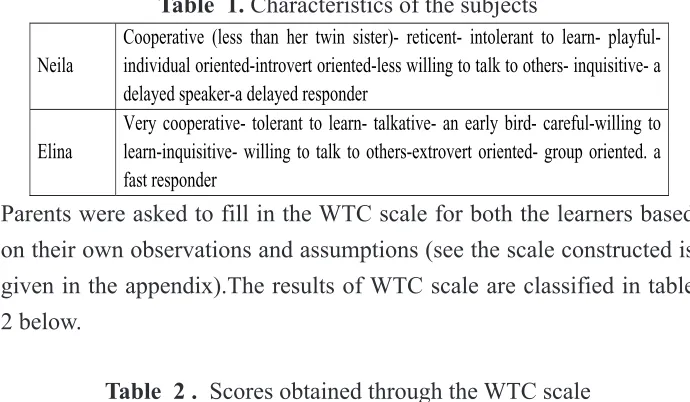
The learners’ parents were interviewed to find the relevant information about the learners’ characteristics and styles. The results are reported in table 1 below.
Table 1. Characteristics of the subjects
Parents were asked to fill in the WTC scale for both the learners based on their own observations and assumptions (see the scale constructed is given in the appendix).The results of WTC scale are classified in table 2 below.
Table 2 . Scores obtained through the WTC scale
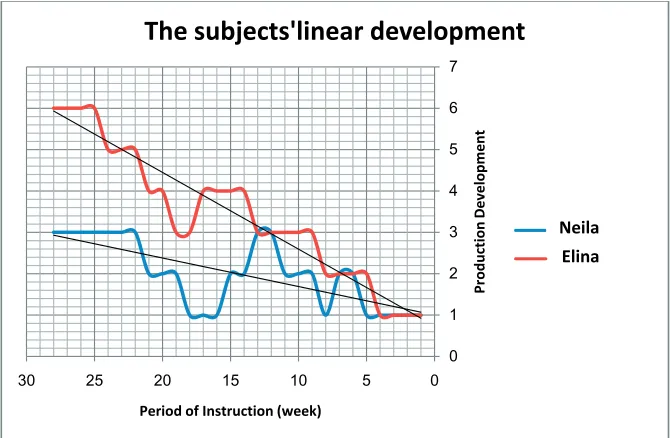
Classroom observations revealed how well the learners were developing their second language. They also showed how willing to communicate the subjects were. The results of both live classroom observations and films recorded are given in the table 3 below.
Willingness to Communicate in the Second...
In case mothers are familiar with English and/ or do not intend the class themselves only kid(s) will take part in the classroom but the mother also receives some instructions concerning how to help the kid(s) complete the teaching learning process.
Data Collection
The learners' parents were interviewed to find the relevant information about the learners' characteristics and styles. The results are reported in table 1 below.
Table 1. Characteristics of the subjects
Parents were asked to fill in the WTC scale for both the learners based on their own observations and assumptions (see the scale constructed is given in the appendix).The results of WTC scale are classified in table 2 below.
Table 2
Scores obtained through the WTC scale.
Classroom Family settings Iranian out of home context Foreign countries
Stranger Acquaintance Total WTC
Elina(E.) 90 95 80 90 90 95 90.00
Neila(N.) 60 70 80 80 60 80 71.66
Classroom observations revealed how well the learners were developing their second language. They also showed how willing to communicate the subjects were. The results of both live classroom observations and films recorded are given in the table 3 below.
Table 3 Neila (the blue line) and Elina's (the brown line) development in L2
Neila
Cooperative (less than her twin sister)- reticent- intolerant to learn- playful- individual oriented-introvert oriented-less willing to talk to others- inquisitive- a delayed speaker-a delayed responder
Elina
Very cooperative- tolerant to learn- talkative- an early bird- careful-willing to learn-inquisitive- willing to talk to others-extrovert oriented- group oriented. a fast responder
help the kid(s) complete the teaching learning process.
Data Collection
The learners' parents were interviewed to find the relevant information about the learners' characteristics and styles. The results are reported in table 1 below.
Table 1. Characteristics of the subjects
Parents were asked to fill in the WTC scale for both the learners based on their own observations and assumptions (see the scale constructed is given in the appendix).The results of WTC scale are classified in table 2 below.
Table 2
Scores obtained through the WTC scale.
Classroom Family settings Iranian out of home context Foreign countries
Stranger Acquaintance Total WTC
Elina(E.) 90 95 80 90 90 95 90.00 Neila(N.) 60 70 80 80 60 80 71.66
Classroom observations revealed how well the learners were developing their second language. They also showed how willing to communicate the subjects were. The results of both live classroom observations and films recorded are given in the table 3 below.
Table 3 Neila (the blue line) and Elina's (the brown line) development in L2
Neila
Cooperative (less than her twin sister)- reticent- intolerant to learn- playful- individual oriented-introvert oriented-less willing to talk to others- inquisitive- a delayed speaker-a delayed responder
Elina
152 153 Table 3. Neila (the blue line) and Elina’s (the brown line)
development in L2
X axis stands for development in producing L2 from one word level=1, two words=2, sentence level=3, appropriate use of sentences=4, limited continuous speech=5, and understanding others’=6.
Y axis stands for the weeks from 1 to 28 equal to 7 months of instruction
6. Data Analysis
Looking at table 2 above, we come to know that Elina has recorded high degree of WTC in all the related factors assumed in the scale set. Her average is 90.00 which indicates that her WTC total score is 90 and she enjoys a 90 percent interest in communicating with others. When learner E’s language development in table 3 is considered again we can see that she has had a high progress in L2.
X axis stands for development in producing L2 from one word level=1, two words=2, sentence level=3, appropriate use of sentences=4, limited continuous speech=5, and understanding others'=6.
Y axis stands for the weeks from 1 to 28 equal to 7 months of instruction.
Data Analysis
Looking at table 2 above, we come to know that Elina has recorded high degree of WTC in all the related factors assumed in the scale set. Her average is 90.00 which indicates that her WTC total score is 90 and she enjoys a 90 percent interest in communicating with others. When learner E's language development in table 3 is considered again we can see that she has had a high progress in L2.
Table 2 also indicates that Neila's total WTC score is 71.66 which reveals that she is not so willing to communicate as her sister Elina is. Considering table 3 we can understand that Neila's L2 development has remained in the sentence level and she has not been able to improve her L2 skills and reach beyond the sentence levels of L2 production.
The analyses of interview sessions (table 1.) also indicates that Elina is careful, inquisitive, cooperative, extrovert and group oriented, while Neila is almost introvert, reticent, less careful, and a delayed responder. It can be concluded that Willingness to communicate and L2
0 1 2 3 4 5 6 7 0 5 10 15 20 25 30 Pr od uc ti on � Development
Period�of�Instruction�(week)
The
�
subjects'linear
�
development
L
2
development WTCElina
Table 2 also indicates that Neila’s total WTC score is 71.66 which reveals that she is not so willing to communicate as her sister Elina is. Considering table 3 we can understand that Neila’s L2 development has remained in the sentence level and she has not been able to improve her L2 skills and reach beyond the sentence levels of L2 production.
The analyses of interview sessions (table 1.) also indicates that Elina is careful, inquisitive, cooperative, extrovert and group oriented, while Neila is almost introvert, reticent, less careful, and a delayed responder. It can be concluded that Willingness to communicate and L2 development have indicated a high correlation in the present study.
7. Conclusion and Pedagogical Implications
The findings of the present study indicate that WTC is, to a high extent, a personality trait or construct which affects both L1 and L2 development in kids. It is also considered a socio- culturally oriented element which affects one’s communication in the second language.
The findings of the research could be employed in designing models of L2 teaching to the kids in kindergartens and language learning institutes. In case we focus on the social aspect of WTC we might use the findings of the research to provide the learners with some scaffolding measures to get much more involved in the second language learning process. Enhancing one’s WTC might lead to his / her relative involvement in the SLA as well as his / her social life improvement.
Acknowledgement
Our sincere thanks go to the two unknown reviewers who meticulously covered the article and provided us with valuable insights.
The authors
Parviz Maftoon is associate Professor of teaching English at Islamic Azad University, Science and Research Branch, Tehran, Iran. He received his Ph.D. degree from New York University in 1978 in Teaching English to Speakers of Other Languages (TESOL). His primary research interests concern second language acquisition, SL/FL language teaching methodology, and language syllabus design. He has published and edited a number of research articles and books. He is currently on the editorial board of some language journals in Iran.
Technology in Education from University of Twente in the Nederland, he is currently dealing with completing his PhD in TEFL in Islamic Azad University: Research and Science Branch, Tehran, Iran. He is also founder and present director of TEFL Research Centre in Tehran, Iran.
References
Amiri, M. (2008).Mom and baby method in ELT.Peivand Journal, 12 (2), 23-29. Birjandi, P., &Amiri, M. (2011). Willingness to communicate in the first language acquisition: A case study on Iranian 2-year old kids. European Journal of Social Sciences, 23(1), 41-52.
Brown, H.D. (2007). Principles of language learning and teaching (5th ed.). New York: Pearson education, Inc.
Cao, Y., & Philp, J. (2006). International context and willingness to communicate: a comparison of behavior in whole class, group and dyadic interaction. System, 34, 480-493.
Chan, B., &McCroskey, A. C. (1987). Participation. Communication Research Report, 4(2), 47-50. Retrieved June 15, 2010, fromhttp://www.jamescmccroskey.com/ publications/138.pdf.
Clément, R. (1980). Ethnicity, contact and communicative competence in a second language.In H. Giles, W.P. Robinson, & P. Smith (Eds.). Language: Social psychological perspectives (pp.147-54). Oxford: Pergamon Press.
Clement, R., Baker, S., &MacIntyre, P.D. (2003).Willingness to communicate in a second language: The Effects of Context, Norms, and Vitality. Journal of Language and Social Psychology, 22 (2), 190-209.
Crookes, G., & Schmidt, R. W. (1991). Motivation: Reopening the research agenda.
Language Learning,41, 469–512.
Dornyei, Z. (1994). Motivation and motivating in the foreign language classroom.
Modern Language Journal, 78, 273–284.
Dornyei, Z. (2005). The psychology of language learner: Individual differences in second language acquisition. Mahwa, N.J.: Lawrence Erlbaum.
performance. Language Teaching Research, 4, 275-300.
Ellis, R. (2008). The study of second language acquisition (2nded.). Oxford. Oxford
University Press.
Gardner, R.C. (1988). The socio-educational model of second-language learning: assumptions, findings, and issues. Language Learning, 38, 101-126.
Gardner, R.C. & Tremblay, P.F. (1994).On motivation, research agendas, and theoretical frameworks. Modern Language Journal, 78, 359-68.
Kang, S.J. (2005). Dynamic emergence of situational willingness to communicate in a second language. System, 33, 277–292.
Krashen, S. (1981). Second Language Acquisition and Second Language Learning.Oxford: Pergamon Press.
MacIntyre, P.D., Baker, S., Clement, R., & Conrad, S. (2001).Willingness to communicate, social support, and language learning orientations of immersion students. Studies in Second Language Acquisition, 23, 369-388.
MacIntyre, P. D., Clement, R., Dornyei, Z., & Noels, K.A. (1998). Conceptualising willingness to communicate in a L2: A situational model of L2 confidence and affiliation. Modern Language Journal, 82, 545–562.
MacIntyre, P. D. (2007). Willingness to communicate in the second language: Understanding the decision to speak as a volitional process. The Modern Language Journal, 91, 564–576.
Matsuoka, R. (2004). Willingness to communicate among Japanese college students. Journal of Nurse Studies, 2, 151-160. Retrieved January15, 2011, from www.paaljapan.org/resources/proceedings/PAAL10/.../matsuoka. pdf
Matsuoka, R., & Evans, D.R. (2005).Willingness to communicate in the second language.Journal of Nursing Studies, 4, 3-12. Retrieved January15, 2011, from www.ncn.ac.jp/04_for_medical/kiyo/ar/2005jns-ncnj. pdf
McCroskey, J. C., & Baer, J. E. (1985).Willingness to communicate: The construct and it measurement (Non Journal Document No. 1985-11-00). Paper presented at the Annual Meeting of the Speech Communication Association (71st, Denver, CO, November 7-10, 1985).Denver, CO.( ERIC Document Service No. ED265604). McCroskey, J. C. (1992). Reliability and validity of the willingness to communicate scale. Communication Quarterly, 40, 16–25.
McCroskey, J. C., Fayer, J., & Richmond, V. P. (1985). Don’t speak to me in English: Communication apprehension in Puerto Rico. Communication Quarterly, 33, 185– 192.
McCroskey, J.C., Gudykunst, W.B., & Nishida, T. (1985). Communication apprehension among Japanese students in native and second langue. Communication Research Reports, 2, 11-15. European Journal of Social Sciences. Volume 23, Number 1(2011). McCroskey, J. C., & Richmond, V. P. (1987).Willingness to communicate.In J. C. McCroskey & J. A. Daly (Eds.), Personality and interpersonal communication (pp. 119–131). Newbury Park, CA: Sage.
Noels, K. A. (2005). Orientations to learning German: Heritage language background and motivational processes. Canadian Modern Language Review, 62,285–312.
Oxford, R.L. (Ed.). (1996). Language Learning Motivation: Pathways to the new century. Honolulu: University of Hawaii Press.
Oxford, R.L. &Shearin, J. (1996). Language learning motivation in a new key.In Oxford R.L. (Ed.).Language learning motivation: Pathways to the new century (pp.121-44). Honolulu: University of Hawaii Press.
Scovel, T. (1978). The effect of affect on foreign language learning: A review of the anxiety research. Language Learning, 28, 129-42.
Schumann, J., Crowell, S., Jones, N., Lee, N., Scuchert, S., & Wood, A. (2004).The neurobiology of learning: Perspectives from second language acquisition.Mahwah, NJ: Erlbaum.
Van Lier, L. (1996). Interaction in the language curriculum: awareness, autonomy, authenticity. London: Longman.
Williams, M. & Burden, R.L. (1997). Psychology for language teachers: A social constructivist approach. Cambridge: Cambridge University Press.
Yashima, T. (2002).Willingness to communicate in a second language: The Japanese EFL context. Modern Language Journal, 86, 54–66.
Appendix I. McCroskey’s WTC scale
Source: http://www.jamescmccroskey.com/measures/WTC.htm
Willingness to communicate is the most basic orientation toward communication. Almost anyone is likely to respond to a direct question, but many will not continue or initiate interaction. This instrument measures a person’s willingness to initiate communication. The face validity of the instrument is strong, and results of extensive research indicate the predictive validity of the instrument. Alpha reliability estimates for this instrument have ranged from .85 to well above .90. Of the 20 items on the instrument, 8 are used to distract attention from the scored items. The twelve remain items generate a total score, 4 context-type scores, and 3 receiver-type scores. The sub-scores generate lower reliability estimates, but generally high enough to be used in research studies.
Directions: Below are 20 situations in which a person might choose to communicate
or not to communicate. Presume you have completely free choice. Indicate the percentage of times you would choose to communicate in each type of situation. Indicate in the space at the left of the item what percent of the time you would choose to communicate. (0 = Never to 100 = Always)
1. Talk with a service station attendant. 2. Talk with a physician.
3. Present a talk to a group of strangers.
4. Talk with an acquaintance while standing in line. 5. Talk with a salesperson in a store.
6. Talk in a large meeting of friends. 7. Talk with a police officer.
8. Talk in a small group of strangers. 9. Talk with a friend while standing in line. 10. Talk with a waiter/waitress in a restaurant. 11. Talk in a large meeting of acquaintances. 12. Talk with a stranger while standing in line. 13. Talk with a secretary.
14. Present a talk to a group of friends. 15. Talk in a small group of acquaintances. 16. Talk with a garbage collector.
17. Talk in a large meeting of strangers. 18. Talk with a spouse (or girl/boyfriend). 19. Talk in a small group of friends.
20. Present a talk to a group of acquaintances.
Scoring:
Context-Type Sub-Scores
Group Discussion: Add scores for items 8, 15, & 19; then divide by 3. Meetings: Add scores for items 6, 11, 17; then divide by 3.
Receiver-Type Sub-Scores
Stranger: Add scores for items 3, 8, 12, 17; then divide by 4. Acquaintance: Add scores for items 4, 11, 15, 20; then divide by 4. Friend: Add scores for items 6, 9, 14, 19; then divide by 4.
To compute the total WTC score, add the sub scores for stranger, acquaintance, and friend. Then divide by 3.
All scores, total and sub-scores, will fall in the range of 0 to 100
Norms for WTC Scores
Group discussion >89 High WTC, <57 Low WTC Meetings >80 High WTC, <39 Low WTC
Interpersonal conversations >94 High WTC, <64 Low WTC Public Speaking >78 High WTC, <33 Low WTC
Stranger >63 High WTC, <18 Low WTC Acquaintance >92 High WTC, <57 Low WTC Friend >99 High WTC, <71 Low WTC
Total WTC >82 High Overall WTC, <52 Low Overall WTC
Appendix II
Willingness to Communicate Scale for Kids in SLA
Directions: Below are 20 situations in which a kid might choose to communicate or not
to communicate. Presume your kid has completely free choice. Indicate the percentage of time s/he would choose (chooses) to communicate in each type of situation. Indicate in the space at the left what percent of the time s/he would choose to communicate. 0=Never; 25=Rarely; 50= Sometimes; 75= Often; 100= Always
---1.S/he talks with the teacher very willingly. ---2. S/he talks with the new teacher.
---3. S/he talks with her/his nurse (baby sitter) in English. ---4. S/he talks with taxi drivers.
---5. S/he talks with shopkeepers. ---6. S/he talks with his / her uncle (aunt). ---7. S/he talks with his / her cousins. ---8. S/he talks with the neighbors’ kids. ---9. S/he talks with other kids in the playhouse. ---10. S/he talks with her/ his classmate(s). ---11. S/he talks with her/ his physician.
---12. S/he talks with the passerby patting him/ her.
---13. S/he talks with the stewardess in the airplane speaking in English. ---14. S/he talks with the lady/man asking him /her about his/ her age in English.
---15. S/he talks with other kids speaking English. ---16. S/he talks with other kids speaking Farsi.
---17. S/he talks with her/ his sister / brother in English when they are left alone.
Scoring:
Classroom: 1+2+10; divided by 3.
Family settings: 3+6+7+17+20; divided by 5.
Iranian out of home context: 4+5+ 8+9+11+12+16+18; divided by 9.
Foreign countries: 13+14+15+19; divided by 4.
Stranger: 2+4+5+8+12+13+14+15+18+19; divided by 10.
Acquaintance: 1+3+7+10+11+17+20; divided by 7.