
MUSEUMS AND EVOLUTION
Changing Museum Visitors
’
Conceptions of Evolution
Amy N. Spiegel&E. Margaret Evans&Brandy Frazier&
Ashley Hazel&Medha Tare&Wendy Gram&
Judy Diamond
Published online: 12 April 2012
#Springer Science+Business Media, LLC 2012
Abstract We examined whether a single visit to an evolu-tion exhibievolu-tion contributed to conceptual change in adult
(n030), youth, and child (n034) museum visitors’
reason-ing about evolution. The exhibition included seven current research projects in evolutionary science, each focused on a different organism. To frame this study, we integrated a
developmental model of visitors’ understanding of
evolu-tion, which incorporates visitors’ intuitive beliefs, with a
model of free-choice learning that includes personal, socio-cultural, and contextual variables. Using pre- and
post-measures, we assessed how visitors’ causal explanations
about biological change, drawn from three reasoning pat-terns (evolutionary, intuitive, and creationist), were modified as a result of visiting the exhibition. Whatever their age, background beliefs, or prior intuitive reasoning patterns, visitors significantly increased their use of explanations from the evolutionary reasoning pattern across all measures and extended this reasoning across diverse organisms. Visitors
also increased their use of one intuitive reasoning pattern, need-based (goal-directed) explanations, which, we argue, may be a step toward evolutionary reasoning. Nonetheless, visitors continued to use mixed reasoning (endorsing all three reasoning patterns) in explaining biological change. The personal, socio-cultural, and contextual variables were found to be related to these reasoning patterns in predictable ways. These findings are used to examine the structure of
visitors’reasoning patterns and those aspects of the
exhibi-tion that may have contributed to the gains in museum
visitors’understanding of evolution.
Keywords Museum visitors . Free-choice learning . Developmental model . Evolutionary reasoning . Exhibition
An understanding of evolution is a fundamental component of a broader goal, that of scientific literacy (National
The first two authors contributed equally to this manuscript.
A. N. Spiegel (*)
Center for Instructional Innovation, University of Nebraska-Lincoln, 215 Teachers College Hall, Lincoln, NE 68588-0384, USA e-mail: [email protected]
E. M. Evans
Center for Human Growth and Development, University of Michigan,
300 N. Ingalls Bldg,
Ann Arbor, MI 48109-5406, USA
B. Frazier
Department of Psychology, University of Hawaii at Manoa, 2430 Campus Road, Gartley Hall 110, Honolulu, HI 96822-2294, USA
A. Hazel
University of Michigan Museum of Natural History, 1109 Geddes Ave,
Ann Arbor, MI 48109-1079, USA
M. Tare
Department of Psychology, University of Virginia, P.O. Box 400400, Charlottesville, VA 22904, USA
W. Gram
National Ecological Observatory Network (NEON), Inc., 5340 Airport Road,
Boulder, CO 80301, USA
J. Diamond
Research Council 1996; American Association for the
Advancement of Science1994). Many scientific investigations
that affect our everyday lives utilize evolutionary reasoning, including research on cancer and HIV, the recently rapid evo-lution of antibiotic-resistant bacteria, and the impact of climate change. Yet many U.S. adults have little or no understanding of the mechanisms of evolutionary change (National Science
Board2012), and almost half of them do not accept
evolution-ary origins (Miller2001). Moreover, a significant proportion of
our public schools fail to include, limit content, or obscure
instruction on evolutionary theory (Catley 2006; Lerner
2000), with up to 20% of high school biology teachers includ-ing intelligent design or creationism as part of the science
curriculum (Moore and Kraemer2005). As many as 33% of
high school biology teachers are unsure of or do not accept evolution as a scientifically valid explanation for the state of
living organisms (Rutledge and Mitchell2002).
To move toward the goal of scientific literacy for its citizens, the U.S. must enhance and expand ways to include evolution in the educational system. New science discoveries and con-tinually changing technology mean that scientific literacy
involves learning across a lifetime (Miller2001). In addition
to formal educational settings, informal orfree-choice
educa-tional opportunities should be considered as part of the science
education framework (Bybee2001; St. John and Perry1993).
Free-choice learning environments play a significant role in teaching the public about evolution (Diamond and Scotchmoor 2006; Spiegel et al.2006), with one third of U.S. citizens reporting visiting a museum and 61% visiting some type of informal science venue in the past year (D’Elia and Jörgensen 2003; National Science Board2012). Increasing the overlap among museums, science centers, media outlets, and other informal learning sites with school-based education can
in-crease the depth and breadth of an individual’s science
knowl-edge (Bybee2001; Ramey-Gassert et al.1994).
Evolution is a critical science topic taught in both formal and informal environments, and understanding how learning takes place in both contexts can help guide future efforts to improve the public’s understanding of science. While
stu-dents’understanding of evolution topics in schools has been
the subject of considerable study (e.g., Banet and Ayuso 2003; Bishop and Anderson 1990; Brumby 1979; Greene 1990; Gregory 2009; Jiménez-Aleixandre 1994; Passmore
and Stewart 2002; Trowbridge and Wandersee 1994), how
free-choice learning about evolution takes place in informal environments remains an open question. Our focus, there-fore, is on adult and child museum visitors and the kinds of changes that occur in their understanding of evolution when they are exposed to an interactive exhibition on evolution. To frame this study, we integrate a developmental model of the general public’s understanding of evolution, developed
in earlier research (Evans 2000,2001, 2008; Evans, et al.
2010), with a model of free-choice learning.
Conceptual Framework: Museum Visitors’ Understanding of Evolution
Free-choice learning, which takes place in environments such as museums or science centers, differs from formal
learning in that it is “self-directed, voluntary, and guided
by individual needs and interests”(Falk and Dierking2002,
p. 9). Formal education, in contrast, has a given format, particular prerequisites, obligations, and constraints. Educa-tors working in environments designed for free-choice learning have recently begun more rigorous work to exam-ine and understand the learning that occurs in these settings. In the last decade, theoretical models on learning in muse-ums have incorporated personal, contextual, and socio-cultural variables to provide a framework within which to investigate and interpret learning in free-choice
environ-ments (Bell et al. 2009; Vadeboncoeur 2006). Moreover,
there is evidence to indicate that science learning in muse-ums is mediated by these identified variables (Adelman et al. 2000; Anderson et al. 2000; Bamberger and Tal 2007;
Falk and Storksdieck 2005; Falk and Adelman 2003). A
recent review of museum visitor studies on the topic of evolution, however, has found that most have not been framed theoretically but instead focused on elements such as visitor interest, visitor understanding of terms, and visitor
acceptance of evolutionary concepts (Spiegel et al. 2006).
These studies revealed that museum visitors are more accepting of evolution than is the general public (People
for the American Way 2000; Stein and Storksdieck 2005)
and are also more accepting of non-human evolution than
human evolution (Hayward et al. 1996; Pawlukiewicz et
al. 1990; Spiegel et al. 2006). In addition, these studies identified a high level of visitor interest in evolution topics
(Borun2002; Stein and Storksdieck2005). However, visitor
understanding of terms was limited and frequently contained misinformation indicating use of alternative
con-ceptions (Borun 2002; MacFadden et al. 2007; People,
Places, and Design Research 1992; Squire and Hubbell
Mackinney 1996).
The current study of visitor learning at an evolution exhibition is informed by a theoretical framework that includes elements of the free-choice learning models inte-grated within a constructivist model that incorporates the intuitive beliefs that visitors bring to the learning process
(Evans2008; Evans, et al.2010). While lack of acceptance
of evolution stems in part from strongly held religious
beliefs (Evans 2008; Mazur2005; Numbers 1992), lack of
understanding may also be explained by the intuitive rea-soning processes that both children and adults use to make
sense of everyday biological events (Evans 2000, 2001;
Gregory 2009; Sinatra et al. 2008). In the current paper,
appear early in childhood and that continue to exert their
influence on adult reasoning (Bloom and Weisberg 2007;
Evans2000, 2001,2008; Evans et al.2010). These
early-emerging intuitive reasoning patterns include the essentialist intuition that species are unique and stable, as well as the intuition that any changes within species are goal directed
and intentional (Keil 1994; Kelemen1999; Gelman 2003;
Mayr1982; Medin and Atran2004; Wellman and Gelman 1998). Evolutionary explanations are counterintuitive, prob-ably more so than most complex scientific explanations, because they challenge this commonsense understanding
of the natural world (Evans 2000, 2001, 2008; Sinatra et
al.2008). Natural phenomena, including living things, con-stantly change and, further, this change is neither purposeful nor directed toward a specific end-point.
In the conceptual model that we are utilizing, these intu-itive reasoning processes provide the foundation for reason-ing about evolutionary problems. Over time, these intuitions become interconnected with the system of beliefs, practices,
and values that comprise the socio-cultural practices that
are part of everyday experiences (Evans2000,2001). This
process shapes the beliefs that visitors bring to an exhibition on evolution. In the U.S., in particular, individuals are influenced by two potentially divergent cultural frame-works: Christian fundamentalist creationist beliefs that may support or even extend these intuitive reasoning pat-terns; and scientific models, which typically do not (Evans 2008; Evans et al.2010). Our theoretical model includes the intuitive beliefs of the museum visitor, the belief systems to which the visitor subscribes, the visitor’s personal interests, and the particular context of the museum exhibition in the
current study:“Explore Evolution.”
Explore Evolution Exhibition Description
“Explore Evolution”is an exhibition project funded by the National Science Foundation to increase public
understand-ing of evolution (Diamond and Evans2007; Diamond et al.
2012). It included the development of a permanent exhibit gallery, copies of which are currently installed at five muse-ums across the Midwest. Illustrating the mechanisms of evolution as well as descriptions of phylogenetic change, the exhibition focuses on seven current research projects in evolutionary science. These include work on the rapid evo-lution of HIV, the fossil record of the emergence of a new diatom species, farming ants and their coevolving partners, sexual selection in Hawaiian flies, changes in Galápagos finch populations, genetic links between humans and chimps, and the fossil discovery of walking whales. In
contrast to most natural history museum exhibitions,
“Ex-plore Evolution”illustrates contemporary research on
evolu-tion across diverse organisms, ranging from the microscopic
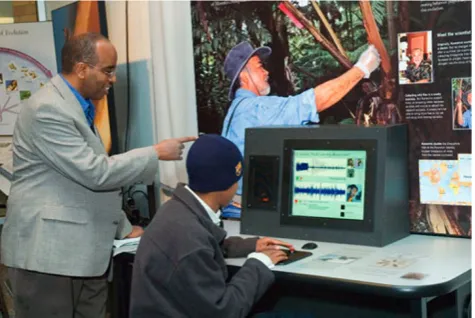
to the largest of all mammals, using interactive, hands-on exhibits that portray the activities and laboratory or field
settings of each of the featured scientists (see Fig.1 for an
example). The exhibition links these diverse studies by em-phasizing the interaction of four fundamental evolutionary
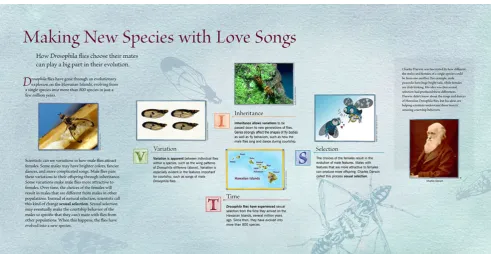
principles:variation, inheritance, selection,andtime(VIST).
The VIST conceptual framework (used with permission from the University of California Museum of Paleontology) served as a unifying theme throughout the exhibition, with specific information about how variation, inheritance, selec-tion, and time all play a role in the evolution of each
organism (see Fig. 2 for an example). Variation refers to
the genetic differences among individuals in a population; inheritancedescribes the process by which traits are passed
from parents to offspring; selectionis the process through
which those organisms with traits that are adaptive in their particular environment are more likely to live long enough
to have offspring; andtimeis the idea that evolution requires
successive generations before changes in a population can be observed. The VIST framework is a cognitive organizer designed to help visitors generalize these evolutionary prin-ciples across the diverse organisms in the exhibition.
The Current Study: Prior Research and Research Predictions
The current study was designed to assess the extent to which the“Explore Evolution”exhibition contributes to
conceptu-al change (Carey1985; Sinatra et al.2008; Vosniadou2008)
in visitors’reasoning about evolution. In previous research
(Evans2005; Evans et al.2010) prior to the installation of
the “Explore Evolution”exhibition, adult museum visitors were presented with scenarios describing changes in the seven organisms presented in the exhibition. Visitors were asked open-ended questions about how these changes
occurred. The interviewers refrained from mentioning evo-lution as a possible mechanism. For example, participants were told that the first few fruit flies arrived on the Hawaiian Islands several million years ago and now there are 800 different species, and then asked explain how this happened. The explanations given by the museum visi-tors in their responses to each of the seven evolutionary problems were transcribed and coded. Of particular in-terest was whether museum visitors would spontaneously invoke evolutionary ideas. Responses that included themes from the intuitive reasoning patterns, described earlier, were
categorized as intuitive or novice naturalistic reasoning;
responses that included themes from the Darwinian model (such as the VIST Framework) were categorized as
evolution-ary or informed naturalistic reasoning; whereas those that
expressed supernatural concepts were categorized as using creationist reasoning.
In this initial study, it was found that even in a sample of well-educated museum-going adults, not one visitor invoked the evolutionary reasoning pattern for all seven organisms, and overall, just over a third of the sample (38%) demonstrated a reasonable grasp of evolutionary concepts. All of the participants combined intuitive and evolutionary reasoning patterns, while a minority also used creationist reasoning. Mammals and birds were more likely than microorganisms or invertebrate species to in-voke the evolutionary reasoning pattern. Twenty-eight percent endorsed creationist explanations for human ori-gins, although only six percent were consistently creation-ist across all seven organisms.
This foundational study provided evidence for the argu-ment that intuitive cognitive biases found in early childhood persist in adulthood, even in well-educated populations interested enough in natural history to visit museums. An example of an essentialist bias was found in the refusal to acknowledge that biological change of this magnitude occurred: New species could not have emerged
from ancestral forms (Evans et al. 2010). Reminiscent of
similar explanations found in children’s responses (Evans 2000, 2001), some adults would use what is called prox-imate-cause reasoning, proposing instead that the appar-ently new organism had always existed and could be found someplace else.
In the same study, a distinction was drawn between two kinds of goal-directed or teleological explanations (Evans 2000; Southerland et al. 2001): (1) desire- or want-based explanations, which imply that the organism has free will and can intentionally change its body parts to adapt to the
environment, such as,“the animal changes because itwants
(desires) to,”and (2) need-based explanations:“the animal
changes because itneedsto.”The latter may cite or
impli-cate an animal’s intrinsic needs—that the changes are deemed necessary for survival—without referencing
con-scious mental states such as desire (Evans et al. 2010).
change (Evans2000). In contrast, adults are more likely to
use need-based explanations (Evans et al.2010). Typically,
individuals who endorse either of these explanations de-scribe species change in terms of individual change (Bishop
and Anderson 1990). The rabbit, for example, acquires
white fur because it needs to or wants to hide from preda-tors, subsequently passing on this acquired trait to future generations. Pre-existing variability within species is ig-nored. In this way, the essentialist intuition that each kind (or species) has an immutable essence is maintained. In contrast, Darwinian evolutionary concepts challenge these intuitions: species are ever-changing, and while those changes are sometimes adaptive, they are not directed toward the goal of surviving in a particular environment.
In the current study, the research questions focused on how museum visitors might change their reasoning patterns
as a result of a naturalistic visit to the“Explore Evolution”
exhibition. Although museum-goers are less likely to be creationist than the population at large (Spiegel et al. 2006), they are not, as described above, well informed about
evolution (Evans et al. 2010; Macfadden et al. 2007). As
such, they provide a useful population to assess which aspects of evolutionary thinking, if any, are absorbed in a single visit to an evolution exhibition. The current focus,
therefore, is on measuring incremental change in visitors’
reasoning patterns.
As well as examining change in the use of evolutionary explanations, we were particularly interested in whether exposure to the exhibit would result in a decrease of one or both intuitive explanations: need-based and desire-based reasoning. This study uniquely assessed this relationship using closed-ended questions, providing a more accurate measure of change than can be obtained with open-ended questions, such as those used in the earlier study (Evans et al. 2010). This measure gave visitors the opportunity to endorse one or both explanations independently of each other, which permits a more nuanced analysis of their rela-tionship. If, as suggested by the earlier pattern of findings as well more recent work with younger children (Legare et al. 2012), need-based (but not want-based) reasoning acts as a “bridge”to evolutionary understanding (Evans et al.2010, p. 348), then it should be positively associated with evolu-tionary reasoning and either remain stable or increase from pre- to post-assessment. In addition, we examined the differ-ences between child and adult reasoning patterns and the relationship among the socio-cultural, personal, and contex-tual variables included in the study. Three instruments were used: (1) a closed-ended questionnaire based on themes that emerged in an analysis of the open-ended questions in the earlier study, described above (2) a subset of items from the earlier open-ended instrument, and (3) measures of visitors’ beliefs, personal and demographic variables, and time spent at and interest in the exhibition.
Based on the earlier study (Evans et al. 2010) we
expected to find that most museum visitors’ explanations
of evolutionary processes would comprise a mixture of different reasoning patterns. In particular, we predicted that as a function of exposure to the exhibition (1) use of the evolutionary reasoning pattern would increase. Further-more, we predicted (2) a disassociation between the three intuitive explanations, with desire-based and proximate cause, but not need-based (goal-directed) reasoning,
de-creasing. In addition, we predicted (3) that visitors’beliefs,
in particular, whether they endorsed a creationist or an evolutionist perspective, would influence their receptivity
to the exhibition material, with creationistreasoners being
the least likely to change. Finally, we predicted (4) that the age of the visitor would influence receptivity to the materi-als, with child visitors being more likely to endorse intuitive and creationist reasoning patterns and older visitors more likely to endorse evolutionary reasoning patterns.
Methods
Participants
Participants were recruited by e-mail through the member-ship rosters of two Midwest natural history museums and a local children’s zoo, and offered $20 as compensation for the time spent on the study. Only volunteers who had not yet seen the exhibition were included in the sample, which was stratified to obtain approximately half youth respondents and half adult respondents, split by gender. Other than these criteria, visitors were randomly selected and scheduled to visit the museum exhibit and participate in the study. Each participant was independent and was not related to (in the same family unit as) any other participant. The instruments and all procedures were approved prior to
use by the participating universities’ Institutional Review
Boards. All participants gave their informed consent prior to their participation, which included audio-taping of the open-ended questions.
Sixty-four visitors (50% female and 50% male; 91% non-Hispanic white, six percent Asian American, and three percent other ethnicity) participated. Just over half the
sam-ple were children (11–13 years,n021, 33%) and youth (14–
18 years, n013, 20%). The remaining participants were
adults (19 years and older,n030, 47%). The education level
of the adult participants was high (ten percent some college, 43% 4-year college, and 47% graduate courses). Similarly, the children and youth participating had highly educated parents (six percent some college, 21% college graduates, and 68% graduate courses). A high percentage of visitors with college education or more is typical of science centers
Institution2006,2010). Only one adult participant, a biolo-gy lab technician, indicated a biolobiolo-gy background. The median number of museum visits in the last year reported by participants was three (range was 0–20).
Procedure
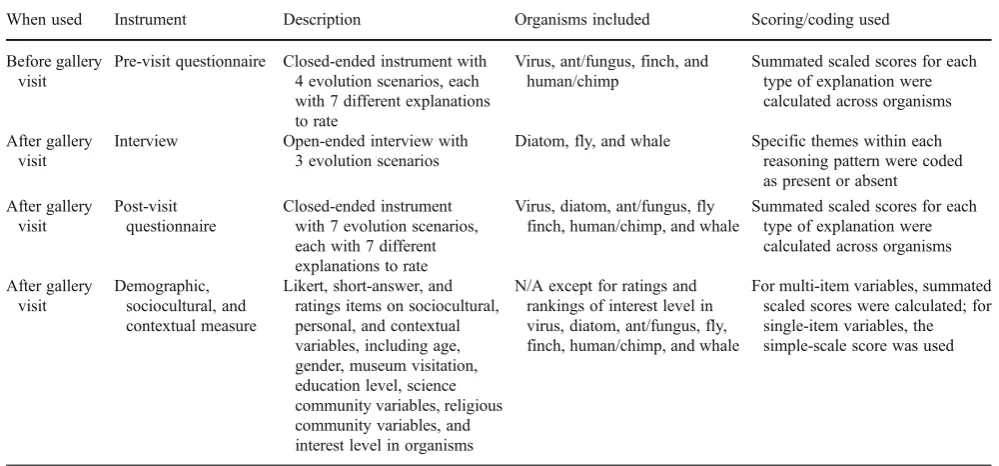
The study began with a pre-visit questionnaire, a closed-ended instrument with four evolution scenarios based on four of the seven organisms featured in the exhibition (finch,
virus, ant/fungus, and human/chimp) (see Table 1, for a
summary). Visitors were then asked to visit the exhibition and spend as much or as little time as they liked, and to
spend time as they would during a“normal museum visit.”
Every visitor in our study (except for two, who viewed the exhibit together), viewed the exhibition alone. The length of
the visits ranged from eight to 100 minutes (M034, SD0
20). When they finished their visit to the gallery, participants were asked three open-ended interview questions about the remaining three organisms featured in the exhibition: fly, diatom, and whale. They were then asked to complete the full seven-organism, post-visit closed-ended questionnaire. Finally, participants were asked to complete a questionnaire that included demographic, socio-cultural, and contextual measures.
Instruments
Open-ended Post-visit Interview QuestionsThe three inter-view questions in the current study were taken from the open-ended instrument used in an earlier study (Evans et al.2010), which examined the reasoning of natural history
museum visitors who were not told that the scenarios were about evolution. Each evolutionary scenario focused on one of the core research questions addressed by the scien-tists featured in the exhibition. Only three of the seven organisms in the exhibition were included in the open-ended questions in the current interview because of the design of the pre- and post-visit questionnaires (see below). The fly, diatom, and whale were chosen because they represented a range in size of organism and also a range
in familiarity (Evans et al. 2010). Visitors’ responses to
these three open-ended questions will be compared with the quantitative results and also used to examine develop-mental differences.
Closed-ended Questionnaire Development The question-naire was based directly on the open-ended interview
instru-ment described above (Evans et al.2010), using virtually the
same questions, but in a closed-ended format (seeAppendix
A for list of questions). Each of the seven evolutionary
scenarios used in the questionnaire focused on a different organism or pair of organisms (whale, human/chimp, finch, fly, ant/fungus, diatom, and virus) with a picture of the organisms. Visitors were asked to rate their level of agree-ment with each of seven explanations for each problem, presented in a randomized order across scenarios. The explan-ations themselves and the language used in the explanexplan-ations were both derived from the most prevalent themes in visitors’ responses to the earlier open-ended questions (Evans et al. 2010) and the kind of language visitors in that study
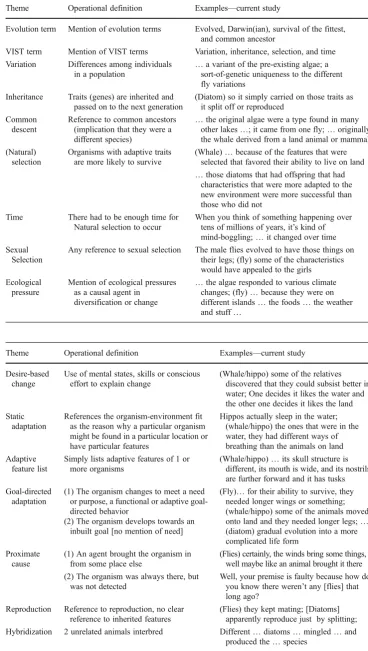
used to explain the problems (see Tables 2 and 3 for
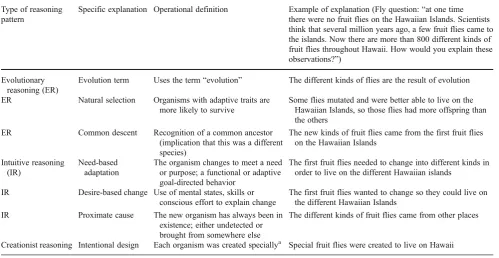
definitions and examples). Of the seven explanations, three
focused on evolutionary reasoning (evolution term,
Table 1 Instruments used in the study
When used Instrument Description Organisms included Scoring/coding used
Before gallery visit
Pre-visit questionnaire Closed-ended instrument with
4 evolution scenarios, each with 7 different explanations to rate
Virus, ant/fungus, finch, and human/chimp
Summated scaled scores for each type of explanation were calculated across organisms
After gallery visit
Interview Open-ended interview with
3 evolution scenarios
Diatom, fly, and whale Specific themes within each
reasoning pattern were coded as present or absent After gallery
visit
Post-visit questionnaire
Closed-ended instrument with 7 evolution scenarios, each with 7 different explanations to rate
Virus, diatom, ant/fungus, fly finch, human/chimp, and whale
Summated scaled scores for each type of explanation were calculated across organisms
After gallery visit
Demographic, sociocultural, and contextual measure
Likert, short-answer, and ratings items on sociocultural, personal, and contextual variables, including age, gender, museum visitation, education level, science community variables, religious community variables, and interest level in organisms
N/A except for ratings and rankings of interest level in virus, diatom, ant/fungus, fly, finch, human/chimp, and whale
Table 2 Evolutionary reasoning pattern: themes, definitions, and examples
Theme Operational definition Examples—current study
Evolution term Mention of evolution terms Evolved, Darwin(ian), survival of the fittest,
and common ancestor
VIST term Mention of VIST terms Variation, inheritance, selection, and time
Variation Differences among individuals
in a population
…a variant of the pre-existing algae; a
sort-of-genetic uniqueness to the different fly variations
Inheritance Traits (genes) are inherited and
passed on to the next generation
(Diatom) so it simply carried on those traits as it split off or reproduced
Common descent
Reference to common ancestors (implication that they were a different species)
…the original algae were a type found in many
other lakes…; it came from one fly;…originally
the whale derived from a land animal or mammal (Natural)
selection
Organisms with adaptive traits are more likely to survive
(Whale)…because of the features that were
selected that favored their ability to live on land
…those diatoms that had offspring that had
characteristics that were more adapted to the new environment were more successful than those who did not
Time There had to be enough time for
Natural selection to occur
When you think of something happening over
tens of millions of years, it’s kind of
mind-boggling;…it changed over time
Sexual Selection
Any reference to sexual selection The male flies evolved to have those things on
their legs; (fly) some of the characteristics would have appealed to the girls Ecological
pressure
Mention of ecological pressures as a causal agent in
diversification or change
…the algae responded to various climate
changes; (fly)…because they were on
different islands…the foods…the weather
and stuff…
Table 3 Intuitive reasoning pattern: themes, definitions, and examples
Theme Operational definition Examples—current study
Desire-based change
Use of mental states, skills or conscious effort to explain change
(Whale/hippo) some of the relatives discovered that they could subsist better in water; One decides it likes the water and the other one decides it likes the land Static
adaptation
References the organism-environment fit as the reason why a particular organism might be found in a particular location or have particular features
Hippos actually sleep in the water; (whale/hippo) the ones that were in the water, they had different ways of breathing than the animals on land Adaptive
feature list
Simply lists adaptive features of 1 or more organisms
(Whale/hippo)…its skull structure is
different, its mouth is wide, and its nostrils are further forward and it has tusks Goal-directed
adaptation
(1) The organism changes to meet a need or purpose, a functional or adaptive goal-directed behavior
(Fly)…for their ability to survive, they
needed longer wings or something; (whale/hippo) some of the animals moved
onto land and they needed longer legs;…
(diatom) gradual evolution into a more complicated life form
(2) The organism develops towards an inbuilt goal [no mention of need]
Proximate cause
(1) An agent brought the organism in from some place else
(Flies) certainly, the winds bring some things, well maybe like an animal brought it there (2) The organism was always there, but
was not detected
Well, your premise is faulty because how do
you know there weren’t any [flies] that
long ago?
Reproduction Reference to reproduction, no clear
reference to inherited features
(Flies) they kept mating; [Diatoms] apparently reproduce just by splitting;
Hybridization 2 unrelated animals interbred Different…diatoms…mingled…and
natural selection,andcommon descent) and three on intuitive
reasoning (need-based adaptation, desire-based change,and
proximate cause).The final explanation reflected one type of
creationist reasoning (intentional design) (see Table4, for an
example, for the fly).
Because visitors’reasoning in the earlier study was often
found to be mixed (including two or more themes from different reasoning patterns), the items in this questionnaire were designed so that respondents could choose to agree or disagree with each explanation, independently of the others
(see Table 4; Appendix A). The survey instrument was
reviewed by biologists, museum educators, and cognitive psychologists, and piloted on a sample of adults and youth before final revisions were made.
Closed-ended Instrument: Pre- and Post-visit Visitors used a five-point Likert scale to rate their level of agreement with each of the seven explanations for each of the seven scenar-ios (49 rating items altogether). For each explanation, we created an explanation measure by combining the same explanation items across all seven organisms. For example, the means of the evolution term explanation item for all seven organisms were averaged to create a composite variable
calledevolution term. Summating the items to create scales
provides a more reliable and valid way to measure the con-structs than a single item; and parametric statistics, which we use with the rating scale data, have been shown to be robust
and appropriate for this application (Norman 2010).
Cron-bach’s alphas were calculated for each of the seven measures on the post-test. Overall alphas were between 0.80 and 0.95, and all individual items within the explanation measures were identified as contributing to the scales. Generally, a reliability
coefficient of 0.70 is considered acceptable (Nunnally1978).
Each of these seven summated rating scales was measured independently of each other, hence every participant had seven unique scores, one for each type of explanation, repre-senting the extent that explanation was endorsed across the seven evolution scenarios.
A subset of the full questionnaire, consisting of the questions for four (finch, virus, ants/fungus, and human/ chimp) of the seven organisms, was used as the pre-visit
closed-ended questionnaire (see Table1). This was done to
minimize the total time that participants spent on the study and to avoid alerting the participants to our interest in all of the organisms. In addition to reducing potential priming effects, this design also enabled a pre-post analysis across the four organisms used in the closed-ended questions from the post-visit questionnaire, which included all the
organ-isms (see Table1). In the post-visit questionnaire, all seven
question sets were presented in a fixed order (the human/ chimp question was last), with the four pre-visit question sets intermixed with the three sets not included in the pretest. Using a closed-ended pre- and post-design com-bined with a small number of open-ended items limited
Table 4 Closed-ended instrument: explanations and examples of items
Type of reasoning pattern
Specific explanation Operational definition Example of explanation (Fly question:“at one time
there were no fruit flies on the Hawaiian Islands. Scientists think that several million years ago, a few fruit flies came to the islands. Now there are more than 800 different kinds of fruit flies throughout Hawaii. How would you explain these
observations?”)
Evolutionary reasoning (ER)
Evolution term Uses the term“evolution” The different kinds of flies are the result of evolution
ER Natural selection Organisms with adaptive traits are
more likely to survive
Some flies mutated and were better able to live on the Hawaiian Islands, so those flies had more offspring than the others
ER Common descent Recognition of a common ancestor
(implication that this was a different species)
The new kinds of fruit flies came from the first fruit flies on the Hawaiian Islands
Intuitive reasoning (IR)
Need-based adaptation
The organism changes to meet a need or purpose; a functional or adaptive goal-directed behavior
The first fruit flies needed to change into different kinds in order to live on the different Hawaiian islands
IR Desire-based change Use of mental states, skills or
conscious effort to explain change
The first fruit flies wanted to change so they could live on the different Hawaiian Islands
IR Proximate cause The new organism has always been in
existence; either undetected or brought from somewhere else
The different kinds of fruit flies came from other places
Creationist reasoning Intentional design Each organism was created speciallya Special fruit flies were created to live on Hawaii
a
pretest priming effects and still provided qualitative data with additional, descriptive information.
Demographics, Beliefs, Sociocultural, and Personal Variables: Post-visitThe post-visit measures included demographic variables, such as age, education level and occupation,
and Likert scale measures of visitors’ beliefs. For the
religious community, these were: (1) religiosity (how important is religion in your life?) and (2) compatibility of the participant’s religion with evolution. For the sci-ence community, these were: (1) acceptance of evolu-tionary origins for three types of organisms: insects, birds, and humans (three items averaged into a composite
scale; Cronbach’s alpha00.91), and (2) importance of
scientists’studying evolution.
In addition, personal variables included: (1) self-assessed knowledge of evolution, and (2) the importance of one’s own understanding of evolution. Finally, contextual varia-bles relating to the museum visit itself included two meas-ures of engagement: (1) interest level in the different organisms at the exhibition (composite scale of ratings) and (2) number of minutes spent at the exhibition. Given the controversial nature of the exhibition, we wanted to avoid potentially intrusive visitor tracking measures, and we also reasoned that these measures of engagement would be a good proxy for any tracking measures.
Qualitative Coding Summary: HIV, Fly, and Whale Res-ponses to the open-ended interview questions on the three organisms (HIV, fly, and whale) were recorded and tran-scribed. The coding and content analyses used for the inter-view responses were those used in the prior study (see
Evans et al.2010for details). Coding of the conceptual units
within each response was based on a coding scheme com-prised of three reasoning patterns discussed earlier: evolu-tionary reasoning (ER), intuitive reasoning (IR), and creationist reasoning (CR). As was done in the earlier study, for each response to each question, specific themes within these reasoning patterns were coded as present (1) or absent
(0). Participants’ responses for each organism were coded
individually by experienced raters, with 75% of the responses coded by two raters. Initial inter-rater reliability was 93%, and following resolution of discrepancies, the final inter-rater reliability was 100%.
Results
This section will be presented in three sections: (1) closed-ended questionnaire data: pre- to post-visit changes, (2) qualitative interview data: post-visit, and (3) relationships between socio-cultural variables and endorsement of the three reasoning patterns.
Closed-ended Questionnaire: Pre-Visit to Post-Visit Change for Four Organisms
Virus, Finch, Ant/Fungus, and Human/Chimp: Overview of Analyses We examined the changes in the summated scale explanation measures from pre-visit to post-visit for the four organisms (virus, finch, ant, and human) included in both questionnaires. As explained earlier, the design of the closed-ended questionnaire resulted in separate summated scale scores for each of the seven explanations. In the
analyses, we first conducted one-tailed t tests to
exam-ine whether there were significant differences in the predicted direction, pre-visit to post-visit, for each of the explanation measures in the overall sample. To examine the role of age in these changes, participants were
grouped into three age categories and t tests conducted for
each age group separately.
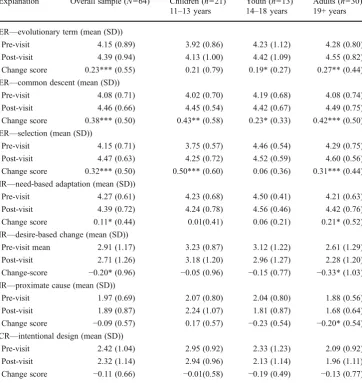
Pre- to Post-visit Change The overall pre-visit to post-visit changes across the sample in the seven explanation
meas-ures are presented in Table5. Significant change was found
for all three ER explanations (evolutionary term; common descent, and selection). To examine these changes more closely, the sample was broken down into three age-groups: children (11–13 years), youth (14–18 years), and adults (19 years and older). The youngest group is similar to age ranges previously studied in other investigations of evolutionary concepts, while the middle group is most likely to have been exposed to evolutionary ideas at school (Evans 2001,2005). While results from these smaller sample sizes must be interpreted with caution, they inform the nature of the change occurring across the sample. All significant changes in ER scores were in the predicted direction, indicat-ing that all three age groups increased their use of evolutionary reasoning. The scaled scores for the IR explanations were mixed. Endorsement of need-based adaptation explanations increased significantly for the group as a whole and for the adults, and endorsement of desire-based change decreased
overall and for the adults. TheCRintentional design
explan-ations showed a trend toward a decline, but these changes were not statistically significant.
cause explanations, but 45% increased endorsement of need-based adaptation. Creationist scores decreased for 45% of visitors.
Open-ended Interview Questions: Post-visit Pattern of Explanations for Three Organisms
Analyzing and coding the three open-ended interview ques-tions yielded qualitative data on the percentage of identified themes from each of the three reasoning patterns present in
respondents’explanations. These were examined across age
groups to investigate developmental differences. We fo-cused on the ER and IR patterns; coding for creationist reasoning will only be briefly reported, in part because we did not include an explicit creationist (God did it) explana-tion in the closed-ended quesexplana-tionnaire; therefore, there is no basis for comparison across the two kinds of measures.
Furthermore, in the earlier study (Evans et al. 2010),
creationist reasoning occurred mostly (28%) for the open-ended question on human/chimp evolution, which was not included in the present study. Consistent with the earlier study, however, six percent of the visitors utilized creationist reasoning for the whale and the fruit fly questions.
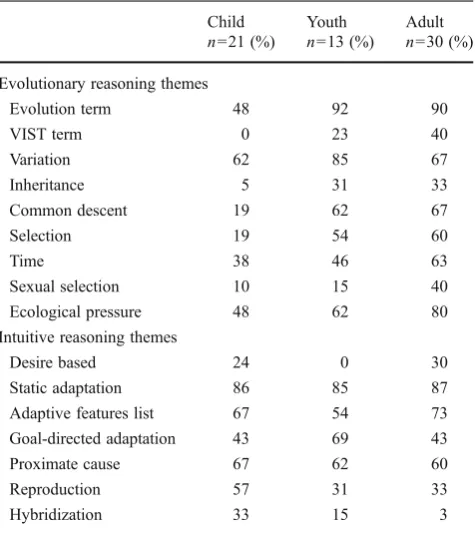
Table 6 shows the percentage of respondents by age
group who mentioned the different themes from the evolu-tionary and intuitive reasoning patterns for at least one organism. Across all the evolutionary reasoning pattern
themes (see Table 2 for themes and examples), the child
group had consistently lower percentages than either of the older groups. Use of an evolution term, the concepts of inheritance, common descent, and selection were all used by a greater proportion of both youth and adults than chil-dren. The concept of variation was used most frequently by the youth group, although a majority of respondents in all groups mentioned this ER theme. With respect to IR (see
Table3for themes and examples), results were mixed, again
providing converging evidence to support the findings from Table 5 Explaining
evolution-ary change: pre- and post-visit means and change scores across four organisms on closed-ended questionnaire for adult, youth, and child museum visitors
ERevolutionary reasoning, IRintuitive reasoning, CRcreationist reasoning *p≤0.05; **p<0.01; ***p<0.001
Explanation Overall sample (N064) Children (n021) Youth (n013) Adults (n030)
11–13 years 14–18 years 19+ years
ER—evolutionary term (mean (SD))
Pre-visit 4.15 (0.89) 3.92 (0.86) 4.23 (1.12) 4.28 (0.80)
Post-visit 4.39 (0.94) 4.13 (1.00) 4.42 (1.09) 4.55 (0.82)
Change score 0.23*** (0.55) 0.21 (0.79) 0.19* (0.27) 0.27** (0.44)
ER—common descent (mean (SD))
Pre-visit 4.08 (0.71) 4.02 (0.70) 4.19 (0.68) 4.08 (0.74)
Post-visit 4.46 (0.66) 4.45 (0.54) 4.42 (0.67) 4.49 (0.75)
Change score 0.38*** (0.50) 0.43** (0.58) 0.23* (0.33) 0.42*** (0.50)
ER—selection (mean (SD))
Pre-visit 4.15 (0.71) 3.75 (0.57) 4.46 (0.54) 4.29 (0.75)
Post-visit 4.47 (0.63) 4.25 (0.72) 4.52 (0.59) 4.60 (0.56)
Change score 0.32*** (0.50) 0.50*** (0.60) 0.06 (0.36) 0.31*** (0.44)
IR—need-based adaptation (mean (SD))
Pre-visit 4.27 (0.61) 4.23 (0.68) 4.50 (0.41) 4.21 (0.63)
Post-visit 4.39 (0.72) 4.24 (0.78) 4.56 (0.46) 4.42 (0.76)
Change score 0.11* (0.44) 0.01(0.41) 0.06 (0.21) 0.21* (0.52)
IR—desire-based change (mean (SD))
Pre-visit mean 2.91 (1.17) 3.23 (0.87) 3.12 (1.22) 2.61 (1.29)
Post-visit 2.71 (1.26) 3.18 (1.20) 2.96 (1.27) 2.28 (1.20)
Change-score −0.20* (0.96) −0.05 (0.96) −0.15 (0.77) −0.33* (1.03)
IR—proximate cause (mean (SD))
Pre-visit 1.97 (0.69) 2.07 (0.80) 2.04 (0.80) 1.88 (0.56)
Post-visit 1.89 (0.87) 2.24 (1.07) 1.81 (0.87) 1.68 (0.64)
Change score −0.09 (0.57) 0.17 (0.57) −0.23 (0.54) −0.20* (0.54)
CR—intentional design (mean (SD))
Pre-visit 2.42 (1.04) 2.95 (0.92) 2.33 (1.23) 2.09 (0.92)
Post-visit 2.32 (1.14) 2.94 (0.96) 2.13 (1.14) 1.96 (1.11)
the quantitative study (see Table 6). Static adaptation, the simple listing of adaptive features, and proximate causes were themes mentioned by a majority of respondents in all age groups. Reproduction and hybridization were men-tioned most frequently by the child group. Desire-based reasoning was not mentioned by a single youth, although about one quarter of both children and adults used this intuitive reasoning theme. The youth also differed from the other groups in their use of goal-directed adaptation, in which over two thirds of youth mentioned this theme while only 43% of children and adults did.
Relationships Between Sociocultural Variables and Endorsement of the Three Reasoning Patterns
Overview In addition to gathering demographic data, our measures also included sociocultural variables concerning
par-ticipants’beliefs about and attitudes toward science and
reli-gion. We first examined how participants responded to each of these measures, then we evaluated the intercorrelations between the measures. Finally, we investigated the extent to
which these sociocultural variables related to visitors’
reason-ing patterns. Pearson’s correlational coefficientrwas used in
the analyses with the summated scaled scores of the different explanations and sociocultural variables, including age, which was measured as a continuous variable. For comparisons with
ordinal data, Spearman’s rho was used.
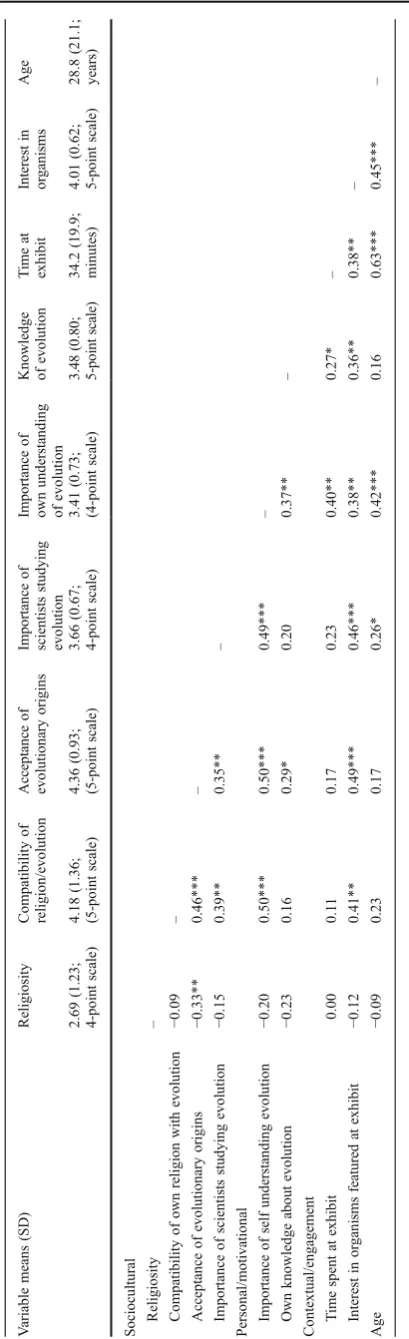
Relationship among the Sociocultural, Personal, and Contex-tual Variables The compatibility of religion with evolution variable was significantly positively related to the com-munity of science variables, importance of self under-standing evolution variable, and interest in the organisms
at the exhibition (see Table 7). The two community of
science variables were also significantly positively corre-lated with one another and with the importance of par-ticipants themselves understanding evolution. The personal/motivational variables were positively correlated with one another and with the two exhibition engagement variables.
Intercorrelations Among Post-visit Measures: Closed-Ended Questionnaire To examine the conceptual structure
underly-ing visitors’reasoning patterns, analyses of visitors’
post-visit scores on all seven organisms were conducted. Overall, visitors were much more likely to endorse the three ER explanations and the IR explanation of need-based
adapta-tion than any of the other explanaadapta-tions (see Table 8, for
means and standard deviations).
The pattern of intercorrelations among explanations revealed clusters of highly correlated explanations, which, we argue, correspond to distinct conceptual structures
with-in each of the different reasonwith-ing patterns (see Table8). The
three ER explanations were all positively correlated with one another. Of the three IR explanations, only desire-based change and proximate cause were positively related to each other. However, there was no correlation between desire-based change and need-desire-based adaptation. A negative corre-lation was found between proximate cause and need-based adaptation. Need-based adaptation (IR) was, however, pos-itively correlated with all three ER explanations while prox-imate cause (IR) was negatively related to all three ER explanations. Desire-based change (IR) was not related to any ER explanation. The CR explanation was significantly negatively correlated with all three ER explanations and positively correlated with two of the IR explanations, desire-based change and proximate cause, but not with need-based adaptation.
Visitors who agreed with the evolutionary reasoning explanations had some understanding of evolutionary pro-cesses. However, this understanding did not mean that they necessarily rejected intuitive explanations. Only one
third of those who “strongly agreed” with ER
explana-tions disagreed or strongly disagreed with IR explanaexplana-tions, again demonstrating the tenacity of intuitive reasoning explanations. To investigate whether there were any
visi-tors who did not exhibit mixed reasoning patterns, we
tried to identify visitors who strongly agreed with all the evolutionary reasoning explanations while strongly dis-agreeing with the intuitive and creationist explanations. Not one visitor did so.
Table 6 Percentage of study respondents by age group mentioning identified themes within the evolutionary and intuitive reasoning pat-terns in their open-ended explanations
Child
n021 (%)
Youth
n013 (%)
Adult
n030 (%)
Evolutionary reasoning themes
Evolution term 48 92 90
VIST term 0 23 40
Variation 62 85 67
Inheritance 5 31 33
Common descent 19 62 67
Selection 19 54 60
Time 38 46 63
Sexual selection 10 15 40
Ecological pressure 48 62 80
Intuitive reasoning themes
Desire based 24 0 30
Static adaptation 86 85 87
Adaptive features list 67 54 73
Goal-directed adaptation 43 69 43
Proximate cause 67 62 60
Reproduction 57 31 33
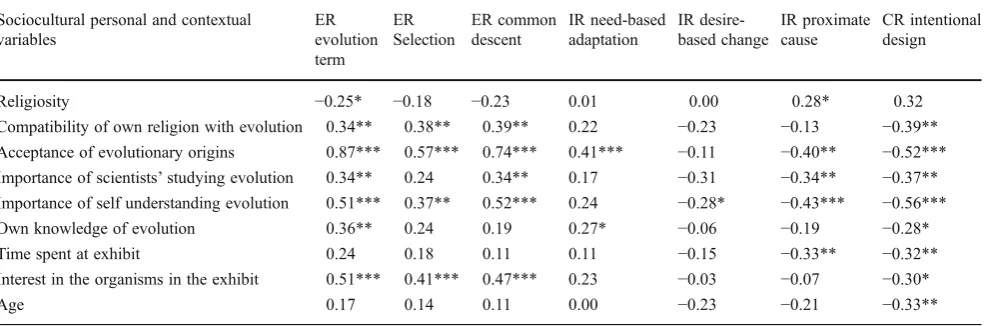
Post-visit Reasoning Patterns and the Sociocultural, Personal, and Contextual VariablesThe earlier analyses indicate that regardless of background, the majority of visitors in-creased their use of evolutionary reasoning post-visit. In the current analysis, the relationship between the
socio-cultural, personal and contextual variables and visitors’
overall reasoning patterns post-visit should give some insight into the impact of variables that were derived from the free-choice learning model incorporated into
this study (see Table 9).
The religiosity variable was negatively correlated with endorsement of the evolution term. The compati-bility of one’s religion and evolution variable was pos-itively correlated with all three ER explanations and negatively correlated with endorsement of the creationist variable. In contrast, the two community of science variables and the personal-motivational variables were positively related to the ER variables and negatively related to the IR proximate cause explanation and the CR intentional design explanation. Of the contextual variables, time spent at the exhibition was negatively correlated with IR proximate cause and CR intentional design. Age of participant was also negatively correlated with intentional design. This pattern of endorsement strongly indicates that our measures had robust con-struct and content validities.
We compared the nine percent of visitors who did not exhibit changes in their use of ER on the pre- versus post-visit questionnaire (no-change group) with the ten percent who exhibited the greatest increase in ER (change group). As described earlier, the no-change group was almost at ceiling on their ER ratings on the pre-visit questionnaire. Compared with the no-change group, those who increased their use of ER explanations had significantly higher ratings
on religiosity (F (1, 10)05.87, p<0.05) and significantly
lower ratings on the importance of scientists’studying
evo-lution (F (1, 10)05.00, p< 0.05) and on interest in the
organisms (F(1, 10)013.16,p<0.01).
Post-test Measures by Age Group Because of the prior research indicating developmental changes in reasoning
about evolution (Evans 2000, 2001, 2008), means on the
seven different reasoning patterns explanations were com-pared across three age groups: child, youth and adult. Means varied by age with some significant differences found between the child and adult groups. Children were significantly more likely to endorse the IR explanations of proximate
cause F(2, 61)04.68, p< 0.05 and desire-based change
F (2, 61)03.97, p<0.05, as well as the CR explanation of
intentional designF(2, 61)05.61,p<0.01. Children were also
significantly less likely to endorse the ER explanation of
selection F (2, 61)03.29, p<0.05. The youth group means
typically fell between the children’s and adults’.
General Discussion
These findings demonstrate that a single visit to an interactive exhibition on evolution effects positive though incremental
change in museum visitors’ understanding of evolution,
regardless of the beliefs, interests, or age of the visitor. Given the self-selection of the volunteer sample, this is an important finding. This study was undertaken to further our understanding of how an exhibition on evolution
might influence visitors’ reasoning. While museum visitors
are more likely than the population at large to be highly
educated and knowledgeable about science (Korn1995), they
still hold alternative conceptions, using intuitive and
creation-ist reasoning to explain evolutionary change (Evans2005,
2008; Macfadden et al. 2007). In keeping with our first research prediction, even though this sample of visitors in-creased their endorsement and expression of evolutionary
ideas, they still maintained some aspects of the intuitive rea-soning patterns that they held prior to the visit, albeit at lower levels of endorsement.
Evolution is a controversial topic that is misunderstood by many U.S. citizens. While it is unlikely that a single visit to a museum exhibition would elicit transformational changes in reasoning about this topic, incremental changes
are critical steps along a visitor’s educational journey.
Al-though the overall change we measured in this study was incremental rather than transformational, this change did occur for over 90% of the visitors on the closed-ended questionnaire. Understanding the nature of these incremen-tal changes can help us learn how to foster those skills that may lead to more radical change over time (Vosniadou 2008; Vosniadou et al.2008), as well as how to foster such changes in populations who might be less interested in natural history, or ideologically opposed to evolutionary
Table 9 Intercorrelations between sociocultural, personal, and contextual variables and the closed-ended explanations from the three reasoning patterns
Sociocultural personal and contextual variables
ER evolution term
ER Selection
ER common descent
IR need-based adaptation
IR desire-based change
IR proximate cause
CR intentional design
Religiosity −0.25* −0.18 −0.23 0.01 0.00 0.28* 0.32
Compatibility of own religion with evolution 0.34** 0.38** 0.39** 0.22 −0.23 −0.13 −0.39**
Acceptance of evolutionary origins 0.87*** 0.57*** 0.74*** 0.41*** −0.11 −0.40** −0.52***
Importance of scientists’studying evolution 0.34** 0.24 0.34** 0.17 −0.31 −0.34** −0.37**
Importance of self understanding evolution 0.51*** 0.37** 0.52*** 0.24 −0.28* −0.43*** −0.56***
Own knowledge of evolution 0.36** 0.24 0.19 0.27* −0.06 −0.19 −0.28*
Time spent at exhibit 0.24 0.18 0.11 0.11 −0.15 −0.33** −0.32**
Interest in the organisms in the exhibit 0.51*** 0.41*** 0.47*** 0.23 −0.03 −0.07 −0.30*
Age 0.17 0.14 0.11 0.00 −0.23 −0.21 −0.33**
Pearson’srwas used for interval data comparisons, including summated scale scores; Spearman’s rho was used for ordinal data comparisons ERevolutionary reasoning,IRintuitive reasoning,CRcreationist reasoning
*p<0.05; **p<0.01; ***p<0.001
Table 8 Means and intercorrelations among post-exhibit closed-ended explanations
Mean (SD) ER—evolution
term (4.45 (0.91))
ER—common
descent (4.47 (0.61))
ER—selection
(4.47 (0.63))
IR—need
(4.34 (0.70))
IR—desire
(2.63 (1.17))
IR—proximate
cause (1.97 (0.84))
CR—intentional
design (2.21 (1.11))
ER—evolutionary term –
ER—common descent 0.81*** –
ER—selection 0.65*** 0.75*** –
IR—need-based adaptation 0.53*** 0.59*** 0.66*** –
IR—desire-based change −0.09 −0.10 −0.02 0.13 –
IR—proximate cause −0.44*** −0.44*** −0.43*** −0.26* 0.34** –
CR—intentional design −0.51*** −0.52*** −0.46*** −0.21 0.48*** 0.72*** –
Pearson’srused to calculate intercorrelations
ideas. We address the nature of those changes in the next sections. Moreover, we consider a further issue central to an understanding of informal and formal science learning: Why was the exhibition successful? We suggest that the critical component was the nature of the exhibition itself, which included unique elements that contributed to the learning of a difficult and controversial topic. Additionally, our measures were constructed to be sensitive to a fine-grained analysis of explanation change.
What Changed? Utilizing Multiple Explanatory Systems
The exhibition was effective in enabling visitors to use evolutionary reasoning more frequently to explain evolu-tionary problems for all organisms as measured in the open-and closed-ended items. Yet the intuitive reasoning patterns were not necessarily supplanted. Consistent with our second research prediction, need-based reasoning was disassociated from the other two types of intuitive reasoning explanations. In contrast with previous research, our closed-ended instru-ment made it possible for visitors to endorse each explana-tion independently of the others, permitting a more nuanced analysis of their relationships and providing evidence for this claim. We found that in contrast with the other two intuitive explanations assessed, endorsement of need-based reasoning increased substantially following the gallery visit; moreover, and again unlike desire-based (want) and proxi-mate cause reasoning, need-based reasoning was correlated positively with evolutionary reasoning. On the other hand, endorsement of desire-based and proximate cause explana-tions and the (creationist) intentional design explanation decreased following the visit, and all three of them were positively correlated. Furthermore, need-based reasoning was uncorrelated with desire-based reasoning and negatively correlated with proximate-cause reasoning. These patterns provide some evidence that these intuitive explanations may be embedded in different frameworks, with desire-based and proximate cause reasoning more closely aligned with an in-tentional framework and need-based reasoning more closely
aligned with a naïve biological framework (Evans2008).
Overall though, adults, in contrast to the younger visitors, seemed better able to integrate information from the
exhibi-tion and reject intuitive explanaexhibi-tions. Visitors’responses to
the open-ended questions were consistent with the pattern of closed-ended endorsements, demonstrating that a large pro-portion of all visitors continued to use intuitive explanations to explain evolutionary change, although this was particularly the case for the youngest visitors.
One possible explanation for these findings is the lan-guage used in the exhibition itself. An exhibition on evolu-tion serves as a translaevolu-tion between the language of evolutionary biologists and the everyday language of the
lay person. Prior studies on museum visitors’explanations
of evolution had demonstrated that need-based reasoning was as much of a problem for museum visitors (Evans et al. 2010; Macfadden et al.2007) as it was for high-school
and college students (e.g., Banet and Ayuso 2003; Bishop
and Anderson 1990) and teachers (Nehm et al. 2010a).
Although adult museum visitors rarely use desire-based reasoning to explain evolutionary change, it is often used
by younger elementary school children (Evans2000; Legare
et al.2012). Consequently, the exhibition developers strove
to eliminate any intuitive language from the explanatory labels; even so, adult visitors not only continued to use need-based language but increased their use following the gallery visit. The positive correlations between need-based reasoning and evolutionary explanation support an alterna-tive hypothesis, suggested earlier, that the use of need-based reasoning serves as stepping stone from the intuitive rea-soning pattern to an evolutionary rearea-soning pattern.
Despite much criticism, evolutionary biologists regularly talk of evolutionary design and often pepper their language
with teleological explanations (e.g., Jungwirth1975; Sprinkle
2006). Indeed, for Darwin the language of design was part and
parcel of his intellectual history (Beer2000). But importantly
for biologists, as it was for the visitors following the gallery visit, need-based reasoning is likely to be disassociated from the anthropomorphic or mentalistic language of wants or
desires (see Mayr1982, pp. 48–49). Even young elementary
school children can distinguish between desires and needs in
that they realize that humans do not breathe because theywant
to, but because theyneed to(Poling and Evans2002). What
appeared to be happening during the visit to“Explore
Evolu-tion”is that visitors’need-based explanations for the
evolu-tion scenarios became disassociated from the desire-based explanations and increasingly associated with evolutionary mechanisms of change.
These results provide support for the suggestion that the “taboo against anthropomorphic and teleological language”
be removed (Zohar and Ginossar1998). Zohar and Ginossar
found that high school students were cognizant of the dif-ference between the use of such language in a metaphorical sense as a general heuristic to help them understand evolu-tionary explanations and its use as a causal explanation. Our study suggests a further refinement. Students or members of the public should be made aware of the difference between anthropomorphic (desire-based) and need-based language and encouraged to use the latter rather than the former. Once they realize that a particular adaptation is needed because it is necessary for survival and, moreover, that the organism cannot make a conscious decision to acquire that adaptation, this lays a foundation for understanding the mechanisms that underlie evolutionary change.
Incremental changes in visitors’reasoning are small steps
study accessed multiple explanatory systems to explain bi-ological events; moreover, they shifted between explanatory frameworks as a consequence of the gallery visit. Based on
the conceptual framework used in this study (Evans2005),
Nehm et al. (2010a) also found similar patterns of mixed
reasoning in biology and non-biology teachers’
explana-tions, indicating that such patterns are widespread. The intentional mode, part of an everyday folk psychology, clearly does not disappear as a consequence of a museum visit or courses in evolutionary biology. Instead, what appears to be happening is that the learner realizes that it is inappropriate to apply this kind of explanation to an evolutionary scenario. Over the course of the gallery visit, visitors were fine-tuning their explanatory repertoire.
Why Was the“Explore Evolution”Exhibition Successful?
What unique aspects of the“Explore Evolution”exhibition
may have fostered these changes? In contrast to many
nat-ural history exhibitions (Diamond and Scotchmoor2006),
“Explore Evolution” explained natural selection using a cognitive organizer, the VIST acronym, which has been used with success on the University of California Museum of Paleontology website as an educational tool. The repeti-tion of the VIST elements across seven different exhibits allowed visitors to generalize their understanding of evolu-tion principles across multiple organisms. In data gathered from a similar sample of natural history museum visitors
prior to the installation of the exhibition (Evans et al.2010),
one of the more interesting findings was that visitors did not spontaneously apply evolutionary explanations across a range of organisms; they were much more likely to apply them to birds and mammals than to the other species. This
exhibition improved visitors’ ability to generalize across
diverse living kinds.
Another issue highlighted in the earlier study was that although many of the visitors accepted evolutionary ideas, they did not use evolutionary mechanisms to explain change. Again, there was a significant shift among the current visitors. Not only did they endorse natural selection explanations in the closed-ended questions, they also used them to explain the open-ended evolutionary scenarios and, moreover, included sexual selection (not one visitor men-tioned sexual selection in the earlier study, Evans et al. 2010). The use of multiple representations of the same elements, along with appropriate labeling, has been shown
to enhance visitor understanding (Botelho and Morais2006;
Falk and Dierking2000), and this appears to have been a
contributing factor to success here as well.
A further explanation for this exhibition’s success is that,
in contrast to more traditional natural history exhibitions, “Explore Evolution” presented contemporary research on evolution. Each exhibit portrayed present-day scientists
carrying out their work in the laboratory or in the field, depending on their area of expertise. The evidence supporting each particular investigation was found in each exhibit, often in an interactive mode; moreover, fossil evidence was tied to genetic evidence. There were multiple representations of the nature of scientific investigations, making any argument about the falsification of all this evidence much less credible. We propose that this presentation of the evidence for evolution was believable even to those who were not initially prepared to endorse evolutionary ideas.
Sociocultural Factors Our measurement of visitors’ reason-ing patterns began with a detailed conceptual model derived
from earlier work (Evans2001,2008; Evans et al.2010) and
was used with success in the current study to model
incremen-tal—not radical—conceptual change (Carey1985; Vosniadou
2008). Without that foundation, we would not have been able to measure or even anticipate the changes that were likely to
occur. Note that in this model we assessed whether visitors’
causal explanations for biological scenarios changed. We did not assess whether they had acquired new facts about the particular organisms in the exhibition. At the same time, we embedded this model in a free-choice learning framework
(Falk and Dierking 2000) and included measures of context
or engagement as well as measures of visitors’sociocultural
affiliations. As predicted, these variables were significantly
related to the knowledge structure underlying visitors’
explan-ations of evolutionary change.
Providing evidenceagainstour third prediction, however,
we found that visitors who initially endorsed thecreationist
intentional design explanation changed as much, if not more (because they had more room to change), than visi-tors who were already sympathetic to evolutionary ideas. Of course, as volunteers, they may not have been as ideologically opposed to evolutionary ideas as creationists in the population at large. Only those who hold a literal interpretation of the Bible are likely to find the theory of evolution untenable. Indeed, in our sample, religiosity per
se was virtually unrelated to visitors’ endorsement of
The effects measured here reflect learning immediately following the museum visit, while longer-lasting effects would need to be assessed in the months following this visit. Additionally, the post-test scenarios presented to the visitors were similar to those seen in the exhibition. Measurement of retention and transfer would be an important contribution to future studies of this nature.
Developmental Factors The greater use of intuitive reason-ing in children was consistent with our fourth prediction, and it suggests that children may benefit from having an accompanying adult to help interpret the VIST framework as they visit the exhibition. Crowley et al. (2001) found that children spend more time at museum exhibits when they are with their parents. Parents provide information about causal
mechanisms and help children to build “islands of
exper-tise”by bridging past experiences with new exhibit
infor-mation (Crowley and Jacobs 2002). This highlights one
limitation of this study, which is that all except two of our visitors saw the exhibition alone. Visitor engagement and learning is likely to be enhanced when the visit is a group
event (Allen2004; Falk and Dierking2000). A recent study
examining parent–child conversation at the same exhibition demonstrated that parents and children engaged in a rich dialogue in which 63% of the conversation was explanatory, with parents often reformulating exhibit text to make it more
understandable for their children (Tare et al.2011).
Conclusion: Implications for Formal and Informal Learning Experiences
This study demonstrates that museum exhibitions can con-tribute to the public’s understanding of evolution. Whatever their age and background beliefs, the visitors in our sample learned more about evolutionary concepts in a single visit to an evolution exhibition. One important question that remains is whether these findings can be extended to infor-mal and forinfor-mal learning experiences for a broader spectrum of the public.
The differences between the somewhat more positive results we find in this study and the findings reported from semester-long courses in schools and colleges can be explained in several ways. Importantly, our criteria for suc-cess were modest. Therefore, in contrast to interventions in
more formal settings (e.g., Bishop and Anderson 1990;
Banet and Ayuso 2003; Passmore and Stewart 2002), we
asked whether incremental change had occurred, not wheth-er visitors could explain natural selection without the use of intuitive terminology. It is also important to note that con-sistent with research in formal settings, we did not find that visitors had abandoned their intuitive explanations, just that they were less likely to endorse anthropomorphic reasoning,
and more likely to endorse need-based explanations as well as evolutionary explanations. Nor did we investigate change in a broad range of misconceptions; recent studies by Nehm
et al., for example, have identified“force-talk”as a
compel-ling intuitive explanation (Nehm et al. 2010b). In terms of
the public understanding of science, however, our modest
expectations are more realistic (Falk et al.2007).
Addition-ally, our instruments were developed in a two-stage process and were very sensitive to subtle changes in explanatory structure because, unlike open-ended instruments, they allowed visitors to endorse each type of explanation inde-pendently of the others.
From the perspective of conceptual change theory
(Sinatra et al. 2008), one issue this study highlights is that
the use of multiple explanatory systems is normative (Evans 2005; Evans et al.2011; Nehm et al.2010a). Visitors shifted effortlessly between evolutionary, intuitive, and creationist explanations as the circumstances dictated, often endorsing multiple explanations concurrently. These findings imply that conceptual change may often be achieved by fine-tuning a particular explanatory system, rather than supplanting intui-tive or creationist explanations with evolutionary ones. This is an important finding. It suggests that the task of teaching evolution should not necessarily be viewed as a struggle to identify and supplant intuitive misconceptions (e.g., Gregory 2009). Rather it is more of an organic process in which evolutionary explanations emerge out of earlier intuitive ideas, especially need-based explanations; however, the latter are maintained but used in a more restricted manner than before. This suggestion, that need-based reasoning may represent a transition point rather than a misconception, challenges the current consensus that it is an impediment to learning
(e.g., Bishop and Anderson1990; Nehm et al.2010a; Nehm
and Schonfeld2008; Southerland et al.2001). Our argument,
however, is simply that not all forms of teleological reasoning are equally problematic. The realization that out of necessity an organism needs to change to survive in a particular envi-ronment and that this change cannot be achieved intentionally is an important step, we propose, in a learning
progres-sion (e.g., Duncan and Hmelo-Silver2009) from intuitive
to evolutionary reasoning (Evans et al. 2012). Moreover,
the changes we observed in visitors’ reasoning are
con-sistent with both historical (Mayr 1982; Quammen 2006)
and ontogenetic patterns of change (Evans 2000; Legare
et al. 2012).
Our goal in the current study was to discover whether measurable learning can occur in a single museum visit. It does. Nevertheless, future research should verify whether this learning is retained and whether this kind of exposure
can jump start students’understanding. For museum visitors
and students who do not realize that evolutionary principles apply to all living things, even a short immersion in an
![Implementação de um Separador Silábico Gratuito Baseado em Regras Linguísticas para o Português Brasileiro (The Implementation of a Free Syllabification Algorithm Based on Linguistic Rules for Brazilian Portuguese) [in Portuguese]](data:image/gif;base64,R0lGODlhAQABAIAAAP///wAAACH5BAEAAAAALAAAAAABAAEAAAICRAEAOw==)