RESEARCH ARTICLE
Teaching evolution in U.S. public schools:
a continuing challenge
Eric Plutzer
1*, Glenn Branch
2and Ann Reid
2Abstract
Background: Over a decade ago, the first nationally representative probability survey concerning the teaching of evolu-tion revealed disquieting facts about evoluevolu-tion educaevolu-tion in the United States. This 2007 survey found that only about one in three public high school biology teachers presented evolution consistently with the recommendations of the nation’s leading scientific authorities. And about 13% of the teachers emphasized to their students that creationism was a valid scientific alternative to modern evolutionary biology. In this paper, we investigate how the quality of evolution teaching, as measured by teachers’ reports of their teaching practices with regard to evolution and creationism, has changed in the intervening 12 years.
Results: We find substantial reductions in overtly creationist instruction and in the number of teachers who send mixed messages that legitimate creationism as a valid scientific alternative to evolutionary biology. We also report a substantial increase in the time that high school teachers devote to human evolution and general evolutionary processes. We show that these changes reflect both generational replacement—from teachers who are new to the profession—and changes in teaching practices among those who were teaching in the pre-Kitzmiller era.
Conclusion: Adoption of the Next Generation Science Standards, along with improvements in pre-service teacher education and in-service teacher professional development, appears to have contributed to a large reduction in both creationist instruction and mixed messages that could lead students to think that creationism is a scientific perspective. Combined with teachers devoting more hours to evolution—including human evolution—instruction at the high school level has improved by these measures since the last national survey in 2007.
© The Author(s) 2020. This article is licensed under a Creative Commons Attribution 4.0 International License, which permits use, sharing, adaptation, distribution and reproduction in any medium or format, as long as you give appropriate credit to the original author(s) and the source, provide a link to the Creative Commons licence, and indicate if changes were made. The images or other third party material in this article are included in the article’s Creative Commons licence, unless indicated otherwise in a credit line to the material. If material is not included in the article’s Creative Commons licence and your intended use is not permitted by statutory regulation or exceeds the permitted use, you will need to obtain permission directly from the copyright holder. To view a copy of this licence, visit http://creat iveco mmons .org/licen ses/by/4.0/. The Creative Commons Public Domain Dedication waiver (http://creat iveco mmons .org/publi cdoma in/ zero/1.0/) applies to the data made available in this article, unless otherwise stated in a credit line to the data.
Background
Over a decade ago, the first nationally representative prob-ability survey concerning the teaching of evolution revealed disquieting facts about evolution education in the United States. This 2007 survey found that only about one in three public high school biology teachers presented evolution consistently with the recommendations of the nation’s lead-ing scientific authorities. And about 13% of the teachers emphasized to their students that creationism was a valid scientific alternative to modern evolutionary biology (Berk-man and Plutzer 2011). In this paper, we investigate how
the quality of evolution teaching, as measured by teachers’ reports of their teaching practices with regard to evolution and creationism, has changed in the intervening 12 years.
Revisiting the state of evolution education is important because the 2007 survey was in the field less than 2 years after the well-publicized Kitzmiller v. Dover case (400 F. Supp. 2d 707 [M.D. Pa. 2005]) was tried in a US federal court. The decision in that case was unambiguous: crea-tionism—even in its newest guise of intelligent design— was religious in nature and could not be taught in public school science classrooms. Kitzmiller v. Dover represented the latest in a long line of cases protecting the teach-ing of evolution and appeared to put an end to any seri-ous efforts to introduce creationism overtly. Furthermore, the last 10 years have seen significant efforts to promote
Open Access
*Correspondence: [email protected] 1 Penn State University, State College, USA
the teaching of evolution. Organizations including the National Science Teaching Association, the National Asso-ciation of Biology Teachers, and the National Academy of Sciences have produced statements, reports, classroom resources, professional development opportunities and more to advance the inclusion of evolution in the nation’s classrooms.
Equally important, the 2010s saw the development and refinement of the Next Generation Science Standards (NGSS Lead States 2013), which are based on the best available evi-dence about how people learn science. The NGSS accord evolution a central role in biology and life science education and have been adopted so far by 20 states (plus the District of Columbia); a further 24 states have based their standards on the same framework (National Research Council 2012) on which the NGSS is based and thus generally have a com-parable treatment of evolution. The NGSS are increasingly reflected in textbooks, on-line resources, pre-service teacher education, and in-service teacher professional development opportunities, and the National Science Teaching Association (2013) is firmly in their favor.
The apparent end of legal battles over creationism and the active promotion of the teaching of evolution, along with the adoption and implementation of standards with a forth-right treatment of evolution, suggest that teaching practices should have changed substantially. Yet the barriers to effec-tive teaching are numerous (e.g., Branch et al. 2010; Sickel and Friedrichsen 2013; Glaze and Goldston 2015), so pro-gress is by no means guaranteed. We put these two possi-bilities—improvement in evolution education or not—to the test by answering four key questions:
• Is evolution being taught more accurately and com-pletely today than in 2007?
• With the Kitzmiller trial more than a decade in the past, have intelligent design and other manifestations of creationism faded from the classroom?
• Is the teaching of evolution discernibly different in states that adopted NGSS in comparison to states that did not?
• What actions are likely to bring about continued improvement in evolution teaching in US high schools?
In answering these questions, we also explore several additional factors that provide context for understand-ing the patterns of change and continuity. These include comparing teachers who began their careers before 2007 (almost all beginning before Kitzmiller) to those beginning after, and examining how completion of evolution-relevant professional development classes is linked to teaching practices.
To address these questions, we rely on results from a new national survey of science teachers that sought to answer
these, and other, questions. To maximize comparability, the 2019 Survey of American Science Teachers adopted the same sampling strategy of the 2007 National Survey of High School Biology Teachers (Berkman et al. 2008; Berkman and Plutzer 2010), surveying a random sample of high school biol-ogy teachers; the 2019 questionnaire included most of the key questions originally asked in 2007.
This report proceeds in three steps. First, we describe the research design of the 2019 survey (with more details on materials and methods in the Appendix). Second, we com-pare key descriptive statistics from the new study with the corresponding statistics from 2007. Third, we provide addi-tional detail on several important factors influencing the curricular decisions made by teachers today. We conclude with a discussion of implications for policy and pedagogy.
Methods
Fielded between February and May of 2019, the 2019 Survey of American Science Teachers included both a high school and a middle school sample. The former is the focus of this paper and is based on a probability sample of public high school biology (and life science) teachers. The sample was drawn, based on investigator specifications, from a national teacher file maintained by MDR (Market Data Retrieval, a Dunn and Bradstreet direct mail firm that maintains the larg-est mailing list of educators in the US). To ensure national cov-erage, the national list of 30,847 high school biology teachers was first stratified by state and urban/suburban/other location. With the District of Columbia serving as a single stratum, this produced 151 segments. Within each segment, we selected a random sample with a sampling probability of roughly 0.08, yielding an initial set of 2503 high school biology teacher names and addresses.
Following the 2007 protocol exactly, and consistent with best practices for mail surveys (Dillman et al. 2014), we then sent each teacher an advance prenotification letter explaining the survey and telling them that a large survey packet would arrive in a few days. The packet included a cover letter, a token pre-incentive (a $2 bill), a 12-page sur-vey booklet, and a postage-paid return envelope. One week later a reminder postcard was sent, and a complete replace-ment packet (though without an incentive) 2 weeks after that. In the week after the replacement packet was mailed, we emailed reminders to the roughly 85% of non-respond-ing teachers for whom we had valid emails. Two email reminders and one final postcard—saying that the study was about to close—followed.
Dragowski et al. 2016) and the mid-teens (Dragowski et al. 2016; Hart et al. 2017) to Department of Education survey programs that approach 70% (National Center for Education Statistics N.d., 2018; Centers for Disease Con-trol and Prevention 2015). In that light, our response rate is at the high end of results achieved outside of govern-ment-sponsored studies. However, survey scientists have sought to discourage a heavy reliance on response rates as indicators or data quality. Indeed, scores of studies show that there is no simple relationship between response rates and Total Survey Error or response bias (e.g., Keeter et al. 2000; Groves and Peytcheva 2008; Keeter 2018), leading to a greater focus on direct measures of a sample’s representativeness. To this end, we conducted a detailed non-response audit, and found that the responding teach-ers were broadly representative of the target population. Details are provided in the Appendix (e.g., Table 15).
We augmented the design weights with a non-response adjustment, and we report weighted estimates throughout this report, although the unweighted results are almost always similar. Full details on the methods of contact, the non-response audit, methods of weight cal-culation are provided in the Appendix.
Results
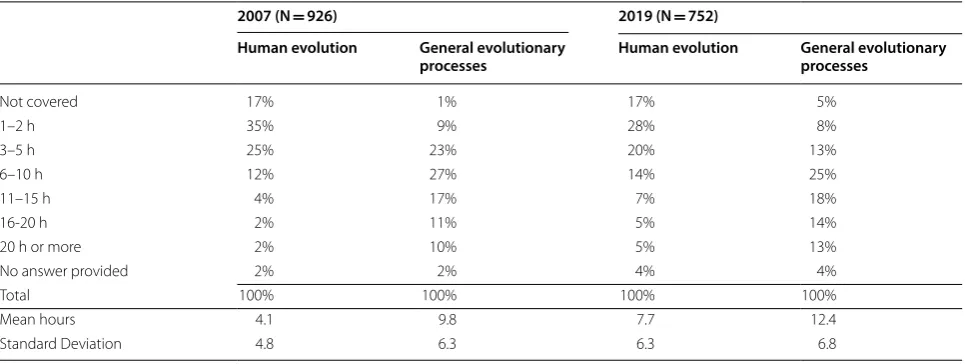
In comparing the statistics from the 2019 sample of high school biology teachers to the corresponding statistics from 2007, we find some similarities but also some important changes. As reported in Table 1, more than 95% of high school biology teachers reported covering evolution at least to some degree in both years. The number of teachers
reporting not teaching evolution at all increased slightly, but this may be due to a change in classification of teacher titles so that our survey included teachers who do not teach core classes in general biology. Most dramatically, we find a 60% increase in the mean number of class hours reported as devoted to human evolution, from 4.1 to 7.7 class hours. While having the potential to exacerbate religiously-driven opposition, human evolution also provides a particu-larly “enjoyable, engaging, and effective way to teach core evolutionary concepts” (Pobiner 2016, 262). In addition, reported instruction in general evolutionary processes rose 25%, from 9.8 class hours in 2007 to 12.4 class hours, driven by an increase in the number of teachers reporting devot-ing ten or more hours to evolution.
The messages conveyed to students
A key feature of the 2007 survey was a set of questions con-cerning the messages conveyed by teachers with respect to evolution’s scientific foundation and its centrality to mod-ern biology. Those questions, with the same wording and in the same order, were included in the 2019 survey as well. Table 2 reports on three key items that the surveys used to identify distinct messages about evolution. The first two concern the centrality of evolution. The first asked teach-ers to agree or disagree that it is “possible to offer an excel-lent general biology course for high school students that includes no mention of Darwin or evolutionary theory.” At the high school level, we see virtually no change at all, with 82–83% rejecting this idea in both 2007 and 2019. The second question asked whether evolution served as a unify-ing theme for their course. At the high school level, we see
Table 1 Hours reported as devoted to human evolution and general evolution in high school biology classes (column percentages)
2007 (N = 926) 2019 (N = 752)
Human evolution General evolutionary
processes Human evolution General evolutionary processes
Not covered 17% 1% 17% 5%
1–2 h 35% 9% 28% 8%
3–5 h 25% 23% 20% 13%
6–10 h 12% 27% 14% 25%
11–15 h 4% 17% 7% 18%
16-20 h 2% 11% 5% 14%
20 h or more 2% 10% 5% 13%
No answer provided 2% 2% 4% 4%
Total 100% 100% 100% 100%
Mean hours 4.1 9.8 7.7 12.4
some small change in those strongly agreeing, from 26 to 31%, a difference that is marginally significant.1
The third panel of the table reports on perhaps the key question on how teachers convey the science of evolu-tion—whether teachers “emphasize the broad consensus that evolution is a fact, even as scientists disagree about the specific mechanisms through which evolution occurred.”
Here the data for high school teachers show consider-able movement. The percentage of teachers disagreeing with this statement has dropped from 22 to 13% and the percentage agreeing rose from 74 to 79%. Most notably, the percentage of teachers who strongly agree has shot up from 30 to 47%. Based on these data, it appears that many more
high school students are being exposed to evolutionary biology taught as settled science today than 12 years ago.
Creationism in the classroom
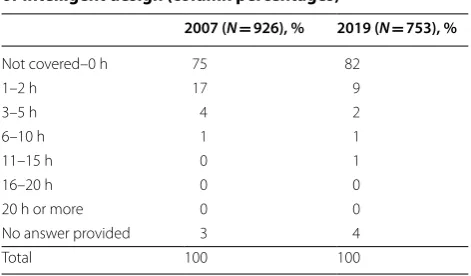
We now turn to creationism in the classroom. Following the question wording used in the 2007 survey, we asked teachers to report on the number of class sessions they devote to “creationism or intelligent design.”2 Table 3 shows
that fewer teachers report discussing creationism and intel-ligent design in high school biology classes, down from 23 to 14% (the 95% margin of error for each percentage, accounting for design effects, is under ± 3%). As in 2007, the modal teacher who reported covering creationism or intelligent design devoted 1–2 class sessions to the topic.
But simply devoting time to creationism might not imply a rejection of modern science. That is because some teach-ers may raise the topic of creationism in the context of explaining why it is not scientific (Nelson et al. 2019). To see the full range of messages conveyed to students, we turn to two questions asking about creationist perspectives.
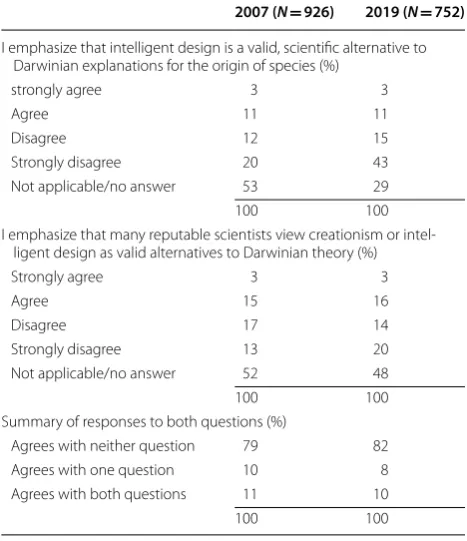
These questions overlap, with the first posing the state-ment “I emphasize that intelligent design is a valid, scien-tific alternative to Darwinian explanations for the origin of species,” and the second “I emphasize that many reputable scientists view creationism or intelligent design as valid alternatives to Darwinian theory.”3 That is, they ask about
the teacher making assertions without and with appeals to scientific authority. The results are reported in Table 4.
Table 2 Reported support of key positions advanced by the National Academy of Sciences and other organizations (column percentages)
2007 (N= 926) 2019 (N= 752)
It is possible to offer an excellent general biology course for high school students that includes no mention of Darwin or evolutionary theory (%)
Strongly agree 5 4
Agree 7 7
Disagree 25 24
Strongly disagree 58 58
Not applicable/no answer 5 8
100 100
Evolution serves as the unifying theme for the content of the course (%)
Strongly agree 26 31
Agree 36 37
Disagree 25 19
Strongly disagree 9 3
Not applicable/no answer 6 10
100 100
When I teach evolution (including answering student questions) I emphasize the broad consensus that evolution is a fact, even as scientists disagree about the specific mechanisms through which evolution occurred (%)
Strongly agree 30 47
Agree 44 32
Disagree 16 10
Strongly disagree 6 3
Not applicable/no answer 5 7
100 100
Table 3 Hours reported devoted to creationism or intelligent design (column percentages)
2007 (N = 926), % 2019 (N = 753), %
Not covered–0 h 75 82
1–2 h 17 9
3–5 h 4 2
6–10 h 1 1
11–15 h 0 1
16–20 h 0 0
20 h or more 0 0
No answer provided 3 4
Total 100 100
1 Significant at the 0.05 level in a two-tailed t test, ignoring design effects.
With an estimated design effect of DEFT = 1.2, the difference is no longer sig-nificant at conventional levels.
2 We recognize that intelligent design is simply a strategy for promoting
cre-ationism, but we maintained this wording to maximize the comparability of our survey results with those from the earlier study.
3 Advocates for creationism have put a lot of effort into claiming that they
Overall, we find that 18% of high school biology teach-ers agreed with at least one of the two statements, down slightly from 21% in 2007—while this difference might hint at a subtle change, the drop does not achieve conven-tional levels of statistical significance. It is notable that the number of teachers disagreeing with the first statement has increased markedly, from 32 to 58%, with the change largely driven by a sharp drop in the number of teachers who declined to answer this question, from 53 to 29%. Also notable is the sharp increase in the percentage of teachers strongly disagreeing with each statement. This result rein-forces the conclusion that more teachers are confident in their acceptance of evolution and rejection of creationism. Taken together with the decline in the percentage of teach-ers devoting class hours to creationism, it is likely that the topic is being raised outside of formal lesson plans or as part of teaching the nature of science rather than as a scien-tifically valid alternative to evolution.
The consistency of messages teachers send to students
Each of these questions reveals a different component of change. However, a clearer picture emerges if we summa-rize the results. To do so, we assigned teachers to four cate-gories based on themes they agreed that they emphasized to
their students.4 The first group are those who reported that
they emphasized to their students that evolution is estab-lished science: all teachers who said that they “emphasize the broad consensus that evolution is a fact, even as scien-tists disagree about the specific mechanisms through which evolution occurred” and did not report sending any pro-cre-ationism messages. Exclusively pro-creationist teachers are all who agreed that they emphasized creationism as a “valid scientific alternative” to their students. All other teachers we classified as either “avoiders” (those who agreed with none of the relevant statements) or sending “mixed messages” (those who told us they emphasize both positions).
We applied this typology to both the original 2007 data and the 2019 survey to assess change over time, and the results are summarized in Fig. 1. We find several impor-tant shifts. First, we see a dramatic increase in teachers who reported emphasizing “the broad consensus that evolu-tion is a fact, even as scientists disagree about the specific mechanisms,” while giving no credence to creationism as science (green squares). This group increased from 51 to 67%. We also see a drop in those reporting exclusively emphasizing creationism as a “valid scientific alternative” (red circles), from 8.6 to 5.6%. Although the 95% confidence intervals overlap slightly, the null hypothesis that the pro-portions are the same in a common population is rejected at the 0.05 level (t = 2.35; or t = 2.08 after accounting for design effects). Of perhaps more importance, the percent-age of teachers reporting sending mixed messpercent-ages (orange diamonds) dropped sharply from 23 to 12% and the num-ber of teachers reporting as avoiders (black triangles) also declined (18 to 15%).
These shifts are sizable. If extrapolated to the roughly 3.9 million students who will complete a general biology course in 9th or 10th grade each year,5 then 116,000 fewer
chil-dren are being exposed to exclusively pro-creationist mes-sages and 418,000 fewer to mixed mesmes-sages than 12 years previously. Moreover, with teachers spending an average of 5 additional hours on human and general evolution than in 2007, the opportunities for students to learn the science of evolutionary biology in an unvarnished and unapologetic way have increased substantially.
Table 4 Teacher-reported orientations to discussing creationism or intelligent design (column percentages)
2007 (N= 926) 2019 (N= 752)
I emphasize that intelligent design is a valid, scientific alternative to Darwinian explanations for the origin of species (%)
strongly agree 3 3
Agree 11 11
Disagree 12 15
Strongly disagree 20 43
Not applicable/no answer 53 29
100 100
I emphasize that many reputable scientists view creationism or intel-ligent design as valid alternatives to Darwinian theory (%)
Strongly agree 3 3
Agree 15 16
Disagree 17 14
Strongly disagree 13 20
Not applicable/no answer 52 48
100 100
Summary of responses to both questions (%)
Agrees with neither question 79 82 Agrees with one question 10 8 Agrees with both questions 11 10
100 100
4 Berkman and Plutzer (2011) used a different typology. There, advocates
for creationism were defined as teachers who devoted a formal class lesson to creationism as well as agreed with at least one of the statements listed in Table 4, while advocates for evolution were defined as teachers who agreed (or disagreed in the case of the first) with the statements listed in Table 2
and strongly agreed (or disagreed) with at least one. This scheme resulted in a large heterogeneous middle category and misclassified, in our view, many teachers who send mixed messages as advocates of creationism, so we have not used it here. However, our basic conclusions would be unchanged if we were to use this coarser classification system.
5 General biology is nearly universal, completed by 97% of secondary
What accounts for the shifts?
To look for factors that might explain these shifts in the context of broader changes in society and science educa-tion, we explored three additional research questions. First, whether teaching practices vis-à-vis evolution are different in states that adopted the Next Generation Science Stand-ards and states that did not. Second, whether teachers who were not yet teaching at the time of the initial survey are different vis-à-vis teaching evolution from teachers with greater seniority. And, third, whether teachers who have participated in continuing education on evolution teach evolution in distinctive ways from those who did not.
The role of the NGSS
Using a classification published by the National Science Teaching Association (https ://ngss.nsta.org/About .aspx), we distinguished among states that have officially adopted the NGSS, states that have adopted standards based on the same framework on which the NGSS are based [viz., the National Research Council’s A Framework for K–12 Science Education (2012)], and states that have adopted standards not based on the Framework.
Table 5 first shows the classification of teachers from 2007 based on whether their states would later adopt the NGSS. It shows that teaching practices did not vary much; if anything, teachers in states that would later adopt NGSS were less likely to report teaching evolution forthrightly and more likely to report conveying mixed messages.
By 2019 this was no longer the case. The percentage of those reporting teaching evolution as established science is slightly higher in NGSS-adopting states (69%) than in non-NGSS-adopting states (66%; a difference that is not statis-tically significant). More dramastatis-tically, the percentage of teachers reporting conveying mixed messages has dropped dramatically in NGSS and NGSS-framework states com-pared to the percentage in non-framework states.
The role of seniority
Long-term trends such as these can come about through generational replacement, behavioral change, or some combination of these. Science faculties now include a substantial number of teachers who were not yet in the profession in 2007. These newer teachers would have com-pleted their pre-service education and taken in-service professional development entirely after Kitzmiller, and many of the newest teachers’ pre-service education would have reflected NGSS. So the change we observe could be entirely due to new teachers replacing older ones, with the new teachers especially strong in their scientific approach to evolution. On the other hand, the change could have occurred because those already in the profession changed their teaching approach—for example in response to new state standards or textbooks, or because they were given opportunities for, or required to attend, professional devel-opment on evolution.
All teachers reported the number of years they have been in the profession, and we used these data to identify teach-ers who were already in the science classroom in 2007 and those who were not. The results, shown in Table 6, show no differences based on seniority. That tells us that the over-time gains have come from both those new to the profes-sion and those with longer tenure. And these more senior teachers must have changed their approach to teaching evolution.
Next Generation Science Standards, seniority, and time devoted to evolution
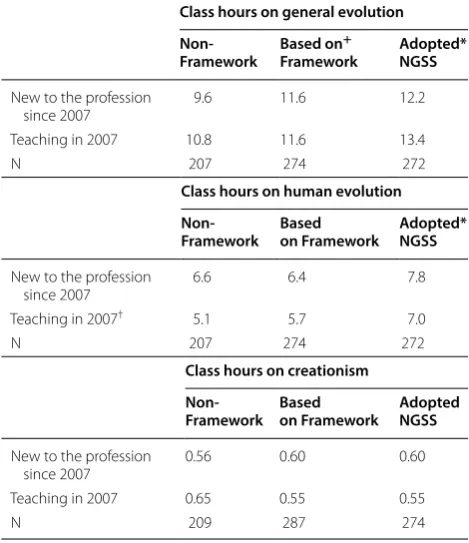
Thus far, we have shown that many more teachers report forthrightly teaching evolution as established science, and fewer report sending mixed messages. The evidence sug-gests that the NGSS may be playing a modest role and that the shift driven both by the entry of new cohorts of teach-ers and changing practices of more senior educators. We next examine how NGSS adoption and seniority are related to the time teachers report devoting to evolution. Table 7 presents the mean number of class hours that teachers report devoting to human evolution and general evolution (exclusive of human evolution), by their seniority and their state’s NGSS adoption.
The top panel, focusing on general evolution. shows that teachers in NGSS-adopting states report devoting about 30% more class hours to evolution than teachers in non-Framework states (states adopting the standards based on the Framework are in between). This pattern is uniform across levels of seniority, and seniority has no independent effect.
The middle panel shows that younger teachers report devoting more time to human evolution than their more senior colleagues, and that teachers in NGSS-adopting states report devoting more time to human evolution than Fig. 1 Teachers classified by the scientific accuracy of the messages
their colleagues in states with non-NGSS standards. Taken together, these results suggest that the less ambiguous mes-sages are being amplified and reinforced by more class time.
Overall, then, it appears that teachers with substantial seniority are changing their approach to teaching evolu-tion and teaching it for more hours, while at the same time, newer teachers are arriving prepared to teach evolution as settled science and now devote more time to evolution than their senior colleagues. In addition, all teachers in NGSS-adopting states report devoting a little more time to evolution than teachers in other states. There are many potential explanations for these patterns, but an important one is the role of formal education: college-level courses for pre-service teachers and professional development classes for experienced educators.
The role of college coursework and professional development
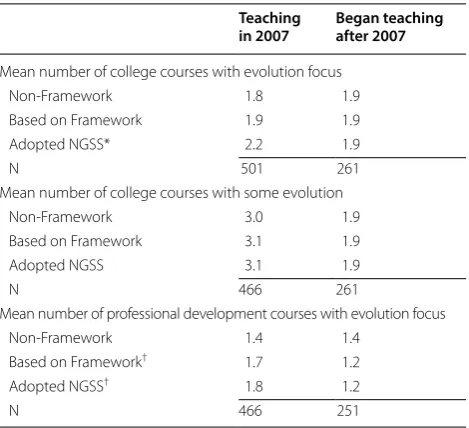
Teachers were asked to report, retrospectively, the number of full college courses focused on evolution, the number of college courses that included evolution as a topic, and the number of continuing education courses focused on evolu-tion they took. Although the number of teachers in some of the subgroups are so small as to make some inferences uncertain, it is apparent that reporting more coursework in each of these categories was positively correlated with reporting teaching evolution as settled science and nega-tively associated with reporting avoidance (see Table 8).
We next examined whether enrollment in these classes is higher in NGSS-adopting states to explore how the NGSS may have contributed to the changes evident in the qual-ity of teaching evolution, as measured by teachers’ reports
of their teaching practices with regard to evolution and creationism, at the high school level. To that end, Table 9 reports the mean number of evolution-related coursework by teacher seniority and their state’s NGSS adoption. While the number of courses or professional development oppor-tunities completed by newer teachers appears unrelated to the adoption of the NGSS, senior teachers in NGSS and Framework states have received significantly more educa-tion in evolueduca-tion than their peers in non-NGSS states. The top panel shows that teachers in NGSS-adopting states reported completing significantly more evolution-focused classes than teachers in non-NGSS-adopting states (two-tailed p= 0.017), an effect primarily driven by more senior teachers (though the interaction does not achieve statistical significance).
The bottom panel tells a similar story. Veteran teachers in NGSS-adopting or Framework states were more likely
Table 5 Summary of reported teacher emphasis when teaching evolution, by current NGSS status of their state (column percentages)
NGSS classification based on report of the National Science Teaching Association (https ://ngss.nsta.org/About .aspx)
Non-Framework Based on Framework Adopted NGSS
2007
Evolution as settled science 52.7 49.8 49.7
Mixed messages 19.8 21.8 26.7
Avoidance 18.8 17.4 17.3
Creationism as valid 8.7 11.0 6.3
Total 100 100 100
N 257 332 333
2019
Evolution as settled science 65.7 66.8 68.9
Mixed messages 12.7 12.7 11.6
Avoidance 16.3 14.0 14.4
Creationism as valid 5.3 6.6 5.1
Total 100 100 100
N 211 243 262
Table 6 Summary of reported teacher emphasis when teaching evolution, by teaching status in 2007 (column percentages)
Teaching
in 2007 Began teaching after 2007
Evolution as settled science 67.0 67.9
Mixed messages 11.5 13.7
Avoidance 15.5 13.4
Creationism as valid 6.0 5.0
Total 100 100
to report completing continuing education classes on the topic of evolution—1.8 and 1.7 courses respectively in comparison to 1.3 courses for all other teachers. While we lack the kind of prospective study that could test all causal effects rigorously, the pattern suggests that the NGSS have contributed to the improvements in the teaching of evolution and that one key mechanism involves teachers with high seniority completing professional development courses that help them adapt to the NGSS. In contrast, lower seniority teachers in NGSS-adopting states seem to be teaching evolution as settled science more than the prior generation did in 2007, and this is probably due to colleges of education better preparing them to teach evolution.6
Personal values and evolution pedagogy
Based on their 2007 study, Berkman and Plutzer (2010) argued that teachers’ personal opinions affected the instruction students receive far more than did state stand-ards. This was especially evident for those teachers who advocated for creationism as a valid scientific alternative. To see whether this is still the case, we examine two addi-tional factors. The first is measured by the standard polling question that asked teachers to select among three com-mon beliefs about human evolution; the second is meas-ured by a standard question about Biblical interpretation.
The results, summarized in Table 10, show how impor-tant personal beliefs remain today. Twelve percent of those reporting sending mixed messages, 25% of those reporting avoidance, and 60% of teachers reporting endorsing crea-tionism reject even God-guided evolution and personally believe in a creationist perspective. Likewise, those who agreed with a literalist interpretation of scripture are much more prevalent among those reporting sending mixed or exclusively creationist messages. These results suggest that there is a small “hard core” of creationist educators for whom accurately teaching evolution conflicts with their personal faith commitments. But the results also suggest that most teachers reporting avoidance and sending mixed
Table 7 Formal class hours devoted to evolution and creationism, by seniority and NGSS adoption
+ Significantly different from teachers in Non-framework states (p < 0.10)
* Significantly different from teachers in Non-framework states (p < 0.05)
† Significantly different from those with less seniority (p < 0.05) Class hours on general evolution
Non-Framework Based on +
Framework Adopted* NGSS
New to the profession
since 2007 9.6 11.6 12.2
Teaching in 2007 10.8 11.6 13.4
N 207 274 272
Class hours on human evolution
Non-Framework Based on Framework Adopted* NGSS
New to the profession
since 2007 6.6 6.4 7.8
Teaching in 2007† 5.1 5.7 7.0
N 207 274 272
Class hours on creationism
Non-Framework Based on Framework Adopted NGSS
New to the profession
since 2007 0.56 0.60 0.60
Teaching in 2007 0.65 0.55 0.55
N 209 287 274
Table 8 Summary of reported teacher emphasis when teaching evolution, by reported previous coursework and professional development (column percentages)
None One Two Three or more
Number of college courses with evolution focus
Evolution as settled science 75.0 70.5 75.6 68.3 Mixed messages 14.3 10.8 11.3 11.4 Avoidance 15.7 8.3 14.7 13.0 Creationism as valid 8.2 5.9 3.6 0.0
Total 100 100 100 100
N 302 191 108 60
Number of college courses with some evolution
Evolution as settled science 62.2 55.0 67.3 79.4 Mixed messages 13.3 16.3 15.9 7.8 Avoidance 16.1 17.8 13.8 9.1 Creationism as valid 8.5 10.9 3.0 3.8
Total 100 100 100 100
N 122 144 144 250
Professional development courses with evolution focus Evolution as settled science 65.1 78.0 77.1 77.2 Mixed messages 14.1 12.5 12.4 6.2 Avoidance 14.2 6.1 10.5 13.2 Creationism as valid 6.6 3.3 0.0 3.4
Total 100 100 100 100
N 390 79 52 32
6 A surprising result of the 2019 survey is the sharp increase in the amount of
messages are not in this hard core, which suggests that their teaching may be improved by providing increased learning opportunities.
Notably, the percentage of teachers who endorse the cre-ationist option in this question has fallen, from 16% in the 2007 sample to just 10.5% in 2019. This change is largely due to generational replacement, as only 7% of the more recent teachers express this view. If this trend continues, the number of strong advocates for creationism in public school science classrooms will continue to decline.
Discussion
This paper compared results of two surveys of public high school biology teachers that used identical sampling pro-cedures and identical survey questions. In the 12 years between the two surveys, evolution instruction in US pub-lic high schools has improved substantially, as measured by teachers’ reports of their teaching practices with regard to evolution and creationism. Many fewer teachers report sending mixed messages and many more report emphasiz-ing to their students “the broad consensus that evolution is a fact, even as scientists disagree about the specific mecha-nisms through which evolution occurred.” In addition, teachers report devoting substantially more class hours to evolution, including human evolution. New teachers who entered the profession after 2007 are doing an especially good job, as measured by their reports of their teaching practices with regard to evolution and creationism, but
teachers with more seniority have also improved on this score and have benefited from professional development opportunities on evolution, particularly if they work in NGSS-adopting states.
But there is still clearly room for further improvement. The teachers classified as teaching evolution as settled sci-ence are a diverse group: most report devoting consider-able time to human evolution, but about 16% report not covering it at all. Most agree that evolution serves as a unifying theme for their course, but 18% do not. Of even greater concern, a substantial number of teachers con-tinue to either avoid evolution altogether or communicate mixed messages that can serve to legitimize non-scientific alternatives in the minds of their students, judging from the results of the 2019 survey. Noting that such teachers “fail to explain the nature of scientific inquiry, undermine the authority of established experts, and legitimize crea-tionist arguments, even if unintentionally,” Berkman and Plutzer (2011, p. 405) suggested that they “may play a far more important role in hindering scientific literacy in the United States than the smaller number of explicit creation-ists.” Especially in light of the dwindling number of explicit creationists among public high school biology teachers seen in the 2019 survey, this concern is even more valid today. It is therefore encouraging that increasing atten-tion is being paid to the need to equip both pre-service teachers and in-service teachers with the wherewithal to teach evolution effectively despite the social controversies surrounding the topic (see, e.g., Borgerding and Dagistan 2018 on pre-service teachers and Friedrichsen et al. 2016 on in-service teachers).
Conclusion
The substantial improvements suggest that current reforms in state standards, pre-service teacher education, and in-service teacher professional development are having their intended effects, at least in the broad strokes that this survey is able to capture. Thus, scientific and educational institutions should continue their efforts to add scientific rigor to standards, seek out and promote textbooks and other resources that cover evolution thoroughly, support professional development opportunities for teachers, and support teachers who come under pressure from parental or community members who resist evolution instruction or advocate for the inclusion of creationism. These efforts should, of course, be informed by evidence of the sort gath-ered by this survey. In that light, an important priority for future research will be better understanding how and why teachers continue to convey mixed messages. More granu-lar research that examines mixed messages and how they are introduced into lesson plans or improvised in response to classroom dynamics would be especially valuable. The evidence that many of the teachers who report avoiding or
Table 9 Mean number of reported college and professional development courses, by teaching status in 2007 and state NGSS adoption
* Significantly different from teachers in non-framework states (p < 0.05)
† Significantly different from teachers in non-framework states only for high
seniority teachers (interactions significant, p < 0.05)
Teaching
in 2007 Began teaching after 2007
Mean number of college courses with evolution focus
Non-Framework 1.8 1.9
Based on Framework 1.9 1.9
Adopted NGSS* 2.2 1.9
N 501 261
Mean number of college courses with some evolution
Non-Framework 3.0 1.9
Based on Framework 3.1 1.9
Adopted NGSS 3.1 1.9
N 466 261
Mean number of professional development courses with evolution focus
Non-Framework 1.4 1.4
Based on Framework† 1.7 1.2
Adopted NGSS† 1.8 1.2
sending mixed messages about evolution do not themselves hold creationist beliefs suggests that additional instruc-tion both in evoluinstruc-tion content and best pedagogical prac-tices could substantially improve their evolution teaching. Equally important will be assessments of the impact such messages have on student learning and their preparation for college-level STEM education. More generally, it seems especially important to identify strategies that are helpful in not only discouraging the advocacy of creationism but also increasing the numbers of teachers who consistently convey a scientifically accurate and pedagogically appro-priate presentation of evolution in the high school biology classroom.
Acknowledgements
We thank Kate Carter and Brad Hoge for advice about the questionnaire content and the two anonymous reviewers for their thoughtful comments.
Authors’ contributions
EP was responsible for all fieldwork, data collection and data analysis; contributed to questionnaire content, and collaborated in the writing of the manuscript. GB and AR contributed to questionnaire content and collaborated in the writing of the manuscript. All authors read and approved the final manuscript.
Funding
The funding of the data collection and analysis were provided by the authors’ home institutions.
Availability of data and materials
Replication data set, codebook, and code to replicate all tables and figures will be made available at https ://datav erse.harva rd.edu/datav erse/2019_Scien ce_Teach ers/ no later than 12 months after publication. Investigators may request access to the data sooner.
Ethics approval and consent to participate
This project involved voluntary participation in a survey. The procedures and recruitment materials were reviewed by the IRB at Penn State University (study # 00011249) and declared exempt.
Consent for publication Not applicable.
Competing interests
The authors declare that they have no competing interests.
Author details
1 Penn State University, State College, USA. 2 National Center for Science Education, Oakland, USA.
Appendix
2019 Survey of American science teachers: materials and methods
Background
The 2019 Survey of American Science Teachers is the third of a series of three scientific surveys of science teachers. The first, the 2007 National Survey of High School Biology Teach-ers, was funded by the National Science Foundation and focused on high school biology teachers and their approach to the teaching of evolutionary biology. The second, the 2014–2015 National Survey of American Science Teachers, was conducted by Penn State under with the National Center for Science Education and focused on the teaching of climate change. This second study added a sample of middle school teachers and sampled high school teachers of all four core subjects: earth science, biology, chemistry, and physics. This third study retains a focus on high school biology teachers (from the 2007 survey) and middle school science teachers (from the 2014–2015 survey).
In order to allow valid comparisons to prior surveys, the most recent effort replicated many of the questions and adhered closely to the study design from previous waves. As a result, when examining the data from identical ques-tions, it is possible to compare this wave’s middle school sample to the middle school sample from 2014–2015, and to compare the high school biology sample to the 2007 sur-vey and to the biology subgroup within the 2014–2015 high school sample.
Sampling
The 2019 Survey of American Science Teachers employs two stratified probability samples of science educators. The first represents the population of all science teachers in public middle or junior high schools in the United States. The second represents all biology or life science teachers in public high schools in the United States.
There is no comprehensive list of such educators. How-ever, a direct mail marketing company, Market Data Retrieval (MDR, a division of Dunn and Bradstreet) main-tains and updates a database of 3.9 million K–12 educators. MDR selected probability samples conforming to our specifications. Specifically, MDR first identified eligible schools (public middle and junior high schools, and public high schools) and then selected all middle school teach-ers with the job title “science teacher” and all high school teachers with the job title “biology teacher” or “life science teacher.”
Table 10 Personal beliefs about creationism and the Bible. Percentage of teachers who endorse each statement, by teaching classification
a God created human beings pretty much in their present form at one time
within the last 10,000 years or so
b The Bible is the actual word of God and is to be taken literally, word-for-word Believe
in creationisma (%)
Literalist interpretation of the Bibleb (%)
Evolution as settled science 4 3
Mixed messages 12 16
Avoidance 25 11
The middle school universe contained 55,001 teach-ers with full name, school name and school address. From these, teachers were selected with probability 0.0455 independently from each of 151 strata defined by urban-ism (city, suburb, all others) and state, with the District of Columbia being its own stratum. This resulted in a sample of 2511 middle school science teachers.
The high school biology universe contained 30,847 teachers with full name, school name and school address. From these, teachers were selected with probability 0.0810 independently from each of 151 strata defined by urban-ism (city, suburb, all others) and state, with the District of Columbia being its own stratum. This resulted in a sample of 2503 middle school science teachers.
Of the 5014 elements in the two samples, MDR provided current email addresses for 4150, or 82.8%.
Questionnaire design
The questionnaires for this survey included questions employed in the 2007 National Survey of High School Biology Teachers (which focused on the teaching of evolu-tion), and the 2014–2015 National Survey of American Sci-ence Teachers (which focused on the teaching of climate change). A few new questions were developed to measure teachers’ perceptions of local public opinion.
The survey was initially written for pencil/paper admin-istration and—when finalized—programmed so it could be administered on the Qualtrics online survey platform.
Fieldwork
The survey design was a “push to mail” strategy in which all 5014 respondents received an advance pre-notification let-ter, a survey packet with incentive ($2 in cash) and a post-age paid return envelope, two reminder postcards and a replacement survey packet. Non-respondents for whom we had an email address then received an email invitation to complete the survey online.
This included 3161 non-respondents with emails sup-plied by MDR, and an additional 352 collected during the non-response audit.
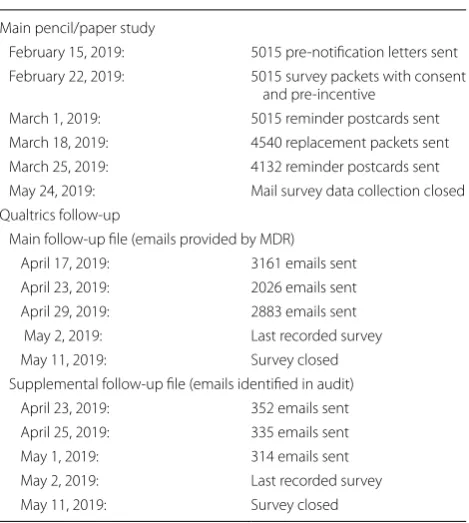
Non-respondents then received two additional email reminders. Field dates are summarized in Table 11.
Non‑response audit
Beginning on April 11, 2019 after most paper surveys had been received and logged, we identified a subsample of 700 non-respondents, and launched a detailed non-response audit on this group. The primary goal was to confirm or disconfirm their eligibility. From the time we began the audit of non-respondents, we received questionnaires from 62 of these teachers. They were removed from the audit, leaving 638 audited non-respondents.
For each person, we first searched for their school, and sought to locate a current school staff directory. If no direc-tory was found, we searched all classroom web sites at the school, and searched the school web site for the teacher’s full name and last name. If we found a match for the teacher anywhere on the school web site, that non-respondent was confirmed as eligible.
In some cases, we found a teacher in the same subject and same first name, but with a different last name. If we were able to absolutely confirm that teacher had recently changed names (e.g., their email matched the name in our list) that teacher was confirmed as eligible.
If we did not find the teacher, we did two broader web searches. First, a search with the teacher’s full name and the keyword “science.” In some instances, this brought up results indicating that the teacher had changed jobs or retired (e.g., information on the former teacher’s LinkedIn page). These were confirmed as ineligible. We recorded the following outcomes:
Teacher confirmed as eligible—listed on school web-site.
Teacher confirmed as eligible—classroom web pages identified.
Teacher confirmed as eligible—other (e.g., listed in recent news story).
Confirmed ineligible—school has current staff direc-tory, and teacher not listed.
Confirmed ineligible—other (e.g., teacher identified as instructing in a different subject).
Table 11 Field Dates
Main pencil/paper study
February 15, 2019: 5015 pre-notification letters sent February 22, 2019: 5015 survey packets with consent
and pre-incentive March 1, 2019: 5015 reminder postcards sent March 18, 2019: 4540 replacement packets sent March 25, 2019: 4132 reminder postcards sent May 24, 2019: Mail survey data collection closed Qualtrics follow-up
Main follow-up file (emails provided by MDR) April 17, 2019: 3161 emails sent April 23, 2019: 2026 emails sent April 29, 2019: 2883 emails sent May 2, 2019: Last recorded survey May 11, 2019: Survey closed Supplemental follow-up file (emails identified in audit)
Unable to determine—school does not have a staff directory.
Unable to determine—school does not have func-tional web site.
The final results of the audit are summarized in Table 12.
Thus, of all non-respondents (and assuming ¼ of the unknowns are ineligible) we estimate that 72% are eligible. This is the basis for calculating the “e” component in the response rate (American Association for Public Opinion Research 2006).
Dispositions and response rates
Every individual on the initial mailing list of 5014 names and addresses was assigned a disposition code.
A survey was considered complete if the respond-ent answered questions from at least two of the following three question groups: Question #1, which asked teachers how many class hours they devoted to each of nine topics (appearing on the second page of the paper questionnaire); a group of attitude questions appearing on pages 7–8 of the written questionnaire; and a group of demographic and background variables on pages 9 and 11 of the paper questionnaire.
A survey was considered partially complete if the respondent answered at least how many class hours they devoted to each of nine topics (appearing on the second page of the paper questionnaire).
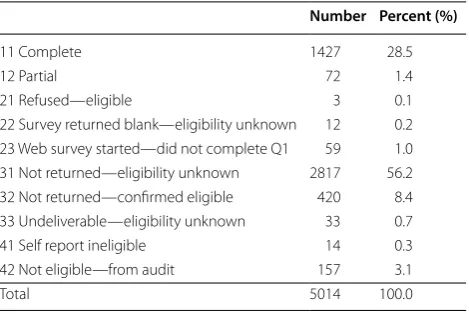
A summary of the dispositions appears in Table 13.
Response rates We utilize the response rate definitions published by the American Association for Public Opin-ion Research. These require an estimate of the percentage of all non-respondents who are eligible or non-eligible (e.g., due to retirement) to complete the survey. This quantity, referred to as e, was estimated from a detailed audit of 638 non-respondents. Based on these dispositions we calculate the response rate (AAPOR response rate formula #4) to be 37%. This is interpreted as the percentage of all eligible respondents who submitted a usable questionnaire (com-plete or partially com(com-plete). Respondents who returned questionnaires that are blank or fail to qualify as partial, are
considered non-respondents. The details of the response rate calculation are reported in Table 14.
Response rates by teacher and school characteris-tics Response rates can be broken down and estimated for different groups, providing that there are data for non-respondents as well as non-respondents. As a result, we cannot test for differences based on questionnaire items (we lack information on seniority, degrees earned, religiosity, and so on for all non-respondents).
We can, however, utilize “frame” variables and those pro-vided by the direct mail vendor MDR. Table 15 reports on eight such comparisons.
Teacher characteristics The response rate was somewhat lower for middle school teachers (34%) compared to high school biology teachers (40%). Using the salutations (Mr., Ms., Miss, Ms., etc.) provided in the direct mail file, we clas-sified teachers as female, male, or gender unknown. The latter group included a small number of teachers with salu-tations of “Dr.” or “Coach.” However, the large majority had gender-ambiguous first names such as Tracy, Jamie, Kim or Chris. Men (39%) and women (38%) did not differ signifi-cantly, but we had a lower return among those whose com-munications could not be personalized (Dear Kim Smith rather than Dear Mr. Smith, for example).7
The value of conducting an email follow-up to the pencil/ paper survey is evident in the 39% response rate for those teachers with a valid email supplied by the vendor (those lacking an email had a 30% response rate). Note that some of these additional returns were paper surveys returned only after teachers received an email announcing the avail-ability of a web survey.
Table 12 Summary of non-response audit
Number Percent (%)
Confirmed eligible 420 65.8 Unknown eligibility 61 9.6 Confirmed ineligible 157 24.6
Total 638 100.0
Table 13 Final dispositions of combined middle and high school samples
Number Percent (%)
11 Complete 1427 28.5
12 Partial 72 1.4
21 Refused—eligible 3 0.1
22 Survey returned blank—eligibility unknown 12 0.2 23 Web survey started—did not complete Q1 59 1.0 31 Not returned—eligibility unknown 2817 56.2 32 Not returned—confirmed eligible 420 8.4 33 Undeliverable—eligibility unknown 33 0.7 41 Self report ineligible 14 0.3 42 Not eligible—from audit 157 3.1
Total 5014 100.0
7 Extrapolating, had we taken the time to track down the gender of all 548
School type We had a somewhat lower response rate from teachers at public charter schools (31%). Note, however, that because charters still represent a tiny slice of the pub-lic school market, raising their response rate to the overall average would have only increased the number of surveys completed by charter school teachers by three or four.
School demographics As in previous surveys we find lower response rates from teachers working in schools with medium or large minority populations. Schools whose stu-dent bodies are more than 15% African American or more than 15% Hispanic or more than 50% free lunch eligible all had response rates between 30 and 33%.
Urbanism Finally, response rates did not differ substan-tially by urbanism except for schools in central cities with
populations exceeding 250,000. Teachers in these large school systems responded at a 30% rate.
Overall, we uncovered systematic differences. By and large these are modest in magnitude and do not introduce major distortions in the data. For example, teachers in large central city school systems constituted 12% of the teachers we recruited, and 10% of the final data set. However, since these individual differences might be additive (e.g., central city schools with many minority and school lunch-eligible students) we estimated a propensity model to assess the total impact of all factors simultaneously.
Table 16 reports a logistic regression model in which the dependent variable is the submission of a usable survey
Table 14 Calculation of Response Rate
Number
Total mailed 5014
Total useable surveys (complete + partial) 1499
Confirmed/assumed eligible among non-returned (codes 21 + 32) 423
Confirmed ineligible (41 + 42) 171
Total non-response of unknown eligibility (22 + 23 + 31 + 33) 2920 “e”—Estimated % eligible among non-returns of unknown eligibility* 73.0% Estimated eligible (e x (22 + 23 + 31 + 33)) + (21 + 32) 2555 RR4 (completes + partials)/(completes + partials + estimated eligible) 37.0%
Table 15 Estimated response rates, by characteristics known for respondents and non-respondents
Estimated Estimated
Response Response
Rate (%) N Rate (%) N
Sample Email availability
Middle school science 34.0 2398 Supplied by vendor 38.6 4137
High school biology 40.4 2445 Not supplied 30.4 706
Teacher gender Public school type
Female 37.6 2740 Conventional 37.3 4776
Gender unknown 31.1 548 Charter 30.7 51
Male 38.7 1555
Black student share of enrollment Hispanic student share of enrollment
Under 5% 41.1 2368 Under 5% 41.5 1320
5% to 15% 36.6 1106 5% to 15% 42.2 1375
15% to 50% 30.7 991 15% to 50% 32.0 1340
Above 50% 32.9 336 Above 50% 30.2 807
Free lunch eligible Urbanism
Under 5% 35.8 524 Large city 30.0 597
5% to 15% 45.2 553 Other city 39.6 659
15% to 50% 39.6 2251 Suburb of large city 37.4 1707
Above 50% 31.5 1474 Other suburb 35.8 276
(scored 1, all other dispositions scored 0, with confirmed ineligible respondents dropped from the analysis).
This confirms most of the observational difference reported in Table 15. The odds ratio column is more intui-tive and shows that the odds of returning a usable survey was 26% higher in the high school sample, 30% higher for teach-ers with a valid email on file, and about 26% higher when we used a gender-based salutation. Teachers at schools with siz-able Black and Hispanic presence in the student body are also under represented (odds rations below 1). However, after controlling for student body composition, the effects of school lunch eligibility and urbanism are diminished.
Propensity scores We use this model to calculate the prob-ability to respond for all original members of the sample. That allows us to calculate the response propensity for all respondents. Those whose characteristics make them unlikely to respond must, therefore, speak on behalf of more non-respondents. We use the inverse of the propen-sity as a second-stage weighting adjustment.
Weighting
Analysis weights were constructed in a two-stage process. A base weight adjusts for possible under-coverage by the sample supplier and the non-response adjustment balances the sample based on characteristics that are predictive of non-response (e.g., student body composition).
Base weight MDR claims to have contact information for approximately 85% of all K–12 teachers, but that coverage rate can vary by grade, subject, and state.
We assume that biology teachers constitute the same share of high school faculty in each state. It follows that the distribution across states in the MDR database should be proportional to the number of teachers in each state. If not, adjustment is necessary to make the sample fully representative.
We therefore constructed the following ratio:
This was standardized to have a mean of 1.0 so that ratios above 1 indicate relative under-coverage by MDR.
Non-response calibration The second stage weight is based on the logistic regression model reported in Table 16. From this model, we calculated the probability of complet-ing the survey (defined as completcomplet-ing a usable survey, clas-sified as “complete” or “partial” in Table 13).
The second stage non-response adjustment is simply the inverse of the response propensity.
Analysis weight (designated as final_weight in the data set) is the product of the first stage coverage adjustment and the second stage non-response adjustment, standardized
Number of high school teachers as counted by the National Center for Education Statistics)
(Number of high school biology teachers in MDR direct mail database)
so it has a mean of 1. The weights range from 0.39 to 3.15, with a standard deviation of 0.35. Ninety percent of the cases have weights between 0.54 and 1.70, indicating that
weighting will have only a small impact on statistical results in comparison to unweighted analyses.
Received: 12 April 2020 Accepted: 15 May 2020
References
American Association for Public Opinion Research. Standard Definitions: Final Dispositions of Case Codes and Outcome Rates for Surveys. 9th edition. AAPOR. 2006. https ://www.aapor .org/AAPOR _Main/media /publi catio ns/Stand ard-Defin ition s2016 9thed ition final .pdf.
Berkman MB, Pacheco JS, Plutzer E. Evolution and creationism in America’s class-rooms: a national portrait. PLoS Biol. 2008;6:5.
Table 16 Multivariate logistic regression model predicting likelihood of completing survey
* p < 0.05
Logit (std err) Odds ratio
High school (compared to middle) 0.231 (0.065)* 1.26 Email supplied by vendor 0.265 (0.092)* 1.30 Charter school 0.054 (0.338) 1.06 Gender unknown (contrast group)
Female 0.237 (0.108)* 1.27
Male 0.230 (0.114)* 1.26
Pct of students who are black
5% to 15% − 0.133 (0.083) 0.88 15% to 50% − 0.365 (0.093)* 0.69 Above 50% − 0.310 (0.151)* 0.73 Pct of students who are Hispanic
5% to 15% 0.059 (0.085) 1.06 15% to 50% − 0.343 (0.096)* 0.71 Above 50% − 0.397 (0.128)* 0.67 Pct of students free lunch eligible
5% to 15% 0.254 (0.135) 1.29 15% to 50% 0.194 (0.111) 1.21 Above 50% 0.098 (0.130) 1.10 Urbanism (baseline is large city)
Other city 0.276 (0.131)* 1.32 Suburb of large city 0.104 (0.115) 1.11 Other suburb − 0.037 (0.172) 0.96 Town or rural 0.051 (0.124) 1.05 Student teacher ratio 0.003 (0.007) 1.00 Constant − 1.334 (0.245)* 0.26
•fast, convenient online submission
•
thorough peer review by experienced researchers in your field
• rapid publication on acceptance
• support for research data, including large and complex data types
•
gold Open Access which fosters wider collaboration and increased citations maximum visibility for your research: over 100M website views per year
•
At BMC, research is always in progress.
Learn more biomedcentral.com/submissions
Ready to submit your research? Choose BMC and benefit from:
Berkman MB, Plutzer E. Defeating creationism in the courtroom, but not in the classroom. Science. 2011;331(6016):404–5.
Berkman M, Plutzer E. Evolution, creationism, and the battle to control America’s classrooms. Cambridge: Cambridge University Press; 2010.
Borgerding LA, Dagistan M. Pre-service science teachers’ concerns and approaches for teaching socioscientific and controversial issues. J Sci Teach Educ. 2018;29:283–306.
Branch G, Scott EC, Rosenau J. Dispatches from the evolution wars: shifting tactics and expanding battlefields. Annu Rev Genomics Hum Genet. 2010;11:317–38.
Centers for Disease Control and Prevention. Results from the School Health Poli-cies and Practices Study 2014. 2015. https ://www.cdc.gov/healt hyyou th/ data/shpps /pdf/SHPPS -508-final _10131 5.pdf.
Davis JD, Choppin J, McDuffie AR, Drake C. Middle school mathematics teachers’ perceptions of the common core state standards for mathematics and its impact on the instructional environment. School Sci Math. 2017;117:239–49. Dillman DA, Smyth JD, Christian LM. Internet, phone, mail, and mixed-mode
surveys: the tailored design method. New York: Wiley; 2014. Dragowski EA, McCabe PC, Rubinson F. Educators’ reports on incidence of
harassment and advocacy toward LGBTQ students. Psychol Schools. 2016;53:127–42.
Friedrichsen PJ, Linke N, Barnett E. Biology teachers’ professional development needs for teaching evolution. Sci Educ. 2016;25:51–61.
Glaze AL, Goldston MJ. US science teaching and learning of evolution: a critical review of the literature 2000–2014. Sci Educ. 2015;99:501–5018.
Groves RM, Peytcheva E. The impact of nonresponse rates on nonresponse bias: a meta-analysis. Public Opin Q. 2008;72:167–89.
Hart KC, Fabiano GA, Evans SW, Manos MJ, Hannah JN, Vujnovic RK. Elemen-tary and middle school teachers’ self-reported use of positive behavioral supports for children with ADHD: a national survey. J Emot Behav Disord. 2017;25:246–56.
Keeter S, Miller C, Kohut A, Groves RM, Presser S. Consequences of reducing nonre-sponse in a national telephone survey. Public Opin Q. 2000;64:125–48. Keeter S. Evidence about the accuracy of surveys in the face of declining
response rates. In: Vannette DL, Krosnick JA, editors. Palgrave Handbook Of Survey Research. London: Palgrave Macmillan; 2018. p. 19–22.
Lang SN, Mouzourou C, Jeon L, Buettner CK, Hur E. Preschool teachers’ profes-sional training, observational feedback, child-centered beliefs and motiva-tion: direct and indirect associations with social and emotional responsive-ness. Child Youth Care Forum. 2017;46:69–90.
National Center for Education Statistics. Table 203.10: Enrollment in public elementary and secondary schools, by level and grade: Selected years, fall 1980 through fall 2028. Digest of Education Statistics (2018 ed.). 2019. https :// nces.ed.gov/progr ams/diges t/d18/table s/dt18_203.10.asp.
National Center for Education Statistics. School and Staffing Survey Methodology Report. 2018. https ://nces.ed.gov/surve ys/sass/metho ds111 2.asp. National Research Council. A Framework for K–12 science education: practices,
crosscutting concepts, and core ideas. The National Academies Press; 2012. National Science Teaching Association. NSTA Position Statement: The Next
Generation Science Standards. 2013. https ://www.nsta.org/about /posit ions/ ngss.aspx.
Nelson CE, Scharmann LC, Beard J, Flammer LI. The nature of science as a founda-tion for fostering a better understanding of evolufounda-tion. Evo Edu Outreach. 2019;12:6.
NGSS Lead States. Next generation science standards: for states, by states. The National Academies Press; 2013.
Pobiner B. Accepting, understanding, teaching, and learning (human) evolution: obstacles and opportunities. Am J Phys Anthropol. 2016;159:232–74. Puhl RM, Neumark-Sztainer D, Austin SB, Suh Y, Wakefield DB. Policy actions to
address weight-based bullying and eating disorders in schools: views of teachers and school administrators. J Sch Health. 2016;86:507–15. Sickel AJ, Friedrichsen P. Examining the evolution education literature with a
focus on teachers: major findings, goals for teacher preparation, and direc-tions for future research. Evo Edu Outreach. 2013;6:23.
Troia GA, Graham S. Common core writing and language standards and aligned state assessments: a national survey of teacher beliefs and attitudes. Read Writ. 2016;29:1719–43.
Publisher’s Note