Influence of Management Commitment and Organizational Structure on
Application of ERP System & Its Impact on Quality of Accounting
Information: A Survey in Vietnamese Telecommunication Enterprises
Nguyen Thanh Hung1, Tran Thi Hong Mai1 & Nguyen Le Duc1 1 Faculty of Accounting and Auditing, ThuongMai University, Hanoi, Vietnam
Correspondence: Nguyen Thanh Hung, Faculty of Accounting and Auditing, ThuongMai University, Hanoi, Vietnam. E-mail: [email protected]
Received: December 27, 2018 Accepted: January 20, 2019 Online Published: January 21, 2019
doi:10.5430/afr.v8n1p128 URL: https://doi.org/10.5430/afr.v8n1p128
Abstract
The purpose of this study was to determine the influence of management commitment and organizational structure to the application of the enterprise resource planning (ERP) system and its implications on the quality of the accounting information at Vietnamese Telecommunication enterprises (VTEs). In order to achieve the goal of this study, the researcher chooses to survey VTEs that uses ERP systems. A questionnaire was designed and distributed to a sample of accountants and financial managers who works at such companies. A survey with 286 usable questionnaire responses is used to test the research hypotheses. The results show that both management commitment and organizational structure affect the level of ERP application, in which management commitment is the most influential factor. In addition, the ERP application also contributes to improving the quality of accounting information. The research model used is the structure equation model (SEM).
Keywords: ERP system, information accounting quality, management commitment, organizational structure, Vietnam
1. Introduction
In recent years, Vietnam's telecommunication enterprises (VTEs) have made great achievements and important contributions to the country's socio-economic development (Ministry of Information and Communications of Vietnam, 2017). With the development of the market economy, production and business activities of corporations are increasingly expanded, become more complex and diversified. Information for business management and operation has thus become more and more demanded and important. In addition, in the process of international economic integration, besides opportunities, VTEs also face many challenges, especially competitive pressure from international telecom corporations (Nguyen Thanh Hung, 2017). As a result, reducing costs, lowering the cost of providing quality telecommunication services at reasonable rates and ensuring business efficiency are important tasks for VTEs in the future. In that context, accounting information is one of the most important, highly reliable sources of information that support enterprise management to achieve that goal.
information analysis, as well as system control, ERP affects the quality of accounting information, which is the accuracy, timeliness and relevance of information (Sutton, 2006).
In Vietnam, the application of ERP system in enterprise has encountered many difficulties and obstacles. That also has a significant impact on the quality of accounting information in VTEs in the recent years. The purpose of the study is: (1) to study the impact of management commitment and organizational structure on ERP system application; (2) to assess the effect of management commitment and ERP system application to the quality of accounting information in Vietnam Telecommunication enterprises.
The remainder of the paper is structured as follows: section two discusses the literature review along with the research hypotheses development. The research methodology, data analysis and hypothesis testing, are discussed in section three and four respectively. Section five presents the conclusions along with the implications of the study. Finally, the limitations and further research is presented in section six.
2. Literature Review and Research Hypothesis
2.1 Organizational Structure and ERP System Application
Organizational structure is the formal system of task and authority relationships that control how people coordinate their actions and use resources to achieve organizational goals (Jones, 2010). Organizational structure is formally dictated on how jobs and tasks are distributed and coordinated between individuals and groups within the company (Lussier, 2008). When managers develop or change an organization’s structure, they are engaged in organizational design, a process that involves decisions about four key elements: division of labor, hierarchy, span of control and line and staff (Starling, 2008). Therefore, the organizational structure always has influences on an enterprise's accounting information system, determining the type of information provided to managers at each level, so that they perform their management functions for the enterprise, such as information for short-term, long-term and strategic decision making. Stair & Reynolds (2011) argue that the organizational structure affects the application of software system in an enterprise’s management information system. Similarly, in the study by Gurbaxani & Wang (1991), organizational structure is shown to have influences on the application of management software by providing information more accurately, exactly and flexibly. Dezdar & Ainin (2011) shows that organizational structure of an enterprise can have impact on its ERP system application. Specifically, the application of ERP system helps encouraging employees. Once an organizations decide to adopt ERP systems, they have to communicate to explain and justify their actions. What is important is how the business justification for the ERP system is translated to lower level employees so that they feel motivated to go along with the implementation and do not resist the changes that will occur. Implementing an ERP system encourages communication and can lead to more acceptances of these changes and the reduction of unnecessary worries. Al-Mashari (2003), Egdair et al. (2017) argue that ERP implementation will fail without considering the compatibility of organizational structure with the ERP system. The enterprise may face internal conflicts due to changes in business processes, organization size, centralization as well as span of control. Organizational changes in structure have to be managed prior to, during, and after ERP implementation. Therefore, in order to successfully design and implement an ERP system, management needs to consider the compatibility of their organizational structure with the ERP system. Thus, we hypothesize that:
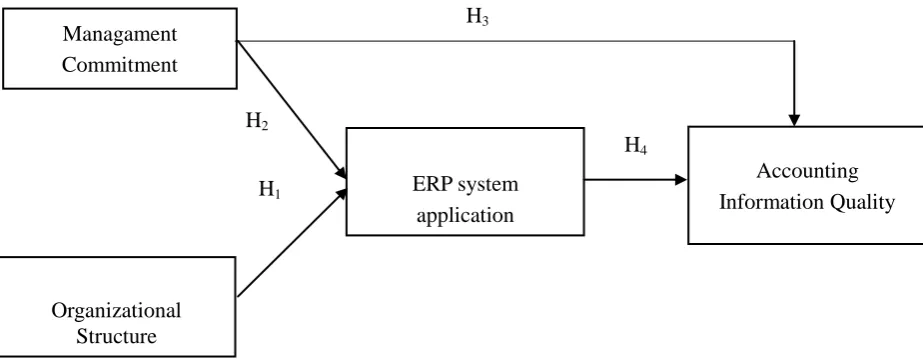
H1: Organizational structure has influences on ERP application. 2.2 Management Commitment and ERP System Application
Management commitment is defined as engaging in and maintaining behaviors that help others achieve a goal (Cooper, 2006). Management commitment includes investing and upgrading the information technology system, which will be ready to provide necessary resources and authority to the implementation of a project (Englund & Bucero, 2006). According to Siakas and Georgiadou (2002) management commitment is one of the driving factors for motivating employees to strive for continuous process of improvement. Management commitment has been emphasized, as a crucial factor in successful ERP implementation by Al-Mashari (2003), Umble et al. (2003). According to Zhang et al. (2005), management commitment in implementing ERP project has two main aspects: (1) providing the necessary resources and leadership; and (2) establishing rational objectives for the ERP implementation. These actions will facilitate the successful implementation of ERP in the organization. Moreover, the commitment and support from management should not stop at the initiation and facilitation stage, but it should continue throughout the entire ERP implementation process (Al-Mashari, 2003). Therefore, we hypothesize the second hypothesis:
2.3 Management Commitment and Accounting Information Quality
Accounting information is considered to be of value when it is useful to users for decision making (Xu, 2003; Gelinas et al., 2012). The quality of accounting information can be evaluated by four attributes accuracy: timeliness, completeness and consistency (Mc Leod & Schell, 2007; Al-Hakim, 2007). Xu (2003) argued that management commitment was the most important factor among 25 factors affecting the quality of accounting information. If enterprises want quality accounting information, managers need to commit and take specific actions such as control the input data and data processing process to ensure and maintain the quality of accounting information system. In turn, Al-Eqab & Ismail (2011) and Meiryani (2014) confirmed that management commitment has a significant effect on the quality of accounting information and assist managers in making decisions. Therefore, we hypothesize that:
H3: Management commitment has influences on the quality of accounting information. 2.4 ERP System Applicationand Accounting Information Quality
In the recent years, enterprises in the world and Vietnamese enterprises in particular, have implemented ERP systems to improve their competitive advantage (Dezdar & Ainin, 2011; Nguyen Viet & Vu Quoc Thong, 2016). ERP allows a company to manage its business with potential benefits of improved process flow, reduced inventories, better data analysis, better customer service, and improved profit margins (Siriginidi, 2000; Fan and Fang, 2006). ERP system is an integrated system, which removes cross functions barrier and result in managers capability to access, process, analyze and disseminate information to external users quickly. As a result, ERP system has had impacts on the quality of accounting information (Ladewi, 2014). The accounting information provided with ERP system becomes more diverse, accurate, relevant, timely and complete. There are many researchers such as Scapens & Jazayeri (2003); Spathis & Constantinides (2004); Nicolaou (2004); and Galani et al. (2010) studied the relationship between ERP and quality of accounting information. Scapens & Jazayeri (2003) explored the experience of the American system (SAP) and concluded that the implementation of the ERP system provides the managers directly with useful information and increases the role of managerial accountants. In addition, Spathis & Constantinides (2004) studied the improvements offered by the ERP system to the process of accounting information in business, and to identify the ways to develop ERP system in the future. Therefore, we hypothesize that:
H4: ERP system application has influences on the quality of accounting information.
The objectives of this study are to examine the influence of management commitment and organizational structure on the application of ERP system and its implications to the quality of the accounting information. The theoretical framework was developed in (figure 1)
Figure 1. Theoretical framework of the study
3. Research Methodology
3.1 Questionnaire Design
Research methodology used in this study is survey method, with questionnaires as the tool. The questionnaire was translated from English to Vietnamese and was evaluated through a group discussion with six experts on the telecommunication industry in Vietnam. Then, the questionnaire was pre-tested with 121 respondents including
Managament
Commitment
Organizational
Structure
ERP system
application
Accounting
Information Quality
H
2H
3H
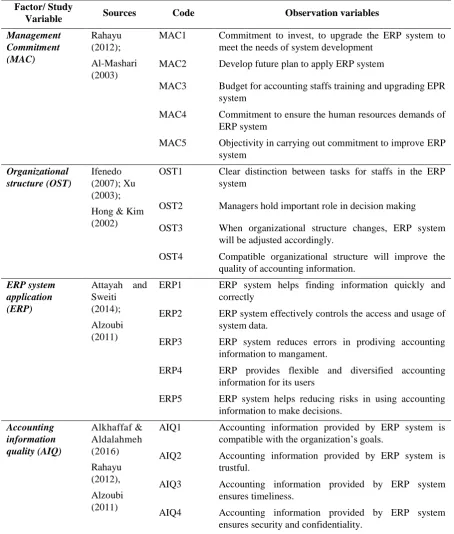
4accountants, managers in VTEs. The measurement scale used 5-point Likert scale form "1 - totally disagree" to "5 - totally agree". We eliminated unsuitable scales using content analysis and tested by Cronbach Alpha test and Corrected Item-Total Correlation. The following table indicates the measures of the study variables used in the study:
Table 1. The Study Variable
Factor/ Study
Variable Sources Code Observation variables
Management Commitment (MAC) Rahayu (2012); Al-Mashari (2003)
MAC1 Commitment to invest, to upgrade the ERP system to meet the needs of system development
MAC2 Develop future plan to apply ERP system
MAC3 Budget for accounting staffs training and upgrading EPR system
MAC4 Commitment to ensure the human resources demands of ERP system
MAC5 Objectivity in carrying out commitment to improve ERP system Organizational structure (OST) Ifenedo (2007); Xu (2003);
Hong & Kim (2002)
OST1 Clear distinction between tasks for staffs in the ERP system
OST2 Managers hold important role in decision making
OST3 When organizational structure changes, ERP system will be adjusted accordingly.
OST4 Compatible organizational structure will improve the quality of accounting information.
ERP system application (ERP)
Attayah and Sweiti (2014);
Alzoubi (2011)
ERP1 ERP system helps finding information quickly and correctly
ERP2 ERP system effectively controls the access and usage of system data.
ERP3 ERP system reduces errors in prodiving accounting information to mangament.
ERP4 ERP provides flexible and diversified accounting information for its users
ERP5 ERP system helps reducing risks in using accounting information to make decisions.
Accounting information quality (AIQ) Alkhaffaf & Aldalahmeh (2016) Rahayu (2012), Alzoubi (2011)
AIQ1 Accounting information provided by ERP system is compatible with the organization’s goals.
AIQ2 Accounting information provided by ERP system is trustful.
AIQ3 Accounting information provided by ERP system ensures timeliness.
AIQ4 Accounting information provided by ERP system ensures security and confidentiality.
3.2 Sample and Data Collection Method
Telecom, FPT Telecom ... These enterprises accounted for about 90% market share of mobile phone service and 95% market share of internet broadband service.
The data used is the primary data obtained through questionnaires that were answered by directly handing paper-based questionnaire form and by the google doc tool. We received a total of 321 responses after 3 months doing survey. The answers were treated as data and processed by statistical measurement, and 282 questionnaires were used for analysis purposes. The descriptive statistical analyses are performed with the support of SPSS 22.0 and AMOS 22.0.
3.3 Data Analysis
The research data were analyzed by multivariate analysis. Firstly, the factors in the research model were evaluated for reliability with Cronbach's Alpha coefficient greater than 0.6 (Hair et al, 2006), Corrected Item-Total Correlation greater than 0.3 (Nunally and Burstein, 1994). Then, we used EFA analysis with KMO greater than 0.5, Barlett's test with p-value less than 0.05 (Hair et al., 2006). Confirmatory Factor Analysis (CFA) was used to evaluate the construct. The model is considered to fit the data when Chi-square/df value < 3, RMSEA < 0.05, and GFI, NFI, TLI and CFI > 0.90 (Hair et al, 2006; Kline 2015, Byrne, 2016). To test the hypotheses, we applied structural equation modeling (SEM) with the level of 5%. We also used direct correlation, indirect correlation and generalized correlation to evaluate the total impact of factor on the accounting information quality.
4. Data Analysis and Hypothesis Testing
4.1 Reliability and Validity Analysis
The results of the reliability analysis showed that all factors had Cronbach’s Alpha coefficient greater than 0.7, the observation variables of each factor all had Corrected Item- Total Correlation greater than 0.5. Exploratory Factor Analysis (EFA) with Principal Axis Factoring and Promax rotation showed that the observed variables in each factor is unidirectional scale and the 18 observed variables are compatible with the data. The KMO coefficient is greater than 0.5, the Barlett test has a p-value less than 0.05, the Eigenvalue coefficient > 1, factor loading > 0.5 (see table 2)
Table 2. Result of reliability analysis
Factor Cronbach’s Alpha coefficient
Corrected Item -
Total correlation Eigenvalue Factor loading
Mangament commitment 0.872 0.610 - 0.734 2.902 0.625 - 0.836
Organizational structure 0.856 0.638 - 0.741 1.397 0.695 - 0.829
ERP system application 0.878 0.639 - 0.751 6.652 0.669 - 0.853
Accouting information quality
0.882 0.732 - 0.757 1.595 0.758 - 0.829
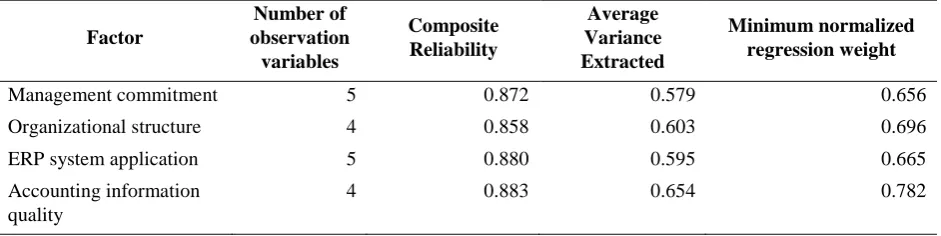
We used Confirmatory Factor Analysis (CFA) to evaluate the fit of the research model with collected data. CFA results indicated that Chi-square/df = 1,833 < 3; CFI = 0.961; TLI = 0.954; GFI = 0.912, were all greater than 0.9; RMSEA = 0.054 < 0.08. The normalized regression weights were greater than 0.5, the Composite Reliability (CR) were greater 0.6 indicating that all factors are sufficiently credible (Hair et al., 2006). Testing discriminant validity representing the level of square roof of Average Variance Extracted (AVE) of factors was greater 0.5 indicating that the factors have convergent value, the latent variable is well explained by its observation variables (Hair et al., 2006) (see table 3).
Table 3. Result of validity analysis
Factor
Number of observation
variables
Composite Reliability
Average Variance Extracted
Minimum normalized regression weight
Management commitment 5 0.872 0.579 0.656
Organizational structure 4 0.858 0.603 0.696
ERP system application 5 0.880 0.595 0.665
Accounting information quality
4 0.883 0.654 0.782
4.2 Structural Equation Modeling Analysis and Hypothesis Testing
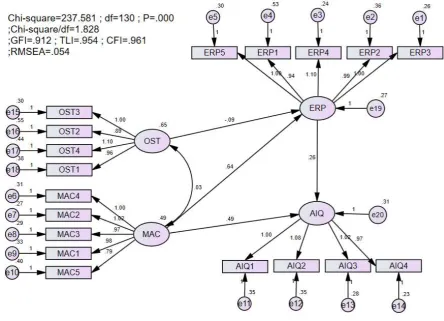
The analysis of structural equation modeling showed that the model fits the data, Chi-square/df = 1,828 < 3; CFI = 0.961; TLI = 0.954; GFI = 0.912, were greater than 0.9; RMSEA = 0.054 < 0.08, P.Value = 0.000 < 0.05. The estimated results of relationships among factors are shown in Figure 2.
Figure 2. Standardized structural equation modeling analysis
The two factors MAC and OST both have influence to the ERP system application, in which MAC has positive impact (β = 0.650) and OST has negative impact (β = -0.110). The quality of accounting information (AIQ) is also influenced by MAC and ERP with beta coefficients of 0.469 and 0.243 respectively. As a result, four hypotheses are accepted. The coefficient R2 of the model that affects ERP system application is 0.426, which shows that 42% of ERP system application in VTEs can be explained by the 2 variables MAC and OST. The R2 coefficient of the model that affects the quality of accounting information is 0.428, indicating that the impacts of these two variables ERP & MAC can explain 42.8% of changes in AIQ. (see table 4).
Table 4. Regression analysis and hypothesis results
Impact Unstandardized estimation
Standardized estimation
S.E C.R P R2
ERP <--- OST -0.095 -0.110 0.048 -1.966 0.048 0.426
ERP <--- MAC 0.642 0.650 0.068 9.464 ***
AIQ <--- MAC 0.495 0.469 0.087 5.659 *** 0.428
AIQ <--- ERP 0.259 0.243 0.083 3.115 0.002
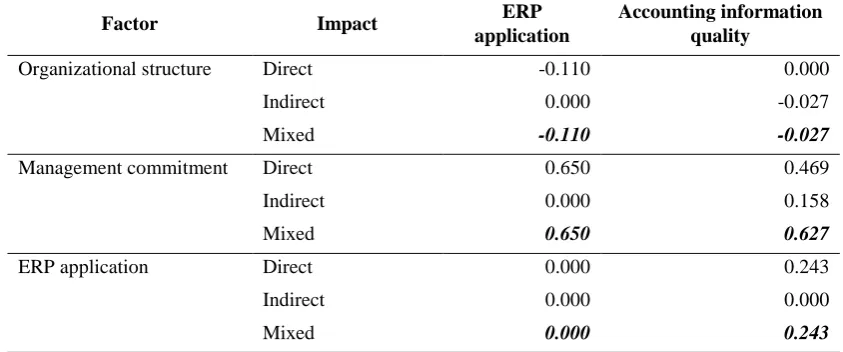
Table 5. Impact of factors on accounting information quality
Factor Impact ERP
application
Accounting information quality
Organizational structure Direct -0.110 0.000
Indirect 0.000 -0.027
Mixed -0.110 -0.027
Management commitment Direct 0.650 0.469
Indirect 0.000 0.158
Mixed 0.650 0.627
ERP application Direct 0.000 0.243
Indirect 0.000 0.000
Mixed 0.000 0.243
5. Conclusion
In the process of integration with the world economies, VTEs have constantly improved production methods to adapt to the increasingly fierce competition environment. ERP application is one of the solutions used by managers to provide quality accounting information for decision making. Results from the research showed that:
Management commitment (MAC) has the largest direct and indirect impacts to the accounting information quality (β = 0.627). When the managers fulfills their commitments, it will enhance the usability of the system, enabling their employees to be motivated to work and work efficiency will be improved. This result are consistent with the findings of earlier research by Rahayu (2012) and Meiryani (2014).
The application of ERP system (ERP) in VTEs has a direct impact on the accounting information quality (β = 0.243). Implementing and applying ERP system will improve the relevance, timeliness, completeness and confidentiality of accounting information; enhance the efficiency of decision making. The findings are consistent with research of Attayah & Sweiti (2014) in Saudi Arabia; Aryani & Krismiaji (2013) in Indonesia and Brazel & Li (2005) in the US. Therefore, VTEs should implement and apply the ERP system in accordance with their production and business process. At the same time, managers at all levels should seriously perform their commitments, as it will contribute to improving accounting information quality.
Management commitment (MAC) also has a strong impact on the application of ERP system (ERP) in VTES (β = 0.650). When management performs their commitments on investing, upgrading the system and human resources, the level of ERP system application in enterprises is higher. Management commitment is also demonstrated through participation in ERP project, the selection and implementation of ERP system. The results are also consistent with study by Ladewi (2014), Umble et al. (2003) which shows that correlation between management commitment and ERP system application in enterprises.
6. Limitations and Further Research
The research also has a number of limitations. Samples were small compared to the size and number of employees participating in the ERP system of VTEs. In addition, there are some factors which influence the application of ERP system that have not been included in the research model such as organizational, managers’ knowledge,... The study also did not assess the changes in the quality of accounting information before and after applying of ERP system in VTEs. Therefore, these issues may be further clarified in further research.
References
Al-Alawi, Ismail, A., Al-Marzooqi, Yousif, N., Fraidoon, Y. (2007). Organizational culture and knowledge sharing: critical success factors. Journal of Knowledge Management, 11(2), 22-42. https://doi.org/10.1108/13673270710738898.
Al-Eqab, M., Ismail, A. (2011). Contingency factors and accounting information system design in Jordanian companies. IBIMA Business Review, 11, 12. https://doi.org/10.5171/2011.166128.
Al-Hiyari, A., AL-Mashre, M. H., Kamariah, N. M., Alekam, J. M. (2013). Factors that Affect Accounting Information System Implementation and Accounting Information Quality: A Survey in University Utara Malaysia. American Journal of Economics, 3(1), 27-31. https://doi.org/10.5923/j.economics.20130301.06. Al-Hakim, L. (2007). Information Quality Management: Theory and applications. United Kingdom: Idea Group
Publishing. https://doi.org/10.4018/978-1-59904-024-0
Al-Mashari, M. (2003). A Process Change-Oriented Model for ERP Application. International Journal of Human Computer Interaction, 16, 1, 39-55. https://doi.org/10.1207/S15327590IJHC1601_4
Alzoubi, A. (2011). The effectiveness of the accounting information system under the enterprise resources planning (ERP). Research Journal of Finance and Accounting, ISSN 2222-1697 (Paper), 2(11).
Alkhaffaf, M., & Aldalahmeh, M. (2016). Enterprise Resources Planning effectiveness and Organizational Performance: The case of Jordanian Hashemite fund for human development. Business and Economic Research, 6(1), 148-161, June 2016. https://doi.org/10.5296/ber.v6i1.8315
Amalnick, M., Ansarinejad, A., Nargesi, S. M. & Taheri, S.(2011). New Perspective To ERP Critical Success Factors Priorities And Causal Relations Under Fuzzy Environment. Journal of Mathematics and Computer Science, 2, 160-170. https://doi.org/10.22436/jmcs.002.01.17.
Aryani, Y. A., Krismiaji. (2013). Enterprise Resource Planning Implementation and Accounting Information Quality. GSTF Journal on Business Review (GBR), 2(4), July 2013. https://doi.org/10.5176/2251-1997_AF13.25 Attayah, O. F., & Sweiti I. M. (2014). Impact of ERP System Using on the Accounting Information Relevance:
Evidence from Saudi Arabia. Journal on Business Review (GBR), 3(2), March 2014.
Byrne, B. M. (2016). Structural Equation Modeling With AMOS: Basic Concepts, Applications, and Programming, 3rd Edition, ISBN 9781317633136.
Bollen, K. A. (1989). Structural Equations with Latent Variables. New York: John Wiley & Sons, Inc. https://doi.org/10.1002/9781118619179
Brazel, J. F. & Li, D. (2005). The effect of ERP System Implementation on usefulness of Accounting Information. Journal of Information System, October 2005. https://doi.org/10.2308/jis.2004.18.2.79.
Cooper, D. (2006). The Impacts Management Commitment on Employee Behaviour A Field Study, Kindom of Bahrain: American Society of Safety Engineers. Middle East Chapter, Professional Development Conference and Exhibition, March 18-22 2006.
Comrey, A. L., & Lee, H. B. (1992). A first course in factor analysis. Hilsdale, New York, Erlbaun.
Daoud, H., Triki, M. (2013). Accounting information systems in an ERP environment and Tunisian firm performance. The International Journal of Digital Accounting Research, 13, 1-35. https://doi.org/10.4192/1577-8517-v13_1
Egdair, I., Rajemi, M. F., Nadarajan, S. (2017). Review factors of organizational structures and organization size on the ERP adoption system in Public Organization-Libya Context, International Journal of Business and Management Invention, 6(1), January. 2017, 45-51.
Englund & Bucero. (2006). Management Commitment for Project success, Project sponsorship: Achieving. John Wiley & Son. Inc., 989 Market Street, CA 94103-174, San Fransisco.
Galani, D., Efthymios, G., Stavropoulos, A. (2010). The Impact of ERP Systems on Accounting Processes. World Academy of Science, Engineering and Technology, 66, Australia, P418-423. https://doi.org/10.5281/zenodo.1082609.
Gelinas, J. U., et al. (2012). Accounting Information Systems. South Western: Cengage Learning.
Gurbaxani, V. and Wang, S. (1991). The impact of information systems on organizations and markets. Magazine Communications of the ACM. 34. https://doi.org/10.1145/99977.99990
Fan, J.C. & Fang, K. (2006). ERP Implementation and information systems success: a test of DeLone and McLean’s model. PICMET (Portland International Center for Management of Engineering and Technology) 2006 Proceedings, 9-13 July, Istanbul, 1272-8. https://doi.org/10.1109/PICMET.2006.296695.
Hair, J. F., Black, W. C., Babin, B. J., Anderson, R. E., Tatham, R. L. (2006). Multivariate Data Analysis, 6th edition, Upper Saddle River, NJ: Prentice Hall.
Hooper, D., Coughlan, J., & Mullen, M. R. (2008). Structural Equation Modelling: Guidelines for Determining Model Fit. Electronic Journal of Business Research Methods, 6(1), 53-60.
Hong, K. K., Kim Y. G. (2002). The critical success factors for ERP implementation: an organizational fit perspective. Information & Management, 40(1), 25-40. https://doi.org/10.1016/S0378-7206(01)00134-3. Ifenedo, P. (2007). Interactions between organizational size, culture, and structure and some it factors in the context
of ERP success assessment: an exploratory investigation. Journal of Computer Information Systems, 47(4), 28-44.
Jones, G. (2010). Organizational Theory, Design and Change. Sixth Edition. Pearson Education. Inc. Upper Saddle River.New Jersey.
Kline, R. B. (2015). Principles and practice of structural equation modeling. 4th edition. New York, NY, US: Guilford Public, ISBN 9781462523368.
Ladewi, Y. (2014). Influence of change management and management commitment on implementation of ERP system & its impact on quality of accounting information - a survey of Bumn companies in Bandung, International Journal of Economics, Commerce and Management, II(9).
Lussier, L. N. (2008). Human Relations in Organizations: Application and Skill Building. Seventh Edition. New York: Mc Graw-Hill. Irwin.
McLeod, R. & Schell, G. (2007). Management Information Systems. 10th Edition. New Jersey: PrinticeHall. Inc. Ministry of Information and Communications of Vietnam. (2017), White Book on Viet Nam’s Information and
Communication Technology. Information and Communications Publishing House.
Meiryani. (2014). Influence of Top Management Support on The Quality of Accounting Information System and its impact on the Quality of Accounting Information. Research Journal of Finance and Accounting. 5(11). Nguyen Thanh Hung. (2017). Organization of cost management accounting information system in
Telecommunication enterprises in Vietnam. PhD thesis.
Nguyen Viet & Vu Quoc Thong. (2016).Factors that determine the effectiveness of organizations applying the enterprise resource planning system in Vietnam.Journal of Asian Business and Economic Studies, 27(9), 102-124.
Nicolaou, A. I. (2004). Firm Performance Effects in Relation to the Implementation and Use of Enterprise Resource Planning Systems. Journal of Information Systems, 18(2), Fall, USA, 79-105. https://doi.org/10.2308/jis.2004.18.2.79.
Nunally, J. C., Bernstein, I. H. (1994). Psychometric Theory, 3rd edition, Mc Graw Hill, New York.
Rapina. (2014). Factors Influencing The quality of accounting information system and its implications on the quality of accounting information. Research Journal of Finance and Accounting, 5(2), 148-154.
Robbins, S. P. (2003). Organizational Behavior. Pearson Education, Inc. International Edition.
Scapens, R. W., & Jazayeri, M. (2003). ERP systems and management accounting change: opportunities or impacts. European Accounting Review, UK. https://doi.org/10.1080/0963818031000087907.
Shehab, E., Sharp, M.W. & Supramaniam, L., & Spedding, T. (2004). Enterprise resource planning. Business Process Management Journal, 10, 359-386. https://doi.org/10.1108/14637150410548056.
Siakas, K. V., & Georgiadou, E. (2002). The Role of Commitment for successful Software Process Improvement and Software Quality Management. The 11th 45. Software Quality Management Conference, SQM 2003, 23-25 April, 2002, Glasgow, UK, pp. 101-113.
Siriginidi, S. R. (2000). Enterprise resource planning in re-engineering business. Business Process Management Journal, 6(5), 376-91. https://doi.org/10.1108/14637150010352390.
Spathis, C. & Constantinides, S. (2004). Enterprise Resource Planning Systems Impact on Accounting Processes. Business Process Management Journal, 10(2), UK, 234-247. https://doi.org/10.1108/14637150410530280. Stair, R.M. & Reynolds, G. W. (2011). Principles of Information System. Course Technology-Cengage Learning. Starling, G. (2008). Managing The Public Sector. Eight Edition. USA: Thomson Wadsworth.
Sutton, S. G. (2006). Enterprise systems and the re-shaping of accounting systems: A call for research. International Journal of Accounting Information Systems, 7(1), 1-6. https://doi.org/10.1016/j.accinf.2006.02.002.
Tabachnick, B. G., & Fidell, L. S. (2007). Using multivariate statistics. 5th edition. Boston, MA, Allyn & Bacon/Pearson Education.
Umble, E. J., Haft, R. R. & Umble, M. M. (2003). Enterprise resource planning: implementation procedures and critical success factors. European Journal of Operational Research, 146, 241-57. https://doi.org/10.1016/S0377-2217(02)00547-7.
Xu, H. (2003). Critical Success Factors for Accounting Information Systems Data Quality. Dissertation, University of Southern Queensland.